
Saudi Vision 2030 is the Kingdom's national strategy to diversify its economy beyond oil. It targets growth across tourism, entertainment, manufacturing, and technology. Giga projects in Saudi Arabia such as NEOM, Red Sea, Qiddiya, Diriyah, and ROSHN anchor that strategy. Every one of those programs runs on cloud computing infrastructure. Nobody has mapped what that infrastructure looks like. Nobody has explained what it means for the enterprise sitting outside the giga-project fence line.
This guide closes that gap and doubles as a Saudi Vision 2030 summary written for IT leaders. It covers what Vision 2030 demands from enterprise IT. It maps what each giga-project actually needs in compute, storage, and networking. It compares the cloud providers in Saudi Arabia positioned to deliver that infrastructure. It covers sovereign cloud rules, regional investment patterns, and AI and digital twin infrastructure. It closes with a bidding guide for vendors. It ends with a practical cloud migration strategy for enterprises, whether you ever sign a giga-project contract.

What Does Vision 2030 Saudi Arabia Actually Demand From IT Infrastructure?
Vision 2030 is a policy document. Its IT consequences are concrete. Government entities must now prioritize cloud procurement under the Cloud-First Policy from the Communications, Space and Technology Commission. That mandate spills into private-sector decision making, and cloud-first procurement is now the visible edge of the digital transformation Saudi Arabia has been funding since 2016. Suppliers, contractors, and partners of government programs face similar expectations by extension.
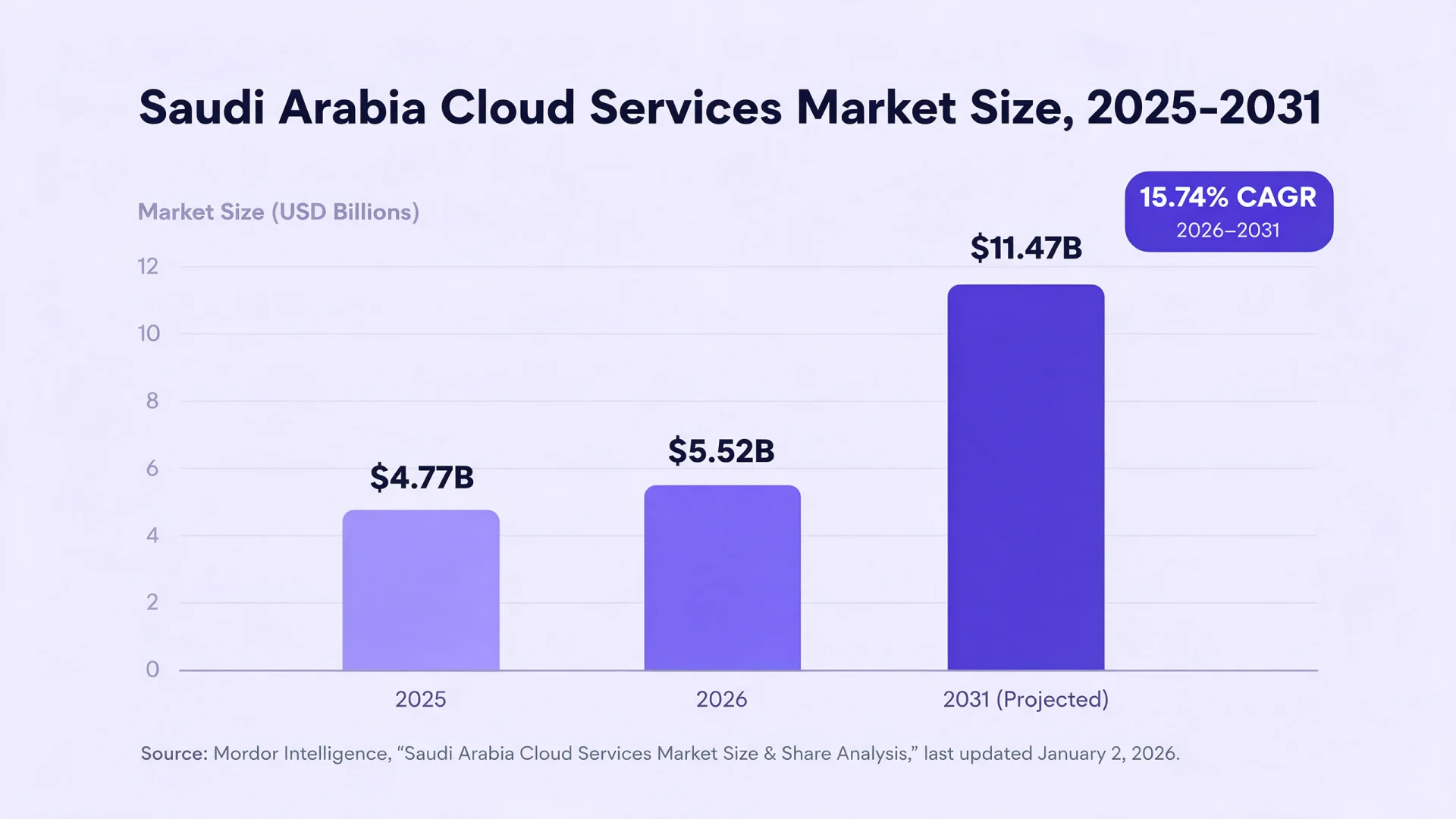
The numbers show how fast cloud computing in Saudi Arabia is moving. Mordor Intelligence values the Saudi Arabia cloud services market at $4.77 billion in 2025. It estimates $5.52 billion in 2026, rising to $11.47 billion by 2031. That is a 15.74% compound annual growth rate. A separate $24.8 billion national digital-infrastructure program has already pushed internet penetration to 99%, with broad 5G coverage nationwide.
Public-sector appetite backs up the spending. Eighty-five percent of surveyed public-sector leaders now budget specifically for cloud-enabled emerging technology. Forty-five percent are actively evaluating AI workloads, according to KPMG's research on government technology adoption. The Digital Government Authority's Emerging Technology Adoption Readiness Index gives agencies a structured way to plan that migration. SDAIA coordinates national cloud infrastructure across more than 200 connected government systems. That coordination reinforces shared data standards that private firms increasingly mirror.
Saudi Vision 2030 Summary: What Changed for Enterprise IT
Here is the Saudi Vision 2030 summary that matters to a CIO. Anyone asking what Vision 2030 Saudi Arabia in practical terms is really asking about three operational shifts, not a policy paper. First, cloud-first procurement, which makes in-Kingdom hosting the default rather than the exception. Second, data residency enforced across several regulators at once. Third, a national push on AI and digital transformation Saudi Arabia is funding directly through HUMAIN, SDAIA, and the giga-project programs. Read that way, the Saudi Arabia 2030 vision is less an aspiration than a procurement standard every supplier is measured against.
What Cloud Infrastructure Do the Giga Projects in Saudi Arabia Actually Need?
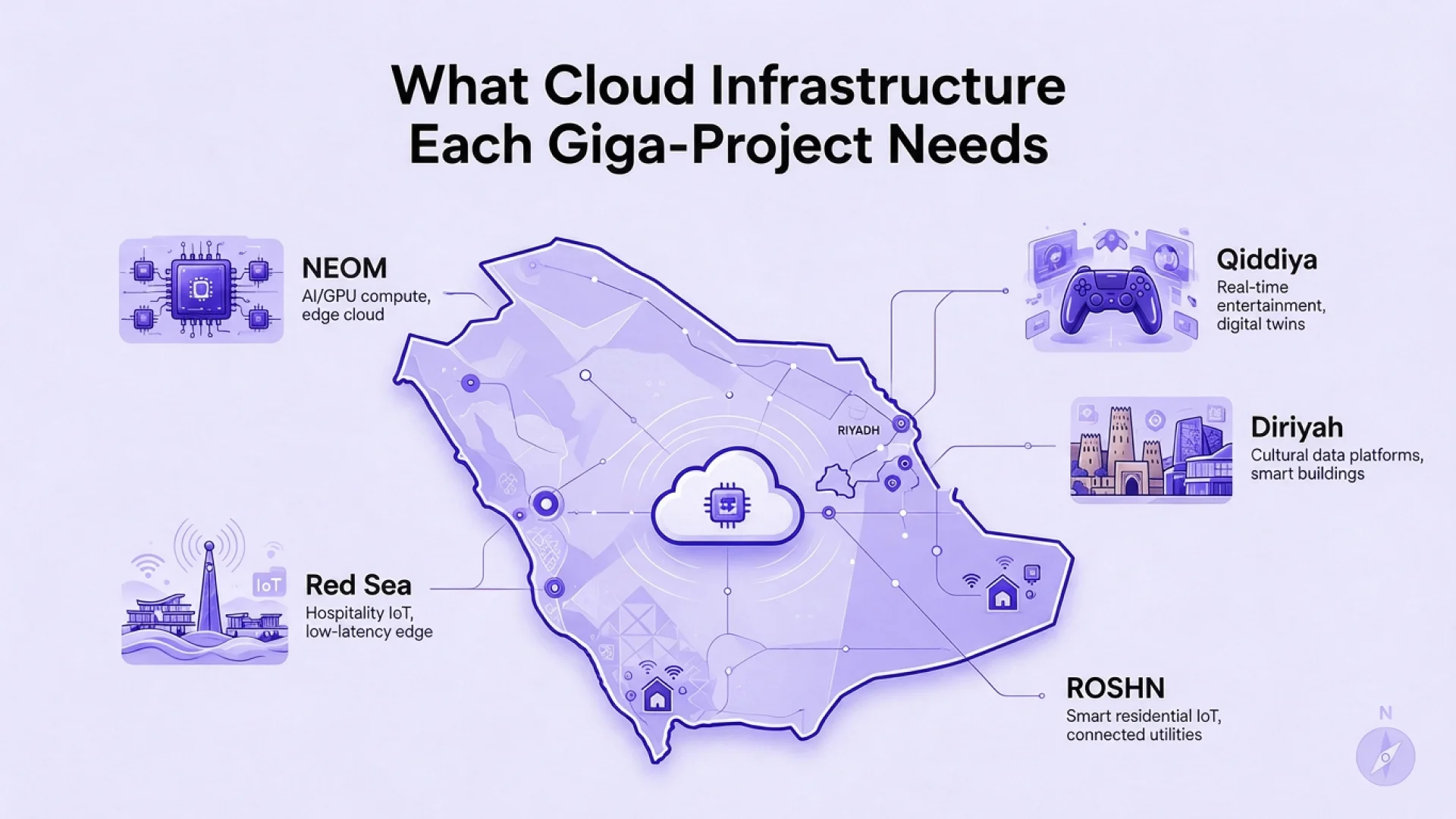
Each of the giga projects in Saudi Arabia has a distinct digital profile. None of them are simply construction sites with Wi-Fi. They function as cloud-native cities and industrial zones, built from a blank sheet.
Giga-Project Cloud Infrastructure Requirements
| Giga-Project | Primary Cloud Need | Notes |
| NEOM | AI/GPU compute, edge cloud, federated data centers | $5B DataVolt partnership for a 1.5GW net-zero AI campus in Oxagon; HUMAIN has procured 18,000 NVIDIA GB300 chips for a 500MW compute roadmap |
| Red Sea (Red Sea Global) | Hospitality IoT, guest-experience platforms, low-latency edge | Remote-island infrastructure demands resilient connectivity and edge processing over centralized compute |
| Qiddiya | Real-time entertainment and gaming infrastructure, digital twins | Latency-sensitive workloads for esports, theme parks, and a planned motorsport venue push edge cloud adoption |
| Diriyah | Cultural and hospitality data platforms, smart building systems | Heritage-site sensitivity favors in-Kingdom hosting and tighter data governance |
| ROSHN | Smart residential IoT, property management platforms, connected utilities | National housing scale requires standardized, repeatable cloud architecture across many sites |
NEOM Saudi Arabia alone illustrates the scale involved. Samsung C&T's construction robotics program has cut manual labor by 80% on parts of the build. A SAR 1.3 billion investment backs that program. Continuous data capture makes that automation possible. Continuous processing does too. Both are exactly the workload these cloud investments are built to support.
Red Sea Global's remote-island properties add a different constraint. Traditional fiber struggles to reach the destination's outer islands. Satellite and microwave backhaul carry much of the load instead. That gap pushes edge processing closer to guest-facing systems, from check-in kiosks to environmental monitoring across the marine reserve.
Which Cloud Providers in Saudi Arabia Should You Actually Consider?
Three categories of cloud service providers in Saudi Arabia now compete for enterprise workloads. Each fits a different combination of scale, sovereignty, and price.
Cloud Provider Categories Operating in Saudi Arabia
| Category | Providers | Best For |
| Global hyperscalers | AWS (3 Riyadh availability zones), Microsoft Azure (3 Eastern Province data centers), Oracle (second Riyadh region), Google Cloud | Enterprises needing global scale, mature tooling, and broad service catalogs |
| Telco-backed cloud | STC Cloud (sovereign AI cloud with Oracle Alloy), Mobily Cloud (in-country data centers) | Enterprises wanting regulatory rapport and existing telecom relationships |
| Sovereign / independent | Saudi Cloud Computing Company (Huawei Cloud, Alibaba Cloud), G42 (Saudi region live 2026) | Government and regulated-sector workloads with strict in-Kingdom control requirements |
Hyperscaler and Sovereign Cloud Investment Commitments in Saudi Arabia
| Provider | Investment | Detail |
| AWS | $5.3 billion | Three availability zones plus two innovation centers targeting 30,000 local trainees |
| Microsoft | $2.1 billion, plus a $30 billion Project MGX alliance | Three Eastern Province data centers; Riyadh AI campus with Temasek and BlackRock |
| Oracle | $1.5 billion, with more than $14 billion pledged in further expansion | Second Riyadh region offering more than 100 cloud services |
| $10 billion | Data center and cloud infrastructure deal with Saudi Arabia's Public Investment Fund | |
| NEOM / DataVolt | $5 billion | 1.5-gigawatt net-zero AI data center campus in the Oxagon industrial zone |
Which Service Model Fits Which Workload?
Spending on cloud computing technology in Saudi Arabia also varies by service model, not just by provider. Software-as-a-Service held 44.02% of 2025 revenue, the largest share. Enterprises favor turnkey software over managing hardware directly. Platform-as-a-Service is growing fastest, at a 16.64% compound annual growth rate. Developers want integrated toolchains and container orchestration, and PaaS delivers both. Infrastructure-as-a-Service persists mainly among large firms needing granular compute control, particularly for security-sensitive oil and gas applications. Function-as-a-Service is gaining traction among startups seeking operational agility without managing servers directly. Saudi Aramco itself pilots industrial large language models through managed PaaS offerings, avoiding infrastructure overhead entirely.
Aggregated commitments from the largest cloud providers in Saudi Arabia already exceed $21 billion. That figure excludes NEOM's separate DataVolt partnership. Competition extends beyond price too. Huawei and Alibaba, operating through the Saudi Cloud Computing Company, promote data sovereignty at competitive rates. Chip supply has become part of the contest as well. US chip contracts exceeding $20 billion now compete against Chinese alternatives. CST security rules add another layer, favoring providers with documented compliance architecture over cheaper, less transparent options.
What Does This Mean for Your Enterprise Cloud Strategy?
Most Saudi enterprises will never sign a giga-project contract directly. The infrastructure boom still reaches them, through four ripple effects.
- Lower latency and better pricing: Dense hyperscaler competition in Riyadh Province is pushing prices down and improving performance for every workload hosted there, not just giga-project tenants.
- Rising compliance expectations: Vendors and partners of government-linked programs increasingly face the same data residency and security expectations as the giga-projects themselves.
- Talent competition: Giga-projects are absorbing scarce cloud and AI talent. Fifty-six percent of Saudi tech leaders already cite skills shortages as their top AI deployment barrier.
- A higher bar for digital maturity: As giga-project suppliers modernize to compete for contracts, the baseline expectation for enterprise IT is rising across every sector, including for IT companies in Saudi Arabia bidding on purely private work.
Which Industries Are Moving Fastest?
Financial services lead current cloud spending. BFSI held a 27.06% share of the Saudi cloud services market in 2025. Saudi Central Bank sandbox programs and blockchain-based interbank platforms drive that lead. Healthcare is growing fastest, at a 16.88% compound annual growth rate through 2031. The government raised its health budget to $68.2 billion in 2023. It targets a $66.6 billion GDP contribution from digital health by 2030. Manufacturing and construction lean on robotics and predictive maintenance, the same pattern behind Samsung C&T's results at NEOM. Oil, Gas, and Utilities keep large cloud budgets too, mainly for predictive maintenance and seismic analytics. Retail and e-commerce felt a sharp spike too. April 2024 sales alone jumped 57%, reaching SAR 23.27 billion, straining systems built for steadier traffic.
Why Smaller Enterprises Are Moving Faster Than Expected
Small and medium enterprises are the fastest-growing customer segment. Mordor Intelligence forecasts a 16.18% compound annual growth rate for this group. Monsha'at government programs have grown the SME base to 1.3 million businesses. Saudi fintech startups have multiplied 14.7-fold since 2018. A total of 147 regulated fintech entities have raised SAR 1.5 billion in funding. That is part of a broader 72% surge in venture funding into Saudi SMEs. Much of that funding now goes toward cloud-native platforms built from day one.
Non-oil activity made up 49.9% of Saudi GDP growth in 2024, and cloud economics are a direct driver. Dell's research found that 90% of Saudi organizations accelerated digital transformation plans. That figure is ahead of the 80% global average, largely driven by a need to control capital spending during diversification. That pace is why digital transformation companies in Saudi Arabia now see steady demand from mid-market firms, not only from giga-project contractors.
Why the Skills Gap Is the Real Bottleneck
Fifty-six percent of Saudi tech leaders cite skills shortages as their top AI barrier. Government programs are responding directly. The One Million Arab Coders initiative aims to build a region-wide developer base. SDAIA's Elevate program targets 25,000 women for AI upskilling. AWS has pledged to train 30,000 Saudi citizens through its regional innovation centers alone. Software development companies in Saudi Arabia are hiring from that same pool, which tightens availability further. These programs will not close the gap immediately. Enterprises planning a 2026 or 2027 cloud migration should budget for external delivery support now, whether through managed services or IT staff augmentation services. Waiting for the local talent pool to catch up by go-live is not a realistic plan.
How Does Cloud Computing in Saudi Arabia Vary by Region?
Cloud investment is not evenly spread across Saudi Arabia. Four areas are developing distinct infrastructure profiles. The differences matter for where you choose to host a workload.
Cloud Investment by Region in Saudi Arabia
| Region | Key Investment | Sector Focus |
| Riyadh Province | LEAP 2025 added $14.85 billion in tech commitments; hosts Oracle's second region and AWS's newest sites | Government ministries, conglomerates, dense hyperscaler competition |
| Eastern Province | Home to Saudi Aramco's Dammam 7 supercomputer and Groq's inference cluster | Energy-sector analytics, petrochemical and logistics operators |
| Makkah Province | Saudi Telecom Company's Jeddah mega-centers | Trade hub and pilgrimage-season latency needs |
| NEOM (Tabuk region) | $5 billion DataVolt net-zero AI campus | Edge-cloud innovation for gaming, streaming, and industrial IoT |
IBM's $200 million Riyadh Software Lab employs mostly Saudi nationals. It supports AI research and development locally. ServiceNow has separately disclosed plans for new Saudi data centers by 2026, adding localized support for enterprise SaaS customers. Enterprises can use this regional map for more than provider selection. It also helps decide where a given workload should physically run.
What Do Sovereign Cloud and the Data Protection Law in Saudi Arabia Require?
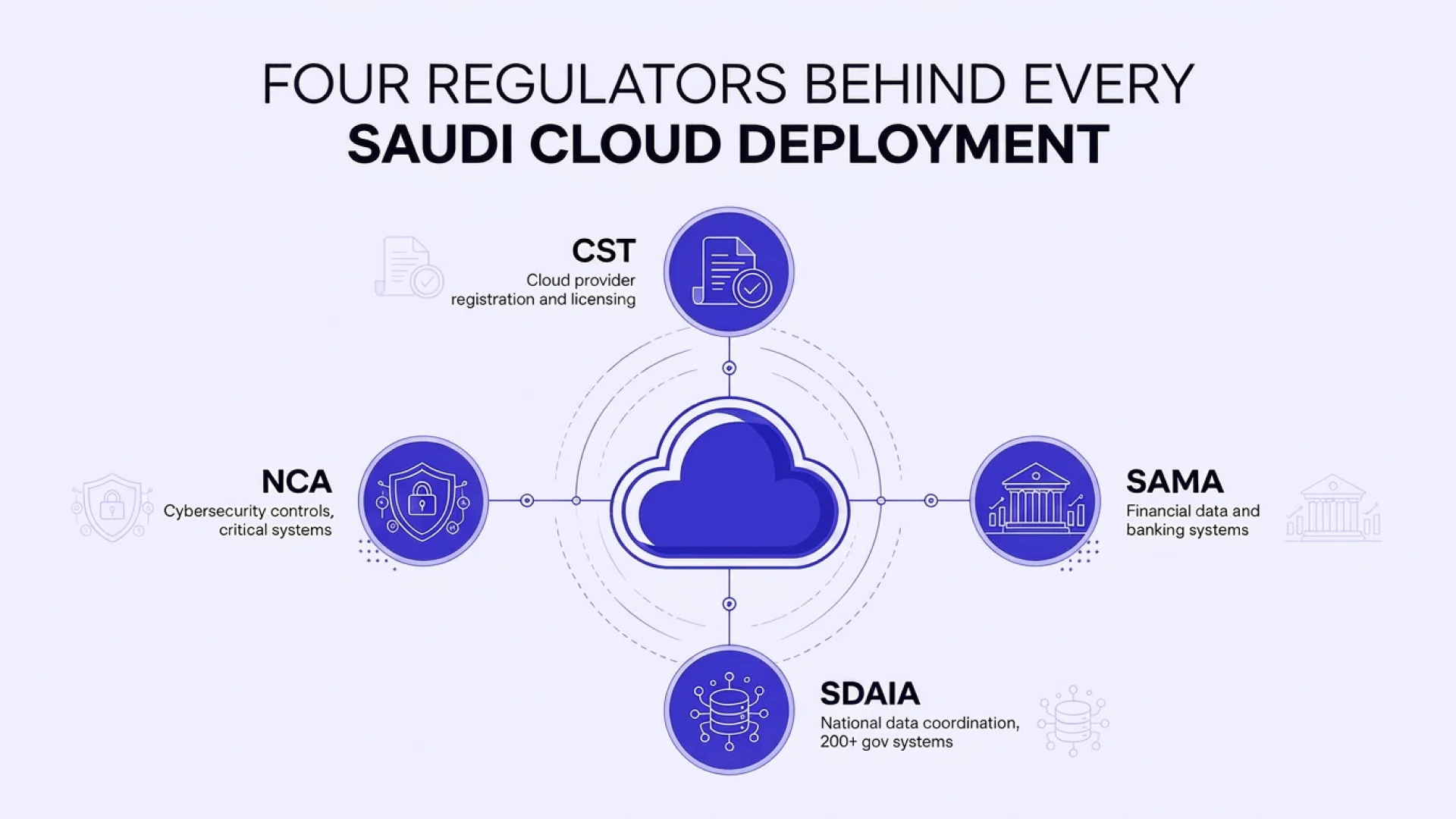
Cloud compliance in Saudi Arabia now runs through several regulators at once. A vendor's technical capability means little if it cannot satisfy every applicable authority, from CST registration to the data protection law in Saudi Arabia. Public cloud captured 65.72% of the market in 2025. Hybrid deployments are forecast to grow faster still, at a 16.41% compound annual growth rate. Compliance frameworks increasingly mandate local data residency for specific workloads, which is the main force behind that shift.
Saudi Compliance Requirements for Enterprise Cloud
| Requirement | Authority | What to Confirm With Your Vendor |
| Cloud provider registration | Communications, Space and Technology Commission (CST) | Is the provider registered under the Cloud Computing Services Provisioning Regulations for your data classification? |
| Government and sensitive data residency | CST / Saudi Data and Artificial Intelligence Authority (SDAIA) | Does hosting stay within Kingdom borders? UAE or European regions typically do not satisfy government requirements. |
| Cybersecurity controls | National Cybersecurity Authority (NCA) | Can the vendor demonstrate the Essential Cybersecurity Controls and, where relevant, Critical Systems Controls? |
| Financial data and banking systems | Saudi Central Bank (SAMA) | Has the vendor passed SAMA's security assessment process for regulated financial workloads? |
| National data coordination | SDAIA | Does the deployment align with SDAIA's national cloud infrastructure standards across 200-plus connected government systems? |
A Gartner senior director analyst captured the pattern behind these rules in a February 2026 research note on sovereign cloud spending. The analyst said organizations outside the US and China are investing more in sovereign cloud. Their goal is digital and technological independence. The note added that the aim is to keep wealth generation within their own borders. Gartner projects Middle East and Africa sovereign cloud IaaS spending will grow 89% in 2026. That is the fastest growth rate of any region worldwide. The same note warned that large cloud providers must take sovereignty concerns seriously per country. Treating digital sovereignty as only a security or compliance topic, he said, is not enough.
NCA's Critical Systems Controls apply specifically to infrastructure classified as critical national infrastructure. That designation is increasingly relevant as giga-projects connect to national utility and transport grids. The data protection law in Saudi Arabia, formally the Personal Data Protection Law, adds a further layer for any workload processing individual data. It runs alongside, not instead of, the CST and NCA frameworks above. The companion guide to on-prem to cloud migration under CST regulations sets out the provider registration categories in full.
Two named examples show how Saudi enterprises are actually structuring these deployments. STCPay runs its core Temenos banking platform on private infrastructure. It connects to public cloud services only for overflow capacity during peak demand. Edarat Group takes a different approach. It runs IBM Cloud Satellite across three domestic sites to meet sovereignty requirements. That setup still offers multi-cloud provisioning to its own clients.
What Infrastructure Do AI, IoT, and Digital Twin Systems Need?
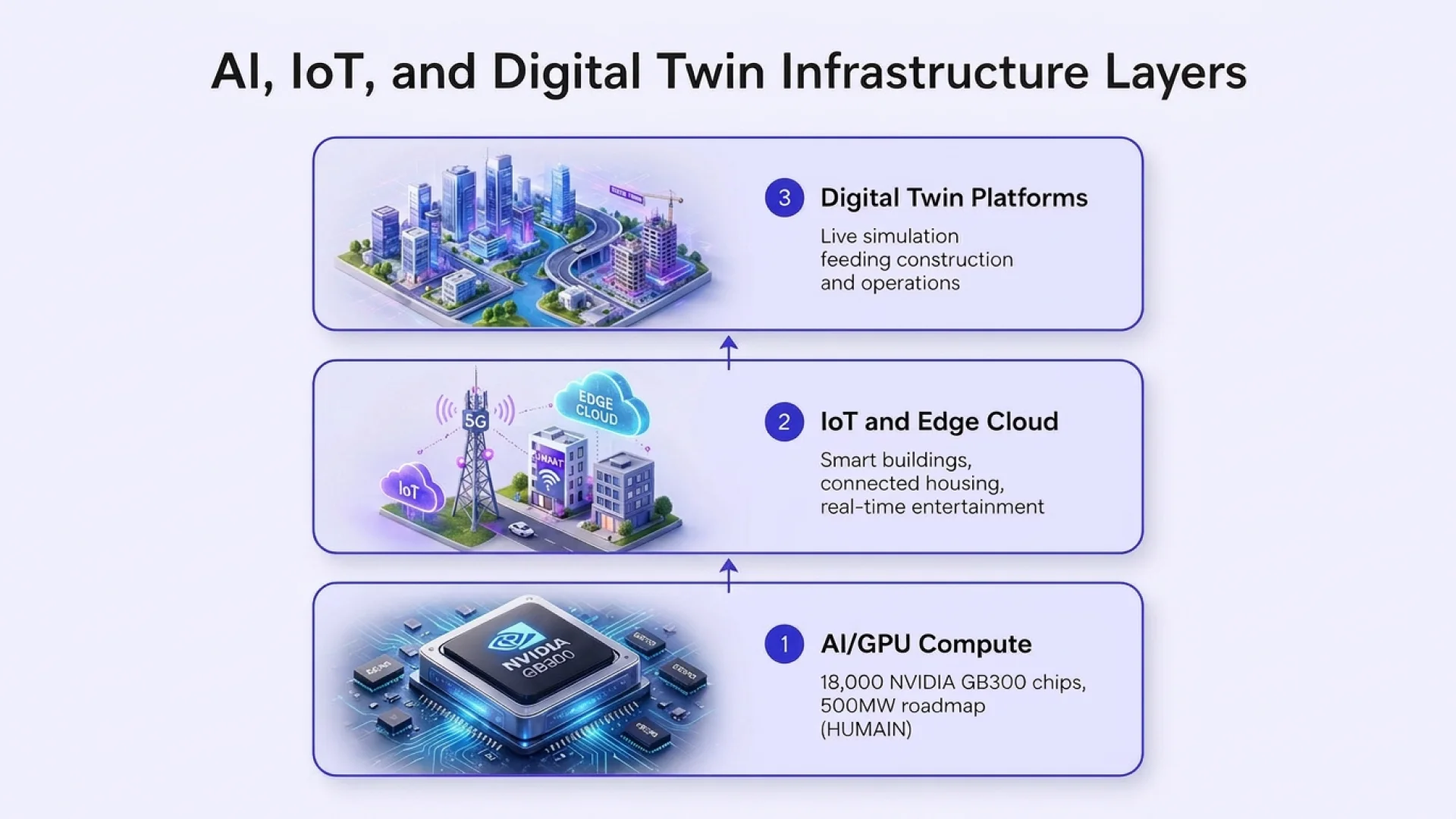
The smart city projects in Saudi Arabia that Vision 2030 anchors depend on three infrastructure layers working together, not on cloud storage alone.
AI and GPU Compute
HUMAIN, Saudi Arabia's national AI initiative, has already procured 18,000 NVIDIA GB300 chips. It may order hundreds of thousands more to support a 500-megawatt compute roadmap completing in early 2026. AMD joined HUMAIN in a $10 billion, five-year accelerator supply agreement. Groq separately secured $1.5 billion to build the region's largest AI inference cluster. SDAIA is training 20,000 AI professionals by 2030 to help staff this buildout.
IoT and Edge Cloud
Edge deployments at NEOM Saudi Arabia, smart buildings, connected housing at ROSHN, and real-time entertainment systems at Qiddiya all depend on edge cloud processing. That processing has to happen near the point of use. Centralized compute alone introduces latency these use cases cannot tolerate.
Digital Twin Platforms
Construction and operations teams increasingly model entire giga-project zones as live digital twins. Continuous sensor and robotics data feeds back into cloud-based simulation. Samsung C&T's 80% labor reduction on the NEOM project Saudi Arabia is building depended on exactly this kind of infrastructure. Robotics hardware alone was not enough.
What Should Vendors Expect When Bidding on Vision 2030 Saudi Arabia Projects?
Procurement teams evaluating giga-project contracts face a different bar than typical enterprise IT bids, and the Saudi Arabia 2030 vision has raised that bar for every bidder. Compliance documentation, not price alone, increasingly decides shortlists.
Bidders should expect requests for proof of CST registration and NCA control alignment. Government-adjacent workloads add an SDAIA compatibility check. Reference deployments matter more than general case studies here. Buyers want evidence of digital transformation Saudi Arabia programs already delivered in-Kingdom, not international logos alone. Giga-project procurement teams want evidence of prior in-Kingdom delivery, not just international experience.
Cost models are shifting too. Fixed-price bids remain common for construction-adjacent IT work. Giga-project buyers are increasingly asking for phased, milestone-based delivery instead, given how often scope evolves as physical construction progresses. Vendors comfortable with that iteration tend to win repeat work across multiple giga-projects, since program offices talk to each other.
Local presence matters more than most first-time bidders expect. A registered Saudi entity, resident technical staff, and prior CST-registered delivery history all shorten procurement timelines. Software development companies in Saudi Arabia with resident engineering teams tend to clear procurement faster than remote-only bidders. International vendors without that footprint often partner with a Custom Software Development Company in Riyadh or another in-Kingdom delivery firm for their first giga-project engagement. The wider field of IT companies in Saudi Arabia is mapped by category in the Riyadh buyer’s map. Direct registration usually follows once the relationship proves out.
How Should You Align Your Cloud Migration Strategy With Vision 2030?
A practical cloud migration strategy has four steps for most Saudi enterprises. Aligning with the 2030 vision Saudi Arabia has set applies whether or not you ever bid on a giga-project contract.
- Map your data classification against CST, NCA, SAMA, and SDAIA requirements before selecting a provider, not after.
- Choose a hybrid deployment model where regulated data stays in-Kingdom while less sensitive workloads use public hyperscaler capacity.
- Budget for the skills gap directly, through training programs, managed services, or a delivery partner with resident Saudi cloud expertise.
- Treat AI and edge cloud computing technology as a near-term requirement, not a future one, given how fast HUMAIN and the giga-projects are moving. For the workload-by-workload version of this decision, the 7 Rs cloud migration strategy for GCC enterprises maps each option against a residency constraint.
VLink's VP of Strategy saw this play out with a Saudi manufacturing client outside any giga-project zone. The client assumed Vision 2030 alignment meant building a private data center to match NEOM and Qiddiya. A phased hybrid migration told a different story. Moving non-sensitive workloads to a hyperscaler region first delivered the same compliance posture. It cost a fraction of the capital outlay. The client's board had been sold the wrong benchmark, built on giga-project headlines rather than their own regulatory footprint. Six months later, the same board was citing the migration as a model for two other business units.
Get Your Free Cloud Readiness Assessment
Vision 2030 is changing what every Saudi enterprise is expected to run on, not only what the giga-projects build. VLink's Saudi cloud team maps your current infrastructure against CST, NCA, SAMA, and SDAIA requirements before any cloud migration services are scoped. It then scores your readiness for a hybrid or sovereign cloud move.
The Vision 2030 Enterprise Cloud Readiness Checklist that comes with the assessment covers the essentials most teams miss:
- Data classification mapped against CST, NCA, SAMA, and SDAIA requirements
- A hybrid deployment plan separating regulated data from general workloads
- A named hosting region for every system that touches government or financial data
- A skills and staffing plan that accounts for the current Saudi cloud talent gap
- An AI and edge infrastructure roadmap, not just a storage and compute plan
- A vendor shortlist scored against Table 2 and Table 3 in this guide
Get your free Cloud Readiness Assessment for Vision 2030 Saudi Arabia projects. Or download the full checklist to score your own environment. Talk to VLink's Saudi cloud team about cloud migration services or a modernization project you are currently planning.
In Summary
Saudi Vision 2030 has turned the Kingdom into one of the fastest-growing cloud computing markets in the world, and the Saudi Arabia 2030 vision now shapes procurement well beyond government. The market is projected to nearly triple by 2031. Mordor Intelligence puts it at $4.77 billion in 2025, rising to $11.47 billion by 2031. The 2030 vision Saudi Arabia is executing has also made smart city projects in Saudi Arabia the reference point for enterprise IT maturity. NEOM, Red Sea, Qiddiya, Diriyah, and ROSHN are not isolated construction projects. Each is a distinct cloud infrastructure program, spanning AI compute, edge IoT, and digital twin platforms. The largest cloud service providers in Saudi Arabia, spanning hyperscalers, telco-backed clouds, and sovereign providers, have committed more than $21 billion combined to serve this demand. That investment is concentrated most heavily in Riyadh and Eastern Province. Every enterprise, whether a giga-project supplier or not, now faces rising compliance expectations across CST, NCA, SAMA, and SDAIA. The businesses moving fastest are not necessarily building the largest infrastructure. They are mapping their actual data classification and regulatory footprint first. Then they choose a hybrid cloud model that matches it, rather than copying the giga-project headlines.

Vice President, Strategy – VLink Inc.
Sambhavi Gopalakrishnan is the Vice President of Strategy at VLink Inc., bringing over a decade of experience in IT leadership, project implementation, and strategic growth. She possesses a strong foundation in technical project management and pre-sales, driving innovation and business transformation at VLink.

 Shivisha Patel