


Saudi Arabia's digital transformation has moved beyond strategy decks and boardroom discussions. With over $69.8 billion projected in digital economy value by 2030 and a 30.9% CAGR driving enterprise technology adoption, the Kingdom is now in full execution mode.
This roadmap addresses the specific challenges facing Saudi enterprises: navigating data sovereignty under the Personal Data Protection Law (PDPL), bridging the gap between digital ambition and operational maturity, and aligning transformation initiatives with Vision 2030's non-negotiable mandates.
The enterprises that master sovereign innovation—building modern capabilities while respecting where data lives and how it's governed—will define Saudi Arabia's economic future beyond oil. Understanding this landscape requires examining both the policy drivers and practical execution challenges that define the current market environment.
Why Digital Transformation in Saudi Arabia Has Entered the "Execution Era"
From Policy Ambition to Enterprise Accountability
The first phase of Vision 2030 (2016–2020) focused on regulatory reform and infrastructure planning. The current phase (2021–2025) demands something different: measurable outcomes at the enterprise level.
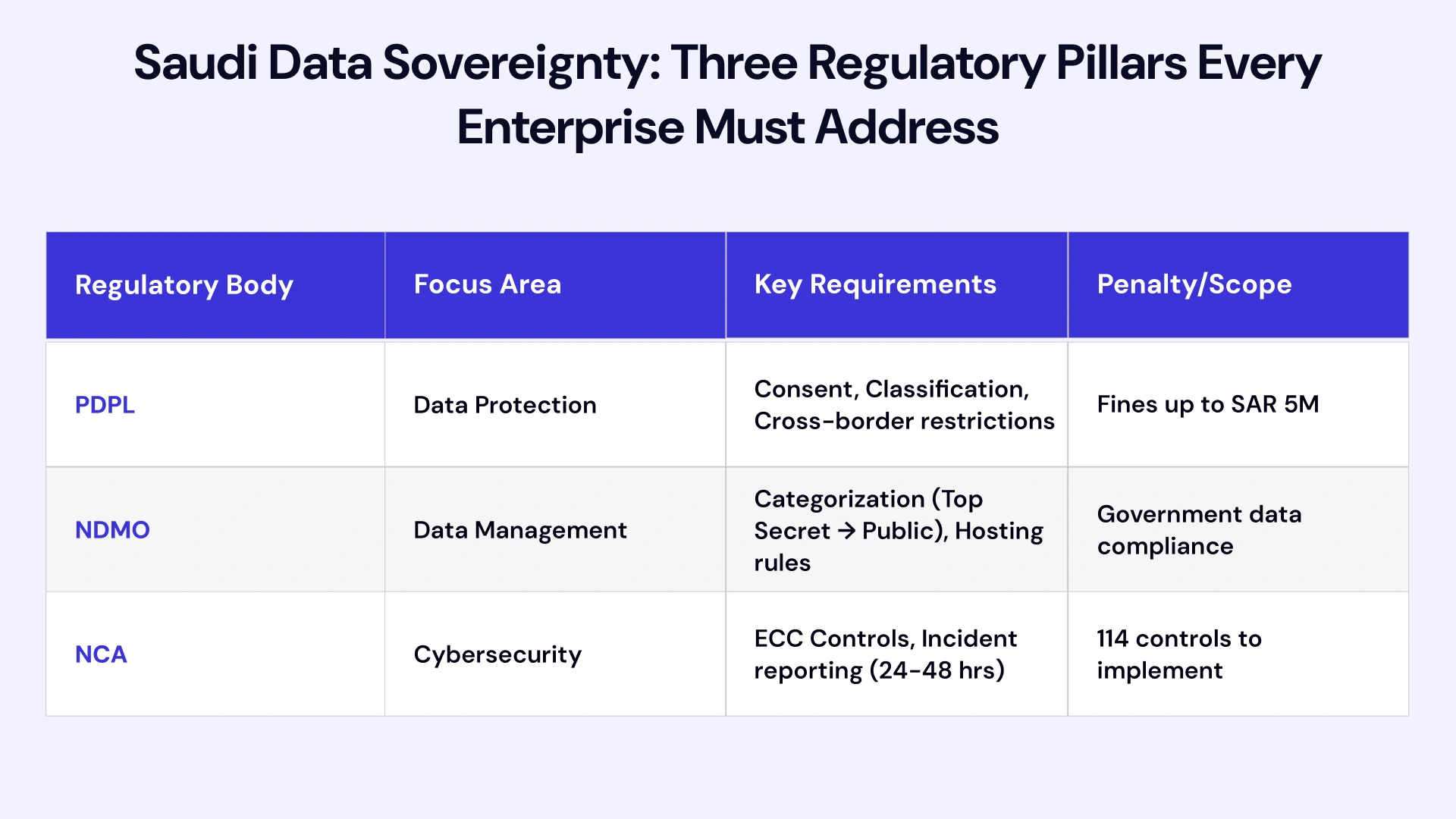
The introduction of PDPL and strict data residency mandates has transformed digital transformation from a technology initiative into a compliance imperative. Enterprises operating without alignment to these frameworks face regulatory penalties, operational restrictions, and exclusion from government contracts that increasingly require digital capability verification.
Why CXOs—Not IT Teams—Now Own Transformation Outcomes
Digital transformation in Saudi Arabia is no longer an IT modernization project. The penalties for data breaches or non-compliance with NCA and NDMO standards now include prison time and substantial fines for executives personally.
This shift has moved transformation accountability from technology departments to the C-suite. CEOs must understand data residency implications. CFOs must budget for sovereign cloud infrastructure. Chief Legal Officers must navigate PDPL compliance timelines. The transformation agenda has become inseparable from corporate governance and risk management functions.
The enterprises succeeding in this environment have restructured ownership models—appointing dedicated Digital Transformation Officers who report directly to CEOs and coordinate across technology, legal, operations, and finance functions. These organizations treat digital transformation as a strategic capability rather than a technology project, embedding transformation governance into existing executive committee structures.
Organizations seeking to accelerate this transition often benefit from partnering with experienced enterprise digital transformation consultants who bring cross-industry perspectives and proven methodologies adapted for Saudi market requirements.
How Vision 2030 Is Reshaping Enterprise Digital Priorities
Key Vision 2030 Pillars Impacting Saudi Enterprises
Vision 2030's digital agenda rests on three interconnected pillars that directly shape enterprise technology decisions.
The second pillar—digital government integration—creates technical requirements. Enterprises must connect to national platforms including the National Information Center (NIC), Nafath identity services, and sector-specific APIs like SAMA's Open Banking protocols. Organizations lacking these integration capabilities find themselves excluded from expanding government and semi-government ecosystems.
Government-Led Digitization vs Private-Sector Readiness
A significant gap exists between government digitization achievements and private-sector digital maturity. While government entities operate sophisticated digital platforms, many private enterprises still run core operations on legacy systems with minimal cloud adoption.
This disparity creates friction. Enterprises attempting to integrate with government APIs discover their internal architectures cannot support modern connectivity requirements. Customer-facing applications promise seamless experiences but break down when backend processes require manual intervention.
The challenge extends beyond technology. Many organizations lack the internal expertise to evaluate cloud architecture options, assess compliance requirements, or design integration approaches. Enterprises exploring cloud migration strategies for regulated markets find that regional expertise significantly impacts implementation success.
Closing this gap requires honest assessment of current capabilities against integration requirements—not aspirational roadmaps disconnected from operational reality.
Sovereignty, Compliance, and Data Residency as Boardroom Issues
Data sovereignty has become the defining constraint for enterprise digital transformation in Saudi Arabia. For regulated sectors including finance, healthcare, and government contractors, primary data storage and processing must occur on Saudi soil.
The grace period for PDPL compliance is ending. Enterprises that defaulted to international cloud regions—AWS us-east-1, Azure West Europe—now face urgent migration requirements. This isn't a latency optimization decision; it's a legal compliance mandate that carries significant penalties for non-compliance.
The Reality Check - Where Saudi Enterprises Struggle Today
Digital Ambition vs Operational Maturity Gap
Most Saudi enterprises have digital transformation strategies. Far fewer have the operational maturity to execute them.
A common pattern emerges enterprises modernize customer-facing applications—mobile apps, web portals, chatbots—while core systems remain legacy-bound. The front-end experience promises digital convenience, but backend processes still require manual data entry, paper approvals, and human intervention at critical handoff points.
This creates what industry analysts call "digital facades"—modern interfaces wrapped around 20-year-old mainframe backends that cannot scale, integrate, or adapt to changing requirements. The resulting customer experience inconsistency damages brand perception and undermines digital investment ROI.
Story Example: Consider a mid-large Saudi enterprise that invested significantly in a new customer mobile application. The app featured modern design, Arabic-native interfaces, and seamless navigation. However, every transaction still required manual reconciliation against legacy ERP systems. Customer complaints increased rather than decreased—because the digital promise raised expectations that backend operations couldn't fulfill. The lesson: front-end modernization without backend transformation creates more problems than it solves.
Talent, Legacy Systems, and Regulatory Complexity
Three interconnected challenges define the operational reality for Saudi enterprises pursuing digital transformation.
Talent shortage remains severe. Senior Arabic-speaking technical architects, cybersecurity leads, and cloud engineers are in short supply. Enterprises compete for limited qualified candidates while Saudization requirements restrict expatriate hiring. The result: transformation programs stall waiting for qualified resources or proceed with underqualified teams that create technical debt requiring expensive remediation.
Legacy integration proves more complex than expected. Many enterprises discover their systems lack APIs, use outdated data formats, or embed business logic in ways that resist extraction. The "strangler fig" pattern—gradually replacing legacy functions with microservices—offers a proven approach but requires patience and investment that quarterly earnings pressure often undermines. Organizations frequently underestimate the documentation, testing, and change management effort required for successful legacy modernization.
Regulatory complexity creates compliance overhead. Enterprises must simultaneously satisfy PDPL data protection requirements, NCA cybersecurity controls, NDMO data classification standards, and sector-specific regulations from bodies like SAMA (banking), SFDA (healthcare), and CMA (capital markets). Navigating overlapping requirements demands specialized expertise most organizations lack internally.
Why "Technology-First" Transformations Fail in KSA
Enterprises that approach digital transformation as a technology procurement exercise consistently underperform.
Purchasing cloud subscriptions without data governance frameworks creates compliance exposure. Implementing AI tools without process redesign generates insights no one acts upon. Deploying automation without change management produces systems employees circumvent. These patterns repeat across industries because organizations prioritize technology selection over business outcome definition.
Successful transformation in Saudi Arabia requires what leading consultancies call "business-first, technology-enabled" approaches. Technology serves business outcomes defined by Vision 2030 alignment, customer experience improvement, and operational efficiency—not the reverse. This requires executive sponsorship that connects technology investments to strategic objectives and holds implementation teams accountable for business results rather than technical deliverables.

A Practical Digital Transformation Roadmap for Saudi Companies
Phase 1 – Digital Readiness & Vision 2030 Alignment (Months 1–3)
The foundation of successful transformation begins with honest assessment—not aspirational planning.
Sovereignty Audit: Map all data assets against PDPL and NDMO classifications. Categorize data into Top Secret, Secret, Restricted, and Public classifications. Determine which workloads must remain on-premises, which can move to sovereign cloud (Class C), and which can utilize international cloud regions. This classification directly determines infrastructure investment requirements and vendor selection criteria.
Capability Assessment: Evaluate current technology infrastructure, integration capabilities, and operational processes against Vision 2030 alignment requirements. Identify gaps between current state and target state across systems, skills, and processes. Include realistic assessments of organizational change readiness and executive sponsorship strength.
Strategic Alignment: Connect transformation initiatives to specific Vision 2030 KPIs relevant to your sector. Banking enterprises align with SAMA open banking mandates. Healthcare organizations connect to SFDA digital health requirements. Manufacturing firms link to Industry 4.0 objectives. This alignment ensures transformation investments contribute to both organizational goals and national economic priorities.
Phase 2 – Platform & Infrastructure Modernization (Months 3–9)
With assessment complete, infrastructure modernization establishes the technical foundation for transformation.
Hybrid Cloud Architecture: Move from legacy on-premises infrastructure to sovereign hybrid cloud configurations. Adopt containerization (Kubernetes) to ensure application portability between local data centers and compliant public cloud regions. This architectural approach provides flexibility for future workload optimization while maintaining compliance with current data residency requirements.
Integration Layer: Implement middleware and API management platforms that connect legacy systems with modern applications and government platforms. Prioritize integration with Nafath identity services, sector-specific regulatory APIs, and internal systems requiring data exchange. Well-designed integration architecture reduces future development costs and accelerates time-to-market for new digital services.
Security Foundation: Implement Zero Trust architecture aligned with NCA Essential Cybersecurity Controls (ECC). As digitization expands attack surfaces, proactive security investment prevents costly breaches and regulatory penalties. Organizations should consider engaging specialized cybersecurity consulting services to ensure comprehensive threat coverage.
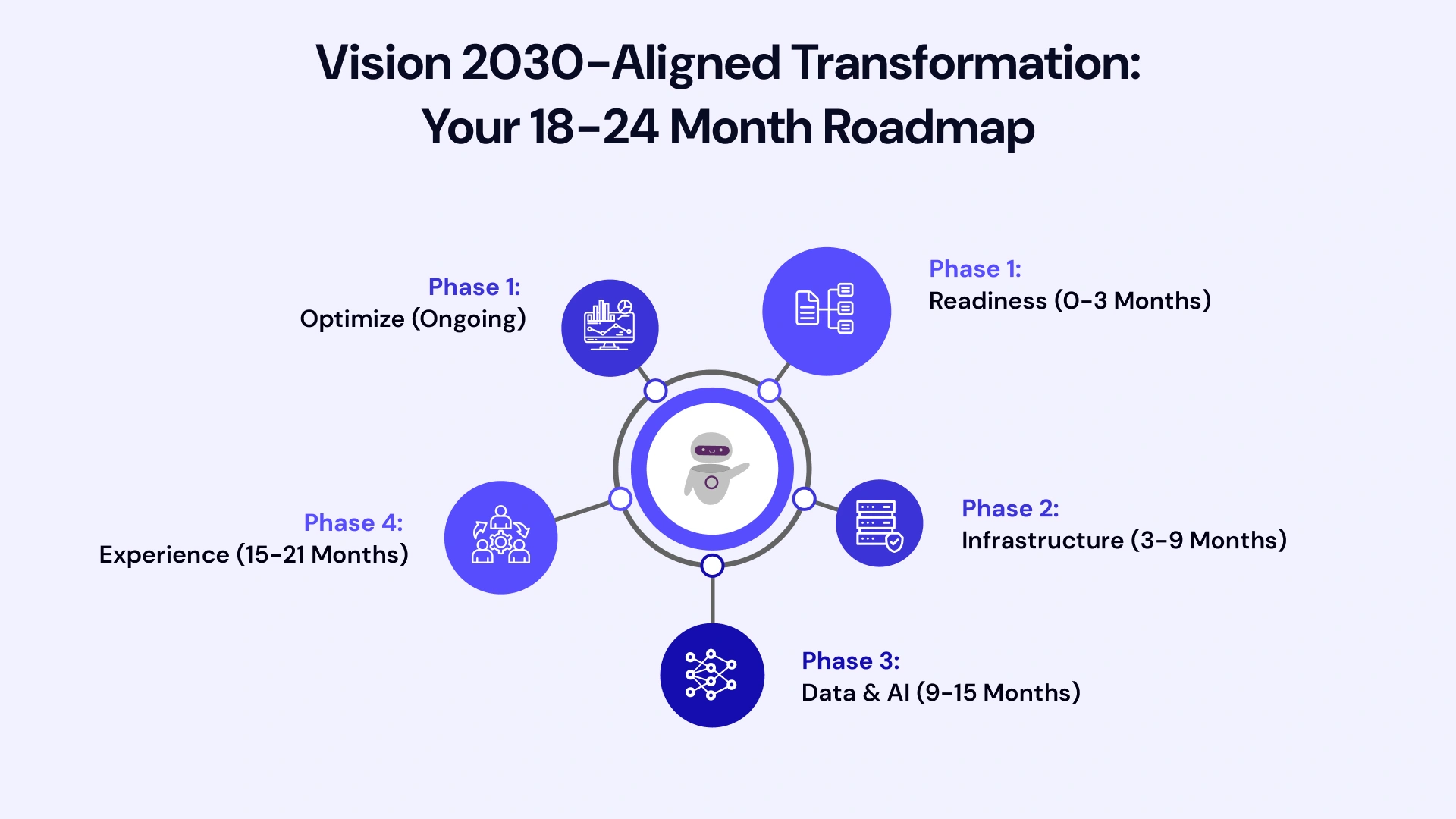
Phase 3 – Data, Cloud & AI Enablement (Months 9–15)
With infrastructure foundations in place, enterprises unlock value through data and artificial intelligence.
Data Platform Modernization: Establish unified data platforms that aggregate, govern, and expose organizational data for analytics and AI applications. Implement data quality controls, lineage tracking, and access management aligned with NDMO standards. Modern data architecture enables both operational reporting and advanced analytics use cases.
Cloud Optimization: Move beyond basic cloud migration to optimize workload placement, cost management, and performance monitoring. Enterprises often discover initial cloud deployments waste 30-40% of spending through oversized instances and underutilized services. Continuous optimization processes recover this waste while improving application performance.
AI Implementation: Deploy AI capabilities aligned with business priorities. Arabic-native large language models (LLMs) like ALLaM enable customer service automation with cultural nuance. Predictive analytics inform demand forecasting, maintenance scheduling, and risk management. Organizations implementing AI development services should prioritize use cases with clear business value and measurable outcomes.
Phase 4 – Experience-Led Digitization (Months 15–21)
Technology investment translates to business impact through experience transformation across three stakeholder groups.
Citizen/Customer Experience: Redesign customer journeys end-to-end, eliminating friction points and enabling self-service capabilities. Integrate with government identity services for seamless authentication. Focus on mobile-first experiences that reflect Saudi consumer preferences for digital engagement.
Employee Experience: Modernize internal workflows, knowledge management, and collaboration tools. Empower employees with automation that eliminates repetitive tasks and AI tools that augment decision-making. Improved employee experience directly correlates with customer satisfaction and operational efficiency.
Partner/Ecosystem Experience: Enable B2B integration through APIs, partner portals, and shared platforms. Participate in industry ecosystems like SAMA Open Banking that create new value through connectivity. Ecosystem participation increasingly determines competitive positioning in Saudi markets.
Phase 5 – Continuous Optimization & Innovation (Ongoing)
Digital transformation is not a project with an end date—it's an ongoing capability.
Performance Monitoring: Establish metrics and dashboards tracking transformation outcomes against Vision 2030 KPIs, operational efficiency targets, and customer experience benchmarks. Regular performance reviews ensure transformation investments deliver expected returns.
Continuous Improvement: Implement feedback loops that identify optimization opportunities, prioritize enhancements, and deploy improvements through agile release cycles. Build organizational muscle for iterative improvement rather than periodic large-scale changes.
Innovation Pipeline: Create structured processes for evaluating emerging technologies, piloting promising solutions, and scaling successful experiments. Maintain awareness of regulatory changes and technology advances that may create new opportunities or requirements.
Digital Transformation Roadmap Summary
| Phase | Timeline | Key Activities | Critical Milestones |
| Phase 1: Readiness | Months 1–3 | Sovereignty audit, capability assessment, strategic alignment | Data classification complete, backlog prioritized |
| Phase 2: Infrastructure | Months 3–9 | Hybrid cloud deployment, integration layer, security foundation | Sovereign cloud operational, Zero Trust implemented |
| Phase 3: Data & AI | Months 9–15 | Data platform modernization, cloud optimization, AI deployment | Unified data platform live, AI use cases deployed |
| Phase 4: Experience | Months 15–21 | Customer journey redesign, employee enablement, ecosystem integration | Digital channels launched, API marketplace active |
| Phase 5: Optimization | Ongoing | Performance monitoring, continuous improvement, innovation pipeline | KPI dashboards operational, innovation governance established |
Key Technologies Powering Vision 2030 at the Enterprise Level
Cloud Adoption in Saudi Enterprises (Sovereign & Hybrid Models)
The Saudi cloud market is expanding at 31.7% CAGR, driven by sovereign cloud demand from regulated industries. Hyperscalers have responded with significant regional investments that address data residency requirements while providing enterprise-grade capabilities.
Oracle, Google, Microsoft, and Alibaba now operate Saudi-based cloud regions that satisfy PDPL data residency requirements. Local providers including solutions by STC offer connectivity and managed services tailored to Saudi enterprise needs. The expanding provider landscape gives enterprises meaningful choice in balancing capability, cost, and compliance requirements.
The choice between hyperscaler sovereign regions and local cloud providers depends on workload requirements, integration needs, and total cost of ownership. Many enterprises adopt hybrid approaches—sovereign cloud for regulated workloads, international regions for development and non-sensitive applications. This hybrid model optimizes cost while maintaining compliance for sensitive operations.
AI and Automation Under Vision 2030
Arabic-native AI addresses the cultural and linguistic requirements that global models handle poorly. LLMs trained on Arabic datasets and Saudi context enable customer service automation, document processing, and knowledge management with appropriate cultural nuance. These capabilities prove essential for customer-facing applications requiring natural Arabic language understanding.
Process automation targets operational efficiency gains critical to Vision 2030 economic objectives. Robotic process automation (RPA) handles repetitive tasks while intelligent automation incorporates AI decision-making for complex processes. Automation ROI typically ranges from 30-50% cost reduction for targeted processes.
Predictive analytics transforms planning functions. Manufacturing enterprises predict equipment failures before they occur. Retailers forecast demand with greater accuracy. Financial institutions identify risks earlier in customer lifecycles. These capabilities deliver measurable business value while building organizational data capabilities.
Data Platforms, Cybersecurity, and Smart Infrastructure
Mega-projects like NEOM offer AI infrastructure lessons from Saudi and UAE mega-projects in sustainability and scale.
Data platforms provide the foundation for AI and analytics initiatives. Modern data architectures support real-time streaming, batch processing, and AI/ML workloads while maintaining governance controls required by Saudi regulations. Investment in data platform capabilities enables future use cases that may not yet be defined.
Smart infrastructure supports both enterprise operations and national giga-projects. The technologies powering NEOM and The Line—IoT sensors, digital twins, autonomous systems—will trickle down to standard enterprise facility management and operations. Early adopters gain competitive advantages as these capabilities become industry standard.
Industry Snapshots - Digital Transformation in Action
Public Sector & Smart Government Initiatives
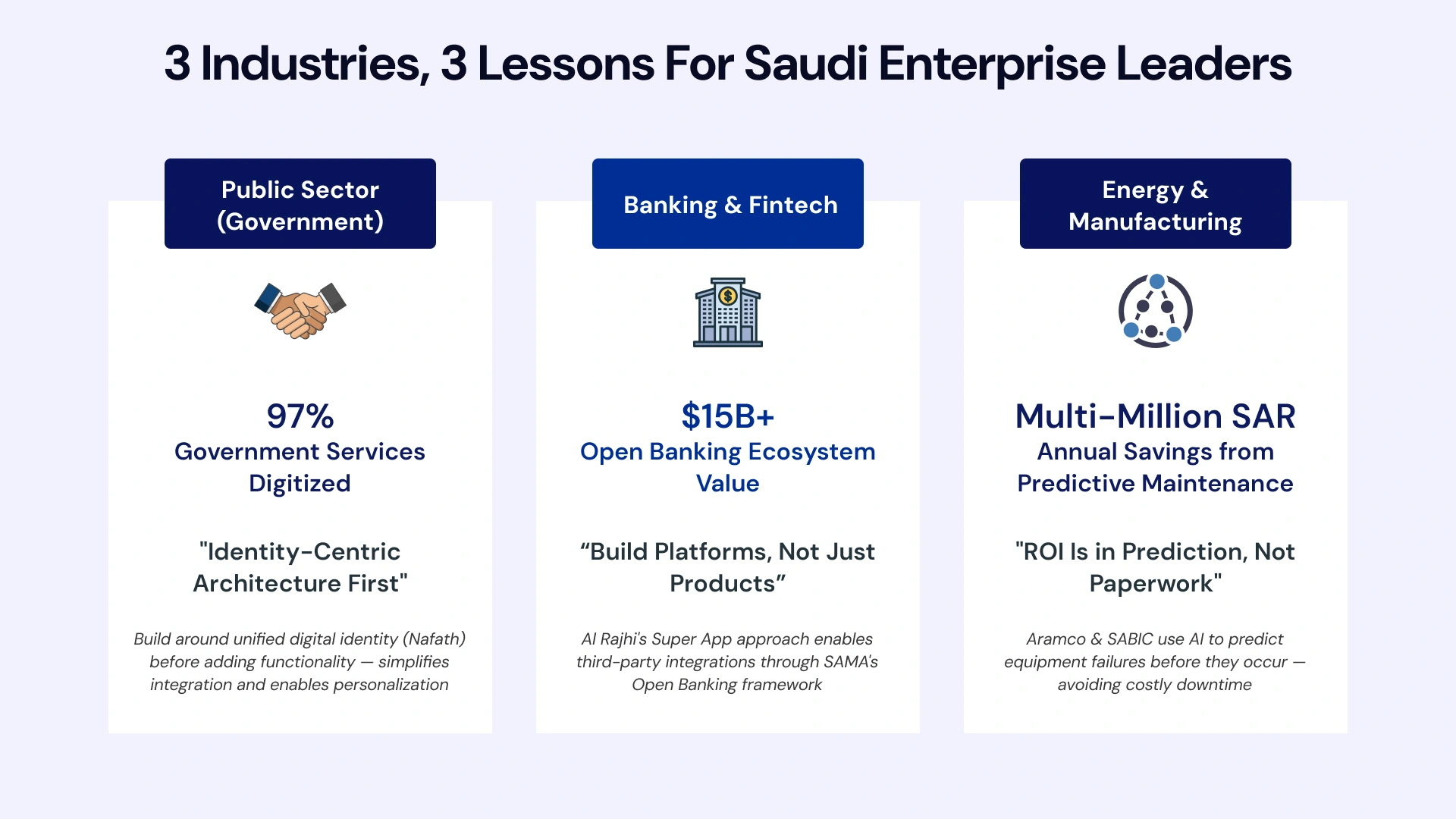
Government entities set the benchmark for digital transformation in Saudi Arabia. Absher—the Ministry of Interior's digital services platform—transformed the Kingdom from paper-heavy bureaucracy to mobile-first nation. The platform processes millions of transactions monthly with high citizen satisfaction rates.
The lesson for enterprises: anchor everything on unified digital identity. Absher's success came from building around a single identity layer (now Nafath) that connects across all services. Enterprises should mirror this approach—unify customer identity across channels before adding functionality. Identity-centric architecture simplifies integration, improves security, and enables personalized experiences.
Banking, Fintech & Open Ecosystems
Saudi banking has moved beyond basic digitization to ecosystem thinking. Al Rajhi Bank exemplifies this shift—building a "Super App" platform that enables third-party integrations through SAMA's Open Banking framework. This platform approach expands service offerings without proportional internal development investment.
The lesson: ecosystems over products. Don't just build applications; build platforms that partners can plug into. STC Pay's growth demonstrates consumer appetite for integrated financial experiences that traditional banking approaches cannot deliver. Financial services enterprises must prepare for ecosystem participation or risk marginalization.
As SAMA tightens regulations, smaller fintechs face consolidation pressure. The "Big 5" banks are acquiring digital capabilities, creating banking conglomerates with sophisticated digital offerings. Enterprises in adjacent sectors must prepare for integration with these expanding financial ecosystems.
Note: As organizations plan the next phase of Banking, Fintech & Open Ecosystems, software development in the Middle East can add useful perspective on execution, scalability, and long-term business value.
Energy, Manufacturing & Industry 4.0
Aramco and SABIC lead Industry 4.0 adoption with heavy investment in digital twins and IoT sensor networks monitoring refinery assets in real-time. These investments demonstrate the operational value available through industrial digitization.
The ROI lesson: transformation value isn't in "paperless" offices—it's in using AI to predict when a multi-million-riyal turbine will fail before it does. Predictive maintenance alone justifies substantial technology investments through avoided downtime and optimized maintenance scheduling. The business case for industrial AI centers on operational continuity rather than administrative efficiency.
NEOM creates a micro-market for "Cognitive City" technology—autonomous systems managing water, energy, and logistics. These capabilities will eventually become standard enterprise requirements for facility management and operations. Organizations investing in IoT and automation capabilities position themselves for this evolution.
Decision-Making Framework for Saudi CXOs
How to Prioritize Initiatives Without Over-Investing
Transformation budgets are finite. CXOs must prioritize initiatives that deliver maximum impact within resource constraints.
Use a Strategic Alignment Matrix evaluating each initiative across three dimensions:
Vision 2030 Impact: Does this initiative directly support national KPIs or regulatory requirements? High-impact initiatives unlock government contracts, avoid compliance penalties, or enable mandatory integrations. Alignment with national priorities often accelerates approval processes and may qualify for government support programs.
Business Value: What operational efficiency, revenue growth, or customer experience improvements will this initiative deliver? Quantify expected returns to enable comparison across initiatives. Prefer initiatives with measurable outcomes over those with qualitative benefits only.
Risk Profile: What execution risks does this initiative carry? Consider technology complexity, organizational change requirements, and dependency on scarce talent or vendor capabilities. Higher-risk initiatives require stronger governance and contingency planning.
Initiatives scoring high across all three dimensions receive priority. Those scoring high on one dimension but low on others require careful evaluation of tradeoffs.
Build vs Partner vs Outsource Decisions
Not every capability should be built internally. Saudi enterprises face talent constraints that make comprehensive in-house development impractical.
Build internally when capabilities represent core competitive differentiation and when qualified talent is available. Proprietary algorithms, unique customer insights, and industry-specific domain expertise warrant internal investment. Protect these capabilities through appropriate intellectual property measures.
Partner strategically when capabilities require specialized expertise your organization lacks but ongoing involvement is essential. Cloud architecture, AI implementation, and cybersecurity operations benefit from partnership models that transfer knowledge over time. Organizations seeking Middle East technology services partners should evaluate regional experience and cultural understanding alongside technical capabilities.
Outsource completely when capabilities are commodity, when speed matters more than control, or when Saudization requirements create workforce constraints. Infrastructure management, help desk operations, and testing services often make sense to outsource. Focus internal resources on differentiated capabilities while leveraging external expertise for standard functions.
Measuring ROI Beyond Technology KPIs
Transformation success cannot be measured solely by technology metrics. System uptime and deployment velocity matter, but they don't demonstrate business impact.
Effective measurement frameworks connect technology initiatives to business outcomes aligned with Vision 2030 priorities: revenue growth from digital channels, cost reduction from automation, customer satisfaction improvement from experience redesign, and compliance achievement from governance implementation.
ROI Measurement Framework
| Category | Tech Metrics | Business Outcomes | Vision 2030 Alignment |
| Operational Efficiency | System uptime, response time | Cost per transaction, processing time | Economic diversification contribution |
| Customer Experience | App downloads, digital adoption | NPS improvement, customer retention | Service sector growth |
| Workforce Productivity | Tool adoption rates | Revenue per employee | Human capital development |
| Compliance & Risk | Control implementation | Audit findings reduction | Regulatory framework alignment |
Common Myths About Digital Transformation in Saudi Arabia
"Vision 2030 Is Only Relevant to Government Entities"
This misconception ignores the interconnected nature of Saudi Arabia's digital ecosystem. Private enterprises must integrate with government platforms (Nafath, NIC, sector APIs) to operate effectively. Government contracts increasingly require digital capability verification. Supply chains serving government entities face compliance requirements flowing down from primary contractors.
"Digital Transformation Is an IT Modernization Project"
Framing transformation as IT's responsibility guarantees suboptimal outcomes. When technology teams' own transformation without executive sponsorship and cross-functional involvement, initiatives optimize for technical elegance rather than business impact.
In Saudi Arabia specifically, executive accountability extends to legal liability for data protection and cybersecurity compliance. Transformation is a CEO and Legal job—not an IT project. Organizations that maintain this framing consistently achieve better outcomes than those delegating transformation to technology functions alone.
"Cloud and AI Adoption Is Optional"
The "optional" window has closed. Enterprises that cannot integrate with cloud-based government platforms face exclusion from expanding digital ecosystems. Those lacking AI capabilities fall behind competitors who can personalize experiences, predict demand, and automate operations.
The question is not whether to adopt cloud and AI—it's how quickly you can deploy compliant, effective implementations before competitive disadvantage becomes irreversible. Early movers establish market positions that late adopters struggle to overcome.
What's Next - The Future of Digital Transformation in Saudi Arabia (2025–2030)
From Digitization to Cognitive Enterprises
The current phase focuses on digitization—converting analog processes to digital equivalents. The next phase demands cognitive capabilities—systems that learn, adapt, and make decisions autonomously.
Enterprise Role in Saudi Arabia's Digital Economy Growth
The digital sector is being built to survive after oil. Enterprises that develop genuine digital capabilities—not just digital facades—will contribute to and benefit from this structural economic shift.
This creates opportunity for enterprises willing to invest in transformation. Government programs actively support private sector digitization. Talent development initiatives will gradually address workforce constraints. Regulatory frameworks, while demanding, provide clarity for compliant organizations.
Preparing for Continuous Regulatory and Technology Change
The regulatory environment will continue evolving. PDPL enforcement will intensify. NCA standards will expand. New requirements will emerge as the digital economy matures.
Enterprises must build organizational capabilities for continuous adaptation—not just point-in-time compliance. This means investing in regulatory monitoring, governance frameworks, and flexible architectures that can accommodate changing requirements without wholesale redesign.
Getting Started - Turning Vision into Execution
Key Questions CXOs Should Ask Before Starting
Before launching transformation initiatives, CXOs should honestly answer several critical questions:
- Where does our data currently reside, and what classification does it require under PDPL and NDMO standards?
- Which government platforms and sector APIs must we integrate with to remain competitive in our industry?
- Do we have the internal talent to execute transformation, or do we need partnership and development strategies?
- How will we measure transformation success in terms that matter to our board, our regulators, and our customers?
- What is our realistic timeline given resource constraints, and how does that compare to competitor and regulatory timelines?
Why Structured Roadmaps Outperform Ad-Hoc Initiatives
Enterprises attempting transformation through disconnected initiatives consistently underperform those following structured roadmaps.
Structured approaches ensure compliance requirements inform technology decisions from the start—not as afterthoughts requiring expensive remediation. They sequence investments to build capabilities progressively rather than creating dependencies on unavailable foundations. They maintain executive visibility into progress and challenges rather than burying issues in technical complexity.
The roadmap framework presented in this guide—moving from readiness assessment through infrastructure, data enablement, experience transformation, and continuous optimization—provides a proven structure for Saudi enterprise transformation aligned with Vision 2030 requirements.
Organizations that partner with experienced digital transformation consultants accelerate timeline, reduce risk, and benefit from lessons learned across similar engagements. VLink's enterprise digital transformation services combine global methodology with regional expertise to help Saudi enterprises navigate the specific challenges of Vision 2030 alignment.

Vice President, Strategy – VLink Inc.
Sambhavi Gopalakrishnan is the Vice President of Strategy at VLink Inc., bringing over a decade of experience in IT leadership, project implementation, and strategic growth. She possesses a strong foundation in technical project management and pre-sales, driving innovation and business transformation at VLink.

 Shivisha Patel