


Consider the Head of Procurement at a mid-market Riyadh retail group. An RFP for a digitization project drew eleven vendor responses in three weeks. Four called themselves software companies. Three called themselves IT consultancies. Two called themselves system integrators. Two did not explain what they were at all. Every proposal claimed Vision 2030 alignment and Arabic-first design. The Head of Procurement has no reliable way to tell which claims are real.
VLink is a global IT services company. It helps procurement managers, CTOs, and enterprise IT directors in Riyadh evaluate and select software delivery partners. VLink's relevant practices include custom software development, mobile app development, AI development, and IT staff augmentation. Delivery teams support Saudi engagements across retail, healthcare, logistics, and government-adjacent projects.
Most Riyadh software company roundups are listicles: a company name, a logo, a one-line description, repeated eleven times. That format does not answer the question a buyer has. This guide maps Riyadh's software market by specialization, buyer type, and industry fit. It also adds the pricing and evaluation details, where most guides skip.
Why Is Choosing a Software Company in Riyadh So Hard in 2026?
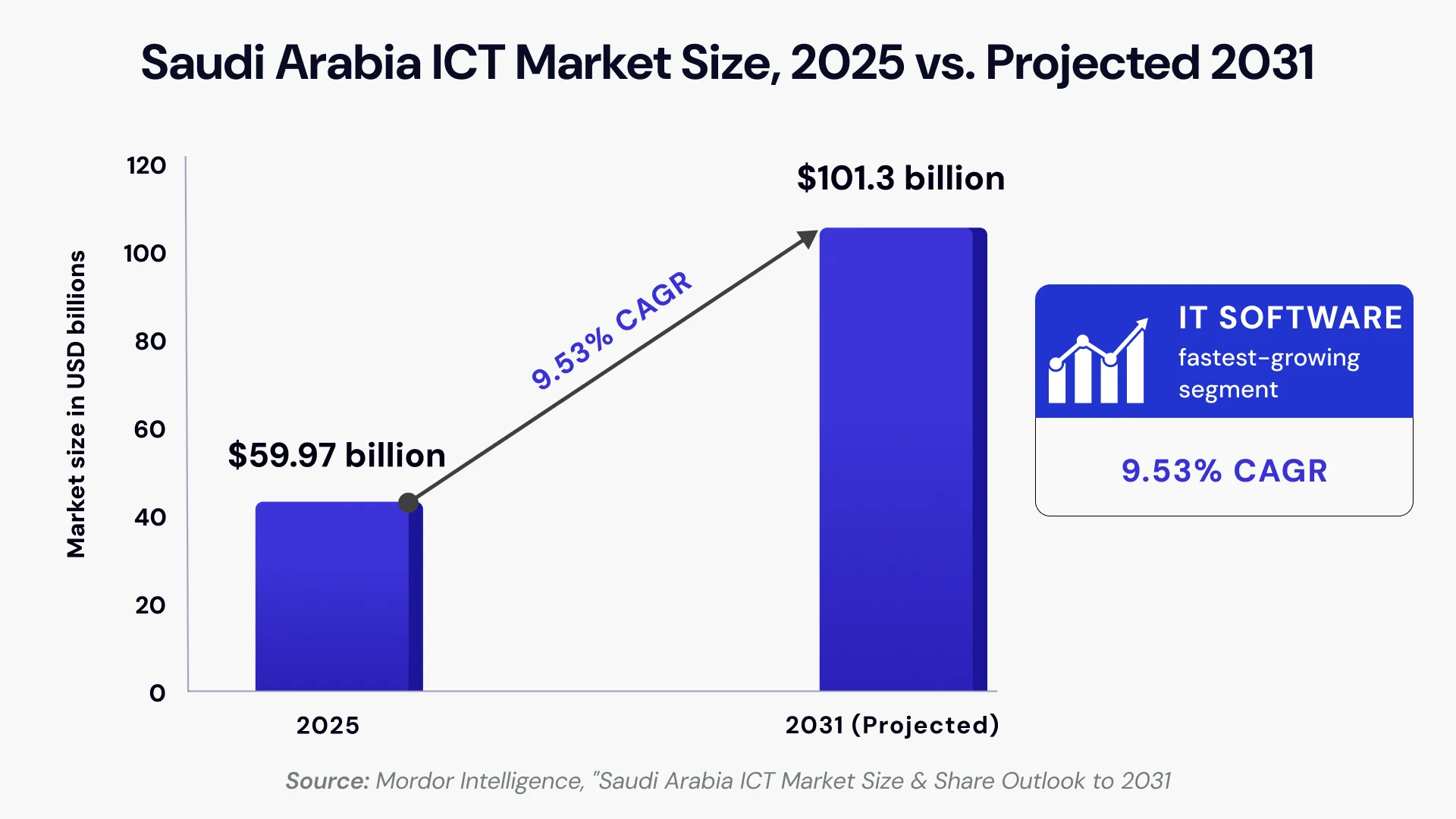
Riyadh's software market has grown fast enough that scale itself has become a problem for buyers. Saudi Arabia's ICT market reached $59.97 billion in 2025. Mordor Intelligence projects it will hit $101.3 billion by 2031, a 9.13% compound annual growth rate. IT software is the fastest-growing segment within that market. It is expanding at a 9.53% CAGR, driven by cloud, AI, and cybersecurity deployments.
Regional IT spending is accelerating the same trend from the demand side. Gartner forecasts MENA IT spending will reach $169 billion in 2026, up 8.9% from 2025. Gartner's VP advisory for the region tied the growth directly to AI infrastructure demand in an August 2025 press release. Data center system spending will accelerate, he said, as MENA leaders invest in "AI-enabled software and AI-optimized infrastructure." Pent-up demand for generative AI is fueling the surge, he added.
Saudi Arabia ICT and Software Market Growth, 2025-2031
| Metric | 2025 | Projected | CAGR |
| Saudi Arabia ICT market | $59.97 billion | $101.3 billion by 2031 | 9.13% |
| Saudi Arabia IT software segment | Fastest-growing segment within ICT | N/A | 9.53% |
| MENA IT spending (regional) | N/A | $169 billion in 2026 | 8.9% YoY growth |
Source: Mordor Intelligence, "Saudi Arabia ICT Market Size & Share Outlook to 2031"; Gartner, "Gartner Forecasts MENA IT Spending to Reach $169 Billion in 2026" (August 2025).
Startup activity is compounding the confusion. Riyadh jumped 60 places in a single year to rank 23rd among the world's top startup ecosystems. That is according to Startup Genome's 2026 Global Ecosystem Report. It posted the highest growth rate in the global top 100 for a second consecutive year. New vendors, new SaaS products, and new consultancies are entering the market faster than most procurement teams can track them.
What does this means for a buyer in that position: more vendors do not mean more clarity. It means a longer list to filter, with no shared taxonomy for what each company actually does.
Who Builds What? A Buyer's Map of Riyadh Software Companies
Riyadh's software market splits into six recognizable categories. Most vendor confusion traces back to companies blurring these lines in their own marketing. Real ambiguity in what they deliver is rarely the actual cause.
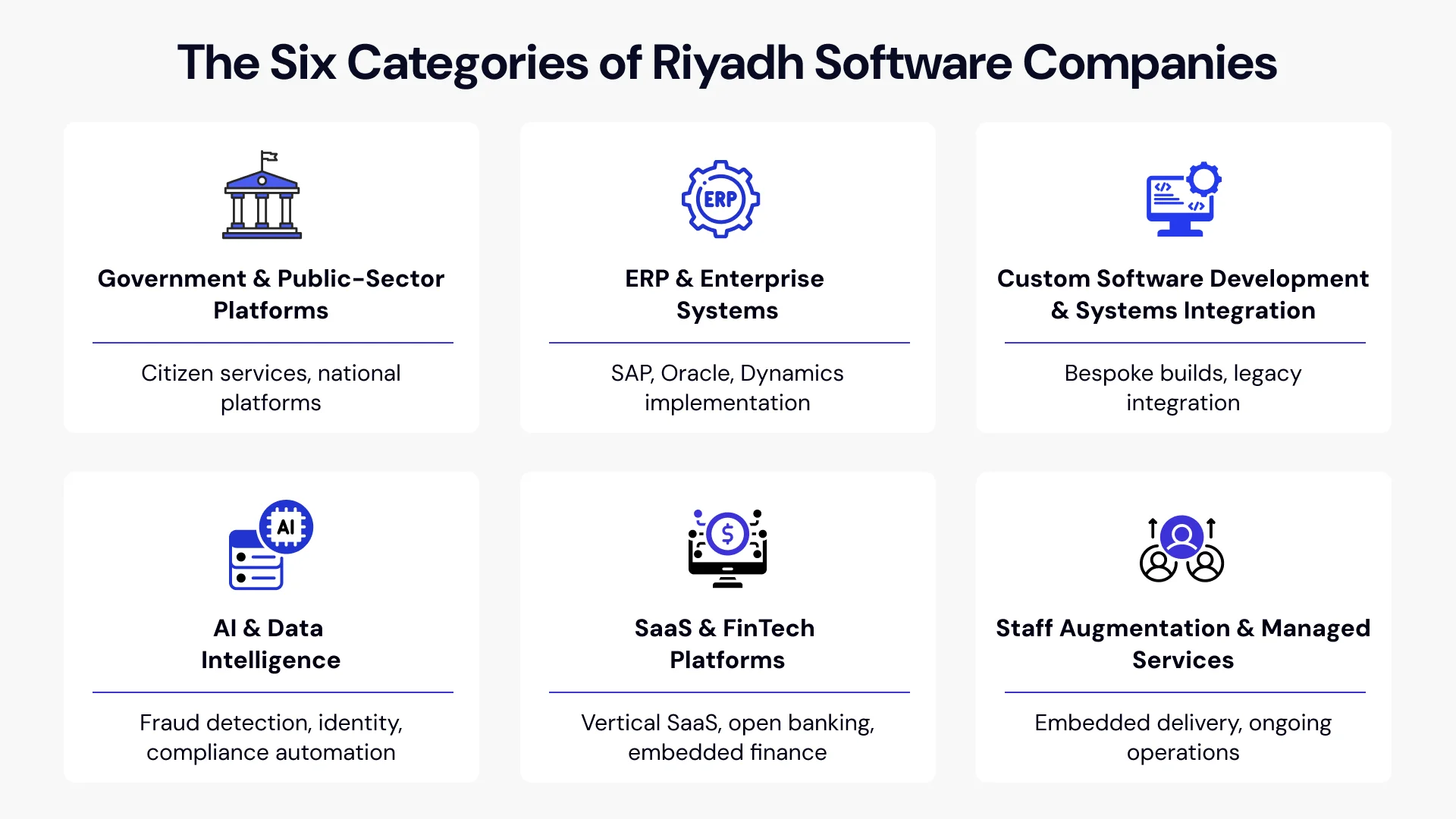
Who Builds What — Riyadh Software Companies by Specialization
| Category | What They Actually Build | Example Players |
| Government & public-sector platforms | Citizen-facing digital services, gov data infrastructure, national platforms | Elm (incorporating Thiqah Business Services) |
| ERP & enterprise systems | SAP, Oracle, and Microsoft Dynamics implementation and integration | Global systems integrators (Accenture, IBM, Deloitte Digital) and Elm's enterprise arm |
| Custom software development & systems integration | Bespoke applications, legacy integration, mobile product builds | Accenture, IBM, Deloitte Digital, Tata Consultancy Services, VLink |
| AI & data intelligence | Fraud detection, identity verification, compliance automation, analytics | Mozn, Lucidya, Sirar by stc |
| SaaS & fintech platforms | Vertical SaaS products, open banking APIs, embedded finance | Lean Technologies, Rasan, Tamara |
| Staff augmentation & managed services | Embedded delivery teams, ongoing operations, dedicated pods | VLink and other global IT services firms with Riyadh delivery capacity |
Mobile app development rarely stands alone as a category in Riyadh. It usually sits inside the custom software development and systems integration category. Most Riyadh buyers hiring for a mobile build are really hiring a custom development team. That team happens to specialize in mobile delivery, not a standalone mobile-only shop.
Elm illustrates the scale gap between government-track vendors and everyone else. It is a publicly traded company on the Saudi Exchange. It acquired Thiqah Business Services, which generated SAR 1.6 billion in 2023 revenue, for SAR 3.4 billion in January 2025. That single deal created a combined entity with a market presence of SAR 6.9 billion. No private Riyadh software house operates at that scale, and few buyers outside government procurement will ever engage Elm directly.
That scale gap matters practically, not just academically. A mid-market SME requesting a proposal from Elm-scale vendors will usually wait longer. It will also pay a premium built around enterprise and government contract overhead. The categories below Government in Table 2 exist for this reason. Most buyers get better speed and value matching their project to a right-sized vendor instead.
The SaaS and fintech category shows the clearest evidence of Riyadh's software maturity outside government. Rasan, which operates the Tameeni and Treza insurance platforms, listed on the Saudi Exchange in June 2024. It raised SAR 841 million, about $224 million, in the first fintech or insurtech IPO in Saudi Arabia's history. Rasan reported SAR 256 million, roughly $68 million, in 2023 revenue ahead of that listing. That is a public, audited revenue figure. Very few private Riyadh software companies can point to anything comparable.
The AI and data intelligence category looks different again. Mozn and Sirar by stc both work on identity, fraud, and compliance problems for regulated clients. Neither carries the same public financial disclosure Rasan's listing requires. Lucidya took a different path. It built enterprise social and customer intelligence software, then raised a $30 million Series B in July 2025. Wamda called that round a MENA AI funding record for its category. Each of these three companies solves a different problem under the same "AI" label. That is precisely why a buyer needs the category breakdown in Table 2, not a single "top AI companies" list.
A note from VLink's Global Delivery Manager. "We once got pulled into a Riyadh insurance integration project. The client's original vendor turned out to be a reseller, not a delivery team. They had sold the engagement, then subcontracted the middleware work to a firm with no direct experience. That firm had never touched our client's core policy system before. We spent the first month rebuilding trust before we could even start the technical work."
Which Riyadh Companies Fit Startups vs. SMEs vs. Enterprises vs. Government?
Company size and category matter less than fit to the buyer's own stage. A vendor built for enterprise ERP rollouts is often the wrong fit for a startup MVP. The reverse holds just as often.
Matching Riyadh Software Companies to Buyer Type
| Buyer Type | What They Need Most | Where to Look First |
| Startup founders (pre-seed to Series B) | Speed, low upfront cost, product-market-fit iteration | SaaS-native teams and lean custom development shops, not large systems integrators |
| SME business owners | Fixed-scope digitization at a predictable price | Mid-size custom development and systems integration firms with local delivery teams |
| Enterprise CIOs and IT directors | Compliance depth, integration with legacy systems, dedicated delivery capacity | Global systems integrators and staff augmentation firms with enterprise references |
| Government and Vision 2030 stakeholders | Security clearance, Arabic-first design, public procurement experience | Elm and vendors with documented government contract history |
A common mismatch happens when an enterprise-focused systems integrator takes on a startup MVP. Their process overhead, built for compliance-heavy enterprise work, slows a startup down instead of helping it move fast. The reverse mismatch is just as common. A lean startup-focused shop takes on enterprise integration work it lacks the compliance depth to support.
Which Companies Have Real Healthcare, BFSI, or Logistics Experience?
Vertical experience is the hardest thing to verify from a vendor's marketing site. Every company claims sector expertise. Few can show a specific, named reference project.
Industry-Specific Vendor Evaluation in Riyadh
| Industry | What Real Expertise Looks Like | Common Red Flag |
| Healthcare | Documented EMR integration work and evidence of handling patient data under Saudi health data protection standards | A generic "healthcare" logo on a homepage with no named clinical system reference |
| BFSI and fintech | Daily engineering work on fraud detection, risk, and compliance, the kind Lean Technologies and Rasan handle inside Saudi financial infrastructure | A vendor that treats fraud detection as a bolt-on feature rather than core architecture |
| Logistics and supply chain | Named references in fleet management, warehouse automation, or IoT integration | Generalist custom development pitches with no named logistics client |
| Manufacturing | Experience integrating shop-floor systems with business applications and ERP | A pure web or mobile development background with no industrial systems exposure |
International companies entering Saudi Arabia face a variant of this same verification problem. Prioritize a vendor with a genuine local delivery presence and a documented localization track record. A partner referral network alone is not sufficient proof.
What this means for a BFSI buyer: a vendor new to fraud-detection work will underestimate its complexity in a proposal.
Which Riyadh Companies Are Actually Working on Vision 2030 Projects?
Vision 2030 alignment appears in nearly every Riyadh vendor pitch. Actual involvement is far narrower than the marketing claims suggest.
Elm sits closest to genuine, documented Vision 2030 delivery work. Its acquisition of Thiqah consolidated public-sector digital platform work under one roof. That deal was directly tied to the Public Investment Fund's ICT sector strategy. Most Vision 2030 project work below that scale flows through public procurement processes that few private software companies win directly. They participate as subcontractors to prime government contractors instead.
NEOM's role in this picture shifted meaningfully during 2026. Saudi Arabia scaled back several NEOM workstreams and placed spending on nearly every NEOM project under reassessment. Reports point to a specific pivot toward AI data center infrastructure. That shift moves away from the broader smart-city buildout most 2023-era vendor pitches still reference. A vendor still selling "NEOM smart city" experience in 2026 marketing should be asked for a specific, current project reference.
What this means for a Government Digital Transformation Director: verify a claimed Vision 2030 project against a specific, named contract. General alignment language in a pitch deck is not evidence of delivery.
How Should an International Company Approach Entering the Saudi Software Market?
International companies entering Saudi Arabia face a different evaluation problem than local buyers. They need a delivery partner and a market-entry guide at the same time, and few vendors do both credibly.
- Local commercial presence: A Saudi Commercial Registration matters for government and enterprise procurement. Confirm whether a vendor operates a genuine registered entity or works through a partner of record.
- Localization depth, not translation: Genuine localization covers Arabic-first UX, right-to-left interface logic, and cultural context in copy and design, not a machine-translated English product.
- Payment and banking rails: Confirm the vendor's familiarity with Saudi payment gateways and banking integrations, particularly for any product handling BFSI or e-commerce transactions.
- Talent sourcing model: Ask whether the vendor staffs projects with in-Kingdom talent, nearshore Gulf talent, or a blended team, and how that mix affects delivery timelines and cost.
A common mistake among international companies is treating Saudi Arabia as a smaller version of the UAE market. Procurement processes, data residency expectations, and localization depth all differ between the two. A vendor with genuine dual-market experience tends to catch these gaps earlier than one working from a UAE base alone. The category guide to IT companies in Dubai maps how that neighbouring vendor market is structured.
What Does a Software Project Actually Cost in Riyadh?
Pricing transparency is one of the most consistent complaints Riyadh software buyers raise. Most vendor sites list no pricing at all, forcing every evaluation to start from a blind RFP.
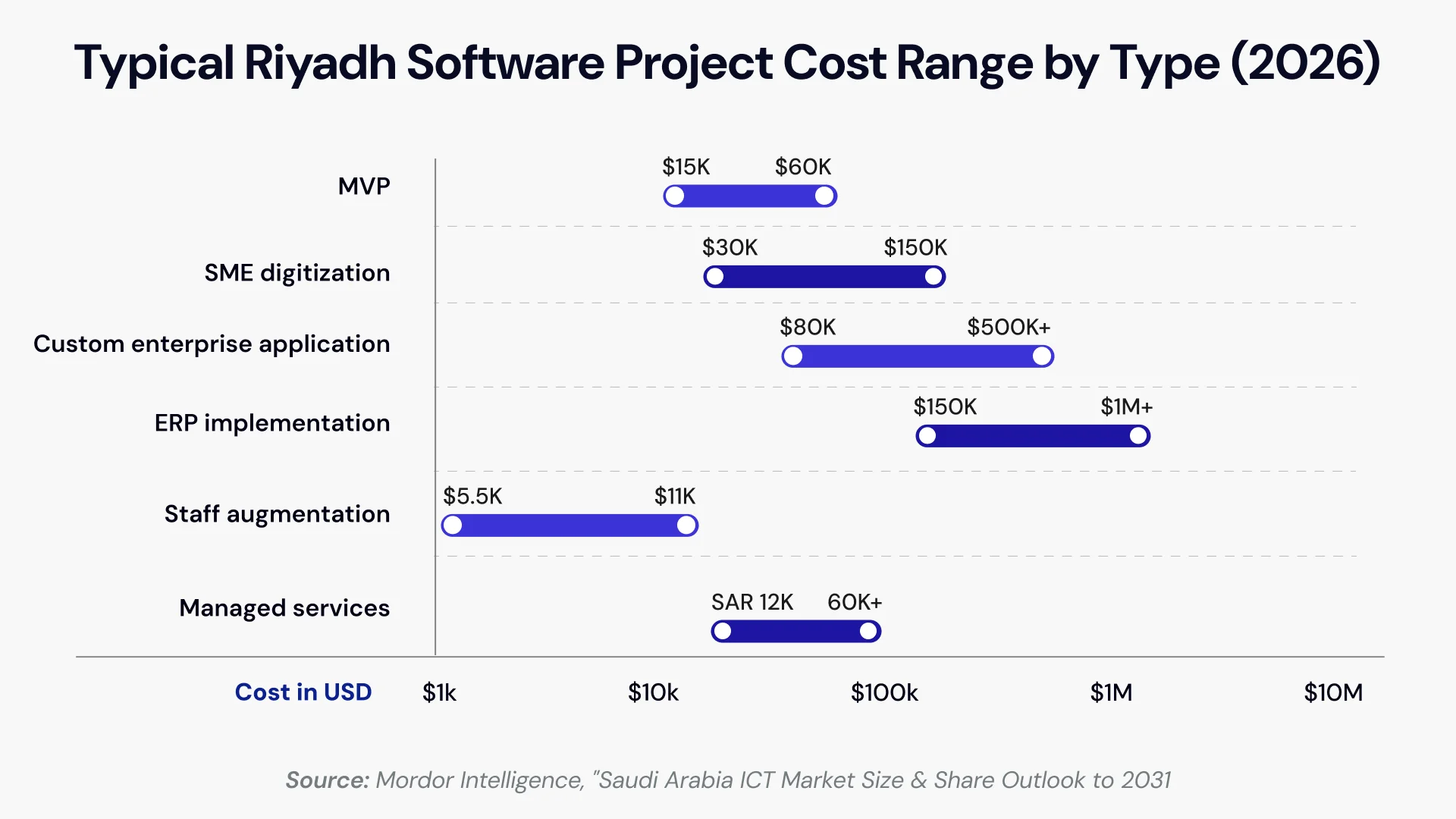
Typical Riyadh Software Project Cost Ranges by Type (2026)
| Project Type | Typical Cost Range | Typical Duration |
| MVP / startup product build | $15,000 - $60,000 | 6-12 weeks |
| SME digitization project (fixed scope) | $30,000 - $150,000 | 2-4 months |
| Custom enterprise application | $80,000 - $500,000+ | 4-9 months |
| ERP implementation (SAP, Oracle, Dynamics) | $150,000 - $1,000,000+ | 6-18 months |
| Staff augmentation (per engineer) | $5,500 - $11,000 per month | Ongoing |
| Managed services retainer | SAR 12,000 - SAR 60,000+ per month | Ongoing |
What Engagement Models Do Riyadh Software Companies Offer?
Four engagement models cover most Riyadh software company relationships. Choosing the wrong one is a common source of buyer frustration independent of vendor quality.
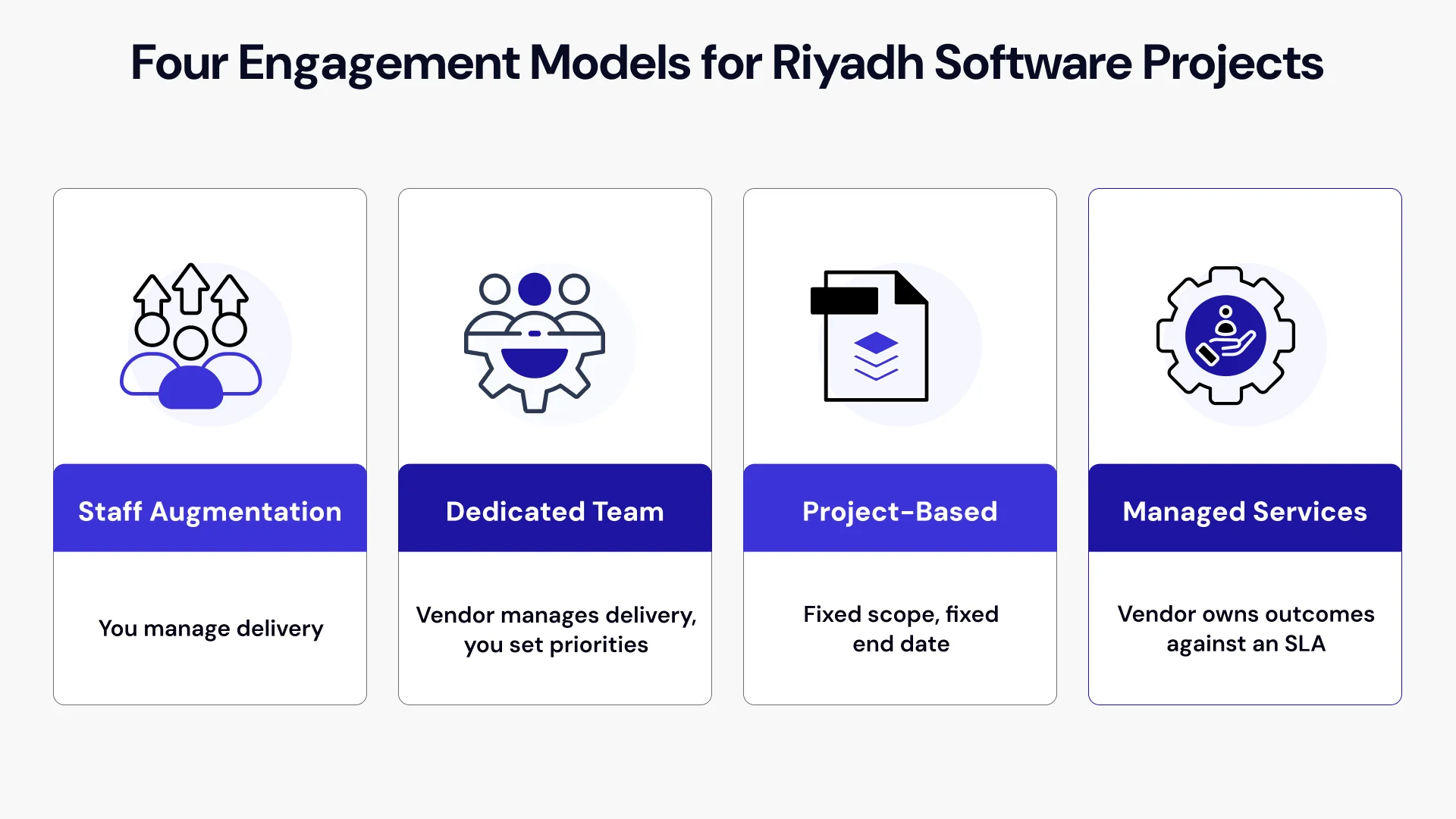
- Staff augmentation: The buyer manages delivery directly, and the vendor supplies individual engineers or specialists to fill a specific skills gap.
- Dedicated team: The vendor manages day-to-day delivery, while the buyer sets priorities and product direction.
- Project-based: A fixed scope, fixed price, and fixed end date, best suited to well-defined SME digitization work.
- Managed services: The vendor owns outcomes against a service-level agreement, common for ongoing platform operations after launch.
Startups and SMEs gravitate toward project-based engagements for a first build. They shift toward dedicated teams once the product needs continuous iteration. Enterprises and government buyers more often start with staff augmentation. They layer it on top of an existing internal team, rather than outsourcing an entire workstream.
Contract structure matters as much as the model itself. A project-based contract should specify exactly what "done" means, with named deliverables and acceptance criteria, not a vague scope description. A dedicated team contract should specify notice periods for swapping engineers. Team continuity is often the entire point of that model. A staff augmentation contract should clarify intellectual property ownership. Buyers frequently skip past that term during negotiation.
What Should You Check Before Signing With a Riyadh Software Vendor?
Six checks catch most of the vendor risk buyers describe after a failed engagement.
Riyadh Vendor Evaluation Scorecard
| Check | What to Ask | Red Flag |
| Team size and structure | How many engineers will actually work on this project, by name? | Vendor cites total company headcount instead of project-specific team size |
| Certifications | Which specific SAP, Microsoft, or AWS partner status does the team hold? | A general "certified team" claim with no named platform or partner tier |
| Named references | Can you provide a reference contact at a company our size and sector? | Only generic case studies offered, with no live contact available |
| Arabic-language and RTL capability | Can you show a live, shipped example of Arabic-first interface work? | Only a translated English marketing page is offered as evidence |
| Data residency and compliance | Where will our data actually be hosted and processed? | Vague assurances about "cloud compliance" with no named data center location |
| Delivery vs. resale | Will the team in this proposal be the team that builds the project? | Reluctance to confirm delivery team identity before contract signature |
Subcontracted delivery, undisclosed upfront, is the single most common source of the trust problems Riyadh buyers report. A vendor confident in its own delivery team answers the last question directly, without hedging. On the data residency check specifically the guide to on-prem to cloud migration in Saudi Arabia sets out CST's data levels and in-Kingdom hosting rules in full.
How Does VLink Fit Into the Riyadh Software Market?
VLink operates primarily in the custom software development, mobile app development, and staff augmentation categories mapped in this guide. VLink's delivery teams support SME digitization projects, enterprise application builds, and embedded staff augmentation engagements for Riyadh-based and Saudi-market-entering clients.
For buyers evaluating a build from scratch, VLink's custom software development practice covers MVP builds through enterprise application work. VLink's mobile app development team delivers native and cross-platform apps directly, not through a subcontractor.
Where internal teams need embedded delivery capacity, VLink's IT staff augmentation services supply it without a resale layer in between. VLink's AI development services build fraud detection, automation, and AI-driven features directly into the product.
To get a shortlist matched to your specific project type and buyer stage, engage VLink's Riyadh advisory team.
In Summary
Riyadh's software market has outgrown the simple "top 10" listicle format most buyers still rely on. Match the vendor category, buyer type, and industry fit before evaluating a single proposal. Pricing transparency and delivery verification follow naturally from there.
- Saudi Arabia's ICT market is projected to grow from $59.97 billion in 2025 to $101.3 billion by 2031, per Mordor Intelligence.
- Six categories cover most Riyadh software companies: government platforms, ERP, custom development, AI, SaaS/fintech, and staff augmentation.
- Elm's $907 million acquisition of Thiqah shows the scale gap between government-track vendors and private software houses.
- NEOM's 2026 shift toward AI data center infrastructure means "smart city" vendor claims need a current, named project reference.
- The single biggest vendor risk buyers report is subcontracted delivery sold as direct delivery, not vendor competence itself.

Global Delivery Manager, VLink Inc.
Shivisha Patel serves as the Global Delivery Manager at VLink Inc., bringing a wealth of experience in program delivery and management, particularly in the insurance and banking sectors. She has a robust technical background with deep expertise in WebSphere MQ, WTX, IIB, middleware, and enterprise system integration.

 Shivisha Patel