

The year 2026 has arrived, and for financial services, the "grace period" for digital transformation is officially over. What used to be a steady climb in risk has become a vertical cliff, leaving security leaders to navigate a landscape where the stakes—and the penalties—have never been higher.
Three numbers define 2026 for financial security leaders.
These three forces have forced a choice. CISOs can keep patching together 30 to 50 separate security tools. Or they can consolidate onto one integrated platform. Most are choosing to consolidate. That is why 78% of financial firms are upgrading their Microsoft security solution stack in 2026.
This blog explores why the industry-wide shift toward a Microsoft security solution for finance is accelerating. We break down the upgrade process, identify the most critical tools, and provide a strategic roadmap specifically designed for highly regulated financial institutions.
Executive Snapshot: The 2026 Maturity Reckoning
Two years ago, most financial CISOs were managing a patchwork of tools. One vendor for endpoint security. Another for SIEM. A third for identity. A fourth for data loss prevention.
That model is now breaking down. Here is why.
AI-powered attacks got cheaper. Fraudsters can now clone executive voices, create fake video approvals, and send thousands of targeted phishing messages — all without human effort. These attacks move faster than any rule-based tool can catch.
Regulatory deadlines got real. The SEC, NYDFS, and DORA all moved from guidance to enforcement in 2025 and 2026. Firms now face mandatory 72-hour breach disclosure windows and documented asset inventories.
Tool costs have become unsustainable. The average financial firm managed 50 or more security vendors by the end of 2024. Each tool created a data silo. Each silo created a blind spot. And each blind spot costs money to manage.
Why Legacy SIEM and Tool Sprawl No Longer Work
Legacy SIEM platforms were built for on-premises networks. They were not built for hybrid cloud, remote workers, open banking APIs, or third-party risk.
A SIEM that takes 18 hours to detect a threat is not a security asset. It is a liability. The Upgrade Trigger Matrix below shows the four forces that pushed firms to act in 2026.
Executive Summary:-
| Trigger | Business Impact | Microsoft Solution |
| Regulatory deadlines (NYDFS, SEC, DORA) | Fines, license risk, reputational damage | Purview Compliance Manager |
| AI fraud and deepfake attacks | Account takeover, payment fraud losses | Entra ID + Defender XDR |
| SOC analyst burnout and alert fatigue | Missed threats, slow response times | Sentinel + Security Copilot |
| Tool sprawl — 30 to 50+ vendors | Visibility gaps, budget waste, integration failures | Microsoft 365 E5 consolidation |
The New Risk Landscape for Financial Institutions in 2026
The old rulebook hasn’t just changed—it’s been shredded. In 2026, financial risk is no longer a linear calculation; it’s a sentient, interconnected web. From industrialized AI fraud to the fragmentation of global markets, institutions are moving past "Digital Transformation" and into an "Algorithmic Siege."
Success today isn't about avoiding risk; it’s about surviving a landscape where "Black Swan" events are the new baseline.
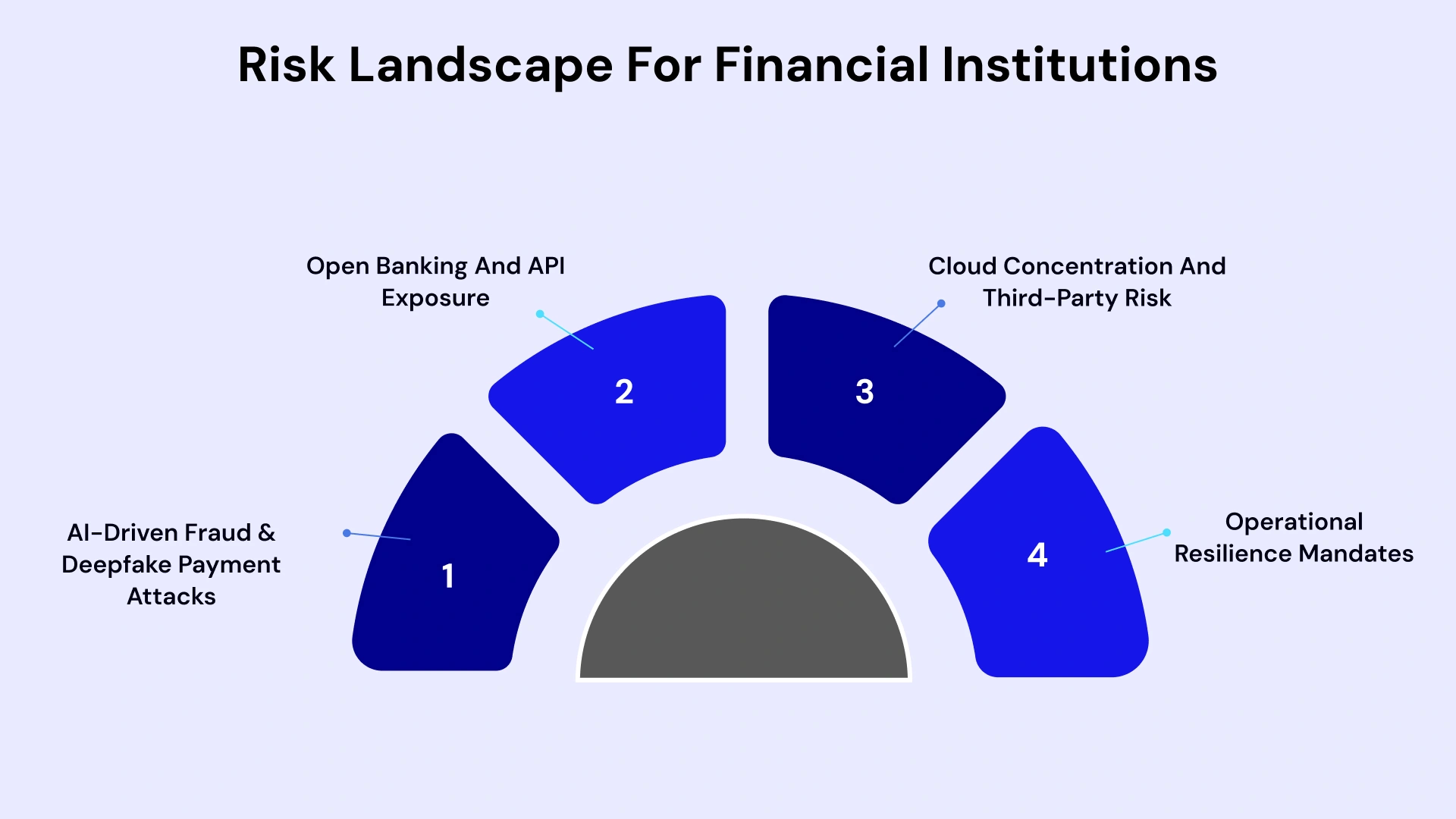
AI-Driven Fraud and Deepfake Payment Attacks
Fraudsters are not sending poorly worded emails anymore. They are using AI to clone voices, fake video approvals, and craft wire transfer requests that look completely real. FinCEN reported a 65% increase in AI-assisted fraud filings from financial institutions in 2024.
Traditional fraud detection tools rely on known attack patterns. AI-driven fraud creates new patterns every time. Microsoft Entra ID and Microsoft Sentinel use behavioral analytics to catch these new patterns — not just known attack signatures.
Open Banking and API Exposure
Open banking rules have forced banks to share data through APIs. Every API endpoint is a potential attack point. API-related incidents made up 29% of financial services breaches in 2024. Legacy tools were not built to monitor API traffic at this scale. Microsoft Defender for Cloud Apps fills this gap.
Cloud Concentration and Third-Party Risk
Most financial firms now run across multiple cloud environments. But many have a serious blind spot: their vendors. According to the WEF Global Cybersecurity Outlook 2026, 54% of organizations say supply chain complexity is their biggest barrier to cyber resilience. For financial firms, a vendor breach can trigger regulatory action against the institution itself.
Microsoft Defender for Cloud monitors AWS, GCP, and Azure from one dashboard. This solves the multi-cloud visibility problem that most point solutions cannot address.
Operational Resilience Mandates
DORA and its North American equivalents have changed the standard. It is no longer enough to recover from an incident. Firms must prove they can prevent, detect, and respond continuously. Annual audits are no longer the benchmark. Continuous control monitoring is the new requirement.
"Businesses evaluating Cloud Concentration and Third-Party Risk should also consider Connecticut financial cybersecurity strategy to improve execution quality, scalability, and long-term operational resilience."
Financial Firms Consolidate on Microsoft Security
In 2026, the shift toward Microsoft Security in financial services sector has accelerated from a "trend" to a full-scale "standard." Driven by the explosion of agentic AI and intensifying regulatory pressure, financial firms are abandoning the "best-of-breed" patchwork of the past in favor of a consolidated, AI-native ecosystem.
Here is an analysis of why and how financial firms are consolidating on Microsoft’s security stack.
From Point Tools to One Integrated Platform
Here is the core problem with tool sprawl. Each tool sees only part of the picture. An endpoint tool sees devices. A SIEM sees logs. An identity tool sees users. None of them talks to each other automatically.
Attackers know this. They move through the gaps between tools.
A Microsoft security solution for finance changes this. Every signal from every layer flows into one platform. Analysts see the full picture — not just isolated alerts.
How Identity, Data, and SOC Layers Connect
Think of it as four connected layers working together:
- Microsoft Entra ID controls who gets access, from which device, under what conditions.
- Microsoft Defender XDR protects endpoints, email, cloud apps, and workloads.
- Microsoft Sentinel collects signals from all layers, finds patterns, and automates responses.
- Microsoft Purview governs data — classifying, protecting, and tracking it across the organization.
Microsoft Cloud for Financial Services adds an industry-specific layer on top. It includes compliance templates, FSI-specific workflows, and pre-built integrations for banking and insurance.
Executive Summary
| Security Layer | Microsoft Tool | What It Does for Financial Firms |
| Identity & Access | Microsoft Entra ID | Zero Trust identity, MFA, privileged access management |
| Endpoint & Workload | Microsoft Defender XDR | Device protection, threat hunting, cloud workload security |
| SIEM / SOAR | Microsoft Sentinel | Threat detection, automated response, compliance reporting |
| Data Governance | Microsoft Purview | Data classification, DLP, compliance automation, insider risk |
| Industry Layer | Microsoft Cloud for Financial Services | FSI workflows, compliance templates, partner ecosystem |
Replacing 15+ Vendors with One Security Fabric
A regional bank in the Midwest consolidated 22 security tools into Microsoft 365 E5 over 14 months. The results were clear:
- 44% reduction in total security operating costs
- 79% drop in false-positive alerts
- SEC materiality disclosures generated in hours, not days
This is not an isolated story. It is the pattern across North American financial institutions in 2026.
For firms moving from legacy infrastructure to a modern stack, our cloud migration consulting services provide the architecture and implementation support to make the transition secure from day one.
The 5 Key Drivers Behind the 2026 Upgrade Wave
Here are the five key drivers fueling this 2026 consolidation on platforms like Microsoft Security solution.
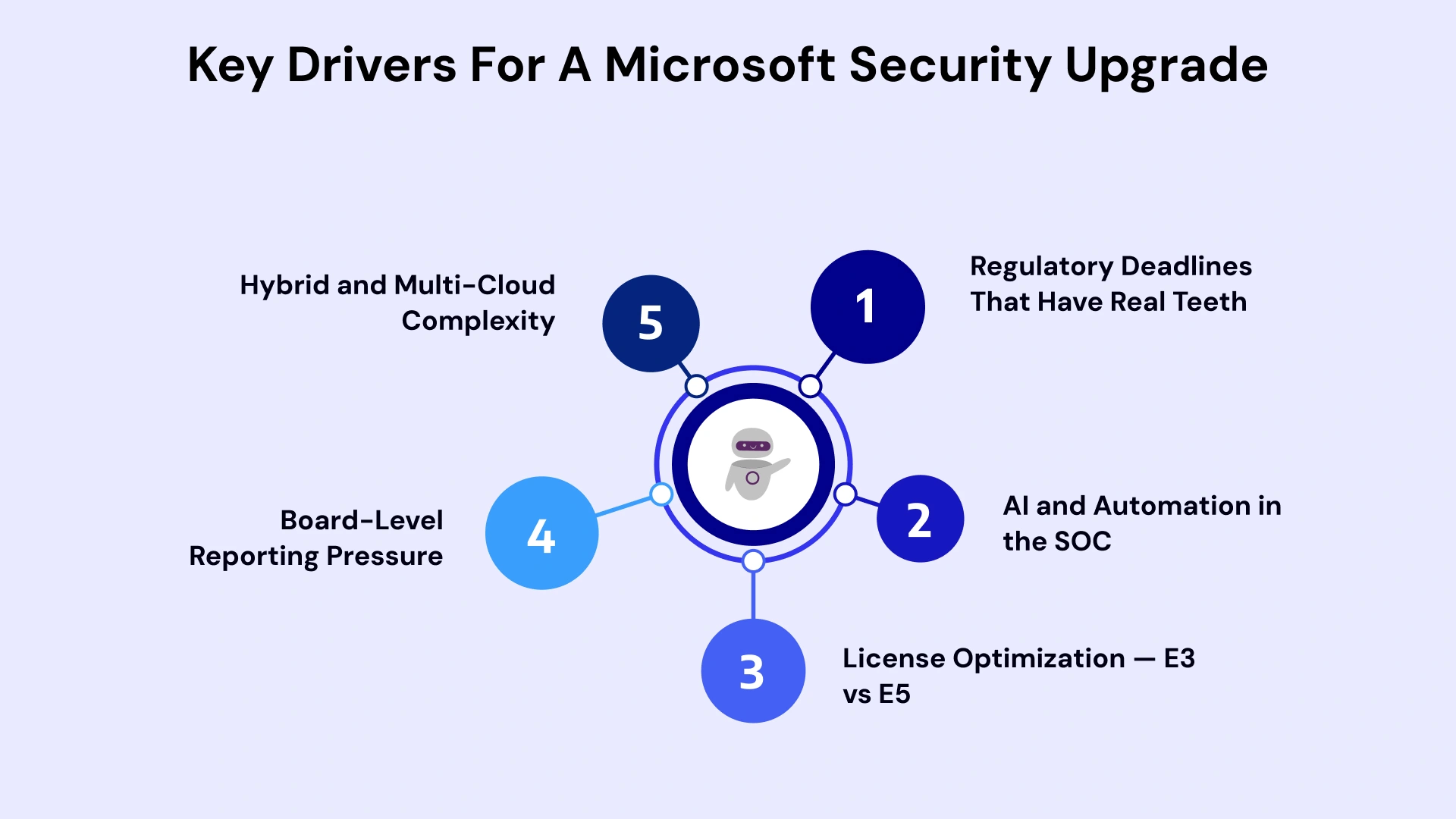
1. Regulatory Deadlines That Have Real Teeth
Three frameworks went from guidance to enforcement in 2025-2026:
- NYDFS Part 500 (April 2026 deadline): Requires asset inventories, annual penetration testing, and 72-hour breach notification. Applies to all licensed financial institutions in New York.
- SEC Cybersecurity Rules: Requires material breach disclosure within four business days. CISOs must now maintain documented incident response programs.
- DORA (EU, fully enforced 2025): Mandates operational resilience testing, third-party risk monitoring, and board-level accountability for digital risks. Affects any firm with EU operations.
Microsoft Purview Compliance Manager tracks compliance against all three frameworks. It maintains a live compliance score and collects audit evidence automatically.
2. AI and Automation in the SOC
The global cybersecurity talent shortage now exceeds 4 million open roles. (Source: ISC2 Cybersecurity Workforce Study 2024)
Hiring alone will not solve this. Automation will.
Microsoft Security Copilot handles Tier-1 alert triage automatically. It writes incident summaries in plain language and suggests remediation steps. Early adopters report 40% faster mean time to respond (MTTR).
Analysts spend less time on repetitive tasks. They focus on real threats.
3. License Optimization — E3 vs E5
Many financial firms are already paying for Microsoft 365 E3. They have endpoint protection, basic identity management, and some compliance tools.
The jump to E5 adds Microsoft Sentinel (full SIEM/SOAR), Defender XDR (cross-domain threat correlation), Entra ID P2 (privileged identity management), and Purview advanced compliance.
For firms already paying for separate SIEM, DLP, and identity tools, E5 often costs the same or less — while replacing multiple vendors with one integrated platform.
4. Board-Level Reporting Pressure
SEC disclosure rules changed what boards now ask in every meeting:
- What is our current Secure Score?
- How fast can we respond to a material incident?
- Can we show regulators our compliance posture today — not next quarter?
Fragmented tools cannot answer these questions cleanly. Microsoft's unified platform generates board-ready dashboards, exposure scores, and compliance reports on demand.
5. Hybrid and Multi-Cloud Complexity
Most financial firms do not run on a single cloud. Core banking may run on-premises. Treasury platforms may be on AWS. Customer apps may be on GCP.
Microsoft Defender for Cloud monitors all three major cloud providers and on-premises environments from one place. This is a capability that no point solution can match.

What a Modern Microsoft Security Architecture Looks Like for Banks
Here is the blueprint of a modern 2026 Microsoft-based banking architecture.
Zero Trust: The Right Framework for Financial Services
Zero Trust is a security model. The rule is simple: never trust, always verify. Every user, every device, and every data request gets checked — every time. It does not matter if the request comes from inside or outside the network.
For financial institutions, Zero Trust is not optional. It is what regulators now expect. Here is how each pillar maps to Microsoft tools and compliance requirements:
| Zero Trust Pillar | Microsoft Tool | Compliance Relevance |
| Identity Verification | Entra ID + Conditional Access | NYDFS MFA mandates, DORA access controls |
| Device Health | Defender for Endpoint | PCI DSS endpoint security standards |
| Application Security | Defender for Cloud Apps | SEC data governance, shadow IT controls |
| Data Protection | Microsoft Purview | GDPR, SOX, PCI DSS data classification rules |
| Infrastructure | Defender for Cloud | Multi-cloud visibility, workload protection |
Identity First: The Core of Every Financial Security Strategy
74% of breaches involve compromised credentials. (Source: Verizon 2024 Data Breach Investigations Report). Identity is the new perimeter. Microsoft Entra ID manages access for both human users and machine accounts — like API service accounts and automated processes.
Phishing-resistant FIDO2 MFA stops credential theft. Conditional Access blocks login attempts that fail device, location, or risk checks. Privileged Identity Management ensures admin access is granted only when needed — and automatically revoked.
Data Governance and Insider Risk
A bank's most sensitive assets are its data. Customer records. Transaction logs. Regulatory submissions. Trading positions. Microsoft Purview classifies this data automatically. It applies retention rules, monitors for unusual data movement, and flags insider risk behaviors before they become incidents.
It does this without exposing employee data to analysts unnecessarily — a design that satisfies both compliance teams and privacy officers. VLink's managed cloud services include full deployment and tuning. Your data governance posture stays aligned with evolving regulations.
Use Cases: How Microsoft Security Solves Real Financial Challenges
Below is a breakdown of how Microsoft Security solves real-world financial challenges
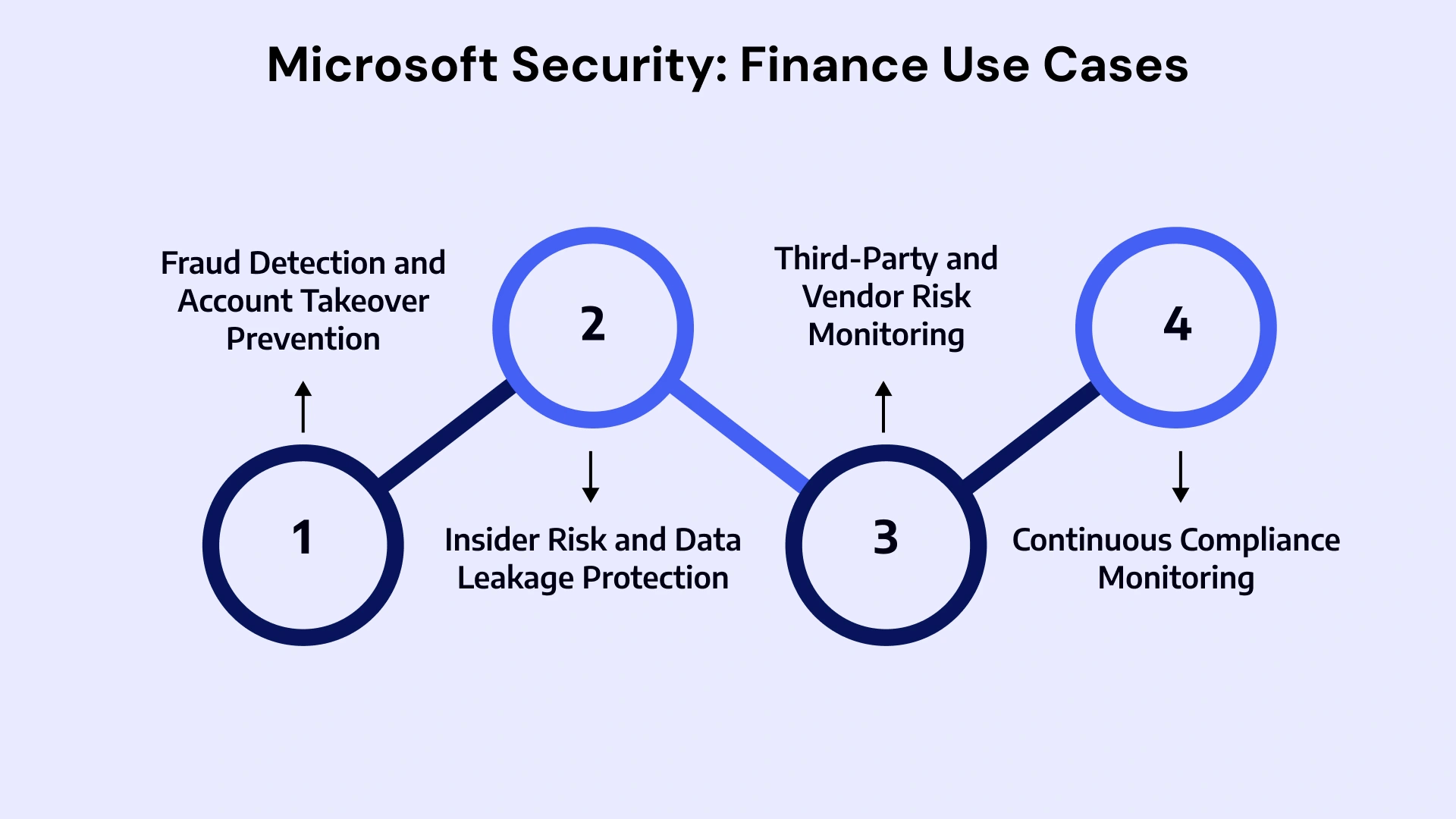
Fraud Detection and Account Takeover Prevention
A Tier-1 North American bank deployed Microsoft Sentinel with custom fraud detection rules. The results:
- Mean time to detect (MTTD): dropped from 18 hours to 12 minutes
- SEC materiality disclosures: generated within the required 4-day window- without manual data extraction
- Alert volume: reduced by 79% through AI-driven signal correlation
Sentinel's machine learning builds a behavioral baseline for every user and entity. It flags deviations — not just known attack signatures. That is why it catches AI-driven fraud that rule-based tools miss.
Insider Risk and Data Leakage Protection
Not every threat comes from outside. Employees leaving for competitors. Accidental file sharing. Unauthorized access to sensitive records.
For Microsoft shops, endpoint security comparison for Microsoft environments weighs Defender's native integration against CrowdStrike's best-of-breed approach.
Microsoft Purview Insider Risk Management monitors for these behaviors. It integrates with HR departure signals. It triggers graduated alerts based on risk level — not blanket surveillance.
The result: a privacy-respecting, audit-ready insider risk program that satisfies both security and HR teams.
Third-Party and Vendor Risk Monitoring
Microsoft Defender External Attack Surface Management (EASM) scans for exposed assets continuously. This includes assets belonging to vendors with shared data access.
This directly addresses the supply chain visibility gap that regulators are scrutinizing in 2026. Firms using EASM can show auditors documented, continuous visibility into their vendor ecosystem.
Continuous Compliance Monitoring
Microsoft Purview Compliance Manager replaces the annual audit scramble with a real-time compliance dashboard.
It tracks control status against NIST CSF, ISO 27001, PCI DSS, and SOC 2 — simultaneously. It surfaces the highest-risk gaps automatically. And it generates audit-ready evidence on demand.
Executive Summary
| Challenge | Microsoft Tool | Measured Outcome |
| Fraud detection and AML monitoring | Sentinel + custom analytics | MTTD: 18 hours down to 12 minutes |
| Account takeover prevention | Entra ID + Defender XDR | Up to 79% reduction in false positives |
| Insider risk monitoring | Purview Insider Risk Management | Behavioral monitoring without privacy violations |
| Third-party vendor risk | Defender External ASM | Continuous, documented vendor visibility |
| Compliance reporting | Purview Compliance Manager | Real-time compliance score across frameworks |
EMS E3 vs E5: What Financial CISOs Need to Know
For a Financial CISO in 2026, the choice between Enterprise Mobility + Security (EMS) E3 and E5 is no longer just about "extra features"—it is a strategic decision regarding regulatory defensibility, automated fraud prevention, and vendor consolidation ROI.
When E3 Is Enough
Microsoft 365 E3 covers foundational security. You get Entra ID P1, Intune for device management, Microsoft Defender Antivirus, and basic information protection.
E3 is a reasonable starting point for smaller financial firms. Community banks, credit unions under $1 billion in assets, or firms with limited multi-state regulatory exposure may find E3 sufficient — with some additional controls added separately.
When to Move to E5
E5 adds the capabilities that regulated financial institutions need most:
- Microsoft Sentinel — full enterprise SIEM and SOAR
- Microsoft Defender XDR — cross-domain threat correlation across email, endpoint, identity, and cloud
- Entra ID P2 — privileged identity management and risk-based conditional access
- Microsoft Purview advanced compliance — data classification, insider risk, eDiscovery
The upgrade case is strong for any firm subject to NYDFS Part 500, SEC cybersecurity rules, or DORA. Forrester's Total Economic Impact Study (2025) found up to 197% three-year ROI for E5 adopters in financial services — driven by tool consolidation, SOC efficiency, and reduced breach costs.
#Pro Tips:- Simple upgrade trigger: If your firm has over 500 employees, handles regulated customer data, operates across multiple states, or has experienced a security incident in the last 24 months, the E5 ROI case is clear.
Common Licensing Mistakes to Avoid
The biggest mistake: paying for E5 but only using E3 features.
Without proper setup, Microsoft Sentinel log ingestion costs can grow unexpectedly. Purview's advanced features sit unused. Conditional Access policies stay unconfigured.
A second mistake: skipping a specialist partner. Our Microsoft business solutions practice has deployed E5 environments across banks, insurers, and wealth management firms. The optimization phase — tuning Sentinel, activating Purview classification, and configuring Conditional Access — is where most of the ROI gets unlocked.
The Upgrade Roadmap: How Financial Firms Make This Transition
The firms that struggle with this upgrade do not fail because of technology. They fail because they try to do everything at once.
This four-phase roadmap is built from real deployments across North American financial institutions. Each phase delivers compliance value early while building toward full platform maturity.
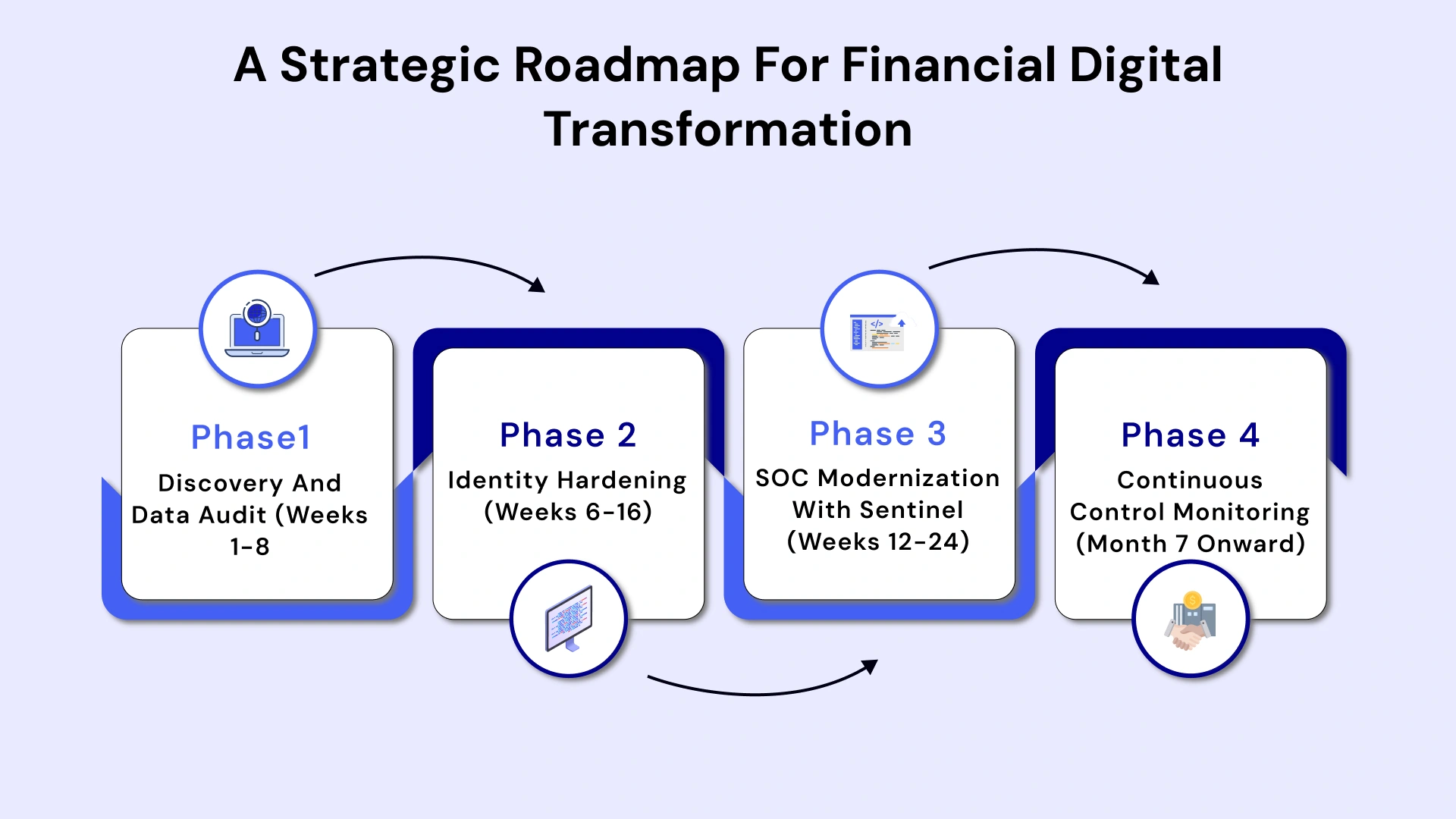
Phase 1: Discovery and Data Audit (Weeks 1-8)
Start with a Microsoft Purview Data Estate Audit. Map all sensitive data — customer PII, financial records, regulated categories — across cloud and on-premises systems. Identify Shadow AI. Employees using unvetted AI tools create data leakage risk that most firms do not know they have.
The deliverable from Phase 1 is the asset inventory that NYDFS Part 500 and SEC Regulation S-P require. You get compliance value in week eight — before the rest of the upgrade is finished.
Phase 2: Identity Hardening (Weeks 6-16)
Move to phishing-resistant FIDO2 MFA across all human accounts. This directly meets the NYDFS MFA mandate and Nacha fraud monitoring requirements.
Extend Entra ID Privileged Identity Management to all admin and service accounts. Set Conditional Access policies that check device health, user risk score, and location before granting access.
This phase closes the credential-based attack vector that causes 74% of breaches.
Phase 3: SOC Modernization with Sentinel (Weeks 12-24)
Migrate legacy SIEM log sources to Microsoft Sentinel. Deploy Security Copilot for automated Tier-1 triage. Build custom detection rules for financial-specific threat patterns.
This is the most complex phase. It benefits most from an experienced implementation partner. Our cybersecurity service provider team handles Sentinel architecture design, deployment, and SOC integration.
Phase 4: Continuous Control Monitoring (Month 7 Onward)
Activate Purview Compliance Manager for continuous control tracking. Configure Security Exposure Management for ongoing attack surface scoring.
Set up monthly board reporting dashboards: Secure Score, compliance posture, and incident trend analysis. Move from annual audits to continuous assurance.
Executive Overview
| Phase | Timeline | Key Deliverable | Primary Tool |
| 1: Discovery and Data Audit | Weeks 1-8 | Asset inventory, Shadow AI report | Microsoft Purview |
| 2: Identity Hardening | Weeks 6-16 | Zero Trust identity baseline | Microsoft Entra ID |
| 3: SOC Modernization | Weeks 12-24 | Unified SIEM, automated triage | Sentinel + Security Copilot |
| 4: Continuous Monitoring | Month 7+ | Board dashboard, live compliance score | Purview + Exposure Mgmt |
For firms managing complex hybrid environments, VLink's cloud infrastructure services provide the architectural foundation this migration requires.
Measuring Impact: KPIs After the Upgrade
A platform upgrade is only as good as the metrics that prove its value. Moving to a unified Microsoft environment isn't just about better tools; it’s about moving the needle on speed, risk, and cost.
By tracking the following KPIs, you can move away from "gut feelings" and provide the board with a data-driven narrative of how the upgrade has hardened your defenses while streamlining the bottom line.
1. Operational KPIs
- Mean Time to Detect (MTTD): Target under 30 minutes (benchmark: 18+ hours on legacy SIEM)
- Mean Time to Respond (MTTR): Target 40-60% reduction via Security Copilot automation
- SOC Alert Volume: Target 79% reduction in false positives through AI correlation
- Microsoft Secure Score: Track quarterly percentage improvement as a board metric
2. Compliance KPIs
- Compliance Manager Score: Measure improvement against NIST CSF, PCI DSS, and ISO 27001 baselines
- Audit Prep Time: Reduce from weeks to days using automated evidence collection
- Regulatory Reporting Speed: Measure readiness for the SEC 4-day disclosure window monthly
- Policy Coverage: Percentage of sensitive data under active DLP and retention policies
3. Financial KPIs
- Total Cost of Ownership (TCO): Target 44% reduction vs. legacy multi-vendor stack
- Fraud Loss Reduction: Track the financial impact of improved detection accuracy
- SOC Efficiency: Revenue-per-analyst ratio before and after automation
- License ROI: 3-year return on E5 investment vs. previous stack maintenance costs
KPI’s Overview
| KPI | Benchmark Target | Driving Tool |
| Mean Time to Detect | Under 30 minutes | Microsoft Sentinel |
| SOC false positive rate | Up to 79% reduction | Defender XDR + Sentinel |
| Compliance score improvement | 20+ points in 90 days | Purview Compliance Manager |
| TCO vs. legacy stack | Up to 44% reduction | Microsoft 365 E5 consolidation |
| 3-year ROI | Up to 197% | E5 full deployment with tuning |
Leveraging VLink Expertise for Managed Cybersecurity Services
Upgrading a Microsoft security stack across a financial institution is not plug-and-play. The decisions made in the first 90 days determine whether the platform delivers its promised ROI — or becomes another expensive tool that underperforms.
VLink has deployed Microsoft security solution environments across regional banks, insurance firms, and wealth management companies. We bring specific experience with NYDFS, SEC, PCI DSS, and DORA compliance requirements.
Our financial services clients rely on three core capabilities:
- Managed Cybersecurity Services: 24/7 SOC support, Sentinel management, incident response, and Security Copilot optimization. VLink's managed cybersecurity services team acts as an extension of your internal security function — without the hiring burden.
- Microsoft E5 Deployment and Tuning: From license assessment through full deployment, VLink optimizes Sentinel ingestion costs, activates Purview classification, and configures Conditional Access policies to match your regulatory framework. Learn more about VLink's Microsoft business solutions.
- Cloud Migration and Infrastructure: For firms moving from legacy on-premises environments to Azure or hybrid setups, VLink's cloud migration consulting services and cloud infrastructure services provide architectural guidance and implementation support.
The difference between a firm that achieves 197% ROI from E5 and one that sees marginal results is almost always the quality of implementation and ongoing management.
VLink also supports financial organizations with finance software solutions built for regulated environments. We serve as a trusted cybersecurity service provider across banking, insurance, and wealth management sectors.
Need to evaluate your managed cloud services needs? Contact us now. VLink can assess your current environment and build a roadmap that fits your timeline and budget.
Conclusion
The upgrade is not hypothetical. It is happening right now — in boardrooms, CISO offices, and SOC teams across North America.
Three forces collided at once: stricter regulations, faster AI-driven attacks, and the unsustainable cost of fragmented security tools. Consolidation onto Microsoft's integrated platform is not just a technology decision. It is a risk management decision.
Staying compliant means monitoring emerging cyber risks in financial services, from supply chain attacks to AI-powered fraud.
Financial institutions that complete this transition in 2026 will have measurable advantages. Lower breach costs. Faster regulatory response. A Secure Score that can be shown to boards and auditors. And a security architecture that scales with AI-driven threats rather than falling behind them.
The firms that delay will face escalating compliance costs, continued SOC overload, and growing regulatory scrutiny. The 78% who are moving are not early adopters. They are responding to a market reality that has made the old approach untenable.
The question is not whether to upgrade. It is how to do it efficiently, compliantly, and with a partner who has done it before.

Vice President, Strategy – VLink Inc.
Sambhavi Gopalakrishnan is the Vice President of Strategy at VLink Inc., bringing over a decade of experience in IT leadership, project implementation, and strategic growth. She possesses a strong foundation in technical project management and pre-sales, driving innovation and business transformation at VLink.

 Shivisha Patel