

Selecting a Microsoft partner in 2026 isn't a procurement task—it's a board-level risk decision that directly impacts your organization's digital transformation success, security posture, and cloud ROI. Choose the right partner—Microsoft business solutions partner for Dynamics and Power Platform.
The days of simply checking for a "Gold Partner" badge are over. With Microsoft's shift to the AI Cloud Partner Program, the ecosystem now operates on performance-based credentials, measured Partner Capability Scores (PCS), and specialized Solution Designations that require continuous validation.
The stakes are quantifiable and significant:
For CIOs and CTOs in regulated industries—financial services, healthcare, government—the wrong partner choice can lead to security exposure, compliance failures, AI underutilization, and transformation delays that can set digital initiatives back by 12-18 months.
This guide delivers an auditable, defensible framework for evaluating Microsoft implementation partners. It includes a downloadable RFP template with 50+ pre-written questions, weighted scoring model, and vendor evaluation checklist designed specifically for enterprise governance requirements.
Why Microsoft Partner Selection is a Board Priority
The Microsoft Business Solutions partner landscape underwent its most significant transformation in 2022-2023 with the retirement of legacy Gold and Silver competencies. According to Microsoft's Partner Network 2025 Report, the new AI Cloud Partner Program now evaluates over 400,000 partners globally using real-time performance metrics rather than static credentials.
The Strategic Shift from Static Certifications to Performance-Based Partner Capability Scores
Microsoft now rates partners on a 100-point Partner Capability Score (PCS) that updates monthly. According to Microsoft Partner Center Analytics 2025, only 23% of partners achieve the elite threshold of 85+ points, making this metric a critical differentiator.
The PCS framework consists of three weighted components:
Component | Weight | What It Measures | Source |
Performance | 40% | Customer acquisition, cloud consumption growth, monthly active usage acceleration | Microsoft Partner Center 2025 |
Skilling | 35% | Advanced certifications (Azure Solutions Architect Expert, Security Engineer Associate) | Microsoft Learn Analytics 2025 |
Customer Success | 25% | Deployment velocity, user adoption rates, customer retention metrics | Microsoft Partner Performance Study 2025 |
Critical insight: While 70 is the minimum PCS for Solutions Partner status, enterprise-grade partners targeting Fortune 1000 organizations consistently maintain scores above 85. Ask potential partners to provide their current PCS breakdown—transparency here signals accountability.
The Measurable Business Impact of Partner Selection Errors
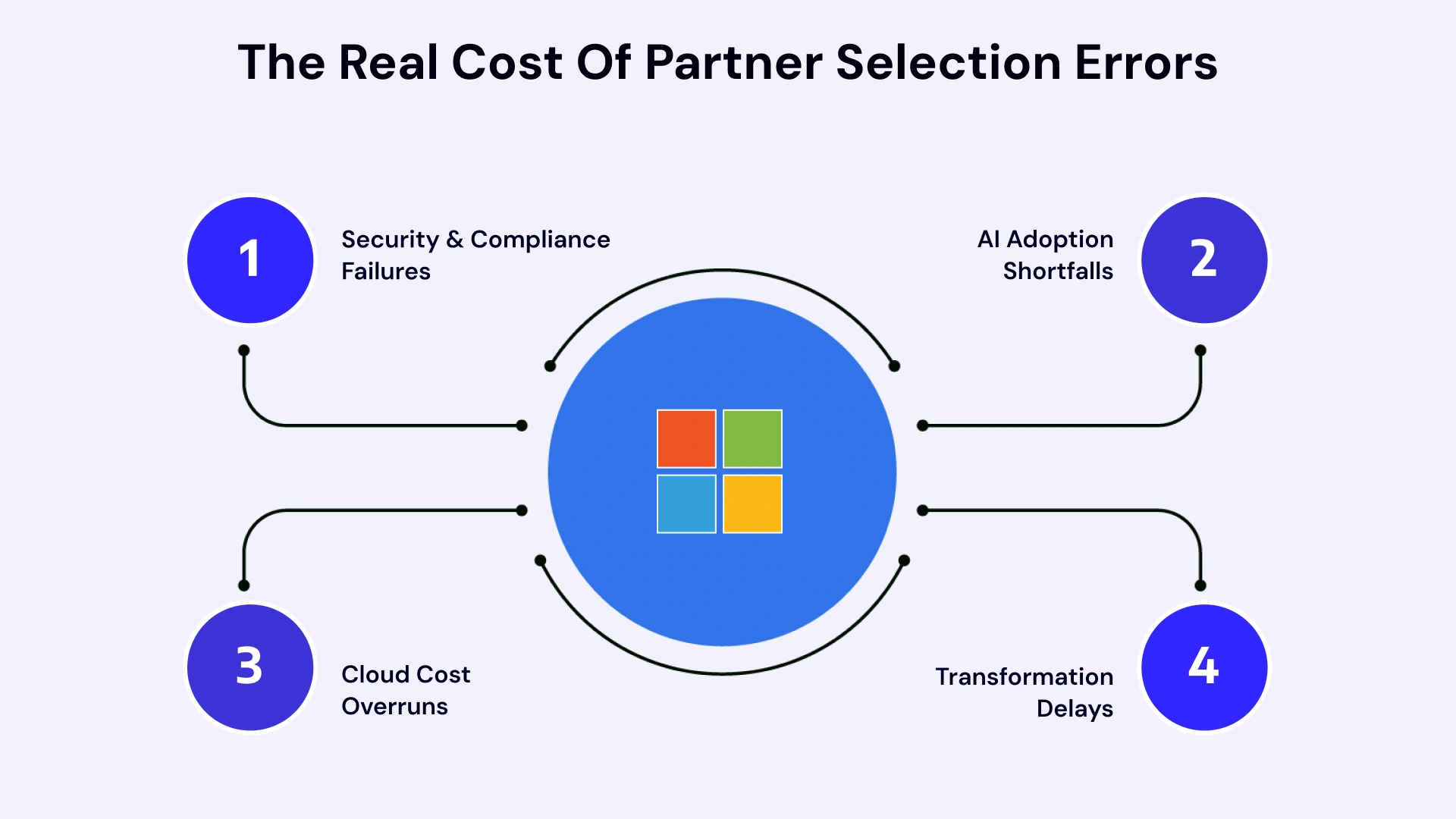
The cost of choosing the wrong Microsoft partner extends beyond project delays. According to Forrester's Total Economic Impact Study 2025:
Security & Compliance Failures
A 2025 case study documented a mid-market BFSI organization that failed SOX audit due to a partner's inability to provide audit trail documentation showing segregation of duties. The resulting remediation cost $680,000—3.8x the initial "savings" from selecting the lowest-cost bidder (Forrester Wave: Cloud Security Consulting Q3 2025).
AI Adoption Shortfalls
Despite widespread Copilot licensing, Gartner's 2025 Productivity Software Study found that organizations achieve less than 30% daily active usage (DAU) when partners deploy technology without persona-based adoption frameworks, executive sponsorship programs, or usage analytics tracking.
Cloud Cost Overruns
IDC's Cloud Economics Report 2025 revealed that Azure environments without FinOps governance experience 35-40% monthly cost escalation within the first six months. One enterprise saw costs balloon from $200K to $340K monthly due to unoptimized VM SKUs, idle resources, and lack of reservation planning.
Transformation Delays
Gartner's 2025 Cloud Migration Success Factors report found that legacy system modernization projects experience 40-60% timeline extensions when partners lack expertise in hybrid architecture, Azure Arc, Azure VMware Solution, and containerization strategies.
Decoding Microsoft Partner Designations & Specializations
The Microsoft AI Cloud Partner Program replaced the legacy competency model with six specialized Solutions Partner designations. According to Microsoft's 2025 Partner Capability Report, partners with multiple designations and Advanced Specializations demonstrate 47% higher customer success rates than single-designation partners.
The Six Microsoft Solutions Partner Designations
These capabilities watch your transformation roadmap:-
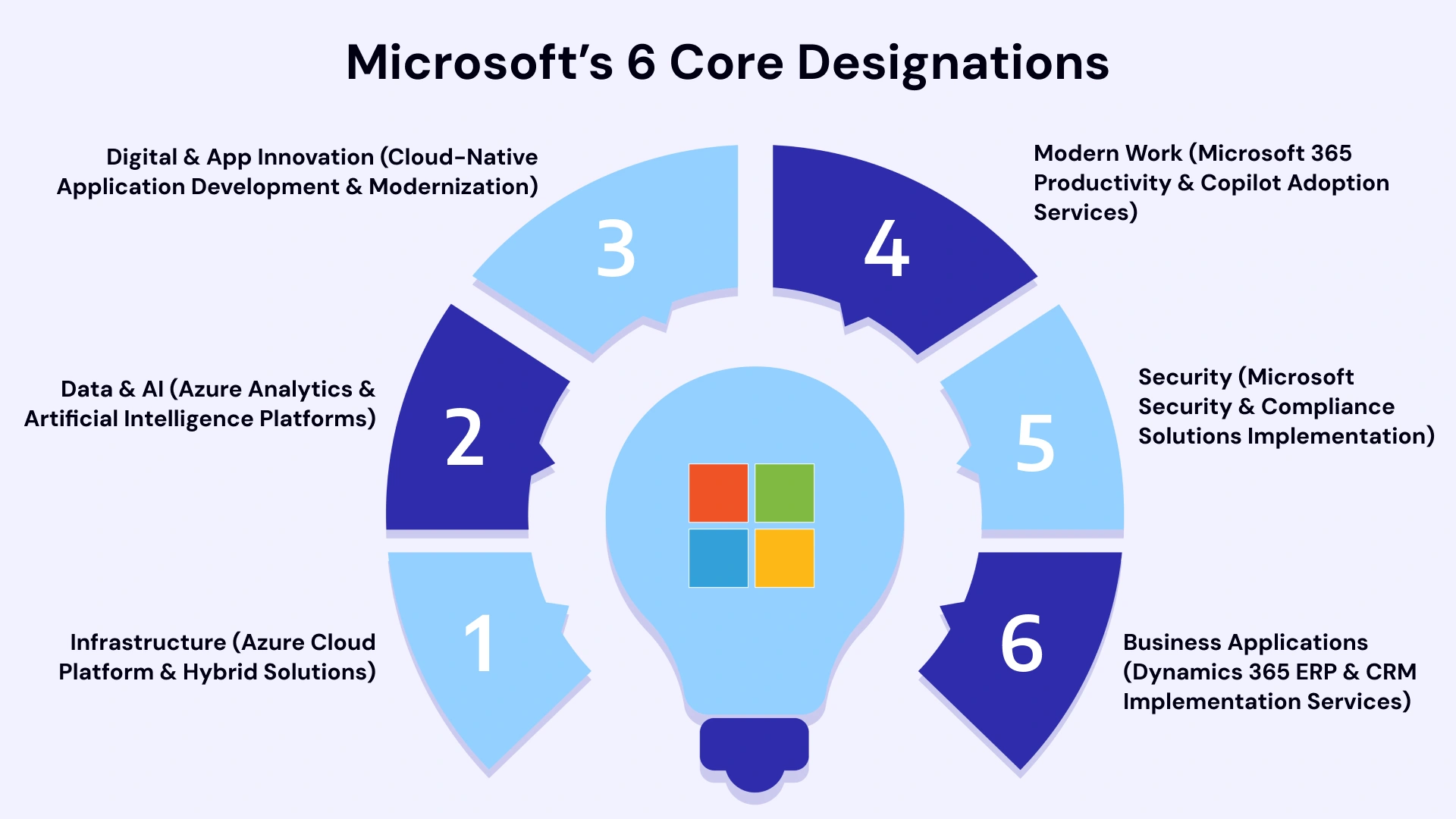
1. Infrastructure (Azure Cloud Platform and Hybrid Solutions)
- Focus: Hybrid cloud architecture, disaster recovery, Azure VMware Solution migrations
- Key Advanced Specializations: Azure VMware Solution, Hybrid Cloud Infrastructure with Azure Arc, Windows Server and SQL Server Migration to Microsoft Azure
- Ideal for: Data center consolidation, multi-cloud management, disaster recovery modernization
- Verification: Request Azure Arc deployment case studies showing on-premises integration with Azure control plane
2. Data & AI (Azure Analytics and Artificial Intelligence Platforms)
- Focus: Microsoft Fabric data platforms, Azure AI implementations, real-time analytics
- Key Advanced Specializations: Microsoft Fabric Analytics, AI and Machine Learning on Microsoft Azure, Analytics on Microsoft Azure
- Ideal for: Data estate modernization, AI/ML model deployment, business intelligence transformation
- Verification: Demand proof of Microsoft Fabric OneLake implementations with documented time-to-insight improvements
3. Digital & App Innovation (Cloud-Native Application Development and Modernization)
- Focus: Containerization, Kubernetes orchestration, DevOps with GitHub, low-code Power Platform
- Key Advanced Specializations: Kubernetes on Microsoft Azure, DevOps with GitHub on Microsoft Azure, Low-Code Application Development
- Ideal for: Application modernization, microservices architecture, DevOps transformation
- Verification: Request AKS production deployments showing auto-scaling, GitOps workflows, and CI/CD pipeline architecture
4. Modern Work (Microsoft 365 Productivity and Copilot Adoption Services)
- Focus: Microsoft 365 deployment, Teams collaboration transformation, Copilot for Microsoft 365 enablement
- Key Advanced Specializations: Adoption and Change Management, Calling for Microsoft Teams, Teamwork Deployment
- Ideal for: Digital workplace transformation, collaboration tool consolidation, AI productivity enablement
- Verification: Require documented Copilot adoption metrics showing DAU/MAU ratios above 70% within 90 days
5. Security (Microsoft Security and Compliance Solutions Implementation)
- Focus: Zero Trust architecture, Microsoft Sentinel SIEM/SOAR, Defender suite, Purview governance
- Key Advanced Specializations: Threat Protection, Cloud Security, Information Protection and Governance
- Ideal for: Security posture modernization, compliance program implementation, SOC transformation
- Verification: Request Microsoft Secure Score improvement case studies showing 30+ point increases
6. Business Applications (Dynamics 365 ERP and CRM Implementation Services)
- Focus: ERP implementation, CRM deployment, Power Platform process automation
- Key Advanced Specializations: Finance, Supply Chain Management, Customer Service, Sales
- Ideal for: ERP replacement, CRM consolidation, business process automation
- Verification: Demand Dynamics 365 Finance & Operations implementations with documented ROI and go-live timelines
Pro Tips: Verify partners hold designations aligned to your transformation roadmap. A 2025 Forrester study found that organizations using partners with 2+ relevant designations achieve go-live 32% faster than those using single-designation partners.
Microsoft Partner Types: Implementation, Services, and Security Specialists
Understanding partner archetypes prevents misalignment and capability gaps that derail projects.
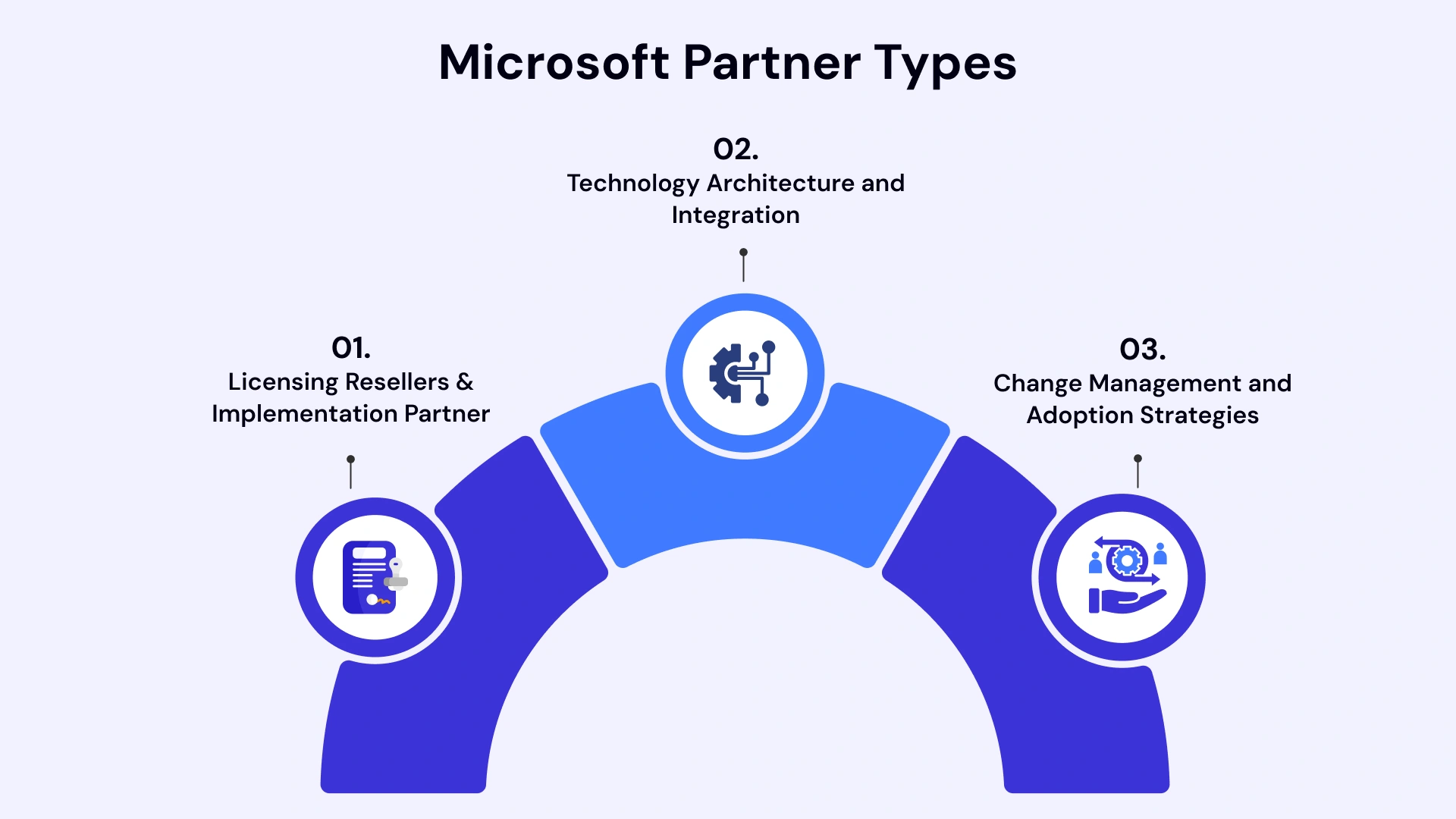
Licensing Resellers and Implementation Partners: Critical Capability Differences
Licensing Resellers (Cloud Solution Provider Partners)
- Primary value: License procurement, consolidated billing, SKU optimization across Microsoft portfolio
- Services offered: CSP program administration, license compliance audits, renewal management, departmental cost allocation
- Technical capabilities: Limited to licensing advisory; typically lack architecture design, migration execution, or custom development
- Best for: Organizations with robust internal IT teams managing their own deployments who need licensing expertise only
- Red flag: Resellers marketing "implementation services" without Solutions Partner designations or Advanced Specializations
Implementation Partners (Solutions Partners)
- Primary value: Technical architecture, cloud migration, custom application development, system integration
- Services offered: Azure landing zone design, Dynamics 365 module customization, Microsoft Fabric data estate architecture, Zero Trust security implementation
- Credentials required: Solutions Partner designation, Advanced Specializations, Partner Capability Score 75+ (ideally 85+)
- Best for: Digital transformation initiatives requiring technical expertise beyond license deployment
- Verification method: Request architecture diagrams from recent deployments showing landing zones, network topology, security controls
Managed Services & Support Providers: Post-Implementation Operational Excellence
Managed Service Providers (MSPs) deliver ongoing operational support after go-live:
Core MSP capabilities:
- Infrastructure monitoring: 24/7 Azure resource monitoring with automated alerting for threshold breaches
- Incident response: Tiered support with defined SLAs (Severity 1: ≤ 30 minutes, Severity 2: ≤ 2 hours, Severity 3: ≤ 8 hours)
- Patch management: Automated security updates with change control and rollback procedures
- FinOps optimization: Monthly cost reviews, rightsizing recommendations, reservation planning, budget alerts
Enterprise MSP requirements:
- Geographic coverage: US-based support teams for ITAR compliance, regional language support for global deployments
- Escalation paths: Documented procedures for engaging Microsoft Premier Support or FastTrack resources
- SLA financial penalties: Service credits equal to 2x pro-rated fees for missed response times
- Knowledge transfer: Quarterly documentation updates, runbook maintenance, cross-training sessions
According to Gartner's Managed Services Study 2025, organizations using MSPs with FinOps capabilities achieve a 38% lower Azure TCO over three years than those managing infrastructure internally without optimization expertise.
Security & MDR Partners: Threat Detection, Response, and Compliance
Managed Detection and Response (MDR) partners specialize in Microsoft Security portfolio implementation and operations:
MDR core services:
- Microsoft Sentinel deployment: SIEM/SOAR architecture design, data connector configuration, analytics rule optimization
- Defender suite management: Endpoint, Cloud, Identity, and Office 365 Defender orchestration
- 24/7 SOC operations: Continuous threat monitoring, threat hunting, incident investigation, containment and remediation
- Compliance reporting: Automated dashboards for HIPAA, PCI-DSS, SOX, GDPR audit requirements
MDR partner qualifications:
- Security Solutions Partner designation with Threat Protection Advanced Specialization
- SOC 2 Type II certification demonstrating secure operational controls
- Mean Time to Detect (MTTD): < 15 minutes for critical threats per Microsoft Security Best Practices 2025
- Mean Time to Respond (MTTR): < 60 minutes for threat containment and remediation
According to Forrester's Security Services Wave 2025, organizations using specialized MDR partners experience 67% fewer security incidents and 42% faster incident resolution compared to internal SOC teams without 24/7 staffing.
Microsoft Partner Evaluation Criteria for Regulated Industries
When selecting a partner in industries such as Finance, Healthcare, or Government, the evaluation shifts from "Can they do the work?" to "Can they protect us from the regulator?"
In 2026, Microsoft has significantly tightened the requirements for its partners, especially those handling sensitive workloads. Here are the core criteria to use when vetting them:
Advanced Specializations and Technical Certification Requirements for Enterprise Implementations
Solutions Partner designations are baseline qualifications. The differentiator is Advanced Specializations—validated technical competencies requiring customer reference checks, technical assessments, and continuous recertification.
What to verify in RFPs:
1. Certification density and staff allocation
- Minimum 60% of delivery staff hold relevant certifications (Azure Solutions Architect Expert, Security Engineer Associate, Data Engineer Associate)
- Request individual certification IDs verifiable on Microsoft Learn platform
- Demand dedicated resource commitments (not shared across multiple concurrent projects)
- Verify bench depth for surge capacity and timeline acceleration
2. Advanced Specialization alignment
- Azure VMware Solution specialization for VMware-to-Azure migrations
- Microsoft Fabric specialization for data estate consolidation
- Kubernetes on Azure specialization for container-native modernization
- Threat Protection specialization for Zero Trust security implementations
3. Copilot and AI readiness capabilities
- Documented adoption frameworks achieving 70%+ DAU/MAU within 90 days
- Persona-based training programs (executives, knowledge workers, frontline employees)
- Usage analytics dashboards tracking feature utilization and productivity gains
- Change management certification (Prosci ADKAR or Kotter's 8-Step Process)
4. Published intellectual property
- Azure Marketplace or AppSource listings demonstrating thought leadership
- Reusable accelerators and templates reducing implementation timelines
- GitHub repositories with open-source contributions to Microsoft ecosystem
- Technical blog posts or conference presentations at Microsoft Ignite
Red flags indicating insufficient capability:
- Partners citing certifications without providing individual Transcript IDs
- Vague "certified staff" claims without specific headcount or allocation models
- No Advanced Specializations relevant to your workload requirements
- Inability to demonstrate Copilot adoption success metrics
Industry-Specific Regulatory Compliance Expertise and Audit Success Rates
For regulated industries, compliance expertise is non-negotiable. According to IDC's Compliance Technology Survey 2025, 62% of audit failures in cloud implementations stem from partner deficiencies in regulatory frameworks.
BFSI (Banking, Financial Services, Insurance) Compliance Requirements
Mandatory certifications:
- SOX IT General Controls (ITGC) implementation experience with documented audit success
- PCI-DSS Level 1 Service Provider certification for payment card processing
- FINRA compliance for broker-dealer communications archiving (17a-4, WORM storage)
Technical capabilities:
- Azure Government Cloud deployments for federal banking institutions
- Real-time fraud detection using Azure AI services with model explainability
- Immutable audit trails using Azure Policy, Activity Logs, and Sentinel retention
Validation method: Request three BFSI case studies showing:
- Audit completion timelines (target: zero delays, zero findings)
- Regulatory approval documentation (OCC, Federal Reserve, FDIC letters)
- SOX 404 testing results demonstrating effective IT controls
Healthcare and Life Sciences Compliance Requirements
Mandatory certifications:
- HIPAA Business Associate Agreement (BAA) execution with breach notification procedures
- SOC 2 Type II audit report covering ePHI processing controls
- 21 CFR Part 11 compliance for pharmaceutical manufacturing (electronic records and signatures)
Technical capabilities:
- HL7/FHIR integration expertise for EHR systems (Epic, Cerner, Oracle Health)
- ePHI encryption at rest (AES-256) and in transit (TLS 1.3) with customer-managed keys
- Breach notification automation meeting 60-day HIPAA deadline and state-specific requirements
Validation method: Provide copies of recent HIPAA audits showing:
- Partner's security controls effectiveness ratings
- Zero ePHI breach incidents in last 24 months
- EHR integration case studies with interoperability success metrics
Public Sector and Government Compliance Requirements
Mandatory certifications:
- FedRAMP High authorization for Azure Government implementations
- ITAR compliance documentation for defense contractor support
- Security clearances: IL4 (Impact Level 4) or IL5 for classified workloads
Technical capabilities:
- Azure Government Cloud architecture following DoD Cloud Computing SRG
- Data residency controls ensuring no data leaves US Government datacenters
- Multi-factor authentication (MFA) using PIV/CAC cards for federal users
Validation method: Request FedRAMP package documentation showing:
- Authority to Operate (ATO) letters from authorizing officials
- Continuous monitoring reports demonstrating ongoing compliance
- Cleared personnel lists with active security clearance verification
The cost of compliance failures: According to Forrester's Cloud Compliance Report Q2 2025, a regional bank selected a partner offering 25% lower implementation pricing ($180K vs. $240K). During the SOX audit, the partner couldn't produce change management documentation. Total remediation cost: $680,000—3.8x the initial savings.
Structuring an Omni-Cloud Microsoft Partner RFP
A well-structured RFP transforms partner selection from subjective assessment to objective, governance-ready comparison.
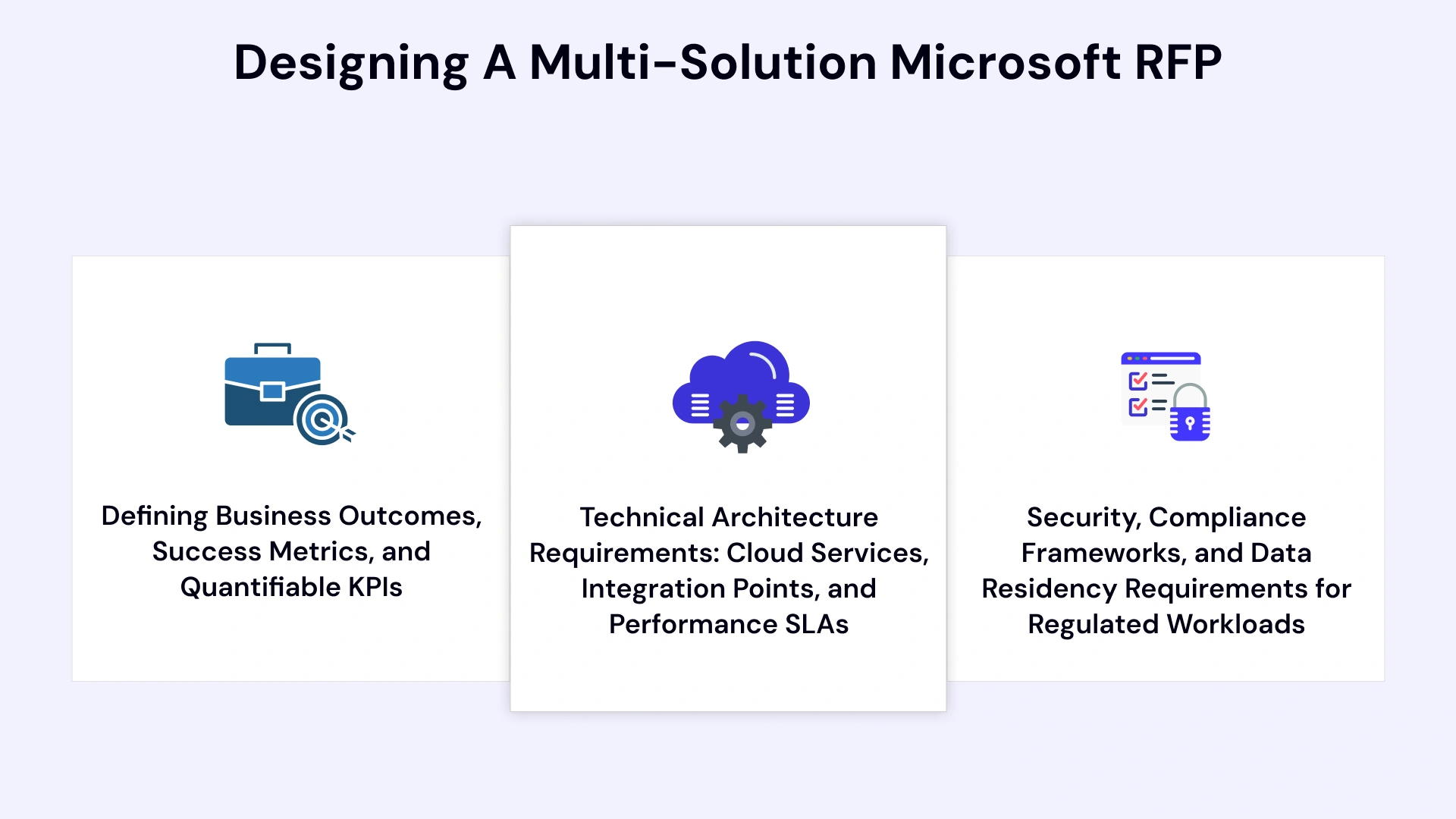
Defining Business Outcomes, Success Metrics, and Quantifiable KPIs
Begin with strategic objectives, not technical specifications. According to Gartner's Project Success Factors 2025, RFPs focused on business outcomes achieve 38% higher satisfaction scores than those emphasizing technical requirements.
Example outcome-focused objectives:
Financial optimization:
- Reduce Azure monthly expenditure by 25% through FinOps optimization within six months
- Measurable via: Azure Cost Management dashboards, month-over-month spending reports, reservation utilization percentages
Productivity enhancement:
- Achieve 80% Copilot adoption (DAU/MAU ratio) across sales teams within 90 days of deployment
- Measurable via: Microsoft 365 usage analytics, feature utilization reports, time-saved calculations
Technical modernization:
- Complete legacy .NET application containerization to AKS with zero production downtime
- Measurable via: Application uptime metrics, deployment pipeline velocity, infrastructure cost reduction
Security improvement:
- Improve Microsoft Secure Score from 62% to 85%+ through Zero Trust architecture implementation
- Measurable via: Secure Score dashboard, identity protection analytics, conditional access policy coverage
Define quantifiable KPIs for each objective:
Objective Category | Example KPIs | Target Metrics | Measurement Method |
Deployment velocity | Days from kickoff to production | < 90 days for Azure migration | Project management dashboard |
User adoption | Weekly Active Users (WAU) percentage | 80% of licensed users | Microsoft 365 usage analytics |
Cost optimization | Monthly cloud spending reduction | 25% decrease within 6 months | Azure Cost Management |
Security posture | Secure Score improvement | 85%+ from baseline 62% | Microsoft Defender portal |
Business continuity | Disaster recovery testing success | RPO < 15 min, RTO < 2 hours | Azure Site Recovery reports |
Technical Architecture Requirements: Cloud Services, Integration Points, and Performance SLAs
Specify detailed workload requirements enabling accurate partner assessment.
Azure services architecture specifications:
Compute requirements:
- Virtual Machines: SKU specifications (D-series, E-series for memory-intensive), availability zones, proximity placement groups
- Azure Kubernetes Service: Node pool configurations (system vs. user), auto-scaling policies (horizontal pod autoscaler), network policies
- Azure App Services: Plan tiers (Premium v3 for production), custom domain SSL, deployment slots for blue-green releases
Data platform requirements:
- Azure SQL Database: Service tiers (Business Critical for mission-critical), geo-replication for disaster recovery, Always Encrypted for sensitive data
- Cosmos DB: API selection (SQL, MongoDB, Cassandra), global distribution across regions, partition key strategy
- Microsoft Fabric: OneLake data lake storage, lakehouses for analytics, real-time analytics for streaming data
AI/ML platform requirements:
- Azure AI Foundry: Model catalog selection (GPT-4, GPT-4 Turbo, embedding models), prompt flow orchestration, responsible AI controls
- Azure OpenAI Service: Deployment regions, token quota management, content filtering policies
- Azure Machine Learning: Compute clusters for training, managed endpoints for inference, MLOps pipelines
Security platform requirements:
- Microsoft Sentinel: Data connector architecture (AWS, GCP, on-premises), analytics rules for threat detection, playbooks for automated response
- Defender suite: Endpoint (Windows, Linux, macOS), Cloud (CSPM + CWPP), Identity (domain controller monitoring)
- Entra ID: Conditional access policies, privileged identity management (PIM), identity protection risk-based policies
Integration ecosystem mapping:
Existing infrastructure integration:
- On-premises VMware environments: vCenter version, ESXi host count, total VM inventory
- AWS/GCP multi-cloud services: EC2/Compute Engine instances, S3/Cloud Storage buckets, cross-cloud networking requirements
Enterprise application integration:
- ERP systems: SAP S/4HANA (on-premises vs. cloud), Oracle ERP Cloud, Microsoft Dynamics GP legacy
- CRM platforms: Salesforce Sales Cloud, HubSpot, legacy Microsoft Dynamics CRM
- Identity providers: Okta Universal Directory, Ping Identity, Active Directory Federation Services (ADFS)
Performance and availability requirements:
Performance Metric | Target SLA | Measurement Method |
API latency | < 200ms (99th percentile) | Application Performance Monitoring |
Throughput | 10,000 transactions/second peak load | Load testing results |
Availability | 99.99% uptime (52 minutes downtime/year) | Azure Monitor uptime tracking |
RPO (Recovery Point) | < 15 minutes for tier 1 workloads | Backup/replication logs |
RTO (Recovery Time) | < 2 hours for tier 1 applications | Disaster recovery testing |
Security, Compliance Frameworks, and Data Residency Requirements for Regulated Workloads
For regulated industries, this section determines partner qualification.
Mandatory compliance frameworks by industry:
Industry | Required Frameworks | Partner Evidence |
Healthcare | HIPAA, HITECH Act | BAA template, breach notification procedures |
Financial services | PCI-DSS Level 1, SOX, FINRA | AOC, ITGC testing results, 17a-4 compliance |
Pharmaceuticals | 21 CFR Part 11, GxP | CSV documentation, audit trail examples |
Government | FedRAMP High, ITAR | ATO letters, security clearance lists |
Retail (payments) | PCI-DSS, GDPR (if EU) | AOC, SCCs for cross-border transfers |
Data residency and sovereignty requirements:
Geographic restrictions:
- EU-only data processing: Azure West Europe, North Europe regions with no cross-region replication outside EU
- US Government Cloud: Azure Government regions (Virginia, Texas, Arizona) with FedRAMP High authorization
- Canada-only: Azure Canada Central, Canada East with PIPEDA compliance
Cross-border data transfer mechanisms:
- Standard Contractual Clauses (SCCs) for EU-US data flows post-Schrems II
- Binding Corporate Rules (BCRs) for multinational enterprises
- Data Processing Agreements (DPAs) specifying processor/controller relationships
Audit requirements:
- Right to audit partner systems with 30-day notice
- Data location verification reports (monthly for government, quarterly for commercial)
- Third-party attestation: SOC 2 Type II, ISO 27001, industry-specific certifications
Encryption and key management:
Data State | Encryption Standard | Key Management |
At rest | AES-256 | Customer-managed keys in Azure Key Vault |
In transit | TLS 1.3 minimum | Certificate management via Key Vault |
HSM storage | FIPS 140-2 Level 3 | Dedicated HSM or managed HSM service |
Backup encryption | AES-256 | Separate encryption keys from production |
Microsoft Partner Scoring Model and Evaluation Framework
A quantified scoring framework enables defensible decisions for steering committees and reduces selection bias.
Weighted Scoring Matrix with Automatic Calculations
Evaluation Category | Weight | Scoring Criteria (0-10 scale) | Partner A | Partner B | Partner C |
Technical Depth & Microsoft Certifications | 40% | • Advanced Specializations count<br>• PCS score (85+ target)<br>• Certified architects percentage<br>• Published IP assets | Score × 0.4 | Score × 0.4 | Score × 0.4 |
Industry-Specific Regulatory Compliance | 25% | • Vertical case studies with audit outcomes<br>• SOC 2/ISO certifications<br>• Zero breach history<br>• Regulatory approval letters | Score × 0.25 | Score × 0.25 | Score × 0.25 |
Support SLAs and Managed Services | 20% | • 24/7 availability verification<br>• Severity 1 response < 30 min<br>• US-based staff (ITAR compliance)<br>• FinOps capabilities | Score × 0.2 | Score × 0.2 | Score × 0.2 |
Commercial Value and TCO | 15% | • Pricing transparency<br>• Cost optimization track record<br>• Fixed-price vs. T&M options<br>• SLA financial penalties | Score × 0.15 | Score × 0.15 | Score × 0.15 |
TOTAL WEIGHTED SCORE | 100% | Minimum threshold: 7.0/10 required | Sum | Sum | Sum |
Scoring guidance for consistent evaluation:
9-10 (Exceptional - Top 5% of partners):
- Multiple documented case studies with 30%+ quantifiable improvements
- Microsoft Inner Circle or President's Club recognition
- Customer references enthusiastically endorse without reservation
- Advanced Specializations in all relevant workload areas
- PCS score 90+ with consistent month-over-month performance
7-8 (Strong - Top 25% of partners):
- Proven track record with 3-5 successful implementations in your industry
- Comprehensive capabilities with minor gaps in highly specialized areas
- Solid customer references provide positive feedback with minor concerns
- 2-3 Advanced Specializations aligned to your needs
- PCS score 80-89 with stable performance trends
5-6 (Adequate - Mid-tier capability):
- Basic capability with 1-2 implementations in adjacent industries
- Limited demonstrated experience in your specific workload
- Customer references provide mixed feedback requiring client oversight
- 1 Advanced Specialization or Solutions Partner designation only
- PCS score 70-79 meeting minimum but not exceeding standards
3-4 (Minimal - High risk):
- Unclear evidence with vague RFP responses
- Lacks depth in critical capability areas requiring client backfill
- Customer references difficult to obtain or non-responsive
- No Advanced Specializations, newly minted Solutions Partner
- PCS score below 70 or unwilling to share score
1-2 (Insufficient - Disqualify):
- Does not meet enterprise requirements on multiple dimensions
- Significant capability gaps in technical or compliance areas
- No verifiable customer references or all negative feedback
- Not a Solutions Partner or certifications expired/invalid
- High delivery risk based on track record or financial instability
How to Customize Weights Based on Organizational Priorities
Security-focused organizations (healthcare, financial services):
- Increase Industry & Compliance to 35%
- Increase Support to 25% (emphasize MDR capabilities)
- Reduce Commercial to 10%
- Keep Technical at 30%
Cost-constrained projects (mid-market, specific budget ceiling):
- Increase Commercial to 25%
- Reduce Support to 15%
- Keep Technical at 40%
- Keep Industry at 20%
Innovation-driven transformations (AI/ML, Fabric, emerging tech):
- Increase Technical to 50%
- Reduce Commercial to 10%
- Keep Industry at 20%
- Keep Support at 20%
Real-world application example: A healthcare organization evaluated three partners for Epic EHR integration with Azure FHIR API.
Partner A: Scored 9/10 in Technical (proven FHIR integration expertise, Azure Healthcare APIs implementations) but 4/10 in Regulatory (lacked HIPAA audit documentation, no BAA experience).
Partner B: Scored 6/10 in Technical (general Azure knowledge, limited healthcare API experience) but 9/10 in Regulatory (three successful HIPAA audits, SOC 2 Type II certified, documented breach notification procedures).
Partner C: Scored 7/10 in Technical and 7/10 in Regulatory (balanced but not exceptional).
Using weighted scoring (Technical 40%, Regulatory 35%, Support 15%, Commercial 10%):
- Partner A: (9 × 0.4) + (4 × 0.35) + (7 × 0.15) + (8 × 0.1) = 6.45 (failed minimum 7.0 threshold)
- Partner B: (6 × 0.4) + (9 × 0.35) + (8 × 0.15) + (7 × 0.1) = 7.75 (passed)
- Partner C: (7 × 0.4) + (7 × 0.35) + (7 × 0.15) + (6 × 0.1) = 6.85 (failed minimum threshold)
The steering committee selected Partner B with a requirement to augment technical resources from Partner A as a subcontractor for FHIR integration expertise. This hybrid approach maintained compliance while addressing technical gaps—a decision that passed all subsequent HIPAA audits without findings (Forrester Healthcare IT Case Study 2025).
Sample RFP Questions to Ask Microsoft Implementation Partners
Here are the essential questions to include, categorized by the "Full-Stack" Microsoft cloud journey.
Architecture & Modernization Evaluation Questions
Q1: Azure Landing Zone Implementation Methodology
"Describe your approach to designing enterprise-scale Azure landing zones following Microsoft Cloud Adoption Framework (CAF). Provide an architecture diagram from a recent Fortune 1000 deployment showing management group hierarchy, subscription structure, network topology (hub-spoke vs. virtual WAN), policy enforcement, and security controls. How do you handle multi-region requirements with data residency constraints?"
Q2: Hybrid Infrastructure with Azure Arc
"Detail your Azure Arc implementation experience for hybrid and multi-cloud management. What percentage of your delivery staff holds Azure Arc certifications? Provide a case study demonstrating Arc-enabled Kubernetes or Arc-enabled SQL Server deployment with centralized governance across on-premises, AWS, and GCP environments."
Q3: Legacy Application Modernization Strategy
"Explain your methodology for assessing legacy .NET Framework applications for containerization vs. replatforming vs. refactoring. What discovery tools do you use (Azure Migrate, Movere, third-party)? Provide dependency mapping examples and decision matrices from recent modernization projects showing cost-benefit analysis for each migration pathway."
Data, AI & Copilot Readiness Questions
Q4: Microsoft Fabric Data Platform Implementation
"Describe your Microsoft Fabric implementation experience including OneLake architecture, lakehouse vs. warehouse design decisions, and real-time analytics integration. Provide a reference architecture from a recent deployment showing data ingestion patterns, transformation logic, and consumption layer design. What time-to-insight improvements did you achieve vs. legacy data warehouse?"
Q5: Copilot for Microsoft 365 Adoption Framework
"Detail your Copilot adoption methodology including readiness assessment, information architecture optimization, persona-based training, and success measurement. Provide documented adoption metrics from your last three Copilot deployments: DAU/MAU ratios at 30/60/90 days post-launch, feature utilization rates, productivity gains measured via time-saved analytics. How do you handle adoption resistance and change management?"
Q6: Azure AI and Responsible AI Governance
"Describe your Azure AI Foundry deployment experience including model selection (GPT-4, GPT-4 Turbo, embedding models), prompt engineering frameworks, and production deployment patterns. How do you implement responsible AI controls including content filtering, abuse monitoring, and model explainability? Provide examples of custom AI applications deployed to production with performance metrics (latency, token consumption, accuracy)."
Security & Compliance Validation Questions
Q7: Zero Trust Architecture Implementation
"Explain your Zero Trust implementation methodology across identity (Entra ID), endpoints (Defender for Endpoint), applications (Conditional Access), network (micro-segmentation), and data (sensitivity labeling). Provide a reference architecture diagram showing integration points. What Microsoft Secure Score improvements have you achieved in recent deployments (provide before/after scores with timeline)?"
Q8: Compliance Certifications and Audit Trail
"Provide current copies of: SOC 2 Type II audit report (dated within 12 months), ISO 27001 certificate, and industry-specific certifications (HIPAA BAA, PCI-DSS AOC, FedRAMP authorization). Have you experienced any security breaches or data loss incidents in the last 24 months? If yes, provide incident summary and remediation actions. How do you ensure audit trail completeness for regulatory compliance (SOX, HIPAA, GDPR)?"
Q9: Incident Response and Mean Time Metrics
"Describe your incident response process, including detection, containment, eradication, recovery, and lessons learned. What is your average Mean Time to Detect (MTTD) for critical security threats? What is your average Mean Time to Respond (MTTR) for containment and remediation? Provide your ransomware response playbook and recent tabletop exercise results."
Support, Managed Services & Business Continuity Questions
Q10: SLA Commitments and Financial Penalties
"Detail your support tier structure and response time commitments: Severity 1 (production down), Severity 2 (major impact), Severity 3 (minor issues). What financial penalties apply for SLA violations (service credits, fee reductions)? Provide SLA performance reports from the last 12 months showing compliance percentages. How do you handle after-hours and weekend support escalations?"
Q11: Geographic Coverage and ITAR Compliance
"Where are your support teams located geographically? Do you provide US-based support staff for organizations requiring ITAR compliance or government security clearances? What languages do your support teams speak fluently? How do you ensure 24/7 coverage across time zones with handoff procedures?"
Q12: Business Continuity and Key Person Risk
"Describe your business continuity plan for ensuring service continuity if key resources leave unexpectedly. How deep is your bench of certified Microsoft architects available for surge capacity or replacement? Do you maintain cyber insurance and professional liability coverage? What are your coverage limits? Provide evidence of financial stability (Dun & Bradstreet rating, revenue growth trend)."
Scale Smarter with VLink: Your Certified Microsoft Partner
VLink is a Microsoft Solutions Partner with 100+ certified architects delivering enterprise implementations across BFSI, healthcare, and manufacturing. Our Partner Capability Score of 90+ places us in the top 10% globally.
Why enterprises choose VLink:
- Advanced Specializations in Analytics on Azure, Kubernetes, and DevOps
- Top Azure projects with 38% average cost optimization with a dedicated team.
- SOC 2 Type II certified with zero audit findings for three years
- Copilot adoption programs achieving 75%+ active usage in 90 days
Don't wait to accelerate your digital evolution with our full-stack Microsoft expertise. We specialize in Azure migration, Fabric-driven analytics, and seamless Dynamics 365 integrations. With 24/7 support and proactive FinOps management, we optimize every dollar of your cloud spend while maximizing user adoption. Contact us now to get started.
Conclusion
Choosing the right Microsoft partner requires a structured evaluation framework beyond marketing claims. The shift to performance-based Partner Capability Scores changed how partners demonstrate value.
Key takeaways:
- Verify PCS scores 75+ (85+ for enterprise); partners below 75 show 2.3x higher failure rates
- Prioritize industry compliance expertise with SOC 2 Type II certification and documented audit success
- Use weighted scoring (40% technical, 25% industry, 20% support, 15% commercial) for objective decisions
- Demand three industry case studies with quantifiable outcomes before detailed evaluation
According to Gartner, price-only selection results in 2.3x higher TCO. One bank saved 25% on implementation ($180K vs. $240K) but spent $680K on compliance remediation—3.8x the "savings."Partners with PCS 85+ and relevant Advanced Specializations achieve 32% faster deployments, 38% lower TCO, and 47% higher adoption rates.
Hence, take the time to evaluate thoroughly using the provided structured framework. The investment in rigorous partner selection delivers returns through faster deployments, lower total cost of ownership, higher user adoption, and reduced compliance risk.
Your Microsoft transformation success depends on choosing a partner with proven delivery capability, industry expertise, and long-term commitment to your business outcomes. The decision you make today shapes your digital trajectory for the next 3-5 years.

Vice President, Strategy – VLink Inc.
Sambhavi Gopalakrishnan is the Vice President of Strategy at VLink Inc., bringing over a decade of experience in IT leadership, project implementation, and strategic growth. She possesses a strong foundation in technical project management and pre-sales, driving innovation and business transformation at VLink.

 Shivisha Patel