
The question isn't whether India is the right destination for your GCC—it's which Indian city offers the optimal balance of cost efficiency and talent availability for your specific organizational needs. Among India's thriving tech ecosystems, three locations consistently emerge as frontrunners: Bangalore (Bengaluru), Pune, and the National Capital Region (NCR) comprising Delhi, Gurugram, and Noida.
This comprehensive guide provides Finance Directors and HR leaders with a data-driven analysis of GCC cost and talent across these three key locations. Whether you're looking for a reliable company to outsource tech talent sourcing or planning your first GCC setup in India, understanding the nuanced differences in hiring costs, talent availability, infrastructure, and operational expenses is essential for making an informed decision that aligns with your organization's strategic objectives.
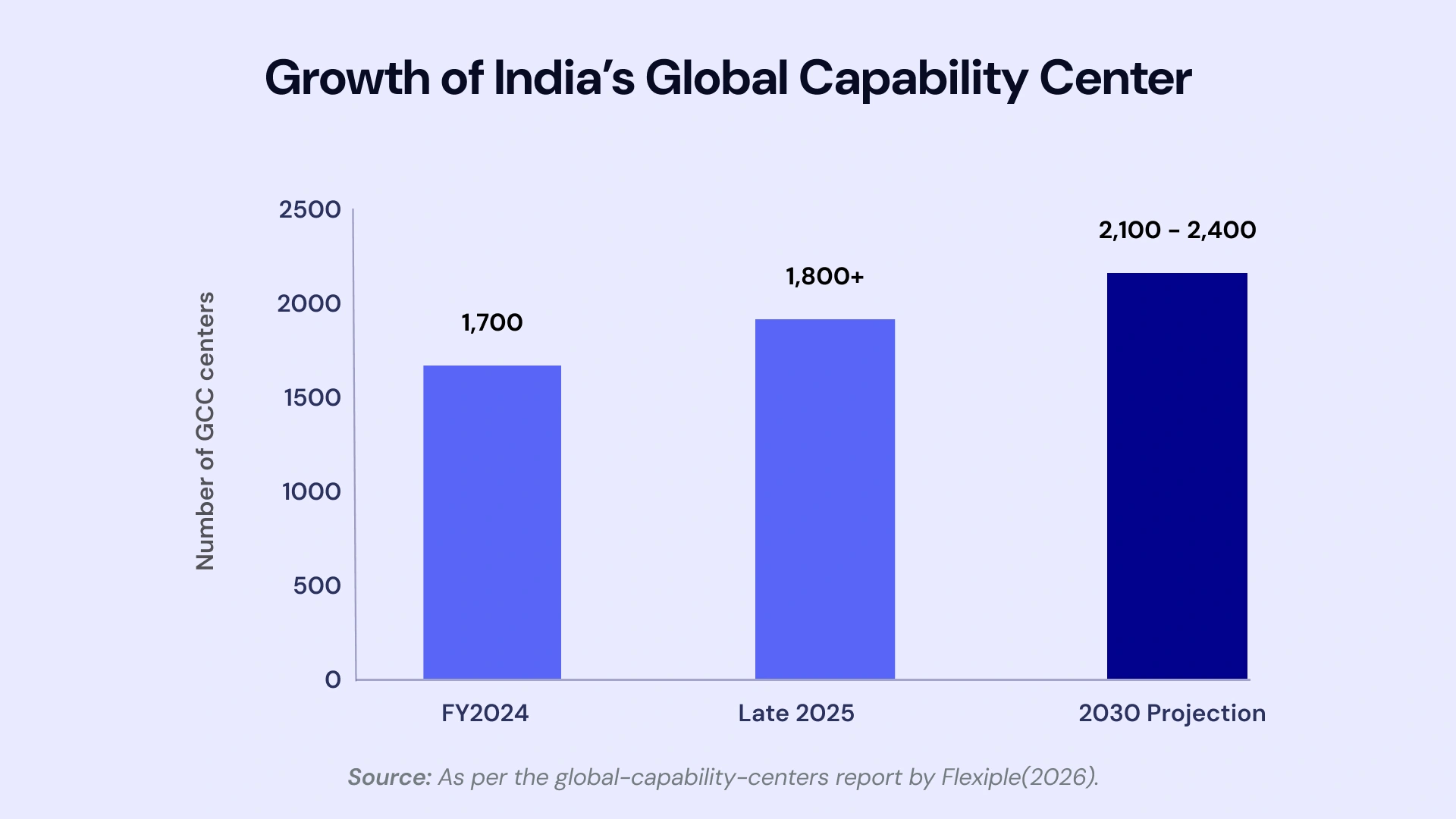
India's GCC sector has grown exponentially, contributing over $64 billion to the national economy and employing more than 1.9–2.0 million professionals. This growth trajectory shows no signs of slowing, with projections indicating the sector could employ 3.5 million people by 2030. However, this rapid expansion has created significant regional variations in talent availability, compensation benchmarks, and operational costs—making location selection more critical than ever.
In this guide, we'll dissect the complete cost structure of setting up and operating a GCC in each location, analyze the tech talent landscape including availability and salary benchmarks for software engineers and IT professionals, examine infrastructure readiness and quality of life factors that impact employee retention, and provide actionable insights tailored for Finance Directors evaluating ROI and HR leaders focused on talent acquisition strategies.
Understanding the GCC Phenomenon in India
Before diving into location-specific analysis, let's understand why India has become the preferred destination for Global Capability Centers. A GCC, also known as a Global In-House Center (GIC) or Captive Center, is an offshore subsidiary wholly owned by the parent organization, established to deliver specific business functions ranging from IT services and software development to finance, analytics, and customer support.
The Indian GCC ecosystem has matured significantly over the past two decades. What began as basic cost arbitrage operations has evolved into innovation hubs driving digital transformation, product development, and strategic decision-making for global enterprises. Companies like JPMorgan Chase, Goldman Sachs, Microsoft, and Google have established substantial GCC operations in India, collectively demonstrating confidence in the country's talent pool and operational advantages.
For Finance Directors, the appeal is clear: Indian GCCs offer 40-60% cost savings compared to similar operations in the US or Europe, while maintaining comparable or superior quality standards. For HR leaders, India offers access to the world's largest English-speaking talent pool, with over 1.5 million engineering graduates entering the workforce each year.
However, the decision between Bangalore, Pune, and Delhi NCR requires moving beyond these macro-level advantages to examine location-specific factors that directly impact your bottom line and talent acquisition success. Let's explore where companies should set up their GCC in India based on comprehensive cost and talent analysis.

Bangalore: India's Silicon Valley and the GCC Epicenter
Bangalore, officially known as Bengaluru, stands as India's technology capital and the most established GCC destination in the country. Home to over 500 GCCs—approximately one-third of all GCCs in India—Bangalore has earned its reputation as the first choice for technology-focused capability centers.
The city's technology ecosystem is unparalleled, hosting the headquarters of India's leading IT services firms (Infosys, Wipro, Mindtree), major product companies (Flipkart, Ola), and substantial operations of global tech giants (Microsoft, Amazon, Google, Apple). This concentration creates a virtuous cycle: companies establish operations to access talent, which attracts more professionals, which in turn draws more companies.
1. Tech Talent Availability in Bangalore for GCC
When evaluating where to hire tech talent for GCC operations, Bangalore offers the deepest and most diverse talent pool in India. The town produces approximately 150,000 engineering graduates annually from premier institutions, including the Indian Institute of Science (IISc), Indian Institute of Management Bangalore (IIMB), and numerous engineering colleges.
Talent Pool Characteristics:
- Software Engineers: Extensive availability across all technology stacks, including Java, Python, cloud technologies (AWS, Azure, GCP), data engineering, and emerging technologies like AI/ML
- Specialized Roles: Highest concentration of architects, principal engineers, and senior technology leaders with 10+ years of experience
- Domain Expertise: Strong talent availability in fintech, enterprise software, e-commerce, and SaaS sectors
- Startup Experience: Large pool of professionals with agile, product-focused mindsets from the city's vibrant startup ecosystem
Hiring Timeline and Competition:
The primary challenge in Bangalore's tech talent landscape is intense competition. For mid-to-senior-level software engineering positions, the average time-to-hire ranges from 45 to 60 days, significantly longer than in Pune or Delhi NCR for similar roles. Multiple competing offers are common, with candidates frequently entertaining 3-4 opportunities simultaneously.
For Finance Directors evaluating Bangalore IT staffing costs, this competitive environment requires either premium compensation packages or specialized tech talent sourcing partners with pre-vetted talent pipelines that can accelerate hiring timelines.
2. Bangalore GCC Setup Cost Analysis
Real Estate and Infrastructure Costs: Bangalore's commercial real estate market reflects its status as India's premier technology destination, with corresponding premium pricing:
- Grade A Office Space: ₹80-120 per sq ft per month ($12-18 per sq ft per month)
- Typical GCC Space Requirement: 15,000-30,000 sq ft for a 150-300 employee center
- Annual Real Estate Cost: ₹1.44-4.32 crores ($175,000-520,000) for a mid-sized GCC
- Setup and Furnishing: ₹800-1,200 per sq ft one-time cost
These costs position Bangalore as the most expensive of the three locations for real estate, though still significantly below comparable facilities in the US or European markets.
Bangalore Software Engineer Salary Benchmarks:
Understanding Bangalore software engineer salary GCC benchmarks is crucial for accurate financial modeling:
- Junior Software Engineer (0-2 years): ₹6-10 lakhs per annum ($7,200-12,000)
- Mid-Level Software Engineer (3-5 years): ₹12-20 lakhs per annum ($14,500-24,000)
- Senior Software Engineer (6-8 years): ₹20-35 lakhs per annum ($24,000-42,000)
- Lead/Architect (9+ years): ₹35-60 lakhs per annum ($42,000-72,000)
- Engineering Manager: ₹40-70 lakhs per annum ($48,000-84,000)
These figures represent the upper end of India's salary spectrum but remain 50-60% below equivalent US compensation for similar roles and experience levels.
Total Cost of Ownership for a 200-Employee GCC in Bangalore:
For Finance Directors conducting a comprehensive cost of hiring software engineers for GCC India analysis:
- Annual Salary Cost: ₹30-50 crores ($3.6-6 million) depending on team composition
- Real Estate: ₹2.4-3.6 crores ($290,000-430,000)
- IT Infrastructure: ₹1.2-1.8 crores ($145,000-215,000)
- Administrative and Support: ₹2-3 crores ($240,000-360,000)
- Total Annual Operating Cost: ₹35.6-58.4 crores ($4.3-7 million)
3. Bangalore's Advantages and Considerations
Strategic Advantages:
- Unmatched depth of technical talent across all technology domains
- Mature GCC ecosystem with established best practices and support infrastructure
- Strong innovation culture and access to cutting-edge technology trends
- Excellent connectivity with direct international flights, facilitating leadership visits
- Robust vendor ecosystem for specialized services and support functions
Key Considerations:
- Highest compensation expectations requiring premium salary positioning
- Intense talent competition leading to higher attrition rates (18-22% annually)
- Infrastructure challenges, including traffic congestion and longer commute times
- The higher overall cost of living is affecting employee expectations
- Premium real estate costs are impacting the total cost of ownership
Pune: The Emerging GCC Powerhouse with Balanced Economics
Pune has rapidly emerged as India's second-most preferred GCC destination, offering a compelling middle ground between Bangalore's premium talent ecosystem and more cost-effective alternatives. Located approximately 150 kilometers from Mumbai, Pune hosts over 250 GCCs representing diverse sectors, including automotive, manufacturing, technology, and financial services.
The city's appeal lies in its balanced value proposition: access to quality talent at more moderate compensation levels, improving infrastructure, and a quality of life that attracts and retains professionals. Major GCCs in Pune include Volkswagen, Mercedes-Benz, Accenture, Cognizant, and numerous financial services organizations—making it one of the best Indian cities to hire tech talent for GCC operations.
1. Pune Tech Talent Availability for GCC
Talent Pool Characteristics:
Pune's talent ecosystem has matured significantly, supported by premier educational institutions including the College of Engineering Pune (COEP), Pune Institute of Computer Technology (PICT), and Symbiosis Institute of Technology. The city produces approximately 60,000 engineering graduates annually.
Key Differentiators:
- Manufacturing and Automotive Domain Expertise: Unique strength in embedded systems, automotive software, and IoT, given the city's manufacturing heritage
- Financial Services Talent: Growing concentration of professionals with banking, insurance, and fintech experience
- Quality-to-Cost Ratio: Excellent balance of skill levels and reasonable compensation expectations
- Retention Advantage: Lower attrition rates (15-18% annually) compared to Bangalore
- Startup to Enterprise Mix: Healthy blend of professionals from both startup environments and established enterprises
Hiring Dynamics:
For HR leaders focused on where to hire tech talent in Pune for GCC, the market offers distinct advantages:
- Time-to-Hire: 30-45 days for mid-level positions, faster than Bangalore
- Competition Level: Moderate, with candidates typically evaluating 1-2 competing offers
- Candidate Expectations: More balanced regarding compensation, with stronger emphasis on work-life balance and company culture
- Relocation Potential: Good attraction for professionals from tier-2 cities seeking quality tech opportunities
2. Pune GCC Setup Cost Structure
Real Estate and Facilities:
Pune offers approximately 25-30% cost advantage over Bangalore for commercial real estate:
- Grade A Office Space: ₹60-90 per sq ft per month ($7-11 per sq ft per month)
- Annual Real Estate Cost for 20,000 sq ft: ₹1.44-2.16 crores ($175,000-260,000)
- Setup Cost: ₹700-1,000 per sq ft, one-time investment
The city's infrastructure has improved substantially, with multiple Grade A office developments in areas such as Hinjewadi IT Park, Magarpatta City, and EON Free Zone, explicitly designed for GCC and IT operations. Launch a GCC without overhead—GCC as a service for talent and operations.
Pune Software Engineer Salary Benchmarks:
A critical factor for Finance Directors evaluating Pune software engineer salary GCC costs:
- Junior Software Engineer (0-2 years): ₹5-8 lakhs per annum ($6,000-9,600)
- Mid-Level Software Engineer (3-5 years): ₹10-16 lakhs per annum ($12,000-19,200)
- Senior Software Engineer (6-8 years): ₹16-28 lakhs per annum ($19,200-33,600)
- Lead/Architect (9+ years): ₹28-48 lakhs per annum ($33,600-57,600)
- Engineering Manager: ₹35-55 lakhs per annum ($42,000-66,000)
These benchmarks represent approximately 15-20% savings compared to Bangalore for equivalent experience and skill levels—a key consideration when comparing Bangalore vs Pune software engineer salary structures.
Total Cost Analysis for 200-Employee GCC in Pune:
- Annual Salary Cost: ₹25-40 crores ($3-4.8 million)
- Real Estate: ₹1.8-2.7 crores ($215,000-325,000)
- IT Infrastructure: ₹1-1.5 crores ($120,000-180,000)
- Administrative and Support: ₹1.5-2.5 crores ($180,000-300,000)
- Total Annual Operating Cost: ₹29.3-46.7 crores ($3.5-5.6 million)
This represents approximately 15-20% total cost savings compared to Bangalore while maintaining comparable talent quality—making it an attractive option for organizations evaluating Bangalore vs Pune GCC hiring cost comparisons.
3. Pune's Competitive Advantages
Strategic Benefits:
- Optimal cost-to-quality ratio for tech talent sourcing
- Lower attrition rates reduce recruitment and training costs
- Improving infrastructure with dedicated IT parks and connectivity
- Strong cultural fit for professionals seeking work-life balance
- Growing ecosystem of specialized service providers for GCC support
- Proximity to Mumbai financial hub for financial services GCCs
Considerations for Decision-Makers:
- Smaller talent pool than Bangalore, requiring longer-term talent pipeline development
- Limited availability of very senior (15+ years) specialized technical leaders
- Infrastructure development is still catching up with demand in certain areas
- Fewer direct international flight connections compared to Bangalore or Delhi NCR
NCR (Delhi/Gurugram/Noida): The Corporate Hub with Strategic Advantages
The National Capital Region encompasses Delhi and its satellite cities, with Gurugram (Gurgaon) and Noida emerging as the primary GCC hubs. The region hosts approximately 300+ GCCs, positioning it as a formidable alternative to Bangalore with distinct characteristics that appeal to specific organizational profiles.
NCR's GCC ecosystem is characterized by strong representation from financial services, consulting, professional services, and technology companies. Major GCCs include American Express, Adobe, Coupa, Salesforce, Samsung, and numerous banking and financial institutions—making it a strong contender when evaluating Delhi NCR GCC setup cost versus other locations.
1. Delhi NCR Tech Talent Availability for GCC
Regional Talent Distribution:
The NCR talent pool is distributed across three primary locations:
- Gurugram: Premium corporate environment attracting senior professionals and leadership roles
- Noida: Technology-focused hub with intense engineering talent concentration
- Delhi: Diverse talent pool with strong finance, analytics, and business operations professionals
Talent Pool Strengths:
- Engineering Graduate Production: Approximately 80,000-100,000 annually from institutions including IIT Delhi, Delhi Technological University, and numerous private engineering colleges
- Business Function Expertise: Strong talent availability for finance, analytics, and business operations beyond pure technology roles
- Senior Leadership: Excellent availability of C-suite and senior leadership talent, given the corporate concentration
- Multilingual Capabilities: A Strong advantage for GCCs serving European markets due to diverse linguistic capabilities
- MBA Talent: Access to top-tier business school graduates from IIM Delhi, FMS Delhi, and ISB
Delhi NCR Tech Talent Availability Dynamics:
For HR leaders evaluating Delhi NCR tech talent availability for GCC setup:
- Developer Talent: Good availability across mainstream technologies, though specialized talent (AI/ML, blockchain) may require longer searches
- Competition Level: Moderate to high, with financial services firms, consulting companies, and tech GCCs competing for similar profiles
- Time-to-Hire: 35-50 days for technical positions
- Candidate Preferences: Strong preference for established organizations and brand names; startups face greater challenges attracting talent compared to Bangalore or Pune
2. NCR GCC Cost Analysis
Real Estate Variations Across NCR:
NCR presents the most complex real estate scenario, given significant cost variations between locations:
Gurugram:
- Grade A Office Space: ₹75-110 per sq ft per month ($9-13 per sq ft per month)
- Positioning: Premium corporate environment with excellent infrastructure
- Tenant Profile: Multinational corporations, financial services firms, premium GCCs
Noida:
- Grade A Office Space: ₹55-85 per sq ft per month ($7-10 per sq ft per month)
- Positioning: Cost-effective technology hub with good infrastructure
- Tenant Profile: Technology companies, BPO/KPO operations, cost-conscious GCCs
Average Annual Real Estate Cost (20,000 sq ft): ₹1.32-2.64 crores ($160,000-315,000) depending on specific location choice within NCR.
Delhi NCR Software Engineer Salary Benchmarks:
Understanding the Delhi NCR software engineer salary GCC rates is essential for accurate budgeting:
- Junior Software Engineer (0-2 years): ₹5.5-9 lakhs per annum ($6,600-10,800)
- Mid-Level Software Engineer (3-5 years): ₹11-18 lakhs per annum ($13,200-21,600)
- Senior Software Engineer (6-8 years): ₹18-32 lakhs per annum ($21,600-38,400)
- Lead/Architect (9+ years): ₹32-55 lakhs per annum ($38,400-66,000)
- Engineering Manager: ₹38-65 lakhs per annum ($45,600-78,000)
NCR compensation levels typically fall between Pune and Bangalore, though there is variation by company, location within NCR, and sector.
Total Cost of Ownership for 200-Employee GCC in NCR:
- Annual Salary Cost: ₹27-44 crores ($3.2-5.3 million)
- Real Estate: ₹2-3.2 crores ($240,000-385,000)
- IT Infrastructure: ₹1.1-1.6 crores ($132,000-192,000)
- Administrative and Support: ₹1.8-2.8 crores ($215,000-335,000)
- Total Annual Operating Cost: ₹31.9-51.6 crores ($3.8-6.2 million)
3. Delhi NCR's Strategic Value Proposition
Distinctive Advantages:
- Excellent availability of senior leadership and C-suite talent
- Strong ecosystem for finance, analytics, and business operations beyond pure technology
- Superior air connectivity with Indira Gandhi International Airport, serving all major international destinations
- Government and regulatory proximity are beneficial for policy-intensive sectors
- A multilingual talent pool is advantageous for European market servicing
- Flexibility to optimize costs by choosing between Gurugram (premium) and Noida (cost-effective)
Key Considerations:
- Infrastructure challenges, including traffic congestion and air quality concerns
- Higher attrition in financial services and consulting sectors (17-20% annually)
- A fragmented talent pool across Delhi, Gurugram, and Noida is impacting collaboration
- Cultural emphasis on established brands makes talent attraction challenging for newer GCCs

Comparative Analysis: Bangalore vs Pune vs Delhi NCR GCC Comparison
1. Direct Cost Comparison Matrix
For Finance Directors requiring a clear tech talent salary comparison in India GCC across all three locations for a standardized 200-employee GCC:
Annual Operating Cost Summary:
- Bangalore: ₹35.6-58.4 crores ($4.3-7 million)
- Pune: ₹29.3-46.7 crores ($3.5-5.6 million) – 15-20% savings vs Bangalore
- NCR: ₹31.9-51.6 crores ($3.8-6.2 million) – 10-12% savings vs Bangalore
Cost Per Employee Analysis:
- Bangalore: $21,500-35,000 per employee annually
- Pune: $17,500-28,000 per employee annually
- NCR: $19,000-31,000 per employee annually
This Bangalore vs Pune vs NCR salary comparison IT demonstrates clear cost differentials that directly impact ROI calculations.
2. Talent Quality and Availability Comparison
Technology Depth:
- Bangalore – Deepest and most diverse technology talent across all domains
- NCR – Strong mainstream technology talent, excellent for business-technology hybrid roles
- Pune – Quality technology talent with particular strength in automotive/embedded systems
Hiring Speed:
- Pune – Fastest hiring cycles (30-45 days)
- NCR – Moderate hiring cycles (35-50 days)
- Bangalore – Longest hiring cycles (45-60 days) due to intense competition
Retention and Attrition:
- Pune – Best retention (15-18% attrition)
- NCR – Moderate retention (17-20% attrition)
- Bangalore – Highest attrition challenge (18-22% attrition)
3. Infrastructure and Quality of Life
Physical Infrastructure:
- Bangalore: Mature but stressed infrastructure, significant traffic challenges
- NCR: Variable (Gurugram excellent, Delhi/Noida moderate), air quality concerns
- Pune: Improving infrastructure with dedicated IT parks, moderate traffic
Connectivity:
- NCR: Best international connectivity via IGI Airport
- Bangalore: Excellent international connectivity, direct flights to major global cities
- Pune: Growing international connectivity, excellent road connectivity to Mumbai
Quality of Life:
- Pune: Best work-life balance, pleasant weather, cultural amenities
- Bangalore: Cosmopolitan culture, weather advantage, startup energy
- NCR: Corporate culture, extreme weather, pollution challenges
Decision Framework: Where Should Companies Set Up GCC in India
1. When to Choose Bangalore for GCC Setup
Optimal Scenarios:
- Technology-first GCC requiring cutting-edge skills (AI/ML, cloud-native architecture, data engineering)
- Need for senior technical leadership and architects
- Product development centers require an innovative mindset
- Organizations willing to pay a premium for the deepest talent pool
- Startups and scale-ups where ecosystem connections matter
Financial Considerations: Accept 15-20% higher costs in exchange for reduced hiring risk and access to specialized talent. ROI justification lies in faster innovation cycles and the ability to handle complex technical challenges.
2. When to Choose Pune for GCC Operations
Optimal Scenarios:
- Organizations prioritizing cost efficiency without compromising quality
- GCCs focused on sustainable operations with lower attrition
- Automotive, manufacturing, or industrial sector GCCs
- Financial services, back-office and middle-office operations
- Organizations valuing employee retention and a work-life balance culture
Financial Considerations: Optimal cost-to-quality ratio delivering 15-20% cost savings while maintaining strong talent quality. Longer-term ROI enhanced by superior retention rates, reducing replacement costs—making it attractive for those evaluating Pune vs Bangalore for GCC setup.
3. When to Choose Delhi NCR for GCC Establishment
Optimal Scenarios:
- GCCs require strong business operations and finance functions alongside technology
- Organizations need senior leadership and C-suite talent accessibility
- Financial services and consulting sector GCCs
- Operations serving European markets requiring multilingual capabilities
- Organizations prioritizing regulatory and government relationship proximity
Financial Considerations: Moderate cost positioning with flexibility to optimize through location choice within NCR (Gurugram vs Noida). ROI enhanced by access to leadership talent and business function expertise—important considerations when comparing Bangalore vs Delhi NCR for GCC setup.
Implementation Roadmap for GCC Setup
Building a Global Capability Center (GCC) in India has shifted from a "back-office" cost-saving play to a strategic "front-office" imperative. By 2026, the roadmap for success focuses on agility, AI-readiness, and deep integration with the global headquarters.
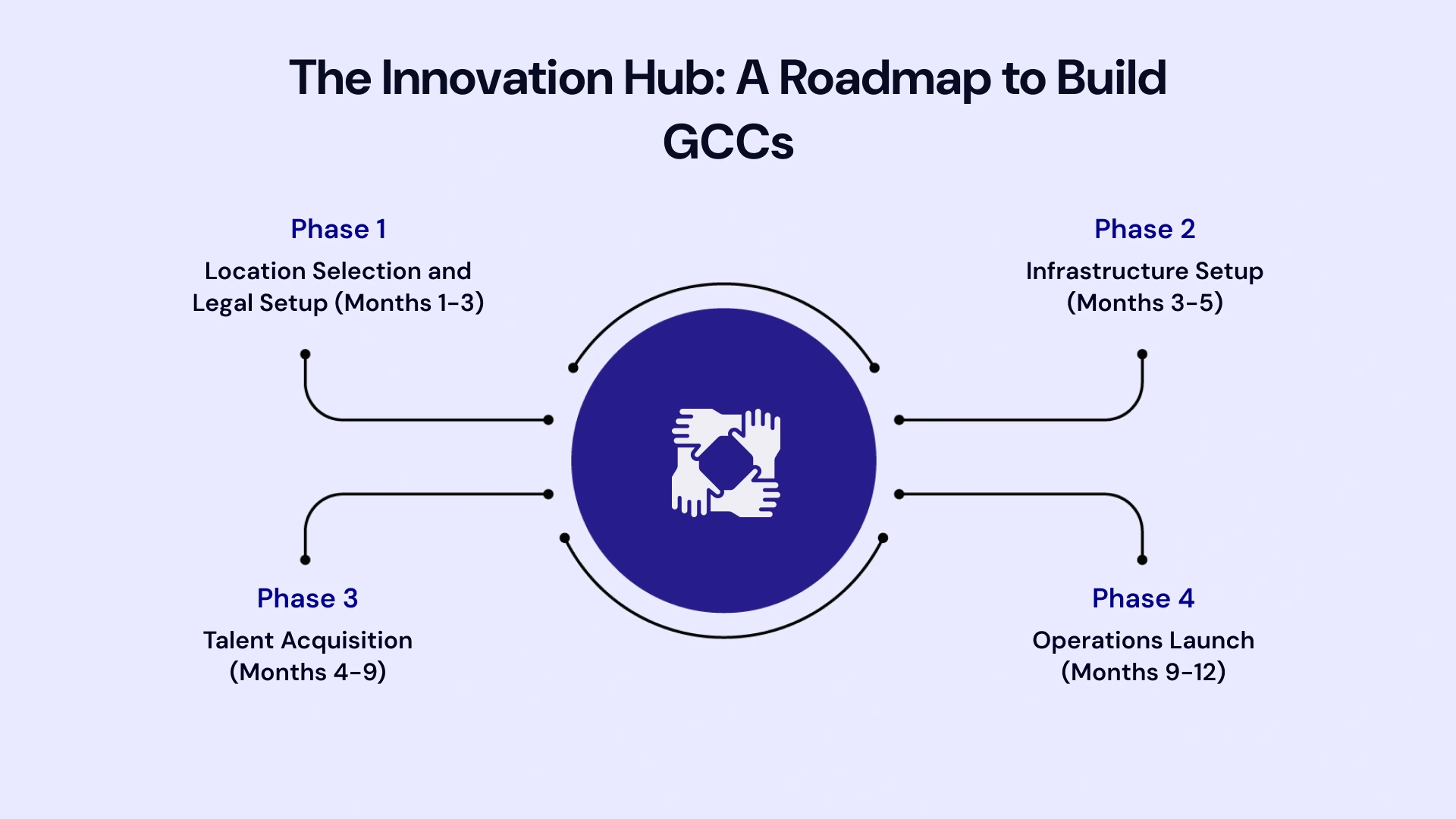
Phase 1: Location Selection and Legal Setup (Months 1-3)
- Detailed Cost Modeling: Engage finance teams to develop 5-year cost projections, including salary inflation assumptions specific to the chosen location
- Market Salary Benchmarking: Conduct comprehensive salary surveys for particular roles you plan to hire, using GCC developer salary benchmarking in India data
- Real Estate Scouting: Identify and evaluate 3-5 office space options with support from commercial real estate advisors
- Legal Entity Formation: Establish legal entity, obtain necessary registrations and compliance certifications
- Talent Sourcing Partner Selection: If outsourcing tech talent sourcing, evaluate and engage specialized recruitment partners with proven GCC experience
Phase 2: Infrastructure Setup (Months 3-5)
- Office Space Finalization: Negotiate lease terms, plan office layout optimized for your team structure
- IT Infrastructure: Deploy secure network infrastructure, collaboration tools, and development environments
- HR Systems: Implement HRMS, payroll systems, and employee engagement platforms
- Compliance Framework: Establish payroll, tax, PF/ESI, and other statutory compliance processes
- Vendor Ecosystem: Identify and onboard key vendors for facilities, IT support, legal, and administrative services
Phase 3: Talent Acquisition (Months 4-9)
- Leadership Hiring: Prioritize GCC leadership roles (Center Head, Delivery Heads) to drive subsequent hiring
- Employer Brand Building: Establish presence on job portals, leverage social media, and engage with local tech communities
- Campus Relationships: For a sustained talent pipeline, establish relationships with target engineering colleges
- Hiring Acceleration: Deploy multiple hiring channels, including direct sourcing, specialized recruitment partners for tech talent, employee referrals, and campus recruitment
- Onboarding Program: Develop a comprehensive onboarding program, including cultural orientation, technical training, and process familiarization
Phase 4: Operations Launch (Months 9-12)
- Phased Team Ramp: Stagger team building to ensure proper knowledge transfer and cultural integration
- Process Establishment: Define and document operational processes, governance models, and escalation frameworks
- Performance Management: Implement KPI frameworks, performance review cycles, and continuous improvement mechanisms
- Retention Strategies: Deploy employee engagement programs, career development frameworks, and competitive retention practices
- Continuous Optimization: Regular review of cost structures, talent strategies, and operational efficiency
Navigating Common Challenges in GCC Operations
Below is a breakdown of the common challenges and the strategic frameworks used to navigate them.
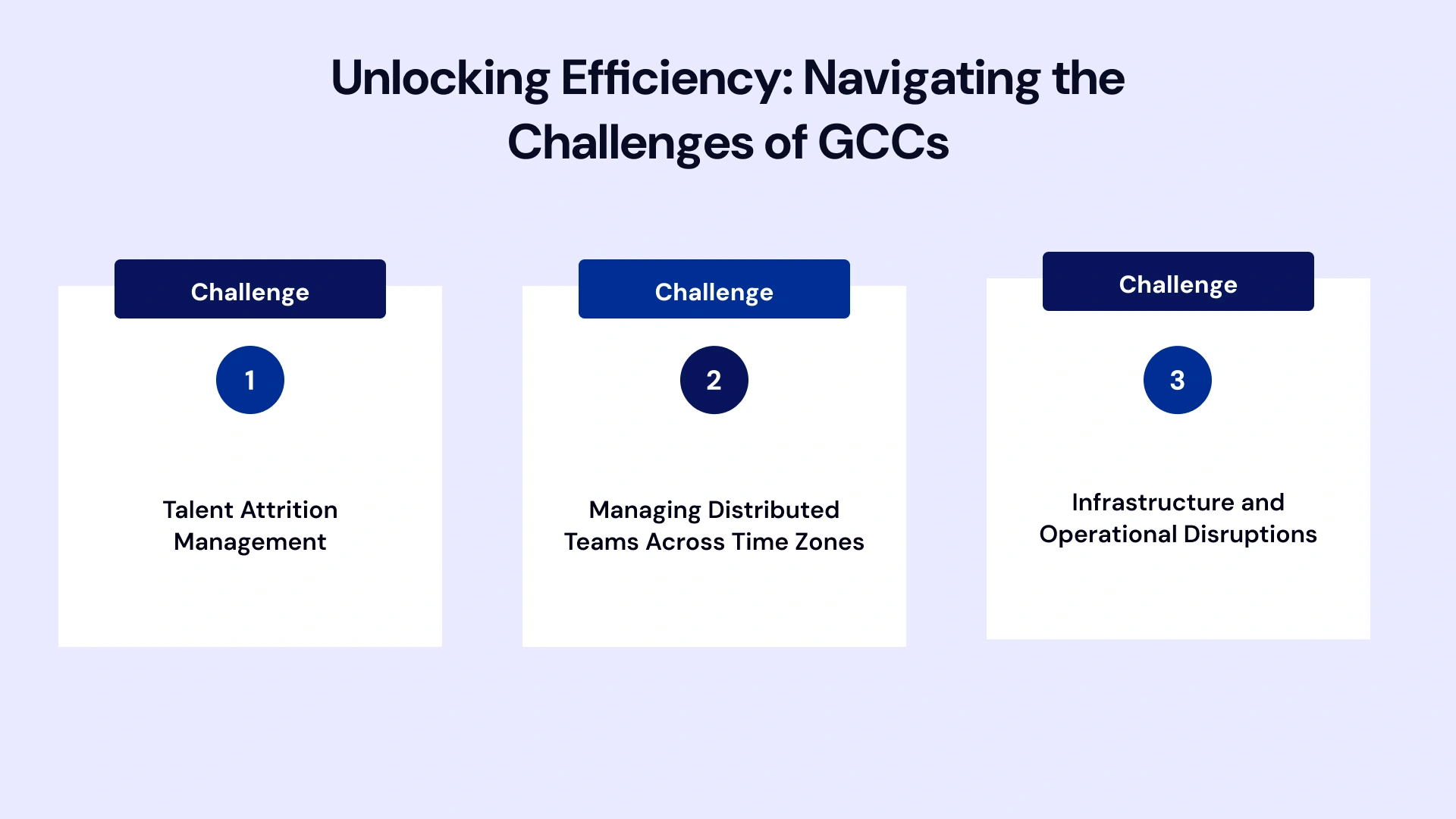
Challenge 1: Talent Attrition Management
The Problem: The Indian tech talent market experiences higher attrition rates (15-22% annually) than Western markets (8-12%), which directly impacts operational continuity and replacement costs.
Location-Specific Mitigation:
- Bangalore: Focus on compelling technical challenges, innovation opportunities, and competitive compensation
- Pune: Leverage work-life balance, stable growth trajectory, and community building
- NCR: Emphasize brand strength, career progression paths, and leadership accessibility
Practical Strategies:
- Implement structured career progression with clear advancement paths
- Deploy retention bonuses tied to project milestones or tenure thresholds
- Create technical leadership tracks allowing senior engineers to grow without moving to management
- Establish stay interviews and early attrition warning systems
- Partner with specialized tech talent sourcing firms that can provide rapid replacement pipelines
Challenge 2: Managing Distributed Teams Across Time Zones
The Problem: Coordination with global headquarters and stakeholder management across significant time zone differences.
Solutions:
- Establish "overlap hours," ensuring 3-4 hours of daily collaboration time with key stakeholder locations
- Rotate on-call or extended hours responsibilities to prevent burnout
- Deploy comprehensive documentation and asynchronous communication practices
- Schedule regular leadership visits, establishing personal relationships and cultural alignment
- Leverage collaboration technologies enabling seamless virtual teamwork
Challenge 3: Infrastructure and Operational Disruptions
Location-Specific Considerations:
- Bangalore: Traffic congestion requires flexible work policies and distributed office locations
- Pune: Growing infrastructure is generally stable, but plan for monsoon-related disruptions
- NCR: Air quality and weather extremes necessitate robust work-from-home policies
Mitigation Strategies:
- Implement a hybrid work model, balancing collaboration and flexibility
- Establish business continuity plans, including backup internet, power, and remote work capabilities
- Consider satellite offices or co-working arrangements for employees facing long commutes
- Deploy employee transportation services for core teams requiring regular office presence
The Role of Specialized Tech Talent Sourcing Partners
For Finance Directors and HR leaders evaluating build versus partner strategies for talent acquisition, engaging specialized tech talent sourcing partners offers several strategic advantages, particularly when navigating complex decisions around where to hire tech talent in Delhi NCR for GCC or other locations.
1. When to Partner for Tech Talent Sourcing
Scenarios Favoring Partnership:
- Rapid Scaling: Need to hire 50+ technical roles within 6-9 months
- Specialized Skills: Requirement for niche technologies with limited talent availability
- Market Entry: First GCC in India without an established brand presence or hiring infrastructure
- Cost Optimization: Desire to maintain lean internal recruiting teams during variable hiring cycles
- Focus on Core: Preference to allocate internal HR bandwidth to retention, engagement, and strategic initiatives rather than transactional recruitment
2. Value Delivered by Specialized Partners
- Accelerated Hiring Timelines: Specialized partners maintain pre-vetted talent pools, reducing time-to-hire by 30-40% compared to building pipelines from scratch.
- Market Intelligence: Partners provide real-time salary benchmarking, competitive intelligence, and talent availability insights critical for accurate planning.
- Quality Assurance: Structured technical assessment frameworks ensure candidates meet both technical and cultural fit requirements before presentation.
- Cost Efficiency: While engagement fees apply, the total cost of hire (including internal recruiter costs, job board fees, assessment tools, and time-to-productivity) often favors partnering for specialized or high-volume hiring.
3. Selecting the Right Tech Talent Sourcing Partner
Evaluation Criteria:
- GCC-Specific Experience: Demonstrated track record with GCC clients in your target location
- Technical Assessment Capability: Robust frameworks for evaluating technical competency across your technology stack
- Talent Pool Depth: Pre-existing relationships and pipelines in your target skills and experience levels
- Transparency: Clear communication on sourcing strategies, candidate pipelines, and realistic timelines
- Flexible Engagement Models: Ability to adapt to your hiring velocity and specific requirements
Future-Proofing Your GCC Location Strategy
Emerging Trends Impacting Location Decisions
- Tier-2 City Emergence: Cities like Coimbatore, Kochi, Jaipur, and Chandigarh are emerging as viable alternatives offering 25-35% cost advantages while talent pools mature.
- Hybrid and Remote Models: Post-pandemic work models enable accessing talent across multiple locations while maintaining a primary hub in Bangalore, Pune, or Delhi NCR.
- Technology Evolution: Emerging technologies (AI/ML, blockchain, quantum computing) create talent concentration in specific locations, with Bangalore maintaining leadership.
- Regulatory Developments: State-specific incentives, tax policies, and infrastructure investments may shift the relative attractiveness of locations over 5-10 year horizons.
Building Flexibility into Your Strategy
- Multi-Location Approach: Consider establishing presence in two locations—a primary hub for the core technology team supplemented by a secondary location for cost-effective scaling or specialized functions.
- Periodic Review Cycles: Establish annual reviews of location strategy, reassessing talent availability, cost structures, and strategic alignment with organizational goals.
- Scalability Planning: Ensure real estate and infrastructure decisions accommodate 2-3x growth without requiring relocation or major disruptions.

Leverage VLink's Expertise in GCC-as-a-Service
As you navigate the complexities of establishing and scaling your Global Capability Center in India, partnering with experienced GCC service providers can significantly accelerate your success while mitigating common risks. VLink’s GCC-as-a-Service solutions are designed for Finance Directors and HR leaders seeking optimal cost efficiency and talent acquisition success across Bangalore, Pune, and Delhi NCR.
Why VLink for Your GCC Journey
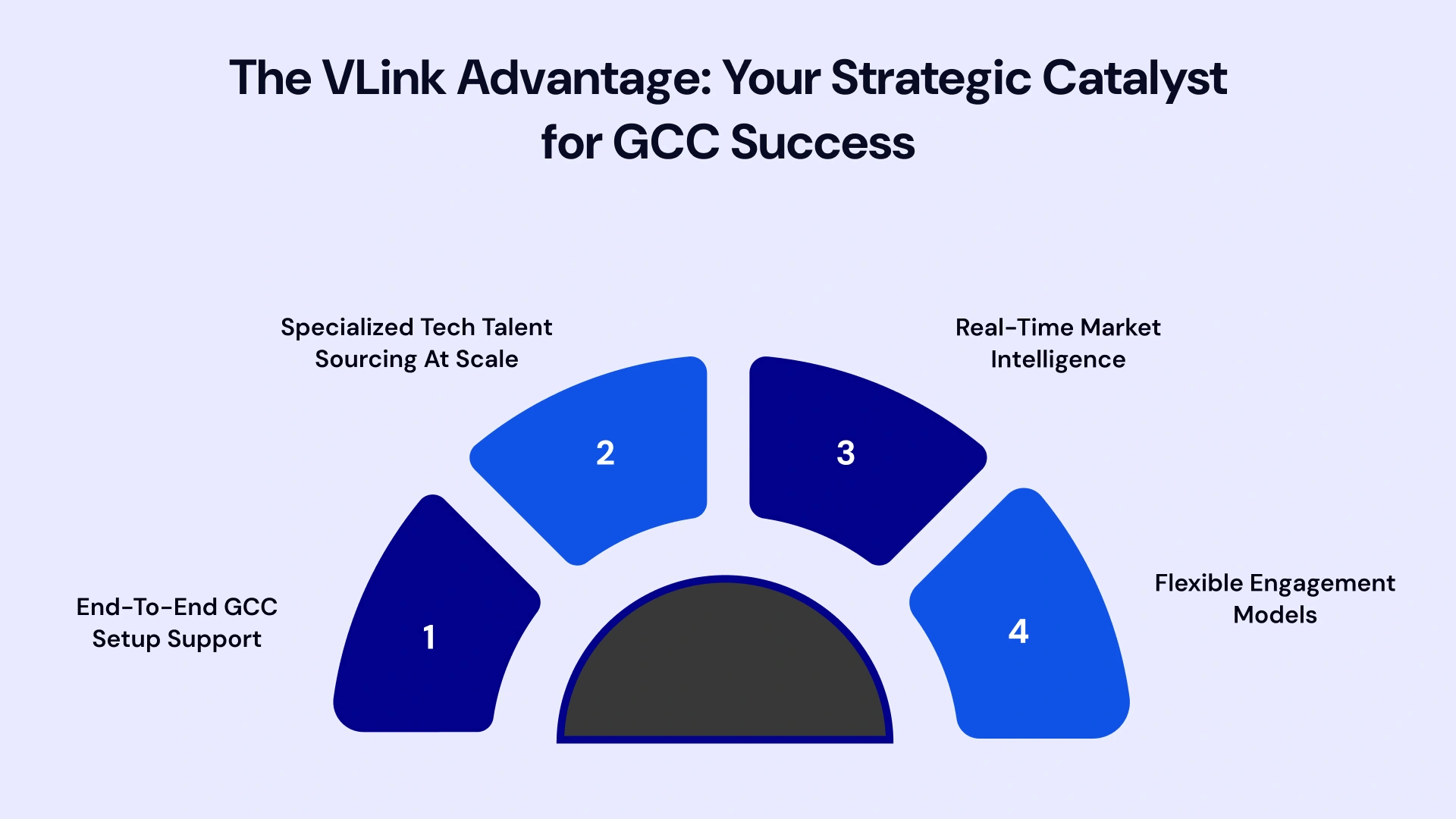
End-to-End GCC Setup Support:
From initial location assessment and cost modeling to legal entity formation and infrastructure setup, VLink provides turnkey solutions that reduce your time-to-operation by 40-50%. Our team has successfully supported 100+ organizations in establishing GCCs across all three primary locations, bringing deep expertise in navigating regulatory requirements, vendor ecosystems, and operational complexities.
Specialized Tech Talent Sourcing at Scale:
VLink maintains pre-vetted talent pools across Bangalore, Pune, and Delhi NCR, covering full-stack developers, cloud architects, data engineers, DevOps specialists, and emerging technology experts. Our proven hiring framework delivers:
- Accelerated Time-to-Hire: 25-35 days average versus 45-60 days industry standard
- Quality Assurance: 95% offer acceptance rates with structured technical assessments
- Retention Excellence: 90-day retention exceeding 92% through cultural fit evaluation
- Cost Transparency: Clear pricing with no hidden costs or surprises
Real-Time Market Intelligence:
Our continuous engagement across 200+ active GCC clients provides unparalleled insights into current salary benchmarks, talent availability trends, and competitive positioning. We update our clients quarterly on market dynamics, ensuring your compensation strategies and hiring plans remain competitive and realistic.
Flexible Engagement Models:
Whether you need comprehensive GCC-as-a-Service covering all operational aspects or targeted support for high-volume hiring initiatives, specialized skill requirements, or market entry acceleration, VLink's dedicated team offers engagement models tailored to your specific needs and budget parameters.
Our Comprehensive Service Portfolio
- Location Strategy Consulting: Detailed cost-benefit analysis across Bangalore, Pune, and Delhi NCR with customized recommendations based on your functional requirements, budget constraints, and strategic priorities.
- Talent Acquisition Services: End-to-end recruitment covering sourcing, technical assessment, interview coordination, offer negotiation, and onboarding support with guaranteed quality and timeline commitments.
- GCC Infrastructure Setup: Complete support for office space identification, IT infrastructure deployment, vendor management, and compliance establishment, ensuring seamless operations from day one.
- Ongoing Operational Support: Payroll management, HR administration, employee engagement programs, performance management systems, and continuous talent pipeline development, enabling your internal teams to focus on strategic initiatives.
Don't let uncertainty about costs, talent availability, or operational complexities delay your India GCC strategy. Connect with VLink experts to accelerate your journey from planning to productive operations, ensuring you make the right location choice and build the right team at the right cost.
Conclusion
Choosing between Bangalore, Pune, and Delhi NCR for your Global Capability Center is a strategic decision that will shape your operational efficiency, cost structure, and competitive advantage for years to come. Each location offers distinct value propositions: Bangalore provides unmatched depth of technology talent and an innovation culture at premium pricing; Pune delivers an optimal cost-to-quality balance with superior retention; Delhi NCR excels in business-technology hybrid talent and leadership accessibility.
For Finance Directors, the data is clear: Pune offers 15-20% cost savings compared to Bangalore, while Delhi NCR provides 10-12% savings. However, the location decision must transcend simple cost comparisons to encompass talent availability for your specific requirements, hiring velocity and time-to-productivity, infrastructure maturity and quality-of-life factors, and long-term scalability aligned with your growth trajectory.
Success in India's GCC ecosystem requires comprehensive planning, realistic expectations, and, often, strategic partnerships with experienced service providers who can navigate local complexities and accelerate your path to operational excellence. Whether you build entirely in-house or leverage specialized GCC service providers, a data-driven approach will ensure your India capability center delivers the innovation, efficiency, and strategic value that defines world-class GCC operations.

GCC & IT Staffing Expert
Swastik, a seasoned professional with 20+ years of proven presence in sphere of Enterprise IT sales market with deep expertise in designing hiring engines, workforce scaling programs and location led talent strategy, in PAN India.

 Shivisha Patel