



Many traditional hiring models satisfy one leader while frustrating the other. Staff augmentation is unique because it aligns seamlessly with both agendas.
This guide outlines the strategic benefits of IT staff augmentation through each executive’s lens, backs the financial argument with a practical cost comparison, and candidly examines where the model delivers maximum impact and where it doesn't. It is written specifically for technology and finance leaders worldwide.

Why Leaders Are Looking at Staff Augmentation Now
Modern enterprise leaders face a core paradox: the pressure to innovate and ship products faster has never been higher, yet the traditional mechanics of full-time hiring have rarely been more complex or costly.
Six critical pressures are accelerating the shift toward IT staff augmentation services:
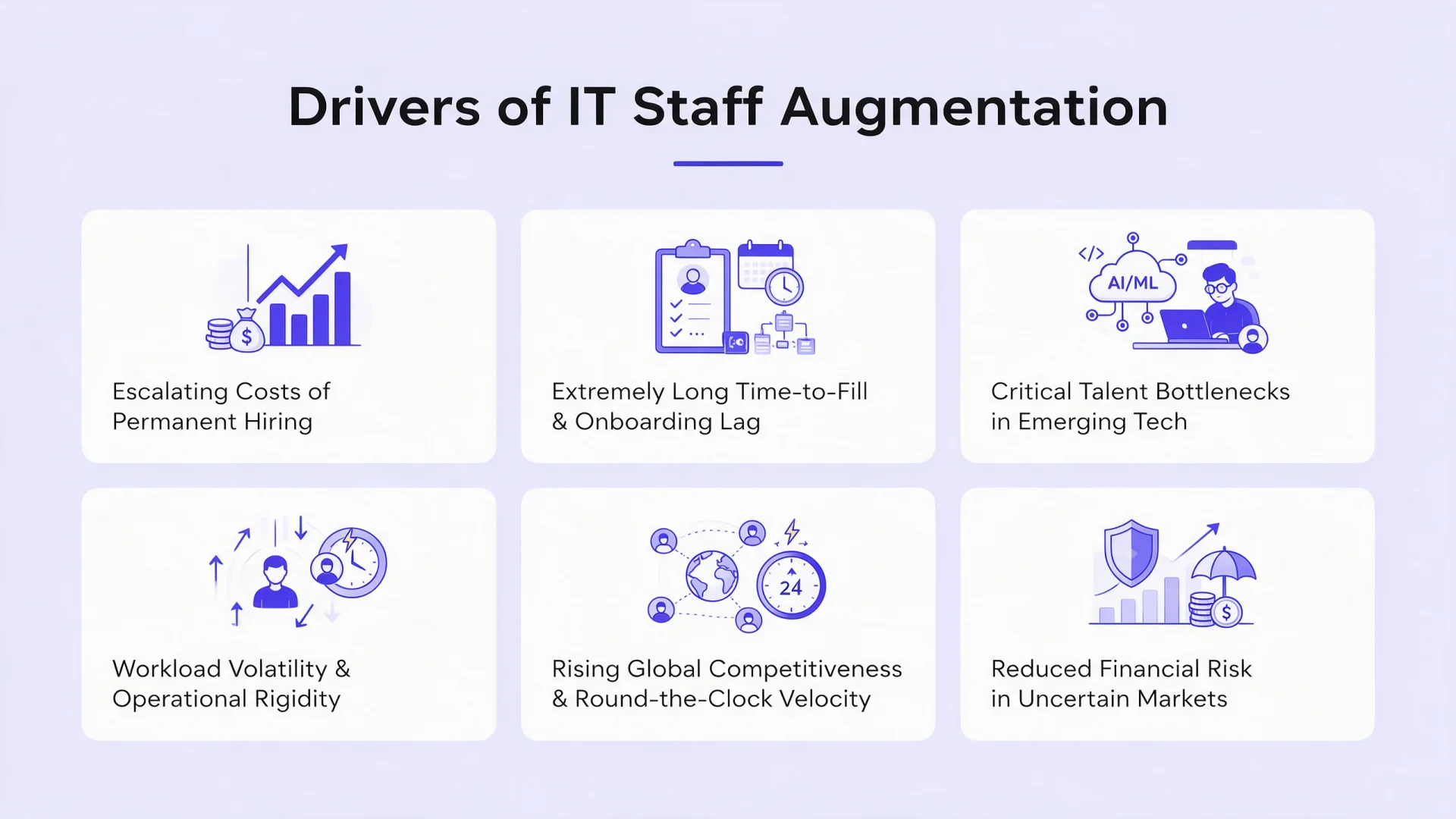
Escalating Costs of Permanent Hiring:
The total cost of an in-house employee extends far beyond base compensation. Factoring in health benefits, bonuses, equity incentives, workstation hardware, software licensing, and recruiter fees (typically 15% to 30% of a candidate's first-year base salary), full-time headcount becomes a massive fixed financial commitment.
Extremely Long Time-to-Fill & Onboarding Lag:
According to industry benchmarks, filling specialized senior tech roles takes an average of 40 to 60 days, followed by another 30 to 90 days for full enterprise onboarding before an engineer reaches peak productivity. In fast-moving markets, a quarter-long recruiting cycle translates directly to missed launch windows and lost revenue.
Critical Talent Bottlenecks in Emerging Tech:
The talent gap is no longer general; it is concentrated in high-demand domains. Finding seasoned professionals in generative AI/ML, cloud architecture, cybersecurity compliance, and modern data engineering locally is often a zero-sum game, forcing companies into bidding wars or leaving key initiatives stalled.
Workload Volatility & Operational Rigidity:
Modern tech initiatives fluctuate; a migration project, product launch, or audit requires heavy developer bandwidth for six months, followed by routine maintenance. Permanent hiring locks organizations into static capacity for dynamic workloads, creating idle overhead during lulls or burnout during peaks.
Rising Global Competitiveness & Round-the-Clock Velocity:
Distributed and augmented teams allow organizations to tap into global tech hubs, establishing follow-the-sun development cycles that double delivery speeds without forcing local teams into unsustainable overtime.
Reduced Financial Risk in Uncertain Markets:
Fixed overhead is a liability during economic shifts. Staff augmentation transforms rigid CapEx/OpEx fixed personnel costs into flexible variable expenses, giving CFOs the agility to scale team size up or down without the cost, friction, or morale impact of structural layoffs.
The result is a persistent IT talent bottleneck felt across global enterprises. Staff augmentation has evolved from a temporary quick-fix into a strategic operational model, making its financial and technical advantages a permanent fixture in modern boardrooms and budget reviews.
The 8 Strategic Benefits of IT Staff Augmentation
IT staff augmentation bridges the gap between ambitious technology roadmaps and severe talent constraints. By integrating specialized external talent directly into your internal workflows, organizations achieve the speed, flexibility, and financial control necessary to execute high-impact initiatives without expanding permanent overhead.
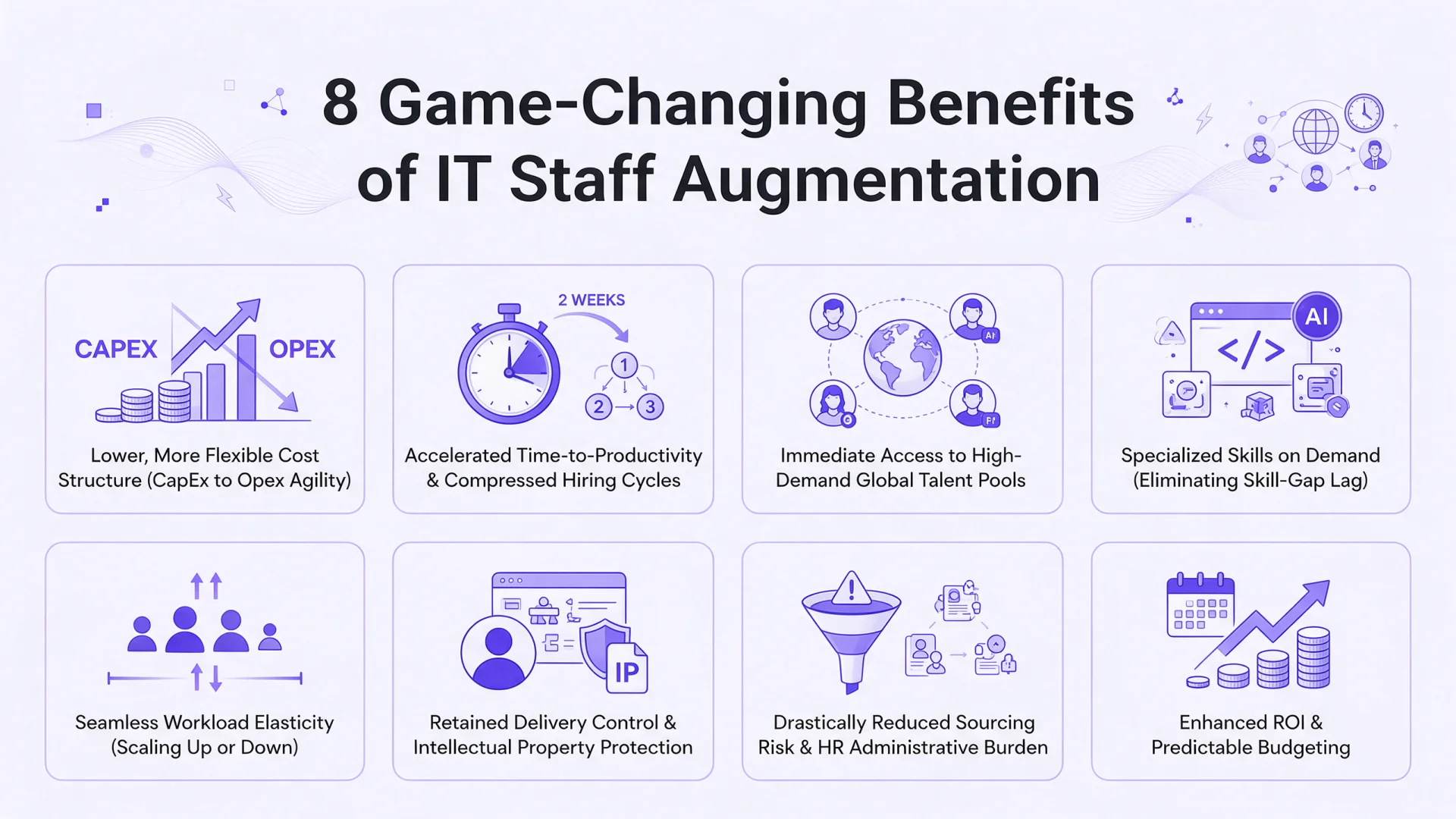
1. Lower, More Flexible Cost Structure (CapEx to OpEx Agility)
The financial case for staff augmentation begins with structural flexibility. A traditional full-time employee (FTE) represents a rigid, multi-year financial liability encompassing base salary, health benefits, payroll taxes, equipment, software licenses, and heavy upfront recruitment fees.
In contrast, an augmented engineer is an operational expense (OpEx) strictly tied to project delivery windows. For CFOs, this converts fixed labor overhead into a flexible variable cost, directly protecting cash flow during market fluctuations.
Total Cost of Ownership (TCO) Breakdown
To evaluate the real financial impact, leaders must look past hourly rates and analyze Total Cost of Ownership. The model below compares the first-year and three-year financial impact of a full-time senior engineer versus an augmented specialist:
| Cost Line (Per Senior Engineer) | Full-Time Hire (FTE) | Staff Augmentation | Notes & Financial Impact |
| Base Pay / Contract Rate | $140,000 | $126,000 | FTE salary vs. Augmentation (~$70/hr × 1,800 hrs) |
| Benefits, Taxes & Overhead (30%) | $42,000 | Included | Healthcare, 401(k), payroll tax, insurance |
| Recruitment & Sourcing (20% Base) | $28,000 | $0 | Upfront agency placement fee (one-time) |
| Equipment, Licenses & Training | $8,000 | Minimal | Hardware provisioning, enterprise software, onboarding |
| Internal Onboarding & Mgmt. | Included in overhead | $10,000 | Initial setup and team integration allocation |
| Year 1 Total | $218,000 | $136,000 | ~38% Year 1 Cost Savings |
| 3-Year Cumulative Total | $598,000 | $408,000 | ~32% 3-Year Cost Savings |
Financial Reality Check:
For core, permanent operational roles needed indefinitely, full-time hiring becomes more cost-effective as initial recruitment costs amortize. However, for project-based initiatives, sprint accelerations, or specialized tech stack builds lasting 6 to 24 months, staff augmentation delivers massive capital efficiency.
2. Accelerated Time-to-Productivity & Compressed Hiring Cycles
Finding and securing top-tier technical talent through traditional HR pipelines typically takes 60 to 90 days, followed by a lengthy enterprise orientation phase before an engineer contributes meaningful code.
Augmentation partners maintain active, pre-vetted talent pipelines. This enables CTOs to deploy qualified developers, software architects, or DevOps engineers within 5 to 10 business days.
- For the CTO: Eliminates project bottlenecks, prevents missed roadmap deadlines, and keeps sprint velocity high.
- For the CFO: Prevents burn rate waste on delayed initiatives and accelerates time-to-market for revenue-generating features.
3. Immediate Access to High-Demand Global Talent Pools
Tapping into a global talent network is one of the single most transformative advantages of modern IT staff augmentation. When local talent markets suffer from severe talent shortages or exorbitant compensation expectations, augmentation allows enterprises to seamlessly scale using nearshore and offshore engineering hubs.
Region-specific hubs; such as India, offer deep technical expertise, robust academic pipelines, and strategic time-zone alignment (providing overlapping hours for EMEA and extended coverage for North America).
Explore our complete framework for enterprise talent expansion in our guide to tech talent sourcing in India.
4. Specialized Skills on Demand (Eliminating Skill-Gap Lag)
Emerging tech initiatives, such as cloud infrastructure modernization, AI/LLM integration, cybersecurity audits, or real-time data pipeline architecture, often require high-level niche expertise for relatively short periods.
Hiring a full-time employee for a 6-month specialized sprint creates long-term financial bloat once that specific project phase finishes. Augmentation allows technology leaders to inject highly specialized experts into the workflow precisely when required and scale them back seamlessly once deliverables are met.
5. Seamless Workload Elasticity (Scaling Up or Down)
Engineering demand across modern enterprises is naturally fluctuating. System migrations, major version releases, compliance audits, and seasonal peak traffic require temporary spikes in development bandwidth.
Augmentation gives organizations true operational elasticity:
- Scale Up: Rapidly add 5 to 10 engineers to hit an aggressive product launch window.
- Scale Down: Effortlessly adjust team size post-launch without incurring restructuring costs, severance payouts, or negative impacts on company culture and employee morale.
6. Retained Delivery Control & Intellectual Property Protection
A common concern among executive leadership is maintaining governance over proprietary code bases and project management architecture.
Unlike traditional project outsourcing; where third-party vendors manage the end-to-end delivery under a black-box model, staff augmentation integrates external developers directly into your existing internal management hierarchy:
- Total Governance: Augmented staff work directly under your engineering managers, utilizing your tools (Jira, GitHub, Slack) and adhering to your CI/CD pipelines.
- IP Security: All code, documentation, and IP created remain 100% owned by your organization from day one.
Looking for a balance between individual contractors and end-to-end outsourcing? Discover how our dedicated teams deliver scalable engineering capacity under your strategic leadership.
7. Drastically Reduced Sourcing Risk & HR Administrative Burden
A mis-hire in a senior technical role is exceptionally costly; factoring in severance, lost productivity, team disruption, and re-recruiting expenses.
With staff augmentation, administrative and risk management burdens shift to the partner:
- Vendor-Backed Vetting: Candidates undergo rigorous technical evaluations and background checks before presentation.
- Turnkey Replacement Guarantees: If a developer isn't a culture or technical fit, the augmentation partner provides a replacement swiftly without financial penalties or HR friction.
- Payroll & Compliance Management: The vendor handles local labor laws, benefits, international tax compliance, and payroll administration.
8. Enhanced ROI & Predictable Budgeting
The Return on Investment (ROI) of IT staff augmentation manifests across three vital operational metrics:
- Lower Cost per Productive Hour: Eliminating unbillable downtime, benefits overhead, and recruiting costs lowers overall labor expenses.
- Accelerated Value Realization: Shorter hiring cycles bring product features to market faster, realizing projected revenue and efficiency gains sooner.
- Predictable Cost Modeling: Engagements operate under transparent, fixed monthly billing schedules, giving CFOs the clear visibility needed for accurate quarterly forecasting.
What CFOs and CTOs Each Care About
While both financial and technology leaders benefit from IT staff augmentation, their underlying priorities differ. CFOs evaluate the model through the lens of capital efficiency, risk mitigation, and budget agility. CTOs focus on engineering velocity, architecture control, and closing technical skill gaps.
Staff augmentation succeeds precisely because it aligns with both agendas, delivering measurable bottom-line value without compromising on technical quality or delivery speed.
Executive Alignment Matrix: CFO vs. CTO Perspectives
| Strategic Benefit | The CFO Perspective (Financial & Risk) | The CTO Perspective (Technical & Operational) |
| Flexible Cost Structure | Converts fixed payroll liabilities into dynamic OpEx; improves quarterly cash flow forecasting. | Preserves budget allocations for modern tooling, cloud infrastructure, and core project delivery. |
| Speed to Deployment | Minimizes capital burn caused by project delays and idle planning phases. | Deploys pre-vetted capacity in 5 to 10 days rather than losing a quarter to recruitment. |
| Global Talent Access | Optimizes labor spend through nearshore/offshore rate structures without sacrificing quality. | Unlocks immediate access to hard-to-find global engineering specialties and niche skill sets. |
| Specialized Skills on Demand | Pays strictly for project-duration expertise, eliminating long-term carry costs for transient needs. | Injects elite talent for specialized sprints (AI, DevOps, Security) precisely when required. |
| Workload Elasticity | Avoids the financial, legal, and severance risks associated with hiring for temporary workload spikes. | Provides rapid surge capacity for major releases, scaling down friction-free post-launch. |
| Delivery Control & Governance | Secures 100% intellectual property ownership and transparent, predictable vendor billing. | Retains direct management over codebase architecture, technical standards, and team workflows. |
| Risk Mitigation & HR Load | Eliminates costly mis-hire liabilities; vendor handles global payroll, compliance, and onboarding. | Features turnkey candidate replacement guarantees with zero interruption to active sprint velocity. |
| Measurable ROI | Delivers clear cost-per-outcome metrics and lowers overall total cost of ownership (TCO). | Accelerates roadmap delivery, shortening time-to-market for critical business capabilities. |
Hidden Costs and When Staff Augmentation Isn't the Answer
Honest evaluation includes the downsides. Watch for:
- Management overhead. Augmented engineers need direction, which takes your leaders' time.
- Knowledge risk. When contractors leave, undocumented knowledge can leave with them; build documentation and knowledge transfer into the engagement.
- Rate creep and minimums. Review contract terms, replacement policies, and notice periods.
- Time-zone friction. Plan overlap hours, especially across regions.
- Cultural fit. Treat them as team members.
Staff augmentation is a poor fit for permanent core roles, highly confidential strategic work, or situations where you lack the leadership to direct additional engineers. In those cases, permanent hiring or a managed delivery model is stronger. Our comparison of IT staff augmentation vs full-time hiring explores this trade-off in depth.
How to Choose Staff Augmentation Providers
Not all staff augmentation providers operate at the same standard. Choosing the wrong vendor leads to low-quality code, hidden fees, security vulnerabilities, and management friction.
To ensure a seamless fit for both technical and financial priorities, evaluate potential partners across six critical dimensions:
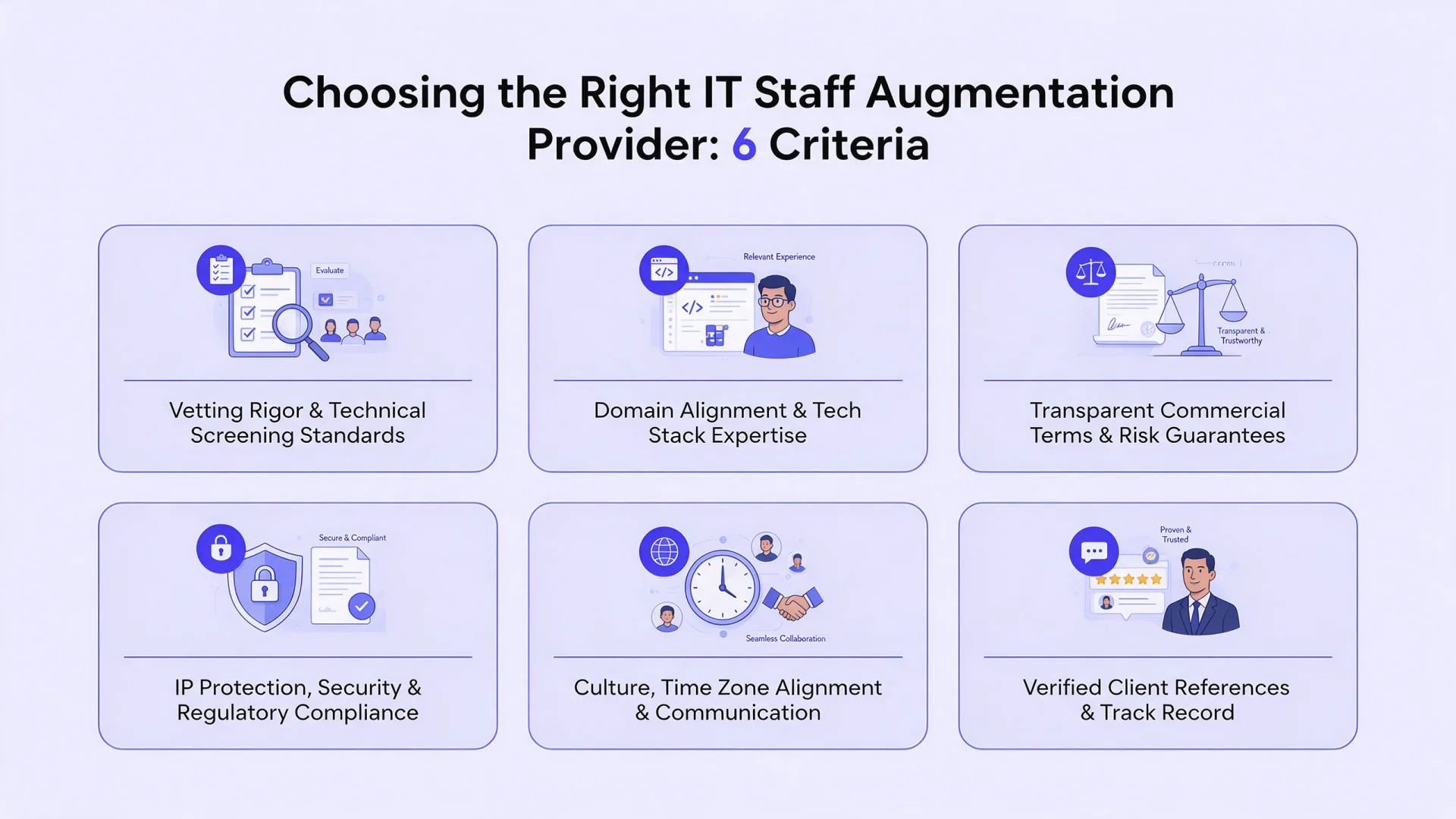
1. Vetting Rigor & Technical Screening Standards
A reliable partner does not just forward resumes from an open database; they maintain a rigorous, multi-stage internal vetting process.
- What to Ask: "What percentage of applicants pass your screening, and how do you test for both technical depth and soft skills like English proficiency and problem-solving?"
- The Benchmark: Top-tier providers accept only the top 3% to 5% of applicants, utilizing live coding assessments, real-world architectural scenarios, and communication evaluations.
2. Domain Alignment & Tech Stack Expertise
Ensure the provider has proven experience within your specific industry, compliance framework, and modern technology stack.
- What to Ask: "Can you share case studies or client profiles featuring our exact stack (e.g., AWS, Python, Kubernetes) and regulatory environment (e.g., HIPAA, SOC 2)?"
- The Benchmark: The provider should present talent profiles that require minimal tech stack adaptation and understand your domain's specific edge cases.
3. Transparent Commercial Terms & Risk Guarantees
Unexpected fees or rigid long-term commitments undermine the financial benefits of staff augmentation.
- What to Ask: "What are your notice periods for scaling down, what are the exact billing terms, and what happens if an engineer isn't a fit?"
- The Benchmark: Look for partners offering itemized pricing, transparent hourly or daily rates, flexible scale-up/scale-down clauses without penalties, and a 2-week risk-free trial or immediate replacement guarantee.
4. IP Protection, Security & Regulatory Compliance
Your code base and proprietary data must remain 100% secure across international borders.
- What to Ask: "What protocols protect our IP, what non-disclosure terms are enforced, and how do you handle remote hardware security?"
- The Benchmark: Firm contract clauses ensuring 100% IP assignment to your company from day one, strict compliance with global data privacy standards (GDPR, CCPA), and mandatory enterprise security measures (MFA, encrypted VPNs).
5. Culture, Time Zone Alignment & Communication
Technical capability means little if time zone gaps create delivery delays or misaligned expectations.
- What to Ask: "How many overlapping working hours will the augmented team have with our core squad, and what collaboration tools do they use daily?"
- The Benchmark: A minimum of 3 to 5 overlapping working hours per day, fluent spoken and written English, and seamless integration into standard agile rituals (daily standups, sprint planning in Jira/Slack).
6. Verified Client References & Track Record
Validate the provider's execution capability through peer leadership reviews.
- What to Ask: "Can we speak directly with 2 or 3 CTOs or Engineering VPs who have scaled teams for similar duration and complexity?"
- The Benchmark: References that confirm low retention turnover, predictable delivery velocity, and honest communication during project hurdles.
Next Steps for Selection: For a deeper dive into technical evaluation metrics, read our comprehensive guide to staff augmentation essentials to consider. To build an enterprise scaling roadmap, explore our strategic playbook on IT staff augmentation strategies.
#Pro Tips: Regional Considerations: North America, Canada, UAE, and India
Delivery context shapes results. North American and Canadian teams often combine onshore leads with nearshore or offshore engineers to balance cost and overlap. UAE organizations frequently pair local oversight with remote engineering capacity, particularly in India, which offers significant technical depth and compatible working hours. Whichever mix you choose, define time-zone overlap, security requirements, and data-handling rules in the contract, and confirm local employment and tax implications with your legal and finance teams.
Scale Faster with Tailored IT Staff Augmentation Solutions
Executing ambitious technology roadmaps shouldn't be derailed by hiring friction, budget constraints, or localized skill gaps. A successful IT staff augmentation strategy requires a partner who combines rigorous developer screening, flexible commercial models, and an operational cadence that seamlessly aligns with your internal team.
VLink’s end-to-end IT staff augmentation services deliver rapid access to pre-vetted senior engineers, software architects, and technical leads across cloud infrastructure, enterprise AI/ML, data engineering, mobile development, and cybersecurity. We eliminate deployment risk through turnkey replacement guarantees, zero-friction scale-up terms, and transparent, metric-driven reporting.
To support your round-the-clock delivery cycles, we leverage world-class development talent through our dedicated offshore delivery centers:
- Enterprise Talent Scaling: Access deep engineering capabilities through our trusted IT staff augmentation company in India.
- Strategic Hub Delivery: Accelerate build velocity with our specialized IT staff augmentation in Gurgaon engineering teams, delivering overlap coverage and follow-the-sun productivity for clients across North America, Canada, and the UAE.
Conclusion
The value of IT staff augmentation lies in its unique ability to satisfy the distinct priorities of both finance and technology leaders:
- For the CFO: Converts fixed labor overhead into a flexible variable cost, lowers recruitment risks, and optimizes Total Cost of Ownership (TCO).
- For the CTO: Accelerates deployment speed from quarters to days, bridges critical skill gaps in emerging tech, and maintains total architectural and delivery control.
Staff augmentation is not a total replacement for traditional hiring; it is a strategic accelerator. It delivers maximum impact during specialized technical sprints, project surges, and high-growth phases where time-to-market is critical and permanent headcount carries unnecessary financial risk.
Moving from Strategy to Action
To build a high-velocity, cost-effective tech organization:
- Identify Immediate Gaps: Audit your roadmap for critical skill shortages or upcoming bandwidth bottlenecks.
- Model the Financial Impact: Compare the TCO of temporary augmentation against full-time overhead using real timelines.
- Pilot Before Scaling: Partner with a proven provider on a targeted, 3- to 6-month initiative to evaluate code quality, communication, and speed.
Ready to Accelerate Your Tech Roadmap?
Whether you need to bridge an immediate specialized skill gap or scale an entire engineering squad for an upcoming launch, we deliver pre-vetted, high-performing talent—in days, not quarters. Talk to Our IT Staff Augmentation Experts Today.

Business Development Professional
Vineel is a seasoned sales and business development leader with extensive experience in the telecommunications and IT industries. Over the course of his career, he has worked with global teams at multinational organizations, having lived and operated in India, Canada, the Netherlands, and the United Kingdom.

 Shivisha Patel