When evaluating IT staff augmentation vs full-time hiring, most frameworks stop at salary comparison. That is a costly mistake for regulated institutions.
For an RBI-governed bank, the true cost equation includes PF, gratuity, bench risk, vendor governance overhead, and compliance audit cycles. None of these appear in a generic blog post.
This guide gives CIOs and CTOs of Indian banks a complete IT staffing cost analysis. You will find:
- A full TCO model for full-time IT hires in India BFSI
- A billing-rate breakdown for staff augmentation
- A side-by-side comparison across 12 and 24-month horizons
- Role-based recommendations for BFSI-specific functions
- A board-ready decision framework
Whether you lead a PSB modernization or a private bank's digital-first roadmap, this analysis is built for you.

Why IT Staffing Decisions Are Different in Indian BFSI
Generic IT staffing comparisons are built for SaaS startups and product companies. Indian banks operate under a different ruleset entirely.
Three factors make BFSI staffing uniquely complex.
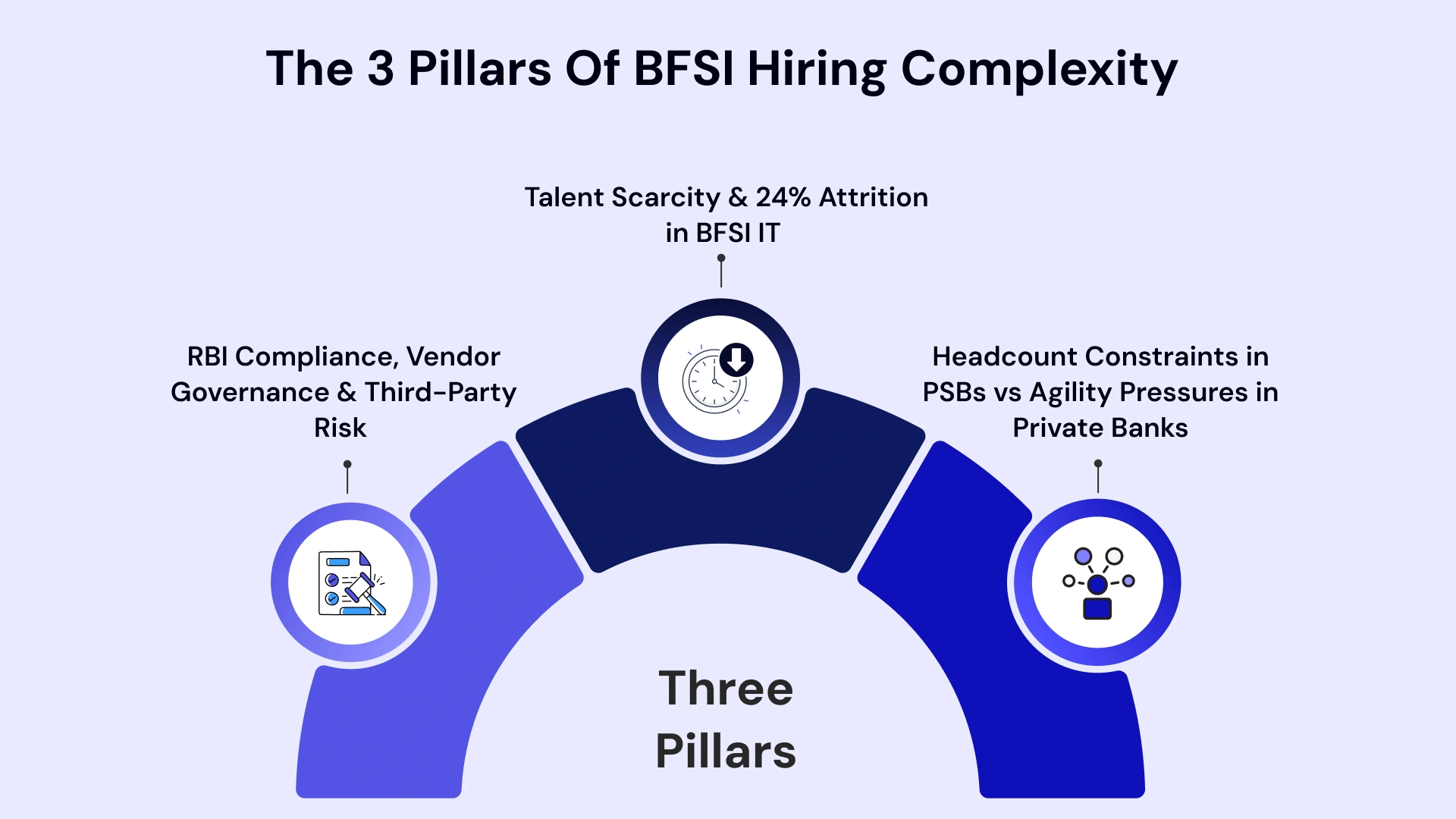
RBI Compliance, Vendor Governance & Third-Party Risk
The RBI Master Directions on Outsourcing of IT Services apply directly to augmented staff arrangements. Banks must maintain an approved vendor list, conduct annual risk assessments, and ensure augmented resources follow internal data security protocols.
This adds 5–8% to the total engagement cost. It also means vendor selection goes beyond rate cards.
Any augmentation partner must support RBI audit trails, data residency controls, and 'right to audit' provisions. A cheap vendor without compliance maturity can become a regulatory liability.
Talent Scarcity & 24% Attrition in BFSI IT
BFSI IT attrition in India hit 24% in 2025 (NASSCOM). Senior roles in cloud architecture, cybersecurity, and GenAI are the hardest to retain.
When an experienced engineer leaves a bank mid-project, the rehiring cost is not just the next salary. It includes lost productivity, knowledge transfer time, and re-onboarding.
Research from PCG International India shows the true rehiring cost ranges from 1.4x to 2.2x the annual CTC of the departing employee.
Over a 24-month digital transformation, two such exits can wipe out all projected cost savings from a full-time hire.
Headcount Constraints in PSBs vs Agility Pressures in Private Banks
Public sector banks operate under government-mandated headcount freezes. Hiring 50 cloud architects through the standard recruitment cycle can take 6–12 months.
Private banks face the opposite challenge. They need to launch GenAI features, digital channels, and UPI 2.0 integrations faster than their internal HR pipelines allow.
Both scenarios demand a staffing model that matches institutional constraints — not just the cheapest option on paper.
What Is IT Staff Augmentation for Indian Banks?
IT staff augmentation services mean bringing in external technical professionals on a contract basis. They work under your project management. They follow your internal processes and security protocols.
Unlike managed services, you retain control of delivery. Unlike outsourcing, the augmented team integrates into your squads.
How Staff Augmentation Works in Regulated BFSI
In a BFSI context, augmented staff must clear the bank's vendor onboarding process. This includes background verification, NDA execution, MFA access provisioning, and security orientation.
Once onboarded, they function like internal team members. The vendor handles payroll, benefits, and HR. The bank handles project direction and compliance access.
How It Differs from Managed Services & Outsourcing
| Model | Control | Accountability | Cost Structure |
Staff Augmentation | Bank | Vendor supplies, Bank manages | Per-day billing rate |
Managed Services | Shared | Vendor owns the delivery | SLA-based fixed fee |
Outsourcing | Vendor | Vendor owns outcomes | Project/milestone-based |
Pro Tips: - Ideal staff augmentation strategies give the most control. It also requires the most internal management bandwidth. Under the 2025 RBI guidelines, augmented staff must follow the same Zero Trust and MFA protocols as employees. Security is a process — not a hiring status.
What Counts as Full-Time IT Hiring in Indian Banks?
An on-roll IT hire in an Indian bank carries a structured CTC that includes:
- Base salary + House Rent Allowance (HRA)
- Provident Fund — employer share at 12% of basic
- Gratuity provision at 4.81% of basic
- Group mediclaim and term insurance
- Performance bonuses — 10–15% of CTC
- Variable pay — often 10–20% in private banks
- For a senior cloud engineer at ₹30L CTC, the employer's effective payout, including all statutory contributions, is closer to ₹36–38L per year.
- Some banks engage IT professionals through payroll partners for 12–24-month contracts. This reduces the direct HR load but shifts compliance risk to the payroll vendor.
- These arrangements often cost more per month than direct hiring, while offering less control than augmentation.
Complete Cost Breakdown of Full-Time IT Hiring in India BFSI
For a Senior IT Professional (₹25L–₹45L CTC band) in Indian BFSI:
Cost Component | Estimated Range |
Annual Base Salary | ₹20L – ₹36L |
Employer PF Contribution | ₹1.2L – ₹2.2L |
Gratuity Provision | ₹0.96L – ₹1.7L |
Group Insurance (Medical + Term) | ₹0.5L – ₹1.5L |
Performance Bonus | ₹2.5L – ₹7L |
Equipment & Software Licenses | ₹0.8L – ₹1.5L |
Effective Annual Cost (Total) | ₹26L – ₹50L |
Note: - Based on our latest IT staffing cost analysis India, the total cost of employment for senior BFSI IT professionals generally includes a benefits load of 18–22% beyond the base CTC.
Indirect Costs
These are the costs most banks underestimate:
- Recruitment fees: 2–3 months' salary for niche tech roles via agencies
- Onboarding & training: 4–8 weeks of reduced productivity plus formal compliance training
- Background verification: ₹5,000–₹15,000 per hire, plus 2–3 weeks turnaround
- Bench time: Average 6–8 weeks per resource per year
- Notice period drag: 90-day notice means 3 months of cost with declining productivity
Note: - For tech talent sourcing in India, add the above together for a senior hire. The indirect cost load rises to 25–40% above base CTC in the first year.
Attrition & Rehiring Economics (1.4x–2.2x CTC Impact)
- BFSI IT attrition is running at 24%. That means roughly 1 in 4 senior IT hires will leave within 12–18 months.
- The PCG International India benchmark for rehiring cost: 1.4x–2.2x the annual CTC of the departing employee.
- For a ₹35L CTC engineer, one attrition event costs ₹49L–₹77L in total replacement cost.
Cost Structure of IT Staff Augmentation in India BFSI
Augmented IT professionals in India are billed on a per-day basis. Rates vary by role and experience.
Billing Rate Model (₹3,500–₹12,000/Day)
Role | Daily Rate Range | Approx. Monthly Cost |
Mid-level Developer | ₹3,500–₹5,500 | ₹84K–₹1.32L |
Senior Cloud / DevOps | ₹6,000–₹9,000 | ₹1.44L–₹2.16L |
Principal Architect | ₹8,000–₹12,000 | ₹1.92L–₹2.88L |
Cybersecurity Specialist | ₹7,000–₹11,000 | ₹1.68L–₹2.64L |
Billing rates are all-inclusive of vendor margin, statutory benefits, and resource salary. There are no PF, gratuity, or bonus surprises.
Vendor Margin & Built-In Benefits
Typical vendor margins in India range from 18–28%. This margin covers:
- Resource salary and all statutory benefits
- Recruitment and bench costs
- Account management and delivery support
From the bank's perspective, the billing rate is a clean, predictable line item.
Internal Governance & Audit Overhead (5–8%)
BFSI augmentation contracts carry governance costs that generic guides ignore.
These include:
- Vendor onboarding and security review: 2–3 weeks per engagement
- Annual third-party risk assessments — RBI-mandated
- Access management provisioning and de-provisioning
- NDA and IP assignment documentation
- Audit trail maintenance
Budget an additional 5–8% of total engagement cost for this governance layer.
Compliance Add-Ons Under RBI
RBI's third-party risk management framework requires banks to:
- Maintain a Board-approved IT outsourcing policy
- Conduct due diligence on all augmentation vendors
- Include 'right to audit' clauses in all contracts
- Ensure data residency within India for regulated processes
- Implement business continuity provisions for vendor failure
These are not optional costs. Factor them into your TCO model before comparing rates.

Side-by-Side Cost Comparison (12–24 Month Horizon)
To provide a transparent cost-benefit analysis of IT Staff Augmentation vs Full-Time Hiring, we have modeled the 12–24 month financial horizon across several common industry scenarios.
Scenario 1 – 12-Month Digital Channels Upgrade
- Project: Mobile banking app revamp — 5 specialists needed
- Roles: 2 Senior React Native Developers, 1 UX Lead, 1 DevOps Engineer, 1 QA Automation Lead
Cost Element | Full-Time Hiring | Staff Augmentation |
Annual Salary / Billing Cost | ₹1.4 Cr | ₹1.65 Cr |
Recruitment & Onboarding | ₹18L | ₹4L |
Compliance & Governance | ₹3L | ₹8L |
Attrition Risk (24%) | ₹28L (1.2 exits expected) | ₹0 |
Post-Project Bench / Severance | ₹22L | ₹0 |
12-Month TCO (Total) | ₹1.71 Cr | ₹1.77 Cr |
Verdict: Costs are nearly equal at 12 months in IT staff augmentation vs full-time hiring. Augmentation wins on speed-to-start (3 weeks vs 10 weeks) and zero post-project liability.
Scenario 2 – 24-Month Core Banking Modernization
- Project: Core banking services platform migration — 10 specialists
- Roles: Cloud architects, API developers, data engineers, security analysts, QA leads
Cost Element | Full-Time Hiring | Staff Augmentation |
24-Month Salary / Billing Cost | ₹5.8 Cr | ₹6.6 Cr |
Recruitment & Onboarding | ₹35L | ₹8L |
Compliance & Governance | ₹6L | ₹18L |
Attrition Risk (24% x 2 years) | ₹1.1 Cr (4–5 exits expected) | ₹0 |
Post-Project Bench / Severance | ₹45L | ₹0 |
24-Month TCO (Total) | ₹7.76 Cr | ₹7.26 Cr |
Verdict: At 24 months, staff augmentation cost vs permanent hiring analysis shows that augmentation is the more economical choice. The high cost of attrition and long-term liabilities inherent in full-time hiring create a tipping point that favors the augmentation model.
Breakeven Horizon Analysis
The break-even point between IT staff augmentation vs full-time hiring for BFSI projects typically falls between 18-22 months. Below this threshold, augmentation costs more but delivers more flexibility.
Given BFSI's 24% attrition reality, the break-even in practice sits closer to 26–30 months.
Payroll Lock-In vs Vendor Lock-In: A Banking CIO's Real Dilemma
Most cost comparisons treat augmentation as the 'flexible' option and full-time hiring as the 'stable' one. The reality is more nuanced.
Long-Term Payroll Liabilities
Every full-time IT hire creates:
- Ongoing gratuity provisions — 5 years to vest
- PF corpus accumulation
- Notice period obligations — typically 90 days in BFSI
- Severance risk if roles become redundant post-project
In a PSB where headcount additions require budget committee approvals, building a 50-person cloud team for a 3-year modernization creates a 50-person HR liability afterward.
Vendor Dependence & Rate Escalation
Augmentation has its own lock-in risks. Vendors often escalate rates after the first 12 months. Average IT staffing rate escalation in India runs at 8–12% per year.
Dependency on a single vendor for niche skills can create leverage imbalances during contract renewal.
Continuity & Knowledge Retention Risk
When an augmented contract ends, institutional knowledge walks out. Banks relying heavily on augmented teams for mission-critical systems face documentation gaps and handover risks.
For Mitigation: Build mandatory shadowing periods — the final 2 weeks of every contract — where augmented staff document and transfer system knowledge to internal FTEs.
Role-Based Recommendations for BFSI IT Leaders
The following recommendations are tailored to the primary IT leadership pillars in a modern financial institution.
Roles Better Suited for Full-Time Hiring
Some BFSI IT functions demand continuity, institutional knowledge, and regulatory accountability. These are better served by permanent hires.
- Core banking system maintenance — deep system knowledge, regulatory accountability
- Regulatory reporting & compliance systems — requires long-term ownership
- CISO and security leadership roles — board-level accountability cannot be augmented
- IT risk management and audit interfaces — requires internal authority
- For these roles, the stability premium of a full-time hire is worth paying.
Roles Where Staff Augmentation Delivers Speed
For time-bound, skill-scarce, or project-based functions, augmentation delivers clear advantages.
- Cloud migration architects — needed for 12–18 months, then the role shrinks
- Data engineering and analytics pipelines — sprint-based, niche skills
- UI/UX modernization and digital channels — project-bound, faster through augmentation
- GenAI experimentation teams — rapidly evolving skills, prevent overpaying for future commodities
- QA automation leads — peak-load demand, scales down post-launch
Public vs Private Banks – Cost & Governance Differences
In 2026, the divide between public and private banks is defined by a trade-off between social mandate and operational agility. While public banks benefit from a lower "cost of trust," they often face higher structural costs and rigid governance compared to their private counterparts.
PSU Scenario
A large Indian PSB needed 50 cloud architects for a 12-month core banking migration. Standard government recruitment cycles would have taken 8–10 months to fill these roles.
They chose staff augmentation. Result: Saved 6 months in hiring time. Avoided long-term pension and benefit liabilities for 50 high-salary employees after migration ended.
Key insight: For PSBs under headcount constraints, augmentation is not a cost choice — it is the only viable operational choice.
Private Bank Scenario
A leading private bank needed to build and maintain a digital-first mobile app team — React Native, Node.js, DevSecOps, and UX.
For the initial build phase (14 months), they used augmentation. Post-launch, they converted 4 high-performing augmented resources to permanent employees.
This hybrid approach cut time-to-launch by 5 months. It created a permanent team with deep product context.
Key insight: Private banks can use augmentation for speed, then convert critical resources to full-time for knowledge retention.

Decision Framework for CIOs & CTOs (Board-Ready Matrix)
The following matrix is designed for executive-level presentations, categorizing technical initiatives by their strategic impact on the balance sheet.
The 5-Factor Evaluation Model
Use this model before any BFSI staffing decision:
Factor | Choose Full-Time If | Choose Augmentation If |
Project Duration | > 30 months | < 24 months |
Regulatory Sensitivity | Core/compliance systems | Digital/analytics layers |
Skill Scarcity | The role is permanently needed | Skill is project-specific |
Budget Flexibility | Predictable multi-year budget | Project-based or flexible |
Knowledge Retention Risk | High — mission-critical system | Low — documentation possible |
The 80/20 Core-and-Flex Workforce Rule
Leading BFSI CIOs are moving to a Core-and-Flex workforce architecture:
- 80% Core (FTE): Security leadership, core banking teams, regulatory reporting, product owners, enterprise architects
- 20% Flex (Augmentation): Cloud migration, data science, UI/UX, DevOps, AI experimentation
This structure protects against knowledge drain while giving banks the digital muscle to move fast on transformation projects.
Leveraging VLink's Expertise for BFSI IT Staffing
Indian banks don't need a generic augmentation vendor. They need a partner who understands RBI compliance, BFSI delivery timelines, and the cost dynamics covered in this guide.
VLink brings deep expertise across financial services, banking services, and regulated IT staffing. Our IT staff augmentation services are built for the BFSI context — with RBI-ready contracts, audit-trail governance, and transparent billing.
Scale your financial tech capabilities with VLink. Whether you’re hiring niche cloud architects or an entire offshore development center, our India-based sourcing specializes in high-stakes BFSI domains:

- Modernization: Core banking and payments evolution.
- Infrastructure: Cloud migration and integrated DevSecOps.
- Intelligence: Data engineering and regulatory reporting analytics.
- Protection: Cybersecurity and automated compliance frameworks.
- Innovation: GenAI integration and digital channel optimization.
Our staff augmentation strategies are built around the 80/20 Core-and-Flex model. We help BFSI leaders build compliant, cost-efficient, and agile IT teams — without the payroll lock-in risk. Explore our ideal IT Services and dedicated teams models for long-term BFSI engagements.
Ready to Scale Your IT Capabilities? Our experts are standing by to help you design a staffing strategy that meets your specific compliance and budgetary goals. Reach out today to start the conversation.

Business Development Professional
Vineel is a seasoned sales and business development leader with extensive experience in the telecommunications and IT industries. Over the course of his career, he has worked with global teams at multinational organizations, having lived and operated in India, Canada, the Netherlands, and the United Kingdom.

 Shivisha Patel