
Application modernization isn't just an IT upgrade; it's the process of transforming legacy software into flexible, cloud-ready systems.
But depending on whether you simply rehost an app or completely rebuild it from scratch, Application Modernization Services cost anywhere from $150,000 to over $2.5 million. Asking three enterprise software vendors for an estimate often yields radically different quotes. This wide variance isn’t arbitrary; it directly reflects the fundamental risk profile and complexity of upgrading legacy infrastructure.
To protect your margins and maximize ROI, gaining clarity on your true application modernization services cost is essential before locking in budgets. In real-world enterprise environments, realistic application modernization cost figures range from $35,000 for modular UI updates or microservice extractions to $1,500,000+ for multi-year core legacy rewrites. For most mid-market platforms, the baseline application modernization services cost between $120,000 and $320,000 per core application.
The Heavy Financial Toll of Stagnation
Holding on to fragile legacy tech creates severe operational drag and inflates application modernization costs over time:
- 74% Maintenance Surcharge: Enterprise engineering teams spend nearly three-quarters of their total bandwidth fixing bugs, managing server updates, and maintaining custom patches.
- 3.2x Operating Costs: Software running past its official End-of-Life (EOL) costs 3.2 times more per user than modern cloud architectures, driven by specialized license fees and high contractor rates.
- Slow Feature Deployment: Monolithic platforms make simple software updates risky, delaying new features and giving agile competitors a massive head start.
When working through your application modernization budget planning, evaluating overall application modernization costs requires looking at specific pain points across key decision-makers:
- CTO & VP of Engineering: Battling fragile monoliths, unmapped dependencies, and technical debt that slows down engineering sprints and increases cloud application modernization cost risks.
- CFO & VP of Finance: Worried about dual-run infrastructure expenses during migration, unpredictable cloud application modernization cost projections, and rising platform license renewals.
- CIO & IT Directors: Struggling with scarce legacy talent (COBOL, VB6, legacy Java), zero documentation, high legacy software modernization costs, and unmaintained security vulnerabilities.
- Head of Product & CPO: Stymied by slow feature rollouts, sluggish software performance, and applications that cannot connect with modern REST APIs or AI services.
- PE Operating Partner & Portfolio CTO: Seeking to cut technical debt post-acquisition, control total enterprise application modernization cost, improve EBITDA margins, and scale business valuation within a 3-to-5-year exit timeline.
Partnering with an experienced application modernization services provider gives leadership teams a proven framework to update legacy systems safely while keeping overall project costs under tight control.

Key Cost Benchmarks: What Does Modernization Actually Cost in 2026?
Establishing an accurate application modernization cost estimate requires looking closely at code architecture, software complexity, and integration requirements. Evaluating baseline application modernization service costs across typical project scopes reveals:
- Small / Modular Modernization ($35,000 – $90,000): Takes 2 to 4 months. Focuses on UI/UX overhauls, wrapping legacy business logic in REST APIs, or basic cloud rehosting (Lift and Shift).
- Mid-Tier Monolith Modernization ($120,000 – $320,000): Takes 5 to 9 months. Involves breaking monolithic databases and business logic into domain microservices, setting up automated CI/CD pipelines, and cloud refactoring. Total application modernization services cost for this tier averages $180,000.
- Enterprise Core Transformation ($350,000 – $1,200,000+): Takes 10 to 18+ months. Reserved for complex core rewrites (mainframes, COBOL, VB6), reverse-engineering undocumented logic, and passing strict compliance audits. At this scale, overall enterprise application modernization costs frequently exceed $500,000.
- Cost Per Line of Code: Basic cloud replatforming averages $3.50 to $5.50/LoC, whereas refactoring tightly coupled, undocumented legacy code increases the cost of modernizing legacy applications to $8.00 to $12.00+/LoC.
- Legacy Developer Premium: Contracting specialists for legacy frameworks commands rates of $160 to $240/hr, making legacy software modernization cost high compared to cloud-native development models.
- Dual-Run Surcharge: Operating parallel legacy and cloud systems during migration adds a temporary 15% to 30% operational surcharge.
- Payback Horizon: Well-executed refactoring projects achieve full financial break-even within 12 to 22 months by eliminating EOL license fees, reducing compute waste, and boosting team velocity.
To optimize your initial software modernization cost projections, it is essential to factor in both technical architecture and team composition before starting full application modernization implementation.
Master Application Modernization Cost Matrix: Scope, Teams & Timeline
Understanding how an application modernization cost breakdown is calculated requires mapping project complexity directly to delivery team structure, investment, and payback timelines. Detailed application modernization cost breakdown analyses show clear distinctions across enterprise tiers:
| Project Scope & Complexity | Primary Architecture Strategy | Core Team Structure | Delivery Timeline | Total Cost Range ($) | Payback & ROI Timeline |
Tier 1: Modular / UI Focus Single module update, REST API layer wrapping, basic cloud rehosts. | Rehost / Replatform | 1 Cloud Architect, 2 Full-Stack Devs, 1 QA Engineer (Part-Time) | 2 – 4 Months | $35,000 – $90,000 | 6 – 10 Months Immediate performance gains and user UX wins. |
Tier 2: Mid-Tier Monolith Decoupling core workflows, refactoring databases, microservices, CI/CD pipelines. | Refactor / Rearchitect | 1 Lead Architect, 1 Project Manager, 3 Sr. Devs, 1 DevOps, 1 QA Lead | 5 – 9 Months | $120,000 – $320,000 | 12 – 18 Months 60% lower maintenance costs, 2.5x faster releases.
|
Tier 3: Enterprise Core System Legacy mainframe, VB6/COBOL rewrite, multi-module microservices. | Rearchitect / Rebuild | 1 Solution Architect, 1 Delivery Manager, 6 Devs, 2 DevOps, 2 QA/Security Engineers | 10 – 18+ Months | $350,000 – $1,200,000+ | 18 – 24 Months Eliminates EOL risk, maximizes valuation ahead of exit.
|
Modernization vs. Off-the-Shelf (COTS) System Replacement
Choosing between modernizing an existing legacy application and replacing it with a Commercial Off-the-Shelf (COTS) or SaaS solution hinges on one core question: Is this software a unique competitive advantage, or a standardized business utility?
Strategy Comparison Matrix
| Evaluation Criteria | Iterative Application Modernization | Outright COTS / System Replacement |
| Upfront Capital Investment | Controlled ($120k - $320k): Capital spread across quarterly sprints. | High ($500k - $2M+): Large upfront licensing, setup, and integration fees. |
| Operational Business Risk | Low: Preserves proven business logic and custom workflows. | High: Up to 50% of full replacements fail or lose core business rules. |
| Time-to-Value | Fast (2 - 4 Months): Incremental feature rollouts deliver early ROI. | Slow (12 - 24 Months): Zero business value until full system cutover. |
| Custom Process Retention | 100% Retained: Competitive operational advantages remain intact. | Compromised: Forces teams to alter business workflows to fit standard software rules. |
Decision Framework: Modernization vs. COTS
Go with Legacy Modernization when:
- It’s your secret sauce: Contains proprietary algorithms, custom features, or core IP that drive competitive edge.
- Organizational disruption is too high: Overhauling deep-rooted workflows or retraining thousands of users risks major downtime.
- Integrations are complex: Bound to legacy databases, custom hardware, or non-standard internal systems.
Go with COTS / SaaS when:
- It’s a commodity function: standard utilities like HR, Payroll, CRM, or ERP don't justify custom builds.
- Speed to market is paramount: Out-of-the-box cloud security, reporting, and mobile features can be deployed in months, not years.
- Engineering bandwidth is tight: Lacking in-house resources to build, maintain, and secure a custom platform long-term.
The Hybrid Approach: Composable Architecture Offload standard capabilities (billing, identity, analytics) to off-the-shelf APIs while refactoring only your high-value core logic into modern microservices.
Industry-Specific Application Modernization Cost Benchmarks
Application modernization costs vary significantly across industries due to differing regulatory frameworks, legacy code age, integration density, and downtime tolerance. Specialized security requirements and industry-specific data standards directly impact engineering labor hours and total capital allocation.
Industry-Specific Benchmarks
| Industry Sector | Typical Cost Range | Primary Architectural Drivers | Key Compliance & Cost Factors |
| Financial Services & Banking | $250,000 – $1,500,000+ | Mainframe/COBOL decoupling, high-frequency transaction engines, core banking refactoring. | Strict PCI-DSS, SOX, and SOC 2 audits; mandatory zero-downtime cutovers. |
| Healthcare & Life Sciences | $150,000 – $900,000 | Legacy EHR/EMR migrations, HL7/FHIR API integration, HIPAA-compliant cloud storage. | Data privacy compliance (HIPAA/FDA), sensitive patient record encryption, audit logging. |
| FMCG, Retail & E-Commerce | $80,000 – $400,000 | Monolith-to-headless commerce, real-time inventory sync, mobile sales force automation. | High concurrency handling for peak shopping events, low-latency mobile API layers. |
| Logistics & Supply Chain | $100,000 – $500,000 | Custom ERP refactoring, IoT/telematics stream processing, dynamic route optimization. | Complex multi-carrier integrations, real-time tracking, and legacy database syncing. |
| Public Sector & Government | $300,000 – $1,200,000+ | Decades-old state/federal mainframes, custom database reverse engineering. | FedRAMP/StateRAMP standards, strict procurement, and scarce legacy language skills. |
Key Sector Cost Influencers
- Regulatory Overhead: Healthcare and financial applications incur a 20% to 35% cost premium due to continuous vulnerability testing, encryption validation, and compliance documentation.
- Transaction Velocity: High-volume platforms (Retail and Logistics) require distributed microservice architectures and serverless auto-scaling, driving up initial cloud refactoring expenses while dropping long-term hosting overhead.
- Integrations & Legacy Debt: Banking and government platforms often feature thousands of undocumented stored procedures, increasing the discovery phase timeline by 4 to 8 weeks compared to commercial SaaS platforms.
5 Core Technical Drivers Behind Your Application Modernization Budget
When analyzing key application modernization cost factors, five key architectural elements dictate final project investments. Understanding these application modernization cost factors enables engineering leaders to construct realistic financial models:
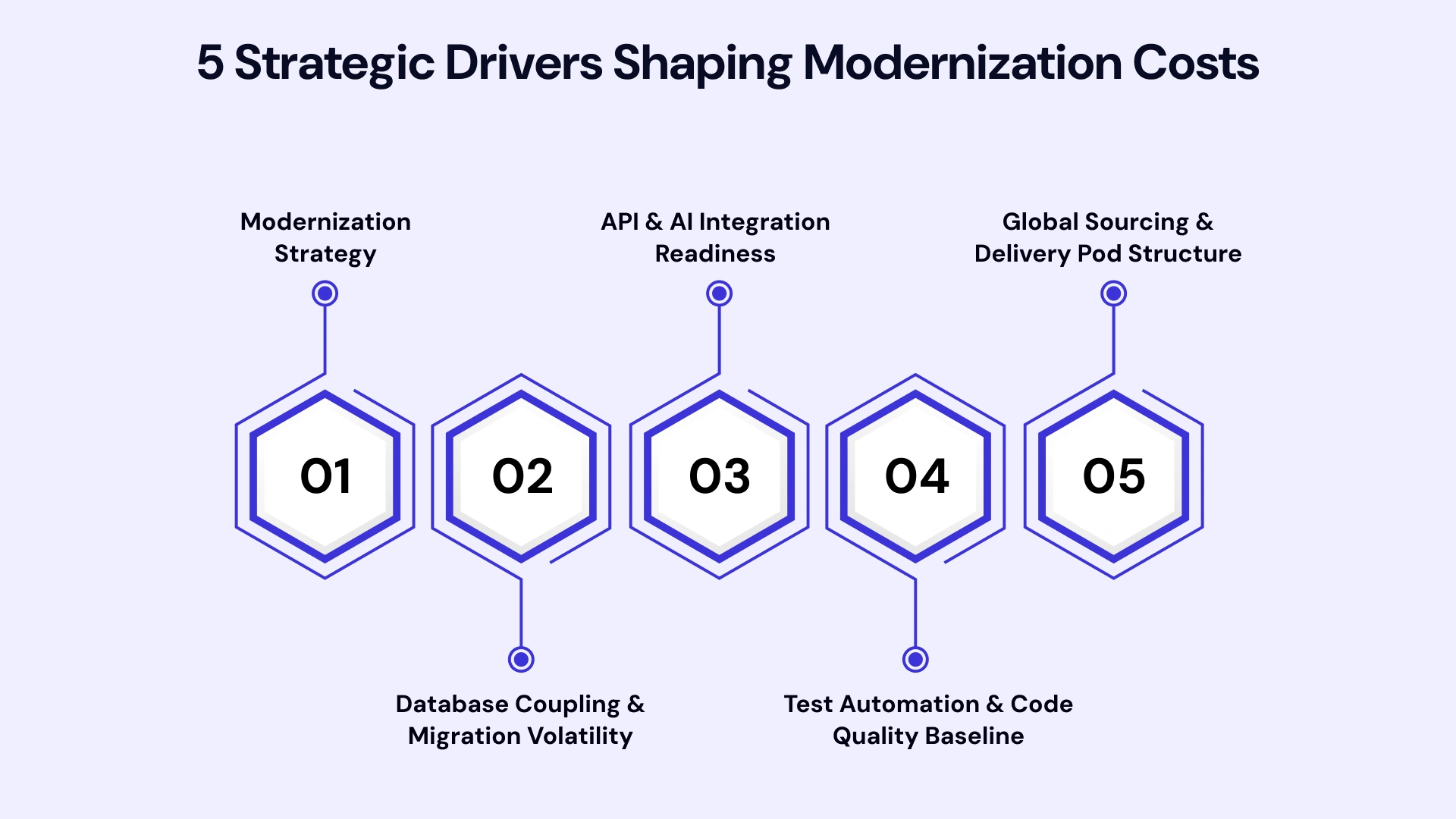
1. Modernization Strategy Selection:
- Rehost (Lift & Shift): Lowest initial application modernization project cost ($35k - $70k) but leaves core technical debt untouched.
- Replatform: Moderate investment ($70k - $140k), upgrades underlying databases and OS without rewriting business logic.
- Refactor / Rearchitect: Higher upfront cost ($150k - $320k+), converts monolithic systems into modular microservices for long-term scalability.
- Rebuild: Full rewrite ($300k - $800k+) using modern cloud frameworks.
2. Database Structure & Migration Volatility:
Extracting legacy relational databases (Oracle, MS SQL) with thousands of stored procedures requires structured ETL engineering and thorough data synchronization, directly shaping legacy application migration cost and overall legacy application modernization cost.
3. API & Ecosystem Integration Readiness:
Connecting older SOAP web services or mainframe backends with modern REST APIs or AI services requires custom wrapper layers, impacting application modernization implementation timelines and long-term maintainability.
4. Test Automation Baseline:
Applications lacking unit tests force engineering teams to perform manual regression testing. Building automated test pipelines early during application modernization implementation cuts long-term QA overhead by up to 30%.
5. Delivery Team Sourcing:
Onshore US consulting firms charge $180 to $250/hr, raising total application modernization consulting cost significantly. Pure offshore outsourcing ($25–$35/hr) frequently struggles with communication gaps and architectural standards. A hybrid delivery model combining US tech leads with global development pods ($45–$75/hr blended) lowers application modernization expenses by 40% to 50% while maintaining enterprise quality.
Note: Evaluating application modernization cost in the US versus hybrid execution keeps total application modernization cost for U.S. enterprise budgets fully optimized while maintaining predictable application modernization consulting cost controls.
Hidden Expenses & Risk Mitigation: Uncovering Unbudgeted Surprises
Budget overruns rarely come from primary development hours; they happen when unmapped dependencies, unexpected technical risks, or compliance needs to pop up mid-project, increasing legacy system modernization cost beyond initial projections.
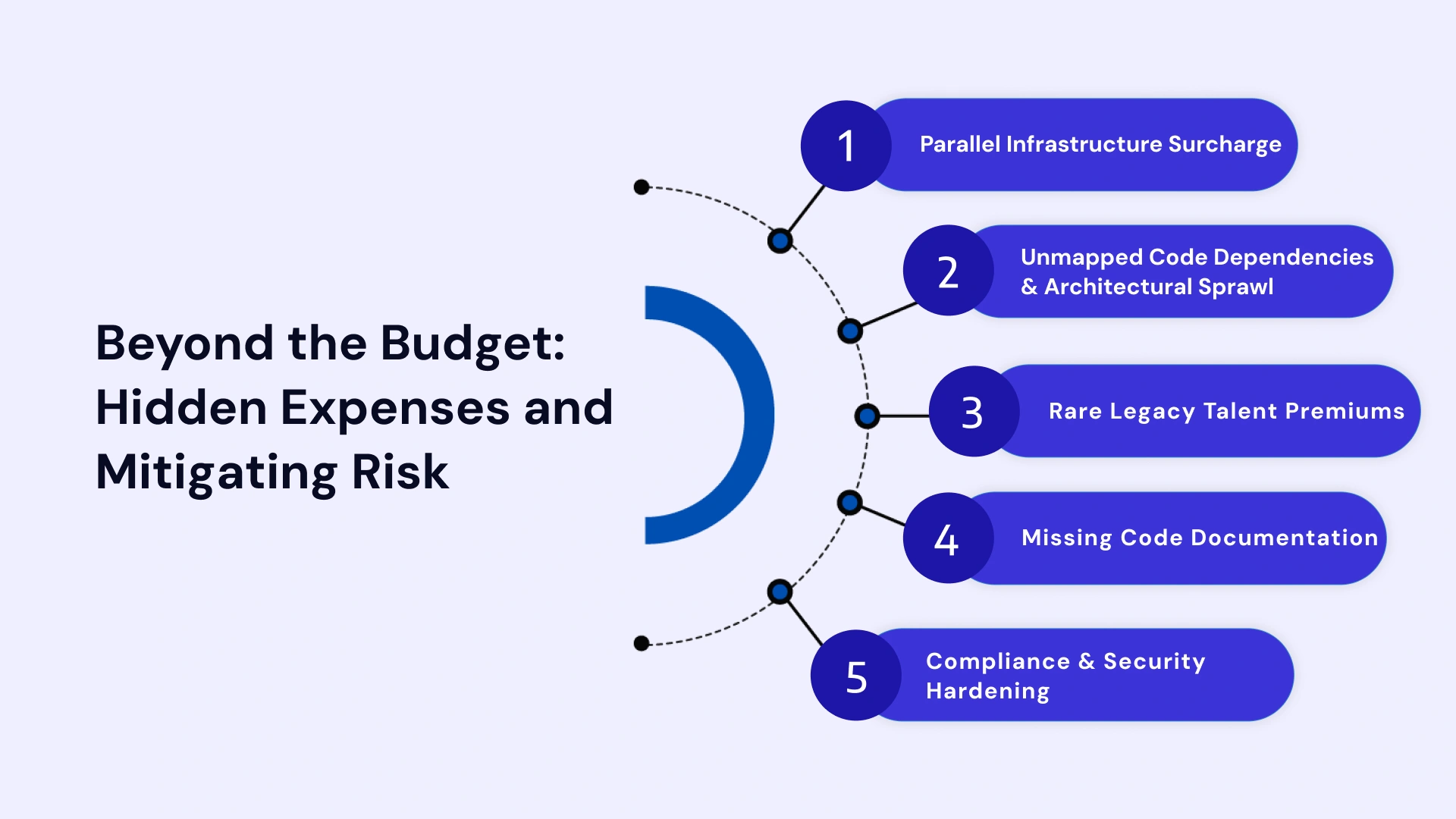
1. Parallel Infrastructure Surcharge (Dual-Run Overhead)
Migrating core applications incrementally using patterns like Strangler Fig requires running legacy servers alongside the new cloud environment for several months.
- Financial Impact: Adds a 15% to 30% temporary spike in hosting and data sync expenses.
- Mitigation: Set strict, milestone-based decommission dates for legacy modules as soon as cloud microservices complete validation.
2. Unmapped Code Dependencies & Architectural Sprawl
Decades-old software often hides undocumented SQL database triggers, forgotten third-party libraries, and hardcoded batch scripts, driving up overall legacy application migration cost.
- Financial Impact: Triggers scope creep that can increase overall legacy system modernization costs by 25% to 40%.
- Mitigation: Conduct automated static code discovery during week one to map code dependencies visually before building modern microservices.
3. Rare Legacy Talent Premiums
Sourcing contract developers who know legacy languages like COBOL, VB6, or early Java releases commands for premium billing rates.
- Financial Impact: Bumps up standard project budgets and increases specialized engineering rates.
- Mitigation: Use AI-assisted code parsing combined with cross-functional engineering teams fluent in both legacy logic and cloud frameworks.
4. Missing Code Documentation
Over 70% of legacy applications lack accurate documentation, forcing engineers to review code line by line just to understand business rules.
- Financial Impact: Consumes 4 to 8 weeks of unbudgeted discovery ($30,000–$75,000 in labor).
- Mitigation: Deploy automated discovery tools to extract business rules directly from source code and schemas during the initial sprint.
5. Compliance & Security Hardening
Moving regulated data (healthcare, financial, PCI) to cloud environments without pre-built security automation leads to costly rework.
- Financial Impact: Audit delays, security fixes, and compliance penalties.
- Mitigation: Build automated security checks and compliance testing directly into your CI/CD delivery pipeline from day one.
Application Modernization Pricing Models
Choosing the right commercial structure ensures predictable financial control while maintaining development flexibility. Evaluating different application modernization pricing models alongside overall application modernization pricing options helps executives align contracts with financial goals:
- Fixed-Price Model: Best for well-documented, smaller projects with rigid scope requirements. Delivers predictable costs but offers limited flexibility if requirements change.
- Time & Materials (T&M): Ideal for complex enterprise refactoring where initial discovery uncovers evolving system requirements. Provides maximum flexibility, though managing total enterprise application modernization cost requires disciplined sprint oversight.
- Dedicated Team / Managed Pods: Combines cost predictability with agility. You can secure a dedicated team (Architect, Developers, DevOps, QA) at a fixed monthly rate, allowing dynamic backlog prioritization while optimizing application modernization services pricing.
- Outcome-Based Pricing: Ties vendor compensation to specific business milestones, such as reducing cloud hosting costs or accelerating release cadence.
Evaluating these application modernization pricing models allows leadership teams to align vendor contracts with internal capital goals. To expand digital touchpoints, organizations frequently combine these frameworks with custom Application Development Services for multi-platform delivery. Understanding baseline application modernization pricing structure ensures full transparency throughout the execution lifecycle.
Pragmatic Strategies to Reduce Total Legacy System Modernization Cost
Modernizing mission-critical software does not require huge upfront capital or high-risk cutovers. These practical strategies help control enterprise application modernization spending and manage overall enterprise application modernization initiatives efficiently:
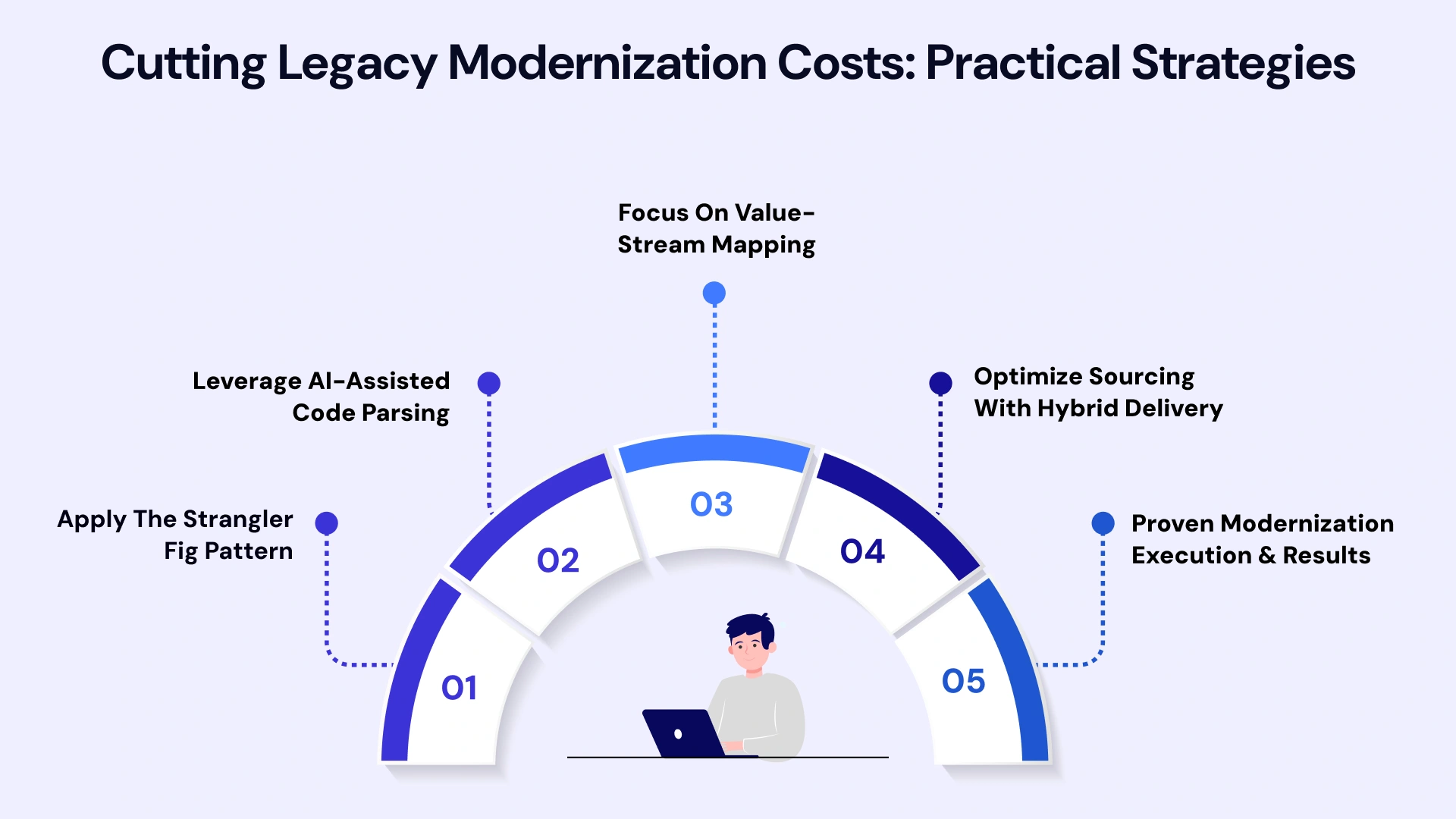
- Apply the Strangler Fig Pattern
Rather than attempting a risky "Big Bang" cutover, use the Strangler Fig approach. Replace legacy application modules incrementally with modern microservices behind an API Gateway, rerouting live traffic step by step as each component passes QA.
Cost Impact: Spreads your application modernization budget across manageable quarters, avoids downtime, and cuts down on parallel hosting fees.
- Leverage AI-Assisted Code Parsing
Modern code transformation tools parse legacy syntax (COBOL, VB6, Java 1.4) into modern languages (C#, Python, Node.js) while generating clean software documentation automatically.
Cost Impact: Cuts discovery time in half, saving up to $50,000 in code audit expenses and lowering the overall cost of modernizing legacy applications.
- Focus on Value-Stream Mapping
PE Operating Partners and product leaders don't need to rebuild 100% of an application. Use value-stream mapping to identify the 20% of core modules that process 80% of business transactions.
Cost Impact: Directs engineering budgets toward high-impact workflows, lowering total legacy application modernization cost while improving key operational metrics.
- Optimize Sourcing with Hybrid Delivery
To balance quality and application modernization services pricing, leverage a hybrid delivery structure. Pair US-based solution architects for strategic oversight with global engineering pods for execution to achieve savings of up to 50% compared to pure onshore consulting.
Cost Impact: Reduces execution and development expenses by 45-50% without compromising architectural governance, directly optimizing overall application modernization services pricing.
- Proven Modernization Execution & Results
Successfully modernizing legacy systems isn't just about choosing the right architectural pattern; it's about execution, risk mitigation, and realizing measurable financial returns from day one.
VLink’s Modernization Acceleration Framework (MAF) pairs structured execution with dedicated engineering pods to eliminate cost guesswork, safely bridge legacy code to cloud-native microservices, and accelerate time-to-value.
Our approach has delivered zero-downtime Azure migrations for critical national healthcare systems like the National Blood Exchange, as well as mobile re-architecting for FMCG leaders like Marico- driving a 2x faster app experience, 40% reduced operational processing time, and a 30% boost in sales revenue.
In Summary
Application modernization is an investment in reducing operational costs, protecting data security, and driving engineering speed. By choosing the right architectural approach, managing dual-run hosting expenses, and utilizing a hybrid delivery model, organizations can modernize legacy core systems predictably without budget overruns.
Whether you are managing enterprise application modernization across global operations or executing targeted enterprise application modernization upgrades locally, establishing realistic cost benchmarks ensures technology investments deliver measurable long-term value. Overcoming the technical challenges of enterprise application debt starts with a clear, incremental roadmap.
Modernize Core Applications Without Budget Overruns.
Stop relying on rough vendor estimates. Partner with VLink experts for a complimentary, zero-friction Architectural & Technical Debt Assessment to build a data-driven modernization roadmap.

Business Development Professional
Vineel is a seasoned sales and business development leader with extensive experience in the telecommunications and IT industries. Over the course of his career, he has worked with global teams at multinational organizations, having lived and operated in India, Canada, the Netherlands, and the United Kingdom.

 Shivisha Patel