

Artificial intelligence in media is already transforming how leading platforms engage audiences, reduce churn, and drive revenue growth.
Netflix knows what you want to watch before you do. Spotify curates playlists that feel personal.
This is not coincidence — it’s AI powering real-time personalization at scale.
Yet across the U.S. and Canada, media companies are struggling to retain audiences. Nearly 4 in 10 users have canceled a streaming service in the past six months.
The problem isn’t content. It’s content discovery, personalization, and data utilization.
Leading platforms are already solving this with AI-driven media solutions:
- Netflix drives over 80% of viewing through AI-powered recommendations
- Spotify uses AI to deliver highly personalized listening experiences
- YouTube influences over 70% of watch time through AI-driven recommendations
While these platforms operate at massive scale, the same challenges and opportunities exist for mid-sized media companies.
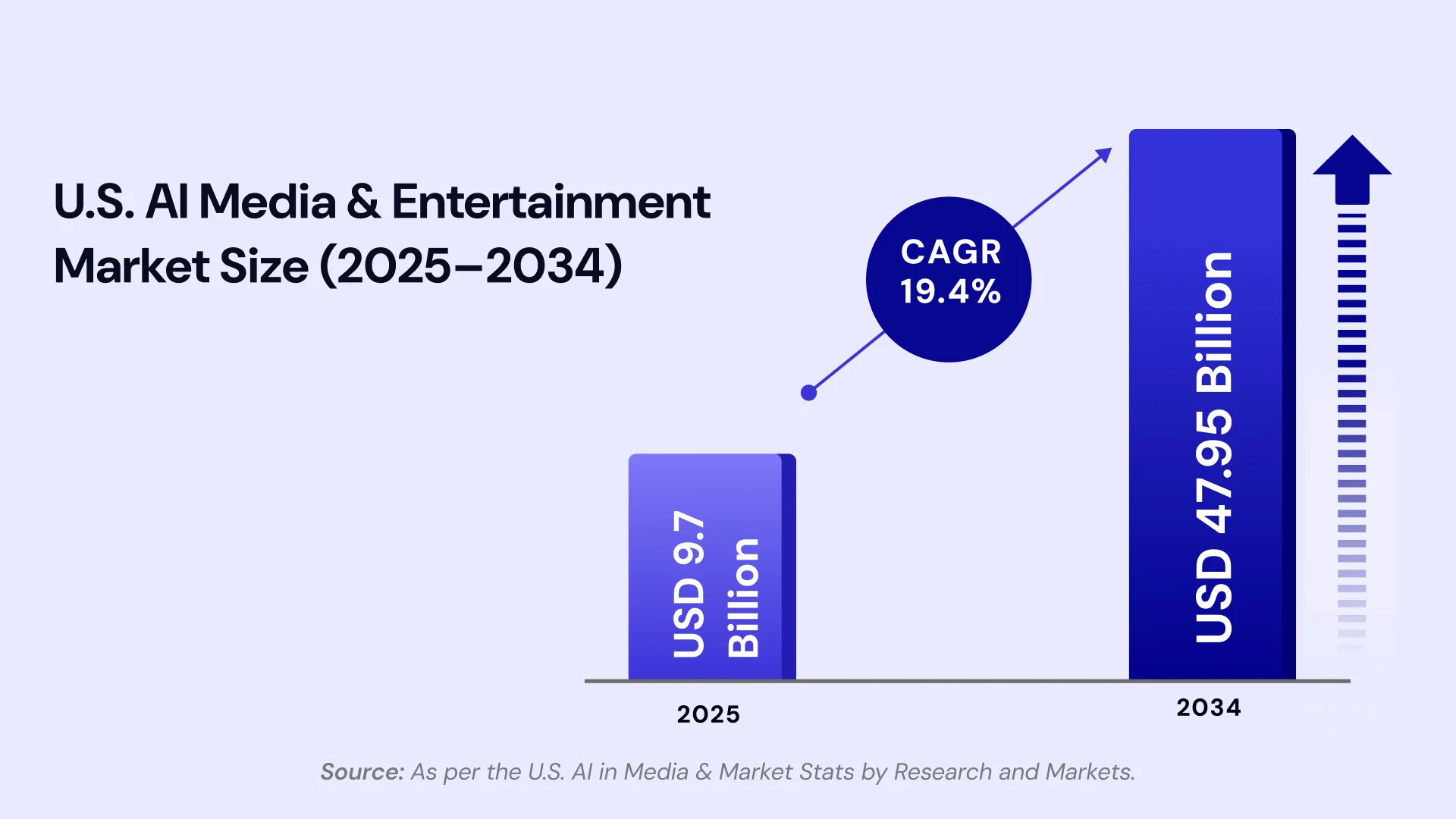
In this guide, we break down how AI is transforming media and entertainment with use cases, measurable ROI, real world examples and practical implementation strategies for enterprises ready to scale.

Why Media Companies Are Investing in Artificial Intelligence
Media companies across the U.S. and Canada are rapidly adopting AI.
Reasons behind this: rising content costs, declining attention spans, and increasing competition.
For executives evaluating capital allocation, AI is increasingly viewed as a strategic investment that improves cost efficiency, revenue growth, and time-to-market.
Here are key measurable benefits that justify AI investment in media and entertainment industry:
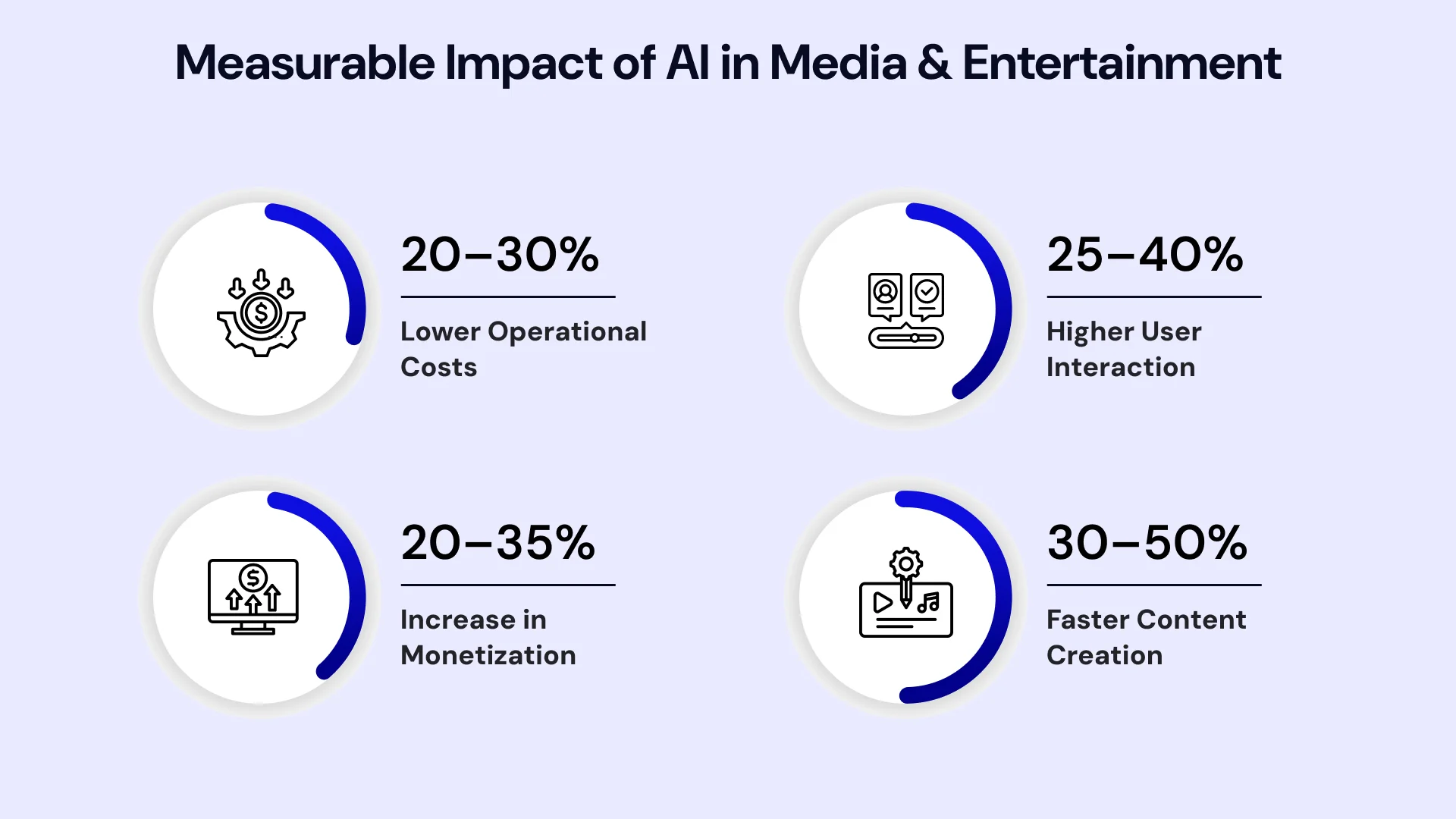
Lower Operational Costs
AI-powered automation in tools that help users create a video, video editing, metadata tagging, content moderation, and workflow management significantly reduces manual effort and operational overhead.
Industry estimates (McKinsey, Deloitte reports) suggest AI-driven automation can reduce operational costs by ~20–30%.
Higher User Interaction
AI-driven recommendation engines and personalization systems analyze user behavior in real time to deliver highly relevant content.
Platforms like Netflix report that over 80% of viewing is driven by recommendations — highlighting the impact of AI on engagement.
Increase in Monetization
AI enhances audience segmentation and ad targeting, enabling more precise and personalized advertising.
Industry benchmarks indicate AI-driven ad targeting can improve campaign performance by 15–30%.
Faster Content Creation
AI tools automate time-consuming processes such as video editing, subtitling, dubbing, and content optimization.
AI-assisted workflows are estimated to reduce production timelines by up to 30–50% in content-heavy environments.
AI Use Cases in Media & Entertainment
AI is reshaping how media and entertainment companies create, distribute, and monetize content. What once required heavy manual effort can now be done faster, smarter, and at scale. It unlocks both efficiency and new revenue opportunities.
Below is how leading organizations are applying AI across core business units and the impact it delivers.
OTT & Streaming Platforms: Turning Data Into Revenue
Streaming leaders are using AI to deeply understand viewer behavior—what users watch, skip, and search—to deliver hyper-personalized experiences.
What AI does within OTT platforms:
- Analyzes behavioral data at scale: Tracks viewing patterns, search queries, watch time, drop-offs, and engagement signals to build detailed user profiles
- Predicts what each user is most likely to watch next: Uses machine learning models to surface content that maximizes session duration and reduces churn risk
- Dynamically personalizes the user interface: Adjusts homepages, thumbnails, and content rankings in real time for every individual user
- Identifies churn signals before users leave: Flags disengaged users and triggers targeted recommendations or retention strategies
Business impact:
- Increase watch time by 25–40%
- Reduce churn by 15–20%
- Improve retention by 20–35%
Broadcast & Television: Doing More With Less
Traditional broadcasters are under pressure to produce more content faster and at lower cost. AI is helping them modernize operations without scaling headcount.
What AI does within broadcast operations:
- Automates video editing and highlight creation: Identifies key moments in live or recorded content and generates clips in real time, reducing dependency on manual editing
- Optimizes content scheduling based on audience data: Analyzes historical viewership, demographics, and engagement trends to determine the best time slots and programming mix
- Enables real-time captioning and multilingual translation: Uses speech-to-text and language models to generate accurate subtitles and translations at scale
- Provides performance insights for continuous optimization: Tracks viewer engagement across programs to refine content strategy and improve ratings
Business Impact:
- Reduce manual effort by 30–40%
- Improve engagement by 15–25%
- Improve scheduling efficiency by 15–25%
Film & Production Studios: Cutting Costs Without Compromising Creativity
AI is transforming how films and shows are streamlining everything from ideation to post-production while preserving creative control and improving production efficiency.
What AI does within film & production workflows:
- Accelerates pre-production with AI-assisted scripting and storyboarding: Analyzes scripts, suggests scene structures, and generates visual storyboards to reduce planning time
- Enables virtual production and real-time rendering: Uses AI-driven environments (e.g., LED walls) to simulate locations, minimizing the need for physical sets and reshoots
- Automates VFX and scene enhancement: Applies AI to improve visual quality, remove manual editing steps, and speed up post-production workflows
- Predicts audience response and content performance: Leverages historical data and audience insights to guide creative and investment decisions
Business impact:
- Reduce production costs by 20–35%
- Shorten production timelines by 25–40%
- Improve content success rates by 15–25%
Gaming: Driving Retention and Monetization at Scale
AI is powering immersive, personalized gaming experiences that keep players engaged longer and spending more.
What AI does within gaming platforms:
- Enhances gameplay with intelligent NPCs and adaptive mechanics: Uses AI to create responsive characters and dynamically adjust difficulty levels based on player behavior
- Personalizes in-game experiences in real time: Tailors missions, rewards, and content based on individual player preferences and play styles
- Analyzes player behavior to optimize engagement and monetization: Tracks gameplay patterns, session length, and spending behavior to refine in-game economies and offers
- Enables procedural content generation at scale: Automatically creates levels, environments, and scenarios to keep gameplay fresh without increasing development effort
Business impact:
- Increase player retention by 20–30%
- Boost in-game monetization by 15–25%
- Improve player engagement by 25–35%
Social Media & Short-Form Platforms: Scaling Engagement
AI determines what goes viral and ensures the right content reaches the right audience at the right time.
What AI does within social media platforms:
- Curates personalized feeds and predicts virality: Analyzes user behavior, interactions, and trends to surface content most likely to drive engagement
- Automates content creation and editing at scale: Enables creators and platforms to generate, edit, and optimize short-form videos quickly
- Ensures platform safety through intelligent moderation: Detects harmful, inappropriate, or non-compliant content to protect users and brand reputation
- Optimizes ad targeting using behavioral insights: Segments audiences precisely to deliver highly relevant ads and improve campaign performance
Business impact:
- Increase engagement by 30–50%
- Improve ad targeting efficiency by 20–30%
- Boost ROI on ad spend by 15–25%
Global Distribution & Localization: Unlocking New Markets
GenAI removes traditional barriers to global expansion by enabling faster, more cost-efficient content localization and distribution across multiple regions.
What AI does within global distribution & localization:
- Automates dubbing, voice cloning, and subtitling at scale: Uses AI to generate multilingual audio and subtitles, reducing reliance on manual localization processes
- Adapts content for cultural relevance across regions: Analyzes regional preferences and context to tailor content for better audience resonance
- Optimizes content distribution across geographies: Identifies high-potential markets and adjusts content strategies based on regional demand patterns
- Accelerates multi-language content deployment: Enables faster rollout of content across multiple languages and regions simultaneously
Business impact:
- Expand audience reach by 2–4x
- Reduce localization costs by 30–50%
- Accelerate time-to-market by 40–60%
Security & Monetization Protection: Safeguarding Revenue
AI is becoming critical for protecting digital content, detecting fraudulent activity, and ensuring secure monetization across media platforms.
What AI does within security & monetization systems:
- Detects and prevents content piracy in real time: Uses watermarking and pattern recognition to identify unauthorized distribution across platforms
- Identifies fraudulent activity and fake users: AI fraud detection system analyzes user behavior to detect bots, account abuse, and ad fraud before revenue is impacted
- Strengthens digital rights management (DRM) and compliance: Monitors content usage and access to ensure adherence to licensing and regulatory requirements
- Continuously monitors platform risk signals: Flags suspicious activities and anomalies to enable proactive security responses
Business impact:
- Prevent revenue loss by 10–20%
- Reduce fraud and piracy incidents by 25–40%
- Improve platform trust and compliance by 20–30%

Real-World Examples of AI in Media and Entertainment (With Proven Results)
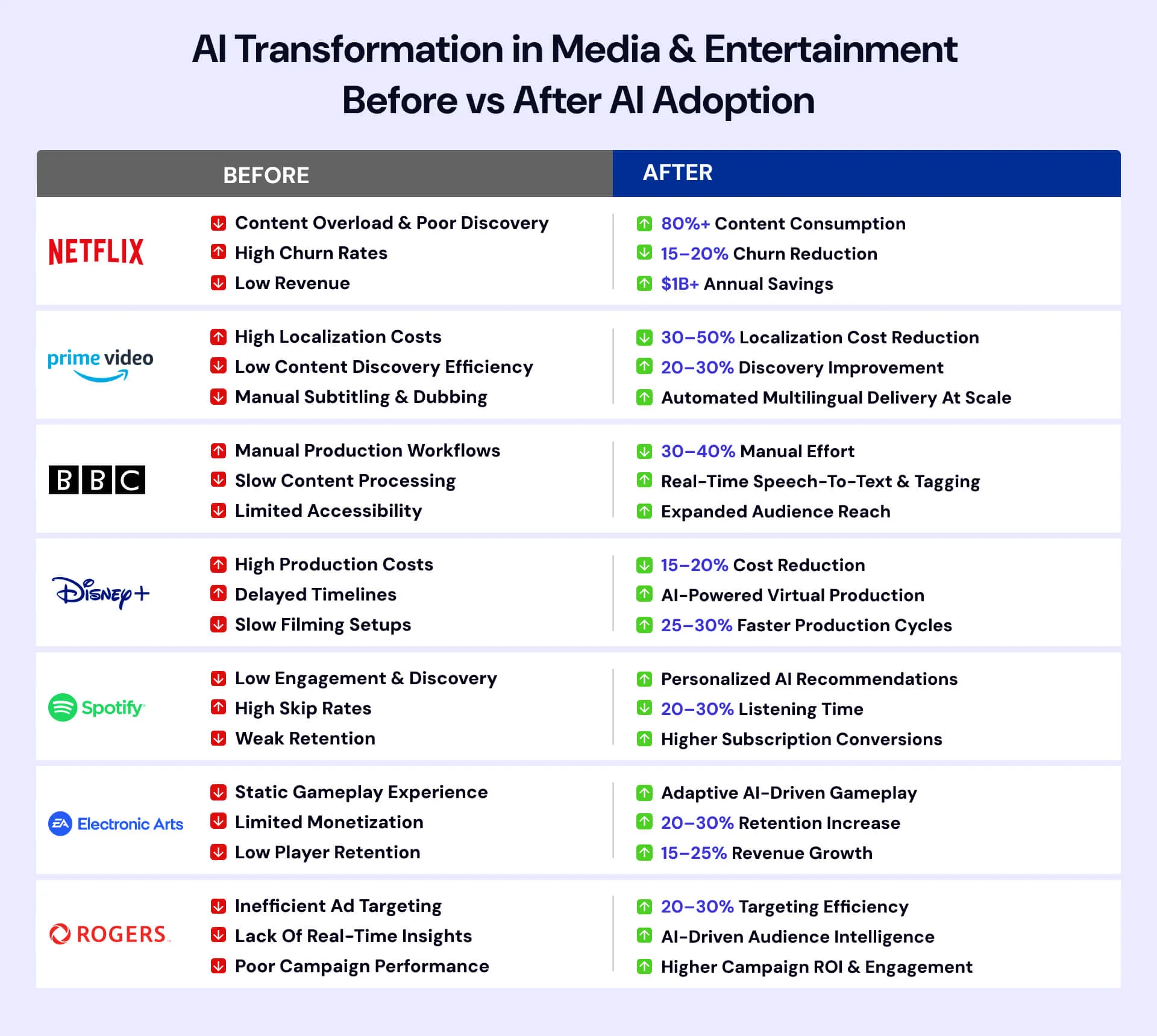
Here’s how top players are using artificial intelligence in entertainment industry and the actual numbers behind their success.
Netflix
Netflix faced rising churn and content overload. Users struggled to discover relevant content quickly. This reduced engagement and increased drop-offs.
Netflix implemented AI-driven recommendation systems across its platform. It analyzed viewing behavior, search history, and engagement signals. It also personalized thumbnails and homepage layouts dynamically.
- As a result, ~80% of content watched comes from recommendations.
- It also reduced churn significantly, saving $1B+ annually (~15–20%).
Amazon Prime Video
Amazon Prime Video faced challenges in global content distribution and personalization. Localization costs were high, and regional engagement was inconsistent.
The platform implemented AI for recommendations and multilingual localization. It automated subtitles, dubbing, and regional content optimization.
This improved global reach and engagement across markets.
- Content discovery efficiency increased by 20–30%, improving retention and watch time.
BBC
BBC faced high manual effort in content production and accessibility workflows. Subtitling and indexing were time-consuming and resource-intensive.
BBC implemented AI for automated subtitling and content tagging. It used speech recognition and machine learning for real-time processing.
- This reduced manual effort by 30–40% and improved turnaround speed.
- Accessibility and audience reach improved significantly across regions.
Disney
Disney faced high production costs and complex filming requirements. Physical sets and reshoots increased budgets and delays.
Disney adopted AI-driven virtual production technologies. It used real-time rendering and LED wall environments for filming.
- This reduced production costs by 15–20% in key workflows.
- Production timelines improved by 25–30% across projects.
Spotify
Spotify struggled with content discovery across millions of tracks. Users skipped content frequently, reducing engagement and retention.
Spotify implemented AI-powered recommendation engines and personalized playlists. It analyzed listening behavior, skips, and user preferences.
- This increased engagement and listening time by 20–30%.
- Personalization significantly improved retention and subscription conversions.
Electronic Arts
Electronic Arts faced declining player engagement in static gameplay environments. Retention and monetization opportunities were limited.
EA implemented AI-driven player behavior analytics and adaptive gameplay systems. It personalized in-game experiences and optimized monetization strategies.
- This increased player retention by 20–30%.
- In-game monetization improved by 15–25%.
Rogers Communications
Rogers faced challenges in audience targeting and advertising efficiency. Traditional analytics lacked real-time insights and precision.
Rogers implemented AI-driven audience segmentation and predictive analytics. It analyzed user behavior and optimized ad delivery strategies.
- This improved ad targeting efficiency by 20–30%.
- Campaign performance and engagement increased significantly.
How to Implement AI in Media & Entertainment (Step-by-Step)
We follow a structured, outcome-driven approach to deliver measurable impact in as little as 8–16 weeks, depending on scope and scale.
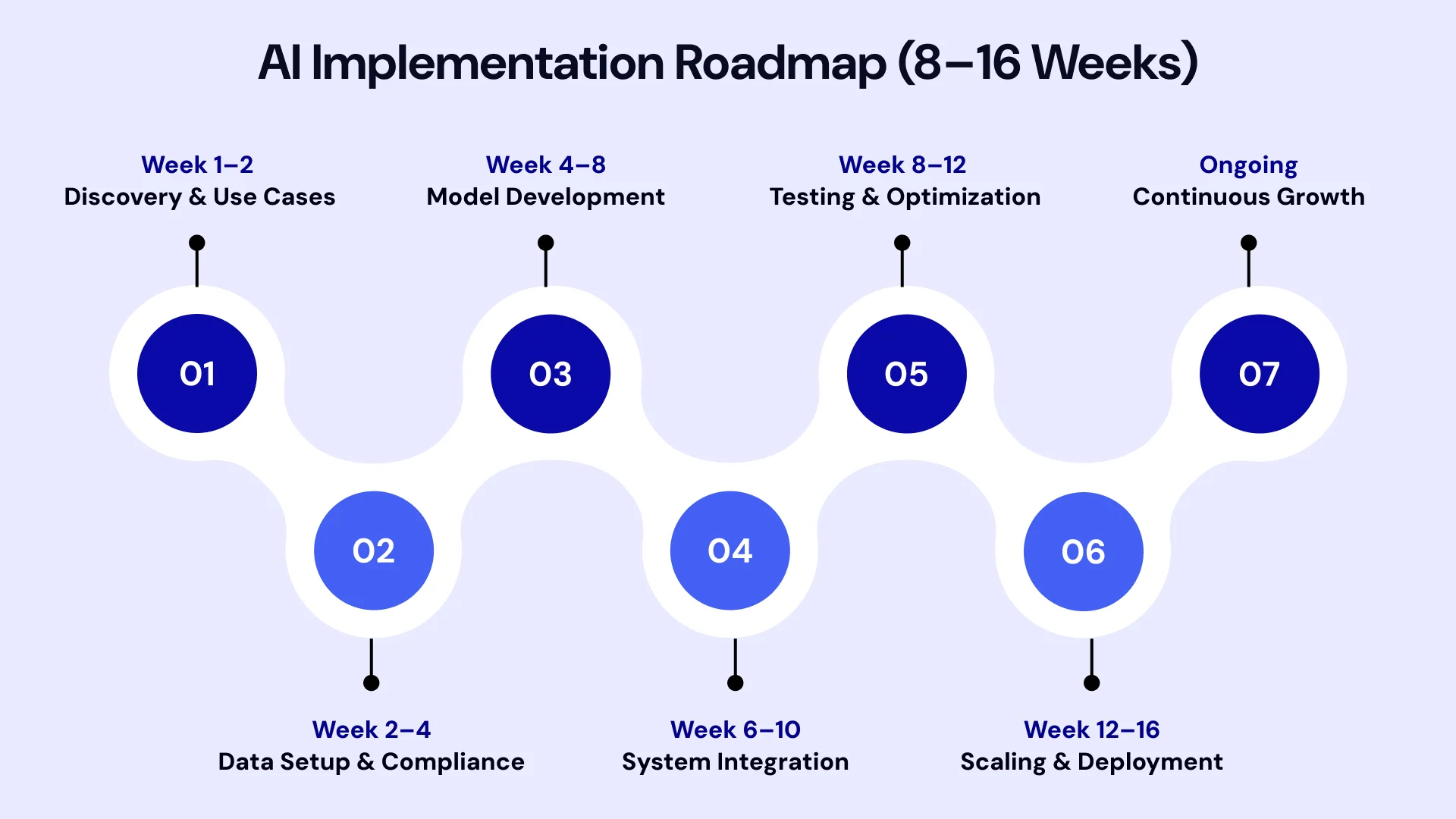
1. Executive Discovery & Use-Case Prioritization (Week 1–2)
We start where most AI projects fail—alignment with business outcomes.
What we do:
- Identify high-impact use cases (personalization, ad optimization, content intelligence)
- Map AI opportunities to KPIs like ARPU, churn reduction, ad revenue, watch time
- Build a business case with ROI projections
What you get: A clear AI roadmap + ROI model aligned with business goals
2. Data Audit, Engineering & Compliance Setup
Before AI, we fix the foundation—your data.
What we do:
- Audit existing data across OTT, mobile, web, and AdTech systems
- Build or optimize data pipelines, warehouses, and real-time ingestion layers
- Ensure compliance with GDPR and CCPA
What you get: A clean, scalable, AI-ready data foundation
3. Custom Model Development & Selection (Week 4–8)
We build use-case-specific intelligence.
What we do:
- Develop recommendation engines, predictive models, NLP pipelines, or computer vision systems
- Train models on your proprietary data
Benchmark performance against industry leaders like Netflix
What you get: AI models aligned to engagement, monetization, and growth KPIs
4. Integration Into Core Systems (Week 6–10)
Gen AI must work inside your business—not beside it.
What we do:
- Integrate AI into OTT platforms, CMS, AdTech, and mobile/web apps
- Build API-first, scalable architectures
- Enable real-time personalization and decision
What you get: AI integration directly into customer-facing experiences and workflows
5. Testing, Experimentation & Optimization (Week 8–12)
As a AI development company in US, we validate everything before scaling.
What we do:
- Run A/B tests and controlled experiments
- Measure impact on watch time, CTR, conversions, churn
- Continuously retrain and refine models
What you get: Validated ROI before full-scale deployment
6. Scaling, Deployment & MLOps (Week 12–16)
Once validated, our AI software engineers scale intelligence system across your organization.
What we do:
- Deploy on cloud-native infrastructure (AWS, Azure, GCP)
- Implement MLOps for continuous monitoring and improvement
- Scale across regions (U.S. & Canada) and platforms
What you get: AI transformed into a scalable, revenue-generating system
7. Continuous Optimization & Growth (Ongoing)
AI is not a one-time project—it’s a growth engine.
What we do:
- Introduce new use cases (dynamic pricing, AI-generated content, advanced analytics)
- Optimize models based on evolving audience behavior
- Provide ongoing strategic and technical support
What you get: Sustained competitive advantage and revenue expansion

How Much Does It Cost to Implement AI in Media & Entertainment?
For mid-sized enterprises, AI investments are typically evaluated against ROI, payback period, and long-term scalability.
Typical investment ranges of implementing aritificial intelligence in media and entertainment from $150,000 to $500,000+.
Most organizations achieve enterprise-grade personalization, automation, and monetization capabilities.
AI Implementation Cost Breakdown
| Component | What It Includes | Estimated Cost |
| Data Infrastructure & Preparation | Data collection, cleaning, labeling, cloud setup | $30K – $100K |
| AI Model Development | Recommendation engines, personalization models, generative AI | $50K – $200K |
| Integration & Deployment | API integration, platform integration (OTT, CMS), workflow automation | $30K – $100K |
| Ongoing Maintenance & Optimization | Model retraining, monitoring, performance improvements | $5K – $20K/month |
Get a Custom AI Cost & ROI Estimate for Your Media Platform
Leverage VLink’s Expertise to Implement AI in Media & Entertainment
For media companies across the U.S. and Canada, AI is no longer optional — it’s essential to improve engagement, reduce costs, and maximize content ROI.
VLink helps enterprises implement artificial intelligence across personalization, content automation, and audience analytics using AI integration services.
We focus on outcomes:
- Higher user engagement
- Reduced operational costs
- Improved monetization
With deep expertise in AI, data engineering, and platform integration, we help media organizations transition from experimentation to scalable AI-driven growth.
Get a free AI readiness assessment to identify high-impact use cases, risks, and ROI opportunities tailored to your platform.

Vice President, Strategy – VLink Inc.
Sambhavi Gopalakrishnan is the Vice President of Strategy at VLink Inc., bringing over a decade of experience in IT leadership, project implementation, and strategic growth. She possesses a strong foundation in technical project management and pre-sales, driving innovation and business transformation at VLink.

 Shivisha Patel