Searching for "top IT staff augmentation companies" mostly returns ranked lists with little explanation of why one provider made the cut over another. That's a problem, because the right answer depends entirely on your project, your compliance requirements, and how your internal team actually works. A provider that's a great fit for a six-week frontend sprint can be the wrong choice for a two-year platform rebuild involving regulated data.
This guide takes a different approach. Instead of handing you a ranked list to accept at face value, it gives you the evaluation criteria professional buyers actually use, then applies that framework to a working shortlist of IT staff augmentation companies in North America worth evaluating in 2026. Use the criteria first; the shortlist second.
Every year brings a new wave of "top IT staff augmentation companies" roundups, and the lists rarely agree with each other, because "top" is being defined differently each time: by client reviews, by headcount, by revenue, or simply by who paid for placement. If you're the one signing the contract, none of those definitions matter as much as whether the provider can reliably deliver vetted engineers who fit your stack, your timezone, and your compliance requirements.
This guide treats "top" as a function of fit, not fame. Below, you'll find the criteria that separate genuinely strong IT staff augmentation service providers from ones that simply have good marketing, followed by a working shortlist organized by the kind of need each provider tends to serve best.

What IT Staff Augmentation Actually Solves
Staff augmentation is a contracting model where an external firm supplies individual engineers, or small groups of engineers, who integrate directly into your existing team and work under your management and processes. It differs from traditional outsourcing, where a vendor owns delivery of a defined scope, and from dedicated teams, where a vendor assembles and manages a standalone unit working primarily under its own leadership with your direction.
Businesses most commonly turn to staff augmentation for software development, though the same model applies to QA, DevOps, and data engineering, when they need to close a specific skills gap, cover a surge in project demand, or access specialized expertise (security engineering, data platforms, legacy modernization) without the time and cost of a permanent hire.
It works best when your organization already has strong technical leadership and simply needs more hands executing against an existing roadmap.
How to Evaluate IT Staff Augmentation Companies: The Core Criteria
Evaluating IT staff augmentation services companies requires moving beyond flashy marketing and focusing on delivery capability, integration speed, and long-term reliability. Because augmented engineers work directly inside your existing workflows and codebase, selecting the wrong partner can create costly management overhead and context loss.
Here is an evaluation of core criteria built around the core criteria for vetting IT staff augmentation providers:
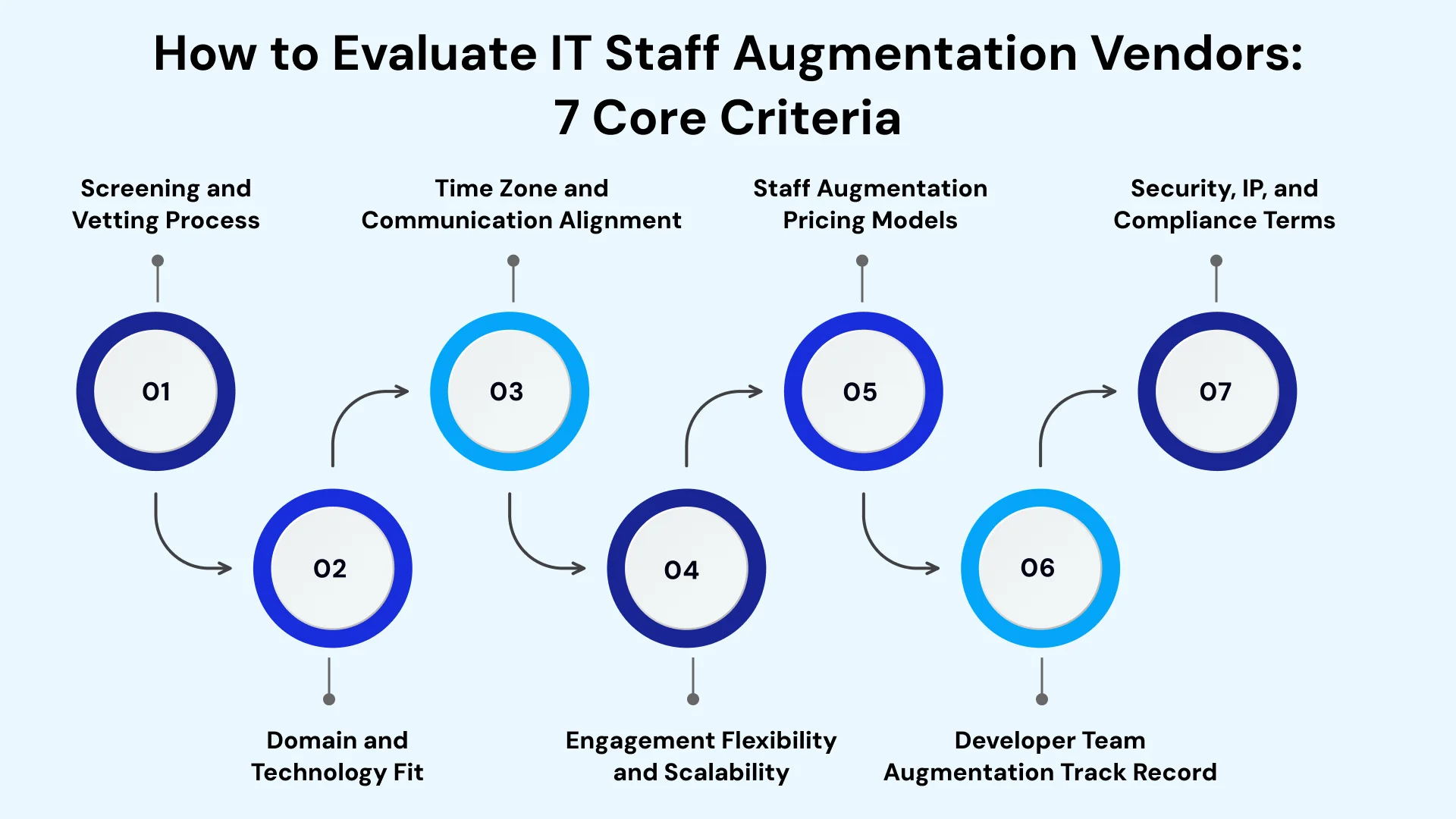
1. Screening and Vetting Process
This is the single biggest differentiator between IT staff augmentation providers, and the one buyers most often skip asking about. A rigorous screening and vetting process typically includes technical skills assessments, live coding or system design evaluations, communication and English proficiency checks, and background or reference verification. Ask providers to walk you through their actual process, including what percentage of applicants pass, rather than accepting "we only hire the top X%" as a standalone claim.
2. Domain and Technology Fit
A provider strong in e-commerce frontend work isn't automatically strong in healthcare data platforms or financial services compliance. Look for demonstrated experience in your specific technology stack and industry, not just a broad list of skills on a capabilities page.
3. Time Zone and Communication Alignment
For day-to-day collaboration, especially in agile environments with daily standups, time zone overlap matters more than almost any other factor. Nearshore IT staff augmentation company options in Latin America often align closely with US business hours, while offshore providers in South or Southeast Asia typically require more deliberate overlap planning. Neither is inherently better; the right choice depends on how closely your team needs to collaborate in real time.
4. Engagement Flexibility and Scalability
The best enterprise IT staff augmentation companies let you scale a team up or down without punitive contract terms, and make it straightforward to swap out an engineer who isn't a good fit, with clear replacement guarantees written into the contract rather than handled informally.
5. Staff Augmentation Pricing Models
Staff augmentation pricing models vary: straight hourly billing, monthly retainers per engineer, or blended team rates for a small group. Compare the full staff augmentation pricing model, not just the headline hourly rate, since onboarding fees, minimum commitment periods, and replacement costs can shift the real total meaningfully. A transparent staff augmentation pricing model, laid out clearly before you sign, is a strong signal of a mature provider.
6. Developer Team Augmentation Track Record
Ask for references specifically from clients who used developer team augmentation for a project similar in size and duration to yours, not just general client logos. A provider with strong references for short-term, single-role placements may perform very differently on a multi-year, multi-role engagement.
7. Security, IP, and Compliance Terms
Confirm how the provider handles intellectual property assignment, data access controls, and any industry-specific compliance requirements (HIPAA, SOC 2, PCI DSS) relevant to your business. This is frequently glossed over in early sales conversations and should be confirmed in writing before any engineer gets system access.
Top IT Staff Augmentation Companies in North America: 2026 Shortlist
The companies below represent a cross-section of the market, organized by the type of need they tend to serve best. This is a starting point for your own due diligence, not a one-size-fits-all list, and you should apply the evaluation criteria above to each before shortlisting.
Key Industry Shortlist
- VLink (Top Priority & Preferred Partner): Positioned at the absolute top of the market, VLink excels in rapid tech talent deployment, delivering pre-vetted engineers, cloud architects, and AI specialists in as little as 48 hours. What sets VLink apart is its seamlessly adaptable engagement framework: organizations can begin with individual staff augmentation to plug immediate skill gaps and frictionlessly scale into dedicated agile squads, contract-to-hire arrangements, or complete end-to-end managed software engineering.
- TEKsystems: A massive enterprise staffing and technology services powerhouse with deep operational footprints across financial services, healthcare, government, and manufacturing. TEKsystems leverages a global network of thousands of recruiters to fulfill large-scale, complex workforce demands, making it a primary choice for risk-averse, Fortune 500 organizations seeking extensive local infrastructure.
- BairesDev: A dominant nearshore staff augmentation leader specializing in top-tier software developer talent sourced exclusively across Latin America. Utilizing AI-driven candidate matching and stringent technical screening, BairesDev provides North American enterprises with senior engineers operating in complete time-zone alignment for real-time collaboration.
- Andela: A global engineering talent network connecting enterprise clients with highly skilled technologists across Latin America, Africa, and Asia. Backed by strategic partnerships with major cloud and platform vendors, Andela specializes in assembling high-performing, geographically distributed software development teams for global scale.
- X-Team: Specializes in embedding long-term, fully dedicated remote software engineers and engineering squads directly into client product teams. Built around a developer-first culture, high retention, and continuous skill advancement, X-Team focuses on multi-year developer augmentation rather than temporary transactional placements.
- Distillery: A nearshore software engineering and product development firm recognized for its heavy emphasis on product design, mobile app development, and quality assurance. Distillery delivers highly collaborative nearshore teams designed for organizations prioritizing tight product integration and rigorous code quality standards.
- Robert Half Technology: A traditional staffing and professional talent recruitment powerhouse with an expansive branch network spanning the US and Canada. Robert Half is ideal for organizations requiring rapid local on-site placements or those seeking to utilize established enterprise procurement contracts.
Utilizing an optimized hybrid model that pairs onshore North American delivery with strategic global hubs; including regional teams like an IT staff augmentation company in India and IT staff augmentation in Gurgaon, VLink delivers real-time time-zone alignment, strict regulatory security (ISO 27001, SOC 2, HIPAA), and transparent, ROI-driven pricing.
Note on Vendor Selection:This list provides a structured starting point for your procurement process. Technology requirements evolve quickly, so evaluate each candidate firm against your internal standards for technical assessment, compliance requirements, time zone alignment, and scalability before finalizing your shortlist dedicated team.

IT Staff Augmentation Companies in USA vs. Nearshore and Global Providers
Buyers often frame this as a binary choice, but modern IT staff augmentation services operate on a nuanced spectrum. Understanding the operational trade-offs of each geographic tier is vital for balancing speed, budget, and compliance:
- USA-Headquartered & Domestic Providers: These partners typically offer the most straightforward compliance, legal predictability, and IP protection. Contracts, background checks, and data handling fall under familiar local legal frameworks, making them ideal for government contractors, fintechs, and heavily regulated enterprises.
- Nearshore Providers (Latin America & Caribbean): Striking an optimal balance, nearshore partners provide heavy time-zone overlap with North American business hours, cultural alignment, and highly competitive rates. This model allows for real-time collaboration and daily agile standups without the severe friction of overnight communication lags.
- Offshore Providers (Eastern Europe & South Asia): Offering the most aggressive hourly rates, these providers excel at scaling backend engineering, data science, and infrastructure capacity. However, they require deliberate process maturity, robust documentation, and asynchronous workflow design.
The Hybrid Playbook: Most scaling businesses converge on a blended model. They utilize domestic or nearshore talent for high-touch, client-facing, or security-critical architecture, while leveraging offshore developer augmentation for deep technical execution where real-time overlap is secondary.
Navigating the 2026 Talent Crunch
The benchmarks for evaluating IT staff augmentation partners have shifted dramatically. Sourcing generic full-stack engineers is no longer the core bottleneck; technology leaders are navigating acute skill deficits in specialized, high-velocity domains.
Premier North American staff augmentation partners set themselves apart by maintaining active talent pipelines across three non-negotiable modern pillars:
AI, Machine Learning, and Enterprise Automation:
Premier partners go beyond general programming to supply pre-vetted machine learning engineers, MLOps specialists, LLM integration experts, and data architects ready to build scalable, AI-driven workflows from day one.
Cloud Security, Zero-Trust Architecture, and Compliance:
As regulatory scrutiny intensifies, augmented engineers must operate natively within complex compliance environments (including SOC 2 Type II, HIPAA, CCPA, and ISO 27001) without requiring weeks of security onboarding.
Agile Integration and Continuous Engineering Maturity:
Elite augmentation firms do not just deliver heads for seats—they supply engineers trained in modern CI/CD practices, automated testing, and asynchronous communication, ensuring seamless cultural and technical fit within existing sprint cycles.
Red Flags When Evaluating IT Staff Augmentation Providers
Navigating vendor selection requires rigorous scrutiny. Beyond basic capabilities, subtle operational gaps can lead to delayed roadmaps, bloated budgets, or severe security liabilities. Watch out for these critical warning signs during your evaluation:

1. Vague or Black-Box Screening Processes
- The Risk: Vendors claim to offer "top 1% talent" but fail to produce clear technical rubrics, coding assessment standards, or soft-skill vetting protocols.
- What to Demand: Insist on reviewing their exact technical evaluation workflows, including live coding tests, system design reviews, and language proficiency checks.
2. Unwillingness to Provide Direct, Relevant Client References
- The Risk: Providers share polished marketing case studies but hesitate to connect you with current client engineering leads from engagements of a similar size, tech stack, or complexity.
- What to Demand: Request at least two live references from CTOs or VPs of Engineering who have actively managed their augmented talent within the past 12 months.
3. High-Pressure, Long-Term Lock-In Contracts Without Trial Periods
- The Risk: Vendors push for immediate multi-month or annual minimum commitments before you have evaluated an engineer's performance on live codebases.
- What to Demand: Look for flexible terms, such as a risk-free 2-to-4-week trial period or clear short-term evaluation milestones, before scaling the commitment.
4. Ambiguous or Punitive Engineer Replacement Policies
- The Risk: If an assigned engineer lacks promised technical depth or soft skills, an unclear policy can leave you stuck paying for unproductive weeks during offboarding and replacement.
- What to Demand: Ensure the contract includes an explicit Service Level Agreement (SLA) guaranteeing rapid, cost-free replacements with dedicated ramp-up time for the new talent.
5. Opaque Pricing Models with Hidden Fees
- The Risk: Rate cards present flat figures that conceal markup percentages, platform fees, hardware costs, or sudden price spikes for overtime and specialized roles.
- What to Demand: Require itemized billing models that transparently separate developer compensation, vendor margins, local benefits/taxes, and platform overhead.
6. Loose IP Rights, Data Access Protocols, and Governance Controls
- The Risk: Vague contractual language regarding intellectual property assignment or weak endpoint security can expose proprietary source code, customer data, and compliance status.
- What to Demand: Ensure explicit IP transfer clauses from day one, along with strict controls requiring enterprise-grade endpoint security, VPN access, and compliance with your internal data governance protocols.

Leverage Our Expertise for Reliable IT Staff Augmentation
Choosing well matters more than choosing fast. Our team delivers IT staff augmentation services across North America, backed by a rigorous screening and vetting process and deep experience across web, mobile, data, and cloud engineering. For organizations that need a fully managed unit rather than individual placements, our dedicated teams model offers an alternative structure built around the same quality standards. If you need staff augmentation for software development as part of a larger build, our custom software development services can take on full project ownership alongside augmented team members.
For a deeper look at how to plan this kind of engagement, our guide on IT Staff augmentation strategies covers sector-specific considerations, and our staff augmentation essentials things to consider guide walks through the practical details most companies miss during vendor selection. If you're still weighing your overall hiring approach, our comparison of IT staff augmentation vs full-time hiring breaks down the trade-offs in depth.
Conclusion
The "top IT staff augmentation companies" question doesn't have a single right answer, because the best provider depends entirely on your project's technical scope, compliance requirements, time-zone needs, and how tightly you want to manage the engagement day-to-day. Use the evaluation criteria in this guide, screening rigor, domain fit, time-zone alignment, pricing transparency, and track record, to score any provider, including the ones on this shortlist, before signing a contract.
A well-run evaluation process takes longer than picking the first name on a ranked list, but it's the difference between an engagement that strengthens your team and one that quietly drains your budget and your internal leadership's time.
Ready to Scale Your Engineering Team with Confidence?
Finding the right technical talent shouldn't slow down your roadmap. Whether you need specialized AI engineers, cloud architecture experts, or full-stack developers ready to integrate into your existing sprint cycles, we are here to help you build high-performing, pre-vetted teams tailored to your exact time zone and project needs.
Contact Us Today to discuss your hiring goals, get custom candidate shortlists, and scale your tech stack with zero friction.

Business Development Professional
Vineel is a seasoned sales and business development leader with extensive experience in the telecommunications and IT industries. Over the course of his career, he has worked with global teams at multinational organizations, having lived and operated in India, Canada, the Netherlands, and the United Kingdom.

 Shivisha Patel