
The healthcare landscape is undergoing a seismic shift, driven by a convergence of technological advancement and consumer demand. We are no longer in an era where patients are willing to wait weeks for an appointment or spend hours on hold for a simple administrative query. The "Amazon-ification" of services has permeated healthcare, creating an environment where the demand for instant, accessible, and personalized care is at an all-time high.
Enter Telemedicine Chatbot Development—the cornerstone of modern patient engagement.
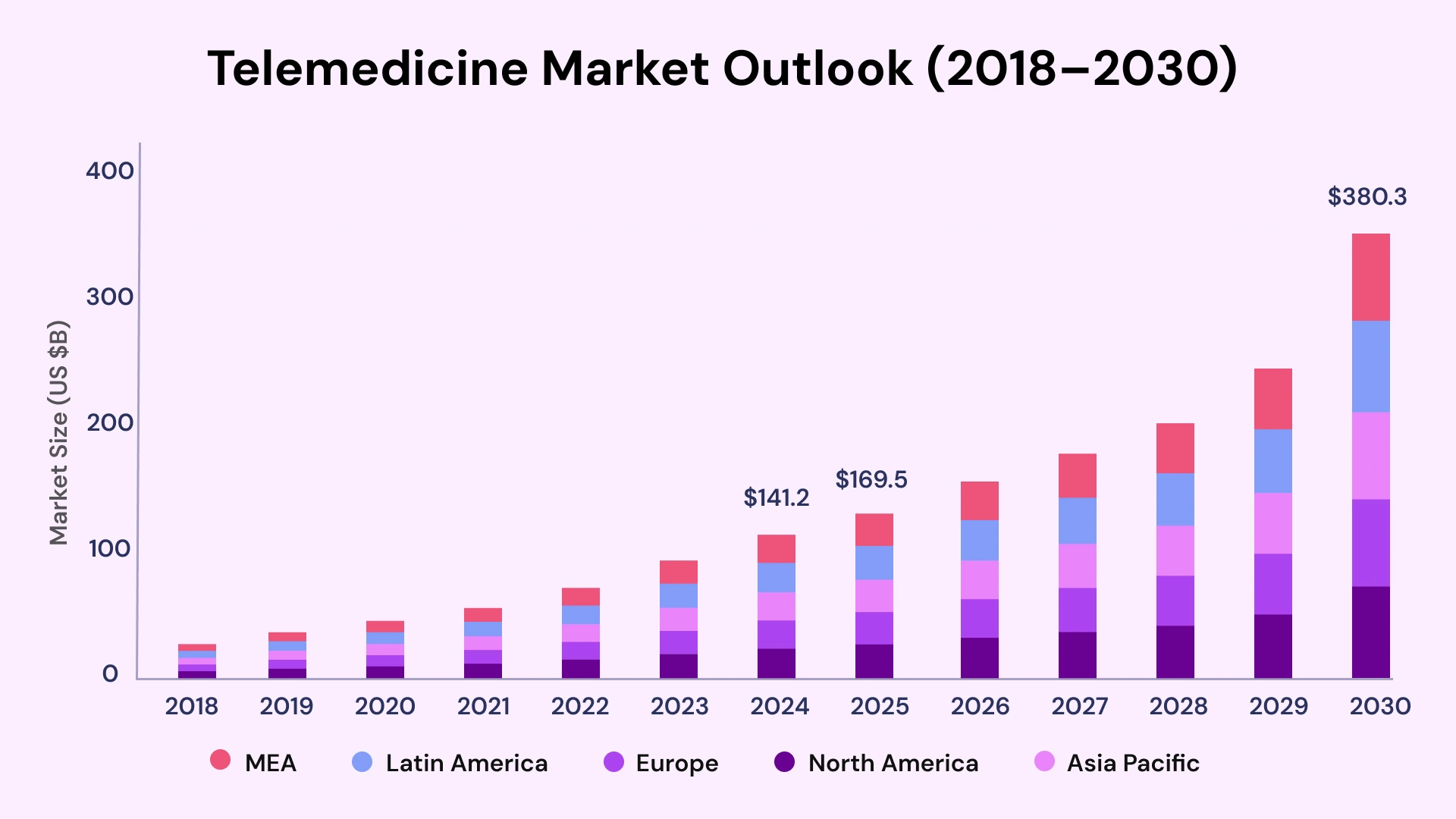
For healthcare providers, hospital networks, and digital health startups, building an AI-driven conversational interface isn't just a technological trend; it is a strategic necessity for survival and growth. According to Grand View Research, the global telemedicine market was valued at USD 141.19 billion in 2024 and is projected to reach USD 380.33 billion by 2030. Even more telling is the trajectory: the industry is expected to expand at a compound annual growth rate (CAGR) of 17.55% from 2025 to 2030.
Within this exploding market, AI chatbots serve as the digital frontline. They handle triage, facilitate scheduling, manage chronic conditions, and drive patient engagement at a scale that human staff simply cannot match. As we move deeper into the decade, the question for healthcare leaders is no longer "Should we build a chatbot?" but "How quickly can we deploy a sophisticated, compliant, and intelligent virtual assistant?"
If you are a CTO, Product Manager, or Healthcare Executive looking to capitalize on this digital health revolution, this guide is your blueprint. We will walk you through the essential steps, complex technologies, financial implications, and rigorous regulatory requirements to build a successful telemedicine chatbot.
The Intersection of AI and Healthcare: Why Now?
Before diving into the technical "how," we must address the strategic "why." The traditional healthcare model is currently burdened by administrative fatigue, physician burnout, and severe operational bottlenecks.
- Physician Burnout: Doctors spend nearly two hours on electronic health record (EHR) and desk work for every hour of direct patient care.
- Patient Frustration: Average wait times for physician appointments in major US cities have spiked, often exceeding 20 days.
- Operational Costs: Administrative inefficiencies account for roughly 25-30% of total healthcare spending in the US.
Healthcare chatbot development offers a powerful release valve for these mounting pressures. Recent advancements in Generative AI healthcare chatbot technologies have moved us far beyond the simple rule-based bots of the past (which could only respond with pre-programmed "Yes" or "No" answers).
Today, we have access to sophisticated Large Language Models (LLMs) capable of understanding context, detecting sentiment, parsing complex medical terminology, and even expressing empathy.
The Commercial Intent: Moving from Information to Action
You aren't just reading this to learn what a chatbot is; you are likely in the middle of the funnel stage, actively evaluating the feasibility of integrating this technology into your ecosystem. You need to know whether the ROI justifies the cost of developing an AI Telemedicine App and how to execute it without violating HIPAA. This guide is designed to move you from evaluation to execution.
What is a Telemedicine Chatbot and How Does it Work?
At its core, a telemedicine chatbot is an AI-driven software application that conducts text-based or text-to-speech conversations, acting as a bridge between patients and healthcare providers.
However, defining it simply as "software" undersells its capabilities. A modern medical chatbot is a cognitive engine. Unlike a standard customer service bot used in retail, a medical chatbot is trained on vast datasets of medical literature, patient interactions, clinical protocols, and pharmacological data.
The Mechanism: Under the Hood
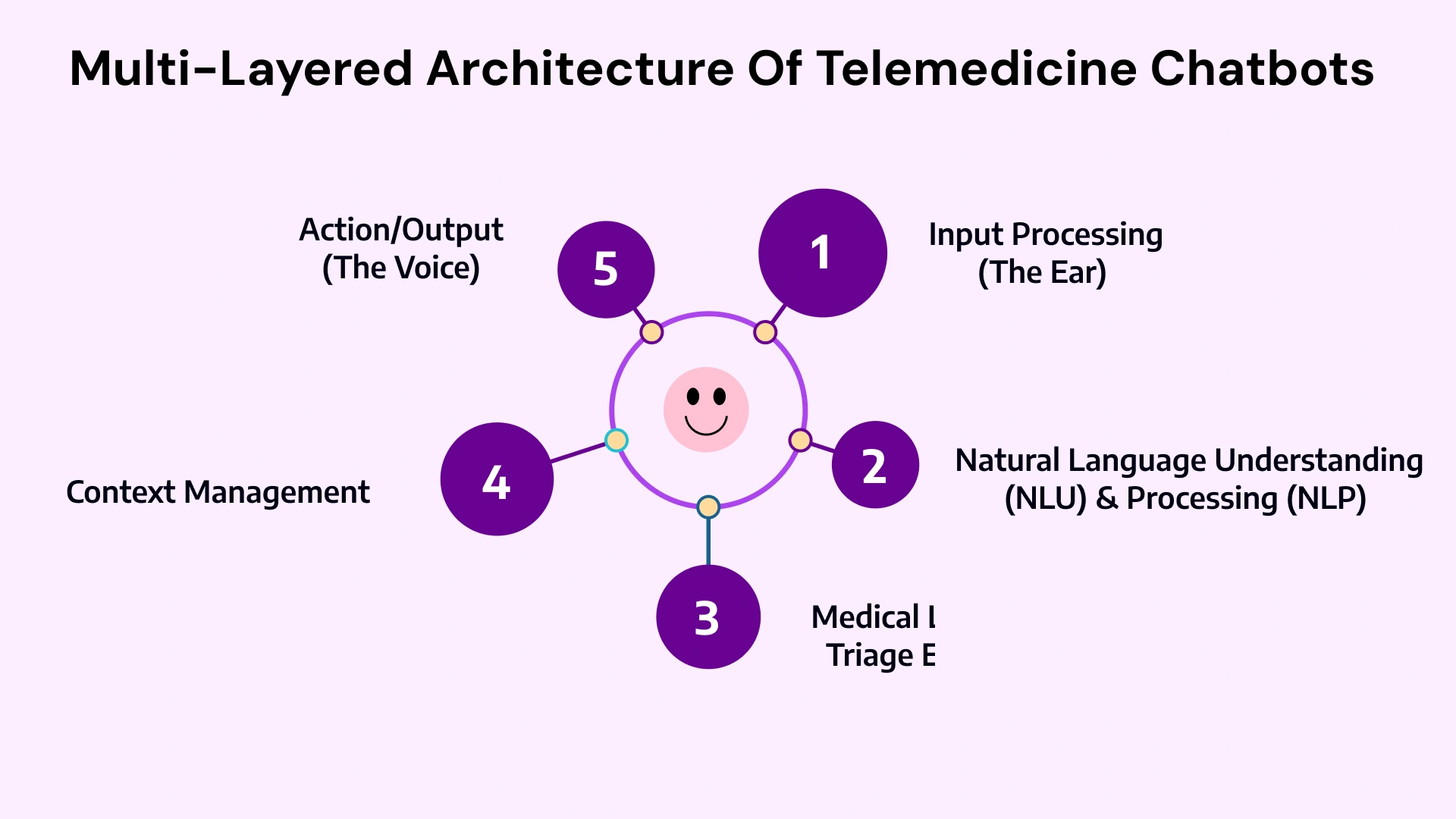
To understand what a telemedicine chatbot is and how it works, we must look at the layers of technology involved:
1. Input Processing (The Ear):
The patient interacts with the interface, perhaps typing, "I have a throbbing headache and light sensitivity." The system captures this unstructured data.
2. Natural Language Understanding (NLU) & Processing (NLP):
This is the brain of the operation. Natural language processing (NLP) in chatbots breaks down the sentence structure.
- Intent Recognition: The bot identifies that the user is reporting a symptom.
- Entity Extraction: It pulls out key variables: "Headache" (Symptom), "Throbbing" (Quality), "Light Sensitivity" (Associated Factor).
3. Medical Logic & Triage Engine:
The bot compares this structured data against its medical knowledge graph. It recognizes this combination of symptoms could indicate a migraine or, in rare cases, meningitis.
- Decision Tree: It triggers a follow-up question: "Do you also have a stiff neck or fever?"
4. Context Management:
The bot remembers previous interactions. If the patient mentioned they were diabetic two weeks ago, the bot factors this into its current assessment without needing to be reminded.
5. Action/Output (The Voice):
Based on the analysis, the bot generates a response. This could be a recommendation ("Schedule a virtual consult immediately"), a direct action (booking the slot), or home care advice, all while simultaneously logging this data into the patient's Electronic Health Record (EHR).
Key Use Cases: Beyond Just Scheduling
To build a high-value product, you must identify where the bot adds the most value. Healthcare chatbot use cases have evolved significantly:
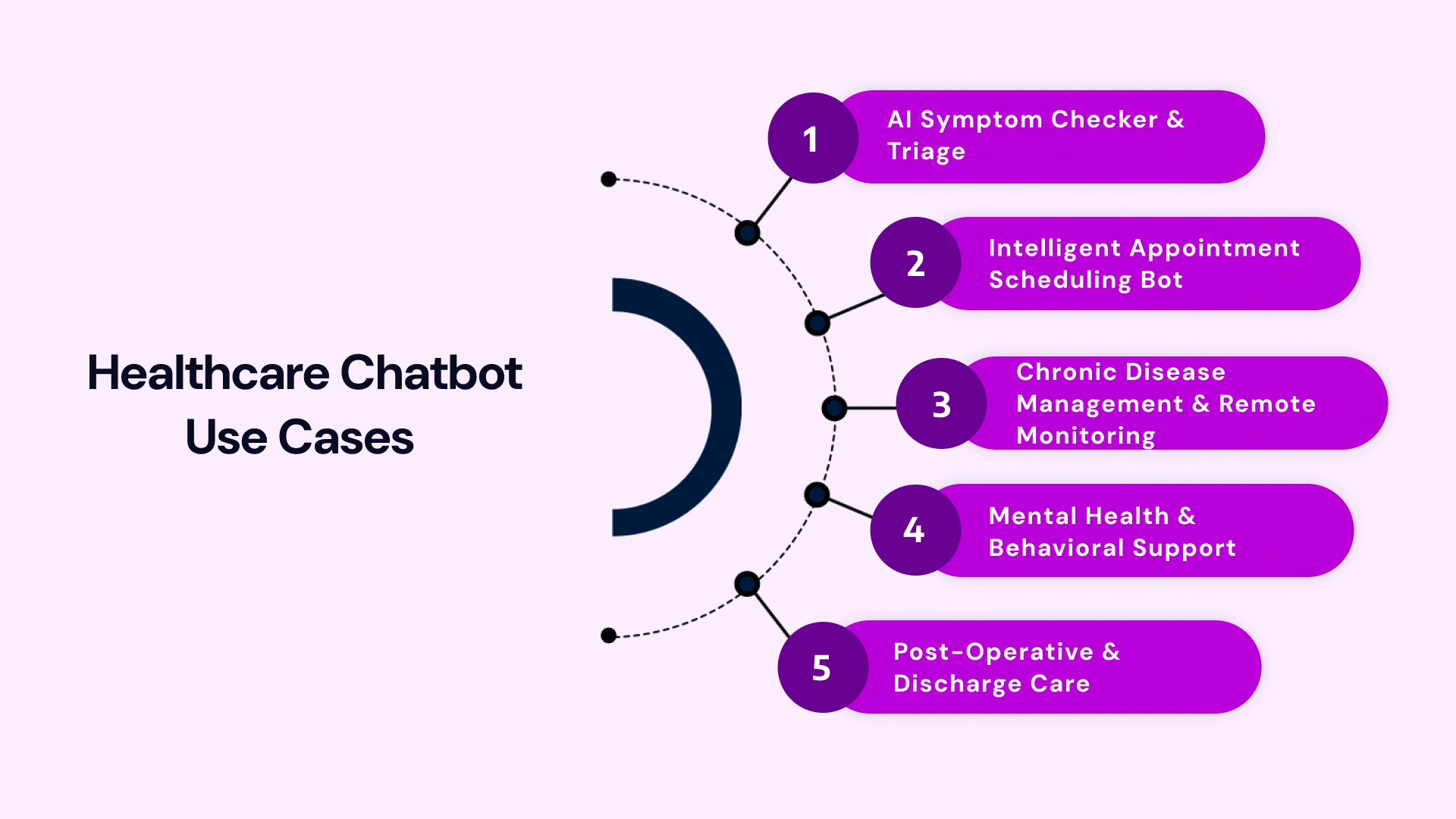
1. AI Symptom Checker & Triage
This is the most common entry point and arguably the most valuable for reducing ER overcrowding. The Symptom Checker chatbot acts as the digital gatekeeper. It assesses the severity of a patient's condition using clinical algorithms (often based on the Manchester Triage System). It directs them to the appropriate level of care—Self-care, Tele-consult, Urgent Care, or Emergency Room. This ensures high-acuity patients get immediate attention while low-acuity cases don't clog physical waiting rooms.
2. Intelligent Appointment Scheduling Bot
Administrative tasks consume significant resources. An Appointment scheduling bot integrates deeply with the hospital's calendar system (like Epic or Cerner). It can:
- Scan doctor availability in real-time.
- Book, reschedule, or cancel appointments 24/7.
- Handle waitlists automatically, notifying patients when a sooner slot opens up.
3. Chronic Disease Management & Remote Monitoring
For patients with chronic conditions like diabetes, hypertension, or CHF (Congestive Heart Failure), consistency is life-saving. Telemedicine automation tools can:
- Send daily check-ins ("What is your blood sugar level this morning?").
- Remind patients to take specific medications.
- Log vitals directly into the EHR.
- Alert the care team if reported vitals breach safety thresholds.
4. Mental Health & Behavioral Support
The demand for AI in mental healthcare often outstrips supply. AI chatbots are proving incredibly effective in providing Cognitive Behavioral Therapy (CBT) techniques. These "therapist bots" offer a judgment-free, anonymous zone for patients to express feelings of anxiety or depression, providing immediate coping mechanisms while waiting for human therapy sessions.
5. Post-Operative & Discharge Care
Readmission rates are a key quality metric for hospitals. After a patient is discharged, the bot can automate the follow-up process:
- "How is your incision healing?"
- "Are you experiencing any fever?"
- "Here is a video on how to change your dressing."
This proactive monitoring helps catch complications early, reducing costly readmissions.
Must-Have Features for a Telemedicine Chatbot
When developing a Telemedicine chatbot, feature selection determines the success of your MVP (Minimum Viable Product). You need a mix of utility, security, and empathy.
1. HIPAA, GDPR, & HITECH Compliance
There is no room for error here. HIPAA-compliant chatbot development is the bedrock of the architecture. This means:
- Data Encryption: AES-256 encryption for data at rest and TLS 1.3 for data in transit.
- Access Control: Strict role-based access control (RBAC), ensuring only authorized providers can view patient chats.
- Audit Logs: Every message, login, and data access must be timestamped and logged.
2. Deep EHR/EMR Chatbot Integration
A standalone bot is an isolated island. To be useful, it must push and pull data from your central systems. EHR/EMR chatbot integration ensures that when a doctor starts a video consult, they already have the chat summary, symptom history, and vitals on their screen. This interoperability is achieved via HL7 and FHIR standards.
3. Multilingual & Multicultural Support
Healthcare is universal, but language is not. Your bot should communicate fluently in the primary languages of your demographic. Beyond translation, it should be culturally competent—understanding that expressions of pain and symptoms can vary across cultures.
4. Omni-channel Availability
Patients shouldn't have to download a new app to get help. The bot should live where the users are:
- Web widget on your hospital portal.
- Integrated into your existing mobile app.
- Secure messaging via WhatsApp Business API or SMS (for notifications).
5. Sentiment Analysis & Escalation
The advanced AI healthcare chatbot guide principles suggest using sentiment analysis. The bot monitors the user's language for signs of distress, anger, or confusion. If the sentiment score drops (indicating frustration or a crisis), the system should automatically and seamlessly hand the conversation over to a human agent or nurse.
A Step-by-Step Roadmap to Telemedicine Chatbot Development
Creating a medical-grade AI requires a rigorous, structured approach. Here is the roadmap we follow at top-tier development firms like VLink.
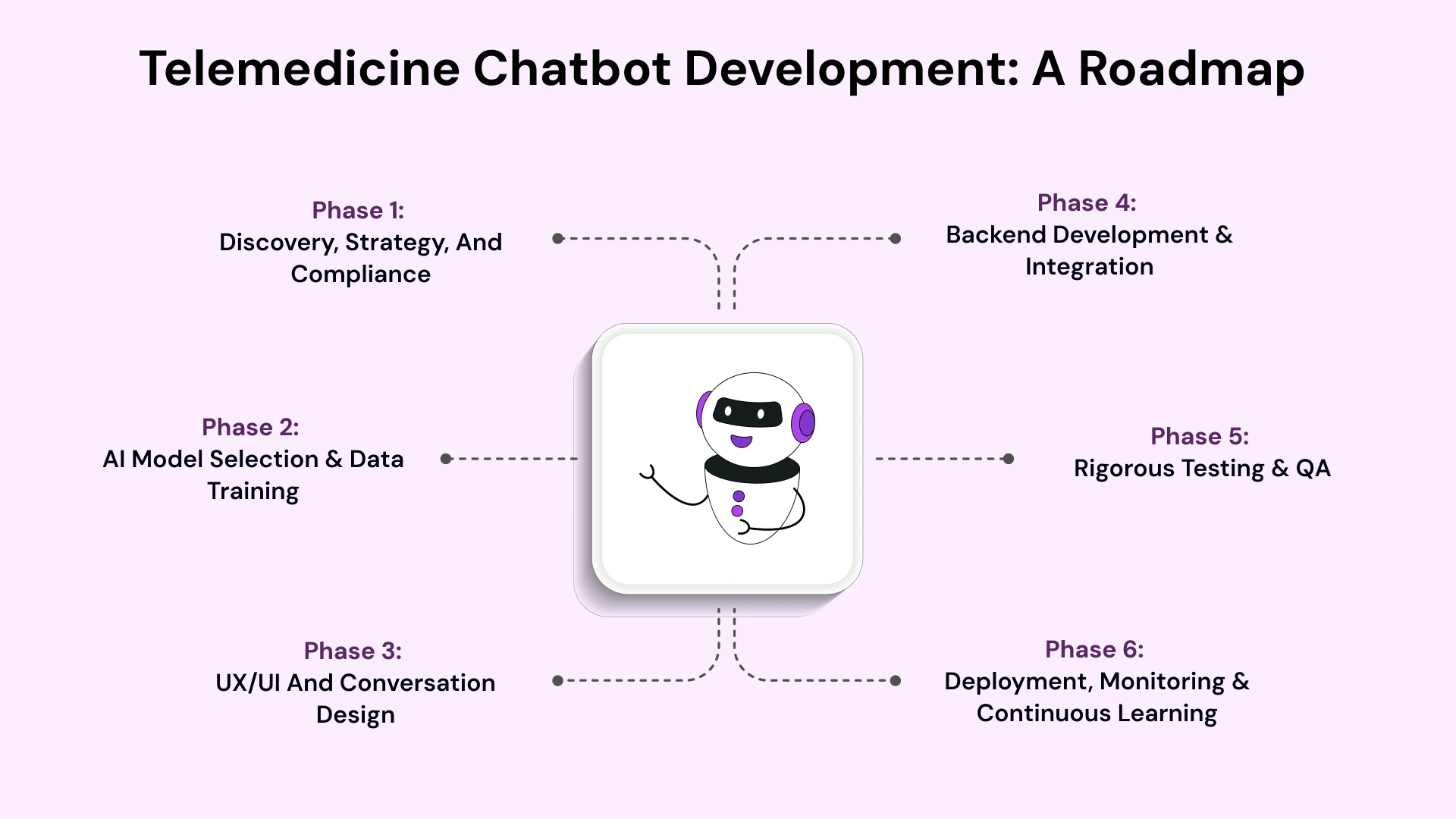
Phase 1: Discovery, Strategy, and Compliance
Before a single line of code is written, we define the scope.
- Stakeholder Interviews: We talk to doctors, admins, and patients to identify pain points.
- Persona Development: Who is the bot? Is it "Nurse Sarah" (warm, nurturing) or "Dr. AI" (efficient, factual)?
- Compliance Framework: We establish the regulatory guardrails (HIPAA, GDPR) immediately.
Phase 2: AI Model Selection & Data Training
Now, select the ideal AI model as per your business needs.
- Rule-Based vs. Generative AI: We decide if a decision-tree model is sufficient (safer, more predictable) or if we need the flexibility of LLMs (more engaging, but requires guardrails).
- Dataset Ingestion: We train the model on curated medical datasets. Critical Note: Data quality is paramount to prevent "hallucinations"—where the AI confidently gives wrong medical advice.
Phase 3: UX/UI and Conversation Design
Chatbot NLP conversation UI/UX design is an art form. In healthcare, clarity is kindness.
- Flow Mapping: Designing the logical paths for thousands of potential user queries.
- Tone Calibration: Ensuring the bot sounds empathetic but not patronizing.
- Fallback Strategies: Designing what the bot says when it doesn't understand (e.g., "I'm not sure I understood that. Could you rephrase or would you like to speak to a nurse?").
Phase 4: Backend Development & Integration
This is where the heavy lifting happens.
- API Architecture: Building the APIs that connect the bot to the EHR, scheduling system, and billing software.
- Cloud Infrastructure: Setting up scalable, HIPAA-compliant server instances (AWS, Azure, or Google Cloud).
Phase 5: Rigorous Testing & QA
Medical software testing goes far beyond standard bug fixing.
- Clinical Accuracy Testing: Doctors must review the bot's advice to ensure medical validity.
- Penetration Testing: Ethical hackers attempt to breach systems to identify security vulnerabilities.
- Load Testing: Simulating high traffic (e.g., flu season spikes) to ensure the system doesn't crash.
Phase 6: Deployment, Monitoring & Continuous Learning
Once live, the work isn't done. We monitor logs for failed interactions ("false negatives") and retrain the AI model to improve its accuracy over time. This is a cycle of continuous improvement.
Tech Stack and Regulatory Compliance for Telemedicine Chatbots
Tech Stack:
To build a robust solution, you need a modern, scalable tech stack.
Natural Language Understanding (NLU) Engines:
- Google Dialogflow CX: Excellent for complex, multi-turn conversations.
- Microsoft Azure Bot Service: best for enterprise-grade security and integration with other Microsoft health tools.
- OpenAI (GPT-4 via API): For state-of-the-art generative text capabilities (requires strict fine-tuning).
Programming Languages:
- Python: The undisputed king of AI and Machine Learning development services.
- Node.js: Great for handling real-time, event-driven interactions.
Databases: MongoDB or PostgreSQL: Flexible, scalable, and capable of handling encrypted JSON data.
Cloud Hosting: AWS (Amazon Web Services): Specifically using their HIPAA-compliant reference architectures.
Integration Standards: HL7 & FHIR: The universal languages for healthcare data exchange.
Regulatory Compliance: The Non-Negotiable
A data breach in healthcare can result in millions of dollars in fines and irreparable reputational damage.
How to Ensure Data Privacy in Healthcare Chatbots?
- End-to-End Encryption: Data must be unreadable to anyone intercepting it, both while in transit and when stored on disk.
- Identity & Access Management (IAM): Multi-Factor Authentication (MFA) should be mandatory for any admin accessing the backend.
- Data Minimization: The bot should only collect the data strictly necessary for the interaction.
- BAA (Business Associate Agreement): If you use 3rd party cloud providers (like AWS or Google), you must sign a BAA. This is a legal contract in which the provider agrees to comply with HIPAA security standards.
Cost Analysis: How Much Does Chatbot Development for Telemedicine Cost?
This is invariably the first question for commercial leads. The cost to develop an AI Telemedicine App or chatbot varies wildly based on complexity, integrations, and compliance needs.
Cost Breakdown (Estimated Ranges)
- Basic Rule-Based Bot ($15,000 - $30,000): A simple button-driven bot for FAQs, clinic hours, and basic contact info. No complex integrations.
- AI-Integrated Bot ($40,000 - $80,000): Utilizes NLP to understand free text. Includes basic integration with scheduling systems and secure user authentication.
- Advanced Generative AI Ecosystem ($100,000+): Deep learning capabilities, full bi-directional EHR/EMR integration, voice recognition, predictive analytics, and multi-language support.
Key Cost Drivers
- Integration Complexity: Connecting to a legacy hospital system (like a 10-year-old EHR) is more expensive than connecting to a modern API.
- Compliance Audits: The cost of hiring 3rd party security auditors to certify HIPAA compliance.
- Custom AI Training: Fine-tuning a model on specific medical specialties (e.g., Oncology vs. Pediatrics) requires specialized data scientists.
ROI: Why Telemedicine Chatbots are Important in Healthcare
Investing in Telemedicine AI chatbot technology isn't an expense; it's a high-yield capital investment.
- Massive Operational Savings: By automating triage and scheduling, hospitals can save hundreds of thousands of dollars annually in administrative labor. It costs pennies for a bot to book an appointment, compared to dollars for a human agent.
- Increased Revenue: By reducing "no-shows" through automated reminders and waitlist management, clinics maximize their billable hours.
- Patient Retention & Loyalty: A 24/7 virtual healthcare assistant ensures patients feel cared for at 3 AM on a Sunday. This convenience is a primary driver of patient loyalty in a competitive market.
- Scalability During Crises: During health crises (like pandemics), call volumes can spike 1000%. Chatbots can scale instantly to handle this load, a feat impossible for human call centers without months of hiring.
Future Trends: The Evolution of Telemedicine Chatbots
The evolution of telemedicine chatbots is moving past simple "if-then" logic toward a more sophisticated, multimodal future. As we look ahead, the integration of Generative AI and sensory technologies is set to redefine the patient experience.
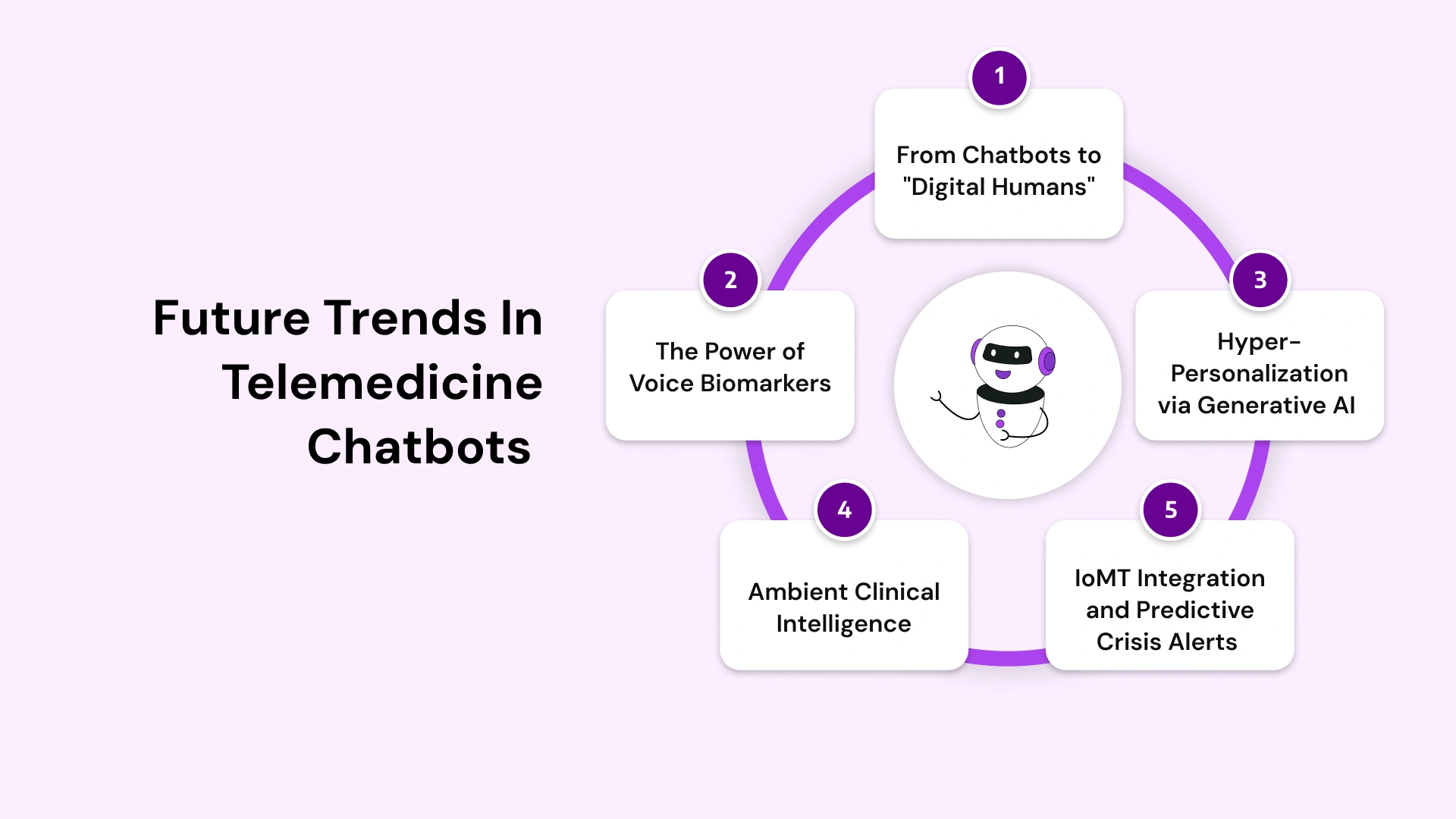
1. From Chatbots to "Digital Humans"
The next frontier is the rise of Digital Humans—hyper-realistic, AI-powered avatars that bridge the gap between clinical efficiency and human empathy. These avatars don't just process text; they use Computer Vision to see.
Imagine a patient showing a skin rash or a post-surgical wound to their camera; the "Digital Human" can analyze the visual input in real-time, cross-reference it with vast medical databases, and provide an immediate preliminary assessment for the doctor to review.
2. The Power of Voice Biomarkers
AI development services are now tapping into the "hidden signals" in human speech. Through vocal biomarkers, future chatbots will be able to detect subtle nuances in pitch, rhythm, and pausing patterns that are invisible to the human ear.
These insights can act as early warning systems for:
- Respiratory Issues: Detecting changes in lung capacity or airway obstruction.
- Neurological Health: Identifying early signs of Parkinson’s or Alzheimer’s.
- Mental Wellness: Monitoring shifts in speed and tone that may indicate worsening depression or anxiety.
3. Hyper-Personalization via Generative AI
Beyond diagnosis, Generative AI will enable chatbots to synthesize a patient’s entire medical history, wearable data, and current symptoms to create bespoke wellness plans. Instead of generic advice, patients receive conversational, context-aware guidance that feels less like a form letter and more like a dedicated health coach.
4. Ambient Clinical Intelligence (The "Invisible" Assistant)
We are moving toward Ambient AI, where the chatbot doesn’t just wait for a prompt—it "listens" and assists in the background. During a virtual consultation, ambient clinical intelligence can automatically transcribe the conversation, extract medically relevant data, and prefill the doctor's EHR (Electronic Health Record) notes in real time.
This eliminates "pajama time"—the hours doctors spend on paperwork after shifts—and allows them to focus 100% on the patient.
5. IoMT Integration and Predictive Crisis Alerts
The future of chatbots lies in their connection to the Internet of Medical Things (IoMT). By syncing with 24/7 wearables (like smart rings or continuous glucose monitors), chatbots will shift from reactive to proactive.
Instead of a patient asking about a symptom, the chatbot might initiate the conversation: "I noticed your resting heart rate and oxygen levels have fluctuated over the last 4 hours; would you like me to book a priority check-in with your cardiologist?" This transforms the chatbot into a preventative life-saving tool.
Next-Gen Telehealth: Secure and Scalable Solutions by VLink
Building a telemedicine chatbot is not just about writing code; it's about understanding the delicate balance between medical rigor and digital innovation. This is where VLink excels.
As a premier Healthcare Development Service provider, VLink bridges the gap between complex healthcare requirements and cutting-edge AI technology. We don't just build bots; we build comprehensive digital health ecosystems.
Why Top Healthcare Leaders Choose VLink:
- Deep Industry Expertise: With over 15+ years of experience working with top healthcare entities in the USA and globally, we understand the nuances of HL7, FHIR, HIPAA, and FDA regulations better than anyone.
- Custom AI Architectures: We reject "cookie-cutter" solutions. Whether you need a simple triage bot or a complex Generative AI assistant integrated with Epic or Cerner, we will architect a solution tailored to your specific workflows.
- Security First Approach: Our development lifecycle is built on a foundation of security. From the first wireframe to the final deployment, data privacy is baked into every layer of our code.
- End-to-End Partnership: We aren't just a vendor; we are your technology partner. From the initial discovery phase and design to backend integration, QA, and post-launch maintenance, we are with you every step of the way.
Don't let technical complexity hold back your digital transformation—partner with VLink’s dedicated team to build a secure, scalable, and future-proof telemedicine solution.
Conclusion
Telemedicine chatbot development is no longer a futuristic concept; it is the present standard of digital care. By integrating AI chatbots into hospital systems, you are not just building software; you are building a more accessible, efficient, and empathetic healthcare system.
Whether you are looking to build a patient triage chatbot, a mental health companion, or a comprehensive Telemedicine automation tool, the key lies in balancing technological innovation with strict regulatory compliance and human-centric design. The data is clear: the demand is here, the technology is ready, and the ROI is proven.
Tips: For teams comparing scope and budget, telehealth app development cost like Teladoc offers useful direction for planning timelines, resources, and delivery expectations.
The digital health revolution is moving fast. The question is, are you ready to lead it?Contact VLink Today for a free consultation and discover how our Telemedicine Chatbot Development services can revolutionize your patient experience.

Vice President & Global Head of Digital, VLink Inc.
Amitabh is the Vice President and Global Head of Digital at VLink Inc., with over 20 years of leadership experience in IT strategy, digital transformation, and emerging technologies.

 Shivisha Patel