
Software development services in Saudi Arabia cover every way a business can contract technical talent. Options range from a single fixed-scope project to a fully dedicated offshore team. Every buyer eventually asks the same two questions. Which engagement model fits this project? What should it actually cost in 2026? Directories list companies. Listicles rank vendors. Nobody in the KSA market answers those two questions directly, with real numbers attached.
This guide answers both. It compares Fixed Price, Time and Materials, Dedicated Team, and Staff Augmentation models directly. It benchmarks 2026 hourly rates by model, seniority, and delivery location. It walks through real cost examples for a typical project under each model. It compares local Saudi firms, offshore teams, and hybrid delivery. It closes with the vendor evaluation criteria that matter more than the rate card alone.

What Is the State of Software Development Outsourcing in Saudi Arabia?
Demand for outsourced software development in the Kingdom is expanding fast. The Saudi Arabia IT services market stands at $20.09 billion in 2025. Mordor Intelligence projects it will reach $45.77 billion by 2030, a 17.9% compound annual growth rate. Saudi Vision 2030 mandates are the biggest driver. Government IT modernization spending alone reached SAR 15 billion in 2024, a 340% jump over pre-Vision 2030 baselines.
Talent supply has not kept pace with that demand. The Kingdom faces a shortfall of more than 15,000 skilled IT and cybersecurity professionals. National training programs reached 50,000 people in 2024, but the gap persists. Salary premiums for scarce specializations now run 45% to 60% above regional norms. That gap is the single biggest reason outsourcing has become standard practice. It is no longer a fallback option for Saudi CTOs and CIOs.
Cloud adoption tells a similar story of rapid change. Saudi enterprise cloud adoption reached 78% in 2024, up from 45% in 2022. Every one of those migrations needs development and integration capacity most internal teams do not have on staff. Data-center investment surged to $21 billion in 2024 alone, adding hyperscale capacity across Riyadh, Jeddah, Dammam, and NEOM. The infrastructure behind those giga-project programs is mapped in the guide to what Saudi Vision 2030 means for enterprise cloud. That expansion lowers latency for cloud-hosted applications. It also gives development teams more infrastructure options than existed even two years earlier.
Talent programs are trying to close the staffing gap directly. Premium Residency visas aim to attract global professionals to the Kingdom. Many recipients still favor oil and gas roles over technology though. That mismatch keeps pressure on outsourced and augmented staffing models.
Which IT Service Types Are Growing Fastest?
Software development rarely gets purchased in isolation anymore. Understanding the surrounding service mix helps set realistic vendor expectations.
Fastest-Growing IT Service Types in Saudi Arabia
| Service Type | 2024 Share or Growth | What It Means for Buyers |
| IT Consulting and Implementation | 35.86% share, the largest segment | Strategic guidance dominates spend; average engagement value reaches $2.3 million |
| Cloud and Platform Services | 19.5% CAGR, the fastest-growing segment | Development work is increasingly bundled with cloud migration, not purchased separately |
| Managed Security Services | Contract values up 34% in 2024 | Security requirements are now baked into most development RFPs from the start |
| IT Outsourcing and Staff Augmentation | Core focus of this guide | Engagement model choice, covered in the next section, matters most here |
Integration across consulting, cloud, and security now features in 67% of large Saudi IT deals. A software development RFP that only asks about coding capacity is increasingly the exception, not the rule.
How Big Is a Typical Contract by Buyer Type?
Contract size varies enormously by buyer type. Knowing where your project sits helps set realistic expectations before the first vendor conversation.
Typical Contract Size by Buyer Type in Saudi Arabia
| Buyer Type | 2024 Market Share / Growth | Typical Contract Value |
| Government and Public Sector | 25.88% of market share | $50 million - $100 million for multi-year citizen platforms and agency integration |
| Large Enterprises | 68.41% of market share | $15 million - $25 million per year for multi-domain contracts |
| SMEs | 19% CAGR, the fastest-growing segment | Average engagement value of $78,000 in 2024 |
| IT Consulting and Implementation (all buyers) | 35.86% of 2024 revenue, the largest service line | Average engagement value of $2.3 million |
SME buyers sit at a very different price point than government or large enterprise buyers. A software house pricing every client the same way is a signal worth noticing. Mandatory FATOORA e-invoicing rules pushed this further in 2025. The nineteenth compliance wave alone affected more than 400,000 SMEs, triggering roughly $800 million in new IT demand almost overnight.
Contract size also signals whether a vendor actually fits your project. A firm built around $50 million government platforms rarely prices SME work competitively. Its overhead and internal processes assume a much larger budget. An SME buyer approaching that vendor often gets quoted a rate designed for enterprise risk, not a $78,000 engagement. The reverse mismatch happens too. A vendor built for fast SME turnarounds may lack the compliance documentation a government RFP requires. Matching vendor size to project size upfront avoids both problems before a proposal is even drafted. That check applies whether you shortlist a global provider or a local Software Development Company in Saudi Arabia.
Which Engagement Model Should You Choose?
Four structures cover almost every software development engagement in Saudi Arabia. Each trade off cost certainty, control, and flexibility differently.
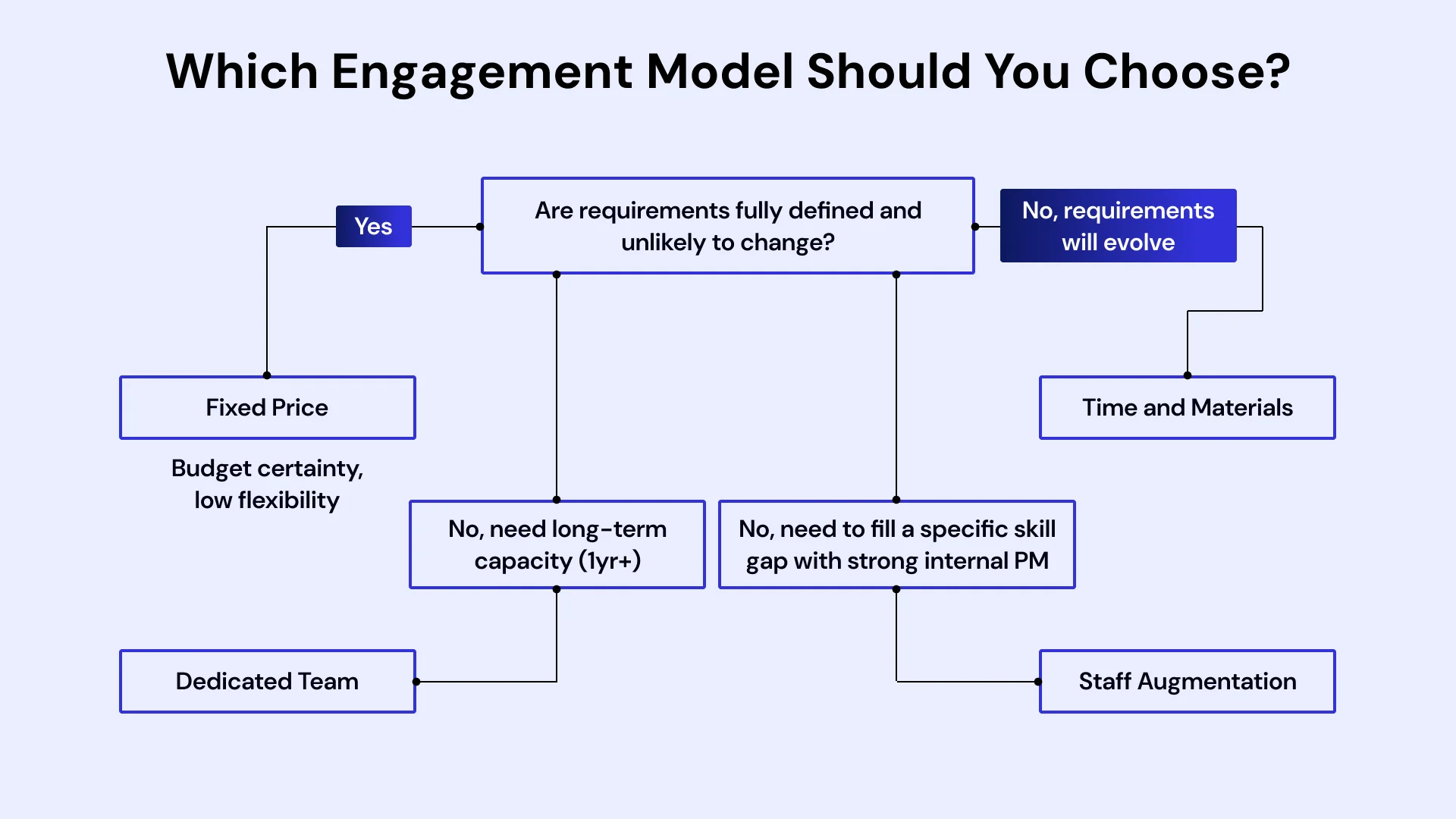
Engagement Model Comparison for Software Development in KSA
| Model | How It Works | Best For | Primary Risk |
| Fixed Price | Scope, timeline, and price agreed upfront; vendor delivers to spec | Well-defined projects with stable, unlikely-to-change requirements | Scope changes trigger costly change orders; discourages iteration |
| Time and Materials (T&M) | Client pays for actual hours worked plus materials, billed periodically | Projects with evolving requirements or unclear final scope | Total cost is harder to forecast upfront; needs active client oversight |
| Dedicated Team | Vendor assembles and manages a team embedded in the client's roadmap long-term | Ongoing product development without hiring an internal team | Requires a genuine long-term commitment to see cost benefits |
| Staff Augmentation | Vendor supplies individual engineers who join the client's existing team | Filling specific skill gaps while the client retains full project control | Requires strong internal management capacity to be effective |
Fixed Price remains the most common first choice for government and enterprise buyers who need budget certainty. Dedicated Team and IT staff augmentation services better serve fast-growing FinTech and startup buyers instead. Those buyers need to scale technical capacity fast, without waiting on local hiring given the talent shortage described above.

What Do Developers Actually Cost in Saudi Arabia in 2026?
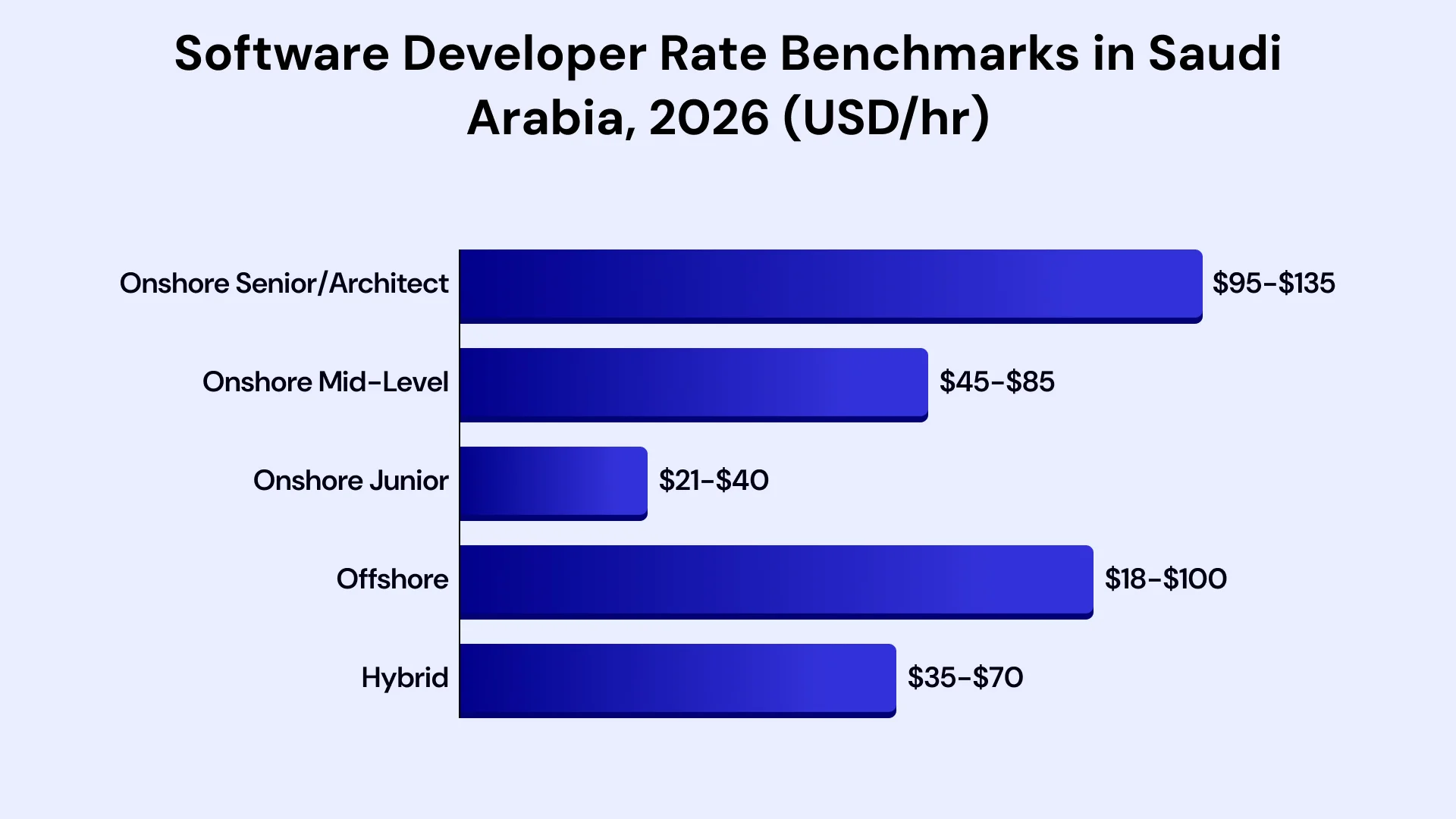
Rates vary by delivery model, seniority, and specialization. The ranges below reflect 2026 Saudi market data. They are converted to USD at current exchange rates. Treat them as directional benchmarks, not fixed prices.
Software Developer Rate Benchmarks in Saudi Arabia, 2026
| Delivery Type / Seniority | Typical Hourly Rate (USD) | Notes |
| Onshore KSA - Senior / Architect | $95 - $135 (SAR 355-500) | Highest tier; typically, Riyadh-based, client-facing, Arabic-fluent |
| Onshore KSA - Mid-Level Developer | $45 - $85 (SAR 170-320) | Average gross hourly rate across the market sits near $30 (SAR 113) |
| Onshore KSA - Junior Developer | $21 - $40 (SAR 80-150) | Freelance and junior-tier rates start around SAR 80 an hour |
| Offshore (South Asia, Eastern Europe blend) | $18 - $100 | Wide range depending on region and seniority; lowest average total cost |
| Hybrid (Onshore lead + offshore team) | $35 - $70 blended | Combines Arabic-fluent client management with offshore delivery cost |
A quoted hourly rate is rarely the full cost per productive hour. Benefits and overhead change the real number substantially. Factor those in, and a Saudi-based hire's true cost typically runs 40% to 65% above the base salary. That loaded-cost gap is the main reason many buyers now default to a hybrid model instead of pure onshore hiring.
When Should You Use Which Model?
A short decision framework narrows the choice faster than comparing every feature side by side.
- Requirements are fully defined and unlikely to change: Choose Fixed Price. You get budget certainty in exchange for less flexibility.
- Requirements will evolve as the product develops: Choose Time and Materials. You pay for actual work, not a guess made before development started.
- You need ongoing development capacity for a year or more: Choose Dedicated Team. The vendor's management overhead pays for itself over that timeframe.
- You have strong internal project management and need specific skills: Choose Staff Augmentation. You keep full control and only pay for the gap you actually have.
Government and large enterprise buyers gravitate toward Fixed Price early. Budget approval processes reward cost certainty, which explains the instinct. That instinct often works against them on integration-heavy projects. Requirements shift once real legacy systems and data enter the picture.
What Does a Typical Project Cost Under Each Model?
Real numbers make the comparison concrete. The examples below assume a mid-sized enterprise application, roughly four to six months of development.
Illustrative Project Cost by Engagement Model
| Model | Example Scope | Illustrative Total Cost (USD) |
| Fixed Price | A defined MVP with a locked feature list and a single delivery date | $60,000 - $150,000, plus change-order costs if scope shifts |
| Time and Materials | A product built iteratively with a product owner steering priorities weekly | $70,000 - $180,000, varying with actual hours logged |
| Dedicated Team | A 4-person team (1 lead, 2 mid-level, 1 QA) engaged for 6 months | $110,000 - $200,000, with predictable monthly billing |
| Staff Augmentation | 2 mid-level developers embedded in an existing internal team for 6 months | $55,000 - $100,000, management overhead excluded |
These figures are illustrative, not quotes. Actual cost depends on several factors. Team seniority mixes matters. So does whether integration work touches legacy ERP or core banking systems. The number of Saudi-specific compliance reviews the project needs also shifts the total meaningfully.
Local KSA Firms vs. Offshore vs. Hybrid Teams: Which Fits You?
Delivery location changes cost, speed, and compliance posture all at once. None of the three options is universally correct.
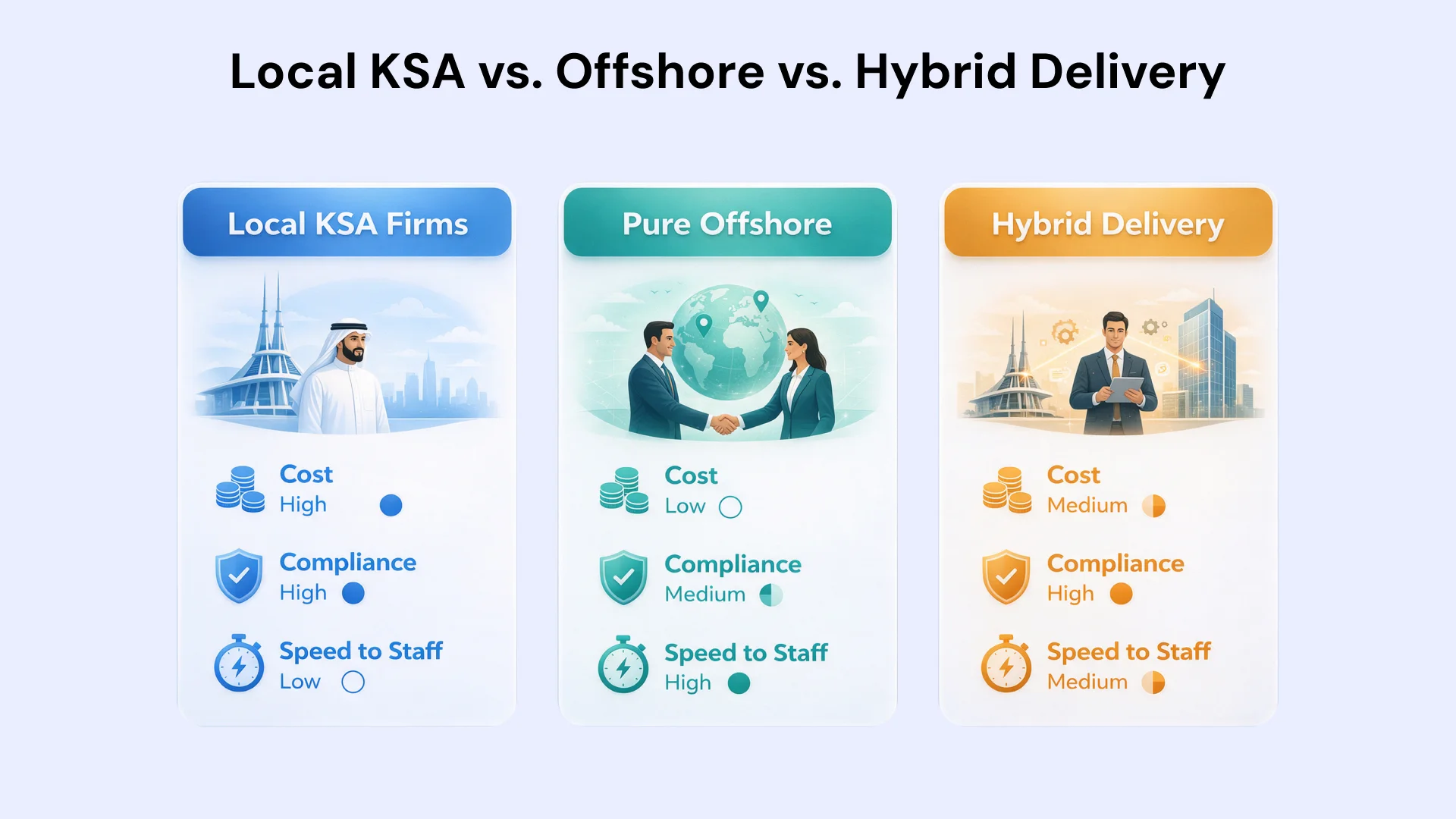
Local KSA vs. Offshore vs. Hybrid Delivery
| Delivery Type | Pros | Cons | Typical Rate Range |
| Local KSA firms | Arabic-first delivery, in-person availability, easier Saudization compliance | Highest rates; talent shortage lengthens hiring and staffing timelines | $45 - $135/hr |
| Pure offshore teams | Lowest total cost; large talent pools across regions | Timezone gaps; weaker Vision 2030 and Saudi compliance familiarity | $18 - $100/hr |
| Hybrid (onshore lead + offshore team) | Balances cost with local compliance oversight and client-facing Arabic support | Requires a vendor experienced at coordinating across both | $35 - $70/hr blended |
Onshore delivery still held 48.77% of the Saudi IT services market in 2024. Government buyers value local presence and Saudization compliance, which explains that share. For onshore work specifically, a Custom Software Development Company in Riyadh keeps delivery inside the Kingdom while offshore capacity absorbs scale. Offshore delivery is growing faster than any other model, at a 19.2% compound annual growth rate. Cost pressure and improved remote collaboration tools are narrowing the practical gap between the two.
What Should You Check Beyond the Hourly Rate?
Gartner published a March 2026 report titled "Predicts 2026: AI Transforms IT Sourcing, Procurement and Vendor Management." A team of Gartner analysts authored it. The finding is direct. 81% of organizations now want their outsourcing partners to function as strategic collaborators. Three in four companies specifically want transformational outcomes, not just cost savings. Rate alone does not predict which vendor delivers that. The buyer’s map of software companies in Riyadh groups the local vendor field by category before you start scoring.
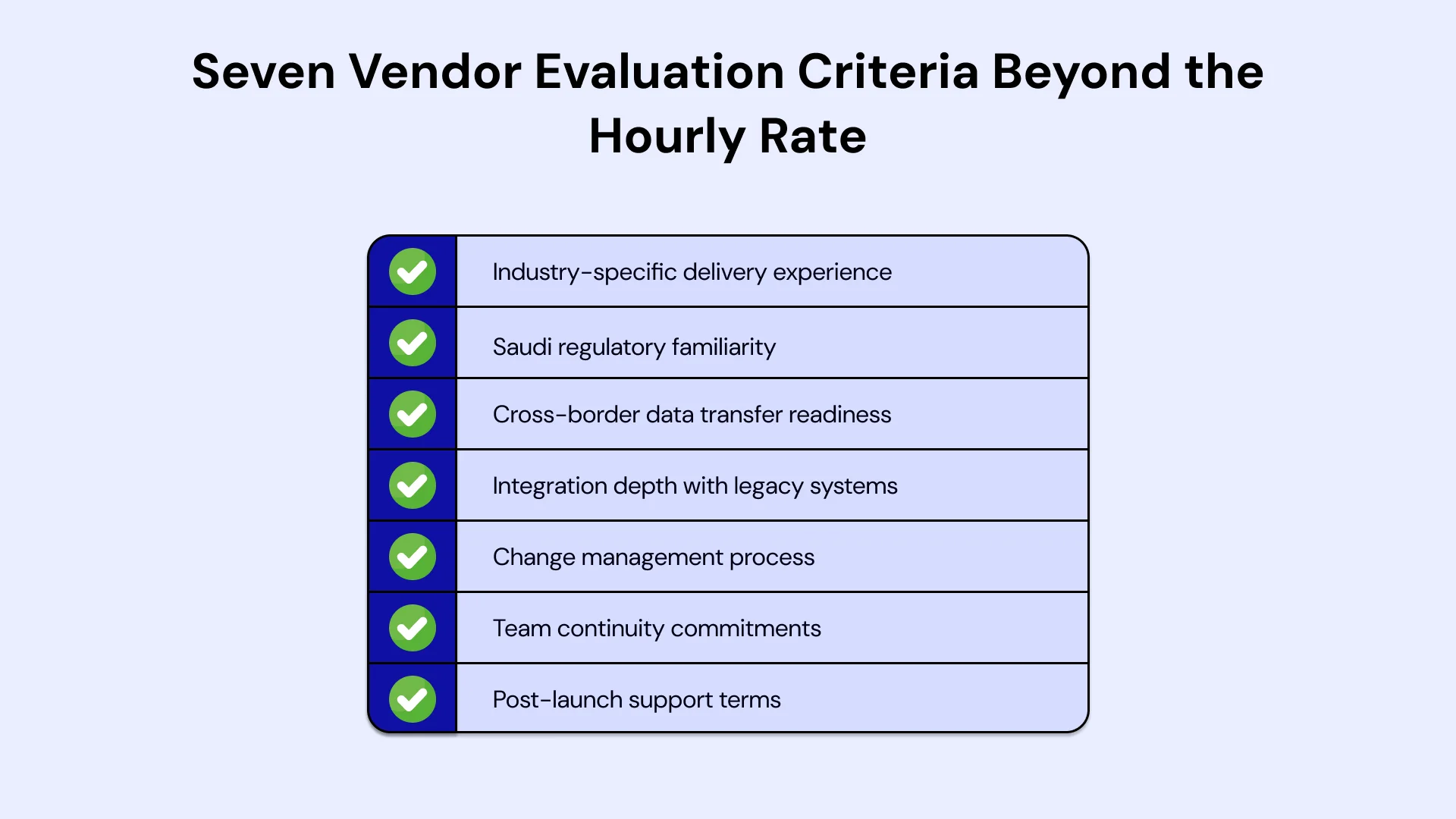
- Industry-specific delivery experience: Ask for reference clients in your exact sector, whether healthcare, FinTech, or government, not general software experience.
- Saudi regulatory familiarity: Confirm the vendor understands data residency, the Personal Data Protection Law, and sector-specific rules relevant to your project.
- Cross-border data transfer readiness: SDAIA issued risk-assessment guidelines in February 2025 requiring flow-by-flow evaluation of any data leaving the Kingdom. Ask how the vendor handles this, since penalties can reach SAR 5 million.
- Integration depth with legacy systems: If your project touches ERP, CRM, SAP, or Oracle systems, ask for specific prior integration work, not general claims.
- Change management process: Ask exactly how scope changes are priced and approved before signing, especially under a Fixed Price contract.
- Team continuity commitments: Ask which named individuals will actually work on your project, and what happens if a key team member leaves mid-project.
- Post-launch support terms: Confirm what support costs after go-live, and whether it is priced separately from the development contract.
VLink's Global Delivery Manager has seen rate-only vendor selection go wrong firsthand. A Saudi insurance client once signed a Fixed Price contract with a low-cost vendor. The project involved a policy system integration built on WebSphere MQ middleware. The vendor had never touched middleware integration before. Requirements shifted within weeks, once real data exposed gaps the vendor had not anticipated. Change orders more than doubled the original contract value. The client ultimately brought VLink in under a Dedicated Team model. This time, the integration finished correctly, on a realistic timeline.
What Hidden Costs Catch Buyers Off Guard Most Often?
The rate card rarely tells the whole story. Buyers who compare only hourly rates often discover the real gap after signing, not before.
- Change orders under Fixed Price: A single mid-project scope change can add 20% to 40% to the original contract value, especially on integration-heavy work.
- Project management overhead under Staff Augmentation: Someone on the client side must direct augmented staff daily. That time is real cost, even without an invoice line for it.
- Onboarding and ramp-up time: A new Dedicated Team typically needs two to four weeks to reach full productivity. Buyers who budget for day-one output are often disappointed early.
- Post-launch support gaps: Development contracts frequently exclude support after go-live. Buyers who assume it is included face a second negotiation at the worst possible time.
- Compliance retrofitting: Adding PDPL or sector-specific compliance work after a project starts costs meaningfully more than designing for it from the first sprint.
None of these costs are hidden in bad faith, in most cases. They simply sit outside the number most buyers focus on during vendor selection. Asking about each one before signing closes most of the gap. What remains is the difference between the quoted rate and the real total project cost.
Get Your Free Project Estimate
Choosing the right engagement model before the first contract is signed saves far more than choosing the cheapest hourly rate. VLink's Saudi delivery team scores your project against the models and rate benchmarks in this guide. It then recommends the structure that actually fits your requirements and timeline.
The Saudi Arabia Software Development Rate Card & Engagement Model Guide comes with the estimate. It covers what most RFPs miss:
- A model recommendation based on your requirements stability and project duration
- 2026 rate benchmarks by seniority and delivery location, matched to your scope
- A realistic cost range for your specific project type, not a generic average
- A vendor evaluation checklist covering the six criteria in this guide
- A Vision 2030 and compliance readiness check for your sector
Get your free Project Estimate. Or compare engagement models for your project directly with VLink's Saudi delivery team.
VLink has delivered custom software development services under all four models covered in this guide. Projects span FinTech, insurance, healthcare, and government-adjacent work across the Kingdom. That range matters when a project shifts mid-course, since a vendor limited to one model cannot adapt as easily. A Fixed Price contract sometimes needs to flex into T&M. A Staff Augmentation engagement sometimes grows into a Dedicated Team. Both transitions work better with a vendor already fluent in every model.

In Summary
Software development outsourcing in Saudi Arabia is growing fast. The market is projected to reach $45.77 billion by 2030. A persistent shortfall of more than 15,000 skilled professionals is pushing more buyers toward Dedicated Team and Staff Augmentation models. It is also driving hybrid delivery, which blends onshore oversight with offshore cost efficiency. Fixed Price still suits well-defined, stable-scope projects. Time and Materials fits evolving requirements better. Rates range from roughly $18 an hour offshore to $135 an hour for senior onshore Saudi talent. A loaded cost premium of 40% to 65% above quoted salary figures applies on top of that. The buyers getting the best outcomes are not simply chasing the lowest rate. They match engagement model to project type first. Only then do they evaluate vendors on integration depth, compliance familiarity, and team continuity.

Global Delivery Manager, VLink Inc.
Shivisha Patel serves as the Global Delivery Manager at VLink Inc., bringing a wealth of experience in program delivery and management, particularly in the insurance and banking sectors. She has a robust technical background with deep expertise in WebSphere MQ, WTX, IIB, middleware, and enterprise system integration.

 Shivisha Patel