Yet, behind these impressive numbers lies a brutal truth: scaling a GCC from 200 to 2000 employees is where most organizations stumble. The journey from a nimble startup team to a full-fledged capability center isn't simply a matter of multiplying headcount by ten. It's a complete organizational transformation that demands strategic foresight, operational excellence, and an unwavering focus on culture.
For companies expanding delivery capabilities, US-based capital markets GCC in India can provide a practical model for scale, governance, and long-term operating efficiency.
The statistics paint a sobering picture. While 70% of GCCs plan aggressive expansion, many struggle to execute it. The fear of chaotic expansion, organizational breakdown, and culture dilution keeps leaders awake at night. How do you maintain delivery predictability beyond 500 employees? How do you align culture across global and India teams when you're adding 50 people per month? When does rapid hiring start hurting productivity rather than helping it?
This comprehensive blog draws on proven frameworks and industry best practices to help you navigate this critical inflection point. Whether you're a GCC Head of Capability, an IT Delivery Leader, or part of the talent acquisition team, you'll discover the exact roadmap to scale your India GCC intelligently—from 200 to 2000 employees without descending into chaos.
Understanding the Critical Inflection Points in GCC Scaling
The 200-500 Employee Transition: Building Your Foundation
The journey from 200 to 500 employees represents your first major scaling milestone. At this stage, your GCC tech solutions are transitioning from a "large team" mentality to a true organizational structure. The informal communication networks that worked brilliantly with 200 people begin showing cracks. Decision-making bottlenecks emerge. Your flat hierarchy that encouraged innovation now creates confusion about accountability.
This is where you must establish scalable operational frameworks. Your talent pipeline needs to shift from reactive hiring to proactive workforce planning. According to industry benchmarks, GCCs at this stage should be planning 6-9 months ahead with a robust pipeline that's 2-3 times your quarterly hiring target. The key is implementing structured processes without killing the entrepreneurial spirit that made your GCC successful.
Smart GCCs invest heavily in middle management development during this phase. You need strong team leads, project managers, and practice heads who can operate autonomously while staying aligned with your strategic vision. This is also when technology infrastructure must scale—your HRIS, project management tools, and communication platforms need enterprise-grade capabilities.
The 500-1000 Employee Challenge: Maintaining Agility at Scale
Crossing the 500-employee threshold changes everything. You're no longer building a GCC; you're running a mid-sized organization with all the complexity that entails. The organizational design questions become more nuanced. Do you organize by function, by global business unit, or by capability? How do you prevent silos while maintaining specialization?
At this scale, culture becomes your most valuable asset—and your biggest vulnerability. The informal culture transmission that happened organically among 200 people now requires deliberate systems. New hires at 800 employees may never interact with your founding team. How do you maintain your DNA? Leading GCCs implement structured onboarding programs, culture ambassador networks, and regular town halls to keep everyone connected to the mission.
Delivery predictability becomes paramount. Your global stakeholders expect consistent quality regardless of team size. This demands robust governance models, standardized delivery methodologies, and transparent metrics. The best-performing GCCs establish Centers of Excellence (CoEs) that drive consistency across teams while enabling execution flexibility.
The 1000-2000 Journey: Building an Institution
The final push to hire dedicated software development team, from 1000 to 2000 employees, is when you transform from a capability center into a strategic institution. At this scale, you're likely supporting multiple global business units, running complex transformation programs, and potentially developing intellectual property that gives your parent organization a competitive advantage.
Organizational complexity reaches new heights. You might be managing 50+ teams across 10+ delivery towers. Your leadership team needs to operate like a well-oiled corporate board. Strategic workforce planning extends 12-18 months into the future. You're thinking about talent ecosystems, not just hiring pipelines.
This is also where attrition management becomes sophisticated. At 2000 employees with industry-average attrition of 15-20%, you're replacing 300-400 people annually. Your talent strategy must address retention, internal mobility, and succession planning simultaneously. Top GCCs build comprehensive career frameworks with clear progression paths, invest in learning and development at scale, and create compelling employee value propositions that go beyond compensation.
Strategic Workforce Planning: The Foundation of Controlled Scaling in GCC
In 2026, Strategic Workforce Planning (SWP) has evolved from a back-office HR function into the primary engine for "controlled scaling" within Global Capability Centers (GCCs). As GCCs shift from being cost arbitrage centers to "Value & Innovation Hubs," the focus has shifted from simple headcount planning to capability-led architecture.
Controlled scaling ensures that growth is not just rapid, but sustainable, compliant, and aligned with the parent organization’s long-term digital roadmap.
Building Predictable Talent Pipelines
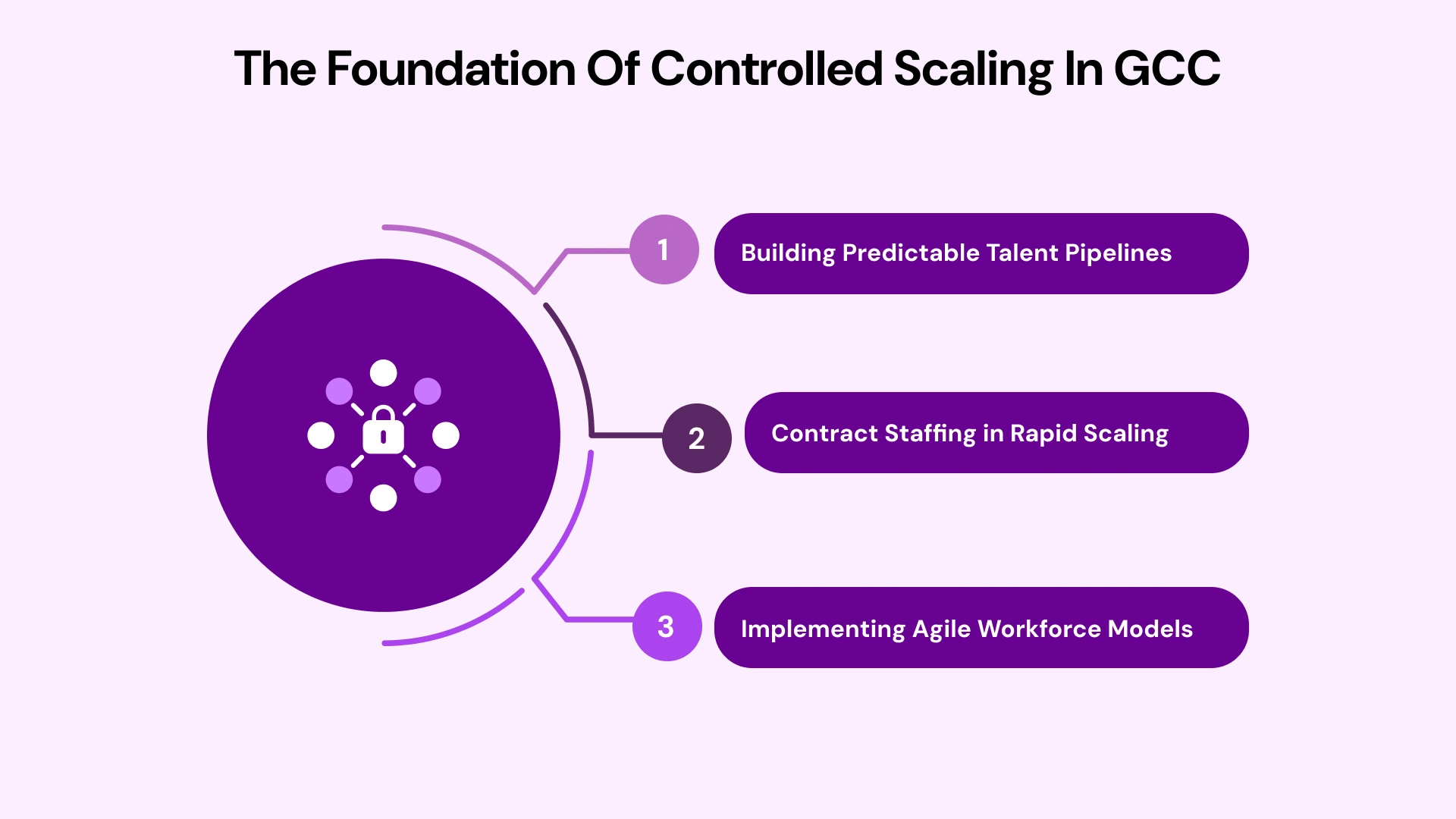
The difference between chaotic and controlled scaling lies in your talent pipeline strategy. Leading GCCs maintain a continuous pipeline that's 3-5 times their monthly hiring needs. This isn't just about having more candidates; it's about having the right candidates at the right time for the right roles.
Your workforce planning should integrate tightly with your business roadmap. If your global product team is launching a new digital platform in Q3 that requires 50 cloud engineers, your talent acquisition should have begun building that pipeline in Q1. This requires close collaboration between your delivery leaders, HR business partners, and recruiting teams.
Consider implementing a multi-channel sourcing strategy. Campus hiring provides volume and cultural fit for junior roles. Lateral hiring brings in experienced professionals who can hit the ground running. Contract staffing offers flexibility for project-based needs. The best GCCs use all three channels strategically, adjusting the mix based on market conditions and business needs.
Technology plays a crucial role. Modern Applicant Tracking Systems (ATS) with AI-powered matching, candidate relationship management (CRM) capabilities, and analytics dashboards help you manage pipelines at scale. Your talent team should have real-time visibility into pipeline health, time-to-fill metrics, and offer acceptance rates across all roles.
Contract Staffing in Rapid Scaling
Contract staffing has emerged as a secret weapon for GCCs navigating rapid expansion. When you're scaling from 200 to 2000 employees, you'll inevitably face situations where demand spikes faster than your permanent hiring can accommodate. This is where strategic contract staffing delivers pace and precision.
The model offers several advantages. First, it provides flexibility to scale up (or down) based on project needs without long-term commitments. Second, it allows you to evaluate talent in real working conditions before converting to permanent roles—a "try before you buy" approach that significantly reduces mis-hires. Third, it gives you access to specialized skills for short-term initiatives without disrupting your core team structure.
However, contract staffing must be used strategically, not as a band-aid for poor planning. The most successful GCCs maintain a healthy mix—typically 70-80% permanent employees who form the cultural and operational core, and 20-30% contract resources who provide flexibility and specialized skills. This ratio varies based on your industry, project portfolio, and growth trajectory.
Integration is critical. Contract team members should be treated as part of the team, included in meetings, given access to necessary tools, and aligned with your quality standards. Poor integration leads to a two-tier culture that damages morale and productivity. Smart GCCs create clear pathways for high-performing contract employees to transition to permanent roles, turning your contract workforce into a talent pipeline.
Implementing Agile Workforce Models
As you scale toward 2000 employees, workforce agility becomes a competitive advantage. Traditional annual planning cycles can't keep pace with rapidly changing business needs. Leading GCCs are adopting agile workforce models that blend permanent employees, contract resources, project-based teams, and even strategic outsourcing partnerships.
The agile workforce model starts with skills-based planning rather than role-based planning. Instead of saying "we need 10 Java developers," you identify "we need expertise in microservices architecture, cloud-native development, and API design for the next 6 months." This shift allows you to mix and match resources—some permanent, some contract, some upskilled from other teams—to meet the need.
This approach requires robust skills tracking and internal mobility programs. Your HR systems should maintain a comprehensive skills inventory across your entire workforce. When new projects emerge, you can quickly identify internal talent who could be redeployed or upskilled, reducing external hiring needs and improving employee engagement through growth opportunities.
Cross-functional project teams become the norm. Rather than rigid departmental silos, you create fluid teams that form around business outcomes, draw members from across the organization, and dissolve when the project completes. This approach maximizes resource utilization, accelerates knowledge transfer, and keeps your employees' work interesting.
Organizational Design for Sustainable Growth in GCC
In 2026, GCCs in India have transitioned from "back-office" cost-saving units to strategic innovation engines. Achieving sustainable growth in this landscape requires an organizational design that balances local agility with global integration.
The following framework outlines the core components of modern GCC organizational design.
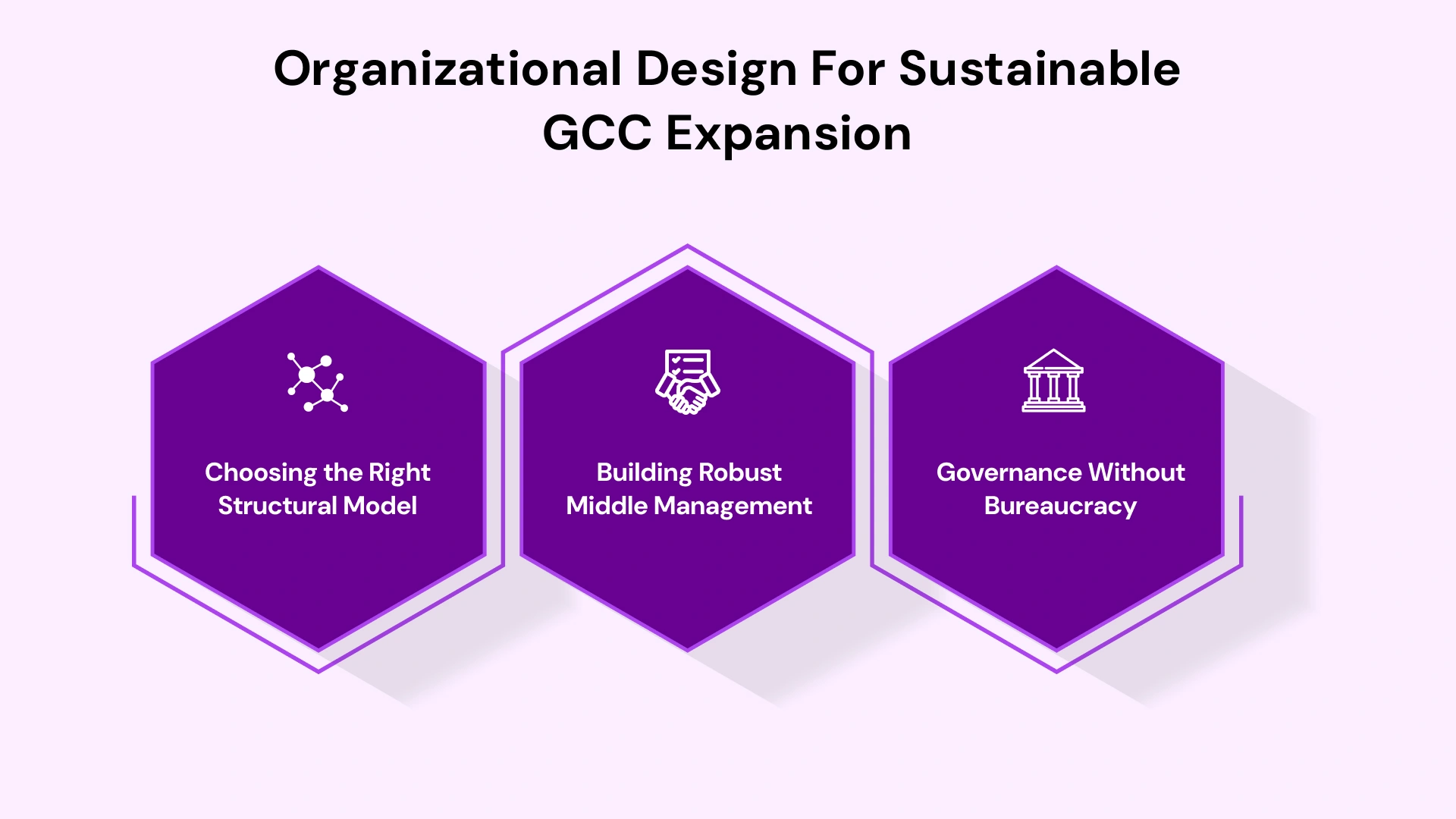
Choosing the Right Structural Model
Your organizational structure at 2000 employees will look dramatically different from what worked at 200. The key question: how do you structure for clarity and accountability while maintaining the agility that made you successful?
Most GCCs evolve through several structural models. Early-stage GCCs often use a functional structure—all engineers together, all operations together. This works well for building expertise but creates challenges as you support multiple global business units. The next evolution is typically a matrix structure, in which employees report to both a functional leader (for capability development) and a business-unit leader (for delivery).
Advanced GCCs often adopt a hybrid model that combines elements of functional, business-unit, and capability-based structures. For example, you might have vertical towers aligned to global business units (Banking Platform, Wealth Management, Insurance), horizontal platforms providing shared services (Cloud Infrastructure, Data & Analytics, Cybersecurity), and Centers of Excellence driving methodological consistency (Agile CoE, Quality CoE, Innovation Lab).
The right structure depends on your strategic mandate. If your GCC primarily serves a single business unit with deep expertise requirements, a functional structure might work best. If you're supporting multiple business units with different needs, a matrix or hybrid model provides better alignment. Whatever you choose, remember that structure should enable strategy, not constrain it.
Building Robust Middle Management
The quality of your middle management layer—team leads, managers, and senior managers—determines whether scaling succeeds or fails. These leaders are the connective tissue between strategic vision and daily execution. They translate goals into action, coach team members, resolve blockers, and maintain quality standards.
Yet middle management is often the weakest link in scaling GCCs. Organizations promote strong individual contributors into management without adequate preparation. The result: brilliant engineers who struggle to lead teams, creating bottlenecks instead of enabling flow.
Invest heavily in management development. Create structured leadership programs that teach essential skills—giving feedback, having difficult conversations, delegation, strategic thinking, and people development. These shouldn't be one-time training sessions but ongoing development journeys with coaching, peer learning, and real-world application.
Define clear expectations and success metrics for managers. What does "good" look like at each level? How do you measure leadership effectiveness? Leading GCCs use 360-degree feedback, team health assessments, and delivery metrics to evaluate management performance. They promote based on demonstrated leadership capability, not just technical expertise or tenure.
Empower your managers with the right tools and the authority to get the job done. They need budget authority for team activities, input into hiring decisions, and autonomy to organize work within their teams. Micromanagement from above kills initiative and turns capable managers into order-takers.
Governance Without Bureaucracy
As you scale, governance becomes necessary—but it doesn't have to mean bureaucracy. The challenge is establishing enough structure to ensure consistency and compliance while maintaining the speed and flexibility that made your GCC competitive.
Start with clear decision rights. Who decides what at which level? Use frameworks like RACI (Responsible, Accountable, Consulted, Informed) matrices to eliminate ambiguity. For example, hiring decisions for roles below manager level might be delegated to team leads, while senior hires require leadership committee approval.
Implement lightweight processes that add value without slowing work. Your project approval process should take days, not weeks. Your budget planning should be continuous, not an annual bureaucratic exercise. Your performance reviews should drive development, not just check compliance boxes.
Use technology to enable governance at scale. Workflow automation, dashboards, and self-service tools reduce the overhead of governance. For example, an automated approval workflow for equipment requests is faster and more transparent than email chains and manual tracking.
Regular governance reviews keep your systems from calcifying. Every quarter, ask: which processes are adding value, and which have become bureaucratic overhead? Kill the latter ruthlessly. Your governance model should evolve as you scale, not ossify.
Culture and Engagement at Massive Scale in India GCC
Scaling Your Cultural DNA
Culture is what makes your GCC special—the shared values, behaviors, and norms that drive performance and engagement. At 200 employees, culture often emerges organically through daily interactions with founders and leaders. With 2000 employees, you need deliberate systems to maintain and evolve your culture.
Start by codifying what makes your culture unique. What behaviors do you want to see more of? What values are non-negotiable? Leading GCCs create culture playbooks that articulate their values, provide concrete examples of values in action, and share stories that bring the culture to life.
Make culture part of every people process. Your hiring criteria should explicitly evaluate cultural fit. Your onboarding program should immerse new hires in your culture from day one. Your performance management should recognize and reward culture carriers. Your promotion decisions should elevate people who exemplify your values.
Create culture carrier networks. Identify employees at all levels who deeply embody your culture and empower them as culture ambassadors. They participate in hiring panels, lead onboarding sessions, organize culture-building activities, and model desired behaviors. This distributes culture transmission across the organization rather than concentrating it with the leadership team.
Measure cultural health actively. Regular pulse surveys, stay interviews, and culture assessments give you early warning of cultural drift. Track metrics like employee Net Promoter Score (eNPS), participation in voluntary activities, and internal referral rates. These leading indicators help you intervene before problems become crises.
Communication Strategies for Large Teams
Communication complexity explodes as you scale. With 200 employees, a single all-hands meeting might suffice. With 2000 employees across multiple locations and time zones, you need a sophisticated communication architecture.
Implement a multi-channel communication strategy. Town halls for strategic updates and major announcements. Team meetings for operational coordination. Digital newsletters for broader updates. Slack or Teams channels for real-time collaboration. Each channel serves a specific purpose, reducing noise while ensuring important information flows.
The cascade model works well at scale. Leadership communicates to the next level down, who cascades to their teams, creating a communication waterfall. This approach ensures messages reach everyone while allowing for local context and two-way dialogue. However, it requires training managers to be effective communicators and to create clear talking points for complex topics.
Don't underestimate informal communication. As organizations grow, the informal networks—coffee chats, lunch groups, cross-functional friendships—often become the primary channel for knowledge sharing and problem-solving. Create spaces and opportunities for serendipitous interactions. Some GCCs use random coffee matching programs, cross-functional lunch groups, or innovation jams to maintain informal connections.
Transparency builds trust at scale. Share business context, performance metrics, and strategic decisions openly. When employees understand the "why" behind decisions, they're more engaged and aligned. Leading GCCs publish internal dashboards showing business performance, team health metrics, and progress toward strategic goals.
Employee Engagement and Retention Strategies
At 2000 employees with 15-20% attrition, you're replacing 300-400 people annually. That's not just a recruiting challenge; it's an institutional knowledge drain that hampers productivity and increases costs. Retention must be a strategic priority.
Understand why people stay and why they leave. Exit interview data is valuable, but stay interviews with high performers are more actionable. What makes your best people choose to stay? Often, it's growth opportunities, meaningful work, great managers, and strong peer relationships more than compensation alone.
Career development becomes critical at scale. Employees need to see a future at your GCC beyond their current role. Create well-defined career frameworks with clear progression paths. Offer multiple career tracks—technical individual contributor, people management, project management—so employees aren't forced into management to advance.
Invest significantly in learning and development. Top GCCs allocate 40-60 hours annually per employee for learning. This includes technical training, leadership development, certifications, conference attendance, and innovation time. Make learning part of the culture, not a perk that gets cut when budgets tighten.
Internal mobility extends careers and reduces attrition. Employees who change roles internally stay significantly longer than those who don't. Create transparent internal job postings, encourage managers to support lateral moves, and celebrate internal mobility as a positive outcome rather than a loss.
Recognition matters at all scales. Don't let employees become anonymous at 2000 people. Implement peer recognition programs, celebrate achievements publicly, and ensure managers frequently recognize good work. Recognition costs little but drives significant engagement.
Note: For companies expanding delivery capabilities, India GCC engineering talent sourcing can provide a practical model for scale, governance, and long-term operating efficiency.

Technology Infrastructure for Scale in GCC India
HR Technology Stack for Managing 2000+ Employees
Your HR technology infrastructure must scale ahead of your headcount. Manual processes that barely worked at 200 employees will collapse under the weight of 2000. You need an integrated HR technology stack that automates routine tasks, delivers actionable insights, and creates an excellent employee experience.
The foundation is a robust Human Resource Information System (HRIS) that serves as your single source of truth for employee data. Leading platforms such as Workday, SAP SuccessFactors, and Oracle HCM Cloud offer comprehensive functionality—core HR, payroll, benefits, time tracking, and reporting. Your HRIS should integrate seamlessly with other systems to avoid data silos.
Talent acquisition requires specialized tools. Modern Applicant Tracking Systems (ATS) like Greenhouse, Lever, or SmartRecruiters manage your hiring pipeline from sourcing through offer. Look for AI-powered candidate matching, automated workflow triggers, and robust analytics. Integration with job boards, LinkedIn, and campus recruiting platforms extends your reach.
Performance management platforms enable continuous feedback at scale. Traditional annual reviews don't work in fast-paced GCC environments. Tools like Lattice, Culture Amp, or 15Five support continuous performance conversations, goal alignment, and real-time feedback. These platforms make it easy for managers to have regular check-ins and track development over time.
Learning Management Systems (LMS) deliver training at scale. Whether you're onboarding 50 new hires monthly or upskilling 500 employees in cloud technologies, platforms like Degreed, LinkedIn Learning, or Cornerstone OnDemand provide the infrastructure. Track completion rates, assess knowledge retention, and tie learning to career development.
Collaboration and Productivity Tools
Your collaboration infrastructure determines how effectively 2000 people work together across locations and time zones. The pandemic proved that remote collaboration can work, but it requires the right tools and practices.
Communication platforms are your digital office. Microsoft Teams or Slack serves as the hub for daily interactions—instant messaging, video calls, file sharing, and app integrations. Organize channels thoughtfully around teams, projects, and topics to reduce noise. Establish norms around response times and availability to prevent an always-on culture.
Project management tools bring visibility to work in progress. Whether you use Jira, Azure DevOps, Asana, or Monday.com depends on your methodology and needs. The key is consistency—when everyone uses the same system with standard workflows, you can aggregate data, identify bottlenecks, and optimize delivery across the entire GCC.
Knowledge management becomes critical at scale. You can't rely on tribal knowledge when you have 2000 employees and 20% annual attrition. Implement a robust knowledge base using tools like Confluence, Notion, or SharePoint. Document processes, architectural decisions, best practices, and lessons learned. Make knowledge capture part of your workflow, not an afterthought.
Analytics and reporting tools turn your data into insights. With 2000 employees generating millions of data points, you need business intelligence platforms that surface meaningful patterns. Track workforce metrics, delivery performance, and engagement indicators in real-time dashboards. Use predictive analytics to identify attrition risks, capacity constraints, and skill gaps before they become problems.
Operational Excellence and Delivery Predictability
Standardizing Delivery Methodologies
Delivery predictability becomes harder as you scale, but it's exactly when your global stakeholders demand more consistency. The solution is standardized delivery methodologies that provide structure while allowing flexibility for different contexts.
Most GCCs adopt Agile methodologies—such as Scrum, Kanban, or SAFe (Scaled Agile Framework)—as their foundation. Agile provides the flexibility needed in fast-changing environments while maintaining disciplined execution. However, simply declaring "we're Agile" doesn't make it so. You need proper training, coaching, and reinforcement.
Establish Centers of Excellence (CoEs) for critical methodologies. An Agile CoE defines standards, develops training, coaches teams, and continuously improves practices. A Quality CoE establishes testing frameworks and quality gates. A DevOps CoE drives automation and CI/CD adoption. These CoEs ensure consistency while serving as expert resources for teams.
Create reference architectures and reusable components. When multiple teams build similar capabilities, capture the patterns as reference architectures. Build shared component libraries that accelerate development. This doesn't mean forcing every team into the same approach, but providing proven starting points that teams can adapt.
Implement quality gates and governance checkpoints without slowing delivery. Automated testing, code quality scanning, security checks, and performance benchmarks should be built into your CI/CD pipelines. Governance becomes automated guardrails rather than manual approval bottlenecks.
Metrics and KPIs for Monitoring Health
What gets measured gets managed. With 2000 employees supporting multiple global business units, you need a comprehensive metrics framework that provides early warning of problems while celebrating success.
Your metrics should span multiple dimensions. Delivery metrics track throughput, quality, and predictability—velocity, defect density, on-time delivery, and deployment frequency. People metrics monitor workforce health—attrition, engagement scores, time-to-fill, internal mobility rates. Business metrics measure value delivered—cost savings, revenue enabled, and customer satisfaction.
Create a balanced scorecard that tells a complete story. Focusing solely on delivery velocity can compromise quality. Optimizing for low attrition at all costs can mean retaining underperformers. The best metrics frameworks balance competing objectives and encourage holistic thinking.
Make metrics transparent and actionable. Dashboards should be accessible to relevant stakeholders, updated frequently, and designed for action, not just information. When a metric indicates a problem, the dashboard should make it easy to drill down, understand root causes, and take corrective action.
Be thoughtful about targets and incentives. Setting unrealistic targets encourages gaming the system. Tying compensation rigidly to metrics creates perverse incentives. Use metrics primarily for learning and improvement, not punishment. Celebrate progress and learning, not just hitting arbitrary numbers.
Talent Development and Leadership Pipeline
1. Building Technical Excellence at Scale
As a GCC scales to 2000+ employees, maintaining a high "technical bar" requires shifting from ad hoc learning to deliberate, institutionalized systems.
- Dual Career Ladders: Establish technical career frameworks with "Principal" and "Fellow" tracks that offer compensation, influence, and prestige equal to those of senior management. This ensures your top architects remain hands-on rather than being forced into people management.
- Communities of Practice (CoPs): Break down silos by creating horizontal networks across domains (e.g., Cloud, AI, Security). A CoP of 200 engineers across different product lines ensures standardized best practices and collective problem-solving.
- Scalable Internal Certifications: Move beyond expensive external training by building internal certification programs. Partner with vendors to create custom curricula that validate skills specific to your organization’s tech stack and security protocols.
- Structured Innovation Time: Institutionalize "Learning Days" or a "10-20% time" model. Providing dedicated space for open-source contributions or R&D prevents skill stagnation and fosters a culture of grassroots innovation.
2. Leadership Development Programs
Your ability to scale is limited only by the depth of your leadership bench. You must move from "hiring leaders" to "manufacturing" them at every level.
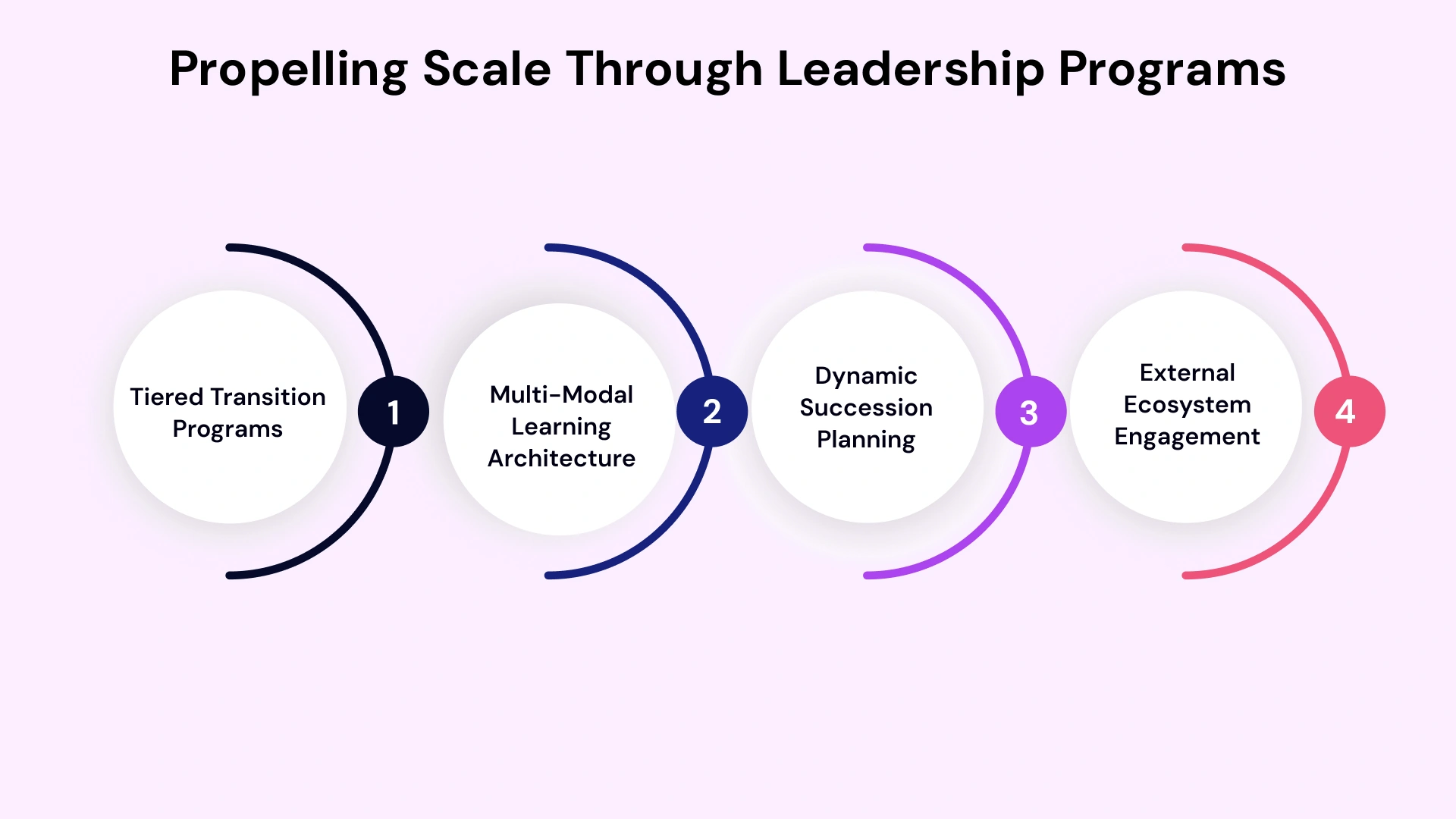
- Tiered Transition Programs: Create distinct development tracks for every career pivot:
- Emerging Leaders: Transitioning from individual contributor to Team Lead.
- Mid-Level Excellence: Transitioning from Team Lead to Manager of Managers.
- Executive Readiness: Preparing Directors for VP and global functional roles.
- Multi-Modal Learning Architecture: Avoid "one-and-done" workshops. Combine:
- Foundational Training: Core management theory.
- Action Learning: High-stakes projects that solve real business bottlenecks.
- Executive Coaching: One-on-one sessions for high-potential senior leaders.
- Dynamic Succession Planning: Conduct quarterly talent reviews to identify 2–3 "ready-now" or "ready-soon" successors for every critical role. Focus on individual development plans (IDPs) rather than static charts to ensure organizational resilience.
- External Ecosystem Engagement: Prevent insular thinking by sponsoring high-potential leaders for executive education at top business schools and encouraging participation in global industry forums.
Managing Global-India Alignment for GCC
Bridging Geographic and Cultural Differences
One of the unique challenges in scaling India GCCs is maintaining alignment with the global headquarters while building a strong local identity. Misalignment creates friction, delays, and frustration on both sides. Excellence requires bridging geographic and cultural differences deliberately.
Time zone differences create natural challenges for collaboration. When your India team's day ends and your US team's begins, real-time collaboration is limited. Leading GCCs establish "overlap hours" where both teams are online, typically early morning India time. Protect these hours for synchronous collaboration—standups, planning sessions, design discussions.
Cultural fluency goes beyond stereotypes. Indian professionals bring different communication styles, decision-making norms, and workplace expectations than their Western counterparts. Neither is better; they're different. Invest in cross-cultural training for both your India and global teams. Create opportunities for teams to interact informally and build personal relationships.
Clear communication protocols prevent misunderstandings. What level of detail do global stakeholders expect in status reports? When should you escalate versus solve problems locally? What decisions require global alignment versus local autonomy? Document these norms and train people on both sides.
Rotate talent between India and global locations. Nothing builds alignment better than working together in person. Send high-potential India employees to global offices for 3-6 month rotations. Bring global team members to India for extended stays. These rotations build relationships, transfer knowledge, and create cultural ambassadors.
Establishing the GCC as a Strategic Partner
Too many GCCs remain stuck in a "staff augmentation" or "cost arbitrage" mindset even as they scale to 2000 employees. Your goal should be to elevate the GCC from tactical execution to strategic partnership with your global business.
This transformation starts with a mindset. Your teams need to think beyond "execute the requirements I'm given" to "understand the business problem and propose better solutions." Encourage curiosity about the business context. Why is this feature important? What business outcome are we driving? How does this fit the broader strategy?
Build business acumen across your workforce. Most engineers are curious about the business but lack context. Create programs that teach your teams about your industry, your company's business model, competitive dynamics, and strategic priorities. When engineers understand that their work directly impacts customer acquisition or revenue growth, engagement soars.
Demonstrate strategic value through innovation. Allocate resources to innovation initiatives that could transform your business. Your India team might pioneer new technologies, develop proofs of concept for emerging opportunities, or drive operational efficiency improvements. When innovation originates from the GCC rather than just being implemented there, you're a strategic partner.
Cultivate executive relationships between GCC leadership and global business leaders. Your GCC head should be a trusted advisor to global CxOs, not just a delivery manager. Regular strategic dialogues, business reviews, and collaborative planning sessions build these relationships. Over time, global leaders should turn to the GCC not just for execution but for strategic thinking.
Risk Management and Compliance in GCC India
In 2026, Global Capability Centers (GCCs) in India have transitioned from being "back-office support" to becoming strategic "Global Brain Trusts." Consequently, Risk Management and Compliance have shifted from simple box-ticking exercises to high-stakes board-level priorities.
Below is a breakdown of the current landscape, key risks, and compliance requirements for GCCs in India.
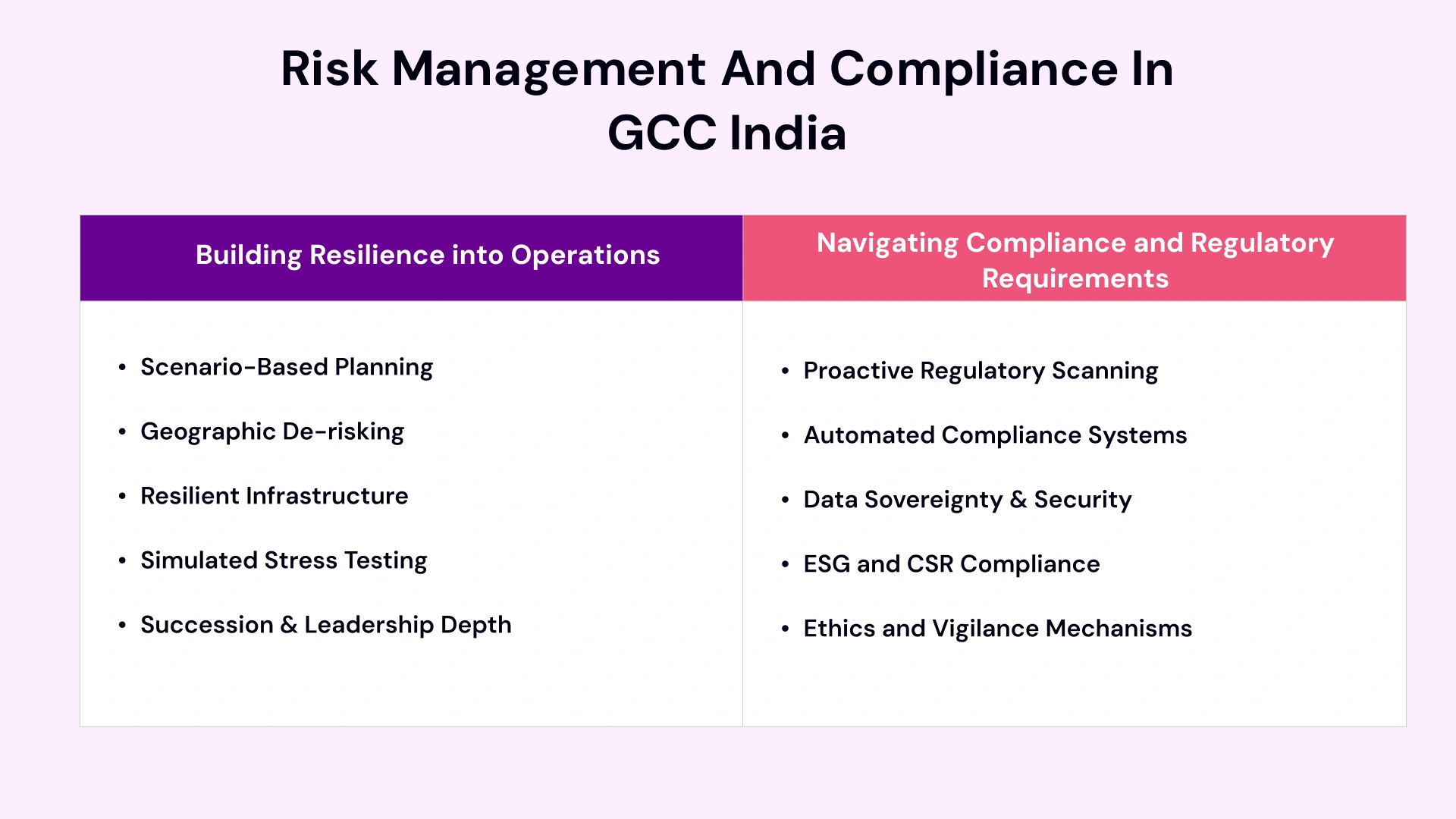
1. Building Resilience into Operations
- Scenario-Based Planning: Conduct rigorous analysis to identify potential disruptions (cyber attacks, natural disasters, or political shifts) and develop specific response and recovery protocols for each. Once established, scaling becomes the focus- India GCC setup guide includes hiring, governance, and operational maturity.
- Geographic De-risking: Avoid concentration risk by distributing your 2000-person workforce across 2–3 cities in India (e.g., Bangalore and Hyderabad) to ensure continuity during localized crises.
- Resilient Infrastructure: Invest in cloud-native systems, automated backups, and "work-from-anywhere" technologies to maintain seamless operations regardless of physical office availability.
- Simulated Stress Testing: Move beyond static plans by running quarterly tabletop exercises and drills. This builds organizational "muscle memory" and reveals gaps in your crisis response before a real event occurs.
- Succession & Leadership Depth: Identify and train "backup" leaders for critical global functions. Resilience isn't just about systems; it’s about ensuring the GCC can function if key personnel are unavailable.
2. Navigating Compliance and Regulatory Requirements
- Proactive Regulatory Scanning: Partner with local experts to track India’s evolving landscape, focusing on shifting labor laws, tax treaties (Transfer Pricing), and data localization mandates.
- Automated Compliance Systems: Replace manual tracking with digital management systems to monitor filings, assign ownership, and provide a real-time audit trail, reducing the risk of human error.
- Data Sovereignty & Security: Implement enterprise-grade controls, including encryption and strict access management. Regular penetration testing is essential for GCCs handling global IP or sensitive customer data.
- ESG and CSR Compliance: Ensure strict adherence to India’s Companies Act regarding Corporate Social Responsibility (CSR) and evolving Environmental, Social, and Governance (ESG) reporting standards required by global stakeholders.
- Ethics and Vigilance Mechanisms: Establish a localized "Whistleblower" framework and internal ethics committee. With 2000+ employees, a transparent, culturally aligned grievance mechanism is a legal and operational necessity.
Financial Management and Cost Optimization
Unit Economics and Cost Management
While cost arbitrage is one reason companies establish India GCCs, uncontrolled scaling can erode economic benefits. Smart GCCs closely monitor unit economics and optimize costs without compromising quality or employee experience.
Understand your fully loaded cost per employee. This includes salary, benefits, infrastructure, tools, training, and allocated overhead. Track how this evolves as you scale. You should see some economies of scale—shared infrastructure and services cost less per person at 2000 employees than at 200. If you're not seeing this, investigate why.
Benchmark your costs against market and industry standards. How does your compensation compare to market rates? Are you competitive enough to attract talent without overpaying? How does your cost per employee compare to other GCCs in similar domains? External benchmarking data from consulting firms, industry associations, and compensation surveys provides valuable context.
Real estate and infrastructure represent high costs at scale. As you approach 2000 employees, negotiate favorable lease terms, consider build-to-suit options, and think strategically about location choices. Lower-tier cities offer cost advantages while still providing good talent. Hybrid work models reduce real estate needs.
Technology spending deserves ongoing optimization. Are you paying for licenses you don't fully use? Can you negotiate better rates with vendors as you scale? Are there open-source alternatives to expensive commercial tools? Regular technology spend reviews identify optimization opportunities.
Demonstrating ROI to Global Stakeholders
Your GCC's continued investment depends on demonstrating clear value to global stakeholders. As you scale to 2000 employees with an annual budget in tens of millions of dollars, you must articulate compelling ROI.
Cost savings remain important, but shouldn't be your only value story. Calculate the fully-loaded cost difference between your India team and equivalent resources in your global headquarters. This cost arbitrage is significant—often 40-60% savings—and represents tangible value.
Go beyond cost to value delivered. What revenue growth has your GCC enabled through product innovation? What operational efficiency gains have you driven? What risk reduction have you delivered through improved security or compliance? These value dimensions often dwarf pure cost savings but require effort to quantify.
Create executive-friendly dashboards that tell your value story. Global executives are busy; they need the story quickly and clearly. Show key metrics—delivery velocity, cost savings, quality metrics, innovation metrics—with clear trends and benchmarks. Use visualizations that make the impact obvious.
Regular business reviews with global stakeholders keep value visible. Quarterly executive reviews provide forums to showcase achievements, address concerns, and align on priorities. These shouldn't be defensive exercises but strategic conversations about how the GCC can drive even more value.

Accelerate Your GCC Growth with VLink's Expert Tech Sourcing
Scaling your India GCC from 200 to 2000 employees is a transformative journey that requires the right partners. VLink specializes in helping global organizations navigate this exact challenge with precision and pace.
Our comprehensive GCC talent solutions address every dimension of your scaling needs. We provide on-demand access to pre-vetted technical talent across 100+ technology skills—from cloud architects to data engineers to AI specialists. Our rigorous vetting process ensures you get professionals who can contribute from day one, dramatically reducing your time-to-productivity.
Our IT staff augmentation services give you the flexibility to scale rapidly without long-term commitments. Whether you need 10 engineers for a six-month digital transformation project or 50 specialists to launch a new capability, we provide the talent with the speed and quality you demand. Our contract-to-hire model lets you evaluate talent in your actual working environment before making permanent hiring decisions.
We go beyond just providing bodies. Our consultative approach means we invest time understanding your business context, technical requirements, and cultural fit criteria. We become an extension of your talent team, proactively building pipelines, managing candidate experience, and ensuring a smooth onboarding process.
With deep expertise in the GCC tech talent sourcing in India, we understand the unique challenges you face—talent competition for hot skills, compensation inflation, attrition management, and cultural alignment. We leverage our market insights, proprietary talent networks, and proven playbooks to help you navigate these challenges successfully.
Hundreds of global enterprises trust VLink to power their growth in India and the GCC. Our clients don't just hire faster; they hire better, reduce attrition, and build sustainable scaling engines that support their long-term vision.
Ready to accelerate your GCC journey? Contact Us Today to learn how VLink can become your strategic talent partner.
Conclusion: Your Roadmap to 2000 Employees and Beyond
Scaling your India GCC from 200 to 2000 employees represents one of the most challenging and rewarding transformations your organization will undertake. The journey demands strategic vision, operational discipline, and relentless focus on your people.
The organizations that succeed in this journey share common characteristics. They plan ahead, building talent pipelines and organizational capabilities before they're desperately needed. They invest in their people through robust development programs, clear career paths, and engaging cultures. They implement scalable processes and technology infrastructure that grow with the organization. They maintain strategic alignment with global stakeholders while building a strong local identity.
The challenges are real—talent competition, cultural complexity, operational scaling, and stakeholder management. But the rewards are substantial. A well-scaled GCC becomes a strategic asset that drives innovation, enables growth, and provides sustainable competitive advantage. Your 2000-person GCC can deliver capabilities that would cost twice as much elsewhere while creating meaningful employment and economic impact in India.
The playbook outlined in this blog provides your roadmap. Strategic workforce planning ensures you have the right talent at the right time. Thoughtful organizational design creates clarity without bureaucracy. Deliberate culture programs maintain your DNA at scale. Robust technology infrastructure enables efficiency and insight. Continuous focus on delivery excellence keeps stakeholders confident.
Remember that scaling is a journey, not a destination. The capabilities you build to reach 2000 employees will enable you to scale further—to 3000, 5000, or beyond. The systems you implement, the leaders you develop, and the culture you nurture become your foundation for sustained growth.
Start with clarity about your destination. Where do you want your GCC to be in 18 months? Three years? Five years? With that vision clear, you can work backward to identify the capabilities you need to build, the talent you need to attract, and the changes you need to make.
The path from 200 to 2000 employees is challenging but absolutely achievable. With the right strategy, the right partners, and unwavering commitment to excellence, your GCC can become the success story that others study and emulate.
Your transformation starts now. The question isn't whether to scale, but how to scale intelligently—building a GCC that delivers exceptional value while creating an environment where talented professionals can thrive and grow.

GCC & IT Staffing Expert
Swastik, a seasoned professional with 20+ years of proven presence in sphere of Enterprise IT sales market with deep expertise in designing hiring engines, workforce scaling programs and location led talent strategy, in PAN India.

 Shivisha Patel