Offshore staff augmentation gets pitched as an easy win: hire engineers at a fraction of domestic rates, scale your team in weeks, and keep full control over the roadmap. Some of that is true. What's usually left out is the part where time zones, communication gaps, and inconsistent onboarding quietly erode the savings on the invoice.
This guide gives you both halves of the picture. This is a practical reference for anyone evaluating offshore IT staff augmentation as a hiring strategy. We'll walk through where offshore IT staff augmentation genuinely saves money, the risks that catch unprepared teams off guard, and the specific practices that separate successful engagements from those that quietly stall six months in.
Demand for offshore IT staffing services has grown steadily as engineering budgets tighten, and offshore staff augmentation has become a default lever for companies trying to stretch engineering budgets further, and the interest is easy to understand: offshore developer rates in popular delivery regions can run a fraction of comparable US or Canadian salaries.
But the providers selling this model rarely spend much time on what makes it work in practice, which is why so many companies try it once, run into friction, and conclude "offshore doesn't work for us" when the real issue was how the engagement was structured.
This blog is written for the second attempt, or the first one done right. It lays out the real numbers behind offshore staff augmentation, the risks to plan for before they become problems, and the operational practices that separate a frustrating experiment from a genuinely productive extension of your team.

What Offshore IT Staff Augmentation Actually Is
Offshore IT staff augmentation is a flexible talent model where a company integrates individual tech professionals- located in a lower-cost region or different time zone- directly into its existing internal engineering team.
Instead of contracting an outside firm to handle a project end-to-end, you scale your in-house capacity with specialized talent on demand. The offshore engineers operate as a seamless extension of your workforce: they use your tools, adopt your workflows, align with your company culture, and report directly to your technical leadership.
Meanwhile, your offshore staffing partner takes care of the operational heavy lifting behind the scenes, including:
- Talent sourcing, technical vetting, and recruiting
- Local payroll, taxes, and legal compliance
- Workstation setup, HR management, and benefits administration
Most tech leaders turn to offshore IT staff augmentation strategies when they want to scale velocity without losing control of product vision, code standards, or delivery timelines. Key reasons include:
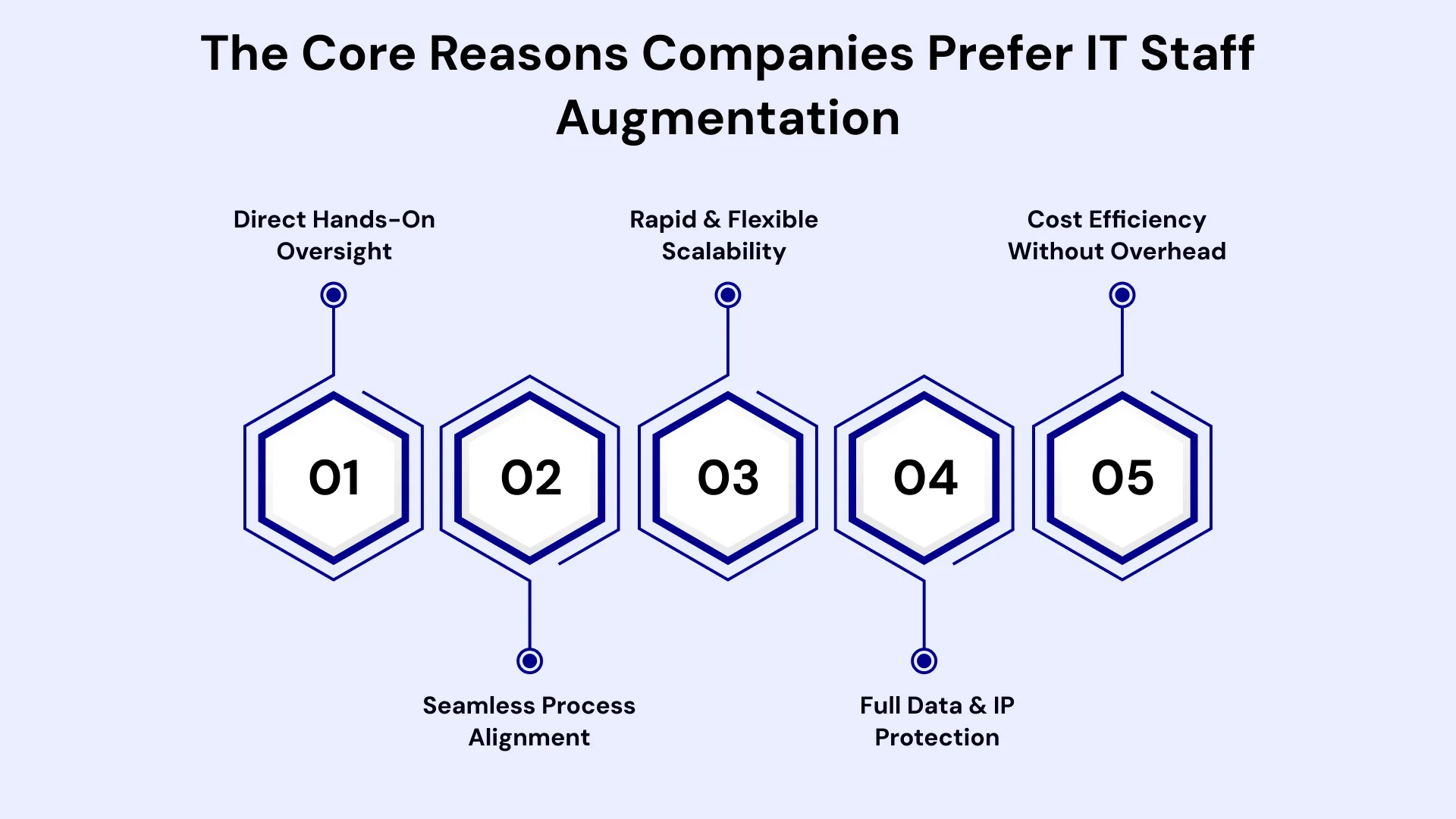
- Direct Hands-On Oversight: Your Engineering Managers and Tech Leads maintain total authority over software architecture, code reviews, quality standards, and deployment pipelines.
- Seamless Process Alignment: External developers integrate directly into your established Agile/Scrum ceremonies, project management tools (e.g., Jira), and CI/CD pipeline workflows rather than imposing proprietary methodologies.
- Rapid & Flexible Scalability: Fill critical skill gaps- such as DevOps, AI/ML, or Cloud Architecture- in weeks instead of months, with the agility to scale team size up or down as business demands evolve.
- Full Data & IP Protection: Because augmented engineers work directly within your secure infrastructure, code repositories, and access environments, your intellectual property remains fully under your control.
- Cost Efficiency Without Overhead: Gain immediate access to top-tier technical talent while eliminating long-term employment liabilities, recruitment fees, onboarding costs, and administrative overhead.
The Real Cost Savings: What the Numbers Actually Show
Offshore developer rates vary significantly by region and specialization, but the cost differential compared to US, UK, or Canadian engineering compensation remains substantial. A senior backend engineer commanding a $160,000 to $200,000 base salary domestically, which easily swells to 220,000- 260,000+ when accounting for fully loaded costs like healthcare, equity, bonuses, equipment, and payroll taxes, can frequently be engaged offshore for a fraction of that total commitment, even after factoring in agency margins.
However, viewing these cost savings through a simple hourly rate comparison creates an incomplete and often misleading financial picture.
Why the Invoice Rate Isn’t the Whole Story
To evaluate true return on investment, engineering leadership must model the Total Cost of Ownership (TCO). When calculating true cost efficiency, four primary friction factors impact the bottom line:
- Onboarding & Ramp-Up Cycles: Offshore engineers typically require a more structured, documented onboarding process to reach full velocity. Productivity losses during the initial 30 to 60 days directly affect early cost efficiency.
- Communication & Decision Latency: Time-zone mismatches create asynchronous delays in pull request (PR) reviews, block clearing, and architecture alignment. An issue that takes 15 minutes to solve in-person can occasionally stretch across a 24-hour cycle, extending overall calendar delivery timelines even when total billed hours remain low.
- Internal Management Overhead: Directing distributed external dedicated teams requires internal cycles from your Tech Leads and Project Managers. The hours spent writing detailed technical briefs, driving asynchronous updates, and conducting thorough code reviews represent a real labor cost that never appears on the staffing agency's invoice.
- Attrition & Knowledge Loss: Highly competitive offshore hiring hubs experience notable turnover rates. Losing a fully ramped developer mid-sprint creates hidden costs in offboarding, re-recruiting, and knowledge re-transfer.
The Realistic Financial Outcome
The Net Savings Model: While headline rate comparisons often promise 60% to 70% cost reductions, an honest TCO calculation, accounting for management cycles, coordination friction, and ramp time, typically yields a realistic net savings of 35% to 50%.
When these variables are modeled transparently, offshore staff augmentation consistently delivers significant, bottom-line financial savings for growth-stage and enterprise engineering organizations alike. The key to capturing those savings lies in operational execution: companies that establish strong asynchronous documentation, clear ownership frameworks, and structured onboarding retain the vast majority of their margin gains.
Offshore Staff Augmentation vs Nearshore Staff Augmentation
Choosing between Offshore and Nearshore staff augmentation comes down to a fundamental strategic trade-off: cost efficiency vs. real-time collaboration.
Comparison Matrix: Offshore vs. Nearshore
Comparison Factor | Offshore Staff Augmentation | Nearshore Staff Augmentation |
Primary Regions | South & Southeast Asia (e.g., India, Vietnam), Eastern Europe | Latin America (e.g., Mexico, Colombia, Argentina, Brazil) |
Time-Zone Alignment | Minimal overlap (1–3 hours) with North American teams | High/Full overlap (6–8 hours) with North American teams |
Cost Profile | Lowest rates (Maximum labor arbitrage) | Moderate rates (15%–30% premium over offshore) |
Collaboration Style | Asynchronous workflows, structured daily handoffs | Synchronous, real-time communication & live pair programming |
Ideal Project Types | Well-defined feature work, backend infrastructure, data pipelines | Rapidly evolving products, UI/UX-heavy apps, active sprint iteration |
Key Strategic Considerations
- Nearshore Advantage (Latin America for North America): Offers near-complete business-day alignment. This real-time overlap is critical for mobile and web application development requiring frequent, live interaction, such as design reviews, pair programming, agile grooming, and daily stakeholder check-ins.
- Offshore Advantage (Asia / Eastern Europe): Provides the highest cost-to-value ratio. For core backend systems, microservices architecture, automated testing suites, or data engineering where tasks can be clearly specified and handed off asynchronously, offshore remains the superior value proposition.
Pro Tips: The comparison against offshore staff augmentation vs. local contractors is less about cost and more about availability and scalability. Local contractors offer the tightest collaboration and zero time-zone friction, but in competitive domestic markets, qualified contractors are often scarce, expensive, and difficult to secure quickly for specialized skills.
Offshore staff augmentation generally offers faster access to a wider talent pool and significantly lower cost, at the expense of some collaboration friction that has to be actively managed rather than assumed away.
The Real Risks of Offshore Staff Augmentation
While offshore staff augmentation offers compelling cost advantages, engaging international talent introduces structural operational, security, and quality risks that organizations must actively navigate.
Far from being a plug-and-play solution, offshoring requires engineering leaders to proactively manage technical alignment, cross-border compliance, and communication barriers to prevent hidden management overhead from undercutting project timelines and eroding ROI.
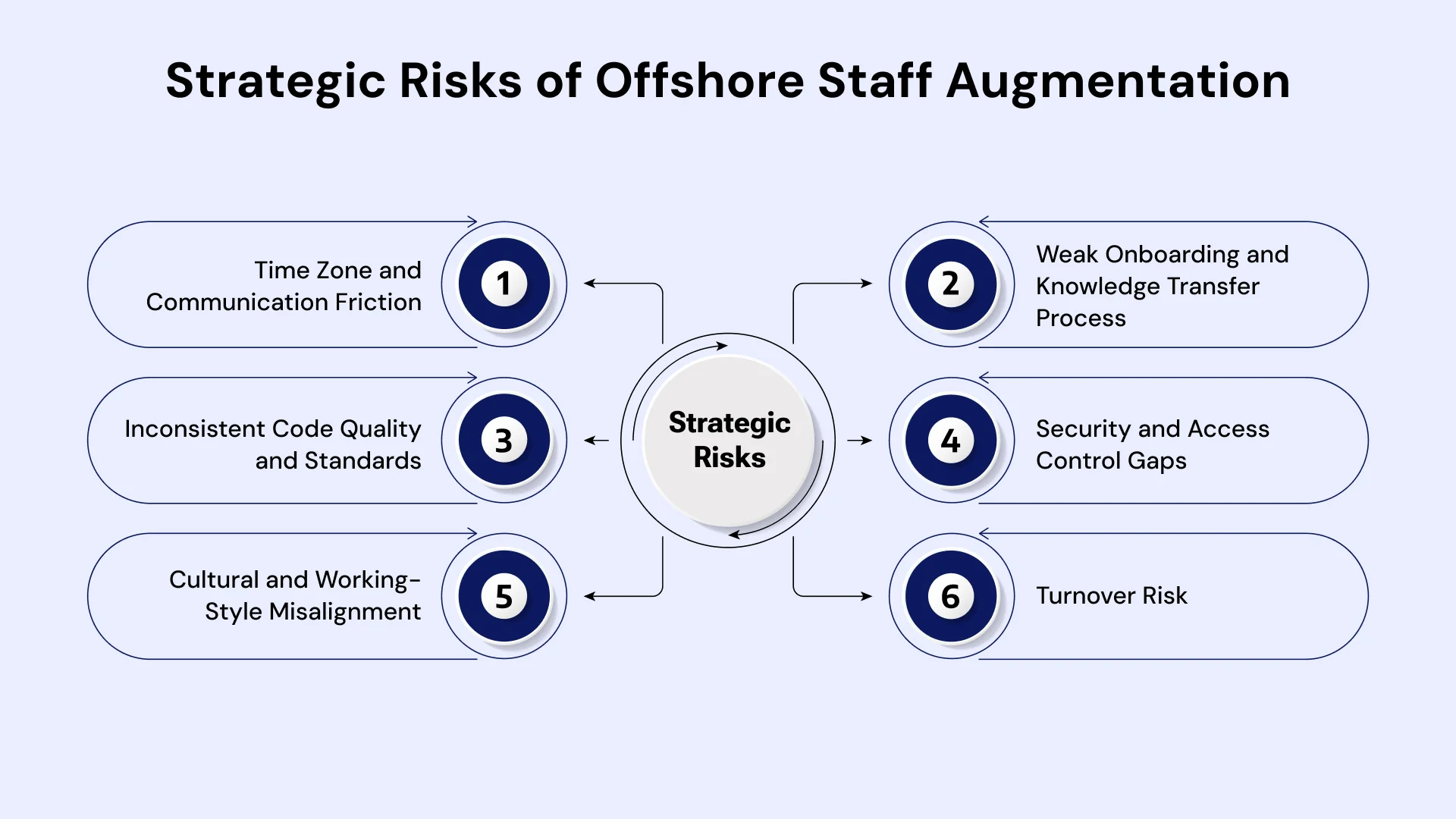
Time Zone and Communication Friction
This is the risk that surfaces fastest and causes the most frustration. Without deliberate overlap hours and clear asynchronous communication norms, decisions stall waiting for the next business day, and small misunderstandings compound into larger delivery problems.
Weak Onboarding and Knowledge Transfer Process
Offshore engineers who are handed a codebase with minimal documentation and left to figure things out alone take far longer to become productive, and often produce lower-quality work in the process. A structured knowledge transfer process, recorded walkthroughs, documented architecture decisions, and a defined ramp-up plan is one of the highest-leverage investments a company can make in offshore developer team augmentation.
Inconsistent Code Quality and Standards
Without shared coding standards, defined review processes, and consistent tooling, offshore and in-house work can diverge in quality and style, creating friction during code review and increasing long-term maintenance burden.
Security and Access Control Gaps
Offshore engineers need system access like any team member, and companies sometimes grant broader access than necessary out of convenience. Clear access control policies, least-privilege provisioning, and offboarding procedures matter just as much for offshore staff augmentation as for any other engineering hire.
Cultural and Working-Style Misalignment
Differences in communication style, feedback norms, and working hours expectations can create friction that has nothing to do with technical skill. Addressing this directly, through clear expectations and regular check-ins, prevents small misalignments from becoming larger team tension.
Turnover Risk
Competitive offshore labor markets, particularly for in-demand skills, can carry higher turnover than companies expect. Losing a ramped engineer resets the knowledge transfer investment and disrupts delivery continuity.

How to Make Offshore Staff Augmentation Actually Work
Here is the operational playbook for turning offshore augmented talent into an effective, high-performing extension of your core engineering team.
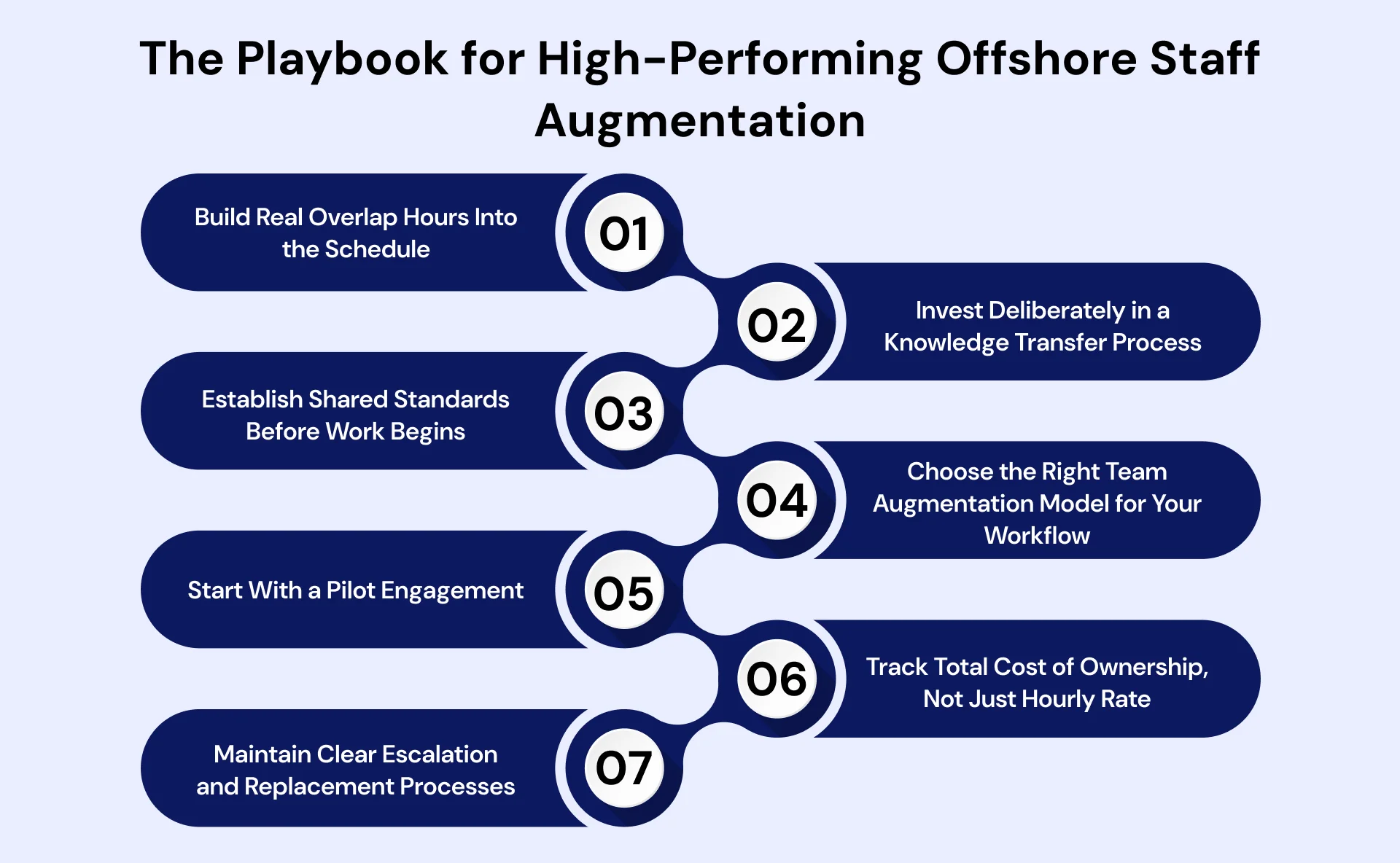
1. Build Real Overlap Hours Into the Schedule
Even a few hours of genuine daily overlap dramatically improves collaboration quality. Agree on specific working-hour adjustments upfront rather than assuming asynchronous communication alone will be sufficient.
2. Invest Deliberately in a Knowledge Transfer Process
Document architecture decisions, record walkthrough videos for complex systems, and assign an internal point of contact responsible for onboarding new offshore team members. Treat this as a defined process with a checklist, not an informal, ad hoc activity.
3. Establish Shared Standards Before Work Begins
Agree on coding standards, review processes, branching strategy, and testing expectations before offshore engineers start contributing code, and apply them consistently across the entire team, not just offshore members.
Note: Offshore agile staff augmentation works best when standups, sprint planning, and retrospectives are deliberately restructured for distributed participation, staggered or recorded ceremonies, written async updates, and a shared backlog tool everyone trusts. Treating offshore agile staff augmentation as "the same ceremonies, just over video call" is a common reason distributed sprints lose momentum.
4. Choose the Right Team Augmentation Model for Your Workflow
A company running tightly coupled, highly collaborative sprints may be better served by nearshore app development staff augmentation or a hybrid model with a small onshore core team. A company with well-specified, modular work may get strong results from a fully offshore team augmentation model.
5. Start With a Pilot Engagement
Before committing to a large offshore team, run a smaller pilot on a defined, moderately scoped project. This surfaces communication, quality, and process issues early, when they're inexpensive to fix.
6. Track Total Cost of Ownership, Not Just Hourly Rate
Measure actual delivery velocity, defect rates, and management time spent, not just the invoiced hourly cost, to get an honest picture of whether the engagement is delivering the expected total cost of ownership advantage.
7. Maintain Clear Escalation and Replacement Processes
Confirm with your staffing partner, upfront, what happens if an engineer isn't working out. A clear, fast replacement process protects both delivery timelines and the relationship.
IT Staff Augmentation Benefits Worth Weighing Against the Risks
When managed as a deliberate engineering strategy, the benefits of an IT staff augmentation model are substantial:
- Accelerated Access to Specialized Expertise: Quickly fill niche technical gaps (e.g., DevOps, AI/ML, Cloud Architecture) with pre-vetted engineers without waiting through month-long local hiring cycles.
- Meaningful Net Cost Efficiency: Realize significant operational savings compared to high domestic fully loaded software engineering costs, even after factoring in vendor margins.
- Dynamic Team Scalability: Adjust headcounts up or down in alignment with sprint cycles or release milestones, eliminating the fixed overhead, severance, and long-term liabilities of permanent hires.
- Expanded Global Talent Access: Bypass local talent shortages and geographically constrained hiring markets by tapping into deep global engineering hubs.
Key Takeaway: These advantages are high-value, but they are not automatic; they depend entirely on how effectively operational and execution risks are managed. Organizations that treat offshore staff augmentation as a structured operating model rather than a simple discount hiring channel consistently maximize their ROI.

Accelerate Growth with VLink Offshore Staff Augmentation
Getting offshore staff augmentation right takes more than sourcing engineers at a low rate; it takes a deliberate onboarding process, clear communication structure, and consistent quality standards built in from day one. Our IT staff augmentation services cover both individual placements and full developer team augmentation, built around exactly that discipline, with structured onboarding, documented knowledge transfer, and defined overlap-hours planning as standard practice, not an afterthought.
For organizations evaluating industry-specific considerations, our staff augmentation essentials things you need to consider guide walks through the practical details most companies overlook during vendor selection. If your project needs full delivery ownership rather than individual placements, our dedicated teams model offers an alternative structure, and our custom software development services can take on complete project ownership alongside augmented team members.
We deliver offshore IT staffing services through established teams, including our IT Staff Augmentation company in India and IT Staff Augmentation in Gurgaon operations, giving clients a proven delivery structure rather than an experimental one.
Wrapping Up!
Offshore IT staff augmentation delivers real, meaningful cost savings for most companies, but the honest version of that story includes real risks, time-zone friction, onboarding gaps, and knowledge transfer challenges that determine whether those savings actually materialize. The companies that get the most value treat offshore staff augmentation as an operating model to be designed deliberately, with overlap hours, documentation standards, and quality processes built in from the start, rather than a cheaper substitute for local hiring that's expected to work the same way by default.
Start with a clear-eyed total cost of ownership comparison, run a pilot before scaling, and invest early in the knowledge transfer process. That combination is what separates offshore engagements that genuinely extend a team's capability from the ones that quietly underperform their promised savings.
Ready to Scale Your Engineering Team with Confidence?
Whether you need to fill critical skill gaps, calculate your true Total Cost of Ownership (TCO), or explore a custom nearshore, offshore, or hybrid model, VLink is here to guide your global expansion. Contact us today to speak with our engineering strategy experts.

Business Development Professional
Vineel is a seasoned sales and business development leader with extensive experience in the telecommunications and IT industries. Over the course of his career, he has worked with global teams at multinational organizations, having lived and operated in India, Canada, the Netherlands, and the United Kingdom.

 Shivisha Patel