
The conversation around the India GCC setup has fundamentally changed. A decade ago, setting up a Global Capability Center in India meant cost reduction through labor arbitrage. In 2026, that framing will be obsolete. Today, India's GCCs are the product engineering, Agentic AI, and innovation nerve centers of global enterprises.
For companies expanding delivery capabilities, capital markets GCC setup in India can provide a practical model for scale, governance, and long-term operating efficiency.
If your organization is still approaching an India GCC as a "cheaper support office," you are already behind your competitors — and your best Indian talent will leave for centers that offer them ownership, not execution tasks.
The current era — GCC 4.0 — is defined by three structural shifts.
First, strategic ownership: Indian GCC teams now architect and own end-to-end global platforms, not support them. Second, Agentic AI integration: over 58% of GCCs in 2026 are deploying autonomous AI systems to handle complex reasoning tasks, moving well beyond RPA-era automation. Third, the mid-market boom: while enterprise-led GCCs still dominate leasing activity, the fastest-growing segment is mid-market US and EU tech companies setting up lean, outcome-first centers of 50–300 FTE.
In this blog, we’ll break down the blueprints and operational shifts needed to build a value-driven innovation hub. From choosing the right talent clusters to navigating new regulations, this GCC India setup guide serves as your definitive roadmap for 2026 and beyond.

India GCC Market Size & 2026 Projections
The numbers make the strategic case impossible to ignore. Consider these 2026 benchmarks:
Metric | 2026 Data / Projection | Source |
Market Size | $75.53 Billion | Grand View Research |
Total Professionals | ~2.1 Million | JLL / NASSCOM |
Grade A Office Leasing | 38% of all Grade A office space in top cities | Colliers India |
AI Talent Gap | 41% deficit in specialized GenAI & MLOps roles | India Employer Forum |
GCCs Deploying Agentic AI | 58% of India GCCs in 2026 | Gemini Deep Research |
Cost Savings vs West | 50–60% across engineering, data, and product functions | Industry benchmark |
Tier-2/3 Cost Advantage | 10–35% lower cost + higher talent retention vs Tier-1 | Taggd 2025-26 Report |
These figures are not aspirational projections. They are the operating reality for CIOs and TA leaders executing GCC buildouts right now. The question is no longer whether to set up a GCC in India. It is how to set it up for strategic scale — from day one.
What Is a Global Capability Center (GCC)?
A Global Capability Center (GCC) is a wholly or majority-owned subsidiary of a multinational company, established in India (or another offshore location) to deliver strategic business functions — including product engineering, data science, AI/ML, digital operations, finance, and risk.
The term "GCC" has largely replaced "captive center" in enterprise vocabulary, but there are meaningful distinctions across delivery models:
Model | Control | IP Ownership | Talent Depth | Scale Potential | Time to Value |
GCC / Captive | Full | Full | High | Very High | 12–24 months |
BOT (Build-Operate-Transfer) | Grows over time | Transferred at handover | High (via partner) | High | 8–16 weeks |
Managed GCC | Partial (via SLA) | Shared / Negotiated | Medium-High | Medium-High | 4–8 weeks |
ODC (Offshore Dev Center) | Limited | Client-retained | Medium | Medium | 4–6 weeks |
EOR (Employer of Record) | Operational | Full | Low-Medium | Low (pilot only) | 2–4 weeks |
Shared Services Center | Full | Full | Function-specific | High (ops-focused) | 12–18 months |
How GCCs Differ in 2026 (Ownership Model Shift)
The defining shift in 2026 is that GCCs are no longer back-office cost centers. The most competitive centers have direct reporting lines to the global CIO or CPO. Indian GCC heads carry P&L responsibility, manage product roadmaps, and lead global AI initiatives. This is not an aspiration — it is the retention strategy.
Why India for GCC Setup in 2026?
In 2026, India has transcended its reputation as a "back-office" destination to become the global capital for strategic innovation. Setting up a Global Capability Center (GCC) in India this year is less about labor arbitrage and more about capability arbitrage.
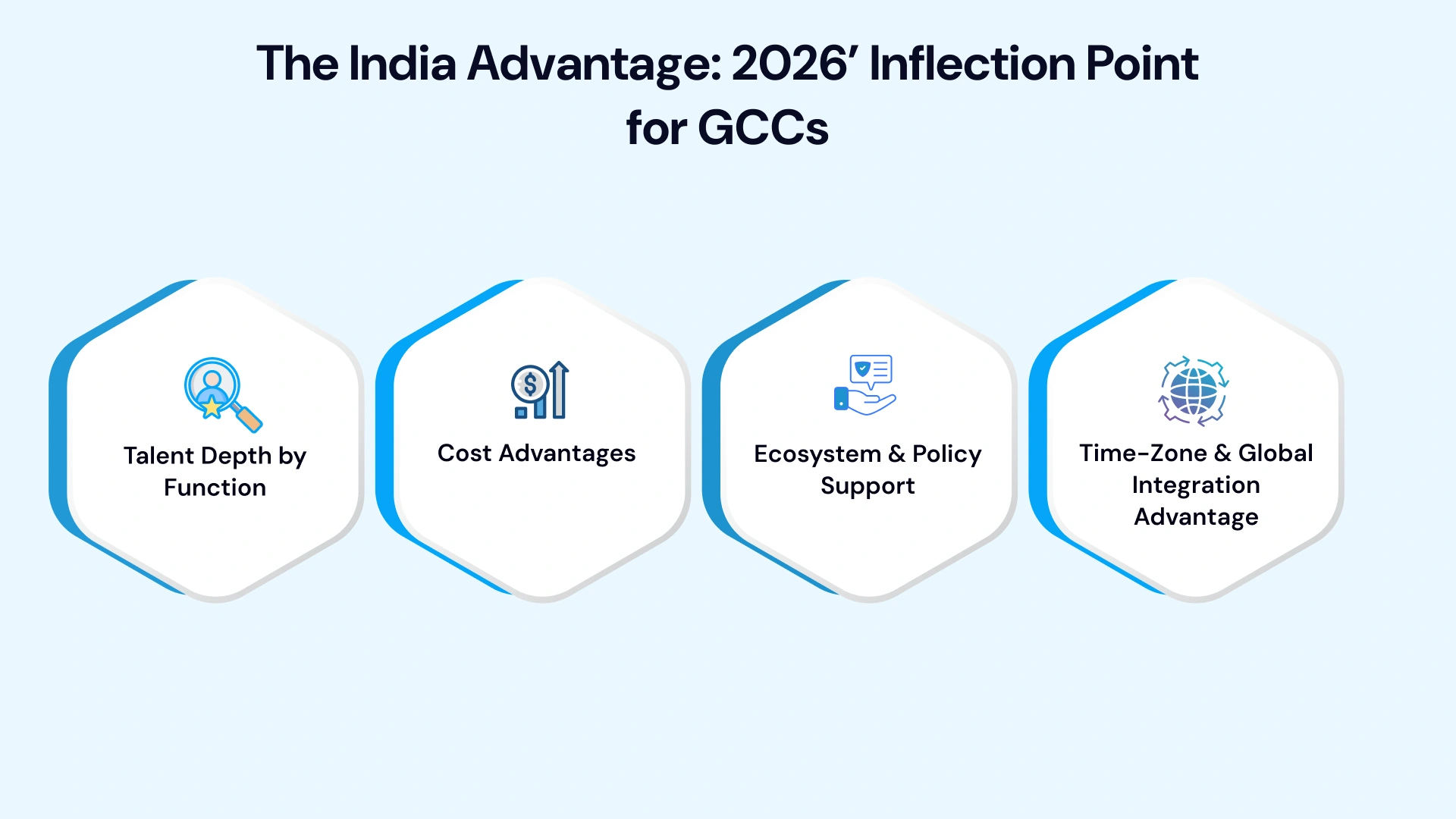
Here is why India is the definitive choice for GCCs in 2026:
1. Talent Depth by Function
India produces 1.5 million STEM graduates annually. But for a CIO planning for GCC expansion in India, the more important metric is the depth of experienced talent in mission-critical functions:
- Engineering & Cloud Architecture: Bengaluru, Hyderabad, Pune or NCR — deep pools of 5–12 year engineers with global SaaS and hyperscaler experience
- AI/ML & Data Science: Strong in Bengaluru and Hyderabad, with specialized clusters in IIT/IISc corridors
- Product Management: Growing rapidly; experienced PMs with FAANG or Series B-D startup pedigree are now accessible
- BFSI & Risk: Hyderabad and Mumbai corridors; strong in compliance, AML, and risk analytics
- Digital Operations & GBS: Chennai, NCR, and Coimbatore — cost-efficient, high-retention talent
2. Cost Advantage: 50–60% with Tier Comparison
The cost advantage of India GCCs remains a compelling board-level argument, but it must be modeled at function and seniority level — not as a blanket number:
Role Level | India Tier-1 (Annual CTC) | India Tier-2 (Annual CTC) | US Equivalent (Annual) |
Senior Software Engineer (7-10 yrs) | ₹28–45L ($33K–$54K) | ₹22–35L ($26K–$42K) | $150K–$180K |
Engineering Manager | ₹45–80L ($54K–$96K) | ₹35–60L ($42K–$72K) | $200K–$240K |
Data Scientist / MLOps (5-8 yrs) | ₹30–55L ($36K–$66K) | ₹22–40L ($26K–$48K) | $140K–$170K |
GCC Head / VP Engineering | ₹1.2–2.5Cr ($144K–$300K) | ₹90L–1.8Cr ($108K–$216K) | $350K–$500K+ |
Product Manager (7-10 yrs) | ₹30–60L ($36K–$72K) | ₹24–45L ($29K–$54K) | $160K–$200K |
Note: CTC figures are indicative 2026 ranges. Add 20–30% for employer costs (PF, gratuity, insurance, benefits). Tier-2 cities deliver 20–35% cost savings vs Tier-1 with materially lower attrition rates.
3. Ecosystem & Policy Support
The National GCC Policy Framework (2025–26) introduced single-window clearance for entity registration, fast-track FDI approvals, and state-level incentive packages — particularly in Telangana, Karnataka, and Rajasthan. SEZ and STPI designations continue to offer significant tax benefits for eligible entities.
4. Time-Zone & Global Integration Advantage
India's IST (UTC+5:30) creates a natural 4–5-hour daily overlap window with UK/EU teams and a 12-hour relay capability with US teams — enabling genuine 24-hour product development cycles when designed correctly.
Choosing the Right GCC Operating Model
In the landscape of GCC setup in India, selecting the wrong operating model is the costliest error a firm can make. Leadership must rigorously vet their strategy against four pillars: time-to-value, operational control, internal readiness, and migration optionality.
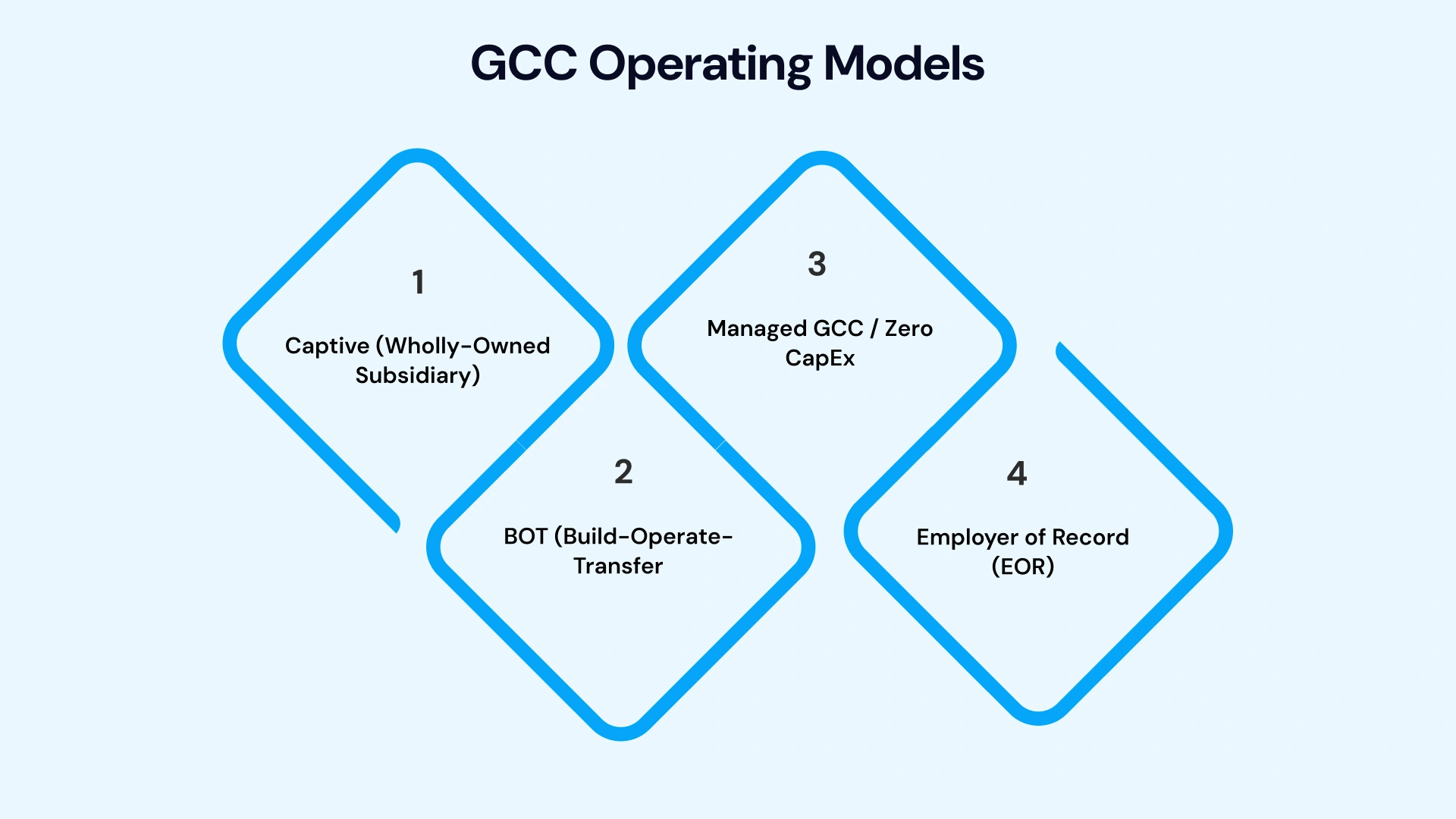
Captive (Wholly Owned Subsidiary)
- Full control over hiring, culture, IP, and operations
- Best for companies with > 100 FTE ambition and 3-5 year India commitment
- Requires internal bandwidth: legal, finance, HR, real estate capability
- Timeline to first hire: typically 16–24 weeks from entity registration
BOT (Build-Operate-Transfer)
- A specialized partner builds and operates the GCC for 18–36 months, then transfers full ownership to you
- Best for: companies that want speed (8–16 weeks to first hire) with a clear path to captive ownership
- Key risk: partner alignment on talent quality and culture from Day 1
- Microsoft, Walmart, and several global BFSI firms have used BOT as their entry strategy
Managed GCC / Zero CapEx
- You get a dedicated development team operating within a partner's infrastructure — no entity, no capex
- Best for pilot teams of 15–75 FTE testing India's talent market before committing
- Typically, 4–8-week time to launch
- IP and data agreements must be airtight
Employer of Record (EOR)
- Hire 5–30 people in India immediately, under a third-party legal employer
- Best for urgent talent needs or pre-entity pilots
- Not scalable beyond 50 FTE — transition to captive or BOT is mandatory for strategic GCCs
Operating Model Decision Matrix
Criterion | Captive | BOT | Managed GCC | EOR |
Time to First Hire | 16–24 weeks | 8–16 weeks | 4–8 weeks | 2–4 weeks |
Control Level | Full | Grows over time | Shared | Operational only |
IP Protection | Maximum | High (via contract) | Medium | High |
Internal Readiness Required | High | Medium | Low | Low |
Scale Ceiling | Unlimited | Unlimited (post-transfer) | Medium (75–150 FTE) | Low (< 50 FTE) |
Best For | Long-term, 100+ FTE | Speed + control | Pilot / validation | Urgent / interim |
Migration Path | Final destination | → Captive (18–36 months) | → BOT or Captive | → Any model |
Migration Journey: Managed → BOT → Captive (18–36 Month Path)
The most successful mid-market GCC buildouts in 2026 follow a sequenced journey — not a "big bang" captive launch:
- Months 0–6: EOR or Managed GCC — pilot with 10–30 FTE, validate talent market, prove delivery model
- Months 6–18: BOT engagement — scale to 50–150 FTE with partner infrastructure; begin entity registration in parallel
- Months 18–36: Transfer to Captive — full ownership, own payroll, own culture and brand, 150–300+ FTE buildout
Step-by-Step: How to Set Up a GCC in India (2026 Roadmap)
This section answers the core query: how to set up a GCC in India. The following framework is designed for a 50–300 FTE GCC with an 18–24 month horizon. Adjust phases based on chosen operating model.
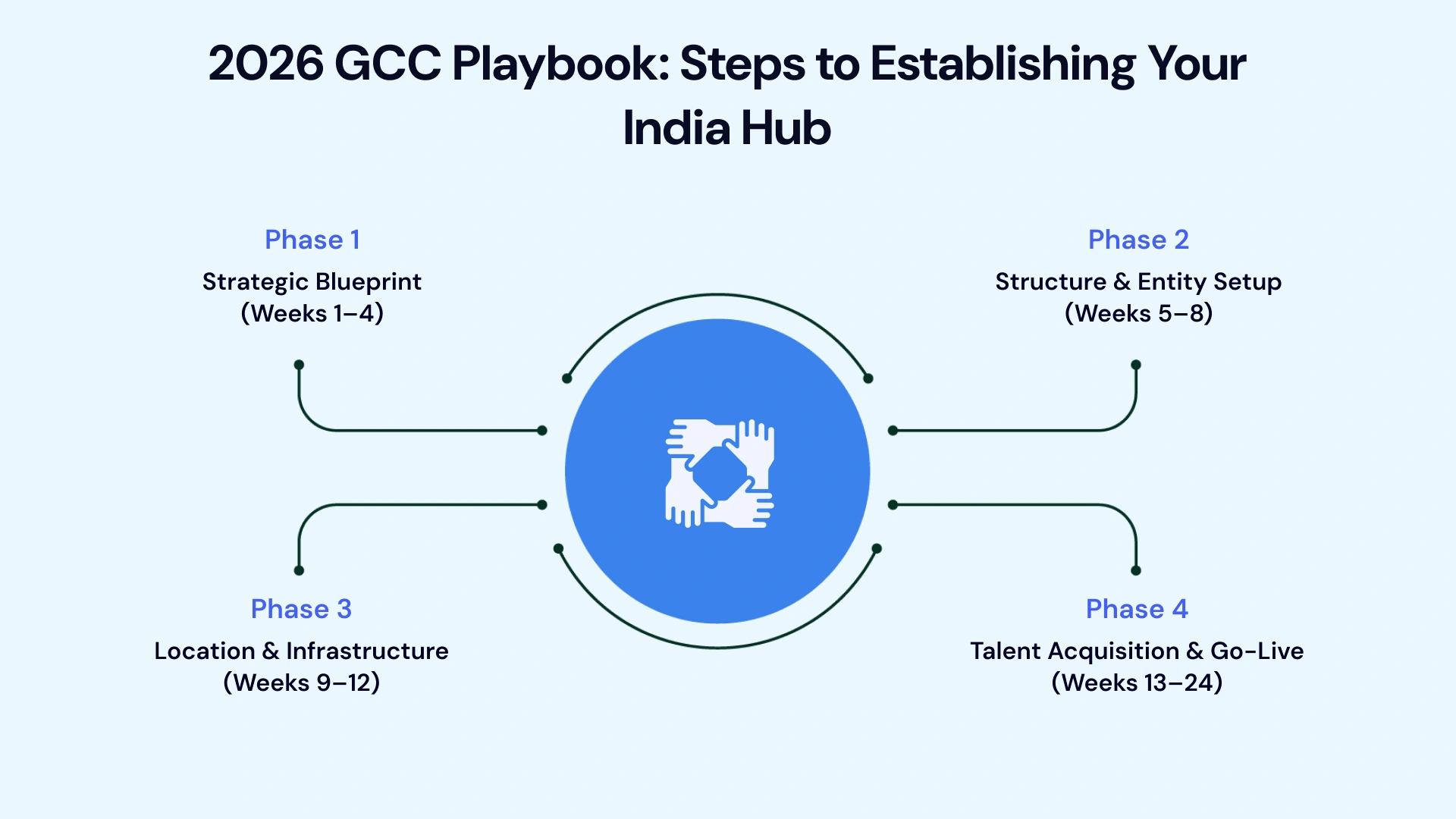
Phase 1: Strategic Blueprint (Weeks 1–4)
Step 1: Define Mandate & Outcome KPIs
Avoid the "headcount-first" trap. Define what business outcomes the GCC must deliver before deciding how many people you need. Example KPIs for a tech GCC:
- Reduce product release cycle by 20% within 18 months
- Own 100% of the AI/ML model governance function by Month 12
- Achieve talent cost savings of 45–55% vs equivalent US roles by Year 2
Step 2: Build the Internal Business Case
Your GCC business case for the board must answer four questions: What functions will India own (not support)? What is the 3-year cost model vs current state? What is the risk and mitigation plan? What is the operating model and transition path?
Phase 2: Structure & Entity Setup (Weeks 5–8)
Step 3: Legal Entity Selection
Most GCCs incorporate as a Private Limited Company under the Companies Act, 2013. Alternative structures include LLP (for smaller operations) or a Branch/Liaison Office (limited scope). Private Limited is the standard for full-function GCCs.
Step 4: FDI / FEMA / RBI Considerations
India allows 100% FDI in most technology and services sectors under the automatic route. Key compliance requirements include: RBI reporting within 30 days of FDI receipt (Form FC-GPR), FEMA compliance for cross-border transactions, and annual filings with the RBI and Ministry of Corporate Affairs (MCA).
Step 5: SEZ / STPI Decisions
Software Technology Parks of India (STPI) and Special Economic Zones (SEZ) offer significant benefits: 100% foreign equity, simplified customs clearance, and potential tax holidays. SEZ units benefit from a 15-year tax exemption on export income. The trade-off is operational restrictions on domestic sales. Engage a compliance advisor before committing.
Phase 3: Location & Infrastructure (Weeks 9–12)
Step 6: City Selection Framework
Do not default to Bengaluru. Each city has a distinct talent profile, cost structure, and attrition pattern. Use the City Matrix in Section 6 to score locations against your function requirements.
Step 7: Real Estate & Tech Stack
For 50–150 FTE, managed office spaces (WeWork, Prestige Tech Parks, Embassy group properties) are faster and lower-risk than long-term leases. For 150+ FTE, negotiate direct leases in Grade A tech parks. Provision for 25–30% expansion buffer in your initial footprint.
Phase 4: Talent Acquisition & Go-Live (Weeks 13–24)
Step 8: Hire the GCC Head First
This is the single most consequential hire in your India buildout. The GCC Head must have three non-negotiable qualities: credibility with your global leadership team, deep local talent networks, and demonstrated ability to build engineering or product culture from scratch. Budget 90–120 days for this hire. Do not compromise.
Step 9: Build the First 25–50 FTE Pod
Sequence the first pod around your highest-value function — typically product engineering or AI/ML. Hire senior ICs and team leads before scaling juniors. A 25-person team with 60% senior-to-mid ratio outperforms a 40-person team with junior-heavy composition.
Step 10: Governance Setup & Global Integration
Establish a Steering Committee with monthly cadence between India GCC leadership and global CIO/CPO. Define SLAs, escalation paths, and shared OKRs in Month 1 — not Month 6. Governance gaps in the first 12 months are the leading predictor of GCC failure at the 24-month mark.
India GCC Location Playbook for CIO & TA Leaders
City selection is one of the highest-leverage decisions in your GCC setup. The wrong city doesn't just cost more — it creates structural attrition risk in Years 2–3, when your most senior talent gets poached by better-branded centers.
Tier-1 vs Tier-2: The Real Trade-Offs
City | Tier | Best Functions | Talent Depth | Cost Index | Attrition Risk | 2026 Trend |
Bengaluru | 1 | R&D, AI/ML, Cloud, Product | Very High | High (100) | High (20–25%) | Dominant but saturating |
Hyderabad | 1 | BFSI, Cloud Infra, Data | High | Medium (85) | Medium (16–20%) | Fastest growing Tier-1 |
Pune | 1 | Engineering, SaaS, Auto-tech | High | Medium (80) | Medium (15–18%) | Stable, strong talent |
Gurugram/NCR | 1 | Fintech, Analytics, Sales Ops | High | High (95) | Medium-High (18–22%) | Strong for BFSI GCCs |
Chennai | 1-2 | Engineering, Mfg-tech, QA | Medium-High | Medium-Low (75) | Low-Medium (12–16%) | Underrated, growing |
Jaipur | 2 | Engineering, Digital Ops | Medium | Low (60) | Low (8–12%) | "Intentional choice" 2026 |
Coimbatore | 2 | Engineering, Operations | Medium | Low (55) | Low (7–10%) | High retention, emerging |
Kochi | 2 | Engineering, FinTech | Medium | Low (58) | Low (8–12%) | Strong for focused pods |
When to Add a Second City
The trigger for a second city is not headcount — it is function diversification. Add a second city when: (a) your primary city talent pool becomes too competitive for your EVP, (b) you are adding an ops or shared services function with different cost requirements, or (c) attrition in City 1 exceeds 20% for two consecutive quarters.
A hub-and-spoke model works well: engineering leadership and senior product talent in Bengaluru or Hyderabad (hub), with digital operations or QA pods in Coimbatore or Jaipur (spoke). Cost delta between hub and spoke is typically 30–40%.
Talent Availability, Retention & Leadership Pipeline Design
This section addresses the hidden concern behind every GCC business case: "Can I actually find and keep the right people in India for the next 3–5 years?" The answer is yes — but only if you design for it.
Hiring Sequence Framework: 0→50→150→300+ FTE
Phase | FTE Range | Priority Hires | Hiring Focus | Timeline |
Foundation | 0–25 FTE | GCC Head, 2–3 Function Leads, People Ops Lead | Hire for leadership DNA, not just skills | Months 1–6 |
Build | 25–75 FTE | Senior ICs, Team Leads, TA Lead | 60% senior-mid mix; establish hiring brand | Months 4–12 |
Scale | 75–150 FTE | Junior ICs, Specialists, HR Business Partners | University pipeline + lateral sourcing | Months 9–18 |
Expand | 150–300+ FTE | Multi-function leads, 2nd city launch | Structured leadership development programs | Months 15–30 |
The 8–15 Year Leadership Vacuum: India's Biggest GCC Risk
GCC talent sourcing in India market has a documented gap: professionals with 8–15 years of experience who can manage global stakeholders, lead complex tech stacks, and build product culture. This cohort is heavily over-solicited — every GCC in India is competing for the same 5,000 people. Your response strategy:
- Hire GCC Head and Function Leads as "founders" — give them equity-equivalent ESOPs or shadow equity, global visibility, and P&L accountability
- Invest in an internal leadership accelerator: identify your top ICs at Year 1 and fast-track them with coaching and international exposure
- Partner with ISB, IIM, and IIT placement cells for pre-management-level talent pipelines
Notice Period Risk & Counter-Offer Mitigation
India's standard 60–90-day notice period creates a high drop-out rate between offer and joining. Candidates receive 2–4 counteroffers during the notice period. Mitigation strategy:
- Implement Pre-Onboarding Engagement Programs: assign the candidate a buddy, share project context, invite to team calls before Day 1
- Structure joining bonuses as retention payouts (e.g., 50% on joining, 50% at 6 months) to reduce drop-out incentive
- Offer "notice period buyouts" for senior hires where the cost of delay exceeds the buyout amount — often true for GCC Heads and Function Leads
Retention Levers for Years 2–3 (The Danger Zone)
Attrition spikes at the 18–24-month mark in most GCCs. This is when initial excitement wanes, career progression expectations surface, and competitor poaching intensifies. Proven retention levers:
- Career ladders with transparent promotion criteria published at Month 1, not Month 18
- Global exposure: mandatory HQ visits, cross-functional project ownership with international teams
- Local leadership brand: GCC Head must be visible in the tech community — speaking at events, publishing on LinkedIn, engaging with universities
- Competitive benchmarking: refresh compensation bands at 18 months based on market data, not internal norms
Multi-City & Multi-Function Scaling Strategy for GCC
Hub-and-Spoke GCC Architecture
The hub-and-spoke model is the dominant scaling pattern for GCCs with 150+ FTE ambitions. The hub city anchors your engineering and product leadership; spoke cities provide cost-optimized talent for specific functions.
Example architecture for a 300 FTE technology GCC:
- Hub: Bengaluru — 180 FTE (engineering, product, AI/ML leadership)
- Spoke 1: Hyderabad — 80 FTE (cloud infrastructure, data operations)
- Spoke 2: Jaipur — 40 FTE (QA, digital ops, tier-1 support)
Governance for Distributed GCCs
Multi-city GCCs require explicit governance upgrades. Add an India Country Head role by the time you cross 150 FTE. Establish city-specific HR BPs and local office leads. Monthly cross-city leadership syncs prevent cultural fragmentation. Shared OKRs across cities, not city-specific targets, prevent internal competition for talent.
When to Diversify Beyond First Location
Trigger criteria for launching City 2: attrition in City 1 exceeds 20%, senior talent acquisition timeline exceeds 90 days, or you are adding a cost-sensitive function (ops, QA, support) that does not need Tier-1 talent depth. Never launch City 2 before City 1 has a stable leadership team.
Compliance, Tax & Regulatory Checklist
This section provides a practical overview. Engage a qualified legal and tax advisor before execution. All compliance requirements must be verified against current regulations.
MCA & Incorporation
- File SPICe+ form with Ministry of Corporate Affairs for Private Limited incorporation
- Obtain Director Identification Numbers (DIN) and Digital Signature Certificates (DSC)
- Register for PAN, TAN, and GST
RBI / FEMA Compliance
- Report FDI receipt to RBI within 30 days via Form FC-GPR
- File Annual Return on Foreign Liabilities and Assets (FLA) with RBI
- All inter-company transactions must comply with FEMA pricing regulations
GST & Corporate Tax
- Register for GST if turnover exceeds threshold or for export services
- GCCs exporting IT services are eligible for GST zero-rating
- Explore SEZ / STPI registration for 15-year income tax exemption on export profits
- Transfer Pricing compliance is mandatory for all related-party transactions
Labor & Data Protection
- Comply with the Code on Wages, 2019; Code on Social Security, 2020; Industrial Relations Code, 2020
- Register under Shops & Establishments Act in respective states
- DPDP Act (Digital Personal Data Protection Act, 2023) compliance is mandatory for GCCs handling personal data
- Implement Data Processing Agreements with parent company covering cross-border data transfers
Risk & Governance Playbook in GCC
Here is a structured playbook for navigating risk and governance in the India region.
Risk Category | Specific Risk | Probability | Impact | Mitigation |
Talent | Attrition spike at 18–24 months | High | High | Career ladders, retention bonuses, global exposure programs |
Leadership | GCC Head departure or underperformance | Medium | Very High | Dual-report structure; leadership assessment at Month 6 |
Cultural | India team becomes "execution arm" not owners | High | High | Mandate product ownership in first charter; EVP must reflect this |
IP & Data | Data leakage or compliance breach | Low | Very High | DPDP compliance, DPA with parent, DLP tools, quarterly audits |
Regulatory | FEMA or Transfer Pricing non-compliance | Low | High | Retain Big 4 advisor from Month 1; monthly compliance review |
Operational | Communication breakdown with global teams | Medium | Medium | Overlap hours policy; Steering Committee with CIO direct involvement |
Steering Committee Governance Model
Establish a formal Steering Committee by Month 2. Suggested composition: Global CIO or CPO (chair), GCC Head, VP TA or People Officer, CFO representative, and a Technology Lead. Monthly cadence for the first 12 months; quarterly thereafter. Documented OKRs reviewed at each session.
Cost Structure & ROI: GCC vs Outsourcing vs Staff Augmentation
A GCC cost model has five primary components:
- Talent costs: 60–70% of total operating cost (salaries, benefits, PF, gratuity, ESOP)
- Real estate & infrastructure: 10–15% (Grade A tech park, IT equipment, connectivity)
- Management & governance: 8–12% (GCC Head, HR, Finance, Admin overhead)
- Compliance & legal: 3–5% (entity maintenance, statutory filings, audits)
- Setup / one-time costs: ₹50L–₹2Cr depending on model and city
GCC vs Outsourcing vs Staff Augmentation: Strategic Comparison
Dimension | GCC (Captive) | Outsourcing | Staff Augmentation |
IP Ownership | Full | Limited / shared | Full |
Talent Alignment | High (your culture) | Variable | Medium (via vendor) |
Cost Structure | Higher upfront, lower long-term | Lower upfront, higher long-term | Medium, per-seat |
Scalability | High | High | Medium |
Control | Full | SLA-bound | Operational only |
Break-even Point | 18–30 months | N/A (perpetual cost) | N/A (ongoing) |
Best For | Strategic, long-term functions | Non-core, process-heavy work | Tactical gaps, short-term needs |
Payback Timeline Model
For a 100 FTE GCC (engineering-focused, Bengaluru), expect: Setup cost: ₹1.5–2Cr. Year 1 operating cost: ₹18–22Cr. Year 2: ₹20–25Cr. Comparable US-based headcount: ₹55–65Cr. Break-even typically occurs at Month 18–24. By Year 3, total savings vs equivalent US team: 50–55%. These are directional figures; model your specific function and seniority mix with a GCC cost and talent analysis.
When to Partner vs Build Independently
Signs You Should Partner
- First India GCC — no internal team with India hiring expertise
- Timeline pressure: board wants first hire within 12 weeks
- Talent function (engineering, AI) is core to product delivery — zero tolerance for mis-hires
- Under 100 FTE initial ambition — captive overhead is disproportionate
Signs You Can Build In-House
- Existing India presence (HR, finance) to handle entity and payroll
- 200+ FTE ambition with 3+ year India commitment
- Internal TA team with demonstrated India executive search experience
- CIO or CPO has personal India GCC experience
Hybrid Execution Model
The most common successful model in 2026: partner for GCC Head search and first-pod talent acquisition (Months 1–12), while building internal TA capability in parallel. Transfer fully to in-house by Month 18. This reduces time-to-hire by 40–50% in Year 1 while building internal capability for long-term scale.
Leveraging VLink Expertise for GCC Talent Solutions
Building a GCC in India is a talent-first challenge. Technology, entity, and real estate challenges are solvable. Finding and retaining the right engineering, product, and AI/ML leaders — at speed, with cultural precision — is where most GCC buildouts stumble.
VLink's dedicated team specializes in solving exactly this problem for CIOs and TA leaders at US and EU technology companies setting up or scaling GCCs in India.
How VLink Supports Your GCC Build
- GCC Head & Leadership Search: We maintain a vetted pipeline of 8–15-year India leaders across engineering, product, data, and BFSI functions — not just profiles, but candidates who have built and led global teams.
- First-Pod Talent Engineering: For 0–50 FTE buildouts, we design the role architecture, source senior ICs and team leads, and manage pre-onboarding programs to reduce drop-out rates.
- IT Staff Augmentation: For tactical gaps during GCC buildout or post-launch scaling, VLink's IT staff augmentation services provides pre-vetted developers and specialists on 3–12-month engagements with no long-term commitment.
- Dedicated Development Teams: Need a dedicated team for a specific product or AI initiative? VLink builds and embeds managed engineering squads that operate as an extension of your GCC from Day 1.
- GCC Cost & Talent Analysis: Before you present your board deck, VLink models your talent cost structure by city, function, and seniority — giving you defensible numbers and a realistic hiring timeline.
- Multi-City Scale Planning: When you are ready to expand to City 2, VLink's city-specific talent data and hiring infrastructure reduce your ramp time by 30–40%.
Whether you are planning your first 25-person engineering pod or scaling to 300 FTE across two cities, VLink's GCC talent practice is designed to get you to first hire developers faster — and keep your best people longer.
Conclusion
Setting up a GCC in India in 2026 is not a real estate decision or a compliance exercise. It is a talent strategy, a culture design, and a board-level capability investment. The GCCs that win in the next five years will be the ones that gave their India teams strategic ownership from Day 1 — not the ones that built the biggest headcount. Expert setup for GCC—global capability center setup services in India.
The framework in this guide is built for CIOs and TA leaders who want to do this right: the right model, the right city, the right leaders, and the right governance to sustain it. Whether you are setting up your first 25-person pod or scaling to 300 FTE across two cities, the principles are the same: talent first, clarity of mandate, and governance from Month 1.
If you are planning a GCC in India in 2026 and want a tailored roadmap — not a generic pitch — VLink's GCC build specialists are ready to help. Contact us now.

GCC & IT Staffing Expert
Swastik, a seasoned professional with 20+ years of proven presence in sphere of Enterprise IT sales market with deep expertise in designing hiring engines, workforce scaling programs and location led talent strategy, in PAN India.

 Shivisha Patel