Most enterprises don't have a technology problem. They have a portfolio problem: hundreds of applications built over twenty years, each one tied to a business process that can't stop, running on stacks that fewer and fewer people understand. Security teams flag unsupported platforms, product teams wait months for small changes, and integration with SaaS tools and data platforms turns into a custom project every time.
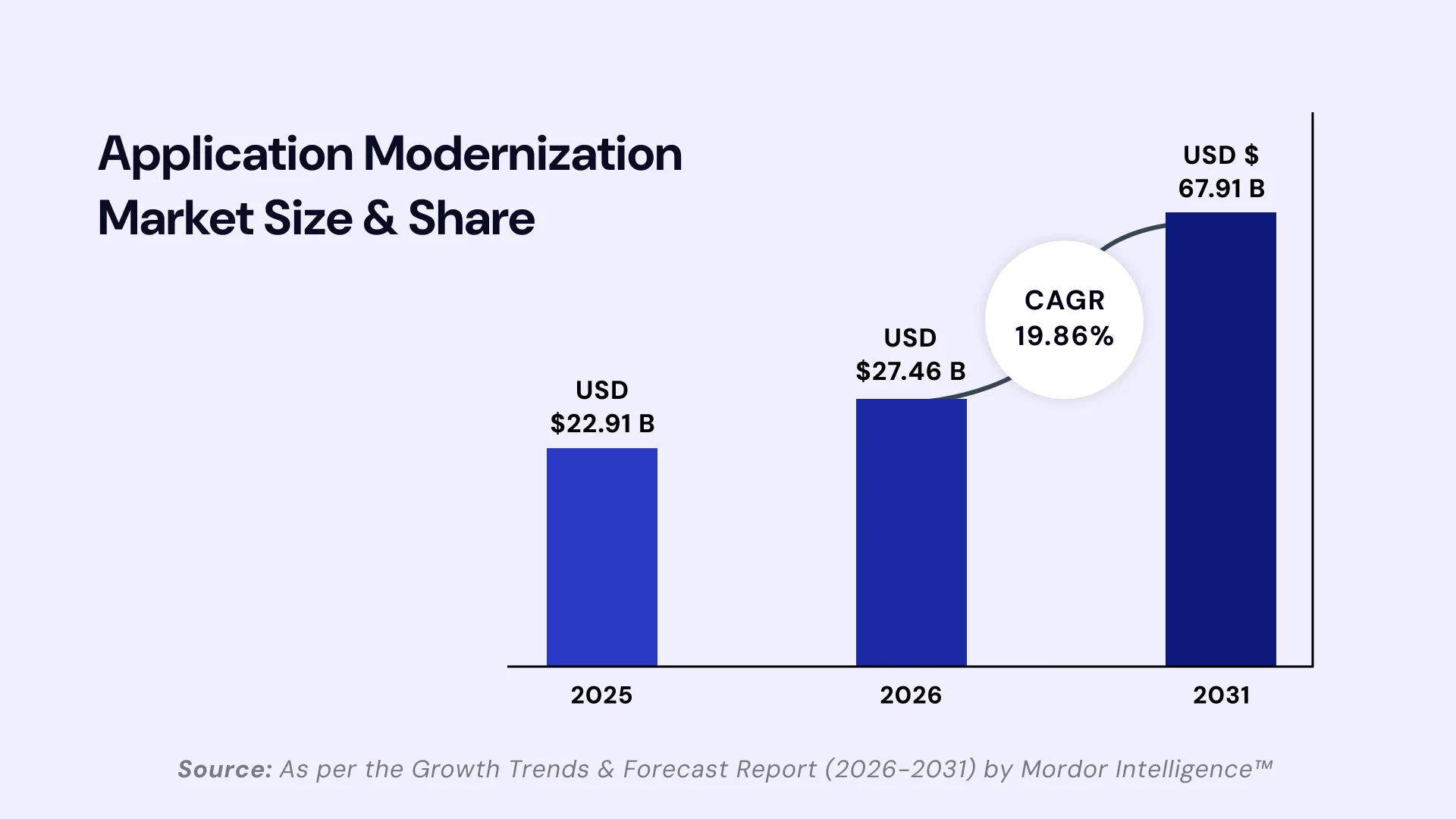
This financial drag is only half the story. The true operational cost shows up in talent attrition, lengthened security exposure windows, and fragile integrations that break under load. When key maintenance knowledge walks out the door, enterprise agility drops to zero.
Enterprise application modernization is how organizations work their way out, but only when it's run as a strategy rather than a string of one-off rewrites. This blog covers the three things technology leaders ask about most: how to build the strategy, which modernization patterns fit which applications, and what to put on a vendor checklist before you sign.
Why Enterprises Are Modernizing Now
Four pressures keep showing up in modernization business cases:
- A shrinking skills pool. Maintaining older technology gets harder and more expensive every year as the people who know it retire or move on.
- Slow delivery and poor scalability. Tightly coupled architectures turn small changes into long release cycles and make peak-load handling costly.
- Integration limits. Legacy systems struggle to connect with SaaS platforms, APIs, and modern data platforms, which blocks analytics and automation.
- Security and compliance exposure. Unsupported operating systems, frameworks, and databases create risk that audits increasingly refuse to accept.
Behind all four sits a fifth, quieter concern: fear. Leaders worry that modernization will disrupt operations, overrun its budget, or fail outright. That fear is reasonable, and it's exactly why your application modernization strategy and vendor selection matter more than technology choice.
Building an Application Modernization Strategy
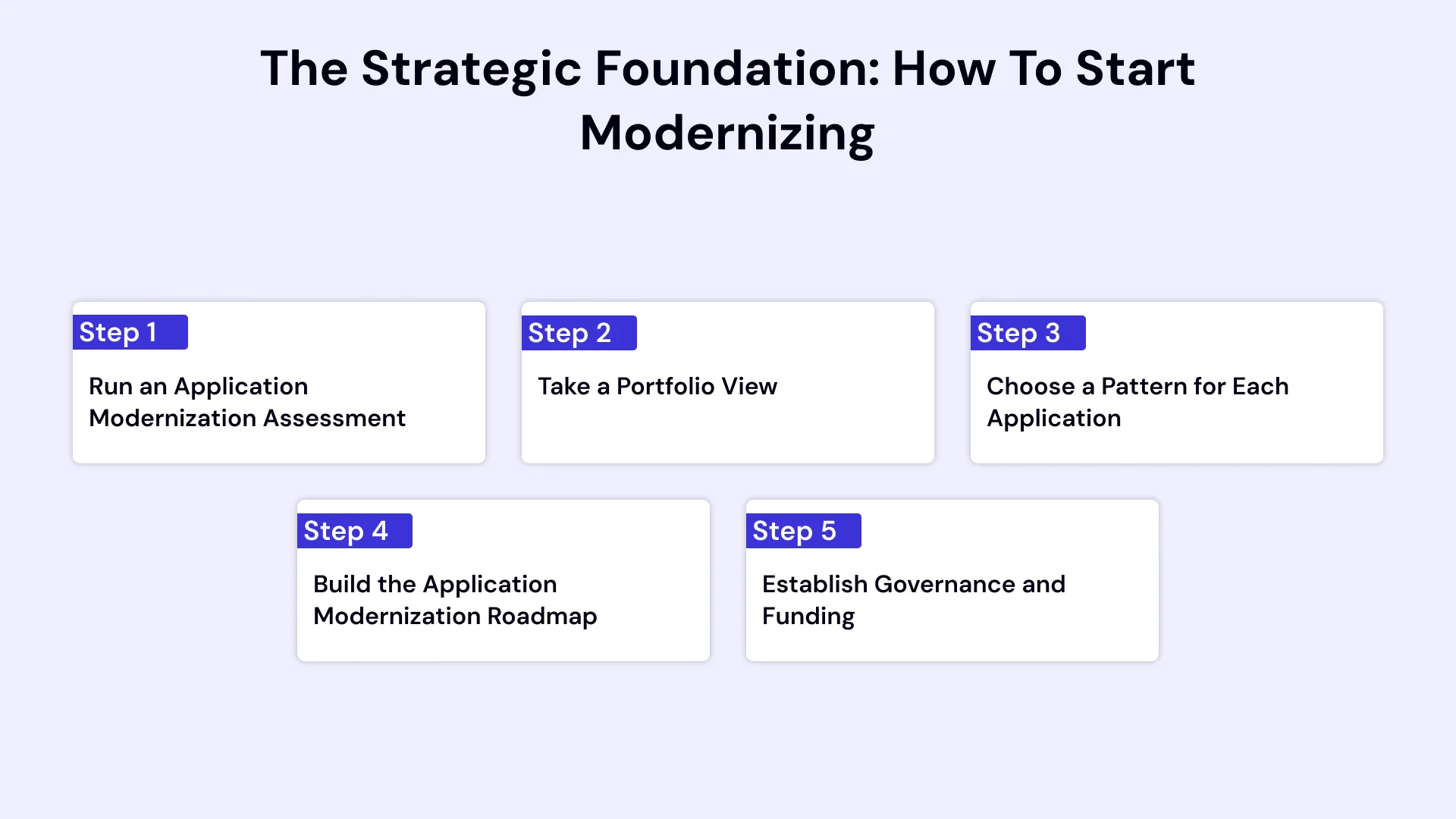
A sound application modernization strategy answers four questions: what do we have, what is it worth, what should happen to each application, and in what order? The steps below turn those questions into a plan.
Step 1: Run an Application Modernization Assessment
An application modernization assessment is the foundation. For every application, capture business criticality, user base, technical condition (language, framework, hosting, test coverage), integration dependencies, security and compliance findings, and run cost. Score the technical debt and the business value separately; the gap between them tells you where to act first.
Step 2: Take a Portfolio View
Application portfolio modernization treats the estate as a set of investments, and application portfolio modernization done well starts with honest scoring. Plot applications on value versus technical health. High value and poor health means modernize now. Low value and poor health usually means retire or replace. High value and good health means leave it alone. This view prevents the most common waste: spending heavily to modernize an application that should have been decommissioned.
Step 3: Choose a Pattern for Each Application
This is where application modernization approaches turn into decisions, and where application architecture modernization choices get made. The next section walks through the seven options in detail.
Step 4: Build the Application Modernization Roadmap
An application modernization roadmap sequences the work. Group applications into waves based on business value, risk, dependency order, and dedicated team capacity. Start with a pilot that is meaningful but not mission-critical, learn from it, and then scale. Define success metrics for each wave: deployment frequency, lead time for changes, change failure rate, availability, and run cost.
Step 5: Establish Governance and Funding
Modernization fails quietly when it competes with feature work every quarter. Set up an architecture review board, agree on target-state standards, and fund the program as a multi-year portfolio rather than a series of project requests.
An Application Modernization Framework You Can Reuse
Teams that modernize successfully tend to follow a repeatable application modernization framework. A simple version looks like this:
Phase | Question | Output |
| Discover | What do we run and what does it cost? | Inventory, dependency map, run-cost baseline |
| Assess | What is each application worth and how healthy is it? | Value and technical-debt scores |
| Decide | Which treatment fits each application? | Pattern assignment per application |
| Plan | In what order, and with what team? | Roadmap, waves, budget, metrics |
| Execute | How do we deliver safely? | Incremental releases, automated testing, cutover plans |
| Optimize | Are we getting the benefit? | Cost, performance, and reliability reviews |
The same framework works whether you are updating a handful of critical systems or running legacy system modernization across hundreds of applications. If you're building the business case, our App Modernization Cost Breakdown explains what drives budgets, and the Application Modernization Checklist gives your team a practical planning tool.
Application Modernization Patterns: The 7 Rs Explained
Modernization isn't one technique. It's a menu of application modernization approaches. Here are the seven treatments most enterprises choose from, from least to most invasive.
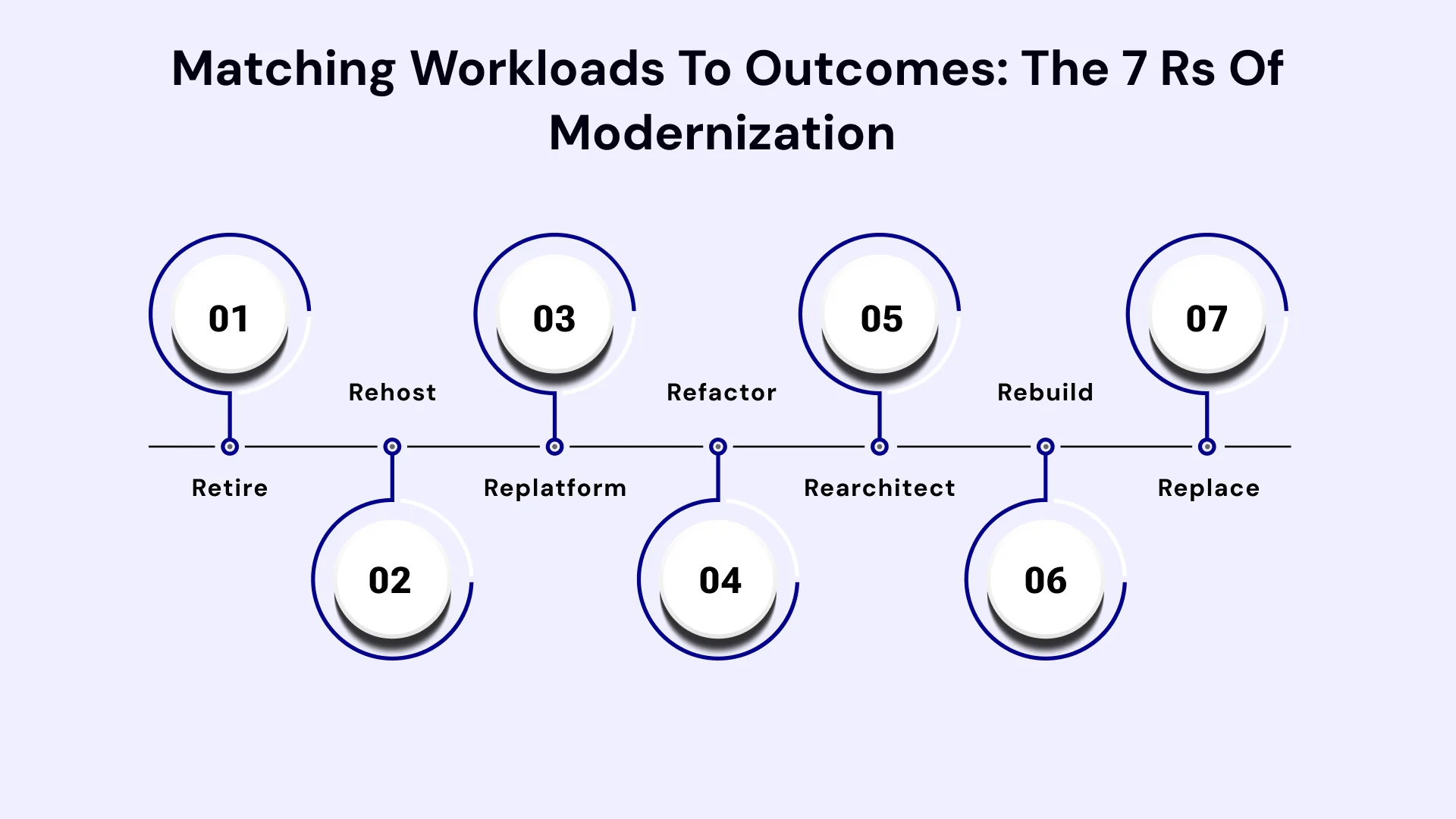
Retire
Switch the application off. If usage is low or the function is duplicated elsewhere, retiring is the cheapest and fastest win, and it shrinks your attack surface and licensing bill.
Rehost (Lift and Shift)
Move the application to new infrastructure, usually cloud virtual machines, with minimal change. Rehosting is quick and low-risk, and it ends data center dependency, but it doesn't fix the application itself. Treat it as a first step, not a destination.
Replatform
Make targeted changes to take advantage of managed services, such as moving to a managed database or containerizing the application, without rewriting the core logic. You get better operability and lower run cost for moderate effort.
Refactor
Restructure the existing code to improve maintainability, remove dead code, and pay down technical debt, while keeping external behavior the same. Refactoring is a good fit when the application is fundamentally sound but hard to change.
Rearchitect
Change the application's structure, for example by breaking a monolith into services, introducing APIs, or adopting event-driven design. This is where the largest gains in scalability and delivery speed come from, and where risk is highest. The strangler fig pattern helps: route functionality to new services gradually and retire old components as they become redundant.
Rebuild
Rewrite the application from scratch on a modern stack while preserving its purpose. Rebuilding makes sense when the existing codebase is beyond repair, or the business model has changed enough that the old design no longer fits.
Replace
Swap a custom application for a commercial or SaaS product. When a market product covers the need, replacing avoids owning code that doesn't differentiate you. Plan carefully for data migration and process change.
Choosing Between Them
If the application is... | Consider |
| Low value, rarely used | Retire |
| Stable, must leave a data center fast | Rehost |
| Sound but costly to operate | Replatform |
| Valuable but hard to change | Refactor or rearchitect |
| Differentiating and outgrown its design | Rearchitect or rebuild |
| Commodity function with a strong market product | Replace |
Most portfolios use several of these, and application architecture modernization is only one of the levers. A typical enterprise might retire 10 to 20 percent of its applications, rehost or replatform the bulk of the remainder, and invest deeply in rearchitecting only the few systems that drive competitive advantage.
Shift in Perspective: From Technical Rewrite to a Modern Operating Model
Legacy application modernization isn't just a technical exercise—it requires a fundamental shift across every layer of your enterprise software model:

- Architecture (Monoliths to Microservices): Transitioning from heavy, tightly coupled monolithic codebases to modular, API-led services that can be updated or scaled independently.
- Delivery & Operations (Batch Releases to Automation): Shifting from slow, manual release cycles to automated CI/CD pipelines, enabling continuous delivery with minimal downtime and reduced operational risk.
- Team Structure & Governance (Centralized IT to Product Ownership): Moving away from centralized IT bottlenecks to cross-functional, product-focused engineering teams that take end-to-end ownership of specific capabilities.
- Integration & Ecosystem (Custom Connectors to Open APIs): Replacing brittle, custom point-to-point integrations with standardized API contracts and event-driven architectures that easily plug into modern SaaS, cloud services, and data platforms.
- Infrastructure & Resiliency (Static Servers to Cloud-Native Scalability): Moving from rigid, self-managed physical/virtual servers to elastic, auto-scaling cloud platforms that adapt dynamically to demand while optimizing compute costs.
Pro Tips: Modernization programs that focus only on cloud hosting or infrastructure rewrites routinely fail to deliver ROI. True speed, innovation, and business agility only happen when architecture, delivery practices, team structure, integrations, and infrastructure evolve together.
Application Modernization Vendor Checklist
Choosing a partner is the other half of the decision. Use this checklist when you evaluate vendors. Every item should be answerable with evidence, not assurances.
1. Assessment and strategy
- Do they run a structured application modernization assessment before proposing solutions?
- Can they show how they score value, risk, and technical debt across a portfolio?
- Will they recommend retiring or replacing applications, even when it means less work for them?
2. Technical depth
- Do they have experience with your source stacks (for example, mainframe, .NET, Java, COBOL) and your target platforms?
- Can they explain when they use each of the seven patterns, and show examples of rearchitecting done incrementally?
- Do they have a clear approach to testing, data migration, and cutover?
3. Delivery and risk
- Do they propose a pilot with defined success criteria before a full commitment?
- How do they keep the business running during migration, and what is the rollback plan?
- Who is on the team, how long have they worked together, and what happens if key people leave?
4. Security and compliance
- Do they follow secure development practices and support your regulatory requirements?
- How do they handle access to production data and environments?
5. Knowledge transfer and ownership
- Will your team receive documentation, architecture decisions, and hands-on training?
- Do you own the source code, infrastructure definitions, and runbooks?
6. Commercials
- Is pricing transparent, with scope, assumptions, and change-control terms in writing?
- Do they offer outcome-linked milestones rather than only time-and-materials billing?
- Can you speak to two or three references with similar scale and complexity?
Note: If a vendor can't answer most of these clearly, that's your answer.
Leverage Our Expertise for Enterprise Application Modernization
Legacy systems shouldn't be an anchor holding your business back. In today's fast-paced digital economy, outdated architecture can stifle innovation, inflate maintenance costs, and slow down time-to-market.
We help technology leaders transform ambiguity into competitive advantage by turning complex modernization challenges into a funded, precisely sequenced, and risk-mitigated strategic roadmap.
Our Proven Modernization Methodology
We ensure seamless business continuity while breathing new life into your core technology stack through a structured, multi-phase approach:
- Comprehensive Portfolio Assessment: We deep-dive into your existing architecture, tech stack, and dependencies to uncover hidden technical debt and identify high-impact modernization opportunities.
- Strategic Pattern Mapping: One size doesn't fit all. We assign the ideal migration and modernization pattern—whether it's refactoring, rearchitecting, rebuilding, or replacing—tailored to each application's unique business value.
- Incremental, Zero-Disruption Delivery: We deliver value in manageable, iterative increments. Your critical day-to-day operations keep running smoothly without costly downtime or unexpected bottlenecks.
End-to-End Capabilities: Beyond the Core Platform
True modernization goes beyond backend infrastructure—it touches every interaction your users have with your brand. When your transformation journey requires fresh, engaging customer-facing experiences, our specialized engineering teams extend your core platform directly to the channels your users rely on every day:
- Mobile App Development Services to craft high-performance, intuitive mobile experiences that bridge the gap between legacy backends and modern mobile users.
- Custom Software Development Services to build bespoke applications tailored precisely to your unique workflows, driving deeper engagement and operational efficiency.
VLink’s team helps technology leaders move from an unclear roadmap to a funded, sequenced plan. We start with a portfolio assessment, assign the right pattern to each application, and deliver incrementally so operations keep running. Explore our Legacy Application Modernization Services to see how we approach this work, and read our overview of Application Modernization trends to see where the market is heading.
Conclusion
Enterprise application modernization works when it is treated as a portfolio strategy with a clear application modernization roadmap, the right pattern for each application, and a vendor chosen against evidence. Assess first, be willing to retire and replace as readily as you rebuild, modernize incrementally to protect the business, and measure results in delivery speed, reliability, and run cost.
Whatever your application modernization strategy looks like on paper, start small: inventory the portfolio, score it, and pilot one meaningful application. That single step will tell you more about your real modernization path than any slide deck.
Partner with Us on Your Modernization Journey!
If you're ready to reduce technical debt, accelerate release cycles, and lower operating costs, we can help. Get in touch with our team to discuss your legacy estate, explore our modernization patterns, or review our vendor checklist with an expert architect.

Business Development Professional
Vineel is a seasoned sales and business development leader with extensive experience in the telecommunications and IT industries. Over the course of his career, he has worked with global teams at multinational organizations, having lived and operated in India, Canada, the Netherlands, and the United Kingdom.

 Shivisha Patel