Here's something most engineering leaders won't say out loud in a board meeting: legacy systems rarely fail with a bang. They fail quietly over years- in the extra sprint it takes to ship a feature that should've taken days, in the developer who spends their morning untangling a workaround someone wrote in 2016, in the customer who quietly switches to a competitor because your checkout flow feels ten years old. Because it is.
That slow erosion is exactly why application modernization trends have crept out of the IT department and into the boardroom. Startup founders are trying to figure out how fast they can realistically scale, and enterprise CXOs are staring down a budget line for "digital transformation." They're asking a surprisingly similar question: what does modernization actually look like heading into 2026, and how do we avoid getting this expensive decision wrong?
This blog walks through the application modernization trends 2026 that are actually worth paying attention to (as opposed to the ones that just sound good in a vendor pitch deck), what's driving them, and how to turn all of it into a roadmap you can act on; whether you're dealing with one stubborn legacy application or an entire enterprise stack that's showing its age.
Why This Conversation Feels Different in 2026
The push behind app development trends this year isn't purely technical; it's competitive, and honestly, a little uncomfortable for anyone still running outdated infrastructure. Slower release cycles. Rising maintenance bills that never seem to shrink. Security gaps that keep the CISO up at night. A widening distance between what customers expect from your product and what your ten-year-old architecture can realistically deliver.
What's changed is the toolkit. AI-assisted code analysis, mature cloud-native platforms, and migration frameworks that don't require betting the whole company on one risky weekend- these have quietly matured to the point where modernization no longer means choosing between "rip everything out" or "leave it alone and pray." There's a real middle path now, and that's a big part of why enterprise application modernization has so much momentum heading into next year.
If you're a startup founder, this usually means building modern from day one, so you don't inherit someone else's technical debt in year three. If you're an enterprise CXO, it means figuring out how to modernize systems the business genuinely can't afford to have gone down, even for an afternoon. Different starting points, same underlying pressure, and the trends below are where most of that pressure is currently pointing.
Top 15 Application Modernization Trends for 2026
This is the part most people scroll down for, so let's get into it. These trends aren't abstract predictions pulled from a crystal ball—they're the exact patterns driving demand for our App Modernization Service, showing up repeatedly across real-world enterprise projects, architectural conversations, and RFPs.
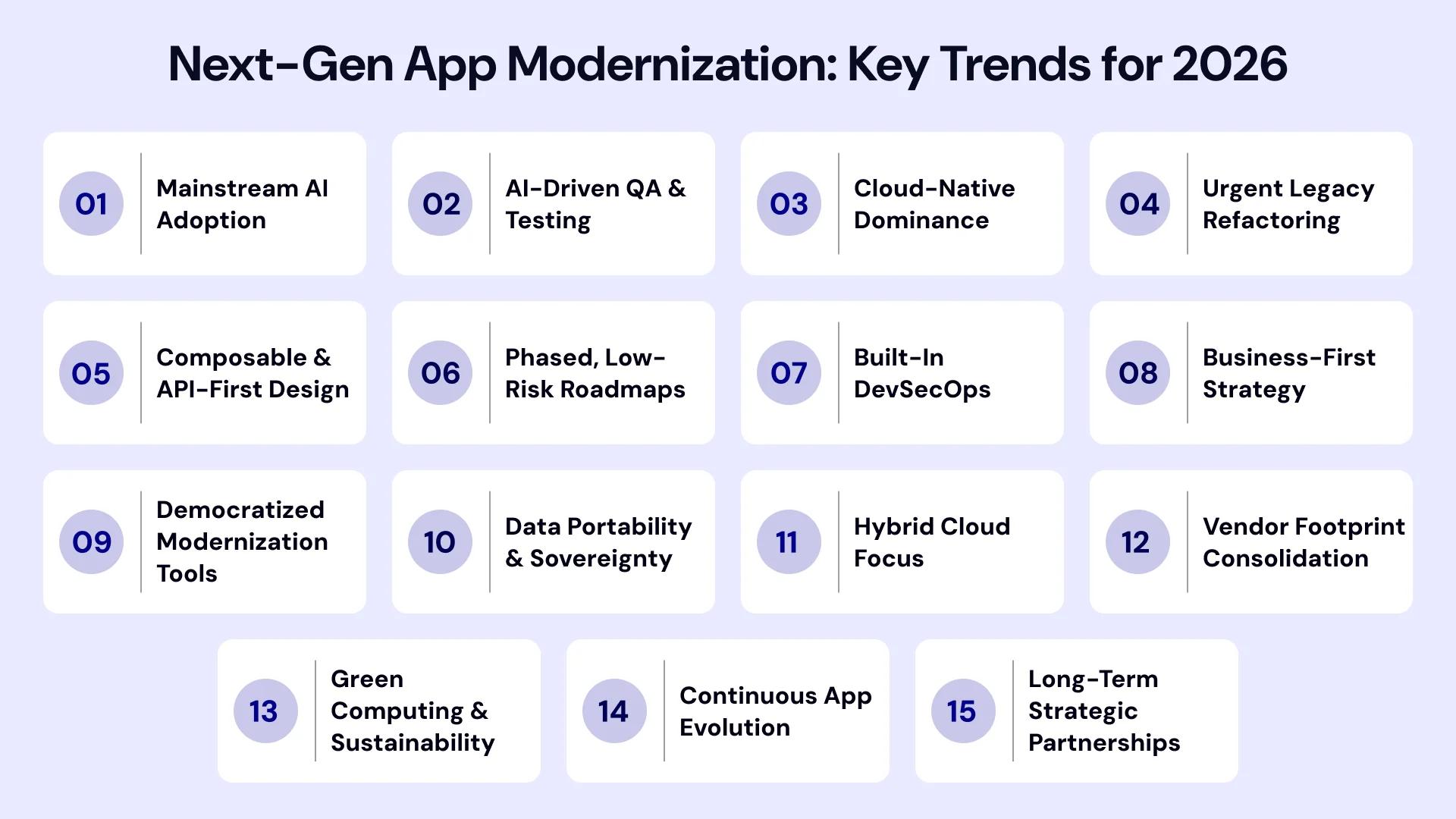
1. AI-Driven Application Modernization Stops Being a Novelty
For a couple of years, AI-driven application modernization was the thing vendors demoed at conferences, but few teams trusted with production code. That's shifting fast. AI tools can now scan a sprawling legacy codebase, map out undocumented dependencies nobody remembers writing, flag security vulnerabilities before they become incident-response emergencies and suggest realistic refactoring paths; the kind of grunt work that used to eat weeks of a senior engineer's time. It doesn't replace human judgment on architecture decisions, but it removes a huge amount of the tedious discovery work that made early modernization phases drag on forever.
2. AI-Powered Application Modernization Moves into Testing and QA
Code analysis was just the opening act. AI-powered application modernization is now reaching into testing- generating test cases automatically, predicting which parts of a modernized system are most likely to break, and catching regressions that a rushed QA cycle would've missed. For teams that have been burned before by a "successful" migration that quietly broke three edge cases in production, this is the difference between sleeping fine after a release and refreshing your error-monitoring dashboard at 2 a.m.
3. Cloud-Native Becomes the Only Serious Target Architecture
Ask a modernization team in 2026 what they're building toward, and almost nobody says anything other than cloud-native application modernization- containers, microservices, managed cloud services, the works. This used to be an ambitious option. Now it's just the baseline. If your modernization plan doesn't lead to a cloud-native end state, it's worth asking why, because the flexibility and scalability gap between cloud-native and everything else has only gotten wider.
4. Legacy Modernization Shifts From "Someday" to "Now"
Legacy application modernization has quietly stopped being a discretionary line item. Vendors are sunsetting support for older platforms faster than they used to. Security risk compounds every year a system sits untouched. And the engineers who actually understand the original codebase keep retiring or moving on, taking that institutional knowledge with them. What used to be a "when we get around to it" project is turning into "we genuinely can't wait much longer,” and most technology leaders we talk to already feel that shift internally, even if it hasn't hit the roadmap yet.
5. Composable, API-First Architecture Keeps Gaining Ground
Instead of one giant, tightly wound monolith were changing one thing risks breaking five others; more teams are building and modernizing toward composable systems: modular pieces connected through APIs, each one replaceable without a full-system overhaul. It's not a flashy trend, but it's arguably one of the most practically important ones, because it's what makes future changes cheap instead of terrifying.
6. Modernization Roadmaps Get More Phased and a Lot Less Reckless
Plenty of companies learned the hard way that a "big bang" modernization- rip out the old system, flip a switch, hope for the best- is a great way to end up in a postmortem meeting. So, the application modernization roadmap most teams are building in 2026 looks different: incremental, phased, deliberately boring in the best way. Modernize the highest-impact piece first, validate it under real load, then move to the next. Slower on paper, dramatically less risky in practice.
7. Security Gets Baked in From Day One, Not Bolted on at the End
Security-first application modernization strategy isn't optional anymore, especially with regulatory scrutiny tightening across most industries. Zero-trust principles, continuous vulnerability scanning, and access controls are getting designed into the modernization process itself, rather than showing up as a panicked audit two weeks before launching. Teams that treat security as a final checkbox almost always end up paying for it later; either in delays or in something worse.
8. Application Modernization Best Practices Start with the Business Case, Not the Tech Stack
The strongest application modernization best practices we're seeing right now don't start with "which framework should we use?" They start with "what's this actually going to do for revenue, retention, or operating cost?" Modernization projects that get greenlit and funded properly are almost always the ones where someone connected the technical work to a number the CFO cares about; not just cleaner code for its own sake.
9. Application Modernization Technologies Get More Accessible
New application modernization technologies, particularly low-code platforms and increasingly capable migration automation tools, are lowering the barrier to entry in a real way. Smaller teams without a bench of ten senior architects can now realistically tackle modernization projects that would've required a specialized consultancy just a few years ago. That doesn't mean every project is simple, but it does mean fewer companies are priced or staffed out of even starting.
10. Application Modernization for Enterprises Puts Data Portability Front and Center
Application modernization for enterprises increasingly treats data as its own workstream, separate from the application logic sitting on top of it. Decoupling data from legacy systems as early as possible means that even if the surrounding application changes shape three more times over the next five years, the underlying data stays clean, structured, and usable; instead of getting trapped in whatever platform happens to be modernized this quarter.
11. Legacy Modernization Trends Lean Hard Toward Hybrid Cloud
Not everyone is going all-in on public clouds, and honestly, that's the right call for a lot of businesses. Legacy application modernization trends show a strong pull toward hybrid setups: keeping certain workloads on premises for compliance, latency, or plain old institutional caution, while modernizing everything else into the cloud. It's a pragmatic middle ground, and it's becoming the default rather than the exception.
12. Enterprise Modernization Strategy Doubles as a Vendor Cleanup Project
A lot of enterprises are quietly using their modernization initiative to cover something they've needed to do anyway: cutting down a vendor and tooling stack that's grown out of control over a decade of "let's just add one more tool." An application modernization strategy for enterprises built well doesn't just upgrade technology; it simplifies the operational mess around it, which finance teams tend to appreciate almost as much as engineering does.
13. Sustainability Quietly Becomes Part of the Decision
This one doesn't get into the spotlight, but it's showing more in procurement conversations than people expect. Energy-efficient cloud infrastructure and smarter resource utilization are factoring into modernization decisions now, partly for cost reasons and partly because sustainability commitments have started trickling down from marketing slides into actual technical requirements.
14. The Future of App Development Is Continuous, not "Done"
Maybe the biggest mindset shifts on this whole list: the future of app development isn't a modernization project with a finish line, followed by years of coasting. It's continuous. Forward-thinking teams are folding modernization into their ongoing release cycles, treating technical debt the way they'd treat any other operational risk; something you manage constantly, not something you clean up once every five years when it finally becomes unbearable.
15. Modernization Partnerships Get Chosen for the Long Game
As these projects get more layered- AI tooling, cloud strategy, security, data portability, all happening somewhat in parallel- businesses are getting pickier about who they partner with. It's less about "can this vendor execute this one migration" and more about "will this partner still make sense two roadmaps from now." The companies getting this right are choosing partners the way they'd choose a long-term hire, not a one-off contractor.
The 2026 Modernization Roadmap: From Strategy to Execution
Knowing the trends is the easy part, honestly. Turning them into a working application modernization roadmap is where most projects either find their footing or quietly stall out. In our experience, the approach that consistently works looks something like this:
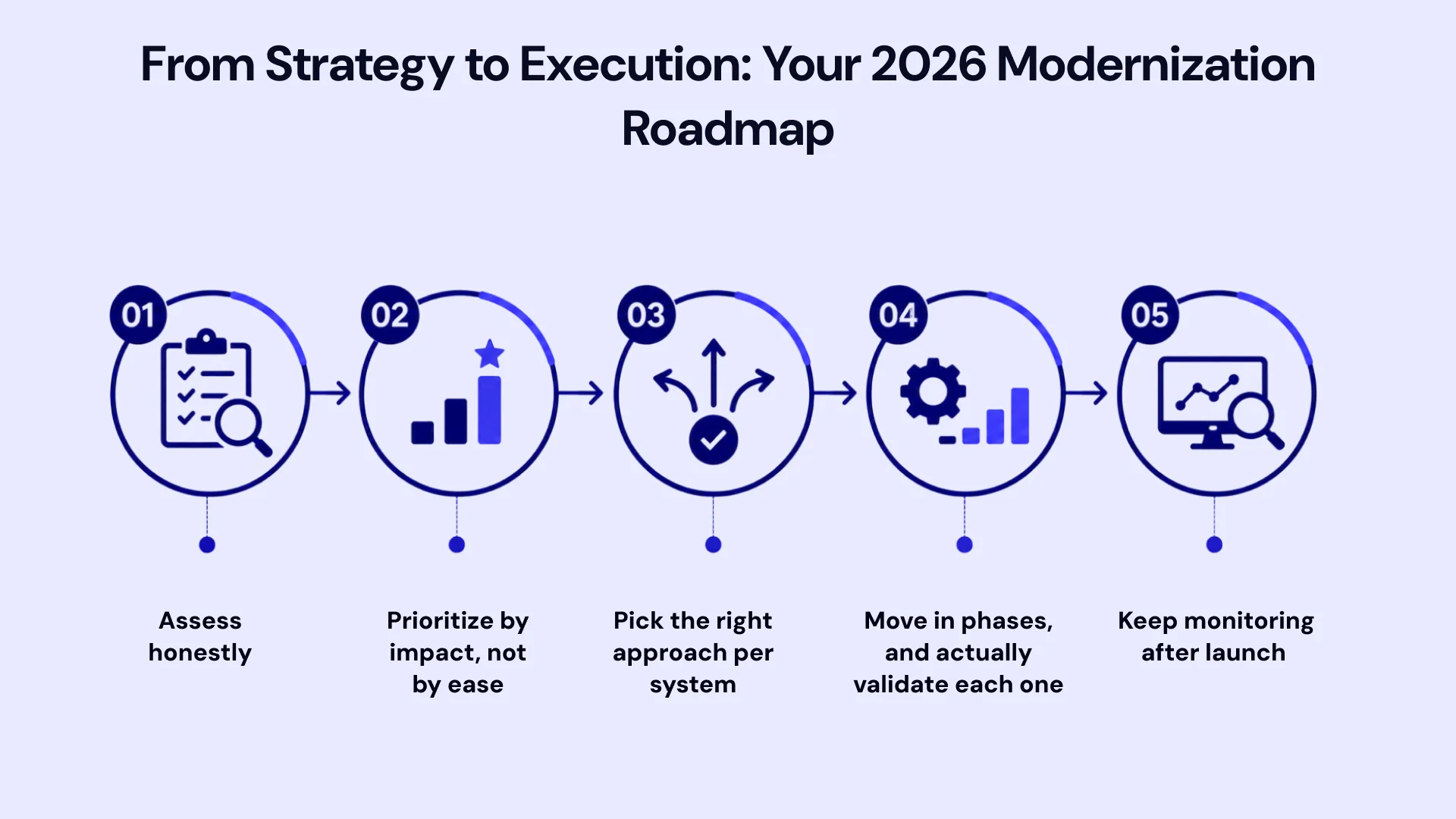
- Assess honestly: Inventory every application, dependency, and pocket of technical debt, including the ones nobody wants to admit still exists.
- Prioritize by impact, not by ease: Tackle the systems creating the most business risk or missed opportunity first, even if they're the scariest ones to touch.
- Pick the right approach per system: Rehost, refactor, replatform, or rebuild. Not every application needs the same treatment and treating them all the same is a common (expensive) mistake.
- Move in phases and validate each one: Resist the temptation to rush. A phase that's rushed through without proper validation tends to create the exact problems you were trying to modernize your way out of.
- Keep monitoring after launch: Modernization doesn't end at go-live. Treat it as an ongoing discipline instead of a project you can close out and forget.
This phased, patient approach is noticeably less risky than the reactive, all-at-once overhauls that still dominate a surprising number of modernization horror stories, and it's the model behind most of the enterprise application modernization programs that actually deliver what they promised.
What This Looks Like for U.S. Enterprises Specifically
Application modernization for U.S. enterprises comes with its own wrinkles. Regulatory frameworks, data residency rules, and industry-specific compliance requirements- particularly across finance, healthcare, and anything government-adjacent- shape how modernization gets approached in ways that don't always show up in generic playbooks.
Enterprise application modernization in the U.S. is also being pulled along by something less technical and more human: a genuinely tight labor market for specialized engineering talent. A lot of organizations are turning to modernization partners not because they can't hire, but because hiring the right people fast enough has become its own uphill battle.
Broader application modernization trends for U.S. businesses point clearly toward hybrid and multi-cloud strategies, driven partly by vendor risk management and partly by a reluctance to hand every regulated workload over to a single cloud provider.
And for enterprises specifically weighing legacy application modernization for U.S. enterprises, it usually comes down to a genuine trade-off: how much speed can you afford to sacrifice for safety when the system you're modernizing is one your business genuinely can't survive without for even a day? That's exactly why a phased, well-governed application modernization strategy for U.S. enterprises tends to beat a rushed, all-at-once transformation almost every time.
Mistakes Worth Avoiding (Because We See Them Constantly)
Even with better tools and clearer trends, modernization projects still trip over the same handful of problems:
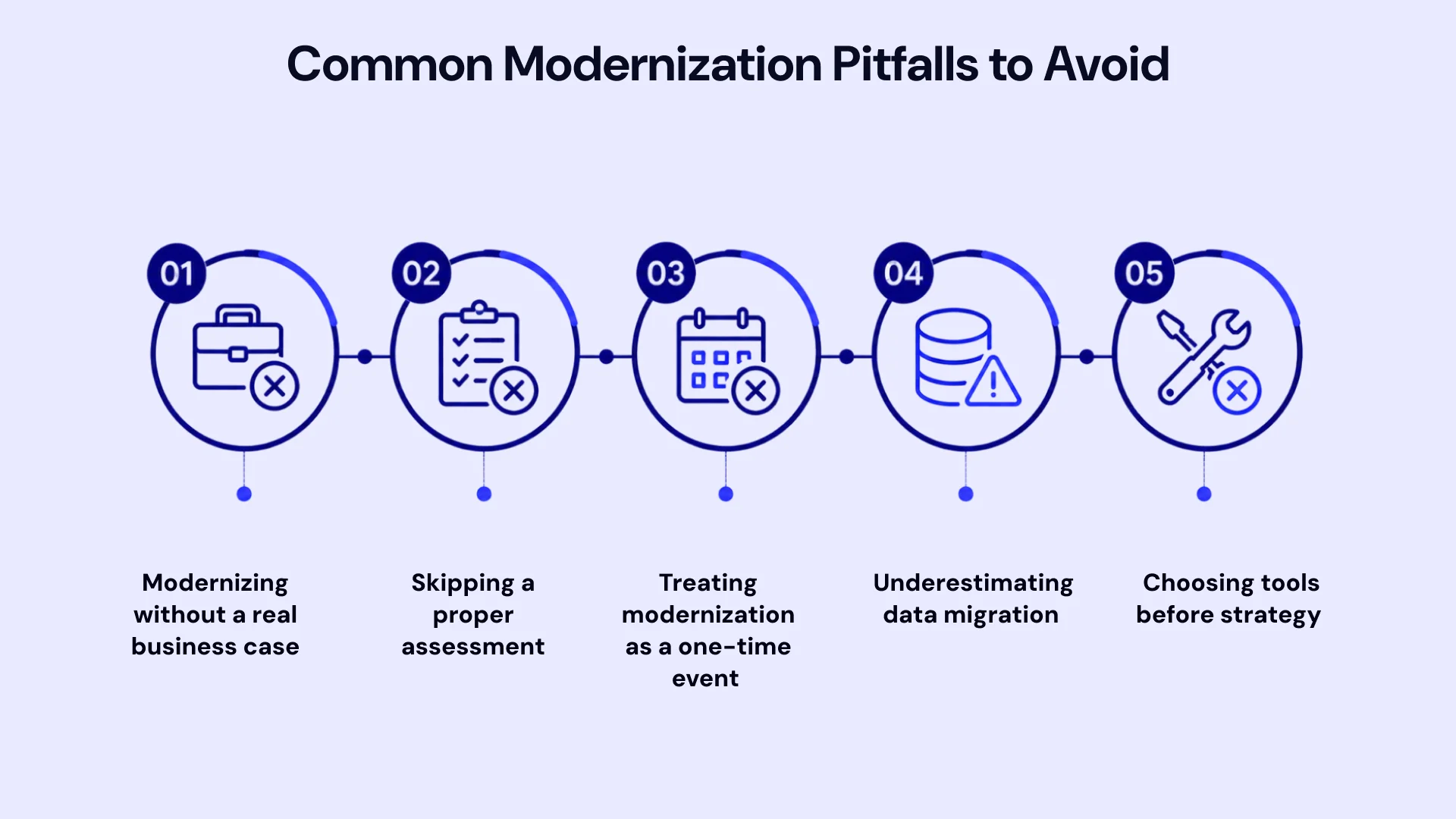
- Modernizing without a real business case. "The code will be cleaner" doesn't get budget approved on its own, and it shouldn't.
- Skipping a proper assessment. Jumping straight into migration without mapping dependencies is how a "six-week project" turns into a six-month one.
- Treating modernization as a one-time event. Systems that get modernized once and then left alone tend to fall behind again faster than people expect.
- Underestimating data migration. This is, without exaggeration, one of the single most common reasons modernization timelines slip.
- Choosing tools before strategy. Picking technology before defining what success looks like is a fast way to end up with impressive infrastructure and no clear business win to show it.
Partner with VLink to Execute Your Modernization Strategy
Modernizing legacy systems is a genuinely high-stakes call. Done well; it becomes a real competitive edge. Done poorly or done by the wrong partner; it becomes an expensive distraction that eats a year of roadmap and delivers half the value promised.
VLink’s app modernization service is built around the same phase-based, business-first approach outlined above, helping startups and enterprise teams modernize legacy applications without breaking the systems they depend on every single day. For businesses whose roadmap includes a cloud move as part of the picture, our Cloud Migration Services work alongside modernization planning to keep both the technical execution and the cost predictable, not something that balloons three months in.
If you're still mapping out where to start, our App Modernization Checklist is a genuinely useful next read; it walks through the same assessment and prioritization process our team uses with clients, so you can start building your own roadmap with something more solid than gut feeling.
Whether you're a startup trying to build modern from the ground up or an enterprise CXO managing a legacy footprint that's grown a little unwieldy, we help you modernize on your own terms, with clear costing, honest timelines, and a team that stays accountable through every phase, not just the kickoff call.
In Summary
Pull back far enough, and every trend on this list points in roughly the same direction: modernization in 2026 is getting faster, smarter, and a lot less of a one-time event. AI is removing the tedious parts of the process. Cloud-native has become the obvious target rather than the ambitious one. And more businesses are finally treating legacy systems for what they are: a genuine business risk, not just a technical inconvenience someone will "get to eventually."
The organizations that treat modernization as an ongoing discipline, backed by a clear strategy and a partner who's in it for the long run, are the ones best positioned to keep up as these trends keep accelerating. Ready to future-proof your tech stack? Contact our modernization team today to evaluate your architecture and build a tailored 2026 roadmap.

Business Development Professional
Vineel is a seasoned sales and business development leader with extensive experience in the telecommunications and IT industries. Over the course of his career, he has worked with global teams at multinational organizations, having lived and operated in India, Canada, the Netherlands, and the United Kingdom.

 Shivisha Patel