

Every enterprise wants the agility, scalability, and cost efficiency that the cloud promises. But here's the part fewer teams talk about openly: the journey from on-premises to cloud is one of the most security-sensitive transitions an organization will ever go through. A single misstep- an open storage bucket, an over-permissioned identity, an unencrypted data pipeline- can turn a strategic upgrade into a headline-making breach.
This is why cloud migration security deserves the same rigor as the migration itself. It isn't a checkbox you tick after the workloads are live. It's a discipline that starts the moment you decide to move and continues long after the last server is decommissioned.
In this guide, we'll unpack the real risks in cloud migration, the controls that actually work, and a practical pre migration checklist you can use right now; whether you're moving to AWS, Azure, GCP, or a hybrid setup.
Why Cloud Migration Security Matters More Than Ever
Cloud adoption has moved from "nice to have" to business-critical infrastructure. But with that shift comes a widening attack surface. Every workload, database, and API endpoint you move to the cloud becomes a new potential entry point if it isn't secured correctly.
Analysts tracking enterprise cloud adoption consistently point to misconfiguration, not sophisticated external attacks, as the leading cause of cloud data exposure. That's a sobering fact: most cloud breaches aren't the result of nation-state hackers. They're the result of rushed migrations, default settings left unchanged, and security being treated as an afterthought rather than a design principle.
A sound cloud migration security strategy flips this script. It treats security as a parallel workstream to the technical migration, not a phase that happens "later." Organizations that do this well tend to see fewer post-migration incidents, faster audits, and stronger customer trust- which, in competitive markets, is a genuine differentiator.
Understanding the Core Risks of Cloud Migration
Before you can build the right controls to secure your digital transformation solutions, you need a clear-eyed view of what can actually go wrong. Here are the risks of cloud migration that show up most often in real-world projects.
1. Data Exposure During Transfer
Moving large volumes of sensitive data- customer records, financial data, intellectual property- across networks is inherently risky if encryption isn't enforced end-to-end. Data in transit that isn't encrypted can be intercepted, and even encrypted transfers can be mishandled if keys aren't managed properly.
2. Misconfigured Cloud Storage and Services
This is, by a wide margin, one of the most common cloud migration challenges. Publicly accessible storage buckets, overly permissive security groups, and default admin credentials left unchanged are all classic examples of configuration drift that attackers actively scan for.
3. Identity and Access Management (IAM) Gaps
When teams migrate quickly, IAM often gets the least attention; yet it's the control plane for everything else. Over-provisioned roles, shared credentials, and a lack of multi-factor authentication turn what should be a locked door into an open one.
4. Compliance and Regulatory Blind Spots
Industries under HIPAA, GDPR, PCI-DSS, or SOC 2 obligations can't simply "lift and shift" without validating that the destination environment meets the same regulatory bar. A migration that overlooks data residency or audit logging requirements can create compliance debt that's expensive to unwind later.
5. Shadow IT and Untracked Workloads
Large migrations rarely move in one clean sweep. Legacy systems, forgotten scripts, and undocumented integrations often get left behind or migrated without proper vetting, creating blind spots that security teams don't even know exist.
6. Downtime and Data Loss
Beyond the strictly "security" risks, poor migration planning can lead to service interruptions or, worse, irreversible data loss if backups aren't validated before cutover.
7. Vendor and Third-Party Risk
Cloud migrations often involve multiple vendors: the cloud provider, migration tooling, and sometimes a systems integrator. Each additional party introduces its own risk profile that needs to be assessed, not assumed.
Partnering with Cloud Consulting Services to recognize these cloud migration security challenges early lets you design controls proactively, instead of firefighting after go-live.
Essential Security Controls for a Safe Cloud Migration
Once the risks are mapped, the next step is building the guardrails. These are the controls that consistently show up in successful, low-incident migrations.
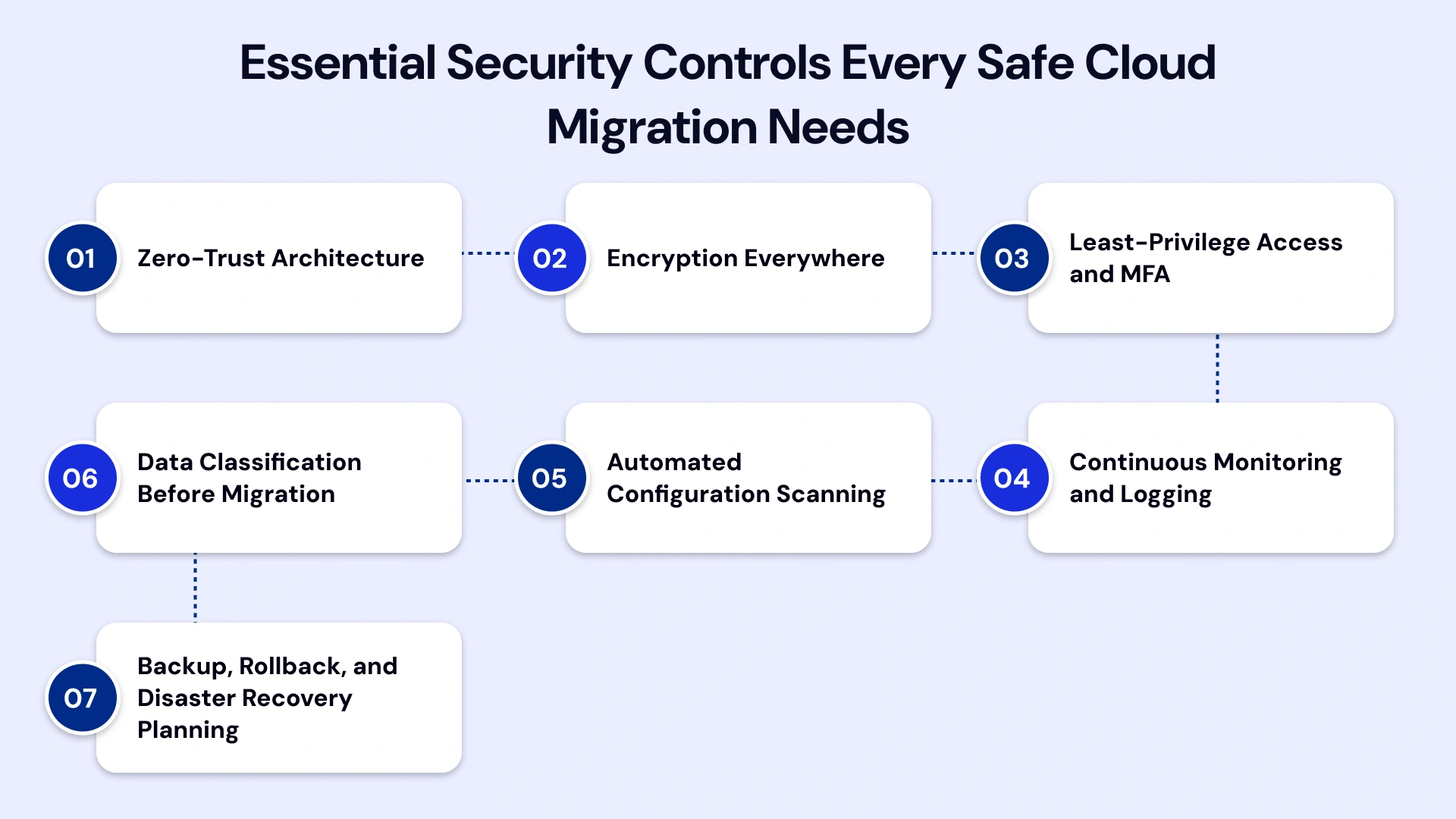
Zero-Trust Architecture
Rather than trusting anything inside the network perimeter by default, zero-trust requires continuous verification of every user, device, and workload. This is especially valuable during migration, when environments are hybrid and harder to monitor with traditional perimeter thinking.
Encryption Everywhere
Data should be encrypted both at rest and in transit, with keys managed through a dedicated key management service rather than hardcoded or shared informally. This single control addresses a large share of the exposure risk during transfer.
Least-Privilege Access and MFA
Every identity- human or machine- should have only the permissions it needs, for only as long as it needs them. Multi-factor authentication should be non-negotiable for anyone with administrative access to migration tooling or destination environments.
Continuous Monitoring and Logging
Visibility doesn't stop once the migration is "done." Centralized logging, anomaly detection, and real-time alerting help catch misconfigurations or suspicious activity before they escalate into incidents.
Automated Configuration Scanning
Manual configuration reviews don't scale. Automated tools that continuously scan for open ports, public storage, and policy violations catch the kind of drift that causes most cloud breaches.
Data Classification Before Migration
Not all data carries the same risk. Classifying data by sensitivity before migration helps prioritize which workloads need the strictest controls first, rather than applying a one-size-fits-all approach.
Backup, Rollback, and Disaster Recovery Planning
A migration plan without a validated rollback path is a gamble. Testing backups and failover procedures before cutover is what separates a controlled migration from a risky one.
Together, these controls form the backbone of any credible best practices for a secure cloud migration approach, and they apply whether you're managing Cloud Infrastructure Services, following an AWS migration checklist, or executing an Azure-focused rollout.
Market Trends: Where Cloud Migration Security Is Heading
The conversation around cloud security trends has matured significantly, with a few key patterns standing out across current industry analysis and enterprise cloud reports:
- Shift-left security is becoming standard; security reviews are increasingly built into migration planning rather than bolted on after deployment.
- AI-assisted threat detection is gaining traction, helping dedicated teams spot anomalous access patterns across sprawling multi-cloud environments faster than manual review ever could.
- Regulatory pressure is intensifying, particularly around data residency and cross-border data transfers, pushing organizations to bake compliance into migration design from day one.
- Multi-cloud and hybrid strategies are now the norm rather than the exception, which means migration security has to account for consistency across providers, not just one.
Competitor blogs and industry reports in this space tend to focus heavily on tooling. What's often missing, and what genuinely moves the needle for businesses, is a structured, phased approach that pairs the right tools with the right process. That gap is exactly where a well-run migration project earns its value.
Pre-Migration Security Checklist
This is the practical part- the cloud migration checklist you can actually put to work before a single workload moves.
1. Assessment & Planning
- Complete a full cloud migration assessment checklist, inventorying every application, dependency, and data store
- Classify data by sensitivity and regulatory scope
- Conduct a risk assessment for cloud migration covering technical, operational, and compliance dimensions
- Define clear success criteria and rollback thresholds
2. Identity & Access
- Review and rebuild IAM policies using least-privilege principles
- Enforce MFA across all administrative and migration-related accounts
- Remove or rotate legacy credentials before migration begins
3. Data Protection
- Encrypt data at rest and in transit using provider-native or dedicated key management
- Validate backup integrity with a test restore, not just a backup log check
- Document data residency requirements for regulated data types
4. Network & Infrastructure
- Design network segmentation for the destination environment
- Apply this as part of your server migration checklist, confirming firewall rules and security groups before cutover
- Test connectivity and latency between hybrid environments
5. Application-Level Checks
- Run an application migration checklist to confirm each app's dependencies and integrations are accounted for
- Patch and update applications before migration rather than after
- Test authentication flows in the new environment
6. Compliance & Governance
- Map compliance requirements (GDPR, HIPAA, PCI-DSS, SOC 2) to the destination environment
- Confirm audit logging is enabled and retained per policy
- Document the entire migration process for audit purposes
7. Post-Migration Validation
- Run a post-migration checklist covering configuration scans, access reviews, and performance benchmarking
- Monitor for 30–60 days post-cutover with heightened alerting
- Decommission legacy systems only after full validation
This checklist works whether you're handling a cloud database migration checklist for a single system or a full best practices for crm data migration security USA-compliant enterprise rollout.
Common Mistakes Businesses Make During Cloud Migration
Even well-resourced teams fall into predictable traps:
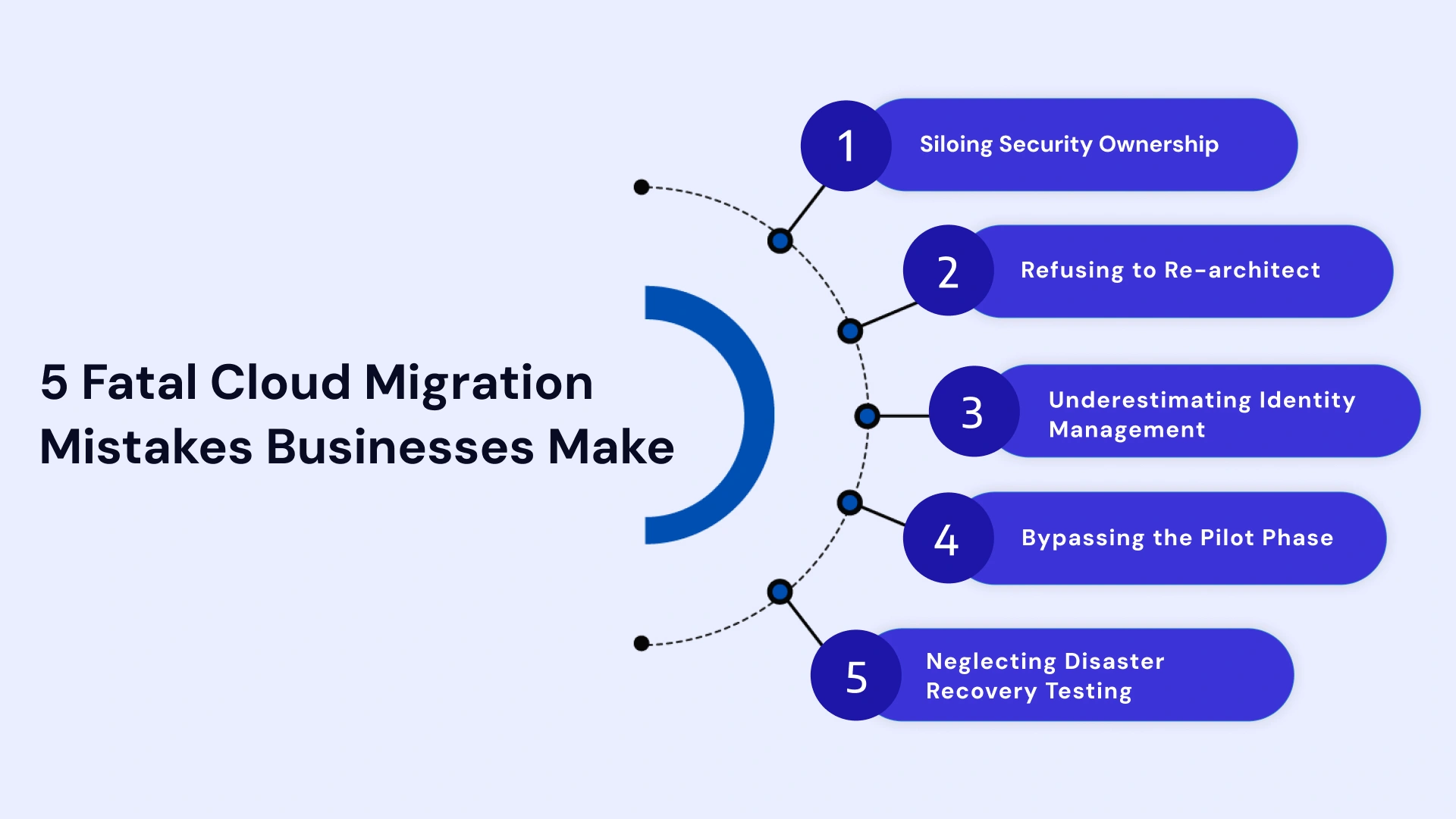
1. Siloing Security Ownership: Treating security strictly as IT's job rather than a shared responsibility across engineering, compliance, and executive leadership.
2. Refusing to Re-architect: Executing a direct "lift-and-shift" migration without redesigning applications for cloud-native security frameworks.
3. Underestimating Identity Management: Miscalculating the time and strategy required for a comprehensive Identity and Access Management (IAM) redesign.
4. Bypassing the Pilot Phase: Skipping a small-scale pilot migration and moving straight to a high-risk, full-scale cutover.
5. Neglecting Disaster Recovery Testing: Deferring disaster recovery and failover testing until after an actual incident occurs.
Avoiding these pitfalls isn't about achieving absolute perfection; it's about embedding sufficient structural rigor into the process so minor errors don't escalate into major incidents.
Accelerate Your Cloud Migration with VLink Experts
Cloud migration security isn't something you want to learn through trial and error; the stakes are simply too high. That's where the right partner makes a measurable difference.
VLink’s team brings hands-on experience across Cloud Migration Services, helping businesses plan, secure, and execute migrations without the guesswork. Whether you need a full Cloud Consulting Services engagement, support with Azure Cloud Migration Services, or help modernizing legacy systems through our Legacy Application Modernization Services, we build security into every phase, not as an add-on.
We also help organizations strengthen the environments they're moving into, with dedicated Cloud Infrastructure Services and broader digital transformation solutions designed to future-proof your technology stack.
If your industry has specific regulatory pressure, our guide on how to reduce cloud migration risk for financial services is a useful next read, alongside our breakdown of common cloud migration challenges and the latest cloud security trends shaping the industry. From the first assessment to post-migration monitoring, we work as an extension of your team; so your migration is fast, but never reckless.
Conclusion
Cloud migration security is ultimately about discipline, not perfection. Every risk outlined here- from misconfigurations to compliance blind spots- is preventable with the right planning, controls, and partner. A comprehensive cloud migration security strategy doesn't just protect your data; it protects your timeline, budget, and brand reputation.
Successful organizations treat security as a design principle from day one rather than a patch applied after something breaks. Ready to secure your cloud migration journey? Reach out to our team to schedule a consultation and get a tailored security assessment for your business.

Vice President, Strategy – VLink Inc.
Sambhavi Gopalakrishnan is the Vice President of Strategy at VLink Inc., bringing over a decade of experience in IT leadership, project implementation, and strategic growth. She possesses a strong foundation in technical project management and pre-sales, driving innovation and business transformation at VLink.

 Shivisha Patel