


This blog walks through the nine most common cloud migration challenges enterprises run into, why each one happens, and the practical fix that prevents it from derailing your project. Whether you're just starting to scope an Enterprise Cloud Migration or trying to figure out why a current migration has stalled, this is meant to be a practical diagnostic, not a generic list of risks.
Why Cloud Migration Challenges Are So Common
Before getting into the specific blockers, it's worth understanding why cloud migration issues keep showing up across so many organizations, even ones with experienced IT teams.
- Migrations are treated as IT projects, not business projects. Cloud migration touches finance, compliance, security, and daily operations across multiple departments. When it's planned purely as a technical exercise, the non-technical risks get missed.
- Assessment gets rushed or skipped. Teams eager to start migrating often underinvest in the discovery and planning phase, missing dependencies and readiness gaps that surface later, mid-project, when they're far more expensive to fix.
- Legacy systems weren't built with the cloud in mind. Applications built years or decades ago often carry assumptions; about hardware, networking, or data structure that don't translate cleanly to cloud environments without extra work.
- Cost and complexity are underestimated upfront. Cloud Migration Solutions look straightforward on paper, but the real complexity usually shows up in the details: data dependencies, compliance requirements, and integration points that weren't fully mapped before migration began.
The 9 Cloud Migration Blockers (and How to Fix Each One)
Migrating workloads to the cloud promises scalability, agility, and cost optimization, but over 60% of cloud migration initiatives encounter severe delays or budget overruns due to predictable roadblocks.
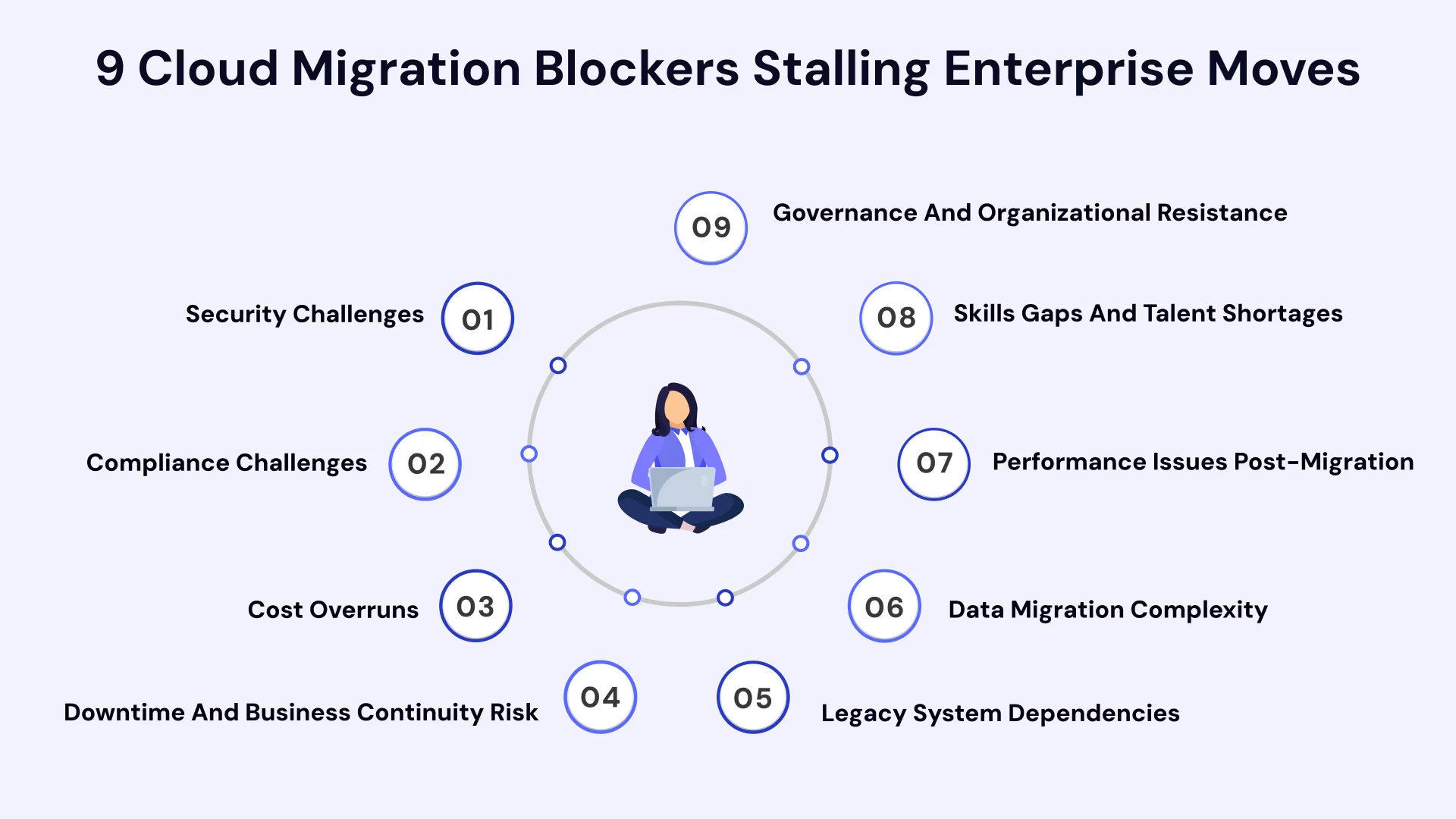
Here are the 9 primary cloud migration blockers organizations face and the actionable playbook to fix each one.
1. Security Challenges
The blocker: Cloud Migration Security Challenges are consistently among the top concerns for enterprises, especially around data exposure during transfer and misconfigured access controls in the new environment.
Why it happens: Security policies designed for on-premises infrastructure often don't translate directly to cloud environments, and teams sometimes migrate first, planning to "secure it later"; a habit that leaves gaps open during the transition window.
The fix: Build security architecture into the migration plan from day one, not after cutover. This means defining identity and access management, encryption standards, and network security policies before any workload moves, and validating them during testing rather than assuming they'll transfer automatically.
2. Compliance Challenges
The blocker: Cloud Migration Compliance Challenges arise when regulated data, healthcare records, financial information, or personally identifiable information needs to meet specific residency, audit, or handling requirements that aren't automatically satisfied by moving to the cloud.
Why it happens: Compliance requirements are sometimes treated as a legal or business concern separate from the technical migration plan, when in reality they directly shape where data can be stored and how it can be accessed.
The fix: Involve compliance and legal stakeholders during the assessment phase, not after migration. Mapping which applications and data sets carry regulatory requirements early lets the technical team design around those constraints instead of retrofitting compliance after the fact.
3. Cost Overruns
The blocker: Cloud Migration Cost Challenges are one of the most common post-migration surprises, with actual cloud spend frequently exceeding initial estimates.
Why it happens: Cost estimates are often based on matching on-premises specifications rather than actual usage patterns, leading to oversized (and overpriced) cloud resources. Ongoing cost monitoring also tends to get deprioritized once migration is technically "done."
The fix: Base sizing decisions on real usage data gathered during assessment, not on-premises specs. Build cost monitoring into the plan as an ongoing practice, not a one-time check, and revisit resource allocation regularly in the months after go-live.
4. Downtime and Business Continuity Risk
The blocker: Cloud Migration Downtime Risks are especially concerning for mission-critical applications that can't tolerate extended outages during cutover.
Why it happens: Migration windows are sometimes planned around convenience rather than actual business impact, or cutover happens all at once instead of in validated stages.
The fix: Stage migrations with continuous replication where possible, allowing validation before full cutover rather than an irreversible one-time switch. Sequence business-critical applications later in the migration plan, after the process has been proven on lower-risk workloads.
5. Legacy System Dependencies
The blocker: Older applications frequently connect to other systems in ways that aren't documented anywhere, and these hidden dependencies surface mid-migration, causing delays or broken functionality.
Why it happens: Legacy systems often predate current documentation standards, and the people who understood the original architecture may no longer be with the company.
The fix: Invest in thorough dependency mapping during discovery, using automated discovery tools rather than relying solely on existing documentation. Treat any undocumented legacy application as higher risk and budget extra time specifically for its assessment.
6. Data Migration Complexity
The blocker: Moving large volumes of data, especially from multiple, inconsistent sources, often takes longer and introduces more errors than teams expect.
Why it happens: Data quality issues that existed for years in on-premises systems (duplicate records, inconsistent formatting, outdated entries) become visible and problematic once data needs to be cleanly migrated and validated in a new environment.
The fix: Treat data cleanup as part of the migration project, not a separate task to handle later. Validate data integrity at multiple checkpoints during migration, not just at the very end, to catch issues while they're still easy to trace back to their source.
7. Performance Issues Post-Migration
The blocker: Cloud Migration Performance Issues sometimes appear only after go-live, when applications behave differently under cloud infrastructure than they did on-premises.
Why it happens: Performance testing before migration is often done in limited or non-production-like conditions, missing issues that only appear under real usage patterns and traffic loads.
The fix: Test migrated applications under conditions that closely mirror real production load, not just basic functionality checks. Monitor performance closely in the weeks immediately following go-live, when issues are most likely to surface.
8. Skills Gaps and Talent Shortages
The blocker: Cloud-native architecture, security configuration, and cost optimization require different skills than maintaining on-premises infrastructure, and many internal teams simply haven't built that expertise yet.
Why it happens: Cloud skills have historically been in high demand and short supply, and internal teams are often asked to manage migration on top of their existing responsibilities without dedicated time to build new expertise.
The fix: Be honest about internal skill gaps early, and bring in Cloud Migration Consulting Services or targeted training where needed, rather than assuming existing infrastructure skills will transfer directly to cloud environments.
9. Governance and Organizational Resistance
The blocker: Even technically sound migrations can stall when internal teams resist the change, or when there's no clear governance around decision-making, budget ownership, or security policy across departments.
Why it happens: Migration is often planned purely as a technical project, without involving the teams whose daily work will be affected, leading to pushback once changes start impacting how people actually work.
The fix: Build change management and clear governance structures into the project plan from the start; defining who owns which decisions, and communicating with affected teams early and often, rather than treating adoption as something that will happen automatically once the technical work is done.
Cloud Migration Risk Assessment: Catching Blockers Before They Happen
Most of the nine blockers above share something in common: they're far cheaper to fix during planning than after migration begins. This is why a structured Cloud Migration Risk Assessment matters so much before committing to a full migration plan.
A solid risk assessment typically evaluates:
- Application dependencies that could cause delays if missed.
- Data quality and volume that will affect migration complexity and timeline.
- Security and compliance requirements specific to each application or data set.
- Skills and resource availability within the internal dedicated team versus what the project actually requires.
- Business criticality and downtime tolerance for each application, which shapes migration sequencing.
Running this assessment early doesn't eliminate every risk, but it turns most of the nine blockers from surprises into known, planned-for challenges with a clear mitigation already in place.
Cloud Migration Success Factors: What Separates the Migrations That Work
Looking across migrations that avoid these nine blockers versus ones that don't, a few Cloud Migration success factors show up consistently:
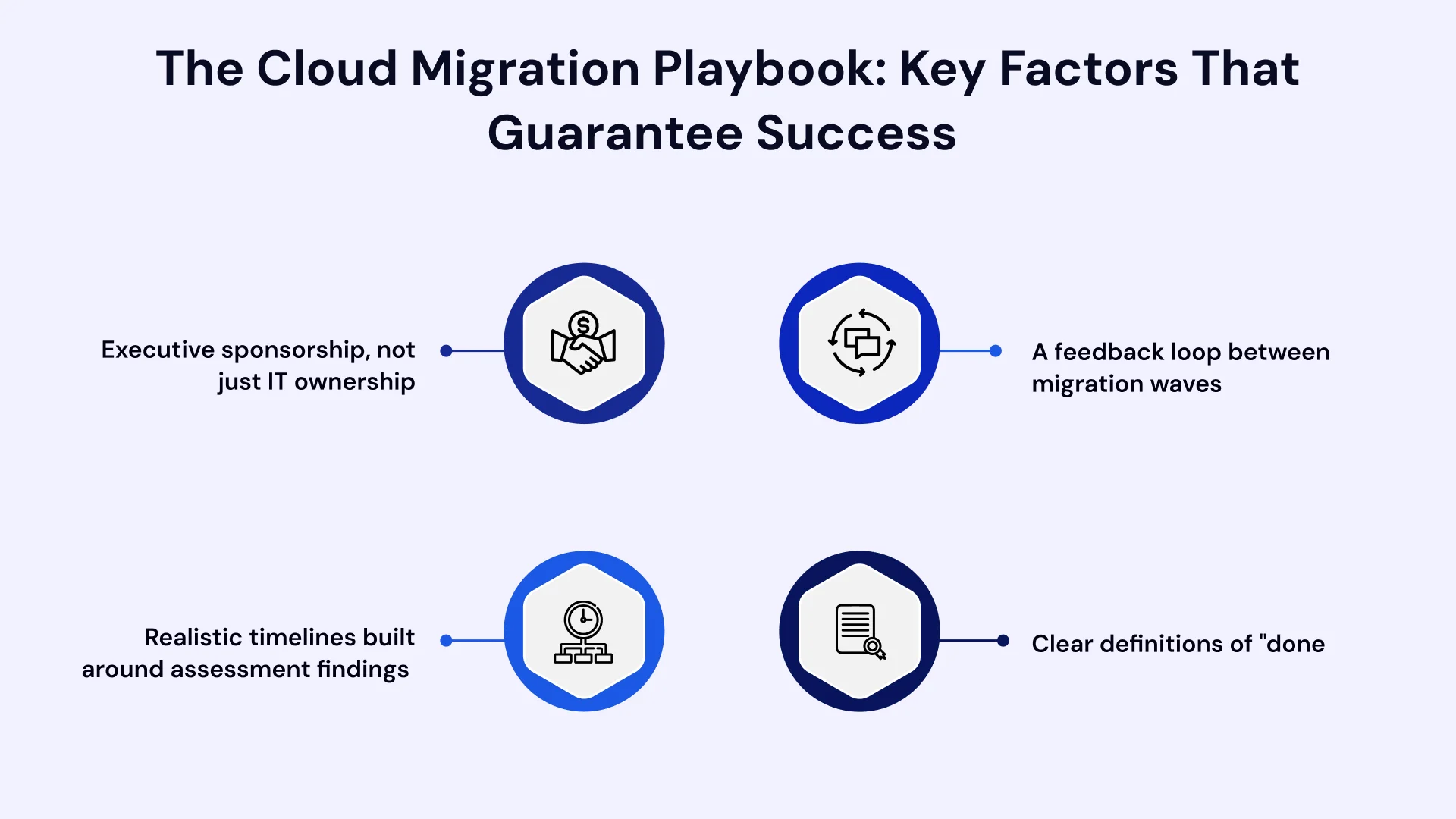
- Executive sponsorship, not just IT ownership. Migrations that succeed typically have leadership actively involved in resolving cross-department conflicts; budget disputes, competing priorities, compliance questions, rather than leaving the technical team to navigate business decisions alone.
- Realistic timelines built around assessment findings. Projects that succeed tend to set timelines after discovery and assessment are complete, not before, so the schedule reflects actual complexity rather than an initial guess made without full visibility into the environment.
- A feedback loop between migration waves. Enterprises running multi-wave migrations that succeed treat each wave as a learning opportunity; adjusting sequencing, resourcing, or risk mitigation based on what the previous wave revealed, rather than repeating the same plan regardless of outcome.
- Clear definitions of "done." Successful migrations define specific, measurable criteria for considering an application successfully migrated, performance benchmarks, security validation, and user acceptance, rather than treating cutover itself as the finish line.
Cloud Migration Failure Prevention, in practice, comes down to combining these success factors with the nine fixes outlined above: plan with real data, involve the right stakeholders early, sequence work around actual risk, and keep monitoring after go-live rather than assuming the project ends at cutover.
Enterprise Cloud Migration Challenges at Scale
Enterprise Cloud Migration introduces additional complexity beyond what smaller migrations face. A few things change at scale:
- More applications mean more compounding risk. A single missed dependency in a small migration is a minor issue; the same mistake repeated across dozens of applications in an enterprise migration compounds quickly into significant delays.
- Governance becomes non-negotiable. Enterprise Cloud Transformation initiatives typically span multiple departments, each with different priorities, making clear Cloud Migration Governance essential to avoid conflicting decisions mid-project.
- Hybrid environments add complexity. Many enterprises don't migrate everything to the cloud at once; Hybrid Cloud Migration, where some systems remain on-premises while others move, requires careful planning around how the two environments will communicate securely and reliably.
- Change management needs dedicated ownership. With more teams affected, informal communication isn't enough; enterprises typically need a dedicated change management function running alongside the technical migration.
Cloud Migration Best Practices to Avoid These Blockers
A few practices consistently reduce the likelihood of running into the challenges above:
- Never skip the assessment phase, even under deadline pressure; it's the single most effective way to catch blockers early.
- Involve security, compliance, and business stakeholders from the start, not just the technical team.
- Migrate in waves, starting with lower-risk applications to validate the process before critical systems move.
- Build cost monitoring and performance testing into the plan, not as afterthoughts once migration is "complete."
- Treat change management as part of the project, with clear communication to every team whose work will be affected.
When to Bring in Cloud Migration Consulting Services
Not every organization has the internal bandwidth or specialized experience to navigate all nine blockers alone, especially during large-scale or high-stakes cloud transformations. Partnering with Cloud Migration Consulting Services adds the highest value in the following scenarios:
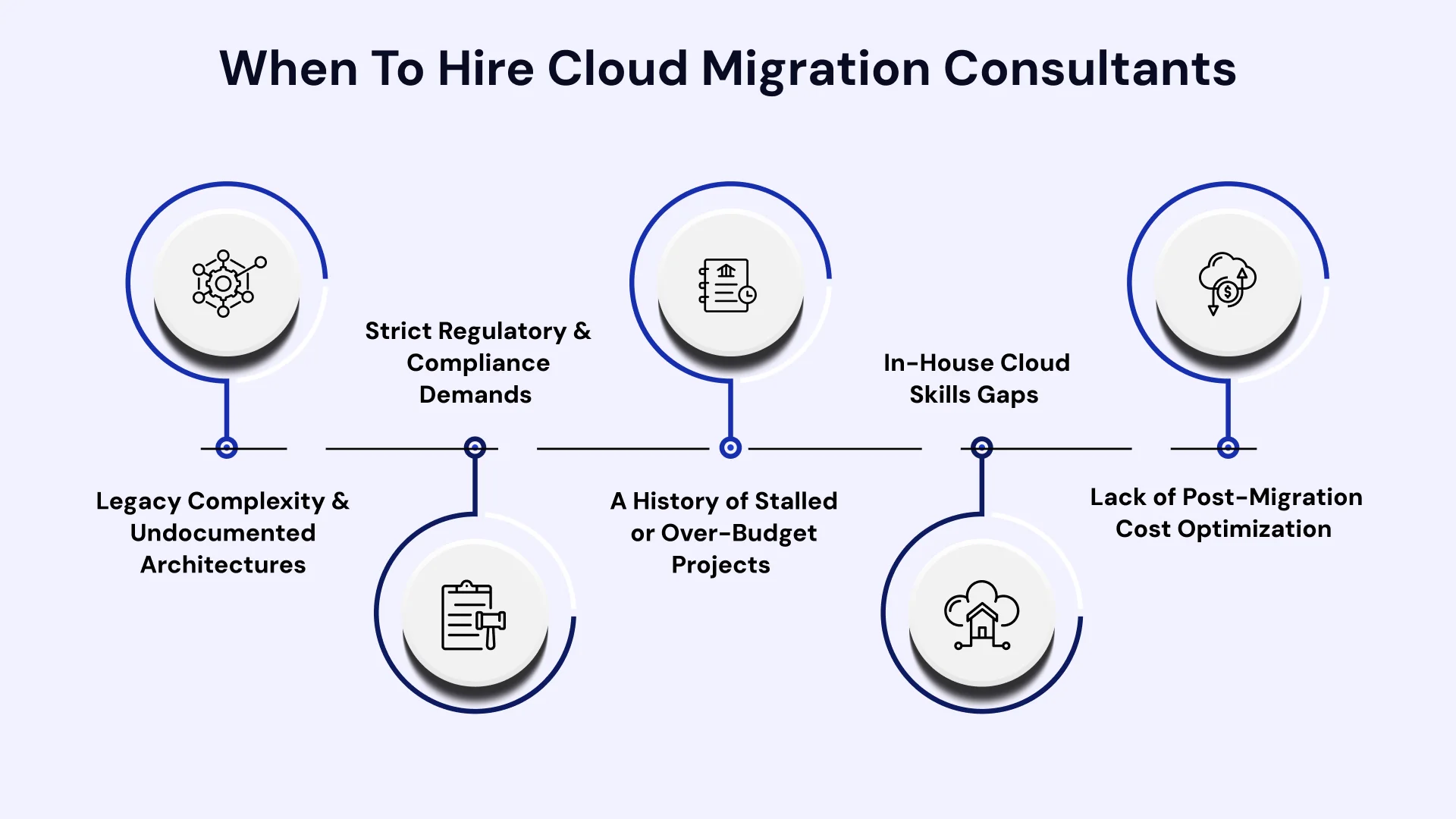
- Legacy Complexity & Undocumented Architectures: Your application portfolio is large, tightly coupled, or includes legacy software with missing or outdated dependency documentation.
- Strict Regulatory & Compliance Demands: You must navigate complex data residency, sovereignty, or industry compliance standards (e.g., HIPAA, GDPR, PCI-DSS) that your internal teams haven't configured in cloud environments before.
- A History of Stalled or Over-Budget Projects: Past migration attempts ran over schedule, exceeded budget estimates, or were quietly paused midway due to unanticipated technical roadblocks.
- In-House Cloud Skills Gaps: Your IT team excels at managing on-premises infrastructure but lacks hands-on experience in cloud-native architecture, automated refactoring, or multi-cloud security.
- Lack of Post-Migration Cost Optimization: Your organization needs proactive FinOps strategies and automated resource-sizing tools to prevent cloud spend from ballooning immediately after cutover.
A capable consulting partner shouldn't just move workloads; they should conduct a comprehensive risk assessment, pinpoint precisely which blockers threaten your specific environment, and stay actively engaged through testing, cutover, and post-migration optimization.
Leverage VLink's Expertise to Overcome Cloud Migration Challenges
Every one of these nine blockers is preventable with the right planning; but catching them requires experience across security, compliance, cost management, and organizational change, not just technical migration skills.
VLink's team runs a structured Cloud Migration Risk Assessment before any workload moves, mapping dependencies, compliance requirements, and business criticality so blockers are identified and planned for, not discovered mid-project.
Whether you're planning your first Cloud Migration Strategy or troubleshooting a stalled Enterprise Cloud Migration, explore VLink's cloud consulting services and cloud migration services to see how this risk-first approach applies to your environment.
In Summary
Cloud migration challenges aren't random; the same nine blockers show up across most enterprise migrations, from security and compliance gaps to cost overruns, legacy dependencies, and organizational resistance. What separates a smooth migration from a stalled one usually isn't luck; it's whether these risks were identified and planned for before migration started, or discovered the hard way mid-project.
A structured risk assessment, phased migration sequencing, and genuine attention to governance and change management address most of these blockers before they ever become a crisis. Whether you're managing a single application move or a company-wide cloud transformation, planning for these nine challenges upfront is what keeps a migration on schedule, on budget, and actually delivering the value it was meant to.
Ready to remove friction from your cloud journey? Contact the cloud experts at VLink today to schedule a personalized consultation. Whether you need a comprehensive risk evaluation, architecture redesign, or hands-on migration management, our certified experts are here to help you move forward with total confidence. Reach out now to get your migration roadmap moving smoothly.

Vice President, Strategy – VLink Inc.
Sambhavi Gopalakrishnan is the Vice President of Strategy at VLink Inc., bringing over a decade of experience in IT leadership, project implementation, and strategic growth. She possesses a strong foundation in technical project management and pre-sales, driving innovation and business transformation at VLink.

 Shivisha Patel