


The financial services industry stands at a critical crossroads. As digital transformation accelerates and customer expectations evolve, cloud migration has shifted from being a competitive advantage to an operational imperative. However, the path to the cloud is fraught with unique challenges that can make or break a financial institution's technology modernization efforts.
The stakes couldn't be higher for financial institutions. A single security breach during cloud migration can cost millions in regulatory fines, reputational damage, and customer attrition. Meanwhile, cloud migration projects in the financial sector have a 40% failure rate when proper risk mitigation strategies aren't implemented. With global cloud spending projected to reach $679 billion in 2024 and financial services accounting for a significant share of this investment, understanding how to reduce cloud migration risk for financial services has become a mission-critical competency for CTOs, CIOs, and technology leaders.
This comprehensive guide explores proven strategies for navigating the complex landscape of cloud migration services in financial services, covering everything from regulatory compliance and data security to vendor management and cost optimization. Whether you're planning your first cloud migration or refining an ongoing multi-cloud strategy, these insights will help you minimize risk while maximizing the transformational potential of cloud technology.

Understanding Cloud Migration Risks in Financial Services
Financial services organizations face a distinctly challenging risk profile when migrating to the cloud. Unlike other industries, banks, insurance companies, and investment firms operate under stringent regulatory frameworks, including PCI DSS, SOC 2, GDPR, and industry-specific requirements like FINRA and SOX compliance. These regulatory obligations create a multi-layered complexity that transforms cloud migration from a technical exercise into a comprehensive risk management challenge.
The risk-free cloud migration for the BFSI sector remains an aspiration rather than a reality, but understanding the specific threats enables more effective mitigation. Cloud adoption risks in banking and finance extend beyond traditional IT concerns to encompass operational resilience, data residency requirements, and the preservation of audit trails during transition periods.
Businesses evaluating Understanding Cloud Migration Risks in Financial Services should also consider cloud adoption trends for BFSI to improve execution quality, scalability, and long-term operational resilience.
Critical Categories of Cloud Migration Risk
Here are the critical categories of cloud migration risk you should keep on your radar:
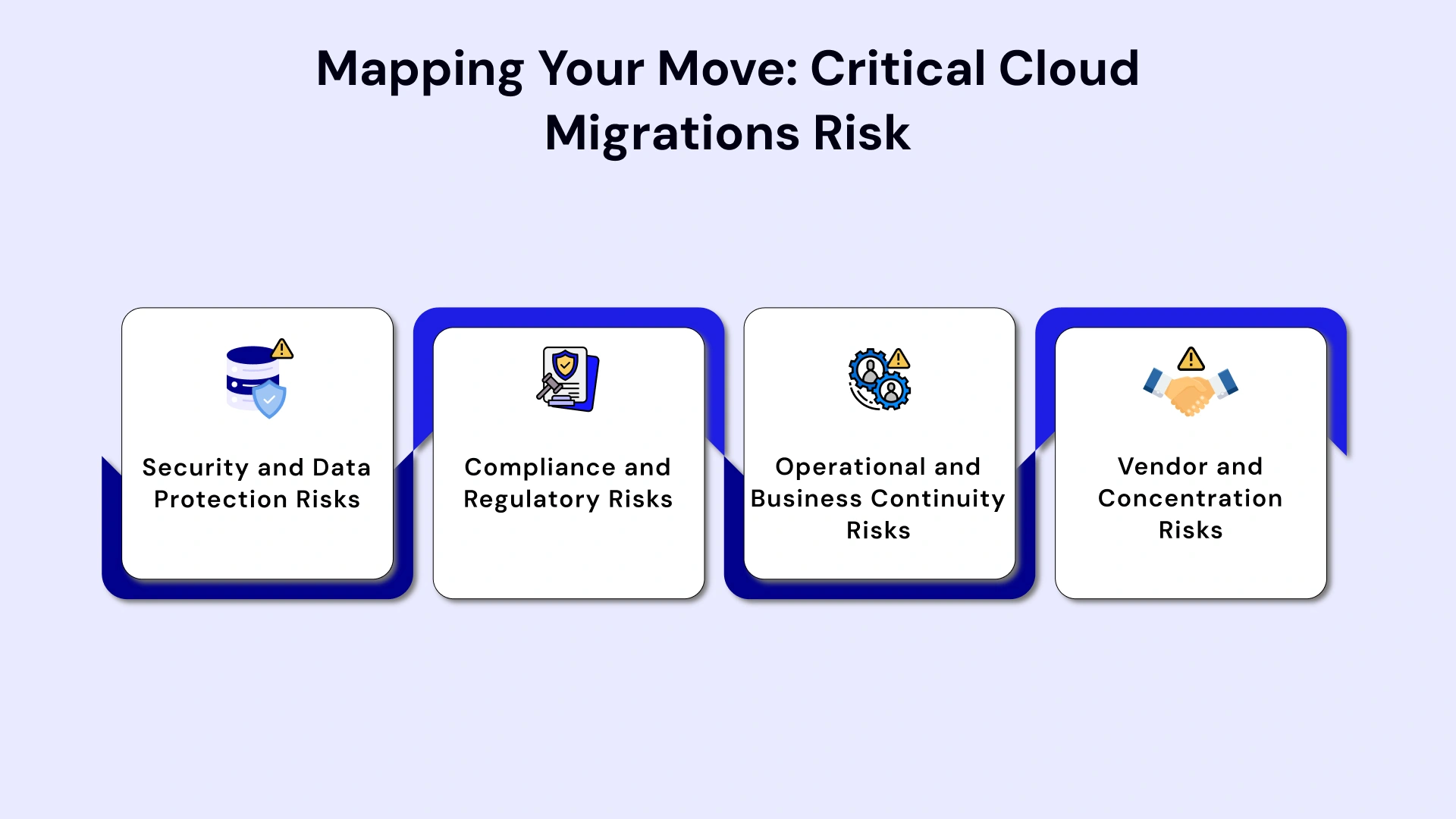
Security and Data Protection Risks
Financial services cloud security risks represent perhaps the most immediate concern for institutions considering cloud migration. Sensitive customer data, transaction records, and proprietary trading algorithms require protection levels that exceed standard enterprise security measures. The shared responsibility model of cloud computing introduces new vulnerabilities, particularly around identity and access management, encryption key management, and data loss prevention.
Cloud migration risks in financial services include the exposure of sensitive data during transfer, inadequate encryption, and misconfigured cloud storage that inadvertently exposes confidential information. The 2025 landscape shows that 45% of organizations experienced at least one cloud data breach in the previous 12 months, with financial services representing a disproportionate target for sophisticated threat actors.
Compliance and Regulatory Risks
Cloud migration compliance requirements for USA financial services continue to evolve, creating a moving target for institutions planning their cloud strategy. Different jurisdictions impose varying data residency requirements, making multi-region cloud deployments particularly complex for global financial institutions. BFSI cloud migration in the USA faces USA-specific challenges, including state-level privacy laws, federal banking regulations, and cross-border data transfer restrictions.
The cloud migration risk management framework must account for continuous compliance monitoring, automated audit trail generation, and the ability to demonstrate regulatory adherence across distributed cloud environments. Financial institutions must navigate cloud migration risk and PCI DSS requirements while simultaneously addressing industry-specific mandates that may conflict with standard cloud service provider offerings.
Operational and Business Continuity Risks
Cloud migration risk mitigation strategies must address potential service disruptions during transition periods. Financial software development services operate under strict uptime requirements, with even brief outages potentially triggering regulatory scrutiny and eroding customer trust. The complexity of legacy system integration, data migration challenges, and the need for parallel operation during cutover periods all contribute to operational risk.
Financial services cloud migration challenges include maintaining transaction processing capabilities during the transition, ensuring disaster recovery isn't compromised during the transition, and managing the cultural change required for teams accustomed to on-premises infrastructure management.
Vendor and Concentration Risks
Dependence on cloud service providers introduces concentration risk that regulators increasingly scrutinize. The risk-free cloud migration for financial institutions must address vendor lock-in concerns, exit strategy planning, and the systemic risk that widespread cloud adoption creates across the financial services ecosystem.
Cloud migration risk management requires careful vendor due diligence, contractual protections for data portability, and architectural decisions that preserve the flexibility to switch providers or repatriate workloads if necessary.
Strategic Framework: Cloud Migration Risk Mitigation Strategies
Migrating to the cloud is a high-stakes evolution. While the benefits of scalability and agility are clear, the "lift and shift" approach often fails because organizations underestimate the complexity of moving legacy data into a shared-responsibility environment.
To succeed, you need a framework that balances technical rigor with operational governance. Such as:-
Comprehensive Risk Assessment and Planning
Effective cloud migration risk mitigation strategies begin long before any workload moves to the cloud. A thorough risk assessment should identify all assets, classify data according to sensitivity levels, map regulatory requirements to specific systems, and evaluate the current security posture against cloud security standards.
The cloud migration risk checklist for financial institutions should include stakeholder alignment workshops to ensure business and technology leaders share an understanding of migration objectives, risk tolerances, and success criteria. This foundational work prevents the common pitfall of treating cloud migration purely as an infrastructure project rather than a business transformation initiative.
Developing Your Cloud Migration Roadmap
Securing the migration of financial data to the cloud begins with a phased approach that prioritizes workloads based on risk, complexity, and business value. Start with non-critical applications to build organizational competency before tackling core banking systems or trading platforms. This iterative approach allows teams to learn from early migrations and refine processes before addressing the highest-risk systems.
Cloud adoption risks in banking and finance diminish significantly when organizations invest in comprehensive planning. Allocate 20-30% of your overall migration timeline to planning and assessment activities. This front-loaded investment pays dividends through smoother execution and fewer costly surprises during implementation.
Building a Robust Governance Framework
Cloud migration compliance for financial institutions requires governance structures that transcend traditional IT management. Establish a Cloud Center of Excellence (CCoE) with representation from security, compliance, risk management, application development, and business units. This cross-functional team should define cloud policies, approve architectural patterns, and oversee the migration program.
The governance framework should address cloud migration risk management through clearly defined approval gates, mandatory security reviews before production deployment, and ongoing compliance monitoring that doesn't impede development velocity. Automated policy enforcement through infrastructure-as-code and cloud-native security tools helps scale governance without creating bottlenecks.
Security-First Architecture and Implementation
Secure cloud migration for financial institutions requires a zero-trust security model in which no user, device, or application is implicitly trusted. Implement micro-segmentation to limit lateral movement if perimeter defenses are breached, enforce multi-factor authentication for all access, and encrypt data both in transit and at rest using keys managed independently from the cloud provider.
Financial services cloud security risks diminish when organizations implement defense-in-depth strategies. Layer security controls across network, application, data, and identity planes. Utilize cloud-native security services while supplementing with specialized financial services security solutions that understand the unique compliance and risk requirements of your industry.
Best Practices for Cloud Migration in Financial Services
Data residency risks cloud financial services require careful attention to where data physically resides and how it moves between regions. Implement data classification schemes that automatically route different sensitivity levels to appropriate storage locations. Use cloud provider regions and availability zones strategically to meet both regulatory requirements and business continuity objectives.
How to reduce cloud migration risk in financial services includes implementing comprehensive logging and monitoring from day one. Every API call, data access, and configuration change should be logged to an immutable storage that supports forensic investigation and regulatory audit requirements. Real-time security monitoring with automated response capabilities helps detect and mitigate threats before they escalate into breaches.
Technical Implementation: Reducing Migration Risks
The technical implementation of a cloud migration strategy must prioritize observability and fault tolerance at every layer. In a banking environment characterized by complex legacy dependencies and strict requirements, risk mitigation is achieved through modularity—specifically, by decoupling services and automating data validation.
The following framework outlines a battle-tested approach to transitioning monolithic financial systems into resilient, cloud-native architectures.
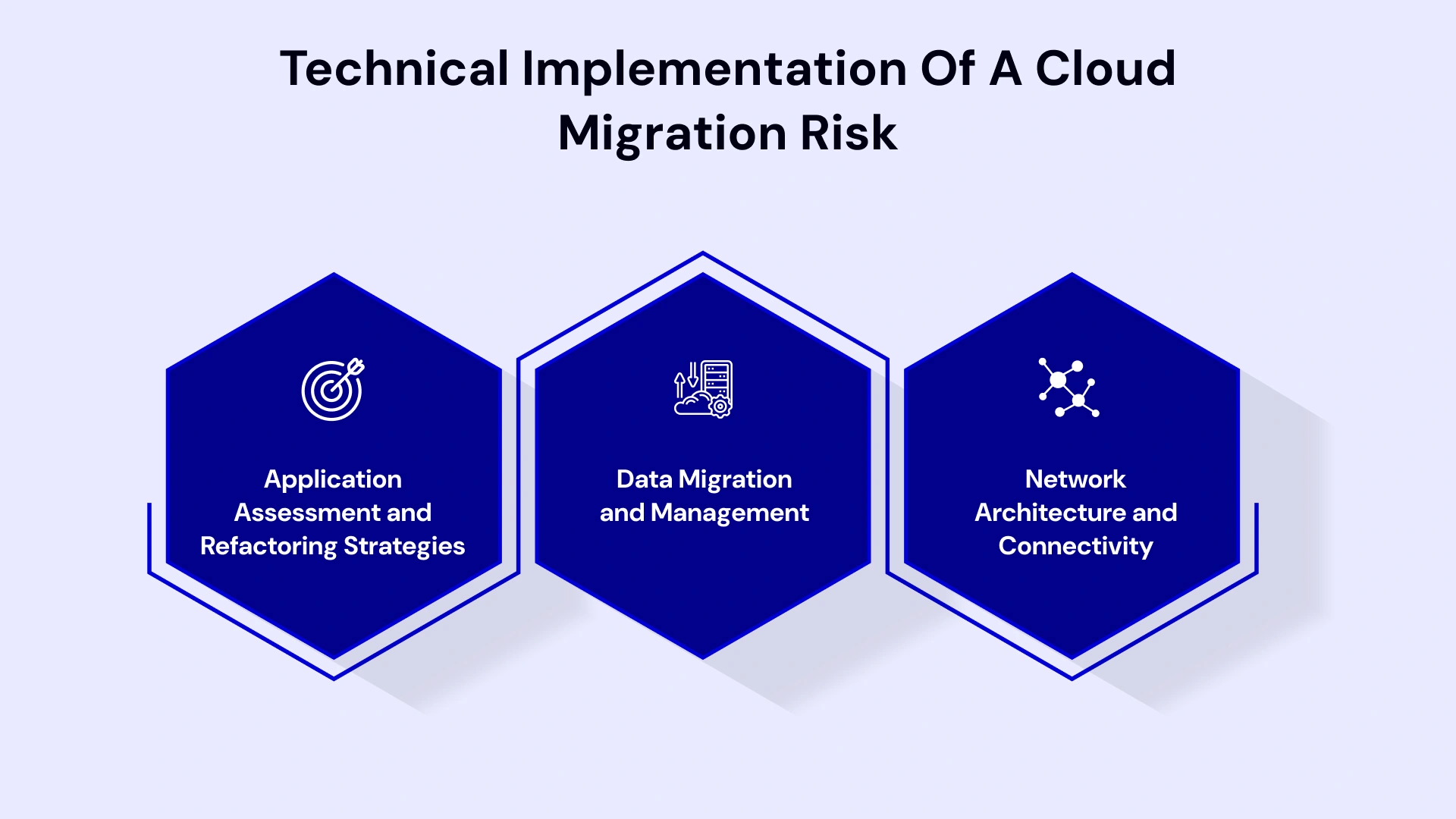
Application Assessment and Refactoring Strategies
What are the risks of cloud migration in banking? Begin with an honest assessment of application readiness for cloud deployment. Legacy applications built for on-premises environments often require significant refactoring to function optimally in cloud environments. The 6 Rs of cloud migration—rehost, replatform, repurchase, refactor, retire, and retain—provide a framework for making these decisions.
Financial services cloud migration challenges often center on monolithic core banking systems or trading platforms with complex dependencies. A strangler fig pattern that gradually replaces functionality with cloud-native services while maintaining the legacy system in parallel can reduce risk compared to big-bang migration approaches.
Cloud migration risk mitigation strategies should include training development teams in cloud-native architectures. Microservices, containerization, and serverless computing offer advantages in scalability, resilience, and cost optimization, but require different design patterns than traditional application development.
Financial services organizations benefit from establishing reference architectures and approved technology stacks that incorporate security, compliance, and operational best practices. This standardization accelerates development while ensuring consistent risk management across all cloud-deployed applications.
Data Migration and Management
Securing the migration of financial data to the cloud requires meticulous planning for data classification, migration tools, validation procedures, and rollback capabilities. Large-scale data migrations should occur in phases with comprehensive testing at each stage. Use encryption in transit, validate data integrity with checksums, and maintain parallel systems until you have full confidence in the migrated environment.
Data residency risks cloud financial services necessitate clear data governance policies that specify where different data types can be stored, how long they must be retained, and under what circumstances they can be moved between regions. Implement automated controls that enforce these policies programmatically rather than relying on manual processes.
Cloud migration often presents opportunities to modernize database platforms, moving from legacy relational databases to cloud-native database services or adopting polyglot persistence strategies. However, these changes introduce risks related to data model changes, query performance, and transaction semantics.
Best practices for cloud migration in financial services include extensive performance testing before cutover, especially for transaction-intensive systems where database performance directly impacts customer experience. Maintain database migration rollback procedures and practice executing them before go-live dates.
Network Architecture and Connectivity
Financial services cloud migration challenges include designing hybrid network architectures that connect on-premises systems to cloud resources while ensuring appropriate security and performance. Direct connect services from major cloud providers offer dedicated, private connectivity that reduces exposure compared to internet-based connections.
Secure cloud migration for financial institutions requires network segmentation that isolates workloads by sensitivity level, implements east-west traffic inspection, and provides defense-in-depth against network-based attacks. Software-defined networking capabilities in cloud platforms enable dynamic adjustments to security posture based on threat intelligence and risk levels.
Compliance and Regulatory Considerations in Cloud Migration
While cloud providers offer robust infrastructure, the 'Shared Responsibility Model' means the burden of compliance still rests with you. Here are the critical regulatory factors you must evaluate to ensure a secure and lawful transition.
Navigating the Regulatory Landscape
Cloud migration compliance in the USA financial services encompasses a complex web of federal regulations, state laws, and industry-specific requirements. The Bank Secrecy Act, the Gramm-Leach-Bliley Act, and state privacy laws such as the California Consumer Privacy Act impose obligations on how financial institutions handle customer data in cloud environments.
Cloud migration compliance for financial institutions requires maintaining comprehensive documentation of data flows, processing activities, and third-party relationships. Cloud service providers operate as service providers under most financial regulations, triggering due diligence and ongoing monitoring obligations that extend beyond technical security assessments.
Audit Trail and Evidence Management
Financial services cloud migration challenges include maintaining audit trails that meet regulatory examiner expectations. Cloud environments generate vast quantities of log data, but organizations must implement systems that correlate events across distributed systems, preserve logs in tamper-evident formats, and enable rapid retrieval for audit and investigation.
Cloud migration risk management includes implementing centralized log aggregation with long-term retention that meets or exceeds regulatory requirements. Many financial regulations require seven-year retention periods, making cost-effective long-term storage and retrieval capabilities essential considerations in cloud architecture design.
Third-Party Risk Management
Cloud migration risk mitigation strategies must address the expanded third-party risk surface created by cloud adoption. Beyond the primary cloud service provider, typical cloud deployments involve dozens of third-party services for security monitoring, identity management, data integration, and specialized functionality.
Banking cloud migration risk US frameworks require due diligence processes that evaluate third-party security controls, financial stability, regulatory compliance, and business continuity capabilities. The concentration risk posed by multiple financial institutions using the same cloud platforms and third-party services is a systemic concern that regulators increasingly scrutinize.
Contractual Protections and SLA Management
A cloud migration risk checklist for financial institutions should include a legal review of cloud service agreements, with particular attention to data ownership, portability provisions, regulatory compliance support, and liability limitations. Standard cloud service agreements often contain provisions incompatible with financial services regulatory requirements, necessitating negotiated modifications.
Financial services cloud migration challenges include ensuring service level agreements align with business requirements for uptime, performance, and support responsiveness. Monitor SLA compliance actively and establish escalation procedures for when cloud providers fail to meet contractual commitments.

Cost Management and Optimization in Cloud Migration Projects
Cloud scalability is a double-edged sword: it’s easy to spin up resources, but just as easy to forget them. Managing your cloud spend requires a proactive blend of automated tools, clear visibility, and architectural discipline. Such as:-
Avoiding Budget Overruns
Cloud migration projects in financial services frequently exceed budget due to underestimated complexity, scope creep, and inadequate cloud cost management practices. The 83% of organizations experiencing unexpected cloud costs often failed to implement proper cost governance from the outset.
Financial services cloud migration challenges around cost management stem from the consumption-based pricing model, which fundamentally differs from traditional capital expenditure for infrastructure. Without active management, cloud costs can spiral as developers provision resources without consideration for ongoing operational expenses.
Cloud Cost Optimization Strategies
Best practices for cloud migration in financial services include implementing FinOps practices that bring financial accountability to variable cloud spending. Establish cost allocation tags that map cloud resources to business units, applications, and projects. Deploy automated policies that shut down non-production resources outside business hours and right-size instances based on actual utilization patterns.
How to reduce cloud migration risk in financial services also includes financial risk mitigation through reserved instance purchases that lock in discounted pricing for predictable workloads, using spot instances for batch processing, and negotiating enterprise discount agreements with cloud providers based on committed spending levels.
Total Cost of Ownership Analysis
Cloud adoption risks in banking and finance include incomplete total cost of ownership calculations that overlook hidden costs of cloud migration and operation. Beyond infrastructure costs, factor in expenses for cloud management tools, specialized skills training, security solutions, compliance monitoring, and the ongoing effort required to optimize cloud spending.
Cloud migration risk management requires an honest assessment of whether anticipated cloud cost savings will materialize for your specific workload patterns. While cloud computing offers compelling economics for variable workloads and eliminates capital expenditure for infrastructure, some steady-state enterprise workloads may prove more expensive in cloud environments than on-premises alternatives.
Organizational Change Management in Cloud Migration
Change often breeds apprehension, and a shift to the cloud can disrupt long-standing workflows and job descriptions. To prevent internal friction from stalling your progress, leadership must prioritize the strategies mentioned below.
Building Cloud Competency
Financial services cloud migration challenges extend beyond technology to organizational culture and skills. Traditional infrastructure teams accustomed to physical hardware and manual processes must develop proficiency in infrastructure-as-code, automated deployment pipelines, and cloud-native operational practices.
Cloud migration risk mitigation strategies should include comprehensive training programs that address both technical skills and the cultural shift toward DevOps practices, continuous delivery, and acceptance of managed services that reduce direct control. Resistance to change represents a significant risk factor in cloud migration success.
Talent Acquisition and Retention
Secure cloud migration for financial institutions requires specialized skills that remain in high demand across industries. Competition for cloud architects, security engineers, and DevOps practitioners creates retention challenges and salary pressures. Consider building partnerships with cloud providers for training and certification programs that develop internal talent while reducing dependence on expensive consultants.
How to reduce cloud migration risk for financial services includes acknowledging the people dimension of cloud transformation. Allocate sufficient budget for training, create career paths that reward the development of cloud expertise, and celebrate early wins to build momentum for broader organizational adoption.
Stakeholder Communication and Alignment
Cloud migration risk management succeeds when business and technology leaders maintain alignment throughout the migration journey. Regular executive updates that translate technical progress into business outcomes help sustain support during inevitable challenges.
Financial services cloud migration challenges often emerge from misaligned expectations between stakeholders. Technology teams focused on architectural purity may clash with business units that demand rapid delivery of functionality, while risk management functions prioritize security and compliance over speed. Effective governance structures that balance these competing interests while maintaining forward momentum prove essential.
Testing and Validation Strategies for Cloud Migration
You can't manage what you don't measure. In the cloud, testing is an iterative process that begins with pre-migration benchmarking and ends with post-migration validation to prove that the new system is faster, more secure, and fully operational.
Comprehensive Testing Frameworks
Best practices for cloud migration in financial services require rigorous testing that extends beyond typical application testing. Beyond functional testing, cloud migrations require performance testing under production load conditions, disaster recovery testing to validate failover procedures, security testing to attempt to exploit cloud-specific vulnerabilities, and compliance testing to verify the completeness of the audit trail.
A cloud migration risk checklist for financial institutions should include parallel-running periods in which migrated systems operate alongside legacy systems while processing real transactions. This approach, while expensive, dramatically reduces cutover risk by providing validated rollback options and building confidence before final transition.
Financial services cloud migration challenges include ensuring cloud-based systems meet performance requirements for transaction processing, real-time analytics, and customer-facing applications. Cloud infrastructure introduces variables around network latency, storage performance, and compute capabilities that differ from on-premises environments.
Cloud migration risk mitigation strategies incorporate realistic load testing using production-like data volumes and transaction patterns. Test autoscaling configurations to ensure they respond appropriately to demand spikes, validate database performance under concurrent access patterns, and identify bottlenecks before they impact customers.
Security Testing and Validation
Secure cloud migration for financial institutions requires specialized security testing that addresses cloud-specific attack vectors. Penetration testing should evaluate cloud configurations, identity and access management policies, and API security. Automated security scanning tools should run continuously, flagging configuration drift from approved baselines and identifying newly discovered vulnerabilities.
Financial services cloud security risks necessitate red team exercises that simulate real-world attacks against cloud defenses using tactics observed in attacks against financial institutions. These realistic scenarios test incident response procedures, detection capabilities, and the effectiveness of security controls under adversarial conditions.
Post-Migration Optimization and Continuous Improvement
Post-migration success hinges on a fundamental shift: viewing cloud management as an ongoing evolution rather than a completed project. By integrating intelligent automation with rigorous financial and security governance, financial institutions can maintain a lean, high-availability environment. This proactive approach ensures that cloud infrastructure scales seamlessly while remaining strictly aligned with stringent regulatory requirements.
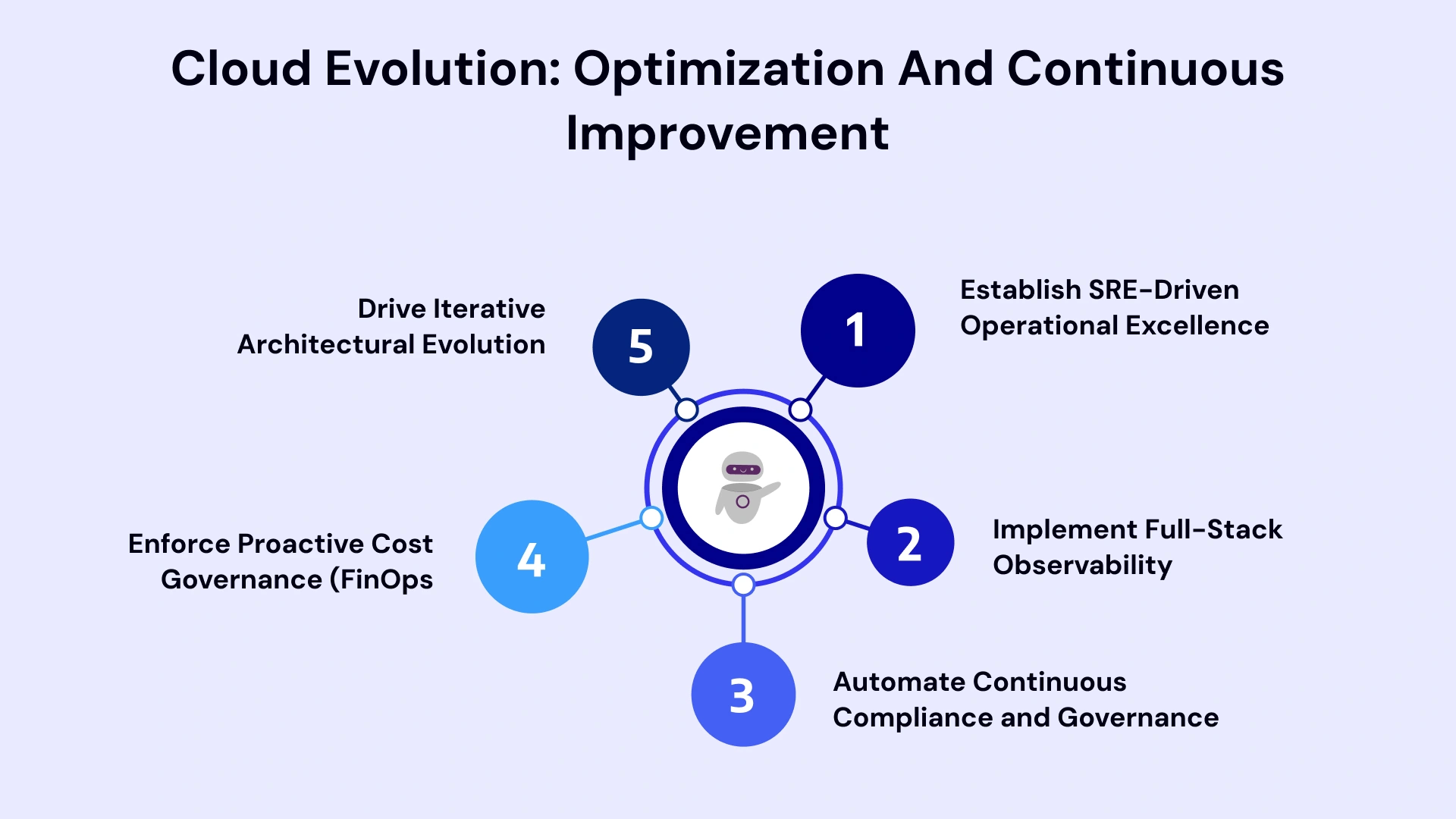
- Establish SRE-Driven Operational Excellence: Transition from traditional support to Site Reliability Engineering (SRE). By applying software engineering principles to operations, you can automate repetitive "toil," manage stability through error budgets, and ensure innovation speed doesn't compromise system reliability.
- Implement Full-Stack Observability: Move beyond basic monitoring to a comprehensive observability framework. This provides deep visibility into application behavior and infrastructure performance, allowing teams to proactively detect and resolve issues across distributed cloud environments before they impact the user experience.
- Automate Continuous Compliance and Governance: Replace point-in-time audits with real-time compliance monitoring. Use cloud-native tools to automatically evaluate configurations against regulatory standards (like PCI-DSS or SOC2), ensuring that "tamper-evident" logs and audit artifacts are always ready for examiner review.
- Enforce Proactive Cost Governance (FinOps): Mitigate "cloud sprawl" by integrating continuous financial management. This includes automated right-sizing to match resources to actual demand and implementing policies to decommission orphaned assets, ensuring the cloud remains cost-effective as it scales.
- Drive Iterative Architectural Evolution: Maintain a competitive edge by regularly evaluating new cloud services. Continuous improvement involves assessing whether emerging technologies or serverless managed services offer better price-performance ratios than your initial "lift-and-shift" architecture.
Emerging Trends and Future Considerations
The rapid evolution of cloud technology requires financial institutions to look beyond immediate migration goals and anticipate shifts in the regulatory and technical landscapes. Proactive adoption of these trends ensures long-term resilience and competitive advantage.
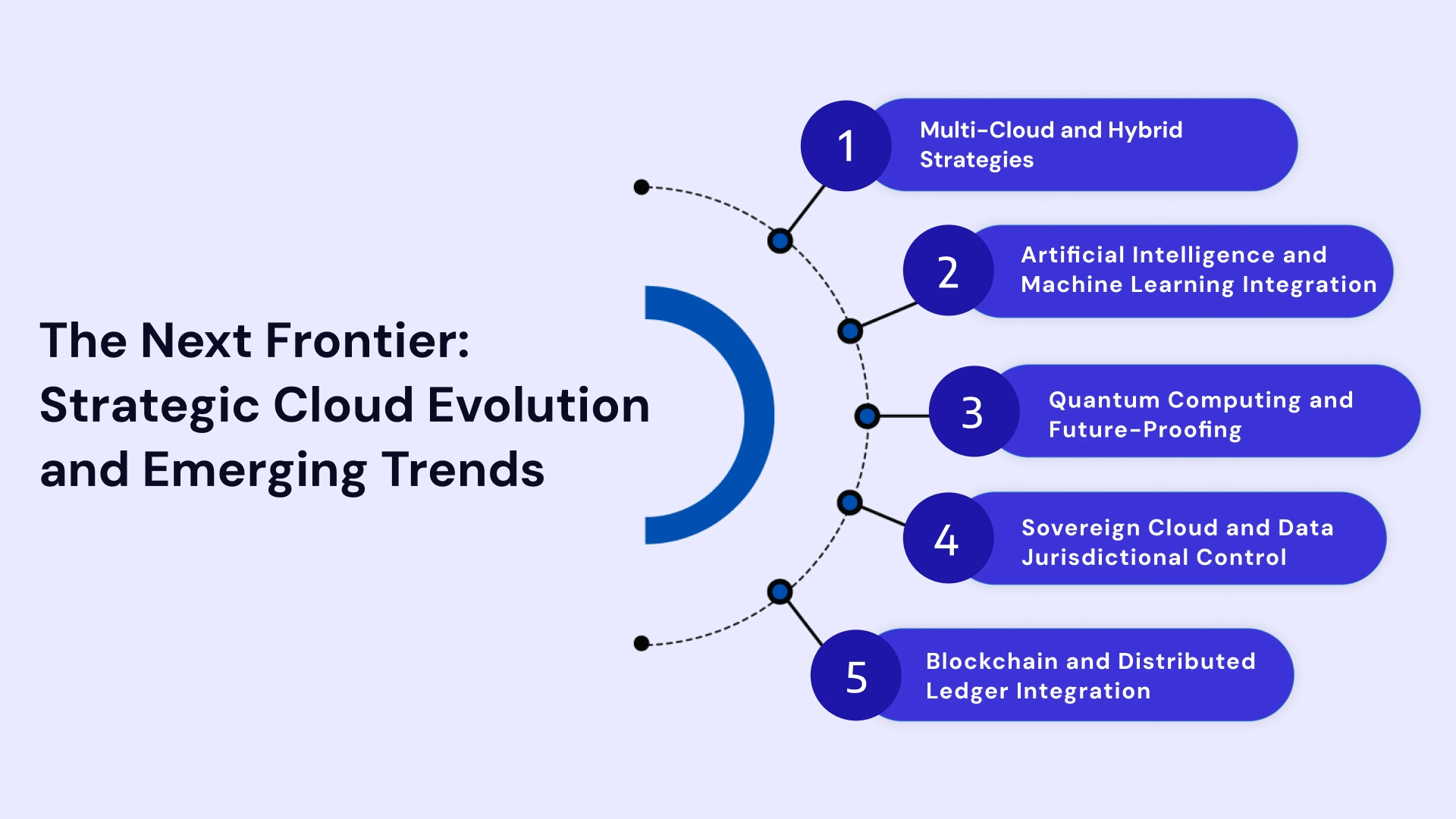
Multi-Cloud and Hybrid Strategies
Organizations are increasingly adopting multi-cloud architectures to distribute workloads, reducing concentration risk and avoiding vendor lock-in while leveraging specialized provider capabilities. However, this approach introduces significant complexity in cross-platform tooling and operational consistency.
Financial services must address the challenge of maintaining unified security policies and visibility across disparate environments. To succeed, firms should carefully weigh the benefits of risk diversification against the increased operational overhead of managing multiple platforms.
Artificial Intelligence and Machine Learning Integration
Cloud-native AI and ML tools are transforming fraud detection and customer personalization, providing financial firms with a decisive edge in data processing. Despite these benefits, AI workloads introduce unique risks regarding data privacy, algorithmic bias, and model transparency.
Establishing robust AI governance frameworks is essential before deployment. Best practices include rigorous model validation and bias testing to ensure that automated decisions remain explainable to both customers and regulatory bodies.
Quantum Computing and Future-Proofing
While quantum computing is still an emerging field, its potential to break current encryption standards poses a long-term threat to the security of financial data. Forward-thinking institutions are now exploring "cryptographic agility" within their cloud frameworks.
Cloud migration planning should include the ability to rapidly update encryption algorithms as new threats emerge. By designing for future tech disruptions today, firms can ensure their cloud architectures remain secure in a post-quantum world.
Sovereign Cloud and Data Jurisdictional Control
Rising global demand for digital sovereignty is pushing financial firms toward sovereign cloud solutions that ensure data remains within specific legal jurisdictions. This ensures compliance with local laws such as GDPR and DORA while preventing unauthorized extraterritorial access.
The challenge lies in balancing localized control with the scalability of global cloud providers. Organizations must implement automated "Policy-as-Code" to ensure data residency requirements are met without sacrificing the speed of cloud operations.
Blockchain and Distributed Ledger Integration
Financial institutions are bridging the gap between legacy systems and decentralized finance (DeFi) by using cloud-based blockchain-as-a-service. This convergence facilitates faster settlements and more transparent trade finance via smart contracts.
To mitigate integration risks, firms should adopt "chain-agnostic" architectures that allow for flexibility between different blockchain protocols. Success depends on ensuring seamless interoperability between decentralized components and existing core banking systems.
Leverage VLink Expertise for Cloud Migration Services
Successfully navigating the complexities of cloud migration in financial services requires more than best practices and frameworks—it demands deep expertise, proven methodologies, and a partner who understands your industry's unique risk landscape.
VLink brings specialized experience in cloud migration for financial services, combining technical excellence with a deep understanding of regulatory requirements. Our dedicated team has successfully guided numerous financial institutions through secure, compliant cloud transformations that delivered measurable business value while mitigating the risks that derail many migration initiatives.
Our comprehensive Cloud Migration Services encompass end-to-end support from initial assessment through post-migration optimization. We employ battle-tested frameworks designed for the financial services sector to address PCI DSS compliance, data residency requirements, and the stringent security controls your institution demands.
VLink's approach goes beyond infrastructure migration to deliver true cloud transformation. We help you modernize applications through our Financial Software Development Services, leveraging cloud-native architectures that enhance agility, scalability, and resilience while maintaining the security and compliance posture your regulators expect.
Don't let cloud migration risks prevent your institution from realizing the transformative potential of cloud technology. Partner with our experts who have successfully navigated these challenges and can guide your organization through a risk-mitigated cloud journey that delivers lasting competitive advantage.
Our proven methodology reduces time-to-value, minimizes operational disruption, and ensures your cloud environment meets the highest standards of security and compliance from day one. We become an extension of your team, bringing specialized skills that complement your internal capabilities and accelerate your cloud maturity.

Conclusion: Charting Your Path to Secure Cloud Migration
Cloud migration in financial services represents one of the most significant technology transformations organizations undertake. The risks are real and consequential, but they are manageable when approached with appropriate expertise, planning, and risk mitigation strategies.
The financial services industry has reached an inflection point where cloud adoption is no longer optional. Customer expectations, competitive pressures, and operational efficiency demands make cloud migration an imperative for institutions seeking to thrive in the digital economy. The question has shifted from whether to migrate to the cloud to how to execute migration in a manner that minimizes risk while maximizing value.
Success requires acknowledging the unique challenges financial institutions face—stringent regulatory requirements, sophisticated threat actors targeting financial data, operational resilience demands, and the concentration risks that widespread cloud adoption creates across the financial ecosystem. Yet thousands of financial institutions have successfully navigated this journey, proving that with proper planning and execution, the benefits of cloud migration outweigh the risks.
The strategies outlined in this guide—comprehensive risk assessment, security-first architecture, robust governance frameworks, careful vendor management, and continuous optimization—provide a roadmap for cloud migration that addresses the full spectrum of financial services risk concerns. Organizations that invest in upfront planning, build cloud competency within their teams, and maintain discipline around security and compliance throughout the migration journey position themselves for success.
As you embark on or continue your cloud migration journey, remember that cloud transformation is a marathon, not a sprint. The most successful migrations take a phased approach that builds organizational capability incrementally, learns from early wins and setbacks, and maintains flexibility to adapt as cloud technologies and business requirements evolve.
The cloud promises unprecedented agility, scalability, and innovation potential for financial services organizations. By understanding and actively managing the risks inherent in cloud migration, your institution can unlock this potential while maintaining the security, compliance, and operational resilience your customers and regulators demand.

Vice President, Strategy – VLink Inc.
Sambhavi Gopalakrishnan is the Vice President of Strategy at VLink Inc., bringing over a decade of experience in IT leadership, project implementation, and strategic growth. She possesses a strong foundation in technical project management and pre-sales, driving innovation and business transformation at VLink.

 Shivisha Patel