


Cloud migration in 2026 looks nothing like it did five years ago. It's no longer a matter of copying virtual machines from a data center into a single public cloud. Today's enterprise migrations involve orchestrating multi-cloud ecosystems, embedding AI workloads into the architecture, and satisfying data sovereignty laws that vary by region, industry, and customer base.
That added complexity is exactly why so many migrations stall or blow past budget. The pattern is consistent: hidden application dependencies surface mid-cutover, security controls get mapped too late, and cost forecasts fall apart within the first quarter of go-live. None of that is inevitable; it happens when migration is treated as a single event instead of a structured program.
This cloud migration checklist for enterprises breaks the process into four predictable phases — Assessment, Landing Zone Design, Execution, and Optimization — so your team, your board, and your security function can move forward with clarity instead of guesswork.
Why Enterprise Cloud Migration Checklists Matter More in 2026
A few shifts have made a rigorous cloud migration readiness checklist essential rather than optional:

- Multi-cloud is the default, not the exception. Enterprises increasingly run workloads across AWS, Azure, and Google Cloud simultaneously, each with different governance models.
- AI workloads change infrastructure requirements. GPU provisioning, data pipeline architecture, and model hosting all need to be planned into the migration, not bolted afterward.
- Data sovereignty laws are tightening globally. Where data physically resides now carries direct legal and compliance weight.
- Boards expect predictable ROI. CIOs and CFOs are under pressure to justify multi-million-dollar architectural pivots with hard numbers, not optimism.
A checklist-driven approach turns an intimidating cloud migration into a series of manageable, auditable phases through expert cloud advisory and cloud consulting services; which is exactly what stakeholders from finance to security need to see.
Overview: -
Driver | The 2026 Shift | Operational Impact |
Multi-Cloud Complexity | Running across AWS, Azure, and Google Cloud is now the default enterprise standard. | Fragmented governance models across providers create severe security blind spots if unaligned. |
AI Infrastructure Demands | Generative AI and ML workloads require massive GPU capacity and specialized data pipelines. | Resource requirements must be architected from day one; bolting them on later leads to massive re-engineering. |
Stringent Data Sovereignty | Global data residency regulations carry severe legal and financial penalties for non-compliance. | Physical data locations and cross-border transfers require strict, infrastructure-level compliance mapping. |
Board-Level Scrutiny | Executive leadership and CFOs demand hard financial metrics, not vague promises of agility. | Every architectural pivot must be backed by accurate TCO modeling and rapid, predictable ROI. |
The Step-by-Step Enterprise Cloud Migration Framework
Executing a seamless cloud transformation requires turning abstract architecture goals into an actionable execution path. Below is the complete, phase-by-phase framework engineered to take your enterprise from initial workload discovery to live multi-cloud deployment without operational disruption.
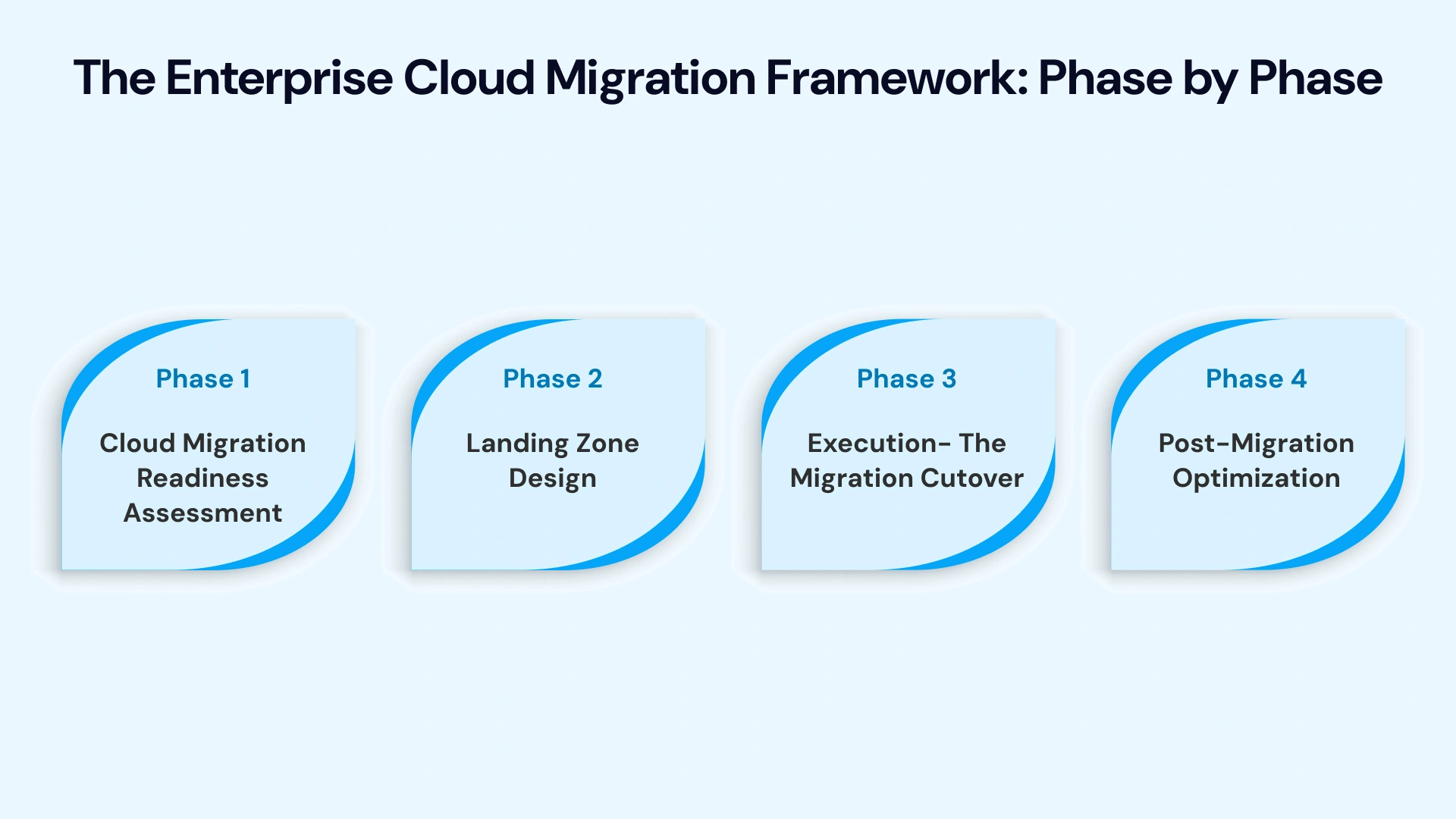
Phase 1: Cloud Migration Readiness Assessment
Everything downstream depends on how thorough this phase is, which is why leveraging specialized cloud migration services during assessment is critical to uncovering hidden architectural risks. Skipping or rushing into the assessment phase remains the single biggest predictor of a troubled enterprise migration.
1.1 Inventory Every Application and Dependency
Build a complete inventory of applications, databases, and infrastructure, including the informal integrations nobody documented. Application dependency mapping tools surface hidden connections between systems that, if missed, cause the downtime enterprises to fear most during cutover.
1.2 Run a Cloud Migration Security Checklist Pass
Before committing to an architecture, map every workload against your compliance obligations- GDPR, HIPAA, SOC 2, and any industry-specific frameworks. This is where CISOs identify gaps in encryption standards, access boundaries, and audit logging requirements early enough to design them.
1.3 Classify Workloads Using the 7Rs Framework
For enterprise architects managing thousands of legacy microservices, the 7Rs give a decision framework for what happens to each workload:
- Rehost: Move as-is for speed, minimal risk.
- Replatform: Apply light optimizations without full redesign.
- Refactor: Rebuild for cloud-native scalability.
- Repurchase: Replace with a SaaS equivalent.
- Retire: Decommission unused or redundant systems.
- Retain: Keep on premises for compliance or technical reasons.
- Relocate: Move to cloud infrastructure without re-architecting (common for VMware-based estates).
1.4 Build a Preliminary TCO Model
FinOps leads should build an early total cost of ownership model comparing current infrastructure spend against projected cloud run costs, including often-overlooked line items like data egress fees, licensing changes, and reserved capacity commitments.
Phase 2: Landing Zone Design
A landing zone is the pre-configured, secure environment your workloads will actually move into. Getting this wrong means retrofitting governance after workloads are already live; it is a far more expensive and disruptive fix.
2.1 Design for Multi-Cloud Governance
VPs of Cloud and Infrastructure need landing zones that enforce consistent policy, tagging, and network segmentation whether workloads sit in one hyperscale or several. This also protects against vendor lock-in by keeping architecture decisions portable where possible.
2.2 Establish Unified Identity and Access Management
Fragmented IAM across hybrid boundaries is one of the most common security gaps during migration. Standardizing identity governance before workloads moves rather than after closing the window where misconfigured access controls are most likely to be exploited.
2.3 Bake in Data Sovereignty Controls
Landing zones should encode data residency requirements at the infrastructure level, ensuring workloads automatically deploy to compliant regions rather than relying on manual enforcement after the fact.
2.4 Plan for AI Workload Requirements
If AI initiatives are on the roadmap, the landing zone needs to account for GPU-backed compute, data pipeline throughput, and model governance from the start, rather than requiring a second redesign later.
Phase 3: Execution- The Migration Cutover
This is where the plan meets reality; a successful cloud migration strategy ensures execution happens in structured waves rather than a single risky cutover event.
3.1 Start with a Pilot Migration
Choose a low-risk, non-critical workload to validate your process, tooling, and landing zone configuration before scaling. This is where most configuration issues surface while the blast radius is still small.
3.2 Migrate in Dependency-Aware Waves
Group workloads by their mapped dependencies, not just by business units. Migrating an application before its database or authentication dependency is a common cause of avoidable downtime.
3.3 Maintain Rollback Readiness
Every wave needs a validated rollback plan. Live replication tools let teams keep source systems available until cutover is confirmed to be stable, minimizing risk to mission-critical operations.
3.4 Validate Security Controls Post-Cutover
Re-run your cloud migration security checklist immediately after each wave to confirm that access controls, encryption, and logging behave as designed in the live environment; not just in the landing zone blueprint.
Phase 4: Post-Migration Optimization
Migration doesn't end at cutover- this is where ROI is either captured or quietly lost.
4.1 Right-Size Resources
Newly migrated workloads are frequently over-provisioned out of caution. A right-sizing pass within the first 30-60 days typically uncovers significant savings.
4.2 Implement Continuous FinOps Governance
VP of Finance and FinOps leads need ongoing visibility into resource provisioning to prevent rogue spend from internal engineering teams. Budget alerts, tagging enforcement, and monthly utilization reviews should become standard operating procedures, not a one-time cleanup.
4.3 Conduct Post-Migration Compliance Testing
Run a full compliance and security audit against the live environment to confirm nothing drifted from the landing zone's original governance design during execution.
4.4 Document Lessons for the Next Wave
Large enterprises rarely migrate everything in one program. Capturing what worked and what didn't make each subsequent wave faster and lower risk.
By systematically executing these four phases, enterprise IT teams transform a complex, multi-cloud migration from a chaotic transition into an organized operational routine. Treating this framework as a continuous, repeatable lifecycle rather than a one-time project ensures long-term cost governance, seamless compliance, and maximum resilience for every workload you deploy.
The Complete Cloud Migration Checklist at a Glance
Before diving into execution, enterprise leaders need a high-level operational cheat sheet to align cross-functional teams. This summary condenses the four core migration phases into an actionable roadmap, ensuring no critical step- from initial dependency mapping to post-cutover cost governance- is overlooked.
Use this quick-reference checklist as a baseline for your project management office (PMO), security reviews, and executive milestone tracking throughout the migration lifecycle.
Phase 1: Assessment
- Inventory all applications, databases, and hidden dependencies
- Run a comprehensive cloud migration security and compliance audit
- Classify legacy workloads using the 7Rs decision framework
- Build a pre-migration Total Cost of Ownership (TCO) and FinOps model
Phase 2: Landing Zone Design
- Architect a governed, multi-cloud-ready landing zone infrastructure
- Standardize unified Identity and Access Management (IAM) before cutover
- Embed data residency and sovereignty controls at the infrastructure layer
- Plan landing zone compute capacity for AI and data-intensive workloads
Phase 3: Execution & Cutover
- Execute a low-risk pilot migration to validate landing zone policies
- Migrate production workloads in dependency-aware waves
- Maintain live replication and continuous rollback readiness
- Re-validate post-cutover security controls after every wave
Phase 4: Post-Migration Optimization
- Right-size over-provisioned resources within 30–60 days of go-live
- Implement continuous FinOps cost visibility and budget alerts
- Conduct post-migration compliance drift testing against live environments
- Document operational lessons learned to accelerate subsequent migration waves
Treating this checklist as an active operating blueprint ensures your enterprise maintains complete security visibility and financial control across every wave. With these core milestones validated, your leadership team can confidently transition from migration execution to long-term cloud optimization.
What Each Enterprise Stakeholder Should Prioritize
Successful cloud migrations require tailored accountability across executive leadership. Here is what every leader must own to keep the program on time, secure, and within budget:
- CIO (Chief Information Officer): Balance legacy technical debt against board pressure for innovation. Leverage this phased checklist to defend a realistic timeline, preventing premature rushes into AI-readiness before the operational foundation is solid.
- CISO (Chief Information Security Officer): Treat unified Identity & Access Management (IAM) and regulatory compliance mapping (GDPR, HIPAA, SOC 2) as non-negotiable gate checks. No workload moves until security controls are validated in the landing zone.
- VP of Cloud & Infrastructure: Focus on application dependency mapping and automated landing zone governance. Preventing cutover downtime relies entirely on surfacing unmapped microservice connections before execution.
- Director of Enterprise Architecture: Drive rigorous portfolio classification using the 7Rs framework (Rehost, Refactor, Retire, etc.). Standardizing decision models across thousands of legacy workloads avoid costly, ad-hoc architectural choices.
- VP of Finance & FinOps Leads: Enforce pre-migration TCO modeling and establish automated, post-migration cost governance. Unchecked resource provisioning and hidden data egress fees are the primary drivers of budget overruns.
Leverage Our Expertise for a Risk-Mitigated Enterprise Migration
Executing this checklist at enterprise scale takes more than good intentions; it takes battle-tested experience across landing zone design, multi-cloud governance, and FinOps discipline. Our team partners with CIOs, CISOs, and enterprise architects to translate this framework into a program tailored to your existing environment, compliance obligations, and AI roadmap.
We handle the heavy lifting of dependency mapping, secure landing zone architecture, and phased execution planning, while giving your finance team the TCO visibility they need to defend the investment to the board. Whether you're consolidating a sprawling legacy estate or building a multi-cloud foundation for AI workloads, we help you move with the clarity and control this checklist is designed to deliver.
Explore our Cloud Infrastructure Services to see how we apply this framework to enterprise environments like yours, backed by our broader Microsoft Business Solutions expertise.
Conclusion
Enterprise cloud migration in 2026 is a far more complex undertaking than it was even a couple of years ago, but complexity doesn't have to mean chaos. When broken into structured phases — Assessment, Landing Zone Design, Execution, and Optimization — migration becomes something leadership can plan around, budget accurately for, and execute with confidence.
The organizations that succeed treat this checklist not as a one-time document, but as an operating model that carries through every future migration wave, every new region, and every emerging workload type, including the AI initiatives already reshaping enterprise infrastructure. Start with a rigorous readiness assessment, and the rest of the migration becomes dramatically more predictable.
Ready to de-risk your enterprise migration?
Whether you need to build a compliant landing zone, map complex dependencies, or control cloud run costs, our experts are here to guide your journey. Contact us today to schedule a strategy call with our cloud architects and build a board-ready migration roadmap tailored to your goals.

Vice President, Strategy – VLink Inc.
Sambhavi Gopalakrishnan is the Vice President of Strategy at VLink Inc., bringing over a decade of experience in IT leadership, project implementation, and strategic growth. She possesses a strong foundation in technical project management and pre-sales, driving innovation and business transformation at VLink.

 Shivisha Patel