India has emerged as a global powerhouse for cloud engineering talent, positioning itself at the forefront of the digital transformation revolution. As organizations worldwide accelerate their migration to cloud platforms, the demand for skilled cloud engineers has reached unprecedented levels.
For businesses looking to build robust cloud engineering teams in India, the landscape presents both tremendous opportunities and unique challenges. India's tech ecosystem offers access to a vast talent pool of over 5 million IT professionals, with approximately 30% specializing in cloud technologies across AWS, Azure, and GCP platforms. The combination of competitive costs, technical expertise, and favorable time zones makes India an ideal destination for building cloud engineering teams that can drive innovation and scalability.
However, navigating this talent landscape requires strategic insight into skill availability, hiring patterns, compensation expectations, and the evolving dynamics of cloud technology adoption. Whether you're establishing a Global Capability Center (GCC), augmenting your existing team, or building a dedicated DevOps services unit, understanding the nuances of India's cloud engineering ecosystem is crucial for success.
This comprehensive guide explores everything you need to know about building cloud engineering teams in India, from talent assessment and hiring strategies to retention best practices and emerging trends in AWS, Azure, and GCP specializations.
Understanding the Cloud Engineering Talent Pool in India
India's cloud engineering talent landscape has matured significantly over the past five years. The country now hosts over 1.5 million cloud professionals, with concentrations in major tech hubs including Bengaluru, Hyderabad, Pune, Chennai, and the NCR region. This talent pool is characterized by strong technical foundations, with many engineers holding certifications from major cloud providers.
The distribution of cloud platform expertise reveals interesting patterns. AWS maintains the largest mindshare, with approximately 45% of cloud engineers holding AWS certifications or experience, followed by Azure at 35% and GCP at 20%. However, multi-cloud expertise is increasingly the norm, with nearly 60% of senior cloud engineers having experience across at least 2 major platforms.
What sets India's cloud engineering teams apart is the combination of cost-effectiveness and quality. Organizations can access senior cloud architects and engineers at 40-60% of the cost compared to their counterparts in North America or Western Europe, without compromising on technical capabilities or delivery quality.
Key Skill Sets and Certifications in Demand
Building cloud engineering teams in India requires understanding the critical competencies that drive success.
- The most sought-after skills include infrastructure-as-code (IaC) with Terraform and CloudFormation, containerization and orchestration with Docker and Kubernetes, CI/CD pipeline development, cloud security implementation, and serverless architecture design.
- Certifications serve as important benchmarks in the Indian market. AWS Certified Solutions Architect, Microsoft Azure Solutions Architect Expert, and Google Cloud Professional Cloud Architect are highly valued credentials. Additionally, DevOps certifications, such as the Certified Kubernetes Administrator (CKA) and HashiCorp Certified Terraform Associate, significantly enhance a candidate's profile.
- Beyond technical skills, successful cloud engineering teams require strong problem-solving abilities, excellent communication skills for cross-functional collaboration, and a deep understanding of business objectives. The ability to translate business requirements into scalable cloud architectures distinguishes exceptional engineers from merely competent ones.

AWS Talent Landscape in India
Market Dominance and Skill Availability
AWS continues to lead the cloud platform race in India, both in terms of market share and talent availability. With AWS accounting for approximately 32% of the global cloud infrastructure market, Indian companies have invested heavily in AWS training and certification programs. This has created a robust ecosystem of AWS-certified professionals across various experience levels.
Organizations building cloud engineering teams focused on AWS can choose from a diverse talent pool spanning multiple specializations. AWS DevOps engineers, solutions architects, cloud security specialists, data engineers working with AWS data services, and machine learning engineers leveraging AWS AI/ML services are all readily available in India's talent market.
The depth of AWS expertise in India extends beyond basic infrastructure management. Many professionals possess advanced skills in AWS-native services like Lambda for serverless computing, ECS and EKS for container orchestration, RDS and DynamoDB for database management, and specialized services for IoT, analytics, and artificial intelligence.
Hiring AWS Professionals: What to Look For
When hire developers with AWS expertise, focus on practical experience rather than just certifications. Look for candidates who can demonstrate hands-on experience with real-world implementations, including migration projects, cost-optimization initiatives, and the development of scalable architectures.
Evaluate their understanding of AWS Well-Architected Framework principles across operational excellence, security, reliability, performance efficiency, and cost optimization pillars. Strong AWS engineers should articulate how they've applied these principles in previous projects and improved infrastructure based on these guidelines.
The technical assessment should include scenario-based questions on designing fault-tolerant systems, implementing disaster recovery strategies, optimizing AWS costs, and ensuring security compliance. Practical coding tests using AWS SDKs and Infrastructure as Code tools provide valuable insights into their hands-on capabilities.
Azure Talent Landscape in India
Growing Enterprise Adoption and Talent Development
Microsoft Azure has witnessed remarkable growth in India's enterprise sector, particularly among organizations with existing Microsoft technology stacks. Azure's enterprise-friendly features, hybrid cloud capabilities, and seamless integration with Microsoft 365 and other enterprise tools have driven significant adoption, creating strong demand for Azure-skilled professionals.
The Azure talent pool in India has expanded substantially, with Microsoft investing heavily in Azure certification programs and partnerships with educational institutions. This has resulted in a steady pipeline of Azure-certified professionals entering the market each year. Many experienced IT professionals from traditional Microsoft technology backgrounds have successfully transitioned to Azure cloud roles, bringing valuable enterprise experience.
Azure specializations in demand include Azure DevOps engineers proficient in CI/CD pipelines, Azure solutions architects for enterprise cloud strategies, Azure security engineers focused on identity and compliance, and Azure data engineers working with Azure Synapse and Data Factory. The integration of Azure with AI and ML services has also created opportunities for specialists in Azure Machine Learning and Cognitive Services.
Building Azure-Focused Cloud Teams
Organizations building cloud engineering teams with an Azure focus should leverage India's strong Microsoft ecosystem. Many Indian IT professionals have backgrounds in .NET development, SQL Server administration, and other Microsoft technologies, making the transition to Azure relatively smooth with appropriate training and mentorship.
When evaluating Azure candidates, assess their understanding of Azure Resource Manager (ARM) templates, Azure Policy for governance, and Azure Active Directory for identity management. Experience with hybrid cloud scenarios using Azure Arc and Azure Stack demonstrates advanced capabilities that are valuable to enterprises with complex infrastructure requirements.
GCC talent solutions seeking Azure expertise should prioritize candidates who understand enterprise compliance requirements, as Azure's strength lies in its enterprise-grade security and compliance certifications. Experience with Azure Cost Management and Azure Advisor shows candidates can optimize cloud spending, a critical concern for large-scale deployments.
GCP Talent Landscape in India
Emerging Opportunities and Specialized Skills
Google Cloud Platform, while holding a smaller market share compared to AWS and Azure, has carved out a distinctive niche in India's cloud landscape. GCP's strengths in data analytics, machine learning, and Kubernetes have attracted organizations focused on data-driven innovation and containerized workloads.
The GCP talent pool in India, though smaller than AWS and Azure, comprises highly specialized professionals with deep expertise in Google's technologies. Many GCP engineers come from backgrounds in big data, machine learning, or open-source technologies, bringing unique perspectives to cloud engineering challenges.
GCP specializations gaining traction include data engineers working with BigQuery and Dataflow, machine learning engineers leveraging Vertex AI and TensorFlow, Kubernetes specialists utilizing GKE (Google Kubernetes Engine), and cloud-native developers building applications on Google Cloud Run and App Engine. GCP's emphasis on open-source technologies and developer-friendly tools has created a community of passionate advocates.
Strategic Considerations for GCP Team Building
Building cloud engineering teams focused on GCP requires targeting candidates with specific technical profiles. Look for professionals with strong backgrounds in data engineering, machine learning, or containerization, as these align naturally with GCP's core strengths. Many successful GCP engineers have transitioned from open-source technology stacks or data science roles.
Organizations should emphasize GCP's innovative features when attracting talent, including advanced AI/ML capabilities, superior data analytics tools, and Anthos for multi-cloud and hybrid deployments. Professionals passionate about cutting-edge technology and innovation often find GCP's roadmap compelling.
For companies pursuing DevOps development services with GCP, prioritize candidates with experience in Cloud Build for CI/CD, Infrastructure Manager (formerly Deployment Manager), and Google's Site Reliability Engineering (SRE) principles. GCP's heritage in SRE provides unique advantages for organizations focused on reliability and operational excellence.

Multi-Cloud Strategy and Hybrid Expertise
The Rise of Multi-Cloud Engineers
The modern enterprise landscape increasingly demands multi-cloud strategies, and India's cloud engineering talent is evolving to meet this need. Organizations recognize that relying on a single cloud provider creates vendor lock-in risks and limits their ability to leverage best-of-breed services across platforms.
Multi-cloud engineers bring tremendous value by understanding the strengths and optimal use cases for each platform. They can architect solutions that leverage AWS for certain workloads, Azure for enterprise applications, and GCP for data analytics and ML, creating a cohesive strategy that maximizes business value.
When building cloud engineering teams in India with multi-cloud capabilities, seek professionals who understand cloud-agnostic tools like Terraform for infrastructure provisioning, Kubernetes for container orchestration, and monitoring solutions like Prometheus and Grafana that work across platforms. These skills enable consistent practices while leveraging platform-specific advantages.
Hybrid Cloud Capabilities
Hybrid cloud expertise has become increasingly critical as many organizations maintain on-premises infrastructure alongside cloud deployments. India's talent pool includes professionals experienced in designing and managing hybrid architectures, particularly in sectors with regulatory requirements for data sovereignty.
Candidates with hybrid cloud expertise understand networking concepts for secure connectivity between on-premises and cloud environments, identity and access management across hybrid deployments, data synchronization and replication strategies, and disaster recovery planning spanning multiple environments. These capabilities are essential for enterprises undergoing gradual cloud transformation.
When seeking IT staff augmentation services for hybrid cloud projects, prioritize engineers with experience with hybrid-specific tools such as Azure Arc, AWS Outposts, Google Anthos, and VMware Cloud solutions. Experience with hybrid networking using VPNs, Direct Connect, ExpressRoute, or Cloud Interconnect demonstrates practical knowledge crucial for successful implementations.
Building Effective Cloud Engineering Teams: Strategic Approaches
Successful cloud engineering teams require thoughtful structure aligned with organizational objectives. Consider establishing specialized roles, including cloud architects who design overall cloud strategy and architecture, DevOps engineers who implement CI/CD pipelines and automation, cloud security specialists who ensure compliance and security, site reliability engineers (SREs) who maintain system reliability and performance, and cloud cost optimization specialists who monitor and reduce cloud spending.
The team structure should reflect your cloud maturity level. Organizations early in cloud adoption may need generalists who can handle multiple responsibilities, while mature cloud operations benefit from specialized roles. Consider establishing a Center of Excellence (CoE) model where cloud experts provide guidance and standards across the organization.
For companies establishing GCC talent solutions in India, a hybrid structure is often the best option. Combine local leadership with a deep understanding of the business context, and leverage Indian technical talent for development, operations, and support capabilities. This model balances strategic oversight with cost-effective execution.
Offshore, Nearshore, and Hybrid Models
Organizations have multiple options for structuring their India-based cloud engineering teams. The pure offshore model places the entire team in India, offering maximum cost advantages and access to the broadest talent pool. This works well for organizations with mature remote collaboration practices and clearly defined requirements.
Hybrid models combine onshore leadership or architects with offshore development and operations teams in India. This approach provides closer alignment with business stakeholders while leveraging India's cost and talent advantages for execution. Many successful implementations use this model, with architects and senior engineers split between locations.
The follow-the-sun model distributes cloud engineering teams across time zones, including India, enabling round-the-clock operations and faster incident response. This is particularly valuable for DevOps development services and cloud-managed services where continuous availability is critical.
Talent Acquisition Strategies for Cloud Engineers
Sourcing Cloud Talent in India
Effective talent acquisition for building cloud engineering teams in India requires multi-channel approaches. Traditional hiring channels include technology-focused job portals such as Naukri and LinkedIn, as well as specialized cloud computing job boards. However, the most successful organizations go beyond passive job postings to actively engage with the cloud community.
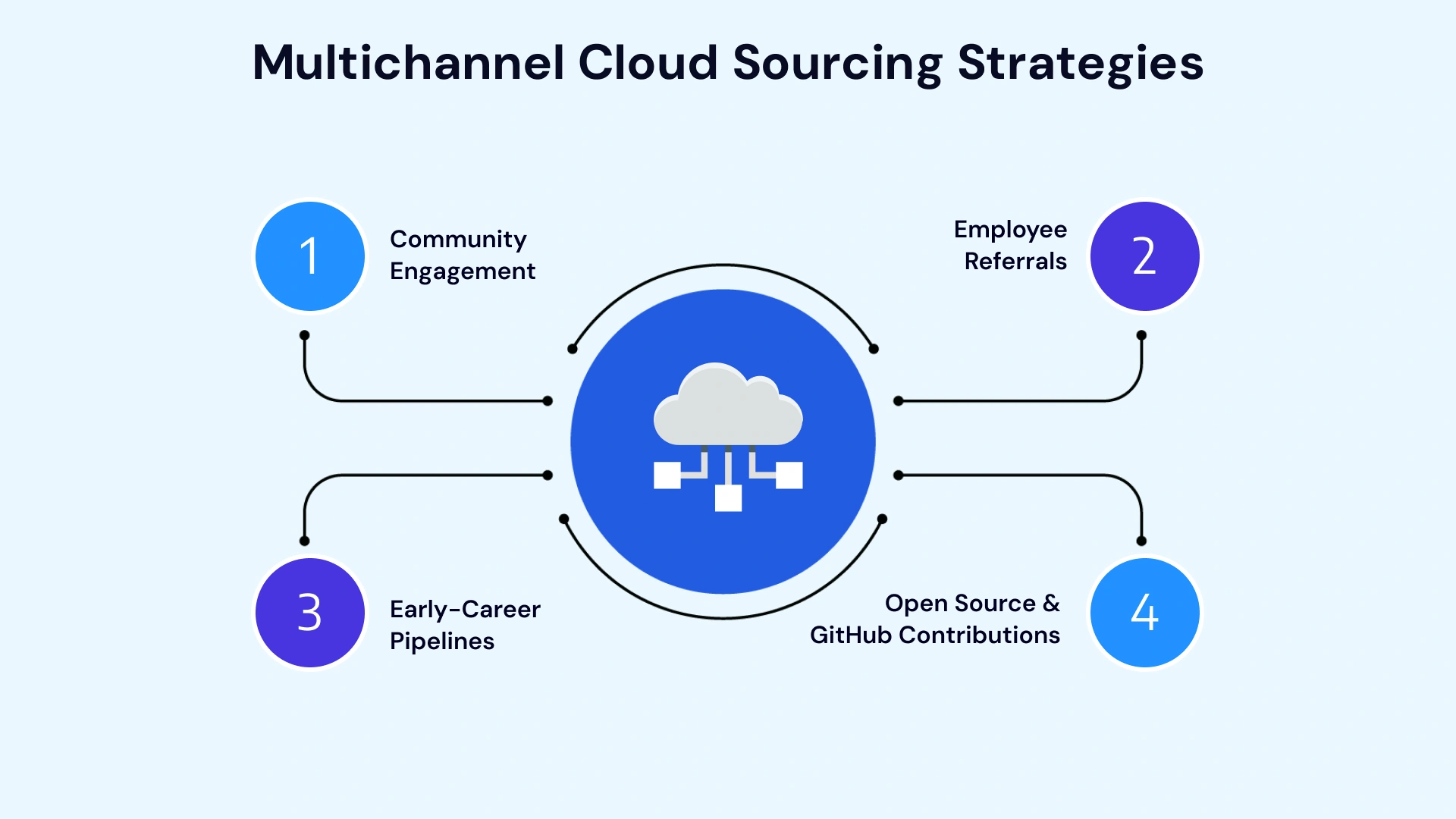
- Community Engagement: Participate in cloud computing meetups, conferences, and hackathons across Indian tech hubs like Bengaluru, Hyderabad, and Pune. AWS re: Invent, Azure conferences, and Google Cloud Next often host regional events in India that attract top talent.
- Early-Career Pipelines: Partner with cloud training providers and certification bodies. Many organizations establish relationships with cloud academies and bootcamps to gain early access to trained candidates. Campus hiring programs targeting computer science graduates with cloud specializations can build a pipeline for long-term development.
- Employee Referrals: Referral programs are particularly effective in India’s close-knit tech community. Offering attractive bonuses for cloud roles often yields higher-quality hires and better retention, as current team members can vouch for both technical skill and cultural fit.
- Open Source & GitHub Contributions: Look beyond resumes to active contributions in the open-source ecosystem. In India’s competitive market, engineers who contribute to Kubernetes, Terraform providers, or CNCF projects often possess the high-level expertise needed for complex migrations. Monitoring GitHub repositories and Stack Overflow activity can help identify "hidden" talent who may not be active on job boards.
Assessment and Interview Best Practices
Evaluating cloud engineering candidates requires comprehensive assessment approaches. Begin with a resume screening focused on relevant certifications, hands-on project experience, and familiarity with required cloud platforms and tools.
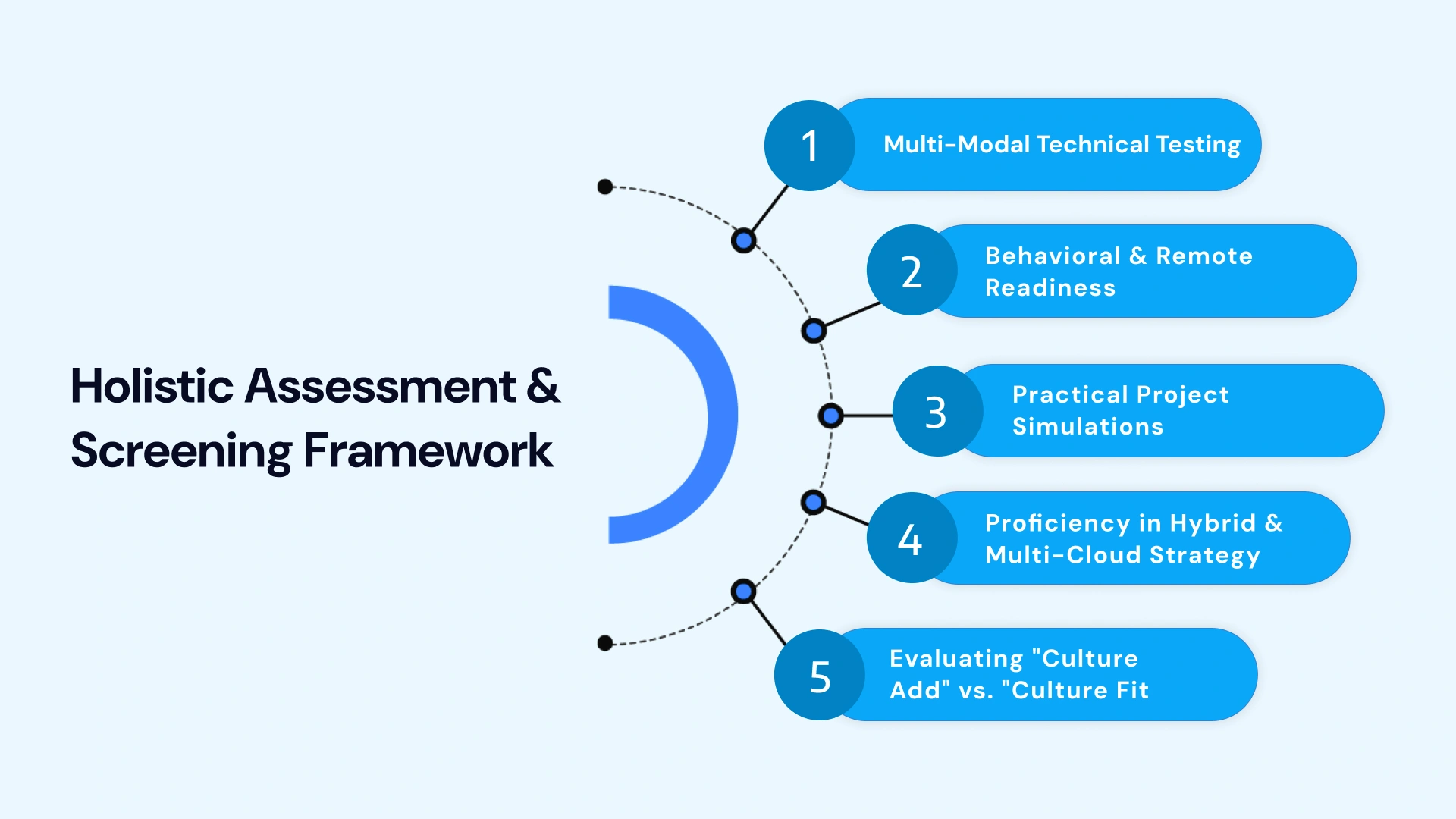
- Multi-Modal Technical Testing: Technical assessments should combine scenario-based questions to test architectural thinking, coding exercises using Cloud SDKs or Infrastructure-as-Code (IaC) tools, and system design discussions to assess understanding of scalability and reliability.
- Behavioral & Remote Readiness: Conduct thorough interviews to assess soft skills crucial for distributed teams. Evaluate communication clarity, adaptability to changing requirements, and an ownership mentality.
- Practical Project Simulations: Use take-home projects or pair programming sessions to gain insights into a candidate's working style, code quality, and ability to document their work. This is often more predictive of job performance than traditional Q&A.
- Proficiency in Hybrid & Multi-Cloud Strategy: Given that many Indian enterprises are moving away from single-vendor lock-in, assess candidates' ability to work across environments. A strong candidate should understand the nuances of data egress, cross-cloud security, and cost-optimization tools (FinOps) rather than just the technical features of a single provider.
- Evaluating "Culture Add" vs. "Culture Fit": Instead of looking for candidates who think exactly like the current team, assess for "Culture Add"—individuals who bring diverse perspectives or niche expertise (e.g., Security/DevSecOps or AI/ML integration) that the current team lacks. This approach fosters innovation and helps build a more resilient, well-rounded engineering organization.
Note: In the Indian context, the "Notice Period" is a significant hurdle. Top-tier organizations are increasingly offering "Joining Bonuses" or "Buy-out" options to secure talent who may be subject to 30-90 day notice periods.
Compensation and Retention Strategies of Cloud Engineers
Compensation for cloud engineers in India varies significantly based on experience level, location, platform expertise, and company type. Entry-level cloud engineers with 0-2 years of experience typically command annual salaries of ₹4-8 lakhs, while mid-level engineers with 3-5 years of experience range from ₹8-15 lakhs. Senior engineers and architects with 6-10 years of experience can earn ₹15-30 lakhs, and principal architects or specialized experts with 10+ years of experience may command ₹30-50 lakhs or more.
Metro cities like Bengaluru, Hyderabad, and Pune typically offer 15-20% higher compensation than tier-2 cities, though remote work has somewhat reduced location-based disparities. Multinational corporations and product companies generally pay 20-30% premiums over traditional IT services firms for similar roles.
Certifications impact compensation significantly. AWS Certified Solutions Architect Professional certification can add 15-20% to base salary expectations, while multiple certifications across platforms command even higher premiums. Specialized skills in areas like cloud security, machine learning on cloud platforms, or FinOps (cloud financial operations) also justify premium compensation.
Beyond base salary, competitive packages should include performance bonuses, equity or stock options for startups, comprehensive health insurance, professional development budgets for certifications and training, and flexible work arrangements. These components significantly influence candidate decisions when choosing between offers.
Retention Best Practices
To retain top-tier cloud talent in India’s high-growth market, you need to shift from traditional HR policies to a developer-centric growth model. Here are five refined pillars for your retention strategy:
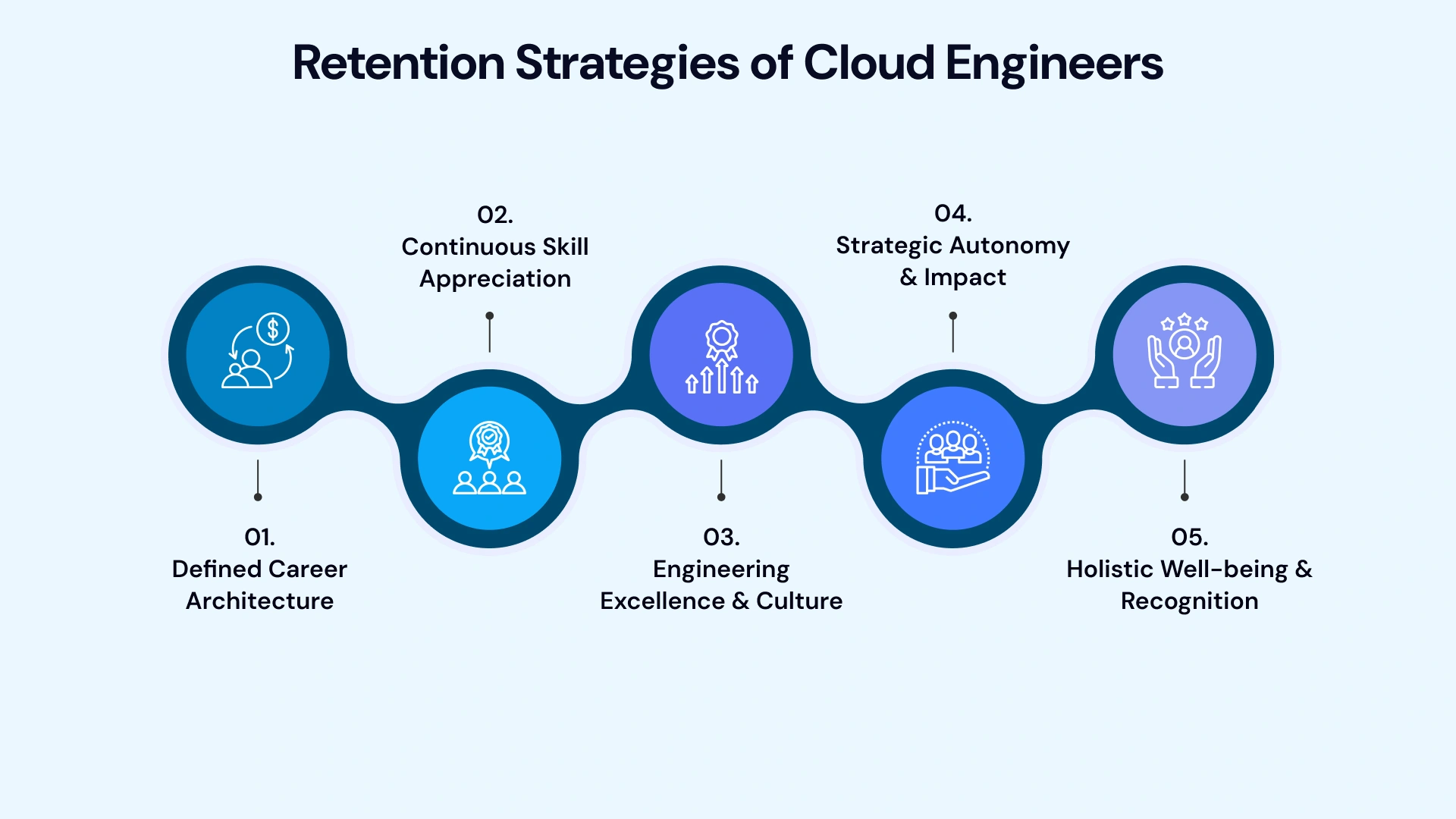
1. Defined Career Architecture
Create transparent, high-visibility growth tracks that offer more than just a title change. Establish clear milestones for both Individual Contributor (IC) paths—focusing on technical mastery and leadership—and Management paths, ensuring engineers don't feel forced into people management to earn a promotion.
2. Continuous Skill Appreciation
In a market where cloud technologies evolve quarterly, shift to a semi-annual compensation review model. Use bi-annual market benchmarking to ensure salaries stay ahead of local inflation and demand. Proactively reward engineers as they acquire high-value certifications (e.g., AWS Solutions Architect, Google Professional Cloud Architect) rather than waiting for annual cycles.
3. Engineering Excellence & Culture
Build an environment that treats developers like creators, not just resources. Foster engagement through internal hackathons, tech talks, and dedicated time for open-source contributions. A culture that prioritizes technical excellence and cross-functional knowledge sharing reduces burnout and increases institutional loyalty.
4. Strategic Autonomy & Impact
Prevent stagnation by involving engineers in architectural decision-making and high-level strategic planning. When engineers understand the "why" behind the infrastructure, they develop a sense of ownership. Implementing project rotation programs also helps them build versatile expertise across different cloud ecosystems (Multi-cloud/Hybrid-cloud), keeping the work intellectually stimulating.
5. Holistic Well-being & Recognition
Balance high-intensity sprints with a robust work-life integration policy. Complement formal performance bonuses with a "culture of appreciation"—frequent, informal recognition of technical wins. Providing access to cutting-edge tools and reducing "toil" through automation shows engineers that the organization values their time and mental energy.
Training and Upskilling Your Cloud Teams
Continuous Learning Culture
Building cloud engineering teams in India requires commitment to continuous learning, given the rapid pace of cloud technology evolution. Organizations should allocate 10-15% of engineers' time for learning and skill development. This investment pays dividends through improved capabilities, higher innovation, and better retention.
Establish structured learning pathways aligned with organizational needs and individual career goals. For engineers transitioning from traditional IT to cloud roles, provide foundational training covering cloud concepts, networking, security, and platform basics before advancing to specialized topics. For experienced cloud engineers, focus on advanced specializations, new services and capabilities, multi-cloud architectures, and emerging areas like FinOps and cloud sustainability.
Partner with cloud providers' training programs, including AWS Training and Certification, Microsoft Learn for Azure, and Google Cloud Skills Boost. These official resources provide high-quality content aligned with certification exams. Many cloud providers offer bulk purchasing options for training credits, making enterprise-wide training programs cost-effective.
Certification Programs and ROI
Cloud certifications provide structured learning paths and objectively validate skills. Implement certification incentive programs that cover exam fees and preparation courses, offer bonuses for achieving certifications, recognize certified employees publicly, and establish certification requirements for role progression.
Prioritize certifications aligned with your technology stack and business needs. For organizations that are heavy on AWS, focus on the AWS Certified Solutions Architect, AWS Certified Developer, and AWS Certified DevOps Engineer certifications. Azure-focused teams should pursue the Microsoft Certified: Azure Solutions Architect Expert and Azure DevOps Engineer Expert certifications. GCP teams benefit from Google Cloud Professional Cloud Architect and Professional Cloud Developer certifications.
Measure the ROI of certification programs through metrics including project delivery efficiency improvements, reduction in production incidents, faster adoption of new cloud services, and employee retention rates among certified versus non-certified engineers. Most organizations find certification programs deliver positive ROI within 12-18 months through these combined benefits.
Cloud Security and Compliance Expertise
Critical Security Skills in Cloud Teams
Security expertise has become non-negotiable for cloud engineering teams as cyber threats grow in sophistication and regulatory requirements expand. When building cloud engineering teams in India, ensure adequate security capabilities across identity and access management (IAM), network security architecture, data encryption and protection, security monitoring and incident response, and compliance frameworks.
Look for engineers with cloud security certifications, including AWS Certified Security Specialty, Microsoft Certified: Azure Security Engineer Associate, Google Professional Cloud Security Engineer, Certified Cloud Security Professional (CCSP), and Certified Information Systems Security Professional (CISSP). These credentials demonstrate a serious commitment to security expertise.
Security should be integrated into DevOps practices through DevSecOps approaches. This requires engineers who understand security automation with tools like Terraform Sentinel or AWS CloudFormation Guard, container security scanning with tools like Aqua or Twistlock, secrets management with HashiCorp Vault or cloud-native solutions, and compliance-as-code with frameworks like Chef InSpec or AWS Config.
Compliance and Regulatory Knowledge
Organizations operating in regulated industries need cloud engineering teams with compliance expertise. India's growing fintech, healthcare, and e-commerce sectors particularly require engineers who understand regulatory frameworks including RBI guidelines for financial data, HIPAA for healthcare information, GDPR for handling EU citizen data, SOC 2 for service organization controls, and ISO 27001 for information security management.
Assess candidates' experience with compliance tools and services specific to each cloud platform. AWS offers services like AWS Artifact, AWS Config, and AWS Security Hub for compliance management. Azure provides Microsoft Defender for Cloud and Azure Policy for governance. GCP offers Security Command Center and Policy Intelligence for compliance monitoring.
Building teams with compliance expertise may require hiring specialists or providing focused training for existing engineers. Many organizations establish cloud governance and compliance centers of excellence that support multiple teams, ensuring consistent standards while avoiding duplication of specialized expertise.
DevOps and Automation Excellence
DevOps Culture in Cloud Teams
Successful cloud engineering teams embrace DevOps principles that break down silos between development and operations. When building cloud engineering teams in India focused on DevOps development services, prioritize cultural fit alongside technical skills. Look for engineers who demonstrate collaboration and communication skills, an ownership and accountability mentality, a continuous improvement mindset, and comfort with automation and infrastructure-as-code.
DevOps implementation requires specific technical capabilities. Engineers should be proficient in CI/CD tools, including Jenkins, GitLab CI, GitHub Actions, and cloud-native services such as AWS CodePipeline and Azure DevOps. Experience with containerization using Docker and orchestration through Kubernetes is increasingly essential as organizations adopt microservices architectures.
Infrastructure as Code (IaC) skills form the foundation of modern cloud operations. Terraform has emerged as the leading IaC tool due to its multi-cloud support, though cloud-native options like AWS CloudFormation, Azure Resource Manager templates, and Google Cloud Deployment Manager remain important. Assess candidates' ability to write modular, reusable infrastructure code that follows best practices.
Automation and Efficiency
Cloud engineering teams should continually seek opportunities for automation to improve efficiency and reduce human error. Configuration management tools, including Ansible, Chef, or Puppet, enable consistent server configuration across environments. Automation should extend to monitoring setup, backup and disaster recovery procedures, security patching and updates, and cost optimization reviews.
Scripting skills in Python, Bash, or PowerShell prove invaluable for cloud engineers. Assess candidates' ability to write scripts that interact with cloud APIs, automate routine tasks, parse and analyze logs, and integrate different tools and services. Strong scripting capabilities significantly multiply an engineer's impact.
When evaluating DevOps capabilities, present scenario-based challenges like designing a CI/CD pipeline for a specific application, automating infrastructure deployment for a multi-tier application, implementing a disaster recovery solution with defined RTO and RPO targets, or setting up monitoring and alerting for a microservices architecture. Candidates' approaches to these scenarios reveal both technical depth and problem-solving skills.
Cloud Cost Management Skills
As cloud spending grows, organizations increasingly seek engineers with FinOps expertise to optimize costs without sacrificing performance or reliability. Building cloud engineering teams in India with cost-optimization expertise delivers significant business value, as even small percentage improvements in cloud efficiency translate into substantial savings at scale.
Cost-optimization skills to prioritize include cloud cost analysis and reporting, rightsizing resources based on actual utilization, implementing auto-scaling and spot/preemptible instances, using reserved instance and savings plan strategies, and tagging and allocating costs to business units. Engineers should understand the cost implications of architectural decisions and actively consider cost efficiency in design.
Each major cloud platform offers native cost management tools. AWS Cost Explorer, AWS Budgets, and AWS Cost Anomaly Detection provide visibility and controls. Azure Cost Management and Billing offers similar capabilities. GCP provides Cloud Billing reports and budget alerts. Engineers should be proficient with these tools and third-party solutions like CloudHealth or CloudCheckr for multi-cloud environments.
FinOps Practices and Team Integration
FinOps represents a cultural shift that brings finance, technology, and business teams together around cloud cost management. When implementing FinOps practices with cloud engineering teams in India, establish cross-functional collaboration between engineers, finance, and business stakeholders. Create visibility into cloud spending with regular reporting, implement accountability by allocating costs to specific teams or projects, and foster a culture of continuous optimization.
Consider hiring dedicated FinOps engineers or training existing team members in FinOps principles. The FinOps Foundation offers the FinOps Certified Practitioner certification that validates understanding of cloud financial management practices. Engineers with this expertise can drive significant cost savings while maintaining or improving service quality.
Cost optimization should be integrated into regular workflows rather than treated as occasional cost-cutting exercises. Implement automated policies that shut down non-production resources outside business hours, rightsize overprovisioned resources based on utilization metrics, clean up unused resources like unattached storage volumes, and alert when spending exceeds budgets. These practices embed cost awareness into daily operations.
Leveraging India's Global Capability Centers (GCCs)
The GCC Advantage for Cloud Teams
Global Capability Centers have proliferated across India, with over 1,600 GCCs employing more than 1.5 million professionals. These centers offer unique advantages for building cloud engineering teams, including access to established infrastructure and processes, proven remote collaboration frameworks, exposure to global best practices, and opportunities for international career paths that attract top talent.
Organizations establishing GCC tech talent sourcing in India benefit from a mature ecosystem that supports these operations. Tier-1 cities offer abundant commercial real estate, reliable connectivity infrastructure, supportive regulatory environments, and ecosystems of service providers supporting GCC operations. The concentration of GCCs also creates opportunities for knowledge sharing through forums and communities.
GCCs typically achieve better talent retention compared to traditional outsourcing models. Employees value being part of the parent organization rather than a third-party provider, with clearer career progression paths and stronger alignment with company culture. This translates into lower attrition and higher retention of institutional knowledge for cloud engineering teams.
Building vs. Partnering Decisions
Organizations have multiple options for accessing India's cloud engineering talent. Building a captive GCC provides maximum control and cultural integration but requires significant upfront investment in infrastructure, HR, legal, and administrative functions. This approach works well for organizations committing to long-term presence and requiring deep integration with global operations.
Partnering with established providers for cloud-managed services or IT staff augmentation services offers faster time-to-value with lower initial investment. Providers handle administrative complexity while delivering skilled resources. This model suits organizations exploring India's talent market or requiring flexible scaling without long-term commitments.
Hybrid approaches are increasingly common. Organizations might start with a partner relationship to validate the model and build understanding, then transition to captive operations as confidence and scale grow. Alternatively, they might maintain a core captive team for strategic work while leveraging partners for supplemental capacity or specialized skills.
Emerging Trends in Cloud Engineering
In 2026, cloud engineering has evolved into "Cloud 3.0." The focus has shifted from simple resource management to an intelligent, self-managing fabric centered on AI orchestration, financial predictability, and data sovereignty.
Here are the defining trends for 2026:
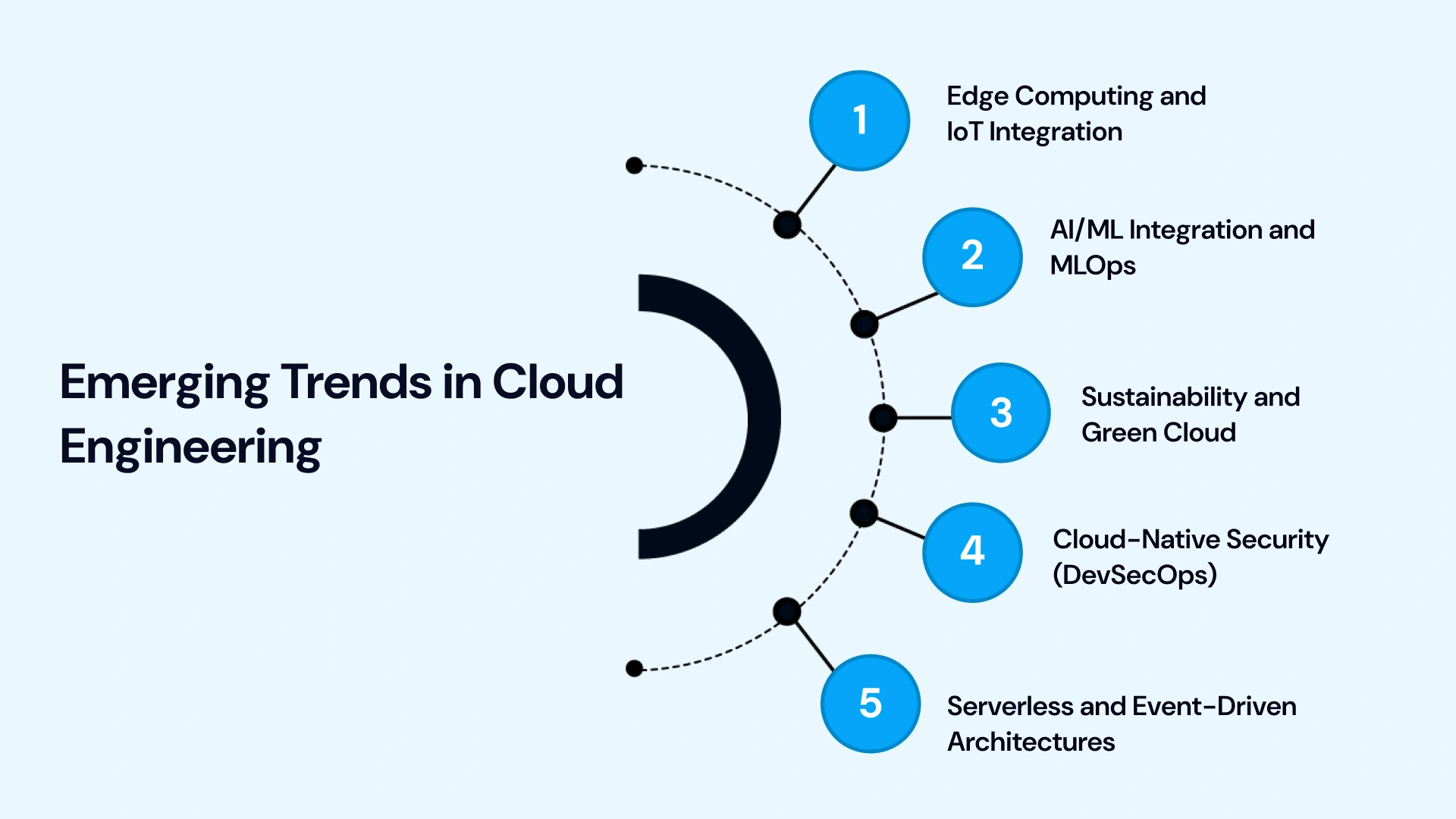
Edge Computing and IoT Integration
Edge computing is fundamentally shifting data processing closer to the source to minimize latency for high-stakes applications like autonomous vehicles, smart cities, and AR/VR. In India, the talent landscape is evolving as engineers move from traditional IoT roles to edge-focused cloud positions, gaining expertise in platforms like AWS IoT Greengrass and Azure IoT Edge. This transition is further accelerated by the national 5G rollout, which creates a critical demand for cloud engineers who can bridge the gap between telecom infrastructure and distributed cloud architecture.
AI/ML Integration and MLOps
Machine Learning has moved from a niche add-on to a core cloud service, requiring teams to master AutoML, model deployment, and MLOps to operationalize AI at scale. India’s robust data science community is increasingly adopting infrastructure skills, creating a unique talent pool that understands both data science concepts and the operational rigors of the cloud. Furthermore, the explosion of Generative AI has shifted the focus toward RAG architectures and vector databases, making engineers who can navigate services such as AWS Bedrock and Azure OpenAI essential for modern innovation.
Sustainability and Green Cloud
Environmental responsibility is becoming a technical requirement, with "carbon-aware" engineering now focusing on rightsizing resources and scheduling heavy workloads during periods of low-carbon energy availability. Organizations are increasingly selecting data center regions based on renewable energy metrics and implementing strict carbon footprint reporting. In India, this trend aligns with national renewable goals, making green cloud initiatives a powerful tool for attracting values-driven talent who prioritize environmental impact alongside technical excellence.
Cloud-Native Security (DevSecOps)
The transition to "Shift-Left" security ensures that security is baked into the CI/CD pipeline from the start, rather than treated as a final audit. As organizations adopt Zero Trust architectures, the focus has moved toward verifying every request and user, regardless of their location on the network. This has created a massive demand for engineers proficient in "Policy as Code" (such as OPA) and automated vulnerability scanning, ensuring that security scales as fast as the cloud infrastructure itself.
Serverless and Event-Driven Architectures
Cloud engineering is moving toward a serverless-first mindset, where the focus shifts from managing virtual machines to writing code that scales automatically via services like AWS Lambda or Google Cloud Functions. This event-driven approach enables granular scaling and extreme cost efficiency, as resources are consumed only when a specific trigger occurs. In India, this trend is a primary driver for application modernization, allowing companies to decouple legacy monoliths into agile, highly responsive microservices.
Common Challenges and Solutions
Addressing the Skills Gap
Despite India's large talent pool, finding engineers with specific cloud specializations can be challenging. The rapid evolution of cloud services creates perpetual skills gaps as new capabilities outpace training and certification programs. Organizations must balance hiring experienced professionals with developing internal talent.
Address skills gaps through comprehensive training programs, partnerships with cloud providers for early access to new service training, internal knowledge sharing and mentoring programs, and hiring for potential and learning ability rather than just current skills. Many successful organizations have built world-class cloud teams by investing in developing promising engineers rather than only pursuing experienced candidates.
Consider establishing cloud excellence programs that identify high-potential engineers and provide intensive training, mentorship, and hands-on project experience. These programs create pipelines of qualified talent while building loyalty through investment in career development. Graduates of such programs often become your strongest advocates in the talent market.
Managing Distributed Teams Effectively
Cloud engineering teams often work in distributed environments across multiple locations and time zones. Effective management requires intentional practices, including clear communication norms and channels, regular video meetings for team building and alignment, documentation of decisions and architectural patterns, overlap hours for real-time collaboration, and visit exchanges between locations to build relationships.
Invest in collaboration tools that support distributed work, including video conferencing platforms with strong connectivity in India, project management tools for asynchronous coordination, documentation systems accessible to all team members, and monitoring dashboards that provide visibility into systems and incidents. These tools form the backbone of effective distributed collaboration.
Build a strong remote-first culture that doesn't privilege in-office team members. Ensure distributed team members participate equally in decisions, have visibility to leadership and career opportunities, receive recognition for contributions, and feel connected to the broader organization. Intentional inclusivity prevents the formation of "first-class" and "second-class" perceptions of team members.
Attrition Management
India's competitive tech talent market leads to higher attrition rates than many Western markets, particularly in in-demand specializations like cloud engineering. Average attrition for tech professionals in India ranges from 15-25% annually, with cloud specialists often experiencing even higher turnover due to aggressive poaching.
Proactive attrition management includes regular stay interviews to understand satisfaction and concerns, competitive compensation reviews at least semiannually, career development conversations and clear progression paths, challenging work assignments that develop new skills, and recognition programs that celebrate achievements. Addressing concerns before engineers begin job searches significantly improves retention.
Exit interviews with departing engineers provide valuable insights into organizational weaknesses. Track patterns in departure reasons, including compensation gaps, limited growth opportunities, technical environment concerns, or management issues. Use this data to implement systemic improvements rather than treating each departure as an isolated incident.

Accelerate Your Cloud Strategy with VLink's Expert Engineering Teams
Building and managing cloud engineering teams in India requires deep expertise, established processes, and continuous investment in talent development. VLink's dedicated team specializes in helping organizations accelerate their cloud initiatives through expert engineering teams across AWS, Azure, and GCP.
Our comprehensive cloud engineering services eliminate the complexity of team building while providing immediate access to certified cloud professionals. Whether you need dedicated DevOps development services, cloud managed services, or IT staff augmentation services, VLink delivers skilled engineers who integrate seamlessly with your existing operations.
VLink's GCC talent solutions combine the cost advantages of India's talent market with the quality and reliability expected by global enterprises. Our rigorous screening processes, continuous upskilling programs, and proven retention strategies ensure you access and retain top cloud engineering talent without the overhead of building internal recruitment and management infrastructure.
We understand that successful cloud transformation requires more than just technical skills. Our teams bring strategic thinking, business acumen, and deep cloud platform expertise to drive meaningful business outcomes. From initial cloud strategy through implementation and optimization, VLink's cloud engineering teams become trusted partners in your digital transformation journey.
Let VLink handle the complexity of building and managing cloud engineering teams while you focus on leveraging cloud technology to achieve business objectives. Contact us today to explore how our expert teams can accelerate your cloud initiatives.
Conclusion
Building cloud engineering teams in India represents a strategic opportunity for organizations seeking to accelerate digital transformation while optimizing costs. The combination of India's vast talent pool, competitive compensation structures, and proven remote collaboration capabilities makes it an ideal location for establishing cloud engineering capabilities across AWS, Azure, and GCP platforms.
Success requires understanding the nuances of India's cloud talent landscape, implementing effective recruitment and retention strategies, and fostering a culture of continuous learning and innovation. Organizations that invest in comprehensive training programs, embrace modern DevOps practices, and prioritize multi-cloud expertise position themselves to leverage cloud technology as a true competitive advantage.
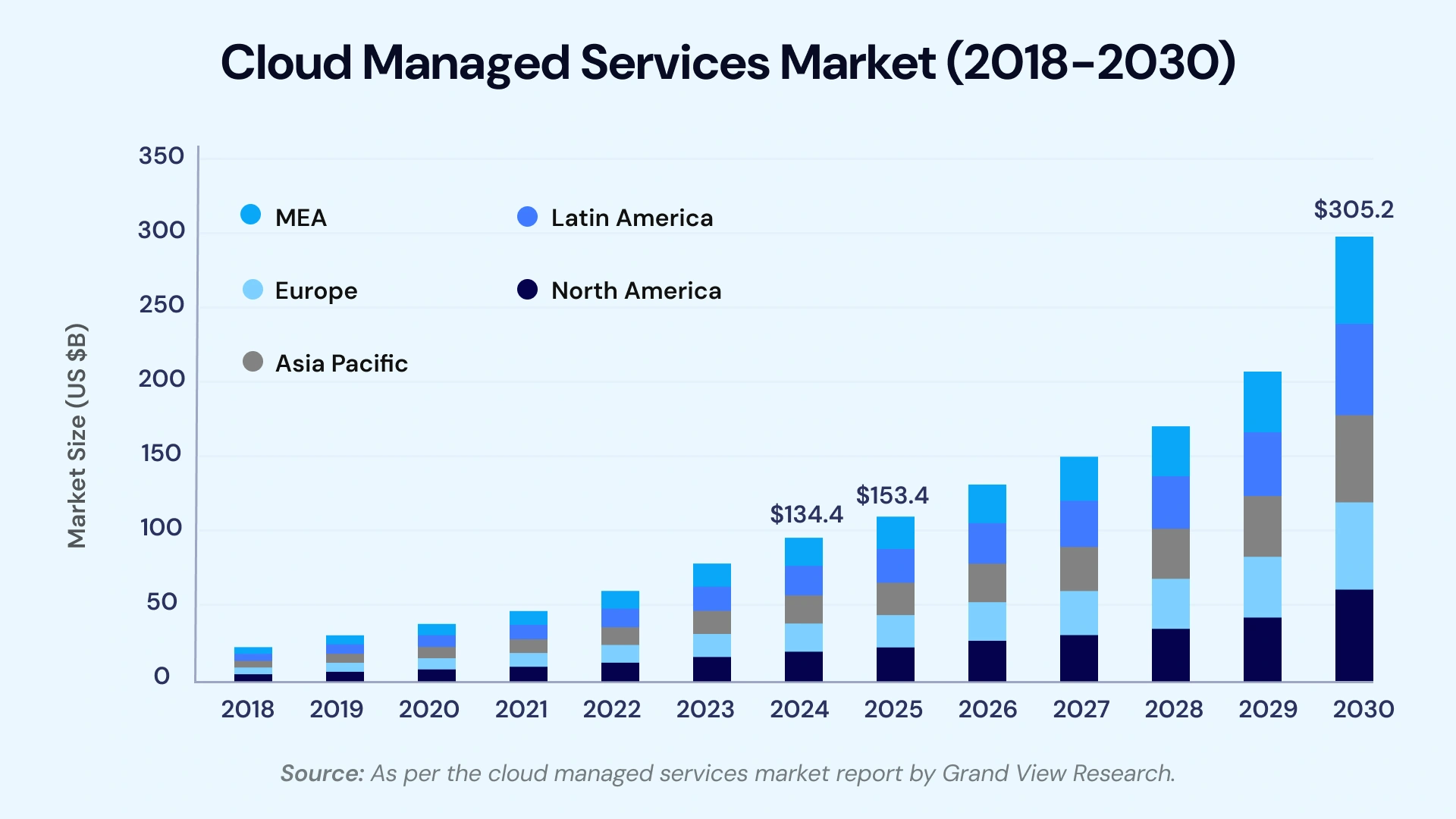
The rapid growth of cloud managed services market, projected to reach $305.16 billion by 2030, underscores the critical importance of building strong cloud engineering capabilities. Whether through captive GCCs, partnerships for IT staff augmentation, or hybrid models, accessing India's cloud engineering talent lays the foundation for scalable, cost-effective cloud operations.
As cloud technologies continue to evolve with emerging trends such as edge computing, AI/ML integration, and sustainability initiatives, India's adaptive and technically proficient engineering community will remain at the forefront of innovation. Organizations that establish strong cloud engineering teams in India today position themselves to successfully navigate the ongoing transformation of the cloud landscape.
The future of cloud engineering is multi-platform, security-focused, cost-optimized, and deeply integrated with business strategy. Building teams with these capabilities in India offers an unparalleled combination of talent quality, cost efficiency, and strategic flexibility to drive sustained competitive advantage in the digital economy.

Business Development Professional
Vineel is a seasoned sales and business development leader with extensive experience in the telecommunications and IT industries. Over the course of his career, he has worked with global teams at multinational organizations, having lived and operated in India, Canada, the Netherlands, and the United Kingdom.

 Shivisha Patel