

Let’s be completely candid; for more than a decade, vendors pitched moving workloads off local servers as a magical silver bullet for reducing IT budgets. Companies were told that trading physical hardware for virtual machines would instantly solve their operational friction.
But over the past few years, that simplistic narrative collided hard with corporate reality. Organizations discovered that executing a mindless "lift-and-shift" without strict architectural redesign or financial governance simply traded local server maintenance headaches for bloated, unpredictable monthly cloud bills.
Today, the entire corporate technology conversation has matured. We have crossed a definitive operational threshold where digital transformation is no longer a differentiator—it is the baseline cost of admission. Global enterprise spending on cloud infrastructure services continues to scale past historic highs as nearly every sector confronts market disruption.
Yet, the driving forces behind this movement have drastically shifted. Organizations are no longer fleeing physical server rooms just to save on hardware depreciation schedules. Instead, they are initiating cloud migration in 2026 to outpace intense market competition, satisfy aggressive new data sovereignty regulations, and unlock the heavy computational horsepower required to run enterprise-grade artificial intelligence.
Whether you are managing a sprawling legacy data center, trying to rein in erratic IT expenditures, or attempting to scale a digital-native ecosystem, understanding the core realities of cloud migration in 2026 will dictate your operational survival for the next decade. This comprehensive blog breaks down the structural shifts, addresses the specific pain points of executive leadership, and provides an actionable blueprint for modern infrastructure modernization.
The Strategic Imperative for Cloud Migration
When evaluating cloud migration services for businesses, executive leaders often find that local hardware limits not only processing speed but also organizational agility. Moving to modern ecosystems unlocks pivotal advantages that directly impact company growth:
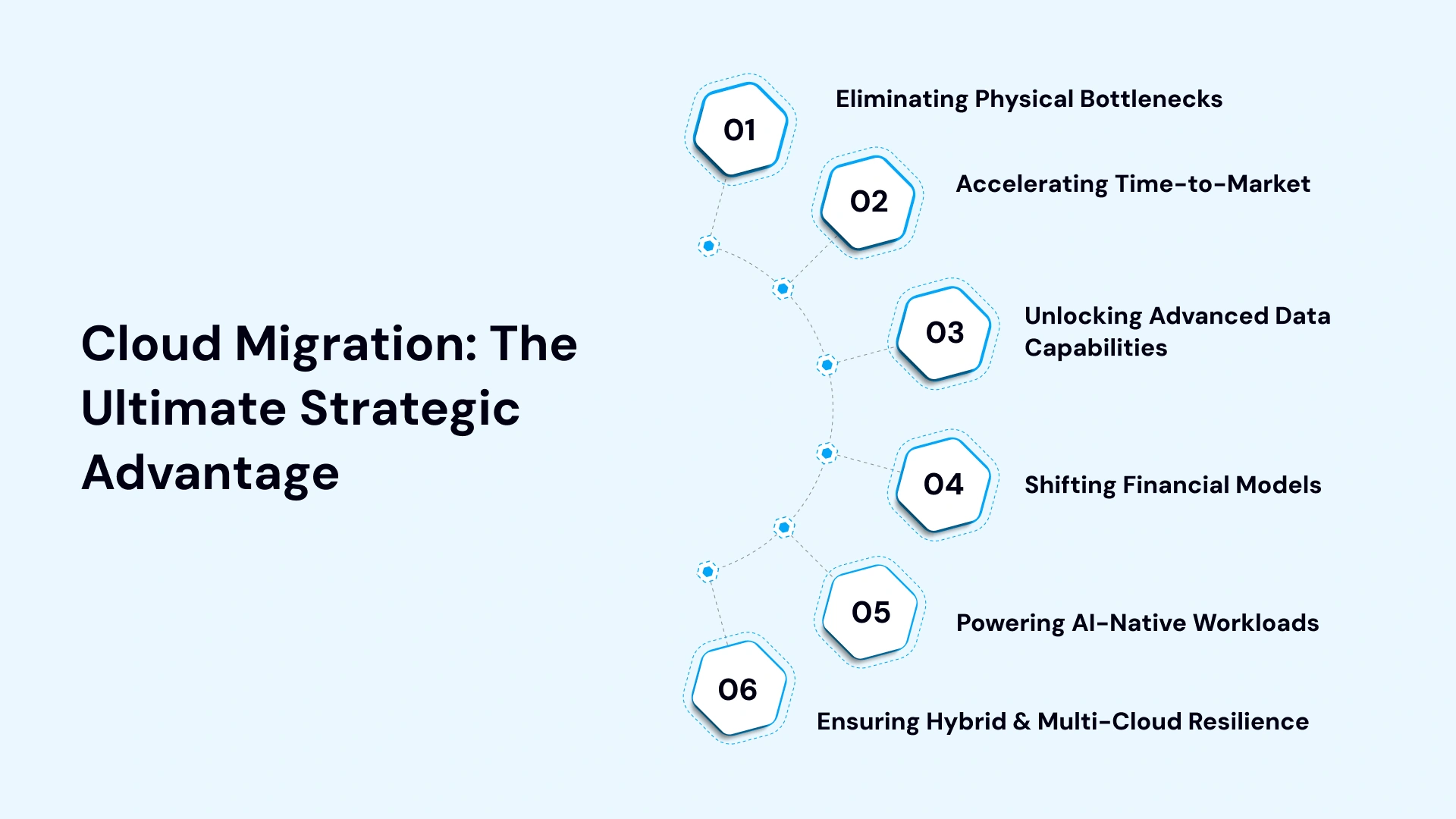
- Eliminating Physical Bottlenecks: Modern cloud migration for businesses removes physical provisioning barriers entirely, giving engineering teams on-demand scalability, elastic compute resources, and global reach.
- Accelerating Time-to-Market: Product and engineering divisions can spin up development, staging, and production environments in minutes instead of waiting months for server procurement.
- Unlocking Advanced Data Capabilities: Centralizing data lakes in the cloud allows organizations to integrate machine learning, real-time analytics, and business intelligence pipelines seamlessly.
- Shifting Financial Models: Capital expenditure-heavy server purchases are replaced with predictable, flexible operational models tied directly to consumption and value generation.
- Powering AI-Native Workloads: Modernized cloud architectures instantly supply the low-latency networking and GPU-ready infrastructure required to train and scale generative AI models.
- Ensuring Hybrid & Multi-Cloud Resilience: Spreading workloads across flexible environments prevents vendor lock-in, boosts operational redundancy, and aligns compliance strategies with localized data laws.
Ultimately, migrating to the cloud has evolved from a routine infrastructure update into a fundamental business strategy. Organizations that view the cloud merely as a cheaper server alternative miss its true transformative potential. By embedding automated security, data governance, and intelligent scalability directly into their operational foundation, forward-thinking enterprises future-proof their operations, turning technical agility into a lasting competitive advantage.
The 2026 Shift: Why Legacy Infrastructure is Collapsing Under Demands
To understand why executive boards are mandating aggressive infrastructure overhauls, one must examine the widening chasm between legacy constraints and modern market velocity. Several compounding factors are driving the rapid collapse of traditional data centers:
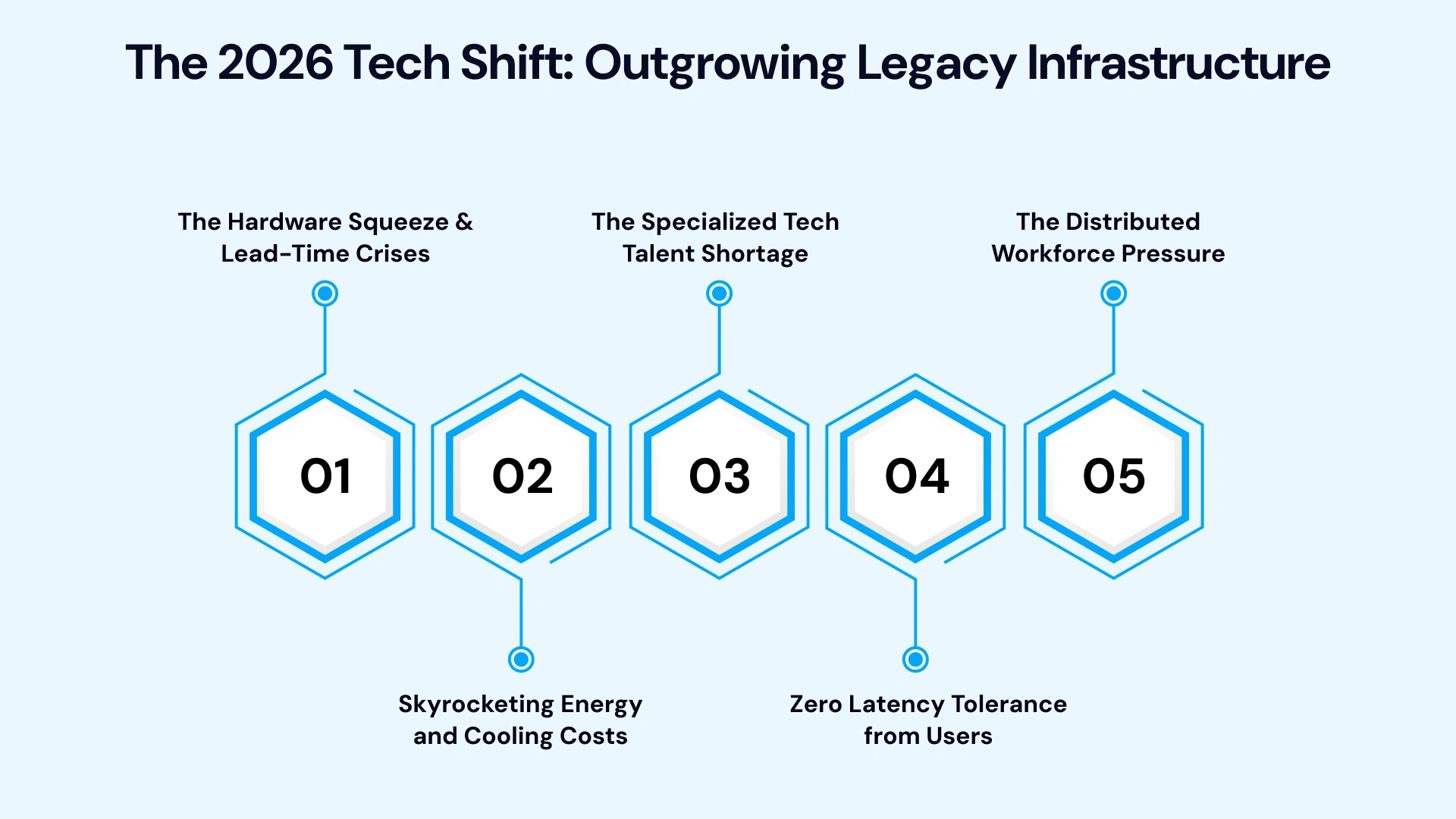
- The Hardware Squeeze & Lead-Time Crises: Supply chain bottlenecks for specialized enterprise server components have stretched procurement timelines to unmanageable lengths, stalling corporate roadmaps.
- Skyrocketing Energy and Cooling Costs: Commercial power expenses required to run and cool localized server rooms have multiplied, turning legacy closets into financial liabilities under strict carbon-tracking mandates.
- The Specialized Tech Talent Shortage: Finding and retaining hardware technicians to maintain aging physical infrastructure has become increasingly difficult and expensive for internal IT departments.
- Zero Latency Tolerance from Users: Modern digital consumers and enterprise clients expect instantaneous response times, making brittle, localized hardware stacks prone to catastrophic user abandonment during traffic spikes.
- The Distributed Workforce Pressure: Remote and hybrid collaboration models require secure, friction-free, around-the-clock access to corporate databases that local infrastructure cannot reliably support.
Deep Dive Into 2026 ICP Pain Points: Solving Enterprise Friction
Every stakeholder within the C-suite views technology modernization through a distinctly different lens. To execute a successful transition, IT leaders must directly resolve the specific operational anxieties plaguing each key decision-maker.
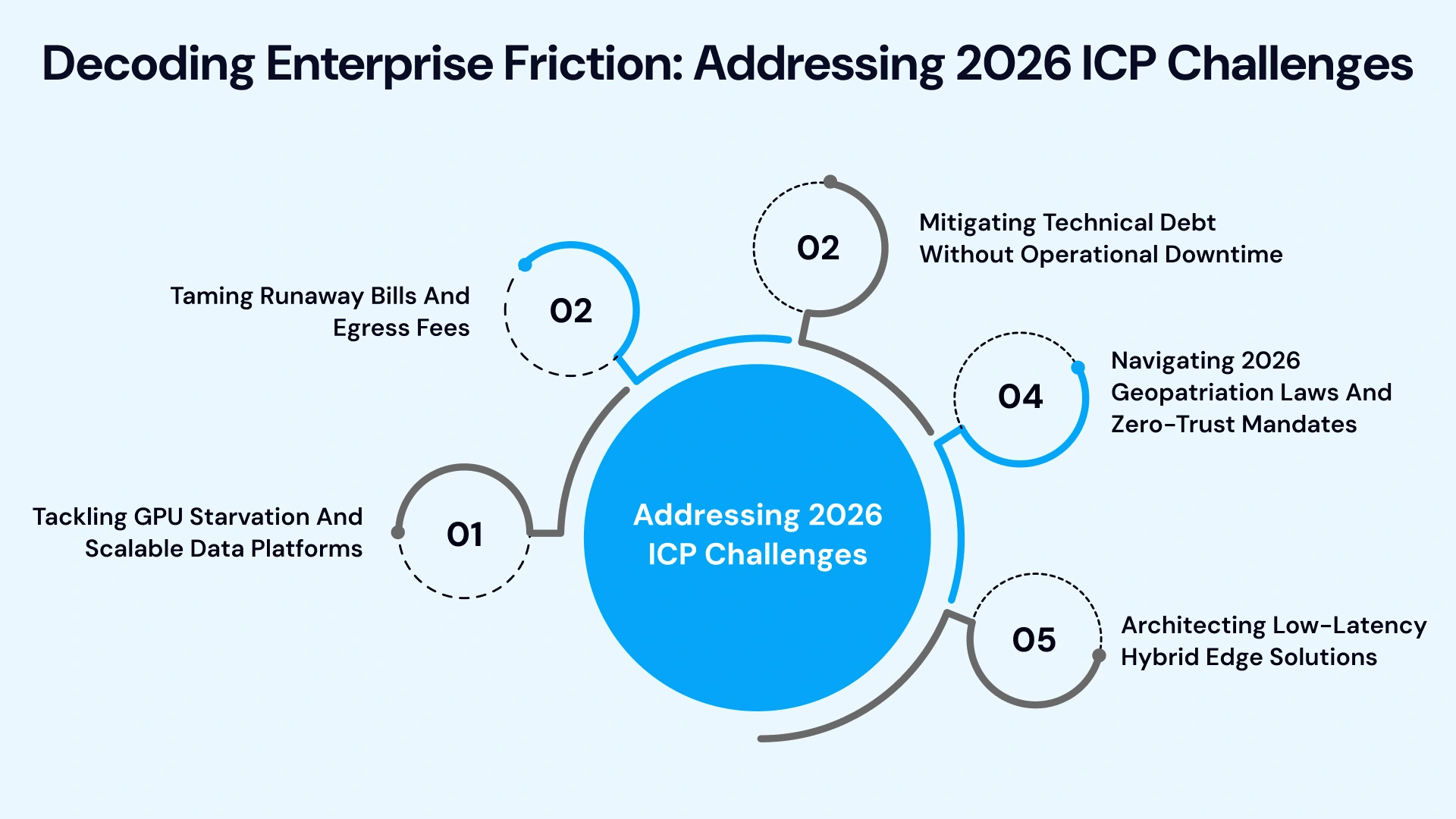
The AI-Ambitious CIO/CTO: Tackling GPU Starvation and Scalable Data Platforms
The modern Chief Information Officer is under intense pressure from the board to deploy generative AI, automated operational agents, and real-time predictive analytics. However, attempting to train large language models or run high-volume AI inference on legacy data centers introduces crippling latency and compute bottlenecks. Modern cloud migration solutions provide instantaneous, on-demand access to specialized GPU clusters, high-speed networking fabrics, and scalable data lakes, allowing engineering teams to deploy AI models in days.
The Cloud CFO and FinOps Leader: Taming Runaway Bills and Egress Fees
In earlier eras of cloud adoption, unmonitored infrastructure sprawl alienated financial leaders who watched initial cost projections evaporate into bloated monthly invoices. The modern cloud CFO and FinOps leader is hyper-focused on eliminating data egress surprises, orphaned storage volumes, and unoptimized virtual machine allocations. Modern migration frameworks integrate strict cost allocation models and continuous observability dashboards to guarantee optimized total cost of ownership.
The Legacy IT Director: Mitigating Technical Debt Without Operational Downtime
For IT directors who have spent decades managing physical server closets and local databases, the thought of migrating core business applications terrifies them due to the high risk of catastrophic operational downtime. Modern enterprise cloud migration methodologies explicitly reject the risky, archaic "big bang" approach in favor of phased, staged transitions that ensure continuous business continuity.
The CISO: Navigating 2026 Geopatriation Laws and Zero-Trust Mandates
Security and compliance officers face a heavily fragmented global regulatory landscape defined by strict data residency laws and aggressive cyber threats. Migrating data without rigorous security alignment is merely moving vulnerabilities, which is why identifying the key questions to ask before migrating data to cloud Infrastructure is critical. Enterprise CISOs require native Zero-Trust security postures, robust identity management, and automated compliance auditing embedded directly into the cloud architecture from day zero.
The Digital Experience VP: Architecting Low-Latency Hybrid Edge Solutions
Digital experience leaders cannot afford sluggish web applications or crashing platforms during peak traffic events. By distributing workloads across global cloud regions and utilizing hybrid edge computing nodes, businesses ensure lightning-fast content delivery, superior fault tolerance, and pristine user interactions regardless of geographic location.
Eliminating Hidden Database Scaling Costs and Engineering Toil
Managing legacy database architecture imposes severe, hidden taxes on organizational productivity and capital efficiency:
- Slaying Engineering Toil: Highly paid software engineers frequently waste up to a third of their working hours wrestling with manual capacity planning, hardware provisioning, and caching layers.
- Breaking Read-Replica Bottlenecks: Moderate traffic growth often causes legacy databases to fail proportionally, forcing teams into expensive workarounds like brittle caching clusters.
- Automated Instance Scaling: Transitioning to managed cloud database solutions eliminates manual overhead, easily handling triple the database traffic while lowering infrastructure run-rates.
- Predictable Maintenance Windows: Routine database patching, indexing, and security updates are handled automatically by cloud providers, eliminating scheduled maintenance downtime.
Post-Migration Governance: Protecting Data and Maximizing Cloud ROI
Ensuring operational stability in modern cloud environments requires robust, automated post-migration governance and continuous protection measures:
- Immutable Backups & Recovery: Modern ecosystems provide automated point-in-time recovery options and immutable backups that neutralize ransomware encryption attempts.
- Real-Time Anomaly Detection: Advanced monitoring tools automatically flag suspicious user behavior, anomalous data spikes, or unauthorized permission changes instantly.
- Proactive FinOps Observability: Continuous cost tracking dashboards alert financial teams to resource drift and unoptimized virtual machine allocations before bills spiral.
- Eliminating Shadow IT: Centralized governance frameworks provide complete visibility into deployed assets, ensuring no rogue environments operate outside cloud migration security parameters.
Note: When structured and governed correctly, cloud migration transforms enterprise operations far beyond simple server consolidation. It accelerates operational agility by allowing teams to launch products in minutes, while delivering enterprise-grade resilience through built-in disaster recovery. Furthermore, it optimizes total cost of ownership through rigorous FinOps oversight and empowers distributed teams with real-time, secure collaboration.
Enterprise vs. Mid-Market: Tailored Architecture and Regional Dynamics
The mechanics of enterprise cloud migration differ significantly from lightweight setups required by growing mid-market enterprises:
- Complex Multi-Region Harmonization: Large-scale corporations must harmonize intricate legacy dependencies and stakeholder hierarchies across global business units.
- Streamlined Mid-Market Modernization: Growing companies leverage flexible business cloud migration pathways to modernize communication suites and eliminate local server closets.
- Navigating U.S. Compliance Frameworks: Organizations executing cloud migration for U.S. enterprises must meticulously align with domestic regulations like HIPAA, SOC 2, and FedRAMP.
- Regional Redundancy & Data Residency: Specialized enterprise cloud migration USA protocols emphasize strict data residency and multi-zone fault tolerance.
- Certified Professional Execution: Partnering with providers of certified cloud migration services USA ensures compliance adherence, while leveraging expert cloud migration service options guarantees seamless multi-region deployment.
Understanding these dynamics ensures that targeted cloud migration benefits for business units center on agility and secure collaboration, while specific cloud migration benefits for enterprise ecosystems focus on massive scalability and advanced data analytics.
Designing a Bulletproof Blueprint: The Modern Cloud Migration Strategy
Too many modernization initiatives fail because organizations treat complex transitions as simple copy-paste exercises rather than strategic transformations. A truly resilient cloud migration strategy requires a disciplined, multi-phase framework designed to mitigate risk and maximize long-term value:
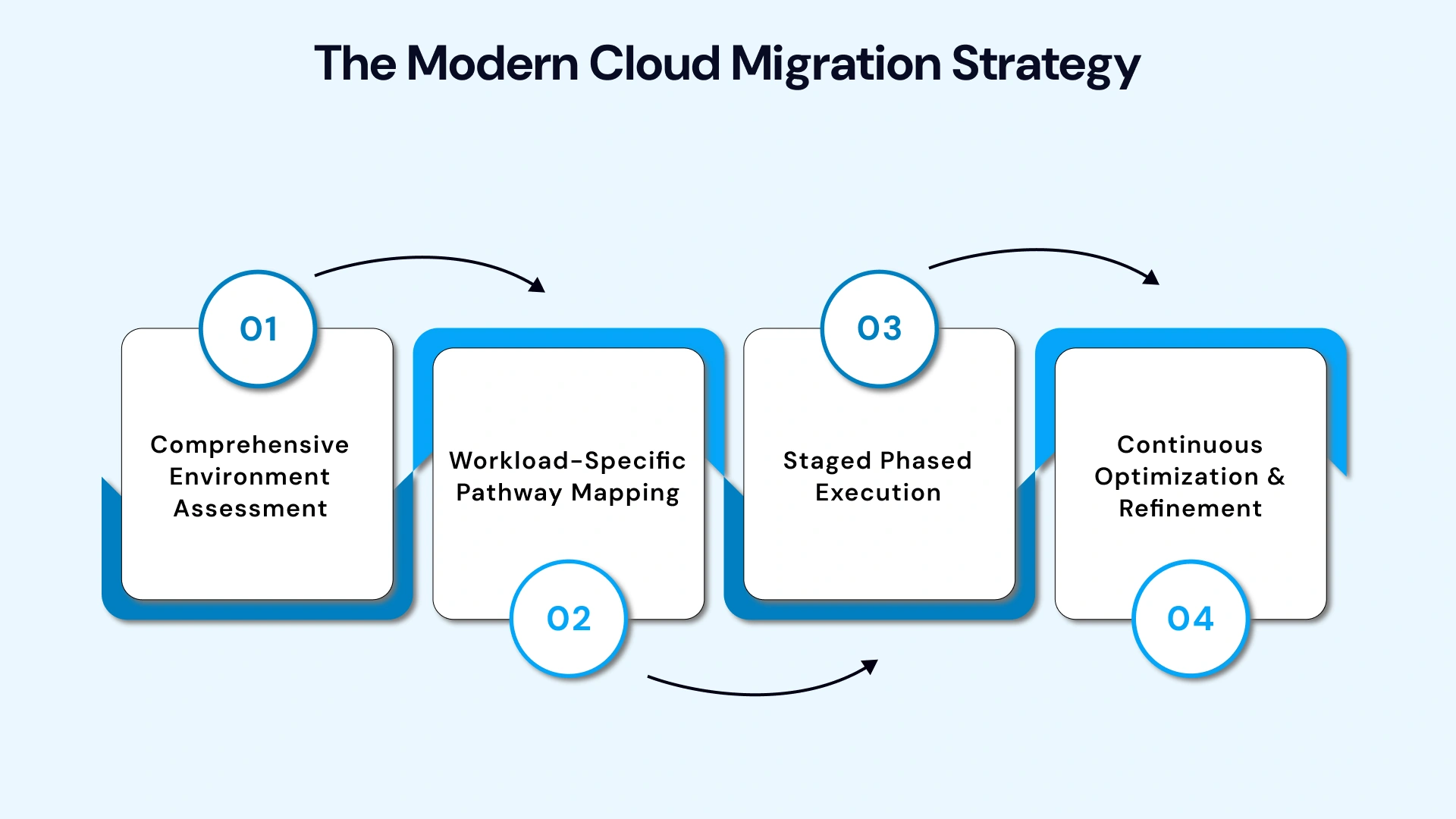
- Comprehensive Environment Assessment: Audit existing on-premises hardware, map deep application dependencies, and evaluate security postures before shifting a single byte of data. This foundational discovery phase ensures you uncover hidden technical debt and performance bottlenecks early.
- Workload-Specific Pathway Mapping: Evaluate every application meticulously across the core migration paths—whether it is a straightforward Rehost, Replatforming for cloud-native services, complete Rearchitecting, Repurchasing, or Retiring—to maximize ROI and operational efficiency.
- Staged Phased Execution: Reject high-risk, all-or-nothing "big bang" cutovers that threaten business continuity. Instead, migrate workloads incrementally through tightly controlled sprints, using automated testing and rigorous validation gates at every checkpoint.
- Continuous Optimization & Refinement: Utilize a structured cloud migration playbook to govern post-migration tuning, automated security reinforcement, and real-time cost tracking to prevent budget overruns.
Executing a seamless migration is only half the battle; the true competitive advantage lies in how effectively your organization adapts to its new environment. By pairing a meticulously planned blueprint with expert guidance from seasoned cloud architects, your enterprise can bypass common pitfalls, accelerate time-to-market, and build a scalable foundation designed to thrive in 2026 and beyond.
Leverage VLink Expertise for Seamless Transformation
Navigating the complexities of modern cloud architecture requires battle-tested execution and deep technical mastery. Partnering with VLink’s seasoned professionals ensures your migration journey yields maximum business value:
- Architectural Mastery: Access certified cloud architects who specialize in designing secure, high-throughput, and resilient multi-cloud environments.
- AI-Ready Infrastructure Setup: Build high-performance data platforms equipped with specialized GPU clusters tailored for generative AI workloads.
- Rigorous FinOps Governance: Implement continuous cost allocation models that protect your bottom line from unexpected billing spikes.
- Zero-Downtime Transition Execution: Execute seamless workload transfers that guarantee absolute business continuity for your daily operations.
Transitioning to the cloud is no longer just an IT upgrade; it is the core engine of your company's long-term agility and market competitiveness. By letting VLink’s dedicated team handle the heavy lifting of planning, security, and execution, your team can stay focused on innovation and driving core business growth.
Conclusion
The corporate mandate for cloud migration in 2026 is clear, urgent, and inescapable. As artificial intelligence reshapes global markets and customer expectations reach unprecedented heights, legacy data centers represent an anchor holding your enterprise back.
By embracing a strategic, security-first, and FinOps-governed approach, businesses can unlock extraordinary operational agility, fortify their cybersecurity posture, and future-proof their entire technology stack. The question facing executive leadership is no longer if your organization should migrate, but how swiftly and strategically you can execute the transition to secure market dominance.
Ready to accelerate your digital transformation and future-proof your tech stack? VLink’s experienced cloud engineers and architects are here to help you design, execute, and optimize a seamless migration strategy tailored to your enterprise goals. Get in touch with our team today to schedule a consultation and take the first step toward high-performance cloud operations.

Vice President, Strategy – VLink Inc.
Sambhavi Gopalakrishnan is the Vice President of Strategy at VLink Inc., bringing over a decade of experience in IT leadership, project implementation, and strategic growth. She possesses a strong foundation in technical project management and pre-sales, driving innovation and business transformation at VLink.

 Shivisha Patel