

If you're a startup founder or enterprise CXO evaluating AI, the first question you face is: how much will this actually cost? The honest answer: AI software development in 2026 costs between $25,000 and $500,000+ — but what you pay depends on the choices you make before writing a single line of code.
This guide gives you the complete breakdown, so you can budget accurately, avoid hidden costs, and make the build-vs-buy decision with confidence. Let’s start!
Why AI Development Costs Are Rising in 2026
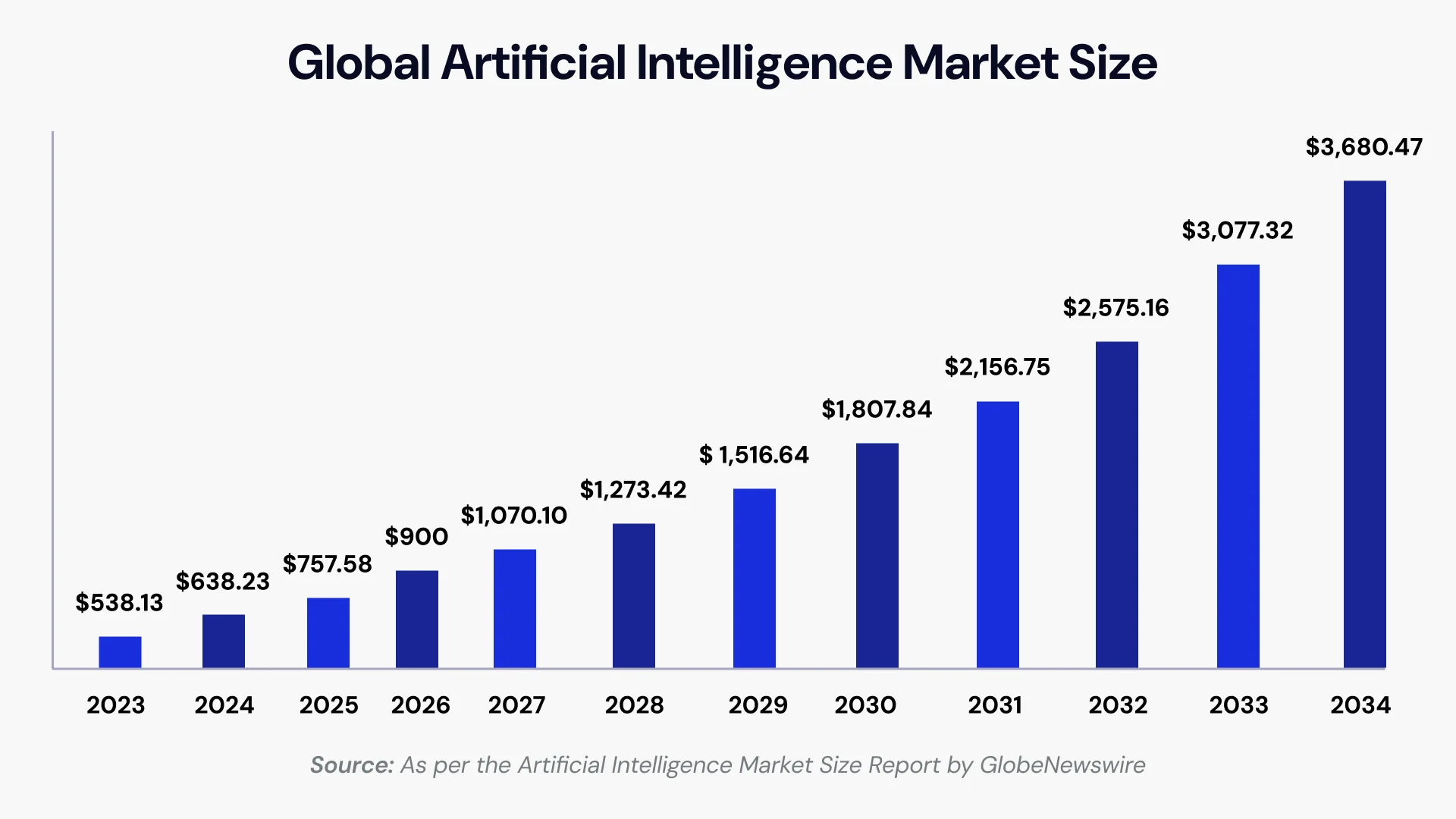
The proportion of companies planning to invest over $100,000/month in AI more than doubled from 20% to 45% in the same period. For startup founders and enterprise CXOs, this means one thing: the cost of not investing in AI is now higher than the cost of investing.
Here is what is driving the spend increase in AI software development:
- Talent scarcity: Senior AI engineers in the US earn $150,000–$200,000/year (source: APPWRK, 2025). Demand outstrips supply.
- Data complexity: Data preparation accounts for up to 40% of total AI project cost (Sparkout Tech, 2025).
- Infrastructure cost: Cloud GPU compute for training runs $2–$15/hour; H100-class GPUs cost ~$25,000/card.
- Regulatory pressure: Stanford's AI Index 2024 found that US AI regulations doubled YoY. Compliance adds 10–20% to budgets.
- Model retraining: AI models degrade over time (model drift). Annual maintenance runs 17–30% of the initial build cost.
Note: For teams comparing scope and budget, AI software development pricing in Dubai offers useful direction for planning timelines, resources, and delivery expectations.
Key Factors That Affect AI Software Development Cost
Every cost estimate begins with seven core variables. Understand these, and you can build a realistic budget — regardless of project type.
| Cost Factor | Impact & Range |
| Development Type (In-house vs Outsourced) | US in-house teams cost $50–$100+/hr. India-based outsourcing: $20–$50/hr. 50–70% cost reduction possible with no quality trade-off. |
| Project Complexity & AI Type | Basic rule-based systems: $5,000–$25,000. Mid-level NLP/CV apps: $25,000–$120,000. Enterprise deep learning: $150,000–$1,200,000+. |
| Data Preparation & Quality | Data accounts for up to 40% of total cost. Clean, labelled, structured data saves 30–50% on this phase. |
| Team Size & Composition | Typical AI team: data scientist, ML engineer, backend dev, QA engineer, PM. Even a small in-house AI team costs $400,000+/year in the US. |
| Third-Party API & Platform Costs | OpenAI, Azure AI, AWS Bedrock integrations: $5,000–$20,000 initial setup. High-traffic inference: $2,000–$10,000/month ongoing. |
| Cloud Infrastructure | GPU compute for training: $500–$5,000 per run. Production hosting: $1,000–$15,000/month depending on usage. |
| Post-Launch Maintenance | Budget 17–30% of initial build cost per year for monitoring, retraining, security patches, and compliance updates. |
AI Software Development Cost by Type & Complexity
The type of AI solution you build is the single biggest cost determinant. Here is a comprehensive breakdown:
| AI Type | Description | Cost (USD) | Cost (INR) | Timeline |
| AI Chatbot (Basic NLP) | FAQ bot, appointment booking, lead qual | $10,000–$50,000 | ₹8.3L–₹41.5L | 4–10 weeks |
| AI Chatbot (Advanced LLM) | GPT/Claude-powered, multi-turn, CRM integration | $50,000–$150,000 | ₹41.5L–₹1.25Cr | 8–20 weeks |
| Predictive Analytics / ML | Sales forecasting, churn, demand planning | $50,000–$200,000 | ₹41.5L–₹1.66Cr | 10–24 weeks |
| NLP / Text Intelligence | Sentiment analysis, document extraction, summarisation | $40,000–$180,000 | ₹33.2L–₹1.5Cr | 8–20 weeks |
| Computer Vision / Image AI | Object detection, medical imaging, quality control | $60,000–$300,000 | ₹49.8L–₹2.49Cr | 12–28 weeks |
| Recommendation Engine | Personalisation, collaborative filtering | $40,000–$150,000 | ₹33.2L–₹1.25Cr | 10–18 weeks |
| Fraud Detection System | Real-time scoring, ML model, data security | $50,000–$300,000 | ₹41.5L–₹2.49Cr | 12–24 weeks |
| Generative AI / LLM App | Fine-tuned or RAG-based proprietary AI system | $80,000–$500,000+ | ₹66.4L–₹4.15Cr+ | 16–40 weeks |
| Enterprise AI Platform | Multi-model, multi-department, API-driven | $200,000–$1,200,000+ | ₹1.66Cr–₹9.96Cr+ | 24–52+ weeks |
Developer Hourly Rates by Region (USA, Canada, India)
One of the most controllable cost levers is where you build. VLink operates across the USA, Canada, and India — giving clients a cost-optimised engagement model without sacrificing outcome quality.
| Role | USA ($/hr) | Canada ($/hr) | India ($/hr) | India (INR/hr) |
| AI/ML Engineer (Mid) | $90–$130 | $75–$110 | $25–$45 | ₹2,075–₹3,735 |
| AI/ML Engineer (Senior) | $130–$180 | $110–$150 | $40–$65 | ₹3,320–₹5,395 |
| Data Scientist | $100–$150 | $85–$120 | $30–$55 | ₹2,490–₹4,565 |
| LLM / GenAI Specialist | $150–$200 | $125–$165 | $45–$75 | ₹3,735–₹6,225 |
| ML Ops Engineer | $110–$160 | $90–$130 | $35–$60 | ₹2,905–₹4,980 |
| AI Project Manager | $80–$120 | $70–$100 | $20–$35 | ₹1,660–₹2,905 |
| Full-Stack AI Developer | $90–$140 | $75–$110 | $25–$50 | ₹2,075–₹4,150 |
Key Insight: Outsourcing software development from India with VLink saves 55–70% on team costs — with the same senior talent and timezone-aligned delivery.
Hidden Costs of AI Development Most Businesses Miss
Most budgets focus on build costs — and significantly underestimate the operational expenses that start from Day 1 of deployment. Here are the hidden AI software development cost drivers that catch founders off guard:
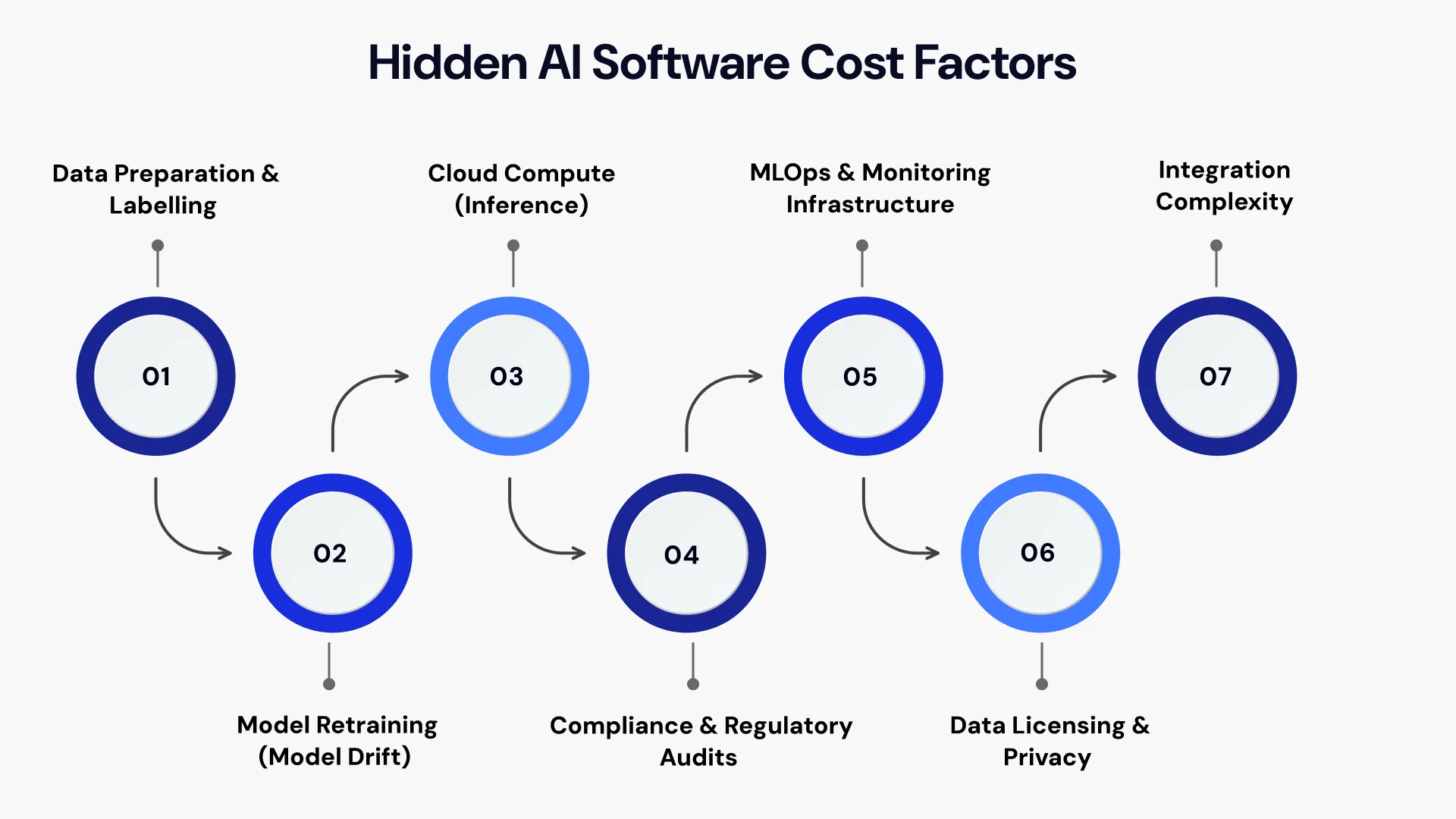
- Data Preparation & Labelling: Up to 40% of the total project cost. If your data is messy, unstructured, or requires custom annotation, this line item grows fast. Budget $5,000–$50,000 depending on dataset size and domain complexity.
- Model Retraining (Model Drift): AI models lose accuracy over time as real-world data patterns change. Expect to retrain quarterly or monthly. Annual retraining cost: 10–20% of the original model build cost.
- Cloud Compute (Inference): High-traffic AI applications spend $2,000–$10,000/month on API inference alone (source: Biz4Group 2025). GPU compute for training: $500–$5,000 per run.
- Compliance & Regulatory Audits: Healthcare AI requires HIPAA compliance. Fintech AI requires SOC2. The EU AI Act (2025) adds documentation requirements. Budget $10,000–$50,000 for regulated industries.
- MLOps & Monitoring Infrastructure: CI/CD pipelines, model registries, drift detection, A/B testing infrastructure. Often overlooked — adds 15–25% to infrastructure costs.
- Data Licensing & Privacy: Certain training datasets require licensing fees. GDPR/CCPA compliance requires anonymisation tools and legal review. Budget $5,000–$20,000 upfront.
- Integration Complexity: Connecting AI to your existing CRM, ERP, or data warehouse adds 15–25% to project cost. Legacy system integrations are the most expensive.
AI Development Cost by Industry Use Case
AI costs vary significantly by industry — driven by data sensitivity, compliance requirements, and model complexity. Here are 2026 benchmarks across key verticals:
| Industry | Use Case Example | Cost Range (USD) | Key Cost Driver | ROI Signal |
| Healthcare | Diagnostic AI, patient monitoring | $80,000–$500,000 | HIPAA compliance, medical data | 81% of healthcare orgs report revenue increase (NVIDIA 2025) |
| Fintech | Fraud detection, credit scoring | $60,000–$300,000 | Real-time inference, SOC2 | MasterCard-style fraud detection saves millions annually |
| eCommerce / Retail | Recommendation engine, personalisation | $40,000–$200,000 | Inventory data scale | Amazon-style recs: $50K–$250K depending on catalogue size |
| HR & Recruitment | Resume parsing, candidate ranking | $50,000–$150,000 | NLP model, ATS integration | 50%+ reduction in screening time |
| Manufacturing | Predictive maintenance, quality control | $100,000–$500,000 | Sensor data, edge deployment | 20–30% efficiency gain (VLink AI case study) |
| Customer Service | AI chatbot, voice assistant | $15,000–$150,000 | LLM inference volume | $40K chatbot automates $70K+ in annual manual labour |
| Legal / Compliance | Contract analysis, document review | $60,000–$250,000 | LLM fine-tuning, accuracy needs | 60–80% reduction in manual review hours |
How to Build an AI Solution: Step-by-Step Process
Understanding the development lifecycle helps you budget each phase accurately — and avoid the most common scope-creep traps.
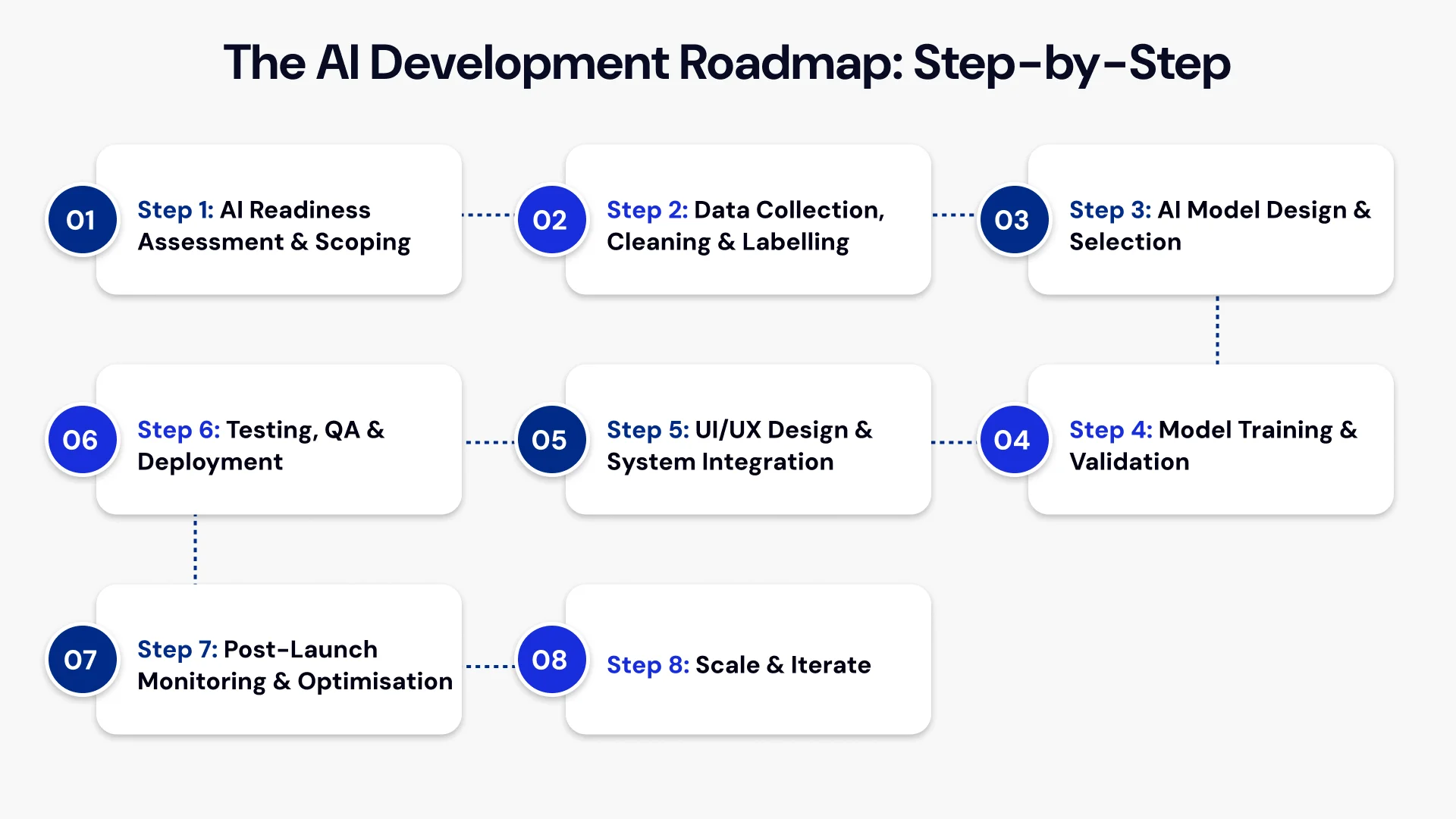
Step 1: AI Readiness Assessment & Scoping ($4,500–$28,000)
Define business objectives, validate AI feasibility, map data availability, and select the right AI approach (rule-based, ML, GenAI). Skipping this phase is how $50,000 projects become $150,000 projects (Aegis Softtech, 2026).
Step 2: Data Collection, Cleaning & Labelling ($5,000–$50,000)
Gather, structure, and label training data. Data preparation accounts for up to 40% of the total AI project cost. Clean pipelines save 30–50% vs. teams starting with raw, unstructured data.
Step 3: AI Model Design & Selection ($10,000–$80,000)
Choose between a custom ML model, a fine-tuned pre-trained model (GPT, Claude, LLaMA), or a third-party AI provider. Custom models have a higher upfront cost but lower long-term inference fees.
Step 4: Model Training & Validation ($15,000–$100,000)
Train using prepared datasets. A single GPU training run: $500–$5,000. Complex generative AI models require dozens of runs. Validate against accuracy, robustness, and fairness benchmarks.
Step 5: UI/UX Design & System Integration ($10,000–$60,000)
Build the user-facing interface with UI/UX developers' expertise and connect the AI model to your existing systems (CRM, ERP, database). Integration adds 15–25% to the project cost when legacy systems are involved.
Step 6: Testing, QA & Deployment ($8,000–$40,000)
Ideal software testing services for model drift, edge cases, security vulnerabilities, and performance under load. Includes staging environment setup and production deployment.
Step 7: Post-Launch Monitoring & Optimisation ($15,000–$60,000/year)
Continuous performance monitoring, retraining schedules, compliance updates, and feature enhancements. Budget 17–30% of the initial build cost annually for a production AI system.
Step 8: Scale & Iterate (Variable)
Once ROI is validated, expand the model to new use cases, geographies, or data sources. Modular architecture during build reduces the cost of future iterations by 30–40%.
ROI of AI Development-Is It Worth the Investment?
The question every CFO asks: when does AI start paying back? The short answer: faster than most expect. According to NVIDIA's 2025 Healthcare AI Report, nearly half of healthcare organisations achieved ROI within one year of deployment.
- The Strategic Summary
| AI Use Case | Investment | Annual Value Generated | Payback Period |
| AI Chatbot ($40K build) | $40,000 | $70,000+ in support hour savings | < 12 months |
| Predictive Maintenance ($120K) | $120,000 | 20–30% reduction in downtime costs | 12–18 months |
| Recommendation Engine ($80K) | $80,000 | 15–25% increase in order value | 12–18 months |
| Fraud Detection ($150K) | $150,000 | $300K–$1M+ in prevented fraud | < 12 months |
| HR Automation ($75K) | $75,000 | 50%+ reduction in screening cost | 12–24 months |
Note: McKinsey's State of AI 2025 found that companies redesigning workflows around AI see the highest bottom-line impact — not just those deploying tools.
How to Reduce AI Development Costs Without Cutting Corners
Smart founders reduce AI costs through architecture decisions — not by skimping on quality. Here are the most effective levers:
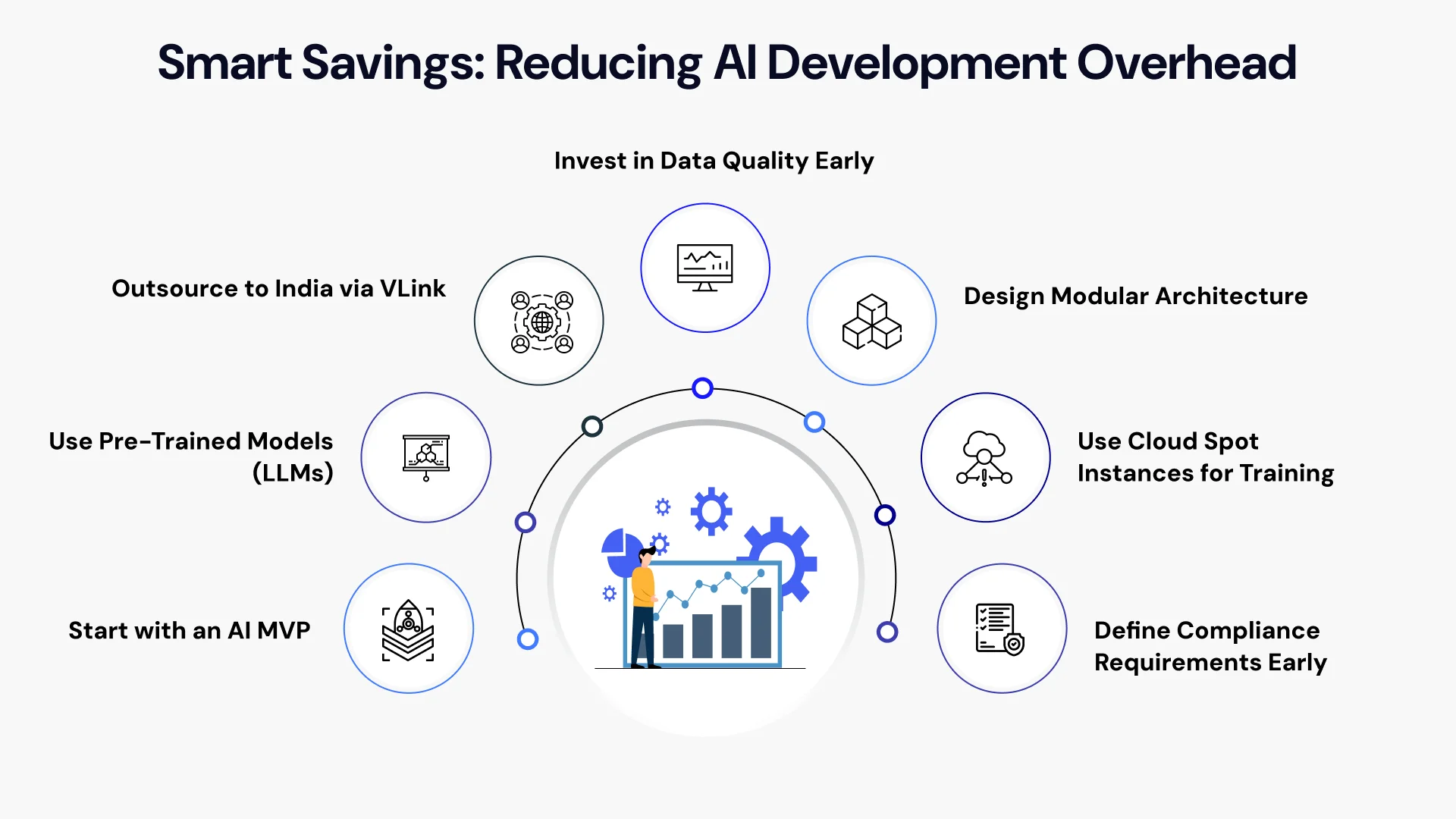
- Start with an AI MVP: Build a successful MVP targeting your single highest-ROI use case. Scale after validation. This reduces initial risk and investment by 40–60%.
- Use Pre-Trained Models (LLMs): Fine-tuning GPT, Claude, or LLaMA on your data is 60–80% cheaper than training from scratch. API costs are predictable and scale with usage.
- Outsource to India via VLink: Access senior AI engineers at $25–$65/hr vs $130–$200/hr for US-based equivalents. VLink provides time-zone-aligned, English-fluent teams.
- Invest in Data Quality Early: Messy data is the #1 budget killer. A $5,000 data audit upfront saves $30,000–$50,000 in rework costs during model training.
- Design Modular Architecture: Build reusable AI components (data pipelines, model wrappers, APIs). Modular design reduces the cost of future iterations by 30–40%.
- Use Cloud Spot Instances for Training: AWS, Azure, and GCP spot/preemptible instances cost 60–90% less than on-demand for non-time-critical training jobs.
- Define Compliance Requirements Early: Retrofitting HIPAA, SOC2, or GDPR compliance after build adds 25–40% to project cost. Build compliant from Day 1.
How to Monetize Your AI App?
Let's explore several different monetization methods to earn money from AI apps:
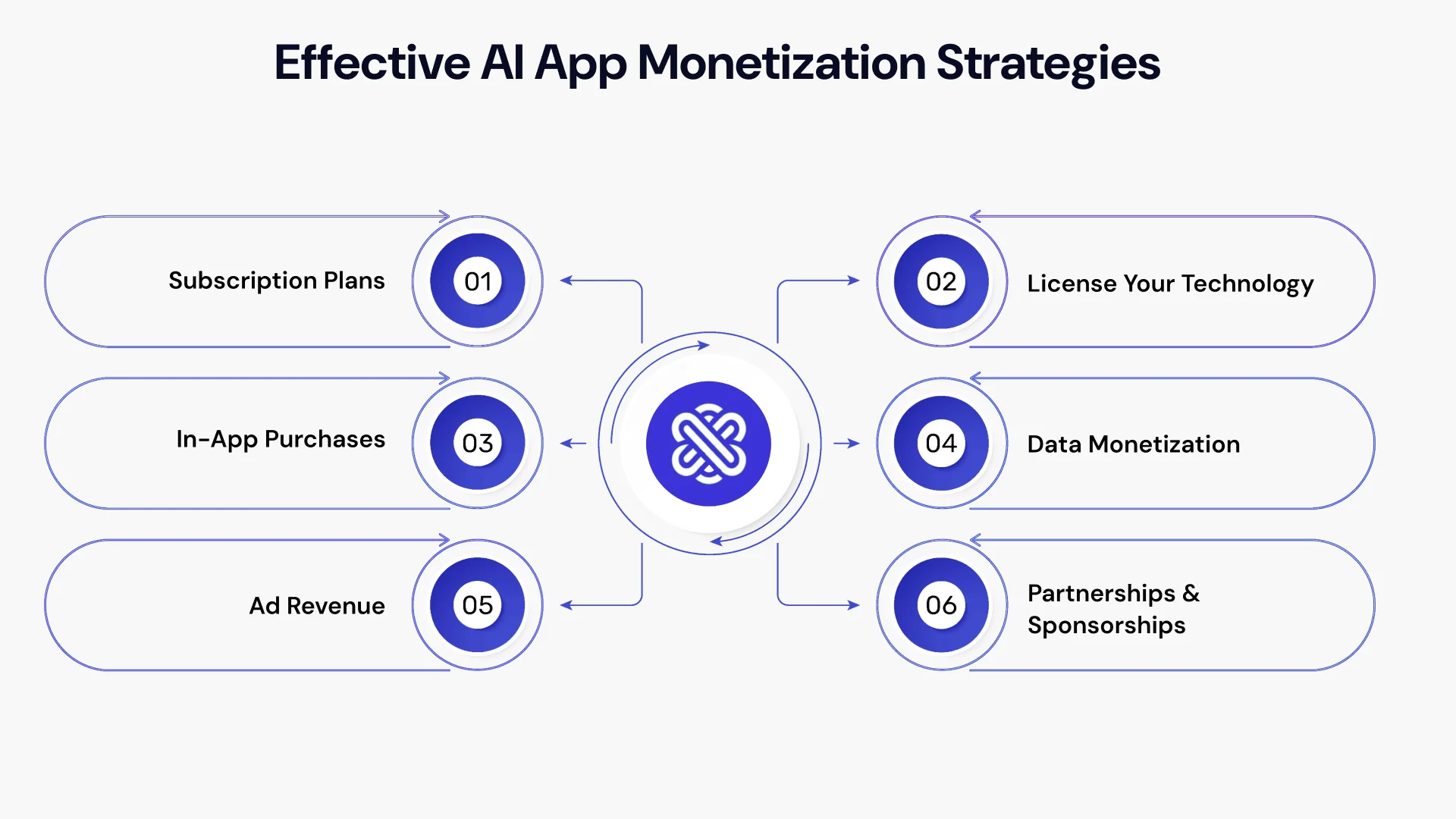
- Subscription Plans: Offer subscription tiers with premium features of an AI app. This monetization model provides a recurring revenue stream and encourages user loyalty through ongoing value delivery.
- In-App Purchases: Offer extra functionalities or content within the app for a one-time fee.
- Ad Revenue: Integrate advertisements within the app and earn money based on user engagement.
- License Your Technology: License your AI algorithms or app for use by other businesses.
- Data Monetization: Explore opportunities to monetize user data or aggregated insights by offering data analytics services to third-party organizations or market researchers. Data monetization can generate more revenue while ensuring user privacy and data security.
- Partnerships & Sponsorships: Collaborate with brands or companies for sponsored content or strategic partnerships.
Why Choose VLink for AI Software Development?
VLink is a trusted AI development company in India. By integrating state-of-the-art artificial intelligence technology, we provide robust AI software development solutions, ensuring an exceptional user experience. With an extensive track record and expertise in harnessing the power of AI, we help businesses stay ahead in the competitive market.
For businesses in the USA, Canada, and India evaluating AI development partners, VLink offers a differentiated value proposition:
- 650+ pre-vetted AI engineers across US, India, and Indonesia — deployed in 48 hours.
- Transparent, fixed-fee pricing with a Total Cost of Ownership (TCO) roadmap. No hidden costs.
- Fractional AI Teams model: access senior ML engineers, data scientists, and GenAI specialists at India rates.
- Data-First delivery: VLink solves 'garbage in, garbage out' with data auditing and automated monitoring before model build.
- Proven across 250+ brands — including Fortune 250 companies like Stanley Black & Decker, Schneider Electric, and Baystate Health.
- Ethical AI delivery: fairness checks, explainable AI (XAI) for analytics, bias mitigation, and compliance-first architecture.
- US-time-zone-aligned teams — with offices in Connecticut and Massachusetts for enterprise clients.
Our dedicated team strives to deliver an artificial intelligence-enabled system that not only meets but exceeds your expectations. Being a recognized AI development company, our professionals bring unmatched experience to the table. They also help you understand the factors affecting AI app development costs.
Conclusion
AI software development in 2026 is no longer a luxury reserved for Fortune 500 companies. With the right partner and a clear scoping strategy, a startup or mid-market enterprise can build production-grade AI for $50,000–$150,000 — and see positive ROI within 12–18 months.
The key is not to minimise cost — it is to maximise ROI per dollar invested. That means starting with an MVP, choosing pre-trained models where appropriate, investing in data quality, and partnering with a team that offers transparent pricing and TCO visibility.
- AI costs range from $25K (MVP) to $500K+ (enterprise) — choose the right tier for your stage.
- India-based outsourcing saves 55–70% on team costs with no quality trade-off.
- Data preparation (up to 40% of cost) and model drift (17–30% annual maintenance) are the biggest hidden costs.
- A well-scoped AI MVP generates positive ROI within 12–18 months in most use cases.
- VLink offers a free AI cost estimation call — no commitment, no generic answers.
Ready to Get Your AI Development Cost Estimate? VLink's AI architects will scope your project, identify the right approach, and provide a detailed cost breakdown — for free. No hidden fees. No lock-in. Book Your Consultation Today.

Vice President, Strategy – VLink Inc.
Sambhavi Gopalakrishnan is the Vice President of Strategy at VLink Inc., bringing over a decade of experience in IT leadership, project implementation, and strategic growth. She possesses a strong foundation in technical project management and pre-sales, driving innovation and business transformation at VLink.

 Shivisha Patel