


The capital markets landscape is experiencing a seismic shift. Legacy trading platforms that once powered billion-dollar transactions are now becoming operational liabilities, struggling to keep pace with real-time data demands, regulatory pressures, and competitive innovation.
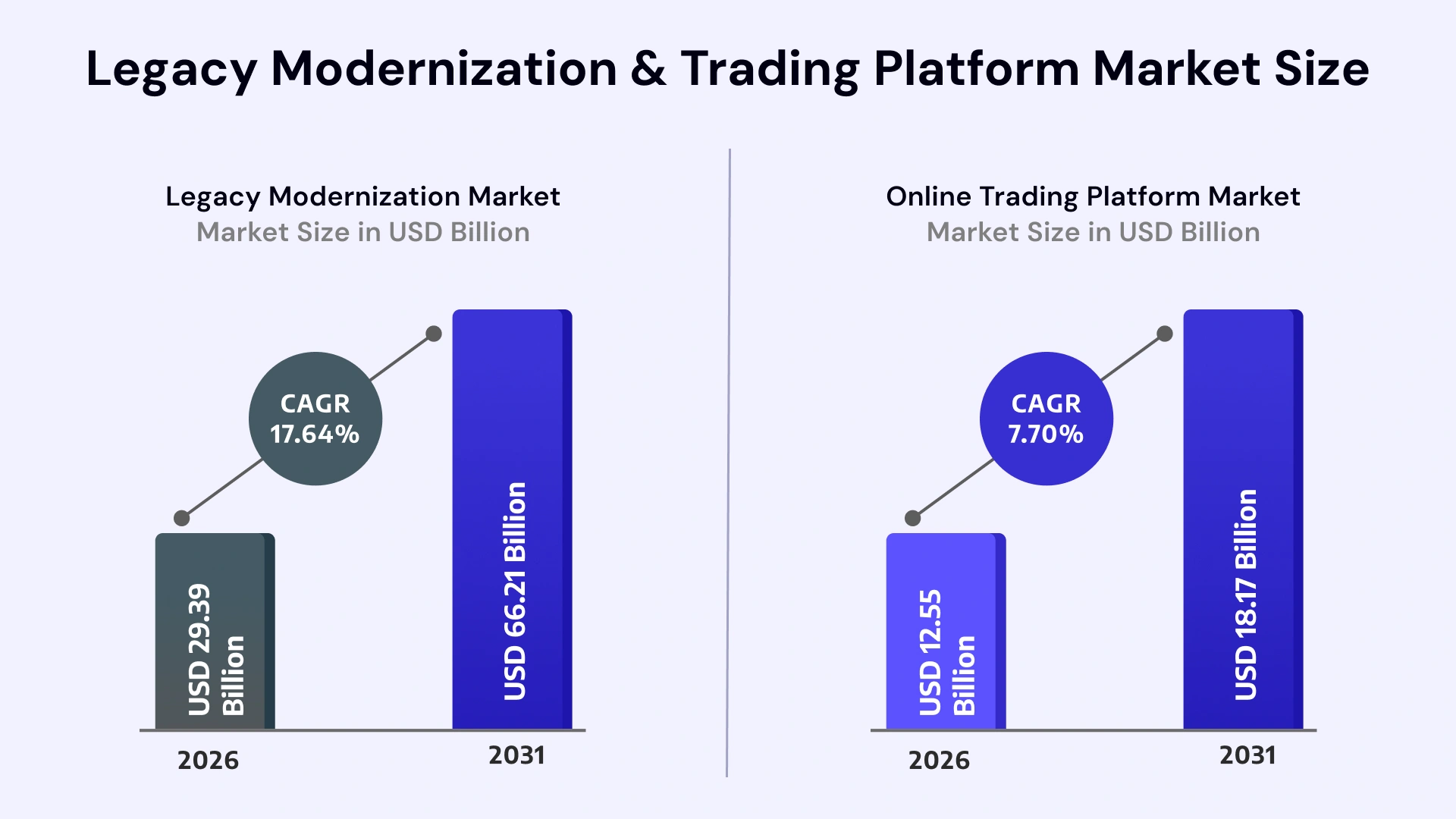
The challenge isn't just technological. Trading platform modernization represents a complex orchestration of business continuity, regulatory compliance, risk mitigation, and competitive positioning. A single miscalculation during migration can result in millions in lost revenue, regulatory penalties, or catastrophic system failures during peak trading hours.
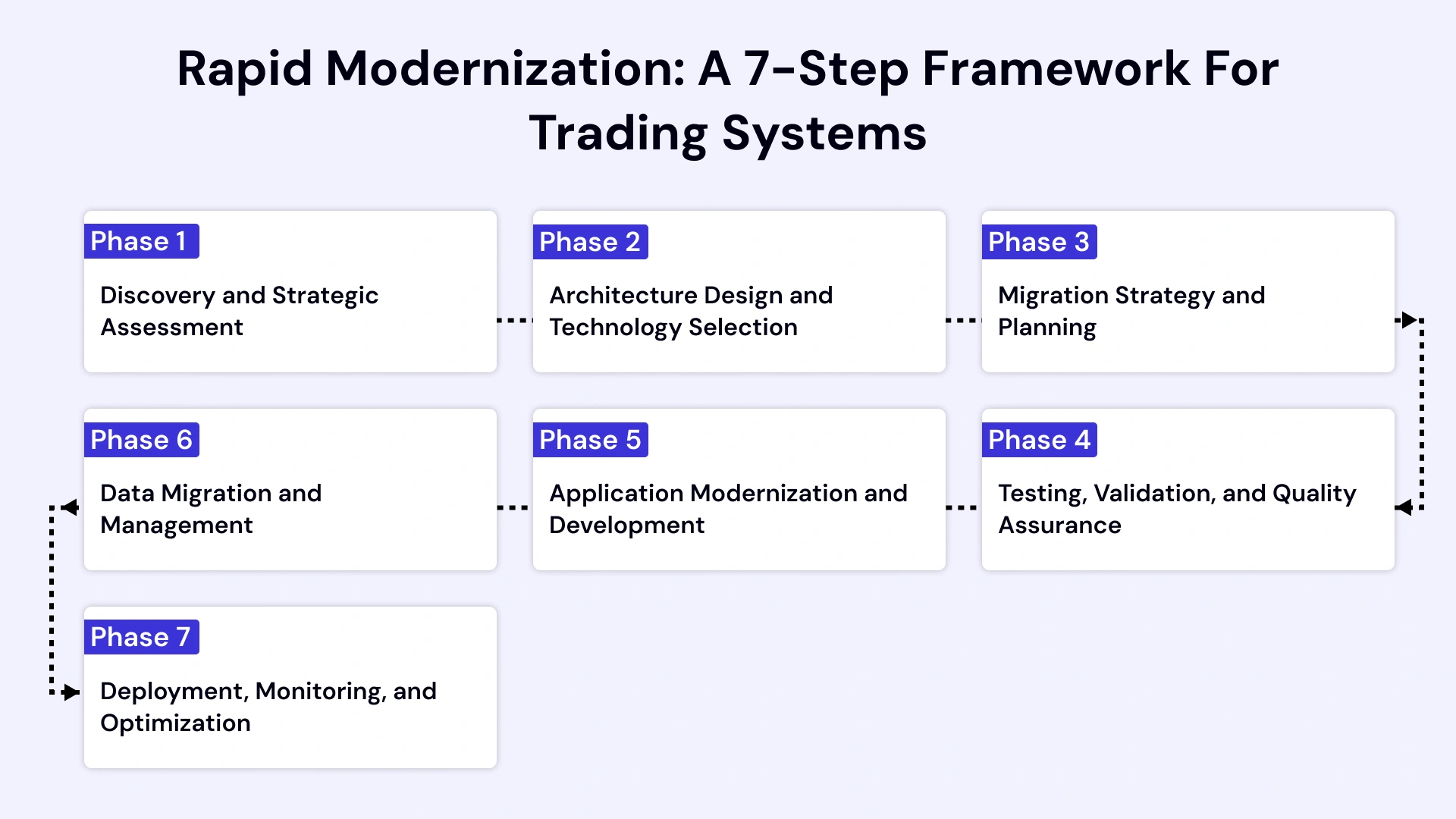
This comprehensive guide presents a battle-tested 7-phase trading platform modernization framework specifically designed for capital market firms. Drawing from real-world implementations across North American financial institutions, this framework addresses the unique complexities of modernizing mission-critical trading infrastructure while maintaining 24/7 operational continuity, ensuring regulatory compliance across multiple jurisdictions, and positioning your firm for sustained competitive advantage.
Whether you're a tier-one investment bank managing multi-billion-dollar daily volumes or a regional broker-dealer seeking competitive differentiation, this implementation guide provides the strategic roadmap, tactical playbook, and risk-mitigation strategies essential to a successful platform transformation.
Trading platforms benefit from microservices—microservices migration for trading platforms improves scalability and deployment velocity.
Understanding the Imperative for Trading Platform Modernization
In an industry where a millisecond can be the difference between profit and loss, relying on aging infrastructure is a risk few firms can afford. Modernization is no longer a luxury for the elite—it is the essential price of entry for staying relevant, secure, and agile in today’s hyper-connected global markets
The Cost of Inaction
Legacy trading platforms carry hidden costs that compound exponentially over time. Beyond the obvious costs of maintaining outdated technology—proprietary languages, scarce talent pools, and expensive vendor lock-ins—firms face strategic disadvantages that directly affect bottom-line performance.
Technical debt accumulates at an alarming rate. Systems built on monolithic architectures lack the agility to integrate emerging technologies like artificial intelligence, machine learning, and real-time analytics. According to industry research, firms spend up to 75% of their IT budgets on maintaining legacy systems, leaving minimal resources for innovation and competitive differentiation.
Operational inefficiencies plague legacy platforms. Manual reconciliation processes, siloed data architectures, and batch-processing limitations create friction that directly impacts trading performance. In microsecond-driven markets, these inefficiencies translate to measurable competitive disadvantages and revenue leakage.
Regulatory exposure intensifies as compliance requirements evolve. Legacy systems struggle to meet modern reporting standards, audit trail requirements, and cross-border regulatory frameworks. The inability to rapidly adapt to regulatory changes exposes firms to penalties, operational restrictions, and reputational damage.
Business Drivers for Modernization
Capital market IT services firm pursues platform modernization driven by compelling business imperatives that extend far beyond technology refresh cycles.
- Enhanced Trading Performance: Modern architectures deliver sub-millisecond latency, real-time risk analytics, and algorithmic trading capabilities that directly improve execution quality and profitability. Cloud-native platforms scale elastically to handle volume spikes during market volatility without performance degradation.
- Operational Efficiency: Automation reduces manual intervention throughout the trade lifecycle, from order routing through settlement and reconciliation. Integrated data architectures eliminate silos, reducing errors and accelerating time-to-insight for trading decisions.
- Regulatory Agility: Modern platforms incorporate compliance-by-design principles, with configurable rules engines, comprehensive audit trails, and automated reporting capabilities that adapt rapidly to regulatory changes across multiple jurisdictions.
- Innovation Enablement: Microservices architectures and API-first designs enable rapid integration of emerging technologies—machine learning models for predictive analytics, blockchain for settlement optimization, and advanced visualization tools for trader decision support.
- Cost Optimization: While modernization requires upfront investment, firms typically achieve a 30-40% reduction in total cost of ownership through infrastructure optimization, automation gains, and reduced vendor dependencies.
Future-Proofing Finance: The 7-Phase Modernization Framework
The journey from legacy trading infrastructure to modern, cloud-enabled platforms demands more than piecemeal upgrades. It requires a systematic approach that addresses technology, operations, compliance, and business strategy simultaneously.
Framework Principles:
- Business Continuity First: Every phase prioritizes uninterrupted trading operations. Migration strategies and deployment approaches incorporate safety mechanisms that protect revenue-generating activities during transformation.
- Risk-Calibrated Progression: Activities sequence from lower-risk assessments through progressively higher-stakes migration and deployment. This graduated approach builds organizational capability while limiting exposure at each stage.
- Incremental Value Delivery: Rather than waiting months for benefits, the phased approach delivers measurable improvements at each stage—performance optimizations, cost reductions, capability enhancements—that maintain stakeholder engagement.
- Regulatory Compliance Integration: Compliance isn't an afterthought. Each phase incorporates regulatory considerations—from requirements mapping in discovery through audit trail validation in deployment.
- Flexibility and Adaptability: While providing structured guidance, the framework accommodates dynamic capital markets environments through parallel workstreams, iterative refinement, and adaptive planning.
Now, let’s break down each 7-phase through the lens of strategic context, tactical execution, and the specific success criteria required for a seamless transition.
Phase 1: Discovery and Strategic Assessment
Current State Analysis
Successful modernization begins with comprehensive discovery. This critical phase establishes the baseline understanding necessary for informed decision-making and risk management throughout the transformation journey.
- Technology Inventory and Dependency Mapping: Document the complete technology landscape, including application portfolios, infrastructure components, data repositories, integration points, and third-party dependencies. Legacy trading platforms often comprise hundreds of interconnected components accumulated over decades. Understanding these dependencies prevents cascading failures during cloud migration consulting services.
- Performance Baseline Establishment: Quantify current-state performance metrics across critical dimensions—transaction latency, throughput capacity, system availability, error rates, and recovery time objectives. These baselines provide objective success criteria for the modernized platform and identify priority areas for improvement.
- Data Architecture Assessment: Map data flows, storage architectures, and integration patterns. Legacy systems typically struggle with data fragmentation, inconsistent schemas, and batch-oriented processing. Understanding data architecture complexity informs migration sequencing and identifies opportunities for consolidation and optimization.
- Regulatory and Compliance Review: Catalog for all applicable regulatory requirements—MiFID II, Reg NMS, CAT reporting, EMIR, and jurisdiction-specific mandates. Identify compliance gaps in the current platform and define requirements that the modernized system must address.
Business Case Development
Transform technical assessments into compelling business cases that secure stakeholder commitment and investment approval.
- Total Cost of Ownership Analysis: Quantify current platform costs across all dimensions—infrastructure, licensing, maintenance, support, compliance, and opportunity costs from system limitations. Project these costs over 5-7-year horizons to demonstrate the escalating burden of maintaining legacy systems.
- Value Realization Framework: Define measurable business outcomes—reduced latency targets, increased trading capacity, automation-driven cost savings, faster time-to-market for new products, and regulatory risk mitigation. Assign financial values to these outcomes to build ROI models that resonate with executive stakeholders.
- Risk Assessment and Mitigation: Identify transformation risks—business continuity threats, migration complexity, regulatory exposure, budget overruns, and timeline extensions. Develop risk mitigation strategies and contingency plans that demonstrate thorough planning and build stakeholder confidence.
- Phased Investment Roadmap: Structure modernization as a multi-phase journey with incremental value delivery rather than a big-bang transformation. This approach reduces risk, demonstrates early wins, and maintains stakeholder engagement throughout multi-year initiatives.
Phase 2: Architecture Design and Technology Selection
Target Architecture Definition
Modern trading platforms require architectural approaches fundamentally different from legacy monolithic designs.
- Microservices Architecture: Decompose monolithic trading applications into discrete, independently deployable services—order management, execution management, risk calculation, market data distribution, and position management. This modularity enables independent scaling, technology diversity, and isolated failure domains, thereby improving overall system resilience.
- Event-Driven Design: Implement event streaming architectures using platforms like Apache Kafka or AWS Kinesis to enable real-time data flow across trading platform components. Event-driven architectures support the sub-millisecond responsiveness required for modern algorithmic trading while providing comprehensive audit trails for regulatory compliance.
- Cloud-Native Infrastructure: Design for cloud deployment leveraging containerization (Kubernetes), serverless computing for specific workloads, and managed services that eliminate undifferentiated infrastructure management. Hybrid cloud strategies balance performance requirements for ultra-low-latency trading with cost optimization for analytics and back-office functions.
- API-First Integration: Establish standardized API layers using RESTful and GraphQL interfaces that enable seamless integration with market data providers, execution venues, risk systems, and downstream applications. Well-designed APIs future-proof the platform for emerging integration requirements.
Technology Stack Selection
Strategic technology choices determine long-term platform sustainability and competitive positioning.
- Core Trading Engine Technologies: Evaluate modern programming languages and frameworks optimized for high-frequency trading—Rust and Go for ultra-low latency components, Java and Python for business logic and analytics. Consider specialized trading platforms versus custom development based on differentiation requirements.
- Data Management Solutions: Select database technologies aligned with specific workload characteristics—in-memory databases (Redis, Hazelcast) for real-time data, time-series databases (InfluxDB, TimescaleDB) for market data and analytics, and distributed SQL databases for transactional consistency.
- Cloud Platform Evaluation: Assess major cloud providers (AWS, Azure, GCP) based on trading-specific capabilities—network latency to major exchanges, specialized financial services offerings, regulatory compliance certifications, and total cost of ownership across compute, storage, and data transfer.
- Integration and Middleware: Evaluate enterprise service bus solutions, API gateways, and message brokers that provide the connectivity fabric for complex trading ecosystems while maintaining performance, reliability, and security requirements.
Phase 3: Migration Strategy and Planning
Migration Approach Selection
Different migration strategies balance risk, timeline, and business impact considerations.
- Strangler Fig Pattern: Incrementally replace legacy functionality with modern components while maintaining the existing system as a functioning whole. New features route to modernized services while legacy functions continue on the old platform. This approach minimizes risk but extends transformation timelines.
- Parallel Run Strategy: Build the modernized platform alongside legacy systems and operate both in parallel during transition periods. This approach provides rollback safety nets but doubles operational complexity and cloud infrastructure services costs during migration.
- Big Bang Migration: Replace legacy systems in a single coordinated transition, typically during extended market closures. This approach minimizes dual-system complexity but concentrates risk and requires exceptional planning and testing discipline.
- Hybrid Modular Approach: Combine strategies based on component criticality and business impact. Core trading functions might use parallel run strategies, while back-office components migrate using the strangler pattern. This balanced approach optimizes risk management while maintaining momentum for transformation.
Migration Sequencing
Strategic sequencing accelerates value delivery while managing complexity and risk.
- Non-Critical Components First: Begin with lower-risk, lower-impact systems—such as reporting modules, analytics platforms, or back-office functions. These early migrations build team capability, validate migration processes, and deliver early wins without jeopardizing critical trading operations.
- Data Migration Foundation: Prioritize modernizing the data architecture early in the transformation. Migrating reference data, historical market data, and client information establishes the foundation for subsequent application migrations and enables parallel development tracks.
- Progressive Core System Migration: Sequence critical trading components based on dependencies and business impact—market data ingestion, order management, execution management, position management, and risk calculation. Each component migration builds upon previous successes while incrementally reducing the legacy system footprint.
- Integration Layer Implementation: Deploy modern integration architecture early to support both legacy and modernized components during transition. This approach enables gradual migration while maintaining end-to-end trading workflows across hybrid environments.
Phase 4: Data Migration and Management
Data Assessment and Preparation
Data migration represents one of the most complex and risk-prone aspects of platform modernization.
- Data Quality Analysis: Audit legacy data for completeness, accuracy, consistency, and currency. Legacy trading platforms often accumulate decades of inconsistent data—duplicate records, orphaned transactions, inconsistent reference data, and incomplete audit trails. Addressing quality issues before migration prevents problems from propagating into modern systems.
- Data Mapping and Transformation: Define mappings between legacy and target data schemas and identify transformations required for data type conversions, format standardization, and structural reorganization. Trading data migrations must preserve transaction integrity and regulatory audit trails while optimizing for modern analytics capabilities.
- Historical Data Strategy: Determine retention requirements for historical trading data based on regulatory mandates, business analytics needs, and storage cost considerations. Develop tiered storage strategies that balance performance for recent data with cost-effective archival for regulatory compliance.
- Data Cleansing and Enrichment: Implement automated and manual processes to correct data quality issues, standardize formats, eliminate duplicates, and enrich records with missing information. Clean data migration reduces downstream operational issues and improves the accuracy of analytics.
Migration Execution
Execute data migration with precision, using controls that ensure data integrity while minimizing business impact.
- Pilot Migrations: Conduct small-scale pilot migrations to validate processes, identify issues, and refine procedures before full-scale execution. Pilot migrations build confidence and enable process optimization without risking production data.
- Incremental Migration: Transfer data in manageable batches rather than in a single large-scale migration. Incremental approaches enable validation checkpoints, reduce resource contention, and provide rollback capabilities if issues emerge.
- Validation and Reconciliation: Implement comprehensive validation processes that compare source and target data across multiple dimensions—record counts, data values, relationship integrity, and business rule compliance. Automated reconciliation tools identify discrepancies for investigation and resolution.
- Cutover Planning: Develop detailed cutover procedures that coordinate data synchronization, system switchover, and validation activities during the transition window. Trading platform cutovers require military-precision timing to minimize market exposure and maintain regulatory compliance.
Phase 5: Application Modernization and Development
Legacy Code Transformation
Modernizing trading applications requires a strategic approach that balances risk, cost, and business value.
- Replatform Strategy: Migrate existing applications to modern infrastructure with minimal code changes—containerization, cloud deployment, database upgrades. This approach delivers quick wins in operational efficiency and cost reduction while deferring more complex code modernization.
- Refactor for Cloud: Restructure applications to leverage cloud-native capabilities—auto-scaling, managed services, serverless computing. Refactoring optimizes cost and performance while maintaining existing business logic and reducing transformation risk.
- Rearchitect for Modernization: Redesign applications using modern architectural patterns—microservices decomposition, event-driven processing, API-first design. This approach delivers maximum long-term value but requires significant investment and carries transformation complexity.
- Replace with COTS or SaaS: Evaluate commercial trading platforms or Software-as-a-Service offerings for non-differentiating functions. Strategic replacement reduces the maintenance burden of custom code and accelerates access to innovative capabilities.
Development and Integration
Build modernized trading capabilities with disciplined engineering practices that ensure quality and reliability.
- Agile Development Methodology: Implement iterative development with short sprint cycles that deliver incremental functionality, enabling continuous stakeholder feedback and adaptive planning. Agile approaches suit the evolving requirements typical of complex trading platform projects.
- API Development and Management: Design comprehensive API layers that enable integration across modernized and legacy components during transition and provide long-term flexibility for ecosystem expansion. API gateways provide security, monitoring, and version management capabilities.
- Testing Automation: Develop extensive automated test suites—unit tests, integration tests, performance tests, and end-to-end workflow validation. Trading platform quality requirements demand testing discipline that manual approaches cannot sustain.
- Continuous Integration/Continuous Deployment: Building CI/CD pipelines to automate build, testing, and deployment. Automation accelerates delivery velocity while reducing human error and enabling rapid rollback if issues emerge in production.
Phase 6: Testing, Validation, and Quality Assurance
Comprehensive Testing Strategy
Trading platform modernization demands rigorous testing across multiple dimensions to ensure reliability, performance, and regulatory compliance.
- Functional Testing: Validate that modernized components correctly implement all business requirements—order processing logic, pricing calculations, risk rules, and regulatory reporting. Functional testing ensures feature parity with legacy systems modernization services in Canada or the USA and validates new capabilities.
- Performance and Load Testing: Simulate production trading volumes and market conditions to validate latency targets, throughput capacity, and system stability under stress. Performance testing identifies bottlenecks and validates auto-scaling behaviors before production deployment.
- Disaster Recovery Testing: Validate recovery time objectives and recovery point objectives through simulated failure scenarios, including infrastructure outages, data corruption, and cascading failures. DR testing ensures business continuity capabilities meet operational requirements.
- Security and Penetration Testing: Conduct comprehensive security assessments, including penetration testing, vulnerability scanning, and security code reviews. Trading platforms are high-value targets that require defense-in-depth security, validated through adversarial testing.
User Acceptance and Training
Successful modernization requires user adoption and operational readiness beyond technical implementation.
- User Acceptance Testing: Engage traders, operations staff, compliance teams, and business stakeholders in structured UAT processes that validate real-world workflows and identify usability issues before production release.
- Training Program Development: Create role-based training programs that prepare users for modernized platform capabilities, changed workflows, and new operational procedures. Effective training accelerates adoption and reduces post-deployment support burden.
- Documentation and Knowledge Transfer: Develop comprehensive technical documentation, operational runbooks, and troubleshooting guides that enable support teams to maintain the modernized platform independently.
Phase 7: Deployment, Monitoring, and Optimization
Production Deployment
Execute production deployment with controlled rollout strategies that minimize business risk.
- Phased Rollout Strategy: Deploy modernized capabilities to limited user populations or trading desks before full production release. Phased rollouts enable production validation with a controlled blast radius if issues emerge.
- Blue-Green Deployment: Maintain parallel production environments—existing (blue) and modernized (green)—with the ability to rapidly switch traffic between environments. This approach enables instant rollback if critical issues surface post-deployment.
- Canary Releases: Route small percentages of production traffic to new capabilities while monitoring performance and error rates. Gradual traffic increase based on success metrics reduces deployment risk while enabling early issue detection.
- Deployment Automation: Implement infrastructure-as-code and automated deployment pipelines that ensure consistent, repeatable deployments across environments. Automation reduces human error and accelerates deployment velocity.
Continuous Monitoring and Optimization
Operational excellence requires comprehensive monitoring and continuous improvement discipline.
- Real-Time Performance Monitoring: Implement comprehensive observability—metrics collection, log aggregation, and distributed tracing—that provides real-time visibility into system health, performance, and business metrics. Trading platforms require sub-second alerting for performance degradation or failures.
- Business Metrics Tracking: Monitor trading-specific KPIs—order-to-execution latency, fill rates, slippage, system uptime, and daily trading volumes. Business metrics validate that technical modernization delivers intended business outcomes.
- Incident Response Procedures: Establish clear incident management processes, including on-call rotations, escalation procedures, communication protocols, and post-incident review practices. Structured incident response minimizes business impact and drives continuous improvement.
- Continuous Optimization: Analyze performance data, user feedback, and business metrics to identify opportunities for optimization. Platform modernization is a continuous journey that requires ongoing refinement in response to changing market conditions and business requirements.
Modernize Without Meltdown: Key Pitfalls and Proven Solutions
Even well-planned modernization initiatives can stumble when firms overlook critical risk factors or underestimate the complexity of transformation. Understanding common pitfalls enables proactive mitigation strategies that protect timelines, budgets, and business continuity.
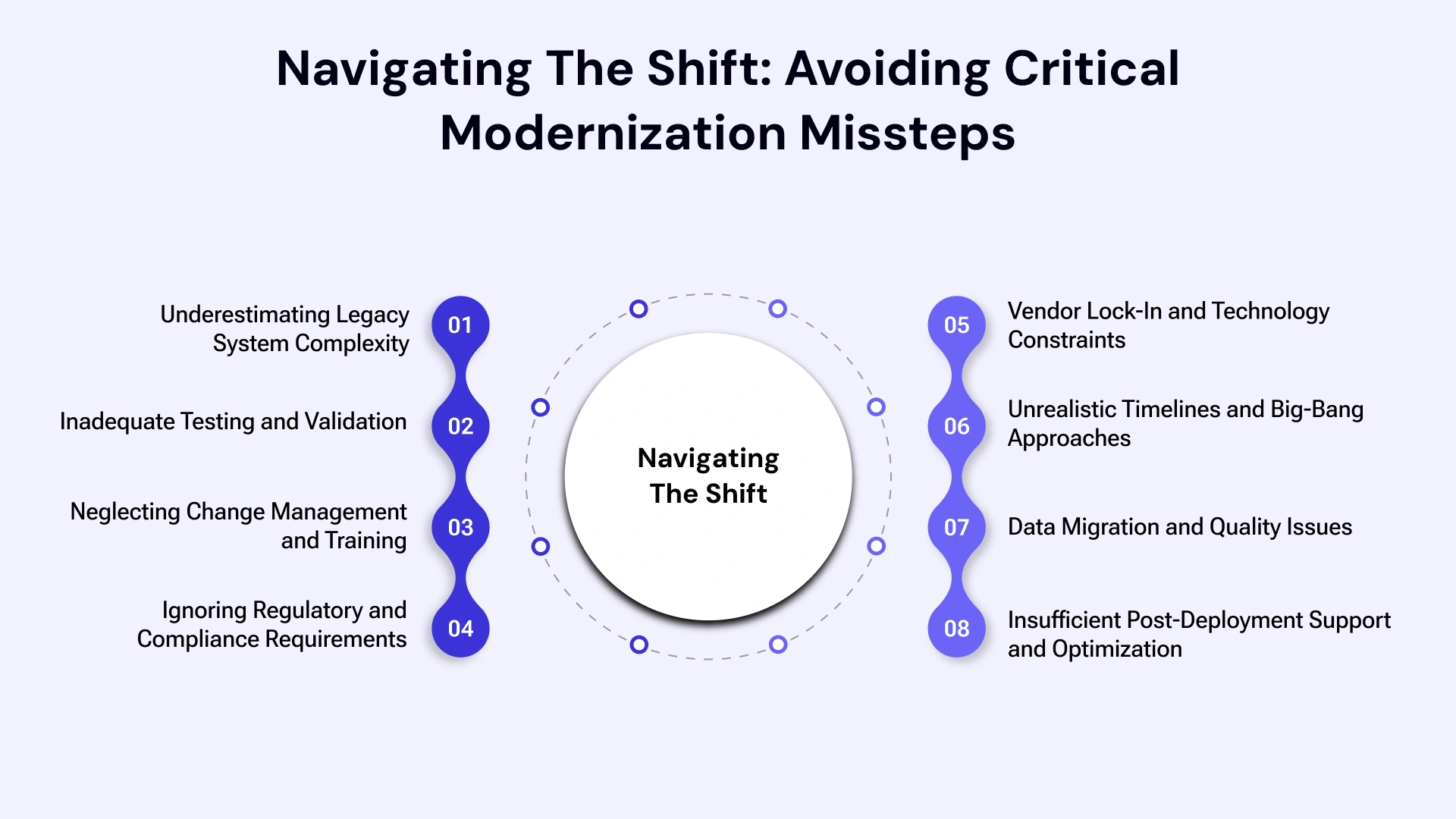
Underestimating Legacy System Complexity
- The Pitfall: Firms frequently discover hidden dependencies, undocumented customizations, and technical debt far exceeding initial estimates. Legacy trading platforms accumulate decades of modifications, workarounds, and tribal knowledge that surface only during deep technical discovery.
- How to Avoid: Invest adequate time in Phase 1 discovery activities. Conduct comprehensive code analysis, interview long-tenured technical staff, document all integration points, and assume complexity is 30-40% greater than initial assessments. Build contingency buffers into project plans and budgets based on realistic assumptions about complexity.
Inadequate Testing and Validation
- The Pitfall: Compressed timelines and budget pressures often result in abbreviated testing cycles. Insufficient performance testing, limited disaster recovery validation, and rushed user acceptance testing create deployment risks that manifest as production failures, data integrity issues, or regulatory compliance gaps.
- How to Avoid: Establish non-negotiable testing requirements, including comprehensive functional testing, load testing at 150% of peak volume, full disaster recovery scenarios, security penetration testing, and structured UAT with actual trading-desk participation. Allocate 25-30% of the project timeline to testing and validation activities.
Neglecting Change Management and Training
- The Pitfall: Focusing exclusively on technical implementation while underinvesting in organizational change management leads to user resistance, adoption challenges, and suboptimal utilization of modernized capabilities. Even technically successful platforms fail to deliver business value when users lack adequate training or stakeholder buy-in.
- How to Avoid: Establish dedicated change management workstreams from project inception. Develop comprehensive training programs tailored to different user roles, create clear communication plans that maintain stakeholder engagement, identify executive champions who advocate for transformation, and allocate sufficient resources for post-deployment support during the critical adoption period.
Ignoring Regulatory and Compliance Requirements
- The Pitfall: Treating compliance as a final-phase checklist activity rather than an integrated design consideration leads to costly rework, deployment delays, and potential regulatory exposure. Modern trading platforms must meet complex requirements across multiple jurisdictions, including MiFID II, CAT reporting, EMIR, and regional mandates.
- How to Avoid: Engage compliance teams during architecture design phases. Map all applicable regulatory requirements early in discovery, incorporate compliance-by-design principles into technical specifications, establish regulatory validation checkpoints at each phase milestone, and consider engaging specialized regulatory consultants for complex multi-jurisdictional requirements.
Vendor Lock-In and Technology Constraints
- The Pitfall: Selecting proprietary technologies, closed ecosystems, or vendor-specific architectures creates long-term dependencies that limit flexibility, increase costs, and constrain future innovation. Trading platforms require 10-15-year operational lifespans—technology choices made today create strategic constraints for years to come.
- How to Avoid: Prioritize open standards, API-first architectures, and cloud-agnostic designs where feasible. Evaluate the total cost of ownership, including exit costs and migration complexity. Implement abstraction layers that isolate vendor-specific dependencies and maintain optionality for future technology evolution. Balance pragmatic vendor selection with strategic independence.
Unrealistic Timelines and Big-Bang Approaches
- The Pitfall: Aggressive timelines that underestimate the complexity of transformation or big-bang migration strategies that attempt to complete a platform replacement in a single deployment concentrate risk and increase the probability of failure. Market pressure for rapid results often drives unrealistic expectations.
- How to Avoid: Adopt phased migration strategies that deliver incremental value while managing risk. Establish realistic timelines based on similar firm experiences and industry benchmarks. Prioritize components based on business value and technical risk. Communicate transparently with stakeholders about realistic transformation durations—typically 18-36 months for comprehensive modernization.
Data Migration and Quality Issues
- The Pitfall: Underestimating data migration complexity, inadequate data quality assessment, and insufficient validation processes lead to integrity issues that undermine the reliability of the modernized platform. Trading platforms rely on decades of historical data, complex reference data relationships, and stringent audit-trail requirements.
- How to Avoid: Conduct thorough data quality audits during discovery; implement comprehensive data cleansing processes before migration; develop detailed data mapping and transformation specifications; execute pilot migrations to validate processes; and establish rigorous reconciliation procedures to verify data integrity across multiple dimensions.
Insufficient Post-Deployment Support and Optimization
- The Pitfall: Declaring success during initial deployment without adequate support resources, performance monitoring, or continuous optimization leads to gradual performance degradation, user frustration, and unrealized business value. Modernization delivers full value only through ongoing refinement based on production learnings.
- How to Avoid: Plan for sustained post-deployment support, including dedicated support teams, comprehensive monitoring and observability infrastructure, clear incident response procedures, regular performance optimization reviews, and continuous improvement processes that incorporate user feedback and changing business requirements.
Learning from these common pitfalls enables firms to navigate the complexity of modernization with greater confidence and a higher probability of success. The frameworks, strategies, and risk mitigation approaches outlined in this guide directly address these challenges, providing structured pathways to protect investments while accelerating the delivery of business value.
Leverage VLink Expertise for Legacy System Modernization
Navigating the complexities of trading platform modernization requires specialized expertise that combines deep capital markets domain knowledge with cutting-edge technology capabilities. VLink brings over a decade of experience delivering legacy systems modernization services tailored for capital market firms across the USA and Canada.
Our proven track record includes successful transformations of mission-critical trading infrastructure for tier-one investment banks, regional broker-dealers, and specialized trading firms. We understand the unique challenges of maintaining 24/7 operational continuity during migration, navigating complex regulatory requirements across multiple jurisdictions, and managing the technical intricacies of high-frequency trading systems.
VLink's comprehensive service portfolio addresses every aspect of your modernization journey—from initial strategic assessment and architecture design through managed cloud services and ongoing optimization. Our capital market IT services are built on industry-leading frameworks, battle-tested methodologies, and a deep commitment to your business success.
Whether you're planning a complete platform transformation or targeted modernization of specific components, VLink's team of capital markets specialists and cloud infrastructure experts provides the guidance, execution capabilities, and ongoing support essential for successful outcomes.
Partner with VLink to transform your legacy trading infrastructure into a competitive advantage. Contact our capital markets modernization team today to discuss your specific requirements and explore how our proven framework can accelerate your transformation journey.
Conclusion
Trading platform modernization represents one of the most strategically important initiatives capital market firms will undertake. The 7-phase framework outlined in this guide provides a comprehensive roadmap for navigating this complex transformation—from initial discovery through ongoing optimization.
Success requires more than technical execution. Effective modernization balances business continuity with innovation velocity, manages regulatory compliance alongside competitive differentiation, and delivers measurable business value while building sustainable long-term capabilities.
The capital markets landscape continues evolving at an accelerating pace. Firms that successfully modernize their trading infrastructure position themselves to capitalize on emerging opportunities, including artificial intelligence-driven trading strategies, real-time risk analytics, multi-asset execution capabilities, and seamless integration with evolving market structures.
The cost of inaction compounds daily. Legacy platforms that sufficed yesterday create competitive disadvantages tomorrow. Market dynamics, regulatory pressures, and technological evolution have created an inflection point at which modernization transitions from a strategic option to an existential necessity.
Begin your modernization journey today. Conduct strategic assessments, build stakeholder alignment, and develop phased roadmaps that balance ambition with pragmatism. With disciplined execution guided by proven frameworks, your firm can transform legacy constraints into competitive advantages that drive sustained business success.

Global Delivery Manager, VLink Inc.
Shivisha Patel serves as the Global Delivery Manager at VLink Inc., bringing a wealth of experience in program delivery and management, particularly in the insurance and banking sectors. She has a robust technical background with deep expertise in WebSphere MQ, WTX, IIB, middleware, and enterprise system integration.

 Shivisha Patel