


More enterprises are running workloads across AWS, Azure, and Google Cloud simultaneously; not by accident, but by design. Whether it's avoiding vendor lock-in, meeting data residency requirements across regions, or taking advantage of each provider's specialized services, multicloud architecture has moved from an edge-case strategy to a mainstream enterprise decision.
But "multicloud" isn't a single technical pattern; it's a spectrum of approaches with very different implementation complexity, cost implications, and operational overhead. This multicloud strategy guide breaks down what enterprise multicloud architecture actually looks like, the real benefits and challenges organizations encounter, and the best practices that separate a well-orchestrated multicloud environment from an expensive, fragmented mess.
Search interest around multicloud guides, enterprise multicloud strategy, and multicloud vs. hybrid cloud has grown as more organizations move from ad hoc multi-provider usage- a team here uses AWS, a team there uses Azure- toward a deliberate, governed enterprise multicloud architecture. The difference matters enormously. Unplanned multicloud sprawl creates duplicated tooling, inconsistent security postures, and cost visibility gaps. A properly architected multicloud strategy, by contrast, delivers genuine resilience, negotiating leverage, and access to each provider's best-in-class services.
This multicloud guide walks through exactly how to build a multicloud strategy the right way, starting with a clear understanding of what multicloud actually means, how it differs from hybrid cloud, the tangible benefits and real implementation challenges, and the best practices that make enterprise multicloud architecture sustainable at scale.
What Is Enterprise Multicloud Architecture?
Enterprise multicloud architecture refers to the deliberate use of two or more public cloud providers- typically AWS, Microsoft Azure, and Google Cloud Platform- to run different workloads based on each provider's strengths, cost structure, regional availability, or specific managed services.
This is distinct from simply "having accounts" on multiple clouds; a true multicloud architecture involves coordinated governance, identity management, networking, and cost visibility across all providers as a unified operating model.
Multicloud vs Hybrid Cloud: Understanding the Difference
One of the most common points of confusion in this space is multicloud vs hybrid cloud strategy. While related, they solve different problems:
- Multicloud distributes workloads across two or more public cloud providers (e.g., running analytics on Google Cloud while hosting core applications on Azure), primarily to avoid vendor lock-in and access best-of-breed services.
- Hybrid cloud combines public cloud infrastructure services with private, on-premises infrastructure, primarily to support legacy systems, meet strict data residency requirements, or maintain control over specific regulated workloads.
Many enterprises actually run a combined multi-cloud vs. hybrid cloud approach, using multiple public clouds alongside a retained on-premises footprint; rather than choosing strictly one model over the other. Understanding which problem you're solving (vendor flexibility vs. legacy/compliance integration) should drive the architecture decision, not the reverse.
Multicloud Benefits: Why Enterprises Invest in a Multi-Provider Strategy
A multicloud strategy- utilizing cloud computing services from two or more public cloud providers (such as AWS, Microsoft Azure, and Google Cloud Platform) has become the operational norm for modern enterprises. Rather than relying on a single vendor, organizations intentionally distribute their workloads to maximize agility, performance, and risk management.
The core benefits of adopting a multi-provider strategy are as follows:
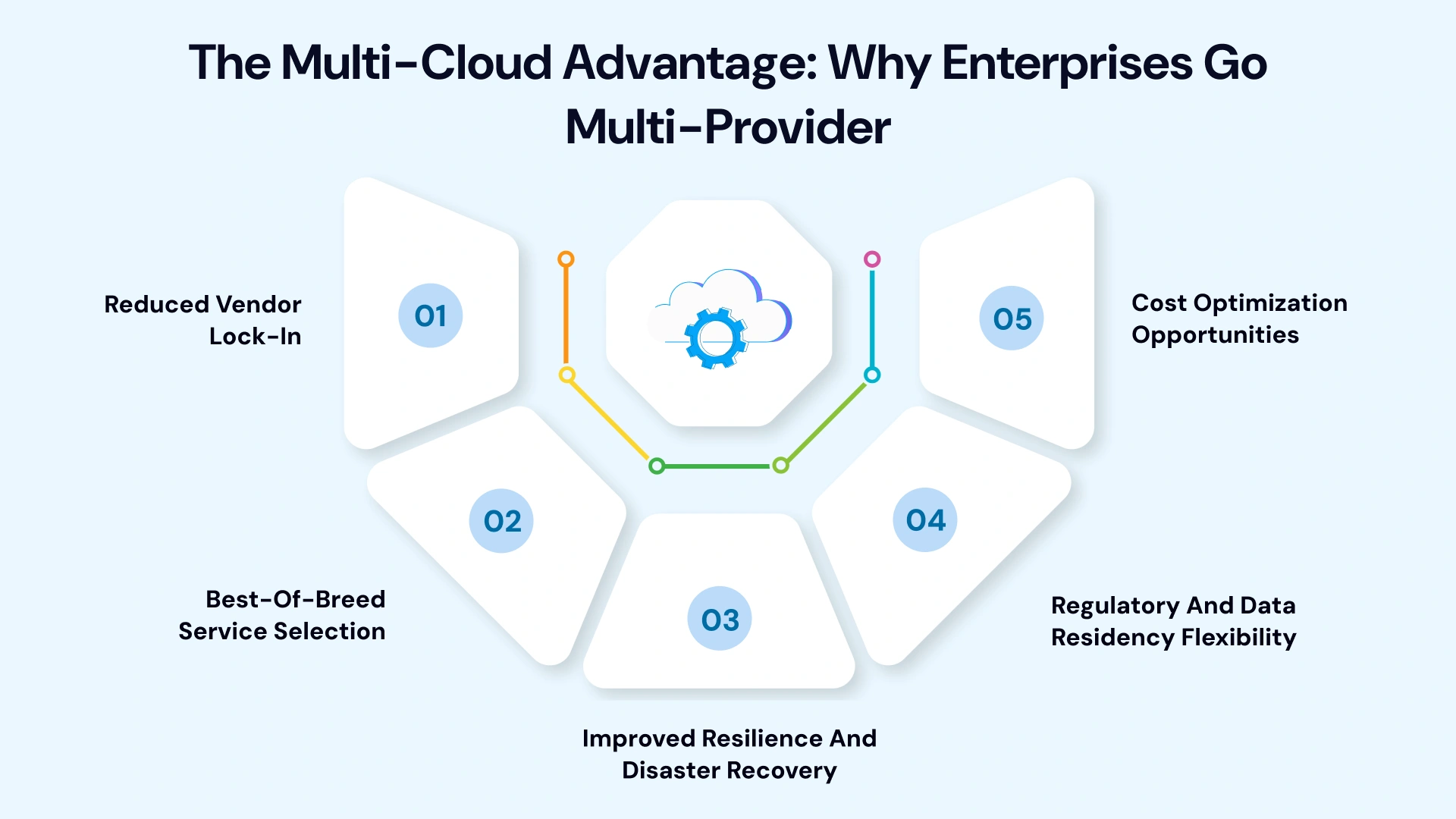
- Reduced Vendor Lock-In
Distributing workloads across multiple providers reduces dependency on any single vendor's pricing, roadmap, or service availability decisions, giving enterprises genuine negotiating leverage and architectural flexibility over the long term.
- Best-of-Breed Service Selection
Each major cloud provider has areas of genuine technical strength: Google Cloud's data analytics and machine learning tooling, Azure's enterprise identity and Microsoft ecosystem integration, AWS's breadth of mature infrastructure services. Multicloud architecture lets enterprises select the best platform for each specific workload rather than compromising across the board with a single provider.
- Improved Resilience and Disaster Recovery
Running critical workloads across multiple providers reduces the blast radius of a single provider's regional outage, providing a genuine resilience advantage over single-cloud architectures for business-critical systems.
- Regulatory and Data Residency Flexibility
Multicloud architecture makes it easier to meet data residency and regulatory requirements across different jurisdictions, since enterprises aren't constrained to a single provider's regional footprint.
- Cost Optimization Opportunities
While multicloud introduces its own cost governance complexity (addressed below), it also opens opportunities to shift specific workloads to whichever provider offers the most cost-efficient pricing for that particular use case, rather than being locked into one provider's pricing structure across the entire portfolio.
Multicloud Challenges: The Real Operational Complexity
While a multi-provider model unlocks strategic agility, it also introduces substantial architectural friction. Transitioning from a single vendor to a complex ecosystem changes an IT department's day-to-day reality.
The primary operational challenges of managing a multicloud strategy are as follows:
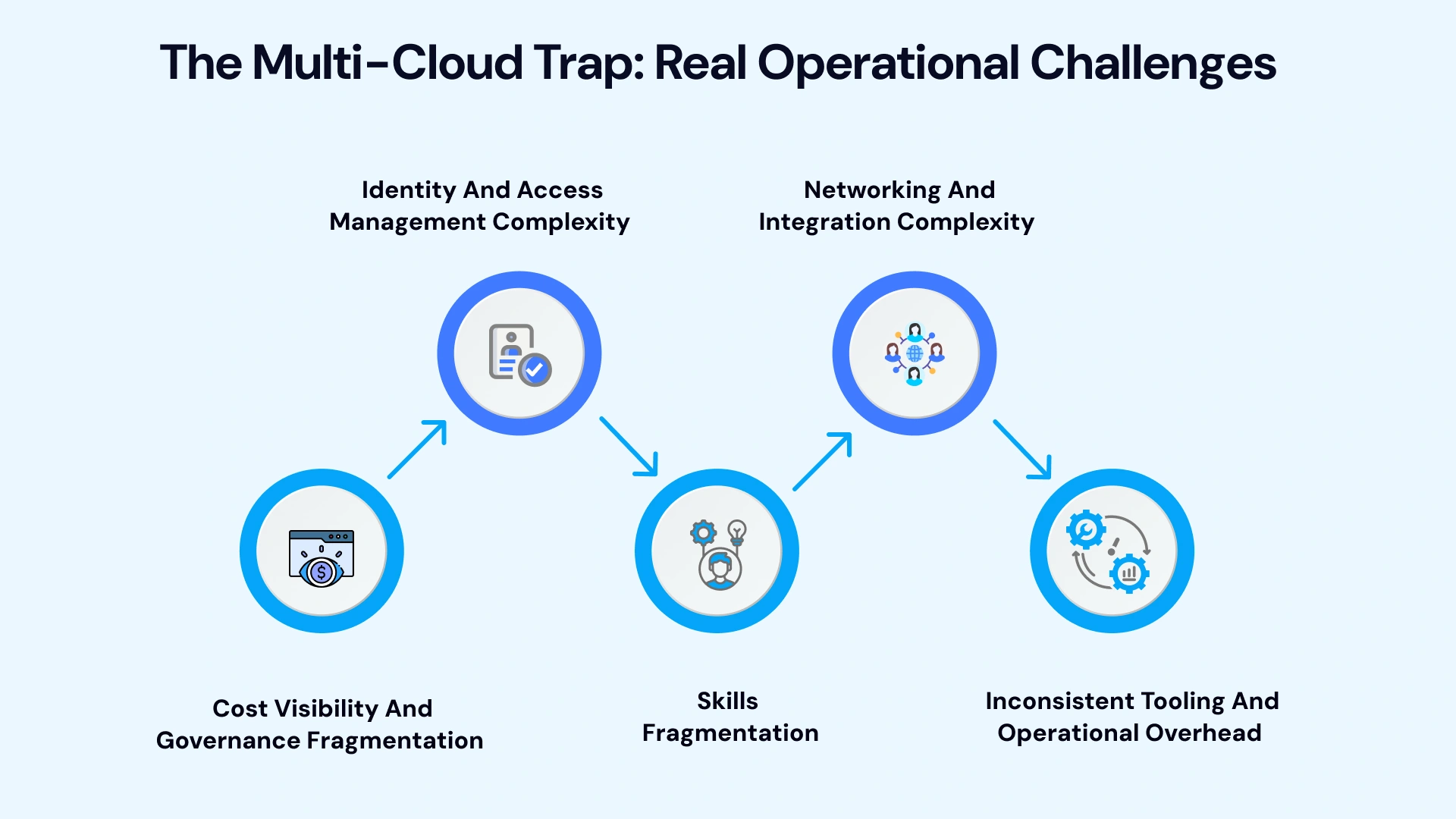
- Cost Visibility and Governance Fragmentation
Each cloud provider has its own billing structure, cost management tools, and reporting format. Without centralized cost visibility tooling, finance and engineering teams struggle to get a unified view of total cloud spend; one of the most consistently cited multicloud challenges among enterprise IT leaders.
- Identity and Access Management Complexity
Federating identity and access management consistently across multiple providers; each with different IAM models, is technically complex and, if done poorly, creates serious security gaps. Inconsistent access controls across providers are a common source of security incidents in poorly governed multicloud environments.
- Skills Fragmentation
Maintaining deep operational expertise across AWS, Azure, and Google Cloud simultaneously requires either a larger team or cross-trained generalists; both of which represent a genuine talent and budget investment that many organizations underestimate when initially building a cloud migration strategy.
- Networking and Integration Complexity
Connecting workloads across different cloud providers' networking models requires careful architecture; multicloud integration between services hosted on different platforms isn't as seamless as connectivity within a single provider's ecosystem, and poorly planned integration points become both performance bottlenecks and security risks.
- Inconsistent Tooling and Operational Overhead
Without dedicated multicloud orchestration tooling, teams end up maintaining parallel, provider-specific monitoring, deployment, and governance processes, multiplying operational overhead rather than simplifying it.
How to Build a Multicloud Strategy: Step-by-Step
Building a successful multicloud architecture requires intentional planning to avoid chaos, bloated costs, and security gaps. Transitioning from theory to implementation means taking a methodical approach.
The essential steps to build a robust multicloud strategy are as follows:
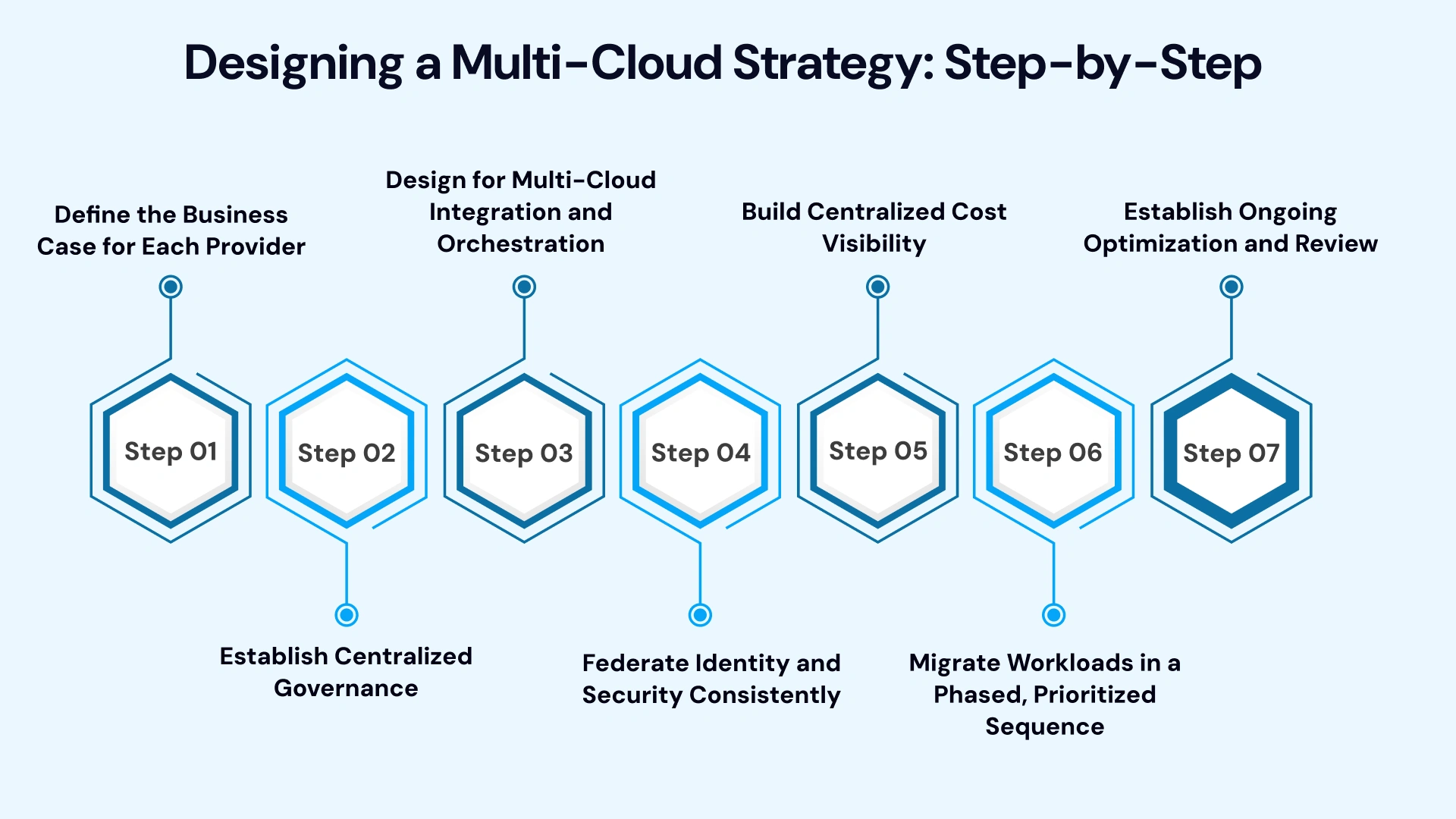
Step 1- Define the Business Case for Each Provider
Before selecting providers, clearly define why each one is included: specific service strengths, regional requirements, existing contracts, or resilience objectives. A multicloud strategy built on genuine business rationale performs far better than one that accumulates providers through unplanned organic growth.
Step 2- Establish Centralized Governance
Stand up a Cloud Center of Excellence (CCoE) or equivalent governance function responsible for cross-provider policy, cost visibility, security standards, and architecture decisions. This is the single most important structural decision in how to implement multicloud successfully at enterprise scale.
Step 3- Design for Multicloud Integration and Orchestration
Invest in orchestration tooling: Kubernetes for container portability, Terraform for infrastructure-as-code consistency across providers, and service mesh technology (like Istio) for consistent service-to-service communication. Multicloud orchestration and multicloud automation are what keep operational complexity manageable as the environment scales.
Step 4- Federate Identity and Security Consistently
Implement centralized identity federation and consistent cloud migration security policy enforcement across all providers, rather than managing separate, siloed IAM configurations per cloud. This is a critical enterprise multicloud strategy decision that directly reduces security risk.
Step 5- Build Centralized Cost Visibility
Deploy a cross-provider cost management platform (such as CloudHealth or CloudZero) to unify billing visibility, rather than relying on each provider's native, siloed cost tools. This is essential for any enterprise multicloud strategy to remain financially sustainable at scale.
Step 6- Migrate Workloads in a Phased, Prioritized Sequence
A structured multicloud migration strategy moves workloads deliberately based on business priority and technical readiness, not all at once. Partnering with an experienced migration team, such as through dedicated Cloud Migration Services, helps sequence this phased approach correctly and avoid the common pitfalls of rushed, unplanned migration waves.
Step 7- Establish Ongoing Optimization and Review
Multicloud architecture requires continuous review: cost optimization, security posture assessment, and architecture refinement, as usage patterns and provider offerings evolve over time. Treating the initial implementation as "done" rather than an ongoing discipline is one of the most common reasons multicloud environments drift into unmanaged complexity.
Multicloud Best Practices for Enterprises
To successfully harness the power of multiple cloud providers without falling into operational chaos, enterprises must implement rigorous governance, security, and architectural guardrails.
The core best practices for managing an enterprise multicloud strategy are as follows:
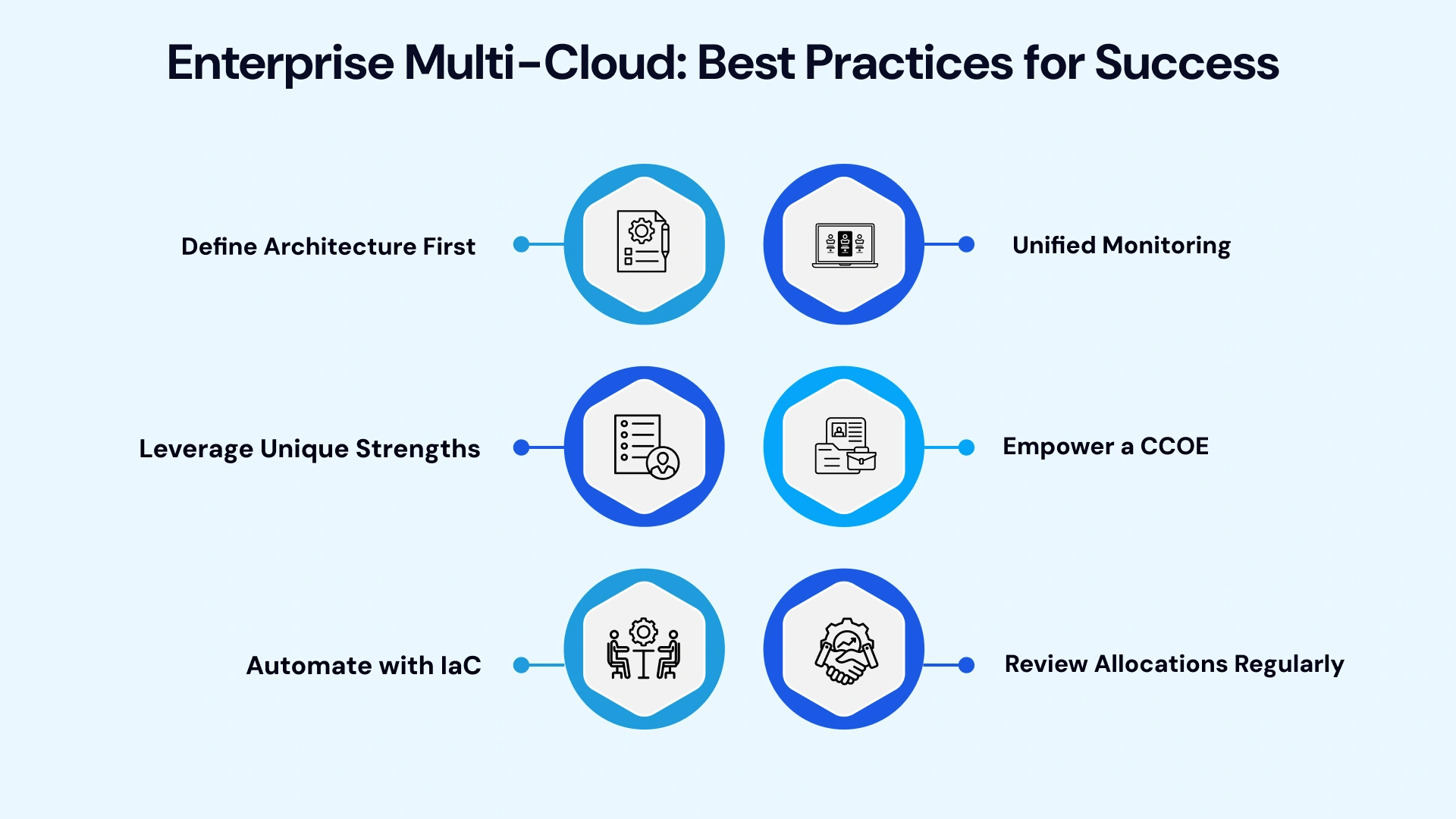
- Start with a clear architecture guide, not just a provider list. A multicloud architecture guide should define which workload types go where, how services communicate across providers, and how governance is enforced, before any workload moves.
- Avoid replicating identical architecture across every provider. Design each provider's footprint around its specific strengths rather than forcing a uniform architecture that doesn't leverage any single platform's advantages.
- Automate everything possible through infrastructure-as-code. Manual, provider-specific configuration is one of the fastest paths to configuration drift and inconsistent security posture across a multicloud environment.
- Centralize monitoring and alerting across all providers into a single operational view, rather than requiring teams to check multiple, disconnected dashboards during an incident.
- Build a genuine Cloud Center of Excellence, not just a policy document; a functioning governance-dedicated team with clear authority is what actually enforces multicloud best practices day to day.
- Review provider allocation regularly. Pricing, service offerings, and regional availability change over time; a multicloud strategy should be revisited periodically, not locked in permanently at initial implementation.
Leverage Our Expertise for a Well-Architected Multi-Cloud Strategy
Designing and implementing enterprise multicloud architecture requires coordinated expertise across cloud networking, identity federation, cost governance, and workload-specific platform knowledge; capabilities that are difficult to build entirely in-house while also running day-to-day operations. Our team has guided organizations across the US, Canada, and India through complex, multi-provider cloud strategies, from initial architecture design through phased migration execution.
Our ideal Cloud Consulting Services support enterprises at every stage of building or expanding a multicloud footprint, with governance, security, and cost visibility built into the process from day one rather than retrofitted after the fact. For a detailed look at how a structured, phased approach delivers real results, our Cloud Migration Case Study walks through the strategy, execution, and outcomes of a real enterprise engagement.

Conclusion
Enterprise multicloud architecture delivers genuine benefits- resilience, vendor flexibility, and access to best-of-breed services but only when it's built deliberately, with centralized governance, identity federation, and cost visibility designed in from the start.
The organizations that struggle with multicloud aren't struggling with the technology itself; they're struggling with the operational discipline required to run multiple providers as a coordinated system rather than a fragmented collection of separate environments.
If your organization is evaluating a multicloud strategy or trying to bring order to a multicloud environment that grew unplanned, the best practices outlined here provide the framework to move forward with clarity instead of accumulating complexity by default.
Ready to take the next step? Get in touch with our team of cloud architecture experts today to discuss your unique environment, audit your current multi-provider footprint, and build a tailored roadmap designed for long-term operational success.

Vice President, Strategy – VLink Inc.
Sambhavi Gopalakrishnan is the Vice President of Strategy at VLink Inc., bringing over a decade of experience in IT leadership, project implementation, and strategic growth. She possesses a strong foundation in technical project management and pre-sales, driving innovation and business transformation at VLink.

 Shivisha Patel