

Capital is abundant. Talent is not.
For enterprise leaders in energy, manufacturing, logistics, and smart infrastructure, the question is no longer whether to invest in IoT and analytics. The question is how to operationalize these investments without the specialized workforce that traditional models demand.
The challenge extends beyond simple recruitment. Organizations need professionals who understand the full stack—from edge device protocols to cloud analytics platforms to business intelligence delivery. Finding individuals with this breadth of expertise in GCC hiring markets has become nearly impossible, driving enterprises toward alternative capability models.
This is where managed IoT services and advanced data analytics enter the conversation—not as temporary fixes, but as permanent strategic layers that transform how enterprises consume intelligence rather than build capability. For organizations seeking to accelerate their digital transformation initiatives, managed IoT represents a strategic pathway that bypasses the talent bottleneck entirely.
The Middle East's Digital Paradox - High Investment, Low Talent Availability
Vision-Led Digital Acceleration in UAE & Saudi Arabia
The paradox is stark: the same government initiatives driving IoT adoption are also competing with private enterprises for the limited talent available. National transformation programs offer competitive compensation, job security, and prestige that private sector roles often struggle to match.
Why IoT and Analytics Initiatives Stall Post-Deployment
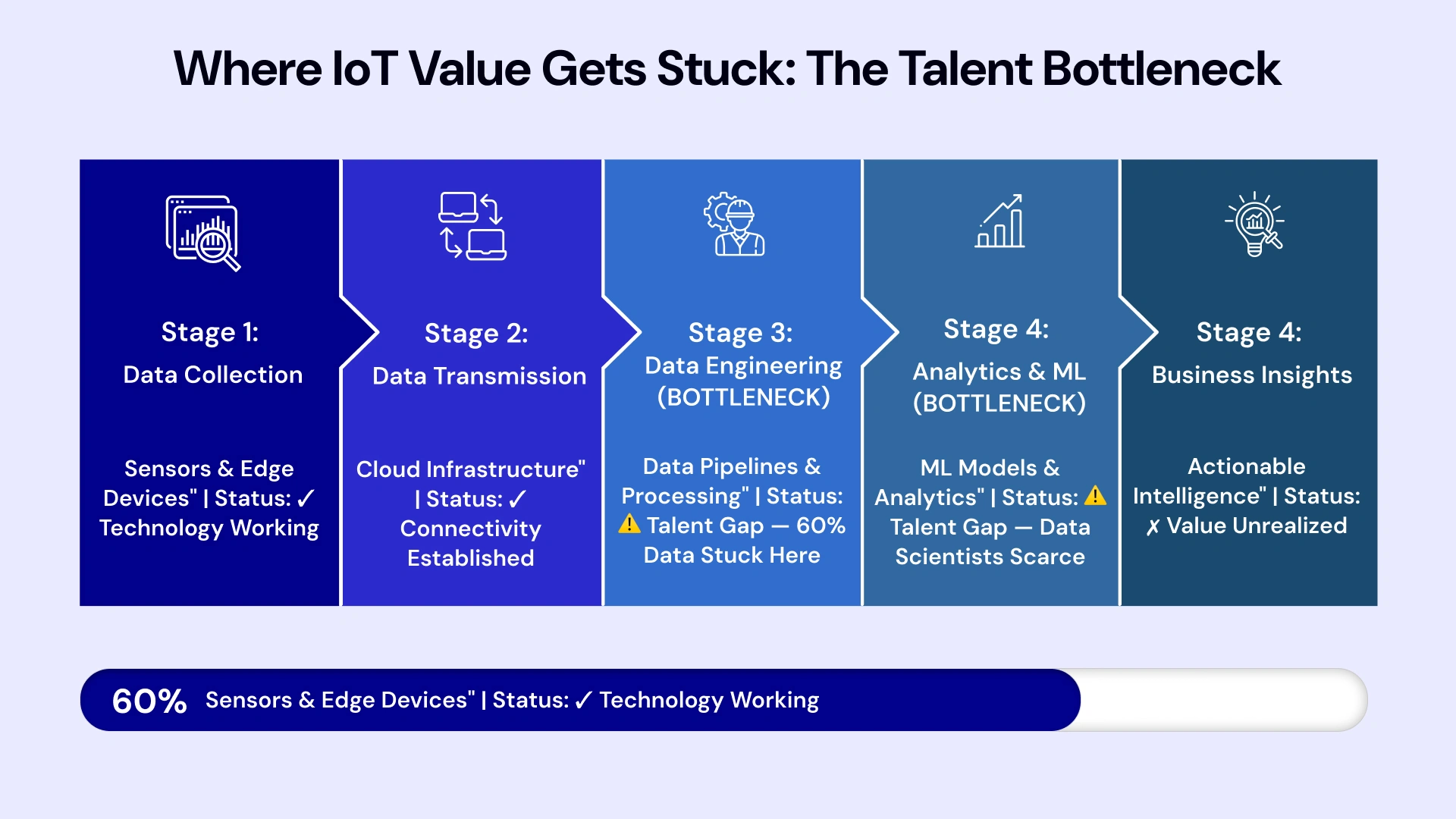
But six months post-deployment, the organization has no actionable dashboards. Data sits in silos. The predictive maintenance use case that justified the investment remains theoretical. The procurement team has delivered on technology acquisition, but operational teams cannot extract the value that business cases promised.
This pattern repeats across industries. The technology works. The integration is complete. But without data engineers to build pipelines, data scientists to develop models, and IoT specialists to optimize device performance, the investment generates cost rather than value.
For enterprises evaluating their IoT development strategy, this reality demands honest assessment of internal capabilities versus external partnership models.
Understanding the IoT and Data Analytics Talent Gap in the Middle East
Why IoT Engineers, Data Scientists, and ML Experts Are Scarce
First, the region's rapid digital acceleration has created demand that local educational institutions cannot yet satisfy. Universities are expanding technical programs, but the pipeline from graduation to enterprise-ready expertise takes years to mature. The skills required for enterprise IoT—understanding industrial protocols, edge computing architectures, and domain-specific analytics—extend far beyond standard computer science curricula.
Second, government digital initiatives compete directly with private enterprises for the same limited talent pool. National transformation programs offer competitive compensation, job security, and prestige that private sector roles often cannot match. When NEOM, ROSHN, and other mega-projects recruit aggressively, mid-sized enterprises find themselves outbid for senior talent.
Third, the specialization required for enterprise IoT and analytics extends beyond general IT skills. Organizations need professionals who understand OT/IT convergence, edge computing architectures, industrial protocols like Modbus and OPC-UA, and domain-specific analytics—a combination rarely found in traditional hiring markets.
The challenge intensifies for organizations requiring expertise in artificial intelligence and machine learning. ML engineers capable of deploying models at the edge, optimizing for constrained computing environments, and maintaining production inference systems represent perhaps the scarcest talent category in the region.
Hiring vs. Retaining Digital Talent in GCC Markets
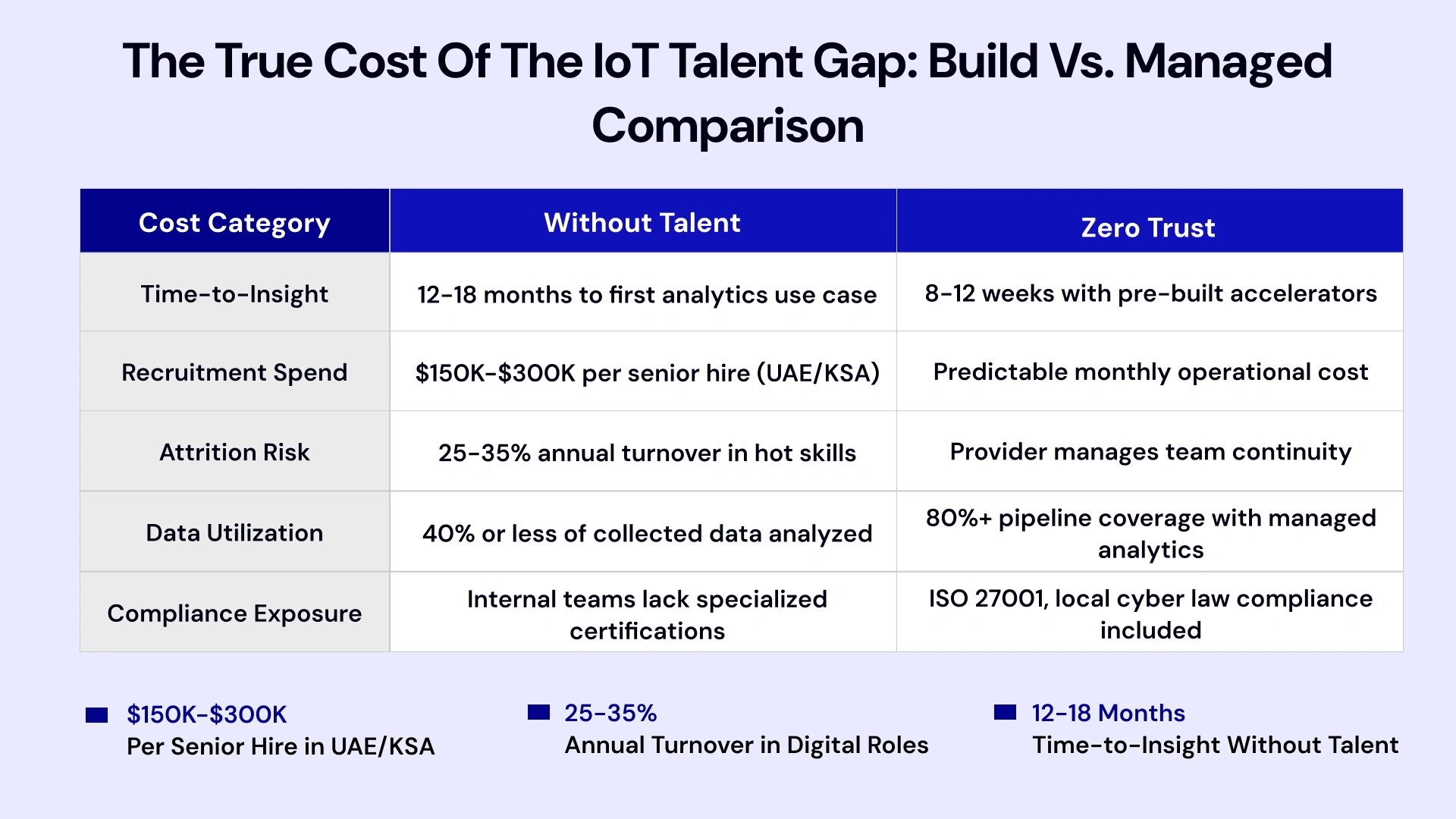
For enterprises without established digital centers of excellence, the cycle becomes exhausting. Recruitment costs accumulate—senior hires in the UAE and Saudi Arabia often require six-figure USD packages plus relocation support. Onboarding delays extend project timelines as new team members learn organizational context. Knowledge walks out the door with each departure, sometimes to direct competitors.
The economics increasingly favor alternative models. Organizations spending $500K+ annually on recruitment, retention bonuses, and turnover-related delays must evaluate whether that investment could deliver better outcomes through managed service partnerships.
The Hidden Cost of Underutilized IoT Data
Beyond direct hiring costs, enterprises face a less visible but equally damaging expense: the opportunity cost of data that generates no value.
Every sensor streaming data that never reaches an analytics model represents wasted infrastructure investment. Every predictive maintenance alert that could have prevented downtime but was never built represents operational risk. Every customer insight buried in unprocessed datasets represents competitive disadvantage.
For organizations in energy, manufacturing, and logistics—where margins depend on operational efficiency—these hidden costs compound rapidly. A single prevented equipment failure can justify months of analytics investment. A 5% improvement in logistics efficiency translates directly to bottom-line impact.
Organizations exploring data analytics and business intelligence capabilities must account for both the direct costs of talent acquisition and the opportunity costs of delayed or unrealized analytics value.
What Are Managed IoT Services? (And Why the Definition Is Evolving)
Traditional Managed IoT Services vs. Outcome-Driven Managed IoT
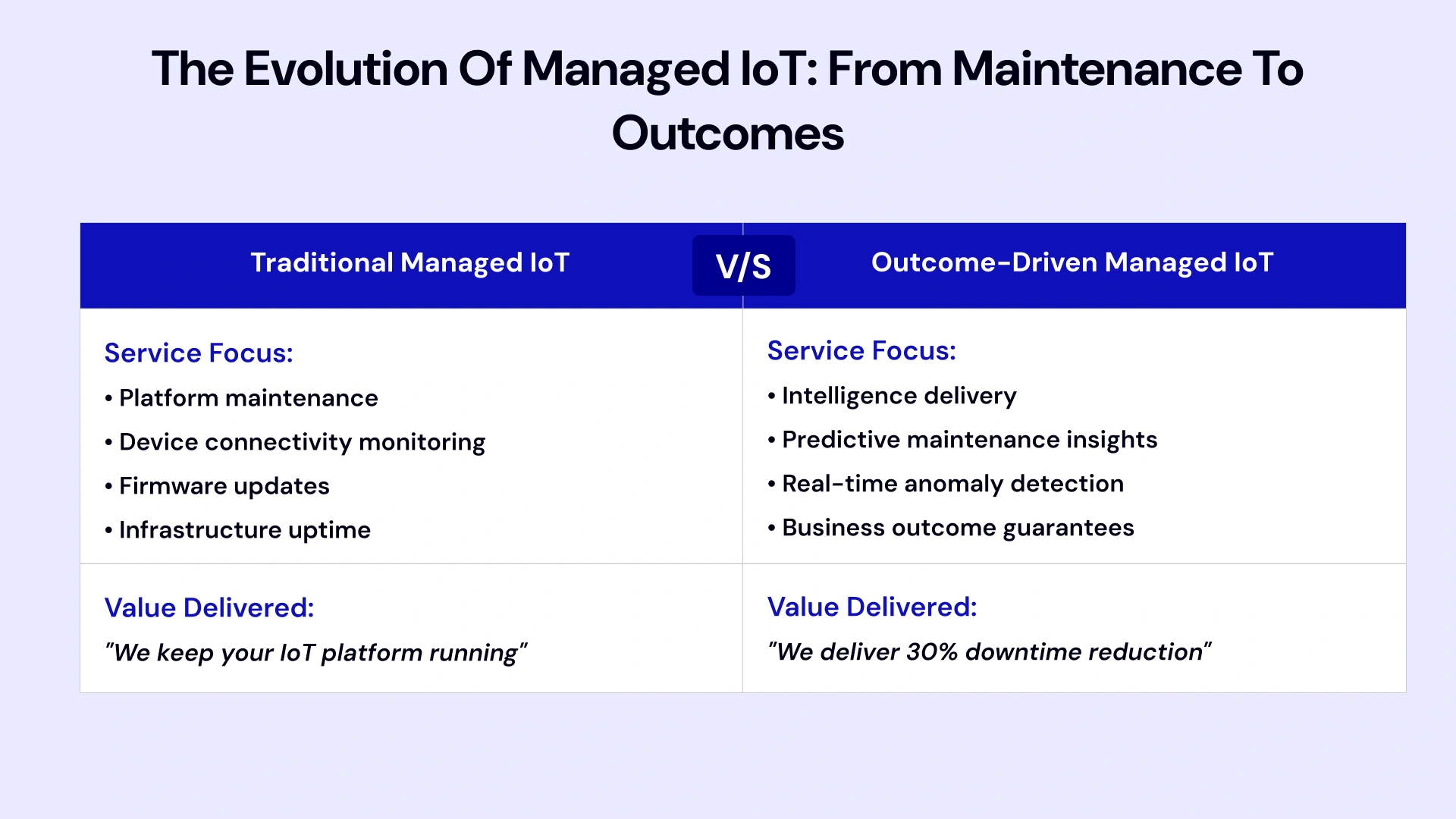
Historically, managed IoT services meant platform maintenance. A provider would monitor device connectivity, manage firmware updates, and ensure infrastructure uptime. The enterprise retained responsibility for deriving business value from the data. This model addressed operational burden but left the core challenge—extracting actionable intelligence—with the enterprise and its scarce internal talent.
The definition is now evolving significantly. Leading managed IoT providers have shifted from selling platform access to selling outcomes. The service is not "we maintain your Azure IoT Hub." The service is "we deliver predictive maintenance insights that reduce unplanned downtime by 30%."
This evolution reflects market maturity. Early IoT adopters focused on connectivity—getting devices online and data flowing. Mature IoT programs focus on value—transforming data into decisions that impact business performance. Managed services have evolved to meet this maturity curve.
Featured Snippet Opportunity:
Managed IoT services provide end-to-end oversight of IoT infrastructure, including device management, data pipelines, security monitoring, and analytics delivery. Modern managed IoT extends beyond platform maintenance to deliver business outcomes—transforming raw sensor data into actionable intelligence without requiring in-house data science teams.
From 'Platform Management' to 'Intelligence Delivery'
This shift represents a fundamental change in the value proposition. Traditional managed services reduced operational burden. Outcome-driven managed IoT reduces strategic dependency on talent that enterprises cannot hire.
For a manufacturing COO in Saudi Arabia, the difference is material. Under the old model, managed services kept the IoT platform running, but internal teams still needed to build the anomaly detection algorithms, design the dashboards, and interpret the results. Under the outcome model, the provider delivers "equipment health scores" and "maintenance recommendations" as finished products.
The enterprise consumes intelligence rather than building capability. This model aligns with how organizations consume other professional services—legal counsel provides legal opinions, not law school education; accounting firms deliver audited financials, not accounting training.
For organizations building cloud infrastructure foundations, this evolution means IoT and analytics can be layered as managed capabilities rather than requiring parallel internal team development.
Where Advanced Data Analytics Fits into Managed IoT Models
Advanced data analytics in the Middle East context means more than business intelligence dashboards. It encompasses predictive modeling, machine learning inference at the edge, real-time anomaly detection, and prescriptive recommendations that drive operational decisions.
In outcome-driven managed IoT, analytics is not a separate workstream. It is the core deliverable. The provider integrates data engineering, model development, and visualization into a unified service layer. The enterprise receives insights rather than managing the complex talent stack required to produce them.
Why Building In-House IoT and Analytics Teams No Longer Scales
Cost Inflation and Attrition Risks in UAE & Saudi Arabia
In the UAE and Saudi Arabia, assembling this team means competing against government mega-projects, well-funded startups, and global technology companies with regional hubs. Compensation packages for senior talent have inflated beyond sustainable levels for many enterprises. A senior data engineer in Dubai commands AED 40,000-60,000 monthly; in Riyadh, equivalent roles approach SAR 50,000-70,000 for top talent.
Beyond direct costs, the attrition dynamic creates ongoing instability. Organizations report 25-35% annual turnover in high-demand digital roles. Each departure triggers recruitment cycles, knowledge transfer gaps, and project delays. The institutional knowledge required to maintain complex IoT systems walks out the door, sometimes requiring months to rebuild.
Time-to-Insight vs. Time-to-Hire Mismatch
Enterprise IoT initiatives operate on business timelines. A logistics company preparing for Vision 2030 infrastructure projects needs fleet optimization analytics now—not after an 18-month hiring and onboarding cycle. A manufacturing operation facing competitive pressure cannot wait two years to operationalize predictive maintenance.
The mismatch between time-to-insight requirements and time-to-hire realities creates strategic risk. Competitors who can operationalize IoT data faster gain market advantage. Internal stakeholders lose confidence in digital programs that promise transformation but deliver extended timelines. Executive sponsors face difficult conversations about ROI delays.
Managed IoT services compress this timeline dramatically. Pre-built industry accelerators, established delivery teams, and proven deployment methodologies enable insights in weeks rather than months. Organizations can begin generating value from IoT investments while competitors are still recruiting.
Compliance, Security, and Data Sovereignty Skill Gaps
Internal teams often lack the certifications and experience required to architect compliant IoT solutions. Security configurations, data handling procedures, and audit documentation require skills that extend beyond general IT security training. The convergence of operational technology (OT) and information technology (IT) creates unique security challenges that traditional IT security professionals may not fully understand.
Organizations evaluating their cybersecurity posture must recognize that IoT security requires specialized expertise beyond traditional enterprise security frameworks.
Decision Framework - When Should Enterprises Choose Managed IoT Services?
The 3-Question CXO Decision Framework
Enterprise technology leaders evaluating managed IoT services should consider three fundamental questions that clarify strategic direction:
Question 1: Do we need outcomes or ownership?
If the strategic priority is operational results—reduced downtime, optimized logistics, predictive maintenance—managed outcomes align with business objectives. If IoT and analytics represent core intellectual property that differentiates the enterprise competitively, ownership may justify the talent investment. Most enterprises, upon honest evaluation, find that IoT enables operations rather than defining competitive differentiation.
Question 2: Is IoT a core differentiator or operational enabler?
For most enterprises, IoT and analytics enable operational efficiency rather than defining competitive differentiation. A manufacturing company's competitive advantage lies in product quality, customer relationships, and market positioning—not in building proprietary data pipelines. A logistics firm differentiates through service reliability and network coverage, not through custom-built fleet analytics. When IoT is an enabler rather than a differentiator, managed services make strategic sense.
Question 3: Can we hire faster than technology evolves?
The IoT and analytics landscape evolves continuously. Edge AI, sovereign cloud architectures, new industrial protocols, and emerging security frameworks appear regularly. Internal teams must continuously upskill to remain current—requiring not just initial hiring but ongoing training investment. If the enterprise cannot hire and train at the pace of technology change, managed providers offer access to continuously updated expertise without the training burden.
Early Signals That Managed IoT Is the Right Model
Enterprise leaders should recognize specific indicators that suggest managed IoT services warrant serious evaluation:
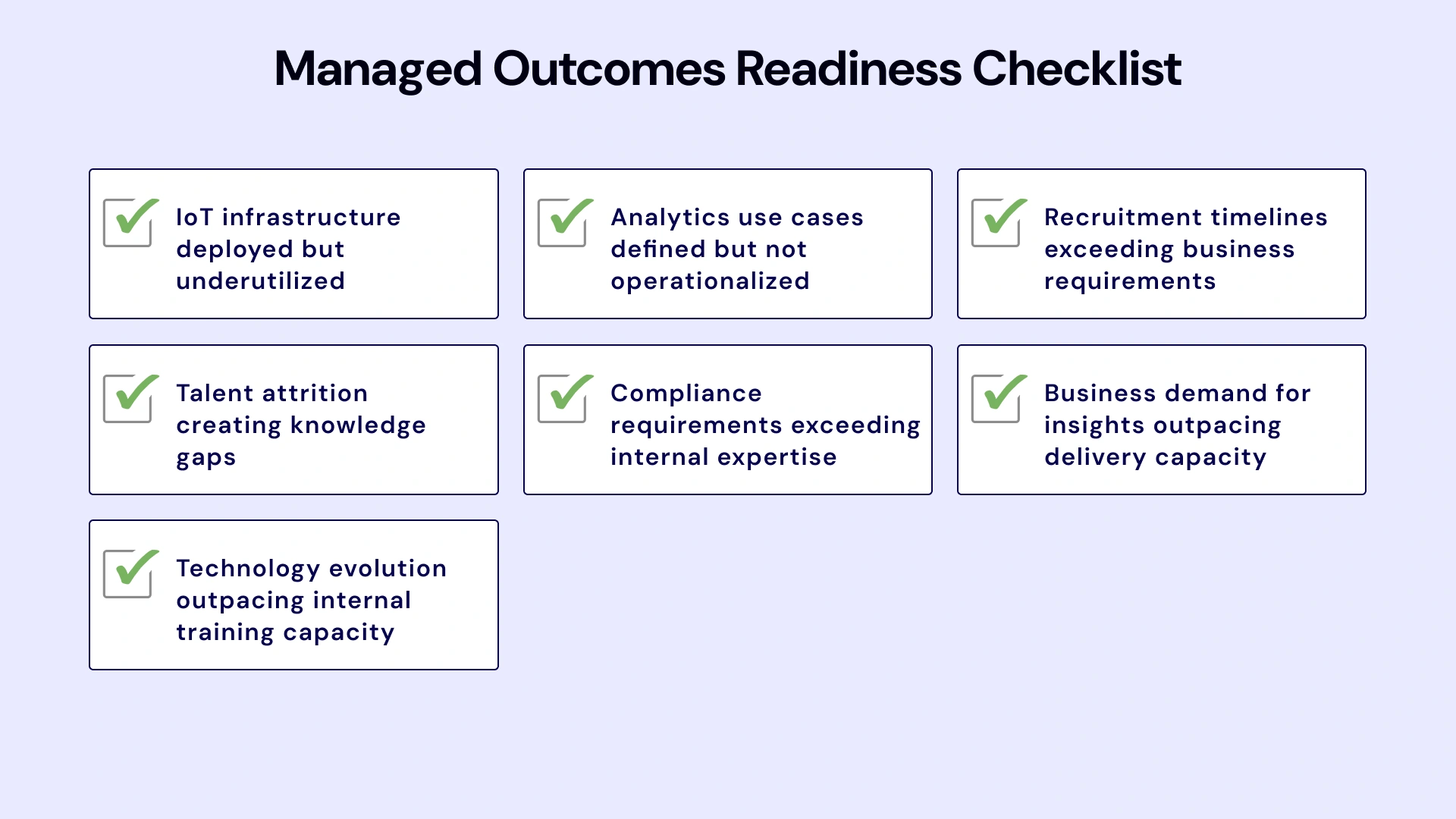
The first signal involves deployment without value. If IoT infrastructure has been deployed but analytics use cases remain theoretical after 6+ months, internal capability gaps are likely the constraint. Technology is rarely the limiting factor; operational capability almost always is.
Recruitment timeline extension provides another indicator. When recruitment cycles for data engineering and IoT roles consistently exceed 6 months, the talent market is signaling scarcity. Extending timelines further rarely improves outcomes.
Knowledge loss through attrition represents a critical signal. If key digital talent has departed in the past year, taking project knowledge with them, the organization faces ongoing instability risk. Managed services transfer this continuity risk to providers structured to handle it.
Compliance gaps identified during audits demand attention. If security or compliance reviews have identified gaps in IoT security or data handling, specialized expertise is required. Internal teams without certifications and training struggle to remediate these gaps effectively.
Business stakeholder frustration provides organizational signal. When business stakeholders express frustration with time-to-insight timelines, confidence in digital programs erodes. Managed services can restore credibility through accelerated delivery.
If three or more indicators apply, managed IoT services merit strategic evaluation.
How Managed IoT and Advanced Analytics Bridge the Talent Gap
Team-as-a-Service for IoT & Analytics
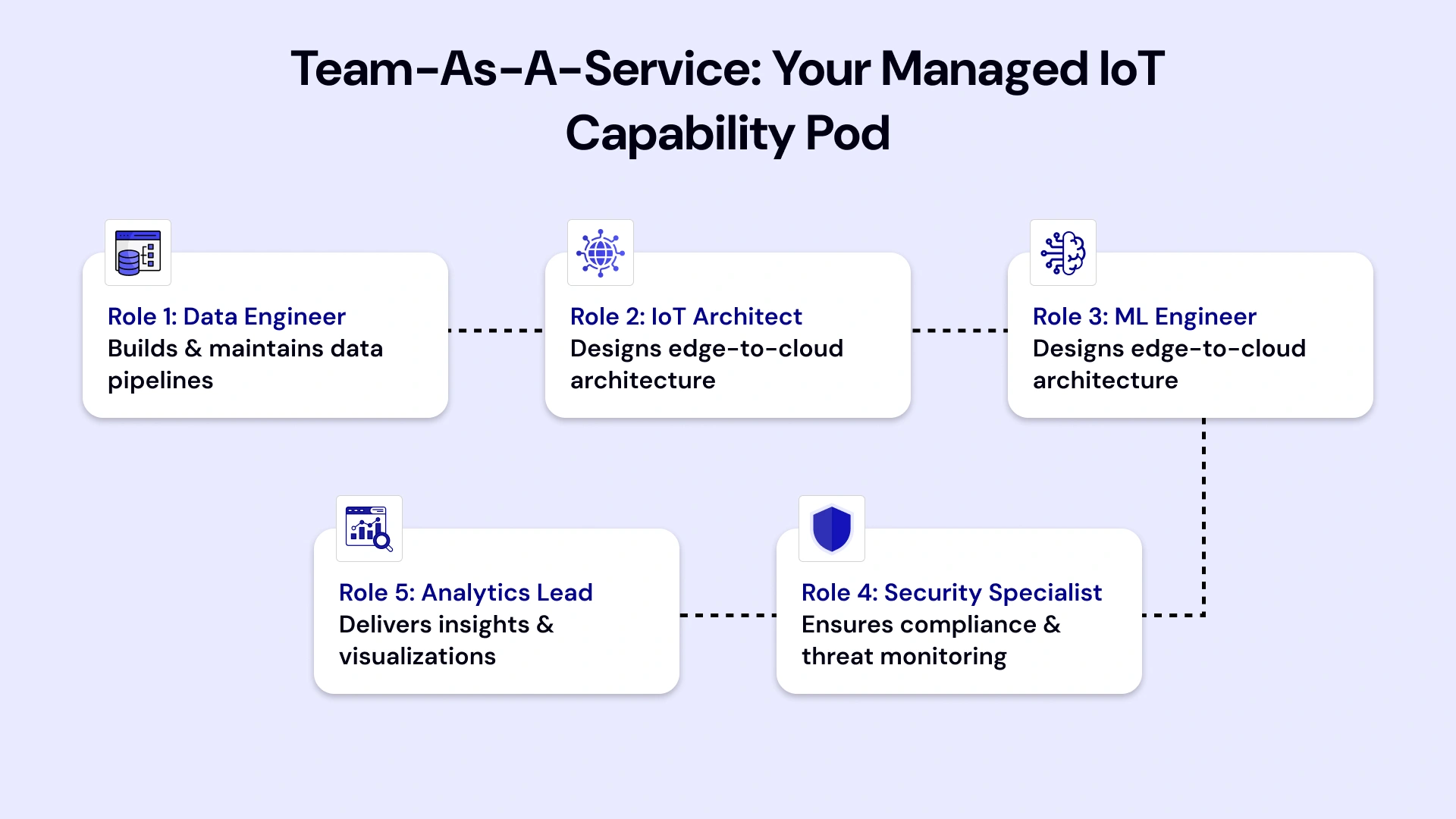
The Team-as-a-Service model provides enterprises with dedicated pods of specialists who function as an extension of internal teams. Rather than hiring individual data engineers and IoT architects, enterprises engage a complete capability set that includes all required roles.
This model insulates organizations from turnover risk. The managed provider maintains team continuity, handles knowledge transfer between team members, and ensures consistent service delivery regardless of individual personnel changes. When a data engineer departs, the provider manages replacement and knowledge transfer—not the enterprise.
For enterprises in the Middle East, Team-as-a-Service addresses both the scarcity and retention challenges simultaneously. The enterprise gains access to expertise that may not exist in local hiring markets while avoiding the attrition dynamics that destabilize internal teams.
Organizations leveraging VLink's IT Staff Augmentation Services often combine staff augmentation with managed IoT delivery to create flexible capability models that scale with project requirements. This hybrid approach provides dedicated resources for strategic initiatives while managed services handle operational analytics delivery.
Pre-Built Industry Accelerators (Predictive Maintenance, Asset Tracking)
Managed IoT providers with industry expertise bring pre-built solution accelerators that compress time-to-value dramatically. Rather than building predictive maintenance algorithms from scratch, enterprises deploy proven models calibrated for their sector.
For oil and gas operations, accelerators incorporate domain knowledge about equipment failure patterns, environmental factors, and maintenance protocols specific to petrochemical environments. For logistics, accelerators address fleet optimization, route planning, and asset tracking use cases with established data models refined across multiple implementations.
These accelerators represent accumulated intellectual property that would take internal teams years to develop. Enterprises gain immediate access to capabilities that reflect hundreds of previous implementations and continuous refinement based on real-world performance data.
The value extends beyond initial deployment. Accelerators continue to improve as providers incorporate learnings from their full client base—improvements that automatically benefit all implementations.
Edge Analytics and Real-Time Decisioning Without Internal ML Teams
Edge computing and real-time analytics demand specialized expertise that extends beyond traditional data science skills. Processing data at the edge—on industrial gateways, in remote facilities, at network endpoints—requires understanding of constrained computing environments, edge AI frameworks, and distributed system architectures.
Managed providers deliver edge analytics capabilities without requiring enterprises to recruit and train specialized ML engineering teams. Models are developed centrally, optimized for edge deployment, and maintained by provider teams with dedicated expertise. Updates and improvements deploy automatically without requiring enterprise engineering resources.
For enterprises in energy, utilities, and manufacturing—where real-time decisioning impacts operational safety and efficiency—this capability gap is particularly consequential. Delayed anomaly detection in industrial settings can result in equipment damage, safety incidents, or production losses.
Organizations developing custom software solutions can integrate managed edge analytics into broader application architectures, combining bespoke business logic with managed intelligence delivery.
Regional Use Cases - UAE and Saudi Arabia Context
Smart Utilities & Energy (UAE)
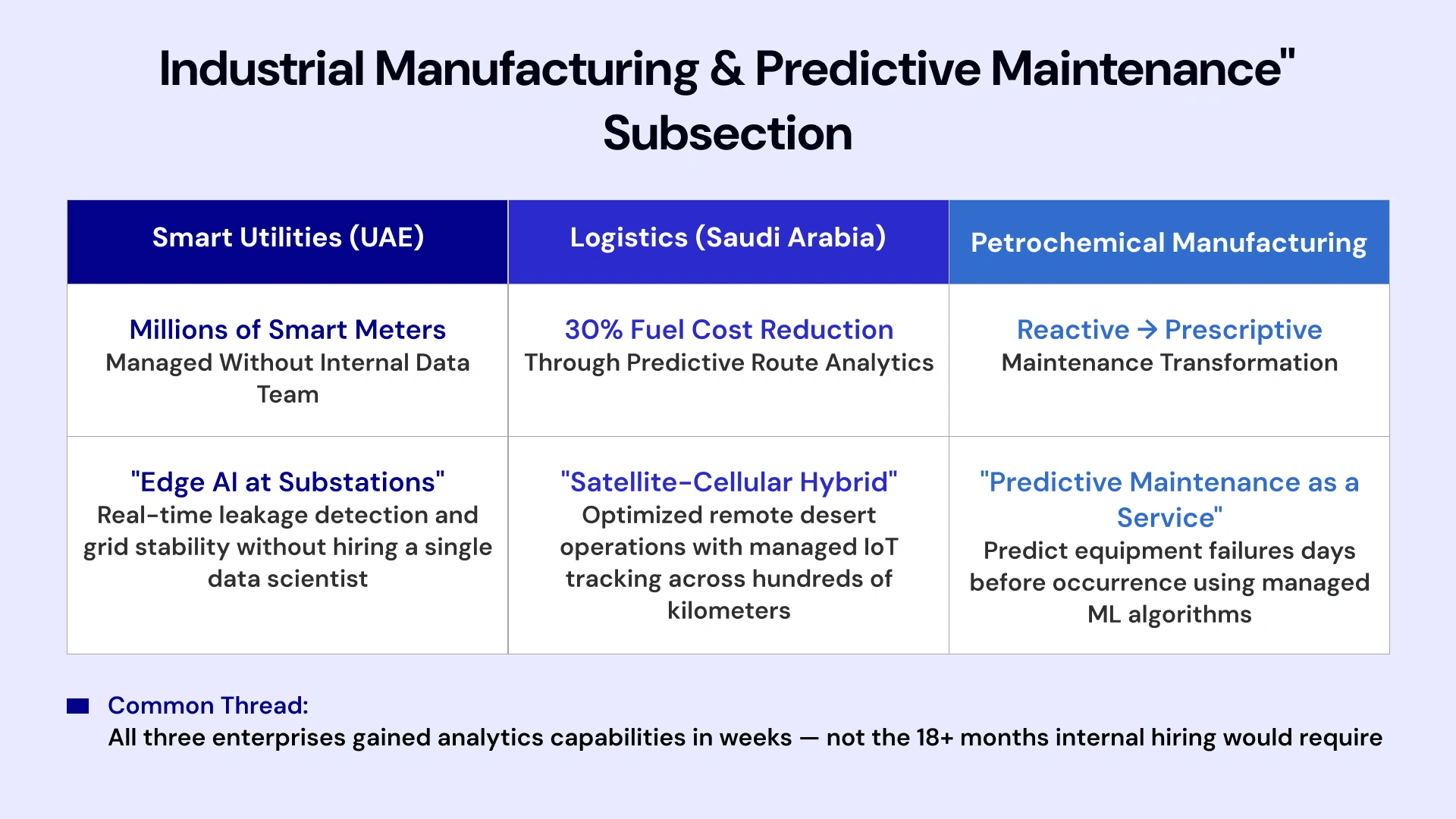
Challenge: A major UAE utility provider deployed millions of smart meters across its service territory as part of broader smart grid modernization. The infrastructure captured granular consumption data at 15-minute intervals, but the organization lacked the internal data team to analyze consumption patterns for load balancing, demand forecasting, and leakage detection.
Internal recruitment efforts over 18 months yielded only two of the eight data engineering positions required. Meanwhile, data accumulated without generating operational value, and executive stakeholders questioned the smart meter investment ROI.
Managed Solution: The utility engaged a managed IoT provider to deploy Edge AI processing at substations throughout the network. Data was analyzed locally, with only aggregated insights transmitted to central systems—reducing bandwidth requirements and ensuring data sovereignty compliance. The provider's team developed consumption pattern models, automated anomaly detection for potential leakage, and built demand forecasting dashboards for grid operations.
Business Outcome: The utility achieved measurable improvements in grid stability and energy efficiency within the first operating quarter. Real-time leakage detection enabled faster response to distribution issues, reducing water and energy losses. Demand forecasting improved load balancing decisions, reducing peak capacity requirements. The utility gained full analytics capabilities without adding permanent headcount to an already constrained organization—and without the 18+ month timeline that internal hiring would have required.
Logistics & Infrastructure Programs (Saudi Arabia)
Challenge: A logistics firm supporting Vision 2030 infrastructure projects struggled with asset visibility across remote desert locations spanning hundreds of kilometers. Traditional GPS tracking provided basic location data, but the organization needed predictive analytics for route optimization, fuel management, and equipment utilization to meet aggressive project timelines.
Cellular connectivity gaps in remote areas complicated data transmission. Internal teams lacked expertise in satellite-cellular hybrid architectures and the ML models required for predictive logistics optimization.
Managed Solution: The provider implemented a managed tracking service using cellular IoT and satellite hybrid connectivity that maintained coverage across remote operations. Predictive analytics models processed location, fuel consumption, environmental conditions, and equipment telemetry to optimize routing decisions and predict maintenance requirements.
Edge processing at regional hubs enabled real-time decisioning even when connectivity to central systems was limited. The provider's team continuously refined models based on operational data, improving prediction accuracy over time.
Business Outcome: The firm achieved 30% reduction in fuel costs through optimized route planning—a significant impact given fuel represents a major operational expense. Asset utilization improved as analytics enabled better deployment decisions, reducing idle equipment time. The organization scaled operations to support major infrastructure projects without proportional increases in internal analytics staff, maintaining lean operations while delivering enterprise-grade intelligence.
Industrial Manufacturing & Predictive Maintenance
Challenge: A petrochemical manufacturer experienced unscheduled downtime due to equipment failures in aging refinery infrastructure. Reactive maintenance created operational risk, cost unpredictability, and safety concerns. Each unplanned shutdown cost millions in lost production and emergency repair expenses.
The organization's maintenance team relied on time-based schedules and operator experience rather than data-driven insights. Attempts to build internal predictive maintenance capability stalled due to inability to recruit ML engineers with industrial IoT experience.
Managed Solution: The manufacturer engaged managed Predictive Maintenance as a Service through a provider with petrochemical domain expertise. Vibration sensors, thermal monitoring, and acoustic analysis were deployed across critical rotating equipment. ML algorithms analyzed sensor data to predict failure patterns and recommend maintenance interventions with specific timing and priority guidance.
The provider's models incorporated domain knowledge about petrochemical equipment failure modes, environmental stress factors, and maintenance best practices refined across multiple refinery implementations.
Business Outcome: The organization transitioned from reactive to prescriptive maintenance within six months. Early failure detection reduced unplanned downtime by identifying issues days or weeks before failure. Maintenance scheduling improved as analytics provided visibility into equipment health across the facility, enabling optimized resource allocation. Safety improved as potential failure modes were identified before reaching critical stages.
Security, Compliance and Data Sovereignty - Addressing CXO Concerns
PDPL, UAE Data Laws, and Local Cloud Requirements
These requirements complicate IoT architectures that rely on global cloud platforms. Data that flows through international processing nodes may violate local regulations, exposing enterprises to compliance risk and potential penalties. For organizations handling citizen data or operating in regulated sectors, compliance is non-negotiable.
Why Managed Providers Often Outperform Internal Teams on Security
A common concern among enterprise leaders is that outsourcing IoT management increases security risk. The evidence suggests the opposite is true for most organizations.
Internal enterprise teams, by contrast, often lack specialized IoT security training. The convergence of operational technology (OT) and information technology (IT) creates attack surfaces that traditional IT security approaches may not address. Industrial protocols, edge device vulnerabilities, and OT network segmentation require specialized expertise.
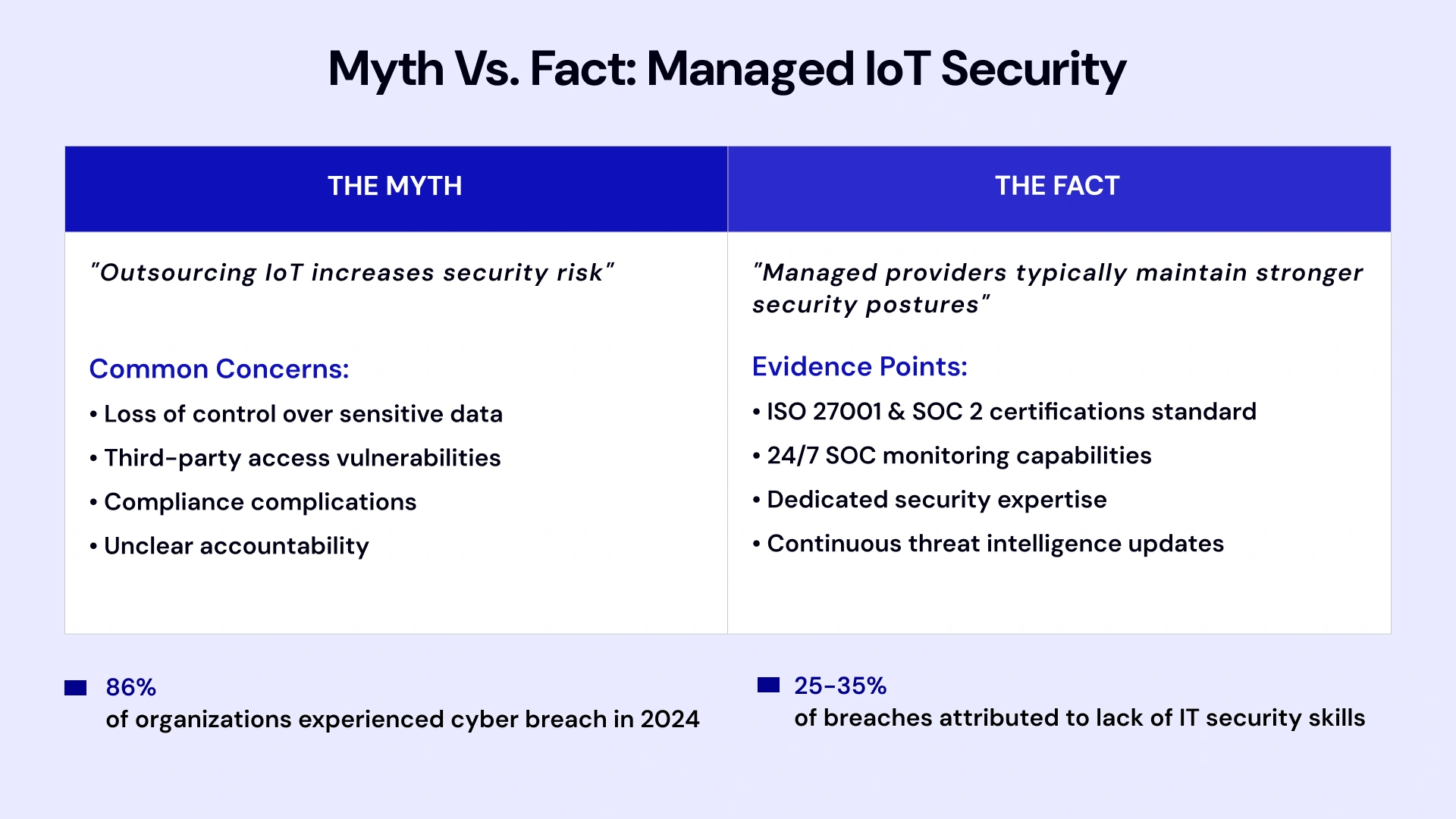
Myth vs. Fact:
Myth: "Outsourcing IoT increases security risk."
Fact: Managed service providers typically maintain more mature security postures than internal enterprise teams. Dedicated security expertise, continuous monitoring, 24/7 SOC capabilities, and compliance certifications reduce—rather than increase—organizational risk. The provider's security investment is amortized across their full client base, enabling capabilities that individual enterprises cannot justify.
Sovereign Cloud and Edge-First Architectures
Forward-looking managed IoT providers are architecting solutions with sovereignty by design. Edge-first approaches process sensitive data locally at the point of collection, transmitting only aggregated or anonymized insights to central systems.
This architecture addresses both regulatory requirements and operational needs simultaneously. Latency-sensitive applications benefit from local processing—real-time anomaly detection cannot wait for round-trip cloud communication. Compliance is maintained by keeping raw data within jurisdictional boundaries. Enterprises gain analytics value without data sovereignty compromise.
The edge-first model also provides resilience. Operations continue even when connectivity to central systems is interrupted—critical for remote industrial sites and infrastructure operations.
Future Outlook - AIoT, Sovereign AI and ESG Analytics
From Connected Devices to Intelligent Systems
The conversation is shifting from IoT to AIoT—the integration of artificial intelligence directly into IoT ecosystems. Connected devices that simply transmit data are evolving into intelligent systems that process, analyze, and act on information at the point of collection.
This evolution accelerates the talent gap challenge. AIoT requires expertise that combines IoT architecture with AI/ML engineering—a skill combination even scarcer than either discipline alone. Professionals who understand both edge computing constraints and neural network optimization represent unicorn talent profiles.
Managed providers positioned at this intersection will deliver disproportionate value. Enterprises gain access to integrated AIoT capabilities without attempting to recruit unicorn talent profiles. The provider handles the complexity of model optimization for edge deployment, continuous learning pipelines, and production inference management.
AI at the Edge and Private AI Models
Governments across the GCC are investing in sovereign AI infrastructure. Saudi Arabia's national AI strategy and UAE initiatives reflect strategic priorities around data control and technological independence. National LLM initiatives and private AI model deployments represent significant government investment in regional AI capability.
Managed services that can deploy private AI models within local data centers align with these national priorities. Enterprises gain AI capabilities while maintaining data sovereignty and supporting regional technology development goals. This alignment with national strategy can provide advantages in government contracting and regulated sector operations.
The trend toward private AI models also reflects enterprise security requirements. Organizations increasingly prefer AI capabilities that do not require sending sensitive operational data to third-party cloud services—even when those services offer strong security guarantees.
ESG, Sustainability, and Compliance-Driven Analytics
Regulatory requirements are tightening globally, and GCC enterprises with international operations or investor relationships face increasing disclosure requirements. Stakeholders—including institutional investors, customers, and regulators—demand verified sustainability data.
Managed IoT providers increasingly offer "ESG Data as a Service"—using sensor networks to capture environmental metrics and analytics platforms to generate compliance-ready reporting. For enterprises facing increasing ESG disclosure requirements, this capability addresses both regulatory compliance and stakeholder expectations without requiring internal sustainability analytics teams.
Key Takeaways for Enterprise Leaders
Stop Chasing Talent. Start Consuming Intelligence.
The talent gap in IoT and advanced data analytics is not a temporary market condition. It reflects structural dynamics that will persist for years—potentially decades. Educational pipelines cannot expand fast enough. Government initiatives will continue competing for the same limited talent pool. Compensation inflation shows no signs of moderating.
Enterprises that continue attempting to build internal centers of excellence face ongoing recruitment challenges, retention risks, and time-to-value delays. The opportunity cost of this approach—measured in delayed insights, unrealized efficiencies, and competitive disadvantage—often exceeds the direct costs of talent acquisition.
The strategic alternative is clear: consume intelligence as a service rather than building the capability to produce it.
This shift does not represent abdication of digital strategy. Enterprises retain ownership of business outcomes, use case prioritization, and strategic direction. They outsource the execution—the data pipelines, the ML models, the analytics platforms—to partners with specialized expertise and scale. This model mirrors how organizations approach other complex professional services.
Managed IoT as a Permanent Strategic Layer—Not a Stopgap
Managed IoT services should not be positioned as temporary measures until internal teams mature. For most enterprises, they represent permanent strategic infrastructure that will persist indefinitely.
Just as organizations outsource legal counsel, financial auditing, and IT infrastructure, IoT and analytics expertise can be consumed as a managed service. The model delivers predictable costs, continuous capability updates, and insulation from talent market volatility. Technology evolution is the provider's problem, not the enterprise's burden.
Enterprise leaders who recognize this shift will operationalize their IoT investments faster, extract more value from connected infrastructure, and focus internal resources on business differentiation rather than technical capability building. The competitive advantage goes not to organizations that build the best internal IoT teams, but to organizations that most effectively consume IoT intelligence to drive business outcomes.

Vice President, Strategy – VLink Inc.
Sambhavi Gopalakrishnan is the Vice President of Strategy at VLink Inc., bringing over a decade of experience in IT leadership, project implementation, and strategic growth. She possesses a strong foundation in technical project management and pre-sales, driving innovation and business transformation at VLink.

 Shivisha Patel