


India's enterprise integration landscape is at a tipping point. IBM Integration Bus (IIB), once the backbone of middleware for banks, insurance firms, and large enterprises — is now a strategic liability. IBM IIB v10 entered extended support in April 2021, and the window for risk-free operation is closing fast. For Indian CIOs and architects, this is not a vendor notice to ignore. It is a board-level decision waiting to happen.
Consider the scale:
- 65% of Indian Tier-1 banks have either initiated or completed their IBM IIB to App Connect migration as of early 2025 (Industry Estimate).
- Enterprises moving to ACE on containers report a 30–40% reduction in infrastructure overhead due to better resource utilization (IBM Impact Studies).
- According to IDC's Modernization Report, adoption of ACE's built-in unit testing framework alone reduces the DevOps lifecycle by 25%.
Yet many Indian enterprises remain stuck — caught between the fear of migration risk and the growing cost of staying on a legacy platform. This guide is for the CIOs, enterprise architects, and infrastructure managers who need a clear, India-specific framework to make that call.
IBM App Connect migration is not just a technical upgrade. It is a strategic shift — from a monolithic enterprise service bus to a containerized, hybrid-cloud integration platform built for the speed of UPI, ONDC, and real-time banking. This guide walks you through what changes, what it costs, what risks you manage, and how to decide if you are ready.
If your integration layer is still running on IIB v10 or v9, you are not just running legacy software. You are running an unsupported risk.
Why Indian Enterprises Must Move from IBM IIB Now
IBM IIB v10 support lifecycle reached its end of standard support in April 2021. Extended support costs more and delivers less. You receive no new features, limited defect resolution, and increasingly expensive support contracts. Every month you delay IBM IIB to ACE migration, the risk exposure compounds — from security vulnerabilities to compliance gaps.
For Indian regulated entities — particularly in BFSI — this matters enormously. The RBI's IT Framework for Banks, IRDAI's cybersecurity guidelines, and SEBI's operational risk circulars all expect enterprises to maintain supported and patched software stacks. Running unsupported middleware is a direct audit finding waiting to surface.
Key risk: IBM IIB support contract renewal costs for extended support can be 2–3x the standard rate. Many Indian PSU banks are discovering this the hard way.
Limitations of Legacy Integration Architecture
IIB was designed for a world of SOA, SOAP, and heavyweight XML processing. It relies on the Integration Node model — a monolithic runtime that is difficult to scale horizontally and expensive to run in modern cloud environments. In India's current digital ecosystem, where UPI processes over 10 billion transactions a month, this architecture is a bottleneck.
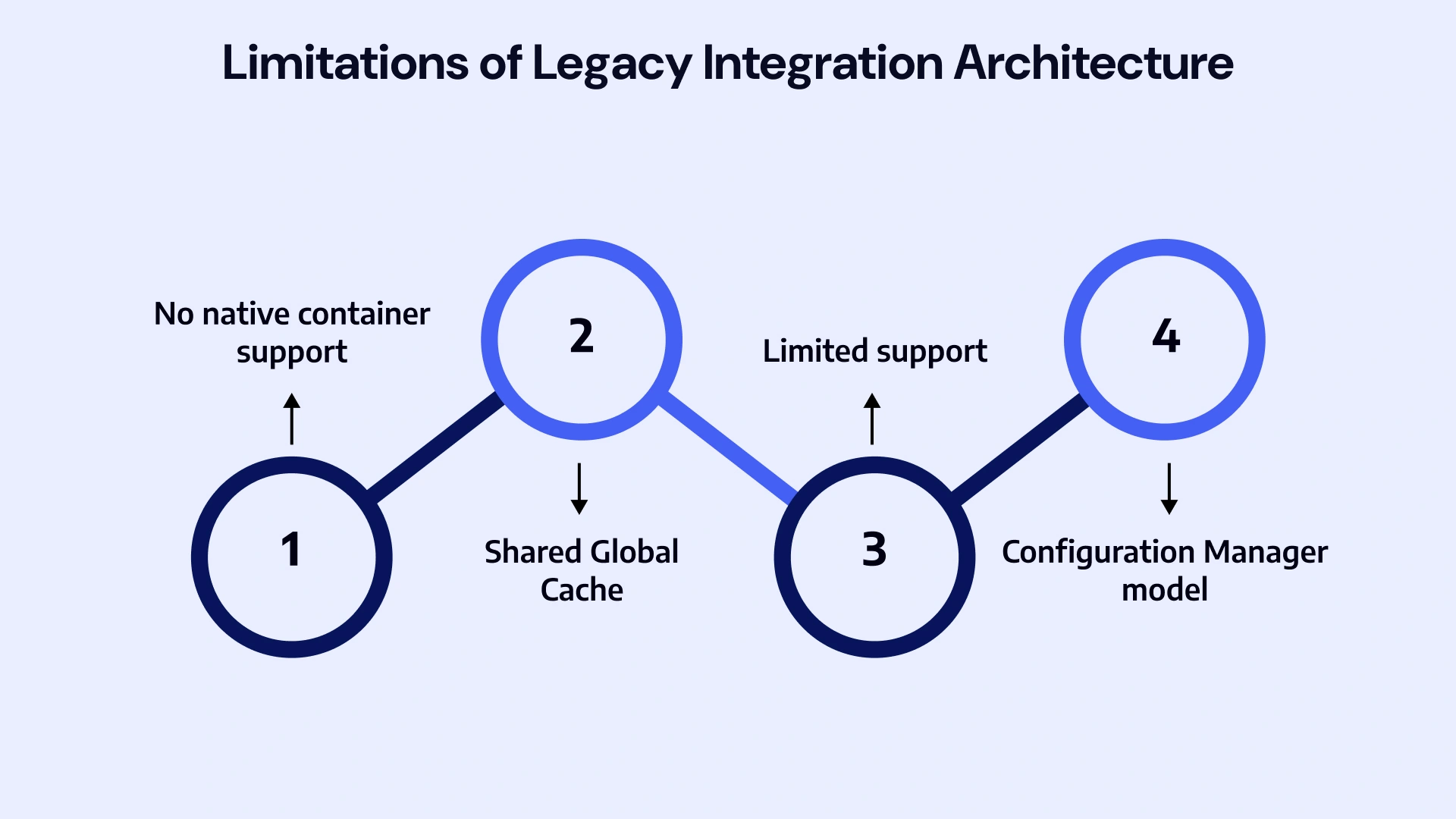
- No native container support, IIB cannot run as a Kubernetes pod without significant custom work
- Shared Global Cache creates stateful dependencies that block horizontal scaling
- Limited support for REST, JSON, and event-driven patterns without workarounds
- The Configuration Manager model adds operational complexity and single points of failure
The Shift Toward Hybrid and Cloud-Native Integration
IBM App Connect Enterprise (ACE) removes the Integration Node dependency entirely. Integrations run as standalone, lightweight servers — deployable as containers on Red Hat OpenShift, Kubernetes, or even traditional VMs for enterprises not yet ready for full containerization.
78% of Indian enterprises prefer a hybrid-cloud integration approach — keeping core banking services and ERP on-premise while exposing APIs via cloud-deployed ACE. This makes the IBM IIB ACE hybrid integration platform the natural evolution for Indian BFSI.
IBM App Connect Enterprise vs IIB: What Actually Changes for CIOs?
For a CIO, the shift from IBM Integration Bus (IIB) to IBM App Connect Enterprise (ACE) is not just a version upgrade; it is a fundamental shift in IT strategy from monolithic stability to cloud-native agility.
IIB vs ACE vs App Connect: Terminology Simplified
The naming can be confusing. Here is the clearest way to understand it:
- IBM Integration Bus (IIB): Legacy product — v9, v10. End of standard support.
- IBM App Connect Enterprise (ACE): The direct successor to IIB — v11, v12. On-premise or containerized. Full ESQL compatibility.
- IBM App Connect (SaaS): Cloud-native, low-code integration platform. Different product, different use case.
- IBM Cloud Pak for Integration: Enterprise suite bundling ACE, API Connect, MQ, and Event Streams on OpenShift.
For most Indian enterprises doing IBM IIB to ACE migration, ACE v12 is the direct migration target. Cloud Pak becomes relevant when you are also modernizing API management and event-driven architecture simultaneously.
Dimension | IBM IIB v10 | ACE v12 (On-Prem) | Cloud Pak for Integration |
Runtime Model | Integration Node + Broker | Standalone Integration Server | Containerized on OpenShift |
Container Support | None (native) | Yes — Docker/K8s ready | Native OpenShift deployment |
ESQL Compatibility | 100% | ~95–98% compatible | Same as ACE v12 |
Scaling Model | Vertical (add resources) | Horizontal (add pods) | Auto-scaling with K8s HPA |
Configuration Mgmt | Configuration Manager | server.conf.yaml | Operator-managed config |
Licensing Model | PVU-based | VPC (Virtual Processor Core) | VPC + Cloud Pak entitlement |
Best Fit | Legacy on-prem | Lift-and-shift + modernize | Full hybrid/cloud integration |
Business Impact: Speed, Cost, Scalability
For the CIO, the App Connect Enterprise vs IBM IIB comparison is ultimately a business case conversation. ACE on containers delivers elastic scaling — critical for BFSI workloads during peak periods like festive season payment surges. Development teams get built-in unit testing and CI/CD integration, cutting release cycles. And the shift from PVU to VPC licensing often delivers meaningful cost reduction when you consolidate multiple IIB nodes into a single ACE cluster.
Note: If execution speed and domain expertise are priorities, businesses often choose to hire IBM App Connect developers to accelerate delivery with lower operational friction.
Migration Paths from IBM IIB to App Connect Enterprise
Here are the primary migration strategies for IBM App Connect migration that your technical leads should consider:
Parallel Migration vs Extract Migration
- Parallel Migration: Run IIB and ACE side by side. Migrate flows one at a time. Lower risk, longer timeline. Best for enterprises with complex, interdependent flows or those running 24x7 critical systems where any disruption is unacceptable.
- Extract Migration: Export IIB artifacts (.PI or .zip files), import directly into the ACE Toolkit. Faster, but requires thorough testing to catch compatibility gaps — especially around deprecated nodes or legacy adapter dependencies.
Supported Migration Paths and Use Cases
Migration Path | Best For | Risk Level | Typical Timeline |
IIB v9 → ACE v12 | Full modernization leap | Medium-High | 4–8 months |
IIB v10 → ACE v12 | Most common Indian scenario | Medium | 3–6 months |
IIB v10 → ACE v12 on K8s | Containerization + migration | High | 6–12 months |
IIB v10 → Cloud Pak | Full integration platform refresh | High | 9–18 months |
IBM's official documentation covers two primary supported paths: import-based migration using the ACE Toolkit, and side-by-side deployment for gradual cutover. For Indian enterprises with complex BFSI flows, the side-by-side approach combined with phased cutover is the safest pattern.
Sample Migration Roadmap for an Indian Enterprise
A typical mid-to-large Indian enterprise with 80–150 IIB flows can follow this 5-phase model:
Phase | Activity | Duration | Key Output |
Phase 1: Assess | Run mqsireportartifacts; classify all flows; readiness scorecard | 3–4 weeks | Flow inventory + complexity map + readiness score |
Phase 2: Provision | Deploy ACE environment (VMs or OCP); configure server.conf.yaml; set up CI/CD pipeline | 3–4 weeks | ACE environment ready; deployment pipeline operational |
Phase 3: Convert | Migrate Simple and Medium flows using toolkit import + automated testing | 8–12 weeks | 70–80% of flows migrated and tested |
Phase 4: Complex Migration | Manually migrate Complex flows; refactor ESQL where needed; stakeholder UAT | 8–12 weeks | 100% flows migrated; UAT sign-off |
Phase 5: Cutover | Blue-Green or Canary deployment; traffic shift; IIB decommission post-stabilization | 4–6 weeks | ACE in full production; IIB decommissioned |
Total timeline: 6–10 months for a 100-flow estate. Enterprises with 200+ flows or high complexity (legacy adapters, Global Cache usage) should plan 12–18 months.
Architecture Choices for Indian Enterprises: On-Prem, Hybrid, or Containers
In 2026, the landscape has shifted toward "Sovereign-ready" architectures. Here is how you should decide the primary paths.
ACE on VMs vs Kubernetes vs IBM Cloud Pak for Integration
This is the decision that keeps Indian architects up at night. The right architecture depends on four factors: current container maturity, regulatory constraints, team skills, and timeline.
Architecture | When to Choose | India Suitability | Key Consideration |
ACE on Windows/Linux VMs | Teams new to containers; quick lift-and-shift | High — most Indian enterprises start here | Easiest migration path; least disruption |
ACE on Kubernetes (OCP) | Container-mature teams; long-term agility goal | Medium-High — growing adoption | Skill gap risk; OpenShift expertise needed |
Cloud Pak for Integration | Full platform modernization; API + MQ + ACE | Medium — typically Tier-1 banks, large NBFC | Higher upfront cost; maximum long-term value |
Data Residency, Latency, and Compliance: The India Lens
For Indian BFSI enterprises, architecture is not just a technical decision — it is a regulatory one. The RBI's guidelines on IT infrastructure require that critical data processing happen within Indian boundaries. When deploying ACE on cloud migration services infrastructure, ensure you target AWS Mumbai/Hyderabad regions or Azure India Central for data residency compliance.
- PSU banks typically prefer on-premise ACE on VMs or a private OpenShift cluster in their own data centers
- Private banks with stronger DevOps maturity are adopting ACE on Red Hat OpenShift — often on-premise or co-located
- Insurance companies and NBFCs are exploring Cloud Pak, particularly those investing in an API-led integration strategy for Open Insurance
Latency matters too. Core banking systems at Indian banks require sub-100ms integration response times for payment flows. ACE's standalone server model — without the overhead of the IIB Integration Node — delivers measurably better latency for high-throughput transaction flows.
IBM IIB Migration Risk Assessment and Zero-Downtime Strategy
IBM IIB migration risk assessment starts with an honest inventory across three dimensions. Most migration failures in Indian enterprises trace back to underestimating one of these three areas:
| Risk Dimension | Specific Risk | Mitigation |
People | ESQL expertise without ACE container knowledge | Parallel upskilling + phased migration |
Process | No formal integration inventory or dependency map | Run mqsireportartifacts; classify all flows |
Technology | Deprecated nodes or legacy adapters in IIB flows | IBM Transformation Advisor scan pre-migration |
Technology | Environment-specific config hardcoded in flows | Refactor to server.conf.yaml externalization |
Compliance | Audit trail gaps during the transition period | Maintain dual-logging on IIB and ACE in parallel |
Business | Cutover downtime for 24x7 payment systems | Blue-Green deployment with API Gateway routing |
Zero-Downtime Migration Patterns
For a Tier-1 Indian bank, the transition from IIB to ACE is a "high-stakes" operation where even a few seconds of UPI downtime can lead to regulatory penalties and massive customer dissatisfaction.
A zero-downtime strategy ensures that your digital backbone remains functional while the engine is being replaced. By utilizing parallel environments and intelligent traffic steering, you move from a "Big Bang" migration—which carries a high failure risk—to a controlled, data-driven evolution.
Here are the ideal strategic patterns for a seamless IBM IIB to ACE migration.
- Canary Deployment: Route 10% of traffic to the new ACE flow while keeping the IIB flow active for fallback. Monitor for 48–72 hours. Gradually shift traffic to 25%, 50%, 100%. Ideal for payment systems where zero-downtime IBM IIB migration is non-negotiable.
- Blue-Green Deployment: Run a complete parallel ACE environment. Switch traffic via API Gateway (IBM API Connect or APIGW) in a single controlled cutover. Best for batch-heavy or time-windowed cutover scenarios.
Pro Tips:- For a Tier-1 Indian bank processing UPI transactions: Deploy ACE v12 alongside IIB v10. Route UPI flows to ACE at 10% during off-peak hours. Validate transaction parity. Scale to 100% over 4 weeks. Decommission IIB post-stabilization.
Rollback and Business Continuity Planning
- Always maintain a rollback-ready IIB environment for a minimum of 30 days post-cutover
- Document rollback SLA — target: restore IIB routing within 15 minutes of triggered rollback
- Define BCP triggers: error rate > 2%, latency > 300ms, or failed transaction count threshold
- Business continuity integration migration requires sign-off from Risk, IT, and Business before cutover

Cost and Effort Estimation for IBM IIB to ACE Migration in India
IBM IIB migration cost estimation in India varies widely based on estate size, architecture target, and internal vs partner-led execution. To facilitate the IBM IIB to ACE migration in India, we have outlined the realistic breakdown.
Cost Components
Cost Component | On-Prem ACE (VMs) | ACE on K8s (OCP) | Cloud Pak for Integration |
IBM Licensing (VPC) | ₹25–40L per year | ₹35–55L per year | ₹60–120L per year |
Infrastructure | Existing servers (low delta) | OCP cluster: ₹20–50L setup | OCP + Cloud Pak: ₹40–80L setup |
Migration Effort (Partner) | ₹30–60L (50–100 flows) | ₹50–90L (50–100 flows) | ₹80–160L (full suite) |
Internal Resource Cost | 3–6 months of 2–3 FTEs | 4–8 months of 3–5 FTEs | 9–18 months of 5–8 FTEs |
Testing and Validation | ₹10–20L | ₹15–30L | ₹20–40L |
Note: Costs are indicative ranges for mid-to-large Indian enterprises. Actual numbers depend on flow complexity, ESQL debt, and consultant rates. IIB migration budget planning should include a 20% contingency buffer for hidden complexity.
TCO Comparison: Stay vs Migrate vs Cloud
Scenario | Year 1 Cost | Year 3 TCO | Strategic Value |
Stay on IIB v10 (Extended Support) | High (support premium + risk) | Very High + compliance risk | Declining — no new capabilities |
Migrate to ACE on VMs | Medium-High (migration + license) | Medium — stable, predictable | Good — modern tooling, supported |
Migrate to ACE on K8s | High (migration + OCP) | Medium — infra savings offset cost | High — elastic, cloud-ready |
Full Cloud Pak for Integration | Very High (platform investment) | Medium-Low — consolidation gains | Very High — future-proof platform |
The business case for IBM IIB to App Connect migration almost always closes within 18–24 months when you factor in extended support premium savings, infrastructure consolidation, and reduced operational overhead.
ACE Migration Readiness Assessment for CIOs and Architects
Before committing to a migration timeline, every CIO and enterprise architect should run an ACE migration readiness assessment. This is the step that separates a successful migration program from an expensive rework cycle.

Inventory and Complexity Analysis
- Run mqsireportartifacts on all IIB brokers — document every message flow, policy, and node type
- Classify flows: Simple (MQ-to-HTTP, <5 nodes), Medium (multi-protocol, ESQL transforms), Complex (heavy ESQL, legacy adapters, Global Cache dependency)
- Flag deprecated nodes: WebSphere MQ nodes v1, old SOAP nodes, legacy system modernization services adapters
- Estimate effort: Simple = 1–2 days, Medium = 3–5 days, Complex = 1–3 weeks per flow
Dependency and Integration Mapping
- Map all upstream and downstream systems connected via IIB
- Identify shared queues, topics, and databases — these create hidden migration dependencies
- Document environment-specific configurations currently hardcoded in flows (to be externalized to server.conf.yaml in ACE)
Governance and Skill Readiness
- Assess team ESQL skills — ACE v12 supports ~95–98% of ESQL compatibility; gaps need identification
- Evaluate container readiness: Does the team have OpenShift or Kubernetes operational skills?
- Review the change management process — ACE CI/CD integration requires updated deployment pipelines
Executive Summary of Scores
Readiness Area | Score 1 (Not Ready) | Score 3 (Partially Ready) | Score 5 (Ready) |
Integration Inventory | No documentation exists | Partial flow list available | Full mqsireportartifacts output |
ESQL Skill Level | Team unfamiliar with ESQL | ESQL used but not documented | ESQL expertise with code reviews |
Container Maturity | No container usage | Docker in dev; no K8s | OpenShift/K8s in production |
Change Management | Ad-hoc deployments | Some CI/CD pipelines | Full DevOps pipeline in place |
Governance/Compliance | No integration governance | Basic logging in place | Full audit trail + API governance |
- Score 20–25: Ready to migrate.
- Score 12–19: Prepare before migrating.
- Score below 12: Run a pre-migration modernization sprint first.
Governance, Compliance, and Audit in Indian BFSI
In 2026, Indian BFSI governance has evolved from periodic audits to continuous, real-time oversight. This shift is driven by three regulatory pillars: RBI’s IT Outsourcing norms, the DPDP Act for data privacy, and SEBI’s Cyber Resilience framework.
RBI and IRDAI Considerations
IBM IIB ACE governance compliance is not optional for Indian BFSI. The RBI's IT Risk and Cyber Security Framework requires financial services institutions to maintain complete audit trails for all inter-system data flows. During the IBM IIB to App Connect migration, there is a window where flows run on both platforms — this dual-running period must be fully logged and auditable.
- Ensure ACE integration servers generate immutable transaction logs — critical for RBI audit readiness
- IRDAI-regulated entities need to demonstrate data residency compliance — deploy ACE in on-shore data centers
- PSU banks under government audit scrutiny need documented change approvals for every migrated flow
Audit Trails and API Governance
ACE v12 integrates natively with IBM API Connect for API lifecycle management. This is significant for the API-led integration strategy that most Indian banks are pursuing under their Open Banking and digital lending roadmaps. Every exposed API carries governance metadata — version, policy, throttling limits — and audit events are captured at the gateway layer.
For enterprises pursuing IBM ACE API Connect integration, this means a single control plane for both integration flows and API governance. Audit and compliance teams get a consolidated view of all data movements — exactly what RBI inspectors ask for during IT audits.
DR, BCP, and High Availability
- ACE on Kubernetes supports active-active HA natively through pod replication across availability zones
- For VM-based ACE, configure Active-Standby using IBM MQ mirroring and shared NFS for integration artifacts
- DR testing must be explicitly planned — RBI circular RBI/2021-22/112 mandates annual BCP/DR exercises for regulated entities
Real BFSI Use Cases: IBM App Connect Enterprise in Action
Proven IBM App Connect Enterprise (ACE) implementations across the Indian BFSI sector include:
Payment Systems and UPI Integration
IBM ACE for banking integration is well proven in India's payment ecosystem. Consider a leading Indian private bank that ran IIB v10 for all payment gateway integrations. During the peak festive season, their IIB environment could not scale horizontally — timeouts spiked to 8% on payment confirmations.
After migrating to ACE v12 on Red Hat OpenShift, the system auto scaled from 2 to 7 pods during peak load, bringing timeout rates below 0.3% and maintaining latency under 200ms.
Core Banking Modernization
A pan-India public sector bank used ESB to ACE migration as the trigger to modernize its core banking integrations. The IIB environment had 180+ flows connecting a legacy Finacle core banking system to over 40 downstream systems.
Using a phased integration migration strategy in India, the bank migrated 30 simple flows in Phase 1 (3 months), 90 medium flows in Phase 2 (5 months), and 60 complex flows in Phase 3 (4 months) — maintaining 100% uptime throughout via the parallel migration pattern.
Lending and API Ecosystems
NBFCs and digital lenders are using IBM App Connect Enterprise in BFSI to build Open Credit Enablement Network (OCEN) integrations. ACE's REST and JSON-native support — a significant improvement over IIB — makes it the platform of choice for API-first lending workflows.
IBM ACE API Connect integration enables these firms to expose loan origination APIs with full policy governance and throttling, directly compliant with RBI's guidelines for Account Aggregator frameworks.
Implementation Patterns and Migration Accelerators
Modernizing from IBM IIB to ACE in the Indian BFSI sector requires a move away from manual "copy-paste" methods toward automated, pattern-based execution. These strategies minimize risk for high-volume payment systems and ensure compliance with 2026 regulatory standards.
One-by-One vs Mass Migration
- One-by-One (Recommended for BFSI): Migrate flows individually or in small batches. Each flow goes through assess → convert → test → deploy → cutover. Higher governance, lower risk, longer timeline.
- Mass Migration (For Simpler Estates): Suitable when the flow inventory is predominantly the Simple category with minimal ESQL. Use IBM's migration tools to batch-convert and validate. Faster, but requires extensive regression testing.
Automation Tools and Accelerators
- IBM Transformation Advisor: Scans IIB artifacts, flags compatibility issues, and estimates migration effort. Essential first step for any IBM IIB to ACE migration program.
- ACE v12 Test Framework: Record-and-replay of live transaction messages for automated regression testing. Reduces test effort by 40–60% on simple-to-medium flows.
- I2AC Accelerator (Royal Cyber): Automated IIB-to-ACE conversion tool for standard flow patterns — demonstrated in IBM partner webinars for bulk migration scenarios.
- Custom migration scripts: For enterprises with 200+ flows, invest in scripted deployment pipelines that automate server.conf.yaml generation and bar file deployment to ACE.
Impact on Timeline and Risk
Using automation tools typically reduces migration effort by 30–40% on simple flows. However, complex flows with heavy ESQL or legacy adapters still require hands-on expert intervention. Budget for a hybrid approach: automate what you can, manually migrate what you must.
The VLink Advantage: Precision Migration via IBM IIB Experts
Choosing the right implementation partner is as important as choosing the right migration path. VLink's IBM integration developers for Indian Banks combines deep ESQL expertise with modern container engineering — a combination that is genuinely rare in the Indian market.
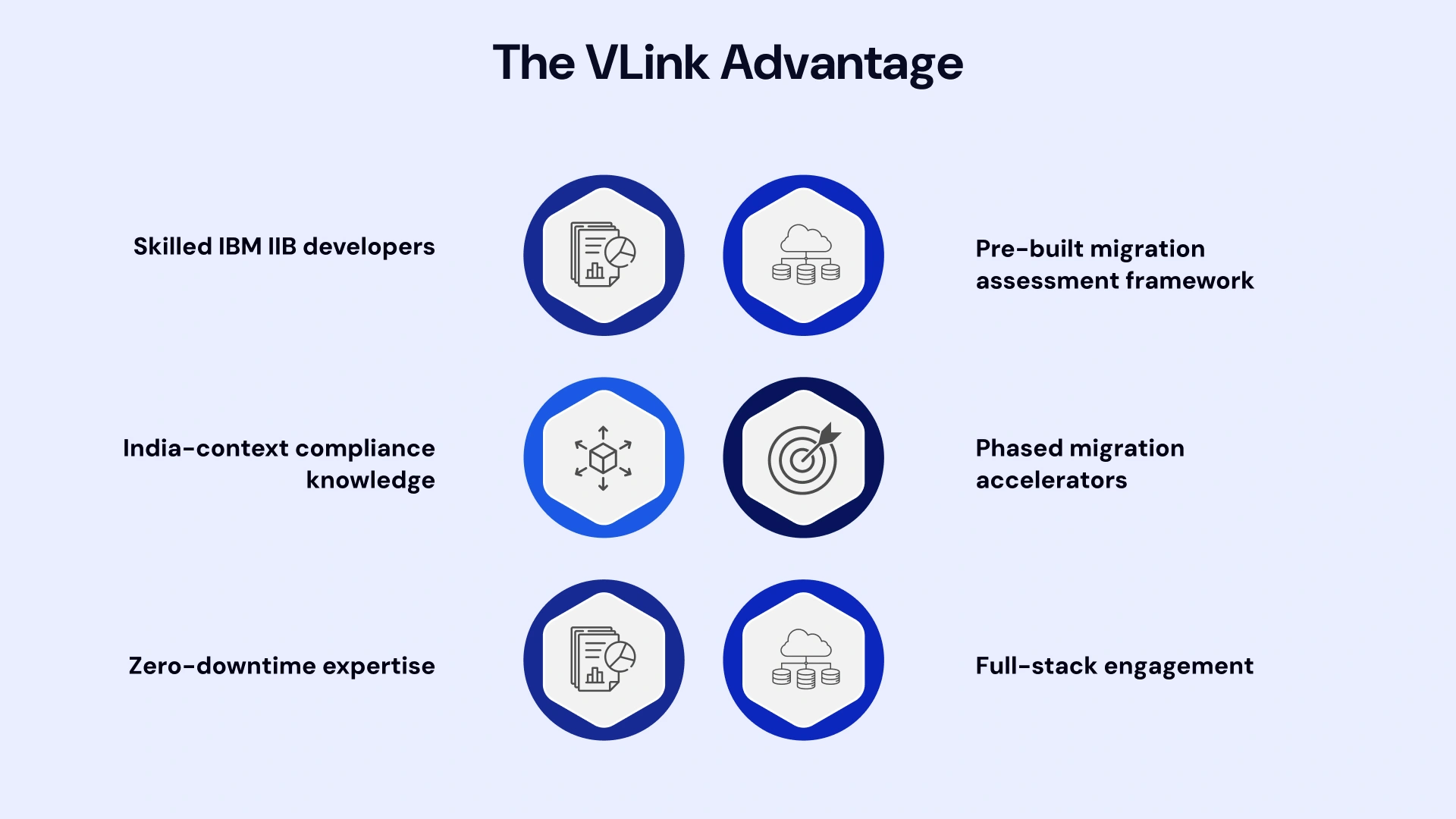
- Hire IBM IIB developers with a proven track record in enterprise environments, experts with hands-on experience on IIB v9, v10, ACE v11, v12, and Cloud Pak for Integration
- VLink's readiness scorecard has been applied across 10+ Indian BFSI migrations
- Our team understands RBI IT Framework requirements, IRDAI data residency mandates, and PSU bank audit documentation standards
- VLink's automated flow classification and generation tools cut assessment time by 50%
- VLink has executed Blue-Green and Canary migration cutovers for Indian banks processing over daily transactions
- From IBM IIB/MQ Integration Best Practices through ACE deployment to IBM API Connect governance setup — VLink manages the full integration modernization lifecycle
VLink's phased integration migration strategy in India framework has helped Indian enterprises migrate 500+ IIB flows to ACE with zero production incidents. Our IBM IIB and ACE developers bring the hands-on expertise that transforms complex migrations into controlled programs.
Conclusion: From Migration to Modern Integration Strategy
IBM IIB to App Connect migration is one of the most consequential infrastructure decisions Indian enterprises will make in the next 24 months. The combination of IIB's extended support timeline, India's accelerating digital transaction volumes, and the growing compliance scrutiny from RBI and IRDAI makes the status quo untenable.
ACE is not just a replacement for IIB — it is the foundation for a modern, hybrid integration strategy built for India's real-time economy. Whether you are a Tier-1 private bank integrating with ONDC and UPI 2.0, a PSU bank modernizing core banking interfaces, or an NBFC building API-led lending ecosystems, IBM App Connect Enterprise gives you the scalability, governance, and compliance architecture to move forward.
The migration itself is manageable — when planned correctly. Use the readiness scorecard in this guide to know where you stand. Choose your architecture based on container maturity and regulatory constraints. Plan phased migration with zero-downtime patterns for your critical flows. And build the business case using the TCO frameworks above.
Your integration layer should be the engine of your digital strategy—not the anchor of your legacy stack. Reach out to our experts to start your migration journey today.

Global Delivery Manager, VLink Inc.
Shivisha Patel serves as the Global Delivery Manager at VLink Inc., bringing a wealth of experience in program delivery and management, particularly in the insurance and banking sectors. She has a robust technical background with deep expertise in WebSphere MQ, WTX, IIB, middleware, and enterprise system integration.

 Shivisha Patel