


Government CTOs and IT decision-makers across India face a unique challenge: managing complex digital platforms that must balance security, scalability, citizen accessibility, and regulatory compliance while operating within budgetary constraints. According to recent data from NDAP, over 500+ government datasets are now digitally accessible, requiring sophisticated platform management strategies to ensure seamless data governance, interoperability, and citizen-centric service delivery.
Digital platform management for government extends far beyond basic IT infrastructure maintenance. It encompasses strategic planning, security frameworks, cloud architecture, legacy system integration, performance optimization, and continuous innovation. Government organizations must navigate the delicate balance between modernizing their technological infrastructure and maintaining the reliability of mission-critical services that millions of citizens depend on daily.
This comprehensive blog explores proven best practices for government digital platform best practices, drawing insights from successful implementations across central and state government departments in India. Whether you're managing e-governance portals, citizen service platforms, or enterprise resource planning systems, this article provides actionable strategies tailored specifically for the Indian government and public sector context.
Understanding Digital Platform Management in the Government Context
Government digital platform management refers to the comprehensive approach of planning, deploying, operating, and optimizing digital infrastructure and applications that deliver public services to citizens, businesses, and government entities. Unlike private sector platforms, government digital ecosystems must prioritize universal accessibility, data sovereignty, transparency, and accountability while adhering to strict regulatory frameworks.
In the Indian context, digital platform management encompasses various systems, including DigiLocker, UMANG (Unified Mobile Application for New-age Governance), e-Office, Aadhaar-enabled services, Government e-Marketplace (GeM), and numerous state-specific citizen portals. These platforms collectively serve millions of transactions daily, requiring enterprise-grade reliability, security, and performance.
Why Traditional IT Management Falls Short for Government Platforms
Government organizations cannot simply replicate private sector IT management practices for several critical reasons:
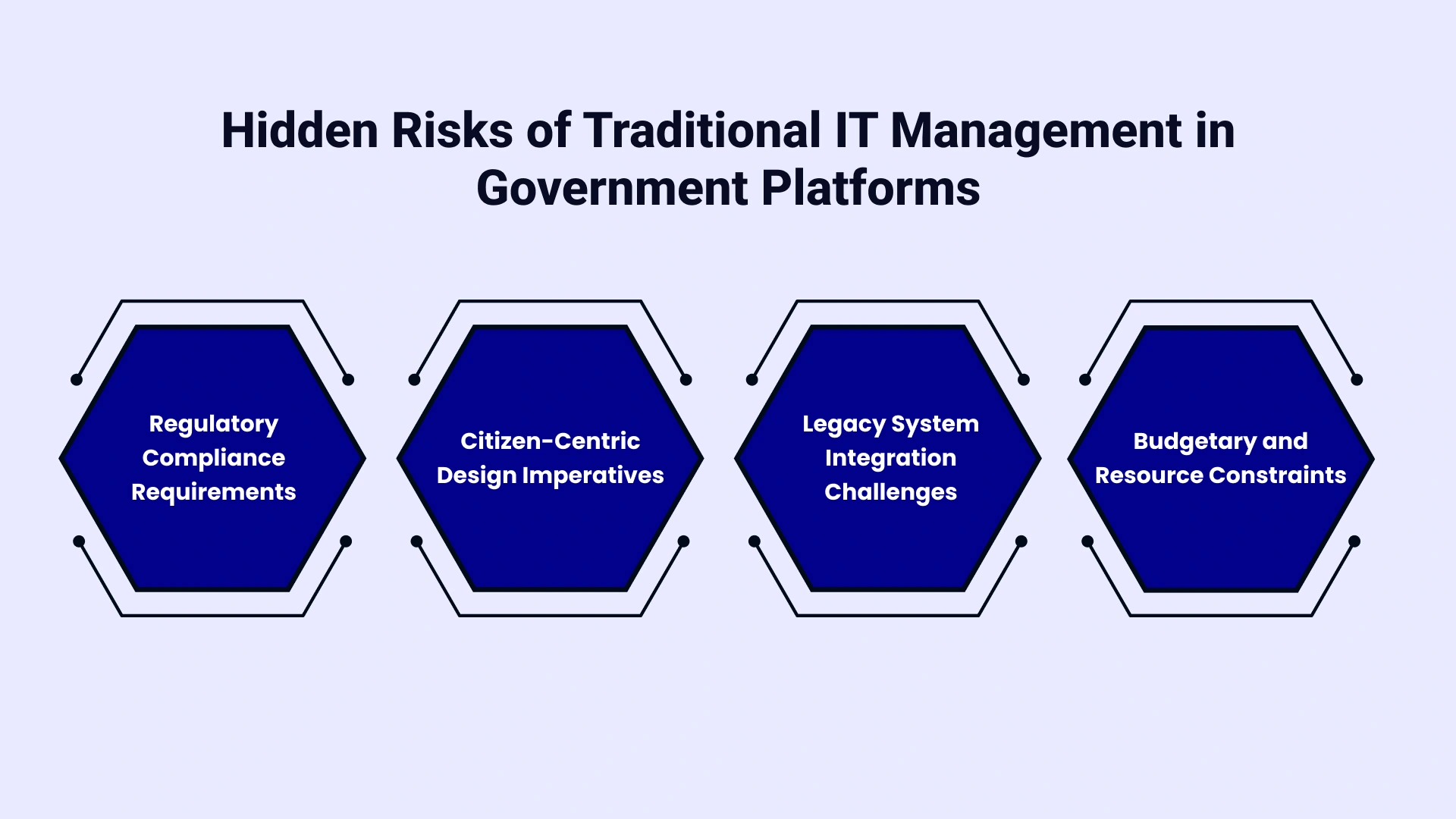
- Regulatory Compliance Requirements: Government platforms must comply with frameworks, including the Information Technology Act 2000, Digital Personal Data Protection Act 2023, and sector-specific regulations. This compliance burden requires specialized governance frameworks that traditional IT management approaches may not address comprehensively.
- Citizen-Centric Design Imperatives: Unlike commercial platforms that can segment their user base, government digital platforms must be universally accessible across diverse demographics, literacy levels, languages, and device capabilities. This requires inclusive design principles and multi-channel service delivery strategies.
- Legacy System Integration Challenges: Most government departments operate legacy systems developed decades ago using outdated technologies. Modern digital platforms must seamlessly integrate with these systems while gradually modernizing the technology stack without disrupting critical services.
- Budgetary and Resource Constraints: Government IT budgets are often constrained and subject to lengthy procurement cycles. Platform management strategies must optimize resource utilization, leverage open-source technologies where appropriate, and demonstrate clear return on investment for technology initiatives.
Core Pillars of Government Digital Platform Best Practices
In 2025, India’s government digital landscape has matured into a globally recognized model often referred to as Digital Public Infrastructure (DPI). The best practices are built upon the "India Stack" philosophy, which moves away from creating isolated websites toward building open, interoperable "rails" that the public and private sectors can use.
The core pillars of the Government Managed IT Services ecosystem are categorized into six vision areas and several operational best practices.
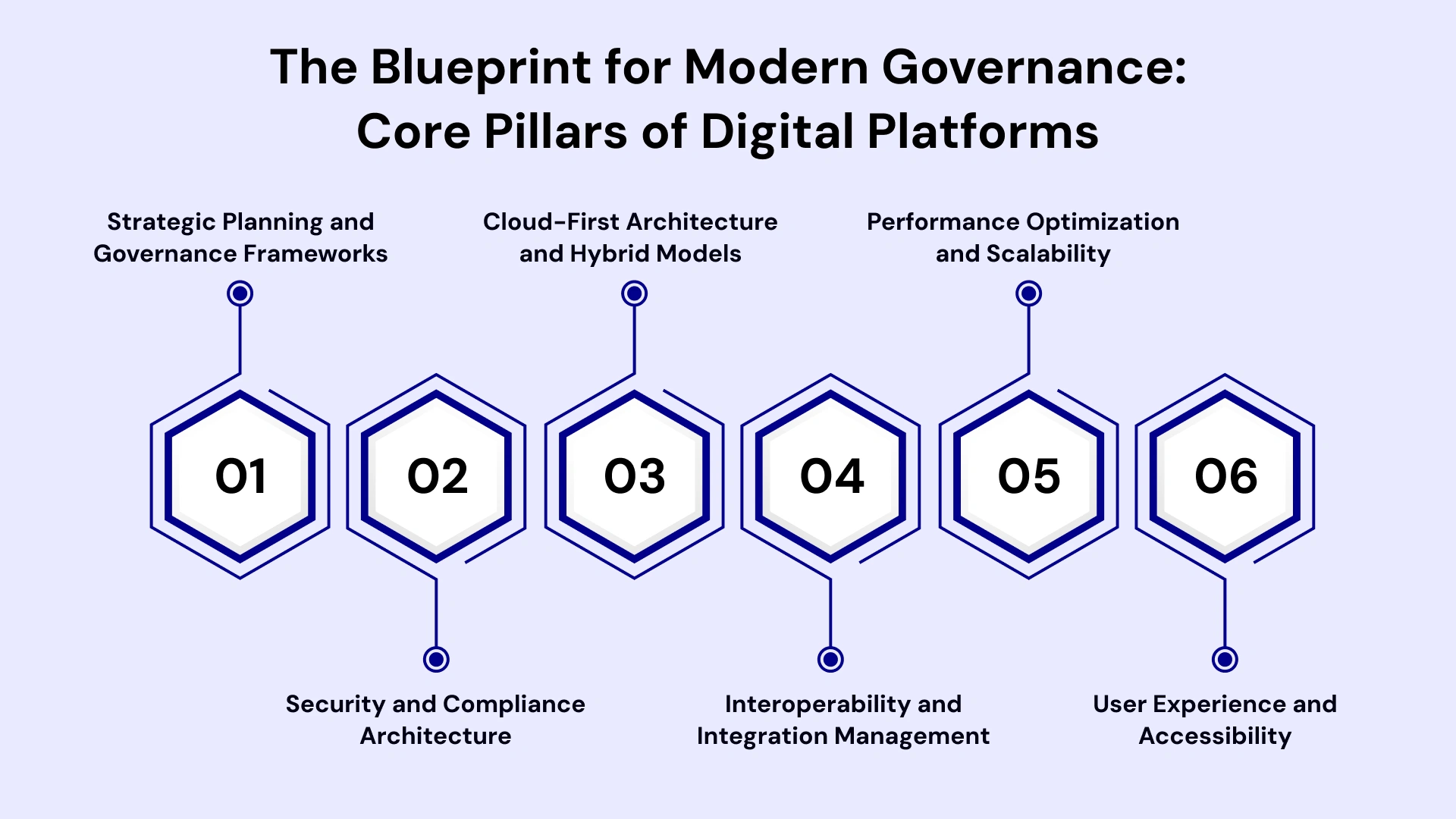
1. Strategic Planning and Governance Frameworks
Effective digital platform management begins with strategic planning aligned with broader e-governance objectives. Government CTOs should establish comprehensive governance frameworks that define roles, responsibilities, decision-making processes, and accountability mechanisms. This includes:-
- Establishing Digital Governance Councils: Create cross-functional governance bodies comprising technical leaders, policy experts, department heads, and citizen representatives. These councils should oversee platform strategy, approve major technology decisions, and ensure alignment with national digital initiatives like Digital India.
- Developing Platform Roadmaps: Create multi-year platform evolution roadmaps that balance immediate operational needs with long-term transformation goals. These roadmaps should identify technology refresh cycles, capability enhancement phases, and integration milestones while accounting for budgetary realities.
- Implementing Policy-Driven Architecture: Define technology policies covering standards, security protocols, data management, cloud adoption, vendor management, and accessibility requirements. These policies provide guardrails for platform development and ensure consistency across government departments.
2. Security and Compliance Architecture
Security represents the foundation of government digital platform management. Cyberattacks targeting government infrastructure have increased significantly, making robust security frameworks non-negotiable. This includes: -
- Adopting Zero-Trust Security Models: Implement zero-trust architectures that verify every access request regardless of source. This approach assumes no implicit trust and requires continuous authentication and authorization, significantly reducing breach risks.
- Implementing Multi-Layered Security Controls: Deploy defense-in-depth strategies combining network security, application security, data encryption, identity and access management, and security information and event management (SIEM) systems. Each layer provides additional protection, ensuring that compromising one layer doesn't expose the entire platform.
- Establishing Security Operations Centers: Create dedicated SOCs to monitor government digital platforms 24/7, detect anomalies, respond to incidents, and coordinate with agencies such as CERT-In (Indian Computer Emergency Response Team). These SOCs should leverage AI-powered threat intelligence to proactively identify emerging threats.
- Ensuring Regulatory Compliance: Implement compliance management systems that continuously monitor adherence to frameworks, including MeitY's guidelines for government websites, data protection regulations, and sector-specific compliance requirements. Automated compliance dashboards help identify gaps before they become critical issues.
3. Cloud-First Architecture and Hybrid Models
Cloud computing offers government organizations scalability, flexibility, and opportunities for cost optimization. However, government cloud adoption requires careful consideration of data sovereignty, security, and regulatory requirements. This includes:-
- Leveraging MeghRaj Cloud Initiative: Align cloud strategies with the Government of India's MeghRaj policy, which provides frameworks for cloud adoption in government. Utilize empaneled cloud service providers that meet government security and compliance standards.
- Implementing Hybrid Cloud Architectures: Adopt hybrid models that keep sensitive data and critical applications in government data centers while leveraging public cloud for non-sensitive workloads, development environments, and scalable services. This approach balances security concerns with the benefits of the cloud.
- Establishing Cloud Governance Models: Define clear policies for workload placement, data classification, cloud provider selection, cost management, and performance monitoring. Implement FinOps practices to optimize cloud spending and prevent budget overruns.
4. Interoperability and Integration Management
Government digital platforms rarely operate in isolation. Effective platform management requires seamless integration across departments, levels of government, and external systems. This includes:-
- Adopting API-First Design Principles: Develop platforms with well-documented APIs that enable secure data exchange and service integration. API management platforms should provide authentication, rate limiting, monitoring, and version control capabilities.
- Implementing India Stack Components: Leverage India Stack building blocks, including Aadhaar authentication, DigiLocker integration, UPI payments, and eSign services. These standardized components accelerate platform development and ensure consistent citizen experiences.
- Establishing Data Exchange Standards: Adopt common data formats, metadata standards, and exchange protocols that facilitate interoperability. Participate in initiatives like the National Data Sharing and Accessibility Policy (NDSAP) to enable government-to-government data sharing.
- Managing Legacy System Integration: Develop integration strategies for legacy systems using middleware, service-oriented architectures, and API gateways. Implement strangler pattern approaches that gradually replace legacy functionality while maintaining operational continuity.
5. Performance Optimization and Scalability
Government digital platforms must handle massive user loads, particularly during peak periods like tax filing deadlines, examination result announcements, or scheme application windows. This includes:-
- Implementing Elastic Scaling Mechanisms: Design platforms that automatically scale computing resources in response to demand. Cloud-native architectures, enabled by containerization and orchestration, enable rapid scaling without manual intervention.
- Optimizing Database Performance: Implement database optimization strategies, including indexing, query optimization, caching layers, and read replicas. For high-transaction platforms, consider distributed database architectures that provide horizontal scalability.
- Establishing Content Delivery Networks: Deploy CDN solutions that cache static content closer to end users, reducing latency and improving user experience. This is particularly important for serving India's geographically distributed population.
- Conduct Load Testing and Capacity Planning: Regularly run load tests simulating peak usage scenarios. Use results to inform capacity planning and identify bottlenecks before they impact citizens.
6. User Experience and Accessibility
Government platforms must serve all citizens regardless of their technical proficiency, device capabilities, or disabilities. Inclusive design principles ensure equitable access to digital services. This includes:-
- Implementing GIGW Compliance: Adhere to the Guidelines for Indian Government Websites (GIGW), which specify accessibility standards, design principles, and content management requirements. Ensure WCAG 2.1 Level AA compliance for accessibility.
- Developing Multi-Lingual Interfaces: Provide platform interfaces in all 22 constitutionally recognized Indian languages plus English. Implement dynamic language switching that preserves user context and workflow continuity.
- Optimizing for Low-Bandwidth Environments: Design platforms that function effectively on 2G/3G networks common in rural areas. Implement progressive web app (PWA) technologies that enable offline functionality and synchronize when connectivity improves.
- Creating Assisted Service Channels: Recognize that not all citizens can self-serve through digital platforms. Provide integrated call center support, Common Service Centers (CSC), and field officer interfaces that enable assisted service delivery.

Advanced Digital Platform Management Strategies
Here are a few ways to elevate "Advanced Digital Platform Management Strategies."
Implementing DevOps and Continuous Delivery
Modern platform management leverages DevOps services to bridge agile development methodologies and automated deployment pipelines, accelerating innovation while maintaining stability.
- Establishing CI/CD Pipelines: Implement continuous integration and continuous deployment pipelines that automate code integration, testing, security scanning, and deployment. This reduces manual errors and accelerates time-to-market for platform enhancements.
- Adopting Infrastructure as Code: Manage infrastructure using code-based definitions that version control, automate provisioning, and ensure environment consistency. Tools like Terraform and Ansible enable reproducible infrastructure deployment.
- Implementing Blue-Green Deployments: Deploy platform updates using blue-green strategies that maintain two identical production environments. This approach enables zero-downtime deployments and rapid rollback if issues emerge.
Leveraging AI and Automation
Artificial intelligence and automation technologies can significantly enhance platform management efficiency and citizen service quality.
- Deploying AI-Powered Chatbots: Implement conversational AI development that handles routine citizen inquiries, guides users through processes, and provides 24/7 support. Integrate these chatbots with backend systems to enable transaction completion.
- Implementing Predictive Analytics: Use machine learning models to predict platform usage patterns, identify potential failures, and optimize resource allocation. Predictive maintenance approaches reduce unplanned downtime.
- Automating Routine Operations: Deploy robotic process automation (RPA) to automate repetitive tasks such as report generation, data validation, and system health checks. This frees technical staff to focus on higher-value activities.
Managing Vendor Relationships and Procurement
Government platforms often involve multiple vendors for hardware, software, cloud-managed services, and professional services. Effective vendor management ensures quality delivery and value optimization.
- Implementing Strategic Vendor Management: Move beyond transactional procurement toward strategic partnerships with key vendors. Establish governance mechanisms, performance metrics, and collaboration frameworks.
- Avoiding Vendor Lock-In: Design platforms using open standards, abstraction layers, and multi-vendor strategies that prevent dependence on single vendors. This enhances negotiation leverage and provides exit options.
- Leveraging GeM Platform: Utilize the Government e-Marketplace for transparent, efficient procurement of technology products and services. GeM provides competitive pricing and standardized contract terms.
Addressing Common Challenges in Government Digital Platform Management
Managing a government digital platform is a high-stakes balancing act between modernization and the weight of legacy obligations. As we move into 2026, the shift is no longer just about "going digital," but about making those digital systems resilient, interoperable, and ethically sound.
Below are the most common challenges and the strategic approach being used to address them.
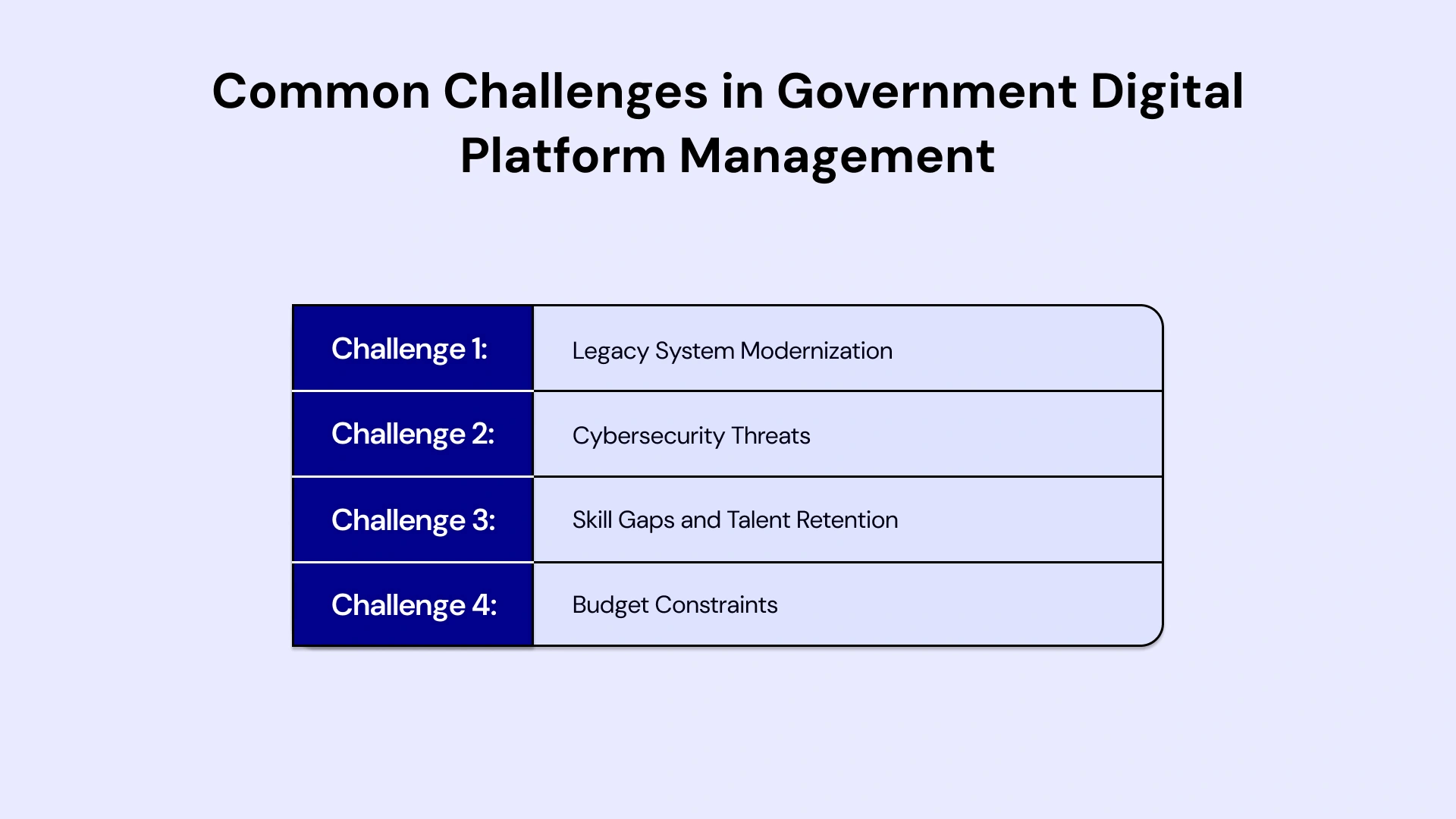
Challenge 1: Legacy System Modernization
Many government departments operate critical systems built on decades-old technology stacks. Modernizing these systems while maintaining operational continuity represents a significant challenge.
- Solution Approach: Adopt incremental modernization strategies using the strangler pattern. Build new capabilities on modern platforms while maintaining legacy systems. Gradually migrate functionality and data, retiring legacy components only after new systems prove stable. This approach reduces risk compared to "big bang" replacements.
Challenge 2: Cybersecurity Threats
Government platforms represent high-value targets for cybercriminals, nation-state actors, and hacktivists. Evolving threat landscapes require continuous security enhancement.
- Solution Approach: Implement comprehensive cybersecurity services combining prevention, detection, and response capabilities. Conduct regular security assessments, penetration testing, and security awareness training. Establish incident response playbooks and conduct regular drills. Collaborate with CERT-In and other government security agencies to share threat intelligence.
Challenge 3: Skill Gaps and Talent Retention
Government IT organizations often struggle to attract and retain skilled technical professionals capable of managing modern digital platforms.
- Solution Approach: Develop comprehensive workforce development programs that include training on cloud technologies, DevOps best practices, and security frameworks; partner with educational institutions to offer specialized courses. Consider hybrid staffing models that combine permanent government staff with specialized contractors for niche skills. Implement knowledge management systems that capture expertise and reduce dependency on individuals.
Challenge 4: Budget Constraints
Government IT budgets face competing priorities and procurement cycle limitations that can hinder platform investment.
- Solution Approach: Adopt a total cost of ownership (TCO) analysis that demonstrates long-term savings from platform modernization. Leverage operational expenditure (OpEx) cloud models that reduce upfront capital requirements. Explore public-private partnership models for large platform initiatives. Implement rigorous cost-optimization practices to maximize value from existing investments.
Measuring Success: KPIs for Government Digital Platforms
Effective platform management requires clear success metrics that demonstrate value and identify opportunities for improvement.
- Citizen Satisfaction Metrics: Track citizen satisfaction scores through surveys, feedback mechanisms, and platform usage analytics. Monitor metrics such as task completion rates, time-to-service delivery, and support ticket volume.
- Platform Availability and Performance: Measure platform uptime, response times, transaction success rates, and error rates. Establish service-level agreements (SLAs) and monitor adherence via automated systems.
- Security Posture Indicators: Track security metrics including time-to-patch vulnerabilities, incident response times, security assessment scores, and compliance audit results.
- Operational Efficiency Metrics: Monitor infrastructure utilization, cost per transaction, automation rates, and mean time to resolution for issues. These metrics demonstrate platform efficiency improvements.
- Innovation Metrics: Track feature release velocity, adoption rates for new capabilities, and time-to-market for platform enhancements. These indicators measure platform evolution speed.
Leverage VLink's Expertise for Government-Managed IT Services
Navigating the complexities of government digital platform management requires specialized expertise, proven methodologies, and a deep understanding of India's regulatory landscape. VLink, a leading software development company in India, brings over a decade of experience delivering Government & Public Sector IT Services India to central and state government departments.
Our comprehensive Government Managed IT Services portfolio encompasses end-to-end platform management, including cloud managed services, security operations, DevOps services, and 24/7 platform monitoring. We understand the unique challenges government CTOs face and deliver solutions tailored to public sector requirements.
As a trusted AI software development company in India, VLink helps government organizations leverage artificial intelligence and machine learning to enhance citizen services, automate operations, and derive actionable insights from government data. Our AI solutions comply with data protection regulations and ethical AI principles essential for government applications.
Our dedicated team of certified professionals combines technical excellence with domain expertise in e-governance, public service delivery, and regulatory compliance. We partner with government organizations as strategic advisors, not just service providers, helping chart digital transformation roadmaps aligned with national initiatives.
VLink's flexible engagement models, including staff augmentation, managed services, and outcome-based partnerships, enable government organizations to scale capabilities without long-term resource commitments. Our proven track record of delivering mission-critical government platforms makes us the preferred partner for forward-thinking government CTOs.
Conclusion
Digital platform management for government represents both a tremendous opportunity and a complex challenge. As India accelerates its digital governance journey, government CTOs and IT leaders must adopt best practices that balance innovation with security, accessibility with performance, and modernization with operational continuity.
The strategies outlined in this guide provide a comprehensive framework for effectively managing government digital platforms. From strategic governance and security architecture to cloud adoption and citizen experience optimization, each element contributes to platforms that serve citizens efficiently, securely, and equitably.
Success in government digital platform management requires more than technology implementation. It demands organizational change management, workforce development, vendor partnerships, and a continuous-improvement mindset. Government organizations that embrace these principles position themselves to deliver transformative digital services that enhance citizen trust and improve governance outcomes.
As India's digital government ecosystem evolves, platforms that embody these best practices will set new standards for public service delivery. By prioritizing security, accessibility, interoperability, and user experience while leveraging modern technologies like cloud computing, AI, and DevOps practices, government organizations can build digital platforms worthy of the world's largest democracy.
The journey toward digital excellence requires expertise, commitment, and strategic partnerships. Connect with VLink experts who understand both technology and the unique context of Indian governance, combining technical capability with domain knowledge and regulatory understanding.

Vice President, Strategy – VLink Inc.
Sambhavi Gopalakrishnan is the Vice President of Strategy at VLink Inc., bringing over a decade of experience in IT leadership, project implementation, and strategic growth. She possesses a strong foundation in technical project management and pre-sales, driving innovation and business transformation at VLink.

 Shivisha Patel