Digital transformation in financial services is no longer a future initiative. It is today's survival strategy.
That gap — between investment intent and execution reality — is exactly where a structured finance digital transformation roadmap becomes your most critical leadership asset.
This guide is written specifically for CIOs and VPs of Strategy in capital markets. It covers how to build a finance digital transformation roadmap that sequences modernization around risk, ROI, and operating resilience — not just technology trends.
The goal is simple: modernize without disrupting trading, compliance, or client service. Let’s start!
Digital Transformation: The New Standard for Financial Services
The old framing — treating digital transformation as a series of IT upgrades — no longer holds. Today, financial digital transformation is about business model reinvention: building infrastructure that is agile, AI-ready, and regulation-proof.
Capital markets firms are no longer competing only with each other. FinTechs, platform banks, and cloud-native trading venues are raising the bar on speed, transparency, and cost-to-serve. Standing still is a competitive liability.
Capital Markets Pressure Points: Latency, Compliance, Cost-to-Serve
Three forces are converging on capital markets CIOs right now:
- Trade Speed: T+1 settlement mandates are compressing trade lifecycle timelines, demanding real-time data flows and faster reconciliation.
- Regulatory Pressure: Basel III Endgame and evolving SEC/FINRA rules are pushing compliance costs higher — firms that have not embedded RegTech into their stack will pay the price.
- Cost Pressure: 84% of TMT and Finance companies are increasing cloud budgets in the current planning cycle (PwC). Firms that fail to modernize cloud infrastructure will face rising cost-to-serve and falling margins.
Current-State Assessment: Where Most Financial Firms Fall Behind
Before building a finance transformation roadmap, you need an honest picture of where your firm stands. Most capital markets organizations share the same three structural weaknesses.
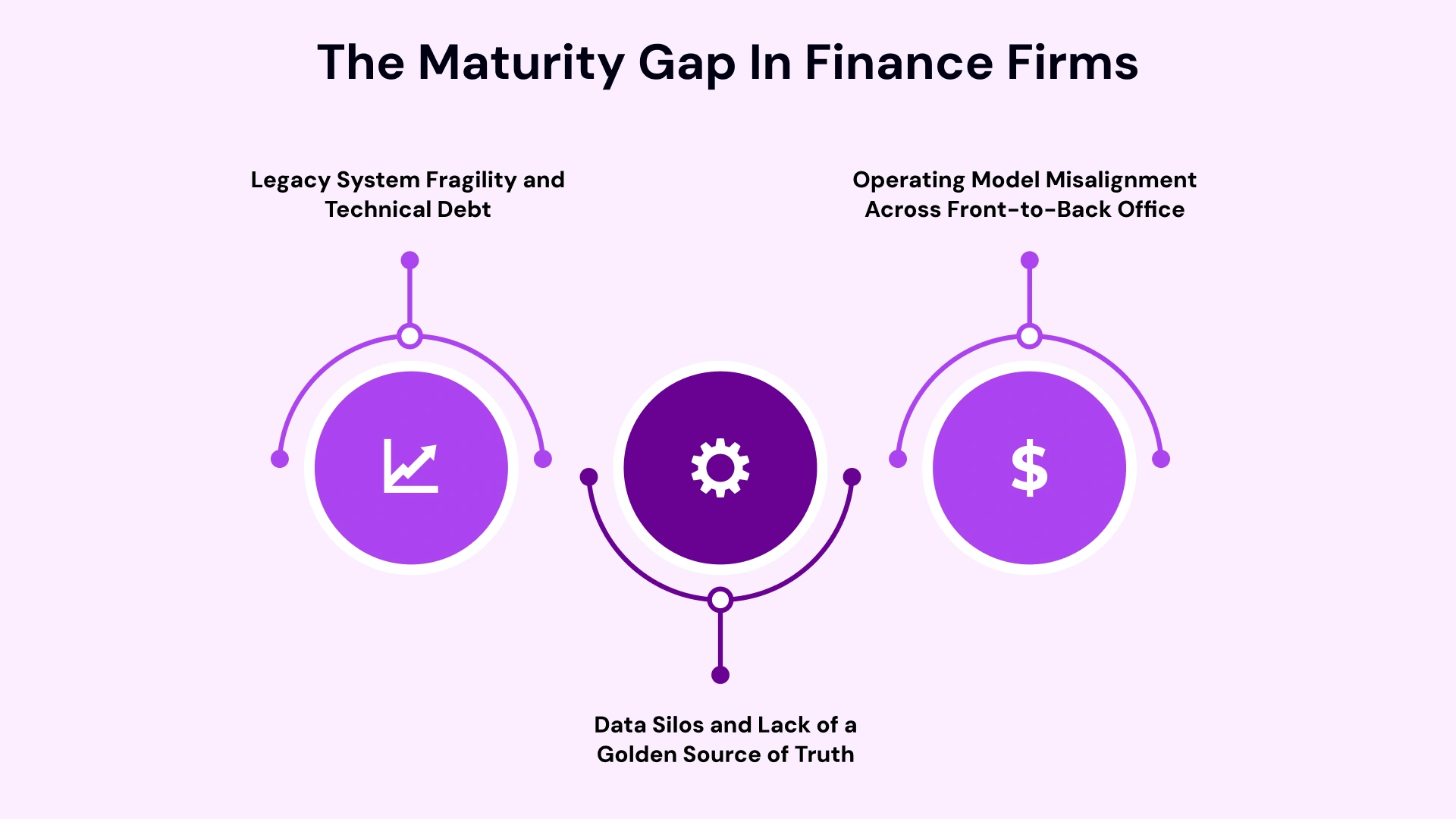
Legacy System Fragility and Technical Debt
Most capital markets' core systems were built for a different era. They are brittle, expensive to maintain, and deeply interconnected in ways that make legacy system modernization in capital markets feel like defusing a bomb. The risk of downtime during migration is not hypothetical — it is a daily operational reality.
The answer is not rip-and-replace. It is modernization-via-abstraction: using APIs and microservices to wrap legacy cores, decouple dependencies, and create parallel modern pathways that run alongside existing systems until the moment of cutover.
Data Silos and Lack of a Golden Source of Truth
Fragmented data is the hidden tax on every capital markets firm. Risk, operations, compliance, and client teams each maintain separate data stores. The result: inconsistent reporting, slow reconciliation, and AI initiatives that stall because the training data is unreliable.
A unified data fabric — combining a real-time data layer with a governed lakehouse architecture — is the foundation of every successful digital finance transformation. Without it, every downstream initiative is built on sand.
Operating Model Misalignment Across Front-to-Back Office
Technology upgrades rarely fail because of the technology. They fail because front-office, middle-office, and back-office teams are optimizing for different objectives with different tools and different data. Transformation without operating model alignment produces faster versions of the same dysfunction.
Modernization Readiness Scorecard
| Dimension | Green (Ready) | Amber (Partial) | Red (At Risk) |
| Technical Debt | Modular architecture | Hybrid legacy/modern | Monolithic core |
| Data Maturity | Unified data platform | Partial integration | Siloed systems |
| Cloud Adoption | >60% workloads | 20–60% workloads | <20% workloads |
| Regulatory Exposure | Embedded RegTech | Manual compliance | Point solutions only |
| Talent Readiness | Cloud/AI native team | Upskilling in progress | Traditional IT only |
Defining Transformation Objectives That Tie to Business Outcomes
One of the key factors in finance transformation success is this: CIOs who frame digital transformation in technology terms lose C-suite alignment within six months. CIOs who frame it in revenue, risk, and efficiency terms sustain investment through the full program.
Before approving a single initiative, map every transformation objective to a measurable business outcome. The technology is the means. The outcome is what gets funded.
Sample Outcome-to-Initiative Mapping Matrix
| Business Problem | Target Outcome | Transformation Initiative |
| High trade failure rate | Reduce fails by 40% | Real-time reconciliation platform |
| Slow client onboarding | Cut KYC time from 14 days to 3 days | Automated perpetual KYC (pKYC) |
| Manual regulatory reporting | 100% automated reporting | RegTech integration layer |
| Rising cost-to-serve | 15% reduction in ops cost | Cloud migration + AI automation |
| Data latency in risk models | Sub-second risk pricing | Real-time data fabric rollout |
The 5-Phase Finance Digital Transformation Roadmap (Execution Model)
This is the core execution model. It is designed for capital markets firms that need to modernize without creating operational disruption. Each phase has clear deliverables, a budget posture, and a risk level.
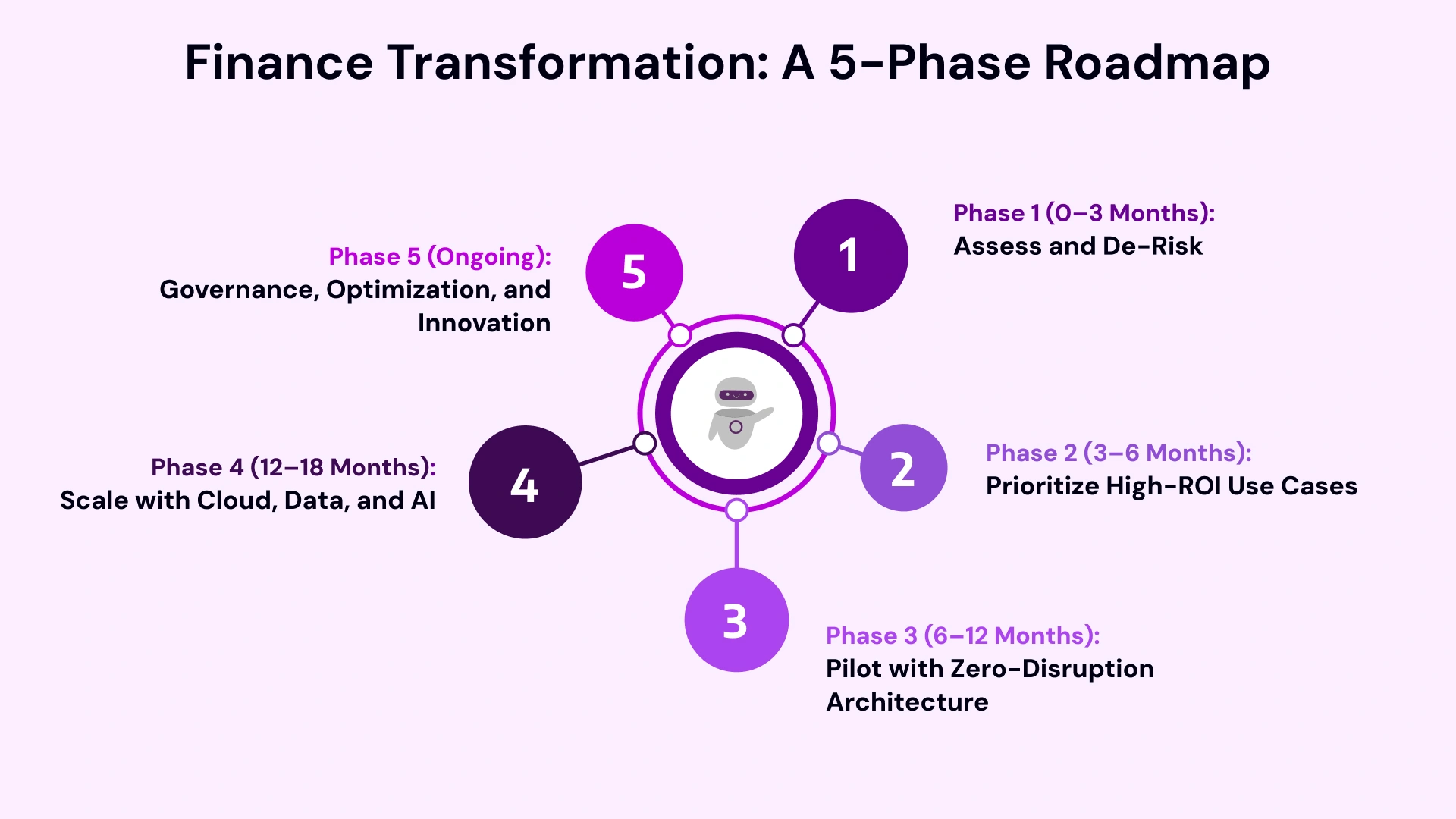
Phase 1 (0–3 Months): Assess and De-Risk
- Conduct a full system inventory — map every legacy dependency, API, and data flow.
- Run a risk mapping exercise to identify migration risk per system component.
- Define KPIs tied to business outcomes (not system uptime).
- Establish a Transformation Steering Committee: CIO, CTO, CDO, and Business Leads.
Risk Level: Low.
Budget Posture: Diagnostic.
Output: Prioritized transformation backlog.
Phase 2 (3–6 Months): Prioritize High-ROI Use Cases
- Identify 2–3 'lighthouse projects' — high-visibility initiatives with fast, measurable ROI.
- Allocate budget using a 70/20/10 model: 70% core modernization, 20% AI/data, 10% innovation pilots.
- Begin vendor assessment for cloud migration consulting services and data platform partners.
Risk Level: Low-Medium.
Budget Posture: Targeted.
Output: Approved initiative portfolio.
Phase 3 (6–12 Months): Pilot with Zero-Disruption Architecture
- Deploy shadow systems: new architecture runs in parallel with legacy, synchronized via real-time data feeds.
- Execute parallel run strategy — validate outputs from new systems against legacy before any traffic cutover.
- Pilot pKYC and automated reconciliation in a controlled environment.
Risk Level: Medium.
Budget Posture: Investment-heavy.
Output: Validated, production-ready modules.
Phase 4 (12–18 Months): Scale with Cloud, Data, and AI
- Execute cloud migration at scale — prioritize dynamic workloads for public cloud; retain static, high-volume workloads on-prem or private cloud.
- Deploy lakehouse architecture as the enterprise data platform.
- Roll out agentic AI workflows for post-trade reconciliation, risk monitoring, and regulatory reporting.
- Integrate finance software solutions across front-to-back office for a unified operational view.
Risk Level: Medium-High.
Budget Posture: Scale-up.
Output: Modernized core with measurable efficiency gains.
Phase 5 (Ongoing): Governance, Optimization, and Innovation
- Establish continuous compliance monitoring through embedded RegTech.
- Run quarterly cloud cost optimization reviews — including cloud repatriation decisions for overprovisioned workloads.
- Scale innovation pilots: tokenization, DLT for settlement, real-time risk pricing.
- Review KPI performance against the baseline quarterly with the Steering Committee.
Risk Level: Managed
Budget Posture: Optimize and invest
Output: Self-reinforcing digital ecosystem
SUMMARY:- 0–18 Month Transformation Timeline
| Phase | Timeline | Focus | Risk Level | Key Output |
| 1: Assess | 0–3 Months | System audit, KPI definition | Low | Transformation backlog |
| 2: Prioritize | 3–6 Months | Lighthouse projects, vendor selection | Low-Medium | Approved portfolio |
| 3: Pilot | 6–12 Months | Shadow systems, parallel runs | Medium | Production-ready modules |
| 4: Scale | 12–18 Months | Cloud, data, AI rollout | Medium-High | Modernized core |
| 5: Govern | Ongoing | Compliance, optimization, innovation | Managed | Resilient ecosystem |
Technology Stack Priorities for Financial Services Transformation
Choosing the right technology stack is not about chasing innovation. For capital markets CIOs, it is about choosing infrastructure that supports speed, resilience, and regulatory safety.
Here are the five stack priorities that define every successful digital transformation of finance.
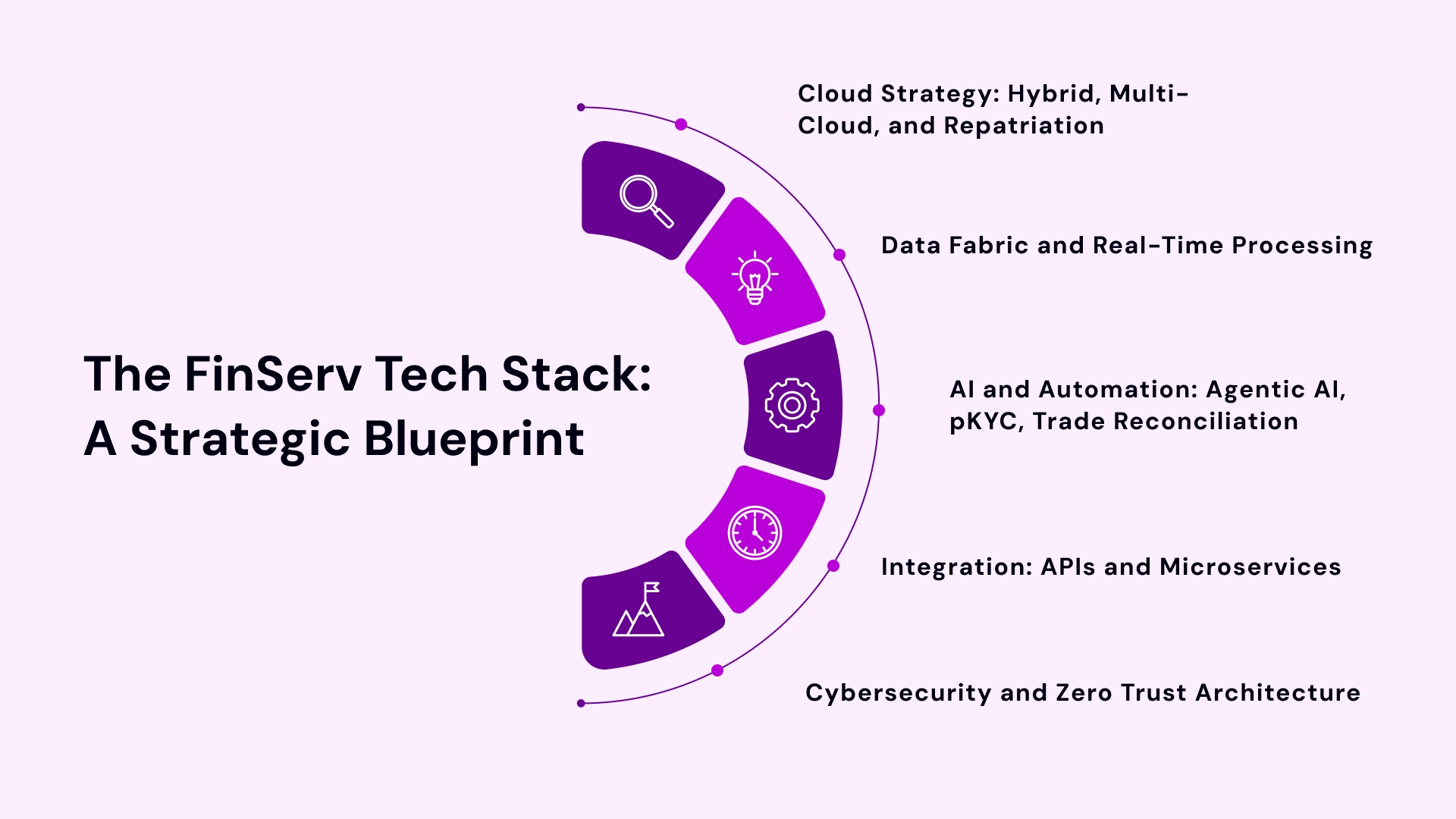
1. Cloud Strategy: Hybrid, Multi-Cloud, and Repatriation
Hybrid cloud remains the dominant architecture for capital markets. High-frequency trading workloads demand low-latency on-prem compute. Compliance and analytics workloads benefit from cloud elasticity. Work with experienced managed cloud services and cloud infrastructure services partners to design the right boundary. Note the 2025 trend: cloud repatriation — bringing static, over-provisioned workloads back from public cloud — is now part of every cost optimization review.
2. Data Fabric and Real-Time Processing
A modern data fabric connects disparate data sources into a unified, governed layer. For capital markets, this means sub-second data availability across risk, operations, and compliance. Platforms like Snowflake and Databricks are now infrastructure-grade for this use case, not just analytics tools.
3. AI and Automation: Agentic AI, pKYC, Trade Reconciliation
The shift from AI tools to agentic AI is the defining technology trend of 2025. Agentic AI does not just suggest actions — it executes workflows autonomously. In capital markets IT services, this means automated post-trade reconciliation, real-time pKYC monitoring, and AI-driven regulatory reporting with no human in the loop for routine tasks.
4. Integration: APIs and Microservices
API-first architecture is the connective tissue of digital finance transformation. By wrapping legacy cores with microservices and exposing data via APIs, firms can modernize incrementally without disrupting live trading or settlement operations. This is how Goldman Sachs built Marquee — its client-facing data and analytics platform — on top of existing infrastructure.
5. Cybersecurity and Zero Trust Architecture
The average cost of a data breach in financial services reached $4.88 million in 2024 (IBM). Zero Trust architecture — where every access request is verified regardless of origin — is now table stakes for any capital markets firm undertaking core modernization. Engage a qualified cybersecurity service provider before any cloud migration begins.
- Executive Summary:-
| Technology Pillar | Capital Markets Use Case | 2025 Priority |
| Hybrid Cloud | Latency-sensitive trading + compliant analytics | High |
| Data Fabric | Golden source of truth across front-to-back | Critical |
| Agentic AI | Post-trade reconciliation, pKYC, reporting | High |
| API/Microservices | Legacy wrapping, front-to-back integration | Critical |
| Zero Trust Security | Cloud migration security perimeter | Non-negotiable |
Operating Model and Governance: The Missing Layer in Most Roadmaps
Most finance digital transformation programs fail not because of bad technology choices but because of governance gaps. Without clear ownership, accountability, and decision rights, even well-designed roadmaps stall at execution.
Product-Based vs. Project-Based Operating Models
Project-based models treat transformation as a series of discrete deliverables with fixed budgets and end dates. When the project ends, so does the team. Product-based models treat transformation capabilities — like real-time data or automated reconciliation — as ongoing products with permanent ownership, continuous improvement, and a dedicated team.
For capital markets transformation, the product model wins every time. It aligns with agile delivery, supports regulatory adaptability, and builds internal capability rather than dependency on external vendors.
Governance Structure: CIO, CTO, and CDO Alignment
Transformation governance requires three aligned leaders: the CIO driving technology strategy, the CTO owning architecture decisions, and the CDO accountable for data quality and governance. Without alignment across these three roles, data initiatives and cloud programs will conflict at the seams.
KPI Ownership and Accountability
Every KPI needs a named owner. Business KPIs (trade fail rate, onboarding time) belong to operations leads. Technology KPIs (system uptime, cloud cost) belong to engineering. Without named accountability, KPIs become reporting exercises rather than performance levers.
Transformation Governance Model
| Layer | Role | Responsibility |
| Strategic | CIO + CTO + CDO | Roadmap approval, budget, vendor strategy |
| Program | Transformation Director | Phase delivery, dependency management |
| Capability | Value Stream Owners | Product-based team leadership, KPI ownership |
| Execution | Tech Leads + Architects | Build, test, deploy, monitor |
Risk, Compliance, and Regulatory Readiness in North America
For capital markets CIOs in North America, regulatory compliance is not a separate workstream — it is a constraint that shapes every architecture decision in your digital transformation roadmap.
SEC, FINRA, and Basel III Implications
SEC Rule 17a-4 governs records retention and immutability requirements for electronic communications and trading data. FINRA Rule 4370 mandates documented business continuity and disaster recovery plans — both of which must be updated for cloud-based architectures. Basel III Endgame requirements demand more granular capital reporting and faster risk data aggregation (BCBS 239).
Any technology modernization initiative that does not account for these requirements from day one will face costly rework. Compliance is a design constraint, not an afterthought.
Embedding RegTech into Transformation Architecture
The most effective approach is to embed RegTech directly into the transformation architecture rather than layering it on top. Automated regulatory reporting, real-time surveillance, and AI-driven anomaly detection should be features of the data and operations platform — not separate compliance bolt-ons.
Firms that embed compliance into their architecture reduce regulatory reporting costs by an average of 30–40% and respond to audit requests in hours rather than weeks.

KPI Framework: How to Measure Success Across the Roadmap
A structured KPI framework is what separates a program that delivers from one that drifts. Use the Transformation KPI Pyramid to maintain clarity at every level.
| KPI Level | Metric Examples | Owner |
| Business (Strategic) | Revenue from new digital channels, Cost-to-serve reduction, Client onboarding speed | CFO / COO |
| Operational | Trade fail rate, STP %, Reconciliation cycle time, KYC completion time | Operations Lead |
| Technology | Cloud cost per workload, System uptime %, Data latency (ms), Deployment frequency | CTO / Engineering |
Capital Markets Use Cases: Execution-Level Examples
Abstract transformation principles only matter when they translate into operational outcomes. These are finance transformation case studies and execution examples that demonstrate what digital transformation looks like inside a capital markets firm.
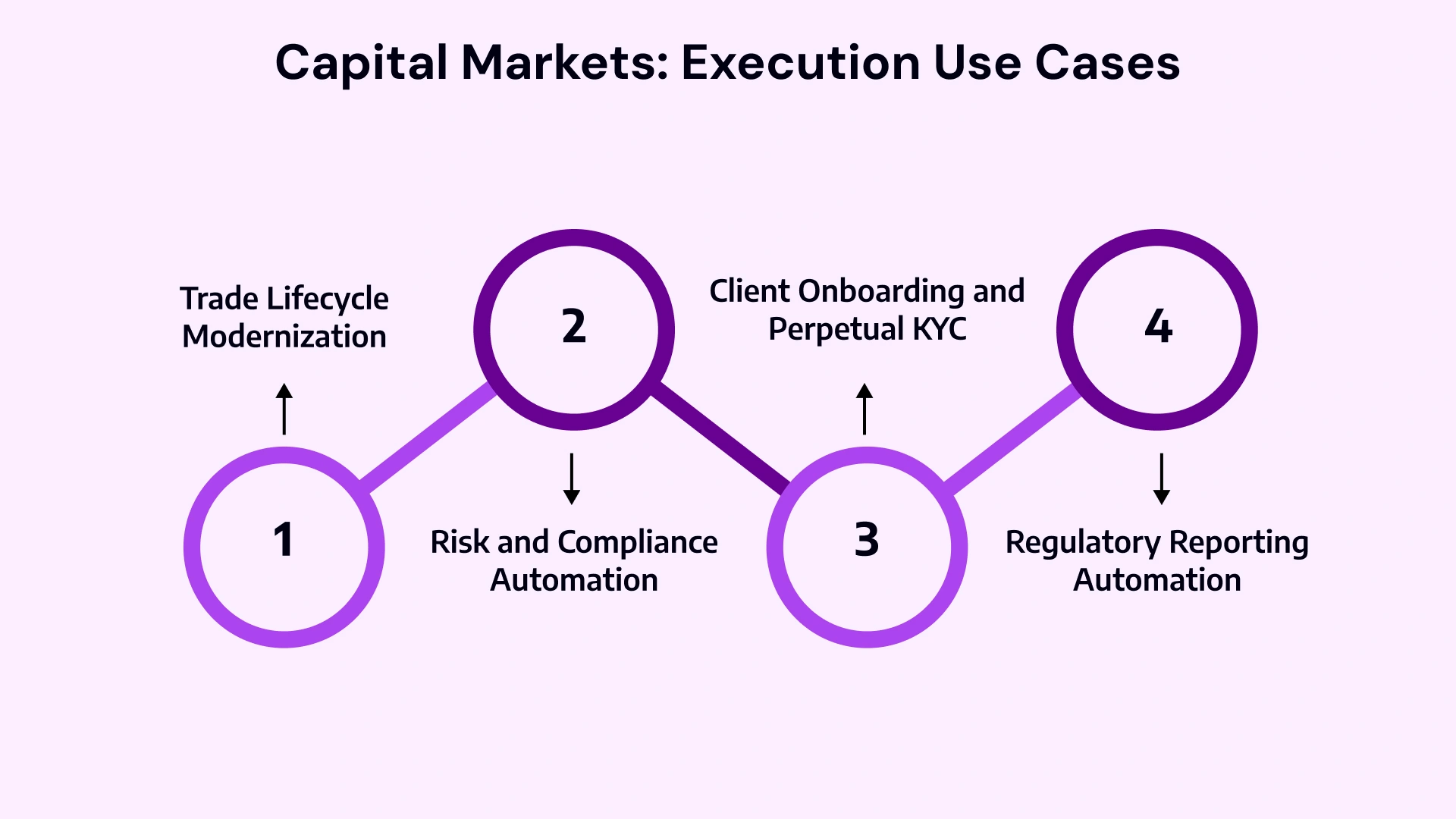
Trade Lifecycle Modernization: Front-to-Back Integration
A Tier-1 investment bank reduced trade reconciliation time by 65% after deploying a real-time data fabric that unified front-office order management, middle-office risk systems, and back-office settlement platforms. The key was an API gateway that allowed each system to continue operating independently while sharing a synchronized data layer — no big-bang migration required.
Risk and Compliance Automation
A leading sell-side firm embedded AI-driven surveillance into its trading platform as part of its corporate finance digital transformation. The system now flags anomalous trading patterns in real time, reducing the manual compliance review workload by 50% and improving regulatory response time from five days to four hours.
Client Onboarding and Perpetual KYC
Traditional KYC processes average 14 days for institutional clients. By deploying pKYC — a continuous, AI-driven monitoring model that replaces periodic manual reviews — a North American broker-dealer reduced onboarding time to three business days while improving compliance coverage. This is a direct example of how to implement finance transformation effectively: targeting a high-friction business process and eliminating it through intelligent automation.
Regulatory Reporting Automation
Manual regulatory reporting is one of the highest-cost, highest-risk processes in capital markets operations. Automating CCAR, FINRA, and Basel III reporting through a unified data and reporting platform eliminates manual error risk, reduces reporting cycle time by 70%, and creates an auditable data lineage trail that satisfies regulators from the first submission.
Common Roadblocks and How to Mitigate Them
In any transformation, the "soft" hurdles—culture, communication, and inertia—are often more difficult to clear than the technical ones. Identifying the roadblocks mentioned below early allows you to move from reactive firefighting to proactive mitigation.
| Roadblock | Business Impact | Mitigation Strategy |
| Legacy migration risk | Potential trading downtime, data loss | Shadow system + parallel run architecture; phased cutover |
| Data fragmentation | AI models fail, reconciliation errors persist | Data fabric with governed lakehouse as enterprise standard |
| Talent and skills gap | Delayed delivery, vendor dependency | Upskilling programs + agentic AI tools to leverage existing staff |
| Budget constraints | Programs stall at Phase 3 or 4 | 70/20/10 budget allocation; Phase 2 lighthouse ROI funds Phase 4 |
| Stakeholder misalignment | Scope creep, competing priorities | Product-based operating model with named KPI owners per initiative |
VLink: Your Partner in Seamless Legacy System Modernization
Executing a finance digital transformation roadmap at the pace capital markets demand requires more than a good plan — it requires a partner with deep capital markets expertise and a proven track record of zero-downtime modernization. That is what VLink delivers.
VLink specializes in legacy system modernization services for capital markets firms across North America. We have helped Tier-1 and Tier-2 institutions modernize core banking and trading infrastructure without a single day of unplanned downtime. Our approach combines cloud migration consulting services, cloud infrastructure services, and managed cloud services with deep domain knowledge of trading lifecycle, risk systems, and regulatory architecture.
We do not just modernize technology. We redesign operating models, embed RegTech compliance into the transformation architecture, and deploy Microsoft business solutions and finance software solutions that integrate seamlessly with existing workflows.
- Legacy system modernization in capital markets — phased, zero-disruption approach
- Cloud migration consulting services — hybrid, multi-cloud, and repatriation strategy
- Cybersecurity service provider capabilities — Zero Trust architecture for cloud migrations
- Digital transformation in finance consultancy — from roadmap to production at every phase
As 72% of capital markets CIOs cite execution risk as their #1 barrier to transformation. VLink's engagement model is built around eliminating that risk — from Phase 1 assessment through Phase 5 governance optimization.

Conclusion: From Roadmap to Resilient Digital Ecosystem
The firms winning in capital markets today are not the ones with the most advanced technology. They are the ones that have built resilient, connected ecosystems — where data moves in real time, compliance is embedded in architecture, and modernization happens without disrupting what matters most.
A well-executed finance digital transformation roadmap is the difference between a transformation that stalls at Phase 2 and a transformation that compounds value across every subsequent phase. It requires an honest current-state assessment, business-outcome-led objectives, phased execution with zero-disruption architecture, and governance that holds accountability at every level.
The digital transformation of finance is not a single destination. It is a continuous capability — one that, when built correctly, becomes your most durable competitive advantage in capital markets.
Ready to build a finance transformation roadmap that delivers measurable impact? Partner with VLink. Our team merges deep capital markets expertise with a proven modernization framework to ensure a seamless transition. No disruption. No downtime. Real ROI.

Business Development Professional
Vineel is a seasoned sales and business development leader with extensive experience in the telecommunications and IT industries. Over the course of his career, he has worked with global teams at multinational organizations, having lived and operated in India, Canada, the Netherlands, and the United Kingdom.

 Shivisha Patel