


Yet modernization in capital markets differs fundamentally from retail banking or wealth management. Trading systems demand microsecond latency. Clearing engines process millions of transactions without downtime. Market data platforms ingest terabytes daily. A single outage during market hours can cost millions and trigger regulatory scrutiny.
This guide provides CTOs, Heads of Trading Infrastructure, Chief Data Officers, and VPs with a practical framework for modernizing capital markets technology. You'll find decision matrices, phased roadmaps, and real-world patterns that reduce risk while enabling competitive advantage.
The firms that modernize successfully don't treat it as a one-time project. They build composable, event-driven architectures that adapt to regulatory changes, support new asset classes, and turn technology from a liability into a strategic enabler.

Understanding Legacy Systems in Capital Markets
Legacy in capital markets isn't defined by age alone. A ten-year-old system built with modern architecture patterns may be more maintainable than a five-year-old monolith. Legacy systems share three characteristics: they're difficult to change, expensive to maintain, and they constrain business agility.
In practical terms, legacy manifests as COBOL-based clearing systems that process batch jobs overnight, when T+1 settlement requires real-time processing. It's monolithic trading platforms where adding support for a new exchange requires six months of regression testing. It's a market data infrastructure that can't scale to handle cryptocurrency feeds alongside traditional equities.
The technical debt accumulates in layers. Front-office trading systems communicate with middle-office risk engines via point-to-point integrations maintained by developers who retired years ago. Post-trade systems generate regulatory reports through custom scripts that break with every format change. Data exists in silos—equities in one database, fixed income in another, with no unified view of risk.
Common Legacy Components Across Capital Markets Firms
Here are the most common legacy components found across capital markets firms today:
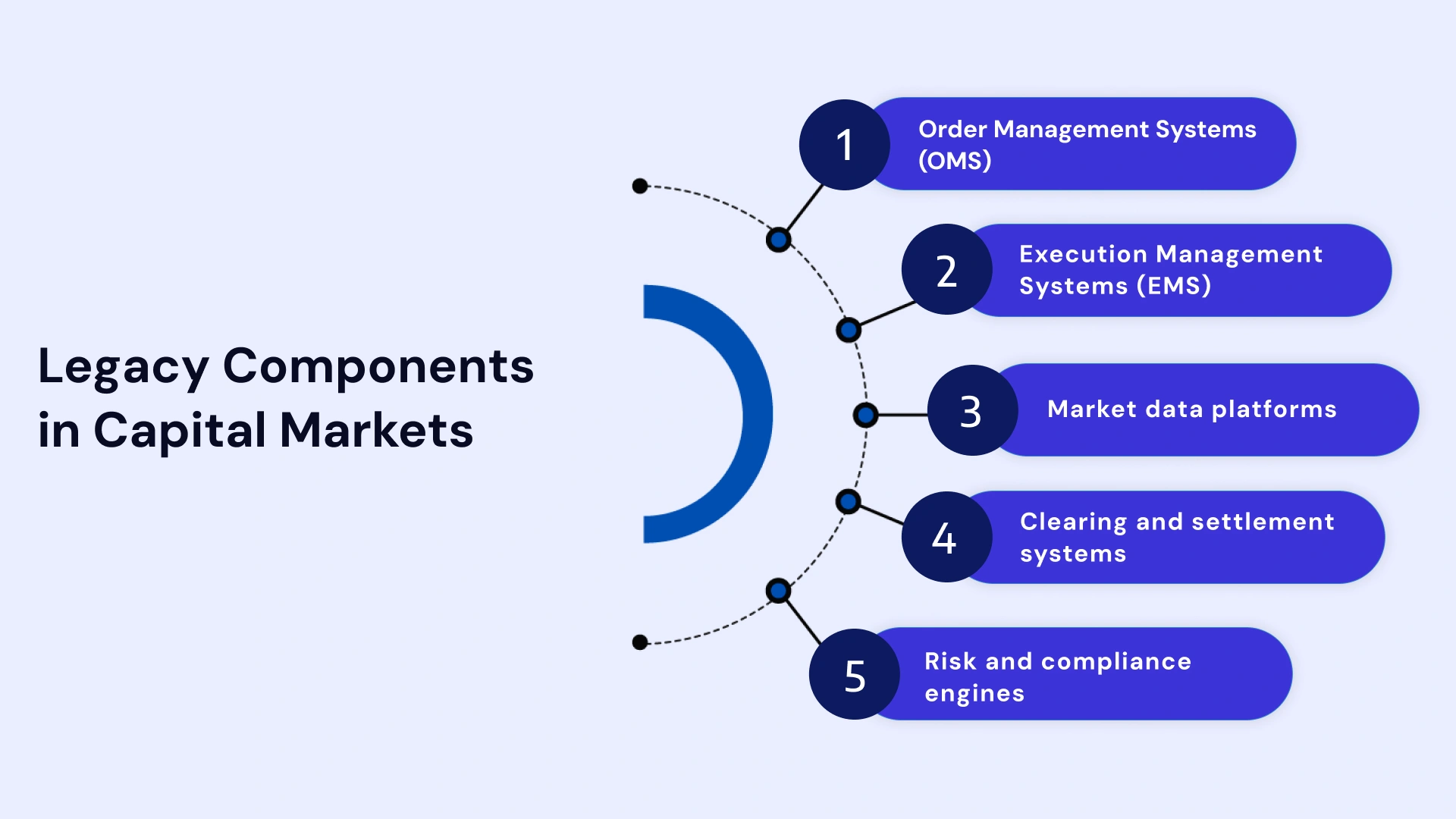
- Order Management Systems (OMS) and Execution Management Systems (EMS) are often the first targets for modernization. These platforms handle order routing, execution algorithms, and smart order routing. Legacy versions typically run on-premises with limited API access, making it difficult to integrate new venues or quickly deploy algorithmic strategies.
- Market data platforms ingest, normalize, and distribute pricing information across the firm. Legacy implementations struggle with the volume and velocity of modern markets—cryptocurrency tickers, ESG data feeds, and alternative data sources strain systems designed for traditional equity and fixed income feeds.
- Clearing and settlement systems reconcile trades, manage collateral, and ensure delivery versus payment. Many run on mainframes with batch-oriented processing cycles. The shift to T+1 settlement exposed the brittleness of these systems, as they lack the real-time processing capabilities required for compressed settlement windows.
- Risk and compliance engines calculate exposures, monitor limits, and generate regulatory reports. Legacy versions recalculate risk periodically rather than continuously, creating blind spots between calculation cycles. Regulatory reporting often involves manual data extraction and transformation, which introduces errors and requires extensive reconciliation.
Business & Technology Drivers for Capital Markets Technology Modernization
Modernizing technology in capital markets is no longer a "nice-to-have" infrastructure project; it is a strategic survival response. In 2026, the industry is moving away from isolated pilot programs toward "AI-native" architectures and unified digital ecosystems.
The drivers for this shift are as follows:-
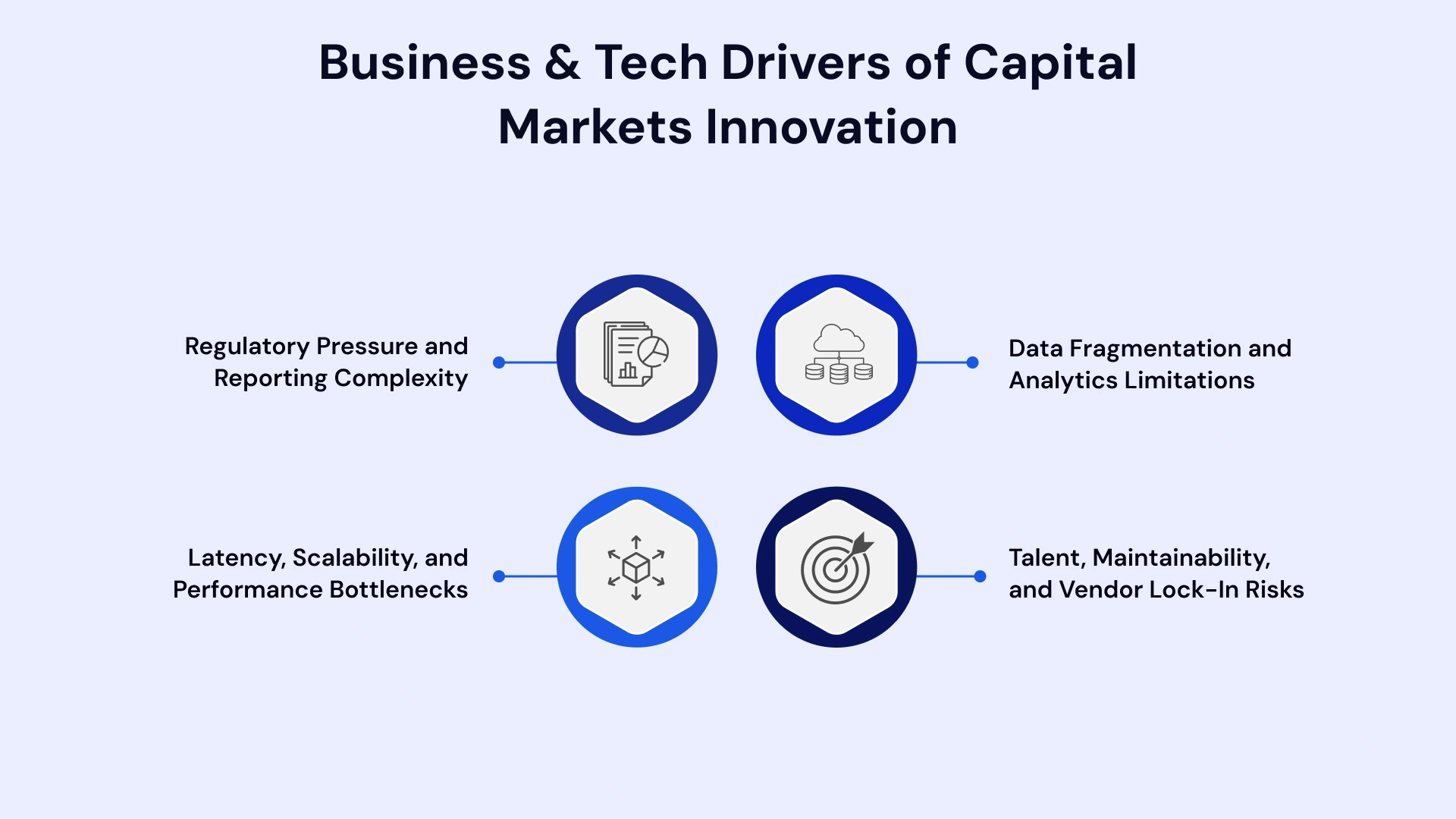
Regulatory Pressure and Reporting Complexity
The Consolidated Audit Trail (CAT) in the US and similar initiatives in Canada require microsecond-level precision in trade reporting. Legacy systems built for end-of-day reconciliation can't meet these requirements without extensive manual intervention. Firms face a choice: retrofit aging systems at increasing cost, or modernize to architectures where compliance is built in rather than bolted on.
MiFID II, EMIR, and Dodd-Frank created reporting obligations that continue to evolve. Each regulatory change triggers costly modification cycles in legacy systems. Modern, API-first architectures allow firms to implement RegTech sidecars—microservices that tap into event streams to handle compliance independently, without touching core trading logic.
Latency, Scalability, and Performance Bottlenecks
High-frequency trading strategies measure advantage in microseconds. Legacy monoliths introduce latency through synchronous processing, database locks, and unnecessary network hops. For managed cloud services, cloud-native architectures with edge computing allow firms to deploy execution logic closer to exchange matching engines, reducing round-trip time.
Market volatility creates scalability challenges that legacy systems can't handle. During the March 2020 market stress, some trading platforms experienced degraded performance as order volume spiked. Modern event-driven architectures scale horizontally, adding capacity dynamically as market conditions demand.
Data Fragmentation and Analytics Limitations
Trading desks need real-time risk analytics. Portfolio managers require historical performance attribution. Compliance teams demand audit trails. Legacy systems store this data in incompatible formats across siloed databases. Extracting insights requires complex ETL jobs that deliver stale information.
Modern data architectures—data lakes, lakehouses, and streaming platforms—provide a unified foundation. Real-time and historical data coexist. Analytics teams query current positions while quantitative researchers backtest strategies against years of tick data. Machine learning models consume live market feeds to detect anomalies or optimize execution.
Talent, Maintainability, and Vendor Lock-In Risks
The talent pool maintaining COBOL, Fortran, and legacy C++ shrinks annually. Firms compete for scarce expertise at premium rates. Younger engineers prefer modern languages and cloud-native tools, making legacy systems a recruitment liability.
Proprietary vendor platforms create lock-in. Customizations accumulate over the years, making migration prohibitively expensive. Modern architectures favor open standards, containerization, and infrastructure-as-code, reducing dependency on any single vendor and enabling portability across cloud providers.
Legacy System Modernization in Capital Markets: Core Challenges
The following are the core challenges currently facing financial institutions.
Zero-Downtime Expectations in Live Trading Environments
Retail banking can schedule maintenance windows overnight. Capital markets operate globally across time zones. Equities trade in New York, bonds in London, and FX in Tokyo. There's no "off hours" for a global trading platform.
Modernization requires parallel-run strategies where legacy and modern systems operate simultaneously. Traffic routes to the new system incrementally—first for non-critical flows, then gradually increasing as confidence builds. Feature flags allow for an instant rollback if issues arise. The strangler fig pattern gradually replaces legacy components without disrupting the whole.
Data Consistency Across Asset Classes
A derivatives trade in Chicago references underlying equities in New York and hedges in London. Legacy systems often maintain separate data models for each asset class, creating reconciliation challenges and inconsistent risk calculations.
Modern architectures adopt canonical data models with asset-class-specific extensions. Event sourcing ensures a complete audit trail of state changes. CQRS (Command Query Responsibility Segregation) separates write operations from read queries, allowing real-time risk calculations without impacting order execution performance.
Integration with Market Participants and Exchanges
Trading platforms connect to dozens of venues through FIX protocol, proprietary APIs, and co-location arrangements. Exchanges upgrade interfaces, change message formats, and introduce new order types. Legacy systems with tightly coupled integrations require extensive regression testing for each change.
API-first architectures abstract exchange connectivity behind adapter layers. New venue support is treated as a configuration change rather than a code modification. Message format changes impact only the specific adapter, not the entire trading platform.
Risk Aversion vs Innovation Mandates
Capital markets culture emphasizes stability and risk management. A failed deployment can result in trading losses, regulatory fines, and reputational damage. This creates organizational resistance to modernization, even as executives mandate innovation.
Successful modernization addresses this tension through proof-of-value pilots. Start with non-critical systems: a market data normalization service, a reporting dashboard, and an analytics tool. Demonstrate success, build confidence, then tackle core trading infrastructure. Automated testing becomes non-negotiable. Golden test suites verify that modernized systems produce identical outputs to legacy systems for identical inputs.

Modernizing Capital Markets Technology: Strategic Approaches
The following strategic approaches define the current landscape of capital markets modernization.
Replatforming vs Refactoring vs Re-architecting
- Replatforming (lift-and-shift) moves applications to new infrastructure—typically from on-premises to cloud—without changing code. This approach delivers quick wins in operational costs and disaster recovery, but doesn't address architectural limitations. A monolithic trading platform remains monolithic whether it runs in your data center or AWS.
- Refactoring improves code quality and structure without changing functionality. Legacy COBOL modules get rewritten in Java or Python. Database queries get optimized. This reduces technical debt and improves maintainability but preserves the underlying architecture. Refactoring works when the architecture is sound, but the implementation has degraded over time.
- Re-architecting and redesigning systems using modern patterns—microservices, event-driven architectures, and API-first design. A monolithic OMS becomes a collection of services: order validation, routing logic, execution algorithms, and fill management. This delivers the most business value but requires the most investment and carries the highest execution risk.
The choice depends on system criticality, business requirements, and acceptable risk. Low-criticality reporting systems tolerate replatforming. Core trading engines demand re-architecture. Middle-office risk systems often benefit from refactoring.
Incremental Modernization vs Big-Bang Transformation
Big-bang migrations—replacing everything simultaneously—rarely succeed in capital markets. The complexity is too high, the risk too great, the testing burden overwhelming. When they fail, they fail catastrophically.
Incremental modernization delivers value continuously while managing risk. The strangler fig pattern wraps legacy systems with modern APIs. New functionality deploys to microservices. Legacy components retire as modern replacements prove themselves. Firms maintain operational continuity throughout the transition.
Domain-driven design guides decomposition. Bounded contexts—order management, market data, risk calculation, settlement—map to microservices. Each team owns its domain and chooses technology stacks appropriate to its requirements. Order routing might use low-latency C++ while risk analytics leverages Python and Spark.
Cloud Adoption Models in Capital Markets
- Public cloud (AWS, Azure, GCP) offers elastic scalability, managed services, and global availability. Market data analytics, back-office processing, and regulatory reporting fit naturally in public cloud environments. Concerns about latency and data sovereignty have diminished as cloud providers offer low-latency zones and region-specific deployments.
- Private cloud maintains on-premises cloud infrastructure services with cloud-like self-service and automation. Some firms choose this for core trading systems where microsecond latency matters or regulatory requirements mandate specific data locations.
- Hybrid cloud combines both models. Ultra-low-latency order execution runs in co-located facilities or private cloud near exchanges. Data-intensive analytics and machine learning workloads leverage public cloud elasticity. Event-driven architectures bridge environments through message buses and streaming platforms.
The trend favors hybrid solutions as public cloud adoption increases. Broadridge reports that 91% of capital markets firms use some form of cloud, though only 32% have modernized their core clearing and settlement engines (Broadridge, 2024). Early movers focused on peripheral systems. The next wave modernizes the trading infrastructure itself.
Event-Driven and Microservices Architectures
Traditional request-response patterns create tight coupling and synchronous dependencies. Event-driven architectures (EDA) invert this model. Services publish events when state changes—order placed, trade executed, position updated. Interested services subscribe and react asynchronously.
This approach enables real-time processing. A trade execution event simultaneously triggers risk recalculation, P&L updates, and compliance monitoring. Services scale independently based on their workload. Risk engines might scale horizontally during volatile markets while order-routing capacity remains constant.
Microservices complement EDA by decomposing monoliths into focused, independently deployable components. Each service owns its data, exposes well-defined APIs, and evolves at its own pace. Teams deploy order routing improvements without coordinating with settlement teams. New market data feeds integrate without impacting execution algorithms.
The combination delivers the composability modern markets demand. New products launch faster. Regulatory requirements are met through new services rather than monolithic modifications. Firms replace individual components without rewriting entire platforms.
Decision Framework: How to Choose the Right Modernization Path
Choosing the right modernization path in capital market IT services is rarely a "rip and replace" scenario. It’s a balancing act between technical debt, regulatory pressure, and the cost of capital. To move from strategy to execution, use the following framework to categorize your existing systems and determine the appropriate actions.
A CTO-Led Decision Matrix (Risk × Time × ROI)
Not all legacy systems warrant the same modernization approach. A decision matrix helps prioritize based on three dimensions:
- Business criticality: How much revenue or risk does this system impact? Core trading platforms score high. Back-office reporting scores lower.
- Technical debt: How expensive is maintenance? How frequently do changes break production? High debt systems justify aggressive modernization.
- Change velocity: How often do business requirements change? Systems that undergo frequent regulatory updates or require new features benefit from modern, agile architectures.
Plot systems on this matrix. High-criticality, high-debt, high-change-velocity systems demand re-architecture. Low-criticality, low-debt systems may suffice with replatforming or even continued maintenance.
System Criticality vs Change Tolerance Framework
| System Type | Criticality | Change Tolerance | Recommended Approach |
| Real-time trading execution | Critical | Zero downtime | Strangler fig + parallel run |
| Market data normalization | High | Brief disruption OK | Microservices refactor |
| Regulatory reporting | Medium | Scheduled downtime acceptable | Replatform + modernize |
| Historical data archive | Low | Extended downtime OK | Lift-and-shift |
This framework guides technical decisions while managing stakeholder expectations. Trading desks understand why their systems require cautious migration. Finance teams accept faster timelines for reporting modernization.
Data Sensitivity and Regulatory Exposure Scoring
Data classification drives architecture choices. Client personally identifiable information (PII), material non-public information (MNPI), and trading strategies demand strict access controls and audit trails.
Score systems by regulatory exposure:
- High exposure: CAT reporting, MNPI handling, anti-money laundering (AML) surveillance
- Medium exposure: Risk reporting, client reporting, general ledger
- Low exposure: Internal analytics, development environments
High-exposure systems require robust authentication, encryption, audit logging, and data loss prevention. These requirements influence cloud provider selection, network architecture, and service design.
Capital Markets Modernization Use Cases (By Function)
Below are the primary modernization use cases organized by functional area.
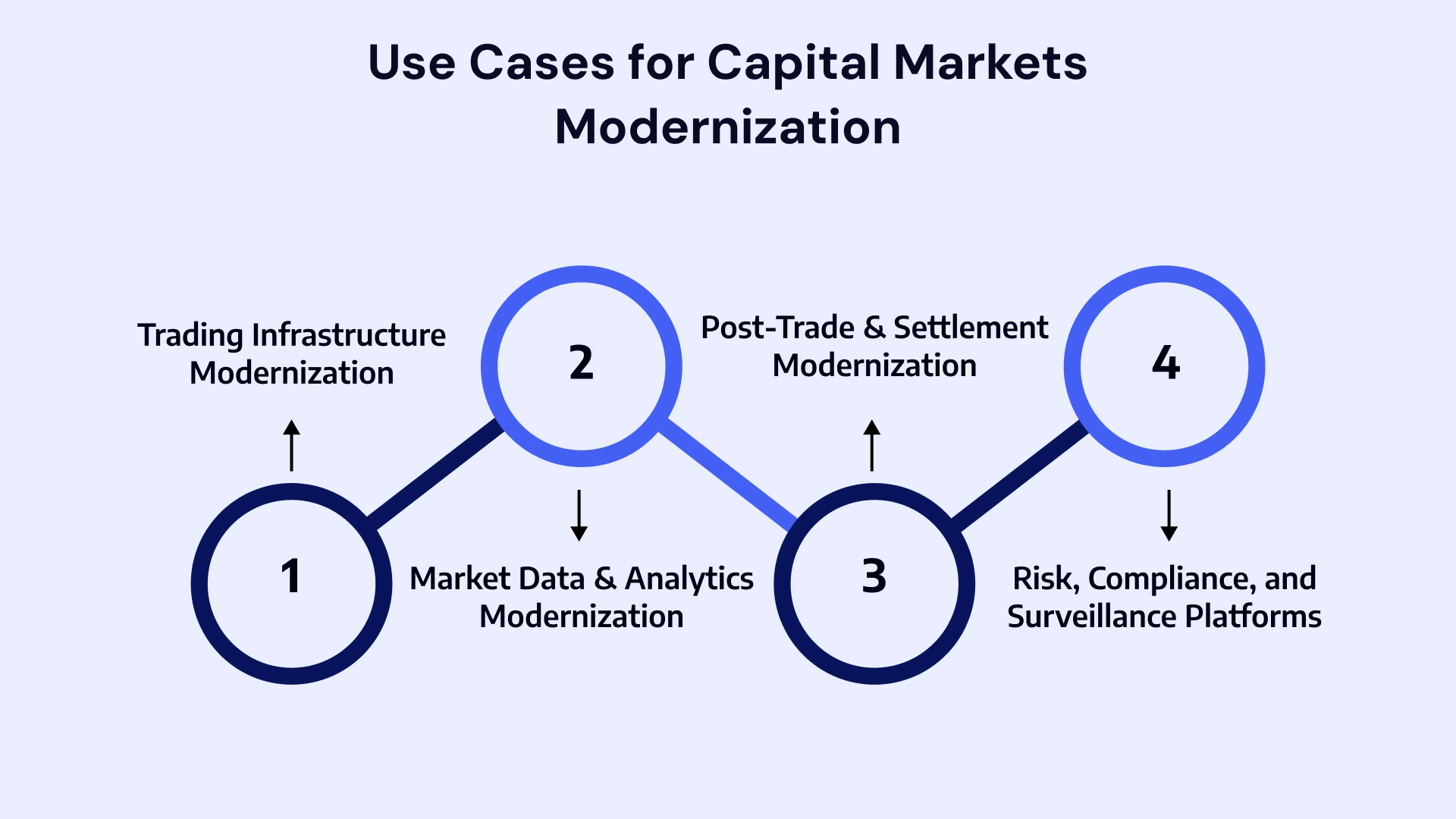
Trading Infrastructure Modernization
A mid-sized broker-dealer operated an aging OMS that handled equities and options. Adding cryptocurrency trading required six months of development and extensive regression testing. The firm chose to re-architect using microservices.
The new architecture separated concerns: order validation, smart routing, execution algorithms, and fill management, each became an independent service. Adding cryptocurrency support involved deploying a new routing service and venue adapter without touching core logic. Time-to-market for new products dropped from months to weeks.
The parallel-run strategy proved essential. For three months, both systems processed identical order flows. Automated reconciliation flagged discrepancies. Only after achieving 99.99% agreement did the firm route live client orders to the modern platform.
Market Data & Analytics Modernization
An asset manager consumed market data from 50+ vendors, each with proprietary formats and delivery mechanisms. Data scientists spent 60% of their time wrangling data rather than building models. The firm implemented a modern data platform.
Real-time feeds are streamed into Kafka. Apache Flink normalized messages into a canonical schema. Historical data landed in a lakehouse (Delta Lake on S3). Data scientists queried current and historical data through a unified API.
The impact extended beyond analytics. Risk teams accessed real-time positions. Compliance monitors trading patterns continuously. Portfolio managers analyzed performance attribution within minutes of market close. A system initially scoped for data science became enterprise infrastructure.
Post-Trade & Settlement Modernization
The T+1 transition exposed weaknesses in batch-oriented settlement systems. A clearing firm processed reconciliations overnight, leaving little buffer for error correction. They modernized to an event-driven settlement.
Trade events are streamed directly from execution venues to settlement services. Matching occurred in real time rather than in batches. Discrepancies surfaced immediately, not the next morning. The firm met T+1 requirements while improving operational risk metrics.
The strangler pattern enabled this transformation. Legacy batch processes continued for weeks while event-driven services handled increasing volumes. Gradual cutover minimized risk. The legacy system was retired only after the modern platform proved itself under peak load conditions.
Risk, Compliance, and Surveillance Platforms
A bank's risk engine recalculated exposures hourly, creating blind spots between calculations. During volatile markets, positions could breach limits without immediate detection. The firm deployed real-time risk architecture.
Position updates streamed to risk services as trades executed. Exposures recalculated continuously. Limit breaches triggered immediate alerts. Pre-trade risk checks blocked orders that would exceed thresholds.
The compliance benefits proved equally valuable. Surveillance algorithms consumed trade events in real-time, detecting potential market manipulation patterns as they emerged rather than discovering them in nightly batch runs.
Technology Stack Considerations for Capital Markets Modernization
Below are the critical technology stack considerations for modernizing capital markets.
Cloud-Native vs Hybrid Architectures
Cloud-native architectures leverage managed services, including serverless computing, managed databases, and container orchestration. Development teams focus on business logic rather than infrastructure management. AWS Lambda executes risk calculations on-demand. Azure Cosmos DB provides access to global market data. Google Cloud Dataflow processes streaming analytics.
Hybrid architectures acknowledge that some workloads demand on-premises deployment. Ultra-low-latency execution remains in co-located facilities. Sensitive client data might stay in private clouds. The key is standardization—the same container images, APIs, and deployment patterns work across environments.
Infrastructure-as-code tools (Terraform, CloudFormation, Pulumi) define environments programmatically. Developers provision identical staging and production environments. Disaster recovery involves running playbooks, not manual rebuild procedures.
API-First and Event Streaming Technologies
API-first design treats every service boundary as an external interface. Internal teams consume the same APIs as external partners. This discipline forces clear contracts, versioning strategies, and backward compatibility.
OpenAPI specifications document endpoints. Code generation produces client libraries. API gateways handle authentication, rate limiting, and monitoring. Teams iterate on internal implementation without breaking consumers.
Event streaming platforms (Kafka, Pulsar, AWS Kinesis) provide the nervous system for event-driven architectures. Services publish state changes. Consumers process events at their own pace. The platform handles buffering, replay, and delivery guarantees.
Schema registries (Confluent Schema Registry, AWS Glue) enforce event contracts. Producers can't publish malformed messages. Consumers adapt to compatible schema evolution. This prevents the runtime failures common in point-to-point integrations.
Data Lakes, Lakehouses, and Real-Time Analytics
Data lakes provide cost-effective storage for vast quantities of market data—tick data, order book snapshots, trade histories. Object storage (S3, Azure Blob, GCS) scales to petabytes without the cost structure of traditional databases.
Lakehouses add ACID transactions and schema enforcement to data lakes. Delta Lake, Apache Iceberg, and Apache Hudi enable reliable updates and deletes. Analysts query data lakes with SQL. Machine learning pipelines consume training data efficiently.
Real-time analytics platforms (Apache Flink, ksqlDB, Materialize) process streaming data with SQL-like languages. Traders see positions update with every fill. Risk teams monitor exposures continuously. Compliance teams detect suspicious patterns in real-time.
The combination eliminates the dichotomy between operational and analytical systems. The same data serves both real-time decision-making and historical analysis.
Security, Identity, and Regulatory Controls
Zero-trust architectures assume breach. Services authenticate every request, even from other internal services. Network perimeters no longer provide security.
Identity and access management (IAM) controls who accesses what data. Role-based access control (RBAC) maps job functions to permissions. Just-in-time (JIT) access provides temporary elevation for specific tasks. Audit logs record every access for compliance review.
Encryption protects data at rest and in transit. Hardware security modules (HSMs) safeguard cryptographic keys. Data loss prevention (DLP) tools detect and block unauthorized data exfiltration.
Regulatory controls are embedded directly in architecture. CAT reporting services automatically consume trade events. MNPI walls enforce information barriers through technical controls. Audit trails capture every state change with microsecond precision.
Common Questions CTOs Ask About Legacy Modernization
Based on current industry trends, here are the most critical questions CTOs are asking, categorized by their strategic impact.
How do capital markets firms modernize without disrupting trading?
Parallel-run strategies allow legacy and modern systems to operate simultaneously. Traffic routes to new systems incrementally—first for synthetic test flows, then non-critical production traffic, and finally critical business. Automated reconciliation compares outputs between systems. Only after achieving extremely high agreement (typically 99.99%+) does the firm route critical traffic to modernized platforms. Feature flags enable instant rollback if issues emerge.
What systems should be modernized first?
Start with high-value, low-risk systems. Market data normalization services or reporting dashboards demonstrate the benefits of modern architecture without disrupting trading operations. These proof-of-value projects build organizational confidence and technical capability. After initial success, tackle higher-criticality systems using lessons learned. Core trading execution typically modernizes last, after teams have refined their approach through less critical migrations.
Is cloud safe for capital markets workloads?
Cloud providers offer security controls that often exceed those of aging on-premises infrastructure. Virtual private clouds (VPCs), hardware security modules (HSMs), and private connectivity (AWS Direct Connect, Azure ExpressRoute) address traditional concerns. The bigger question is latency—ultra-low-latency execution may require edge computing or hybrid architectures. However, most capital markets workloads—risk analytics, regulatory reporting, back-office processing—run safely and effectively in public cloud environments.
How long does legacy modernization typically take?
Timelines vary dramatically based on scope and approach. A focused microservices extraction might take 3-6 months. A comprehensive trading platform re-architecture typically requires 18-36 months. The key is delivering incremental value throughout. Don't wait years for a big-bang cutover. Deploy modernized components to production as they're ready, building value continuously while managing risk.
What are the main risks of modernizing legacy capital markets systems?
The primary risks are data inconsistency, performance degradation, and operational disruption. Mitigate these through extensive testing—functional tests verify business logic, performance tests validate latency requirements, and chaos engineering tests resilience. Automated test suites serve as a safety net. Golden test suites compare the outputs of legacy and modern systems for identical inputs. Only when tests pass consistently does production traffic shift to modernized systems.
How do you measure ROI on legacy modernization?
Track both cost savings and revenue enablement. Cost metrics include reduced infrastructure expenses (cloud OPEX vs. on-prem CAPEX), lower maintenance costs (modern languages vs. scarce COBOL talent), and shorter incident response times. Revenue metrics include faster time-to-market for new products, the ability to support new asset classes, and improved trading performance through lower latency. Don't ignore risk reduction—quantify the value of improved disaster recovery, enhanced compliance posture, and reduced operational risk.
Measuring ROI and Success in Capital Markets Technology Modernization
In 2026, the ROI of modernization is no longer measured solely by reduced server costs; it is measured by the following process:-
Operational KPIs (Latency, Throughput, Uptime)
Latency improvements directly impact trading performance. Measure order-to-execution time, market data processing latency, and risk calculation speed. Modern architectures typically reduce latency by 30-50% through the elimination of unnecessary network hops, optimized data structures, and event-driven processing.
Throughput capacity demonstrates the ability to handle market stress. Track orders processed per second, market data messages ingested per second, and concurrent position updates. Modern systems scale horizontally, adding capacity dynamically during volatile periods.
Uptime and reliability metrics include mean time between failures (MTBF), mean time to recovery (MTTR), and percentage of successful deployments. Modern DevOps practices—such as automated testing, canary deployments, and instant rollback—typically improve these metrics significantly.
Business KPIs (Time-to-Market, Cost Reduction, Revenue Enablement)
Time-to-market for new products measures business agility. How quickly can the firm launch a new asset class, connect to a new exchange, or deploy a new algorithmic strategy? Modern architectures reduce this from months to weeks or even days.
Cost reduction manifests in multiple dimensions. Infrastructure costs often decrease through cloud economics and improved resource utilization. Development costs drop as teams spend less time fighting technical debt and more time building features. Operations costs fall through automation and reduced incident volume.
Revenue enablement is harder to measure but often provides the largest return. New products capture market share. Improved execution quality attracts order flow. Enhanced analytics capabilities enable better trading decisions. These impacts compound over time.
Risk and Compliance Metrics
Operational risk metrics include the number of failed trades, settlement breaks, and reconciliation discrepancies. Modern systems with event sourcing and stronger data consistency typically reduce these significantly.
Compliance metrics track regulatory reporting accuracy, timeliness, and completeness. Automated compliance systems built into modern architectures reduce manual effort and improve quality. CAT reporting errors, late filings, and regulatory exceptions should trend toward zero.
Cybersecurity metrics include time to detect breaches, access control violations, and data loss prevention incidents. Zero-trust architectures and comprehensive audit logging measurably improve the security posture.
Roadmap: A Phased Modernization Blueprint for Capital Markets Firms
Here is a phased blueprint designed to balance risk with the aggressive speed required in today's markets.
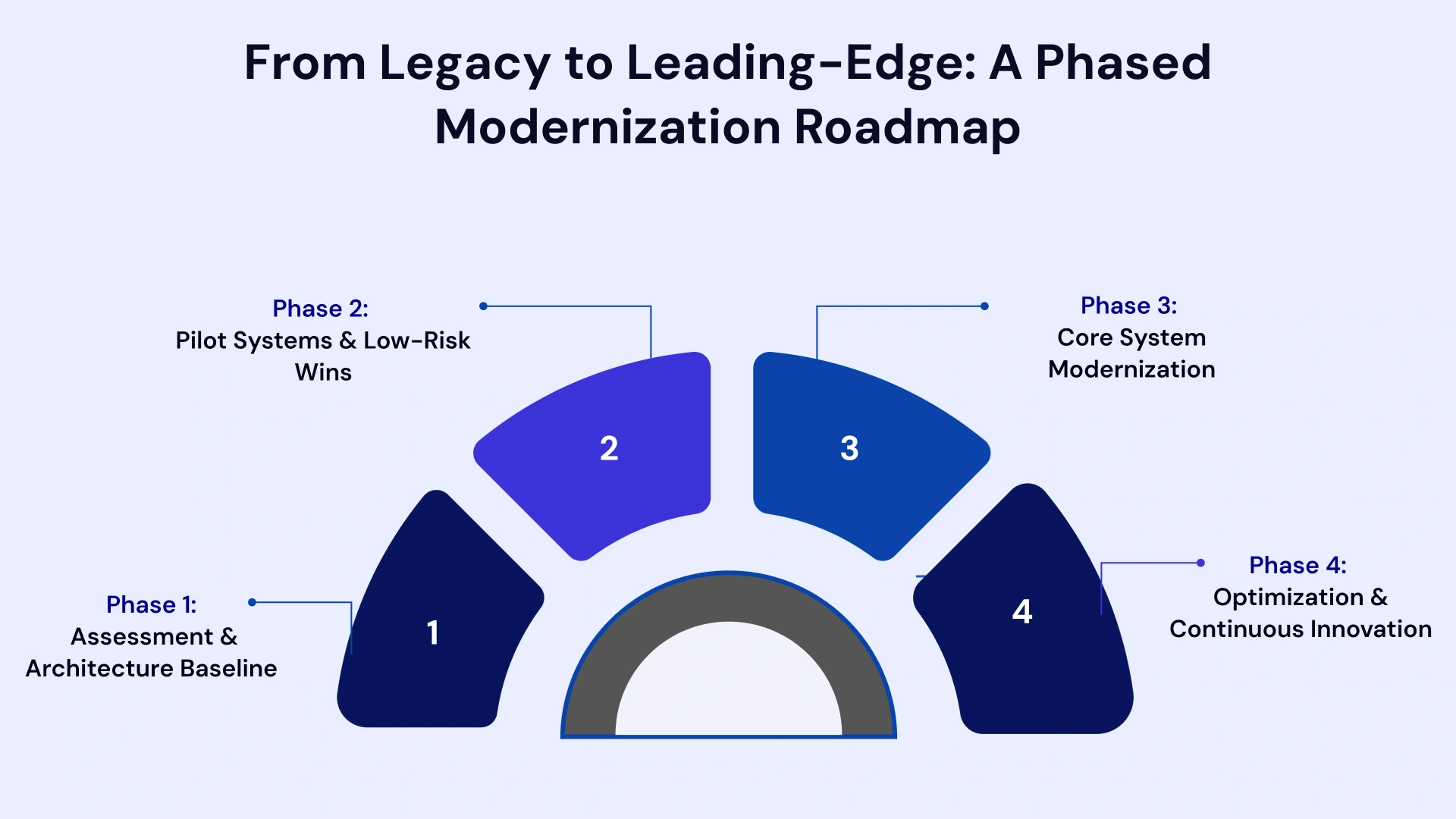
Phase 1: Assessment & Architecture Baseline
Begin with comprehensive discovery. Inventory all systems, dependencies, and integrations. Document current architecture, data flows, and technical constraints. Identify quick wins and high-risk areas.
Technical assessment includes performance profiling, security auditing, and code quality analysis. Business assessment captures stakeholder requirements, pain points, and success criteria. A regulatory assessment identifies compliance obligations and data-handling requirements.
The output is a modernization roadmap prioritized by business value, technical feasibility, and risk. This roadmap guides investment decisions and provides transparency to stakeholders.
Phase 2: Pilot Systems & Low-Risk Wins
Prove the approach through pilot projects. Select systems with meaningful business value but limited blast radius—such as market data normalization, reporting dashboards, or analytics tools.
These pilots validate technical patterns, build team capability, and demonstrate value. They also expose organizational friction—approval processes, security reviews, and change management procedures. Resolving these issues in low-risk contexts prevents delays later.
Celebrate early wins publicly. Executive sponsorship depends on visible progress. Demonstrating that modernization delivers value builds momentum for larger initiatives.
Phase 3: Core System Modernization
With proven patterns and organizational capability, tackle core trading infrastructure. Apply lessons from pilots—parallel run strategies, automated testing, incremental cutover.
This phase requires sustained executive commitment. Core system migration spans quarters or years. Progress may be invisible to business stakeholders for extended periods. Regular communication and intermediate deliverables maintain confidence.
Risk management becomes paramount. Comprehensive testing, gradual traffic shifting, and instant rollback capabilities protect operations. Expect setbacks and plan buffer time accordingly.
Phase 4: Optimization & Continuous Innovation
Modernization doesn't end when legacy systems retire. Modern architectures enable continuous improvement. Release cycles accelerate from quarterly to weekly or daily. New capabilities deploy without disruption.
Establish practices for ongoing optimization. Performance monitoring identifies bottlenecks. Cost analysis finds optimization opportunities. Security reviews address emerging threats.
Most importantly, shift the organizational mindset. Technology is no longer a project with an end date—it's a continuous capability that evolves with business needs. Teams that internalize this mindset turn modernization from a cost into a competitive advantage.
Leveraging VLink Expertise for Legacy System Modernization
VLink brings deep capital markets technology expertise to legacy modernization initiatives. Our engineering teams have modernized trading platforms, market data infrastructure, and post-trade systems for buy-side and sell-side firms across North America.
We understand the unique constraints of capital markets environments—microsecond latency requirements, zero-downtime expectations, regulatory compliance obligations, and integration with exchanges and market participants. Our legacy systems modernization services combine technical excellence with domain knowledge.
Proven Modernization Frameworks & Accelerators
Our modernization approach follows proven patterns refined across dozens of engagements. We begin with a comprehensive assessment—inventorying systems, mapping dependencies, and identifying quick wins. Our decision frameworks help prioritize based on business value, technical feasibility, and risk.
For firms in Canada specifically, our legacy systems modernization services in Canada address regional regulatory requirements, including IIROC obligations, Canadian data sovereignty considerations, and integration with Canadian exchanges and clearing systems.
We leverage modern cloud infrastructure through our cloud migration consulting services and provide ongoing operational support through managed cloud services. Our cloud infrastructure services ensure modernized platforms meet performance, security, and compliance requirements.
End-to-End Capital Markets Technology Capabilities
Beyond legacy modernization, VLink provides comprehensive capital markets IT services covering the entire trade lifecycle. Our teams build trading platforms, market connectivity solutions, risk engines, and regulatory reporting systems.
This breadth matters during modernization. We don't just migrate old systems—we design modern architectures that enable your business strategy. Our engineers understand how trading infrastructure, market data platforms, and post-trade systems interoperate. We optimize across the full technology stack rather than sub-optimizing individual components.
Ready to build a risk-managed modernization roadmap? Connect with our capital markets dedicated team to discuss your specific challenges and objectives.
Conclusion
In today’s capital markets, winning firms no longer view technology as a cost to minimize, but as a strategic capability. Modern infrastructure enables products and real-time analytics that legacy platforms simply cannot support.
This shift requires executive commitment. CTOs must articulate value beyond "keeping the lights on," and Boards must prioritize long-term positioning over immediate ROI. The rewards are clear: accelerated time-to-market, lower operational costs, and improved risk metrics.
Successful programs avoid "big-bang" transformations. Instead, they:
- Start Small: Use pilot projects to prove value and build internal confidence.
- Automate Everything: Invest heavily in testing and deployment pipelines.
- Shift Mindsets: Treat technology as a continuous capability, not a one-time project.
The landscape rewards agility. As regulations shift and new asset classes emerge, firms with composable architectures adapt while those anchored to rigid systems fall behind. Modernization isn't easy, but standing still is riskier. The competitive gap is widening—start with high-value increments, build your momentum, and secure your place as an industry leader.
Unsure where to start? Our assessment framework helps you prioritize by value, technical debt, and risk. Connect with our experts today.

Vice President, Strategy – VLink Inc.
Sambhavi Gopalakrishnan is the Vice President of Strategy at VLink Inc., bringing over a decade of experience in IT leadership, project implementation, and strategic growth. She possesses a strong foundation in technical project management and pre-sales, driving innovation and business transformation at VLink.

 Shivisha Patel