


ERP software in the UAE sits at a decision point for most enterprises. Many installed a system between 2010 and 2018. The question is rarely which new vendor to buy. It is whether to modernize the existing system, replace it outright, or rebuild it as a custom platform. Each path carries a different cost, timeline, and risk profile. Getting the choice wrong is expensive. A full replacement project can run into seven figures. A modernization that should have been a replacement can drag on for years without fixing the underlying problem.
This guide gives UAE enterprises a structured way to make that call. It explains what each path means. It shows how to score your own ERP against a consistent set of criteria. It covers what each approach costs and how long it takes. It also explains how UAE-specific rules around VAT, corporate tax, and e-invoicing change the calculus. Finally, it breaks the decision down by industry, since a manufacturing ERP problem looks nothing like a healthcare one.
Why Are UAE Enterprises Facing This Decision Right Now?
Three forces are converging on UAE ERP buyers at the same time. The first is age. Many UAE enterprises implemented their core ERP during the 2010 to 2018 growth wave. Those systems are now ten to fifteen years old. The second is vendor pressure. SAP ends mainstream support for ECC on December 31, 2027. As of end-2024, only about 39% of SAP's ECC customer base had licensed S/4HANA. Migrations of this scale typically take 18 to 36 months for large enterprises. Organizations that have not started face a genuinely tight runway. The deeper diagnosis of why ERP-era systems become the bottleneck sits in the guide to legacy system modernization for Gulf enterprises.
The third force is regulatory, and it is UAE-specific. E-invoicing under the PEPPOL network's PINT AE format pilots on July 1, 2026. It becomes mandatory on January 1, 2027 for businesses with AED 50 million or more in annual revenue. Large businesses must appoint an Accredited Service Provider by October 30, 2026. This is built on Federal Decree-Law No. 16 of 2024 and No. 17 of 2024. The Federal Tax Authority published the final technical field requirements on February 23, 2026. Non-compliance penalties run up to AED 5,000 per month. An ERP system that cannot generate a PINT AE-compliant invoice through an accredited provider is no longer just outdated. It is a compliance liability with a fixed deadline.
What Do Modernize, Replace, and Rebuild Actually Mean?
Modernize
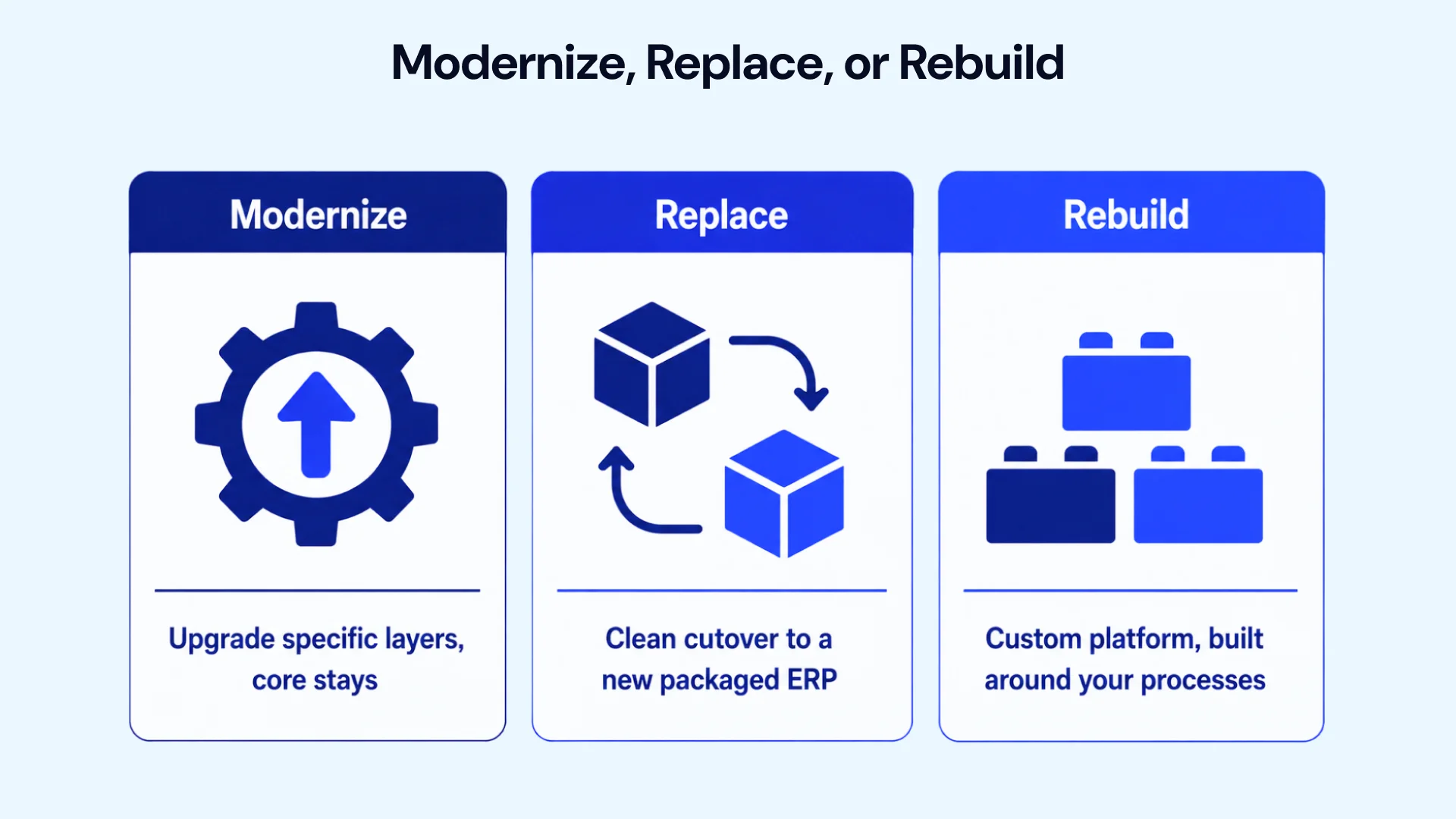
Modernization keeps the existing ERP core in place. It upgrades specific layers: the database, the user interface, integration points, or select modules. A typical example is moving from an on-premises SAP ECC installation to a cloud-hosted version, without a full S/4HANA re-implementation. Modernize works when the core business logic still fits how the company operates today. Where that move also raises data residency questions, the guide to cloud migration services in the UAE covers them in detail.
Replace
Replace retires the existing system and stands up a new packaged ERP. Options include SAP, Oracle, Microsoft Dynamics 365, or Odoo. It is a clean cutover to a modern platform on a set date. Replace fits a system whose logic no longer matches the business. It still requires a packaged product that can cover most requirements out of the box.
Rebuild
Rebuild replaces the ERP with a custom-built platform. It is engineered around the company's specific processes, rather than a vendor's template. It is the slowest and most expensive path upfront. It is also the only path that removes one constraint entirely. That constraint is forcing a unique business model into someone else's software design. Rebuild fits a business with processes packaged ERP vendors do not support well. This is common in construction, logistics, and highly specialized manufacturing. A Rebuild also needs a build partner, and the ranked list of custom software development companies in the UAE covers that field.
Can You Combine Approaches?
Yes, and many UAE enterprises do. A common pattern modernizes the financial core while rebuilding one specific module, such as project costing in construction. Another common pattern replaces the ERP core with a packaged product. It then builds a custom layer on top for a workflow no vendor supports well. Treat the three paths as a spectrum, not three mutually exclusive boxes.
Modernize vs. Replace vs. Rebuild: Core Comparison
| Approach | What Changes | Best Fit | Relative Cost | Relative Timeline |
| Modernize | Specific layers: database, UI, integrations, select modules | Core logic still fits the business; system is outdated but not wrong | Low to Medium | Fastest |
| Replace | Entire system, cutover to a new packaged ERP | Core logic no longer fits; a packaged product can still cover most needs | Medium to High | Moderate |
| Rebuild | Entire system, custom-built around unique processes | Packaged vendors cannot support the company's actual workflows | High | Slowest |
How Do You Score Which Path Is Right for Your ERP?
A workable decision uses a consistent scorecard, not gut instinct. Score the current ERP across each dimension below. Then read the pattern. A system scoring low across most dimensions points toward Modernize. A system scoring low on business fit, but acceptable elsewhere, points toward Replace. A system scoring low on both fit and vendor availability points toward Rebuild.
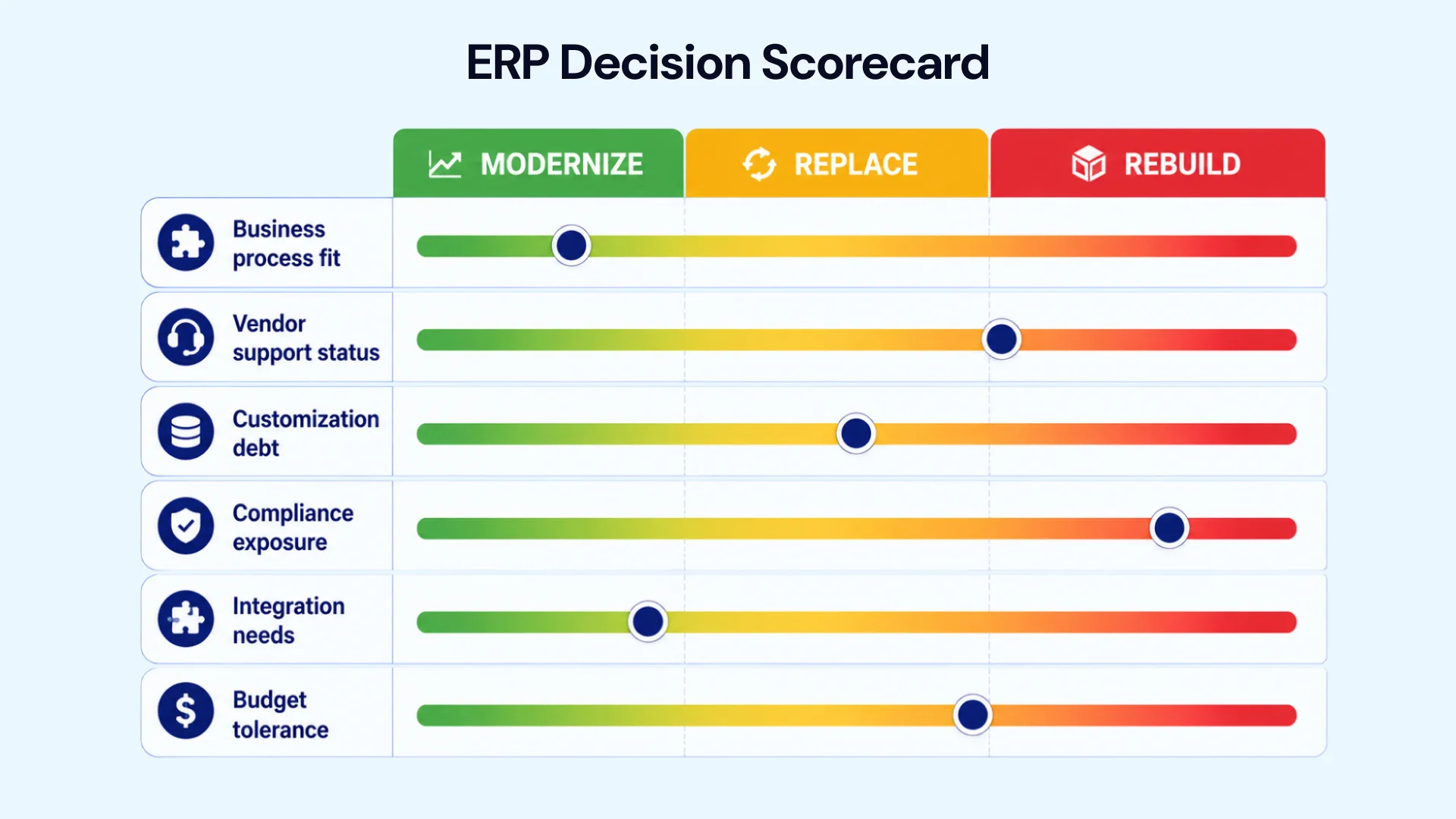
ERP Decision Scorecard: Key Scoring Dimensions
| Dimension | Modernize Signal | Replace Signal | Rebuild Signal |
| Business process fit | Core logic still matches how the business runs today | Logic is outdated but a packaged product covers it | No packaged product fits the actual workflow |
| Vendor support status | Vendor still supports the platform with a clear roadmap | Vendor support is ending or already ended | Vendor category does not serve this business model well |
| Customization debt | Customizations are manageable, and documented | Customizations are heavy but replaceable with standard features | Customizations exist because no standard product ever fit |
| Compliance exposure | System can be updated to meet UAE e-invoicing and tax rules | System cannot meet new compliance rules without a new platform | Compliance needs are unusual enough to require custom logic |
| Integration needs | Can be patched to connect to CRM, HRMS, and cloud tools | Needs a platform built for modern API-first integration | Needs integration patterns no packaged ERP supports natively |
| Budget tolerance | Limited budget, needs a fast, contained project | Moderate to large budget, willing to absorb a cutover | Large budget, multi-year investment horizon accepted |
A UAE construction client once opened a pre-sales call insisting they needed a full ERP replacement. Their existing system, they said, could not be fixed. Discovery told a different story. Roughly 80% of their reported pain traced back to one poorly configured procurement module. Manual workarounds had been built around it for years, not the core platform. The recommendation was a targeted Modernize project, instead of the seven-figure replacement they had budgeted for. The client kept a system that still fits their business. They redirected the savings toward the procurement that caused their frustration.
What Does Each Path Cost in the UAE?
Costs vary widely by company size and scope. UAE enterprises should still expect the following broad ranges for a mid-sized deployment. Modernization projects, covering a database and UI upgrade with select module refresh, typically run from $80,000 to $400,000. Replacement projects are a full cutover to a packaged ERP, such as S/4HANA, Dynamics 365, or Oracle Cloud. These typically run from $250,000 to $1.5 million or more. The exact figure depends on the number of modules and users. Rebuild projects, a fully custom ERP platform, typically start around $400,000. They can exceed $2 million for a large multi-department deployment.
These figures cover implementation only, not total cost of ownership. Annual maintenance and support typically run 15% to 22% of the original license or build cost. That holds regardless of which path is chosen. A Rebuild carries this cost indefinitely, since there is no vendor maintenance contract to eventually replace an in-house team.
Estimated Cost Ranges by Approach (Mid-Sized UAE Enterprise)
| Approach | Typical Cost Range (USD) | Primary Cost Drivers |
| Modernize | $80,000 - $400,000 | Database migration, UI refresh, select module upgrades, integration patching |
| Replace | $250,000 - $1,500,000+ | License fees, data migration, module configuration, user training, cutover support |
| Rebuild | $400,000 - $2,000,000+ | Custom development, process discovery, testing, long-term maintenance ownership |
How Long Does Each Approach Take?
Modernization projects generally run three to nine months. The scope is limited to specific layers, rather than the whole system. Replacement projects generally run nine to eighteen months for a mid-sized enterprise. They can extend past two years for large, multi-country deployments. Rebuild projects generally run twelve to twenty-four months for the initial build. Ongoing development continues well past go-live. Large SAP ECC to S/4HANA replacements specifically tend to run 18 to 36 months. That timeline matters given the December 2027 support deadline.
Estimated Timeline by Approach
| Approach | Typical Timeline | Key Timeline Risk |
| Modernize | 3 - 9 months | Underlying process gaps resurface after go-live if scope was too narrow |
| Replace | 9 - 18 months (up to 36 for large SAP migrations) | Data migration and change management, not the software itself, usually cause delays |
| Rebuild | 12 - 24 months for initial build | Scope creep; custom builds have no vendor roadmap forcing a fixed endpoint |
Which Path Carries the Least Business Disruption Risk?
Gartner's research on ERP implementation outcomes is direct on this point. By 2027, more than 70% of recently implemented ERP initiatives will fail their original business goals. As many as 25% are expected to fail catastrophically. The research points to a specific cause. Technology-centric approaches that ignore stakeholder engagement are the primary driver of failure, not the software choice itself. This holds across all three paths. A Rebuild with strong stakeholder alignment can succeed where a Replace with weak alignment fails.
Modernize carries the lowest disruption risk in absolute terms. The core system and user experience change the least. Replace carries moderate risk, concentrated around the cutover date and data migration. Rebuild carries the highest risk over the longest window. The system stays unproven until it has run through a full business cycle. The mitigating factor for all three is the same. Strong alignment between the ERP initiative and stated business goals has to start on day one. It cannot wait until the project is already underway.
What Does the UAE ERP Vendor Field Look Like?
SAP remains the dominant enterprise ERP vendor in the UAE. This holds especially among large government-linked entities and established conglomerates. SAP S/4HANA is the default Replace path for any organization already on SAP ECC. Oracle Cloud ERP competes strongly in finance-heavy and multinational UAE organizations, particularly those with existing Oracle database or middleware investments. Microsoft Dynamics 365 has strong traction among mid-sized UAE enterprises, particularly in retail and professional services. Part of that traction comes from its integration with other Microsoft business tools. Odoo has a large and growing UAE partner network. It is a common Modernize or Replace choice for SMEs and fast-growing businesses. These buyers need broad functionality without SAP or Oracle-scale licensing costs. Custom-built ERP, the Rebuild path, is most common in construction, logistics, and real estate. UAE-specific project, contract, and payroll structures rarely map cleanly onto any packaged product in these sectors. For implementation partners rather than platforms, the category guide to IT companies in Dubai maps consultancies, systems integrators, and software houses separately.
UAE ERP Vendor Field by Typical Fit
| Vendor / Path | Typical UAE Fit | Common Buyer Profile |
| SAP S/4HANA | Large enterprises, government-linked entities, existing SAP ECC base | Organizations facing the December 2027 ECC deadline |
| Oracle Cloud ERP | Finance-heavy and multinational organizations | Existing Oracle database or middleware customers |
| Microsoft Dynamics 365 | Mid-sized enterprises, retail, professional services | Organizations already invested in Microsoft business tools |
| Odoo | SMEs and fast-growing businesses | Companies needing broad functionality without SAP/Oracle-scale cost |
| Custom-built (Rebuild) | Construction, logistics, real estate | Businesses with UAE-specific processes packaged ERP does not support |
How Does Your Industry Change the Right Answer?
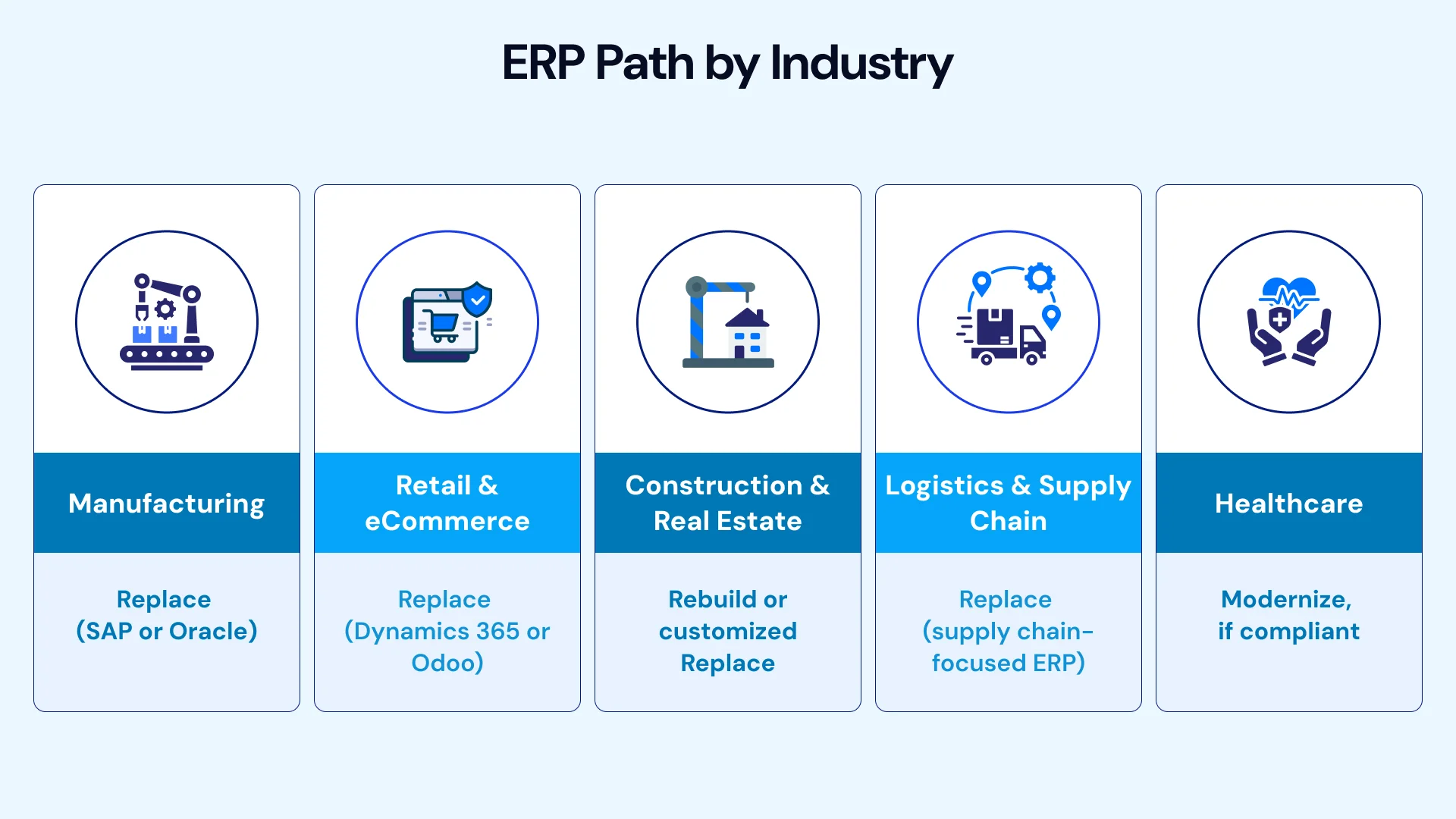
Manufacturing enterprises typically need strong production planning, inventory, and procurement modules. This pushes many toward Replace with SAP or Oracle, rather than a custom build. Retail and eCommerce businesses need integrated inventory, POS, warehouse, and CRM capability across multiple locations. That is a strong fit for Dynamics 365 or Odoo, depending on scale. Construction and real estate companies manage project accounting, contracts, and payroll structures that most packaged ERPs handle poorly. That makes Rebuild, or a heavily customized Replace, more common in this sector. Logistics and supply chain businesses need fleet, warehouse, and procurement tracking with real-time visibility. This is often best served by Replace, with an ERP built for supply chain depth. Healthcare organizations need secure, compliant ERP with clinical-financial integration. That need narrows vendor choice considerably and often favors Modernize if the current system already meets UAE healthcare data rules.
Industry-Specific ERP Guidance
| Industry | Core ERP Need | Typical Recommended Path |
| Manufacturing | Production planning, inventory, procurement, quality control | Replace (SAP or Oracle) |
| Retail & eCommerce | Inventory, POS, warehouse, CRM, multi-location | Replace (Dynamics 365 or Odoo) |
| Construction & Real Estate | Project accounting, contracts, payroll, compliance | Rebuild or heavily customized Replace |
| Logistics & Supply Chain | Fleet, warehouse, procurement, real-time tracking | Replace (supply chain-focused ERP) |
| Healthcare | Secure, compliant ERP with clinical-financial integration | Modernize, if current system meets UAE health data rules |
Should AI Readiness Factor Into the Decision?
AI capability is becoming a genuine differentiator among ERP paths, not just a marketing claim. Gartner research on application modernization notes that AI-driven automation is now cutting the cost and complexity of ERP projects. It speeds up migration, integration, and testing work across all three paths. This affects the decision in two ways. First, AI-driven tooling makes Replace and Rebuild projects faster and less risky than they were two years ago. Testing and data mapping can now be partially automated. Second, the destination system's own AI capability matters. Legacy ERP systems built before 2018 rarely support embedded AI features, like predictive demand planning or automated anomaly detection. Modern S/4HANA, Dynamics 365, and Oracle Cloud releases build these features in natively. A UAE enterprise scoring high on business fit for Modernize should still weigh one question. Does staying on a legacy core foreclose AI capability the business will need within two to three years?
What Do UAE Compliance Rules Mean for Your ERP Decision?
UAE corporate tax applies a 9% rate on profits above AED 375,000. Every taxable person must register with the Federal Tax Authority through EmaraTax. Large multinational groups face an additional layer. Those with consolidated global revenue of at least EUR 750 million owe a Domestic Minimum Top-up Tax. This applies to financial years starting on or after January 1, 2025. It tops up the effective UAE tax rate to 15%, under the OECD Pillar Two framework. An ERP system needs to generate the reporting these rules require, without manual workarounds.
E-invoicing is the more urgent constraint. The UAE has adopted a five-corner PEPPOL model with the PINT AE format. The supplier's accounting or ERP system creates the invoice. It sends that invoice to an Accredited Service Provider. The provider validates and routes it through the network to the buyer's provider. A fifth corner reports tax data directly to the Federal Tax Authority. The pilot begins July 1, 2026. It becomes mandatory January 1, 2027 for businesses with AED 50 million or more in annual revenue. Large businesses must appoint an Accredited Service Provider by October 30, 2026. Any ERP evaluated for Modernize, Replace, or Rebuild in 2026 needs a confirmed roadmap for PINT AE compliance. A platform without one is not a viable long-term choice. That holds regardless of how well it fits everything else on the scorecard.
Score Your ERP Before You Talk to a Single Vendor
Every ERP vendor has an answer for why their product is the right one. None of them will tell a UAE enterprise whether it should be talking to them at all. None will suggest modernizing what it already has instead. VLink's ERP modernization team works through the scorecard in this guide with UAE CIOs, IT directors, and CFOs. This happens before any vendor conversation starts. That includes cost estimates, timeline planning, and a compliance check against UAE e-invoicing and corporate tax requirements.
Get Your Free ERP Assessment, scored against the same criteria used in this guide. Or talk to VLink's ERP modernization team about a specific system you are evaluating right now. Download the ERP Decision Scorecard to score your current ERP across 12 dimensions. Get a directional recommendation before you scope any project.

In Summary
UAE enterprises are facing this decision now because of three forces arriving together. Aging systems, the SAP ECC 2027 deadline, and the UAE's new PEPPOL e-invoicing mandate are converging at once. There is no universally right path. Modernize fit systems whose core logic still match the business. Replace fits systems that need a clean break but can still work inside a packaged product. Rebuild fits businesses whose processes no packaged ERP has ever handled well. The right call comes from scoring business fit, vendor support, customization debt, compliance exposure, integration needs, and budget tolerance together. No single factor decides it alone. Cost and timeline both scale in the same direction, from Modernize through Replace to Rebuild. Compliance deadlines now set a hard outer limit on how long any of the three paths can be delayed.

Global Delivery Manager, VLink Inc.
Shivisha Patel serves as the Global Delivery Manager at VLink Inc., bringing a wealth of experience in program delivery and management, particularly in the insurance and banking sectors. She has a robust technical background with deep expertise in WebSphere MQ, WTX, IIB, middleware, and enterprise system integration.

 Shivisha Patel