


Having spent over a decade guiding the digital transformation strategies of Tier-1 IT services and consulting firms across North America and Asia, I’ve witnessed technology shifts that have fundamentally redrawn the competitive landscape in the BFSI sector.
Today, the most powerful strategic lever for Chief Technology Officers (CTOs) and Chief Experience Officers (CXOs) is not merely automation, but intelligent, humanized interaction at scale. That lever is Conversational AI for Banking.
This guide is your strategic playbook. We move past the hype to focus on the quantifiable strategy, the complex implementation roadmap, and the tangible ROI of conversational AI for banking. This is a mid-funnel conversation aimed at executive decision-makers who understand the fundamental shift from transactional banking to contextual, personalized financial relationships.
Banks need a roadmap for AI adoption—AI chatbot guide for banks covers use cases, compliance, and vendor selection.
The Seismic Shift: Why Conversational AI is Now a BFSI Mandate
The global demand for instant, seamless service has turned banking into a 24/7, high-stakes communication environment. Customers demand the same simplicity and speed they get from consumer tech giants. The only way to meet this demand, while simultaneously driving down operational expenditure, is through sophisticated automation powered by AI.
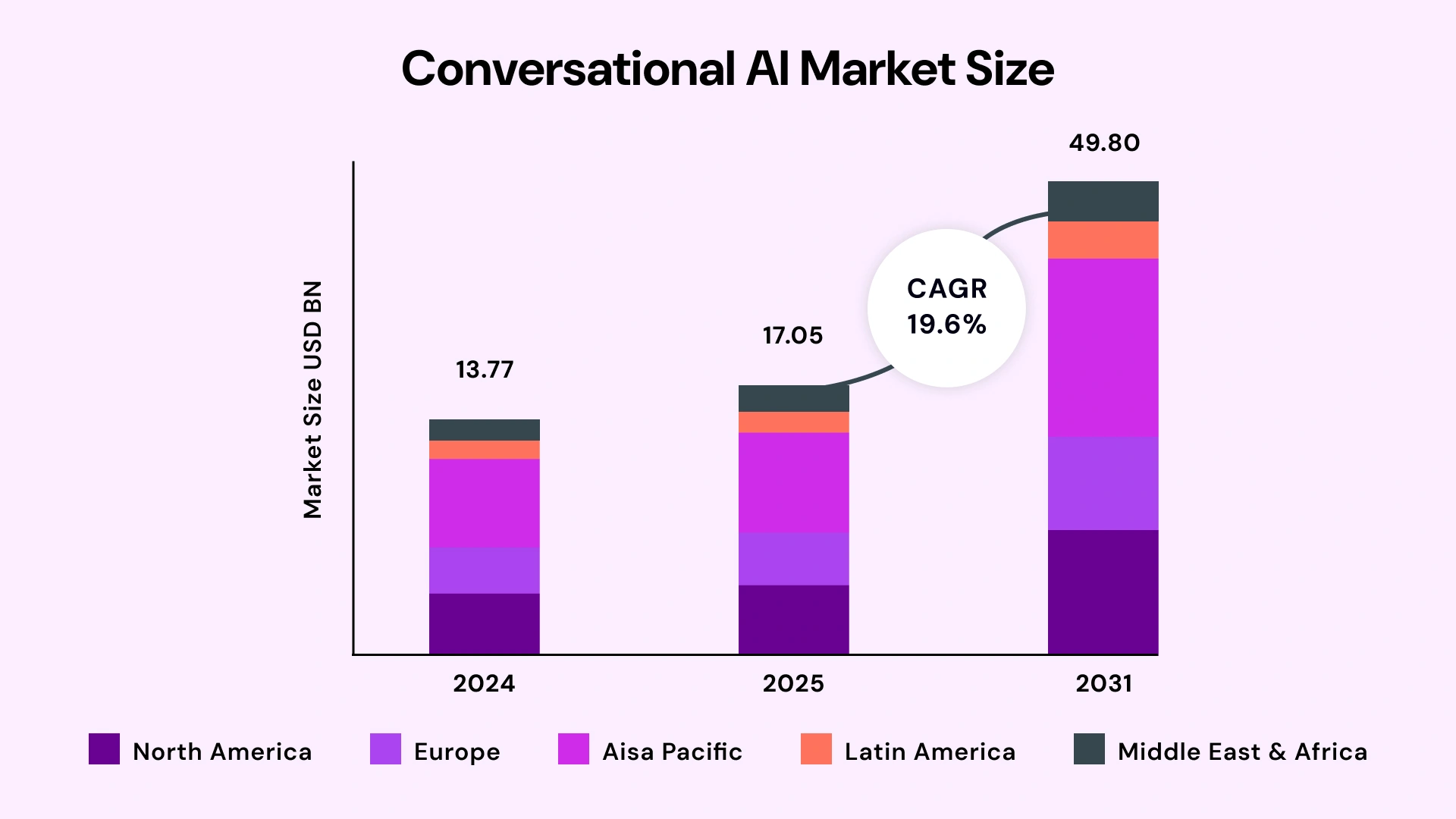
Furthermore, North America accounted for the largest market share in 2025, underscoring the technology's maturity and its necessity in competitive Western markets. This trajectory confirms that implementing advanced conversational AI for banks is no longer a luxury—it’s the cost of entry for digital relevance.
Banks leveraging conversational AI in banking report significant performance gains:
- Up to 30% productivity improvement in service operations by augmenting human agents.
- First-response times reduced by up to 80%, directly contributing to higher Customer Satisfaction (CSAT) scores.
- Reported cost savings, with some financial institutions lowering operating expenses by 30% to 45% through automation.
The successful application of conversational AI for banking is the bridge between meeting customer expectations and achieving executive efficiency targets.
The Strategic Mandate: Driving Efficiency and Competitive Edge
For the CXO, the value proposition of conversational AI in banking is twofold: radically improved customer experience and significantly optimized cost structures. This dual impact enables the scaling of banking operations through AI automation that traditional call centers could never achieve.
Elevating Customer Experience and Hyper-Personalization
The modern customer expects their bank to anticipate their needs. AI-driven customer engagement in banking transforms generic interactions into highly personalized ones. By analyzing transaction history, spending habits, and past service queries, an AI-powered financial assistant can proactively issue financial alerts, suggest budget optimization strategies, and facilitate cross-selling of relevant products.
Leading banks are already deploying sophisticated AI in customer communications to deliver this hyper-personalization. For instance, an AI can automatically generate tailored marketing messages or recommend investment opportunities that align with a client’s real-time financial goals.
This is why banks with strong omnichannel execution see a notable increase in customer satisfaction, primarily due to reduced friction and faster, more relevant resolutions delivered through 24/7 banking support powered by conversational AI.
Quantifiable Operational Efficiency and Cost Reduction with Conversational AI
The most immediate and measurable ROI comes from automation. Routine, high-volume inquiries—such as balance checks, password resets, or loan application status checks—typically account for 70% of a call center's workload. By using AI-enabled chatbots for banking and voicebots to handle repetitive traffic, banks achieve profound cost reductions with conversational AI.
Research shows that AI solutions can cut the cost per customer interaction from the traditional $5–$25 range down to as low as $0.50-$5. This dramatic reduction in labor costs frees up specialized human agents to focus on complex, revenue-generating activities like wealth management or handling sophisticated fraud claims, directly addressing the challenge of reducing call center load with conversational AI.
For CTOs, this efficiency translates into robust, scalable infrastructure that can meet fluctuating demand without the need for continuous, costly human staffing increases.

Foundational Elements: Unpacking the Conversational AI Technology Stack
To ensure strategic clarity, CTOs must understand the technological leap from simple automation scripts to true conversational AI in fintechs. This shift is driven by advancements in language models and deep integration capabilities, essential for providing Secure conversational AI for banks that can handle high-stakes transactions and complex compliance requirements.
NLP, LLMs, and the Power of Contextual Banking Conversations
The intelligence of a conversational AI lies in its ability not only to recognize words but also to comprehend human intent and context truly. This relies on:
- Natural Language Processing (NLP) in banking: This is the bedrock, allowing the system to break down and process human language—text or voice—into structured data. Banking automation with NLP enables the AI to understand the nuances of financial jargon and local dialects.
- Large Language Models (LLMs) for banking: Generative AI is the major differentiator today. LLMs enable AI to generate highly nuanced, human-like responses, creating fluid, context-aware banking conversations. They move the assistant beyond pre-scripted answers, allowing for complex, multi-turn interactions, such as guiding a customer through a multi-step AI process for loan applications. Generative AI agents are projected to grow at the fastest rate (CAGR of 25.5%) in the market, underscoring their increasing strategic importance.
- Chatbots vs. Conversational AI in banking: While a chatbot follows a rigid, linear path, a true Conversational AI uses these advanced techniques to pivot, learn, and maintain context across different channels, acting as a genuine AI virtual assistant for banking.
Omnichannel Solutions and Voice Banking
The days of isolated bots are over. Customers expect a seamless transition from their mobile app (chat) to a voice interface. Omnichannel conversational banking solutions unify the customer journey, preserving context across channels.
The rise of Voice banking and AI voice assistants (like Bank of America's "Erica" or HDFC Bank's "EVA") is proof that voice is becoming a primary channel.
These AI voicebots for banking handle everything from quick account checks to complex identity verification, bringing the efficiency of automation to the most human channel. Implementing these solutions requires expert AI development services focused on low-latency, high-accuracy speech recognition.
Conversation AI in Banking: Roadmap for Success
A successful deployment of conversational AI for banks is not a single project, but a strategic, phased transformation program. The CTO's mandate is to secure the technical core—deep integration—and the organizational core—governance—while minimizing production risk and maximizing the ROI of conversational AI for banking.
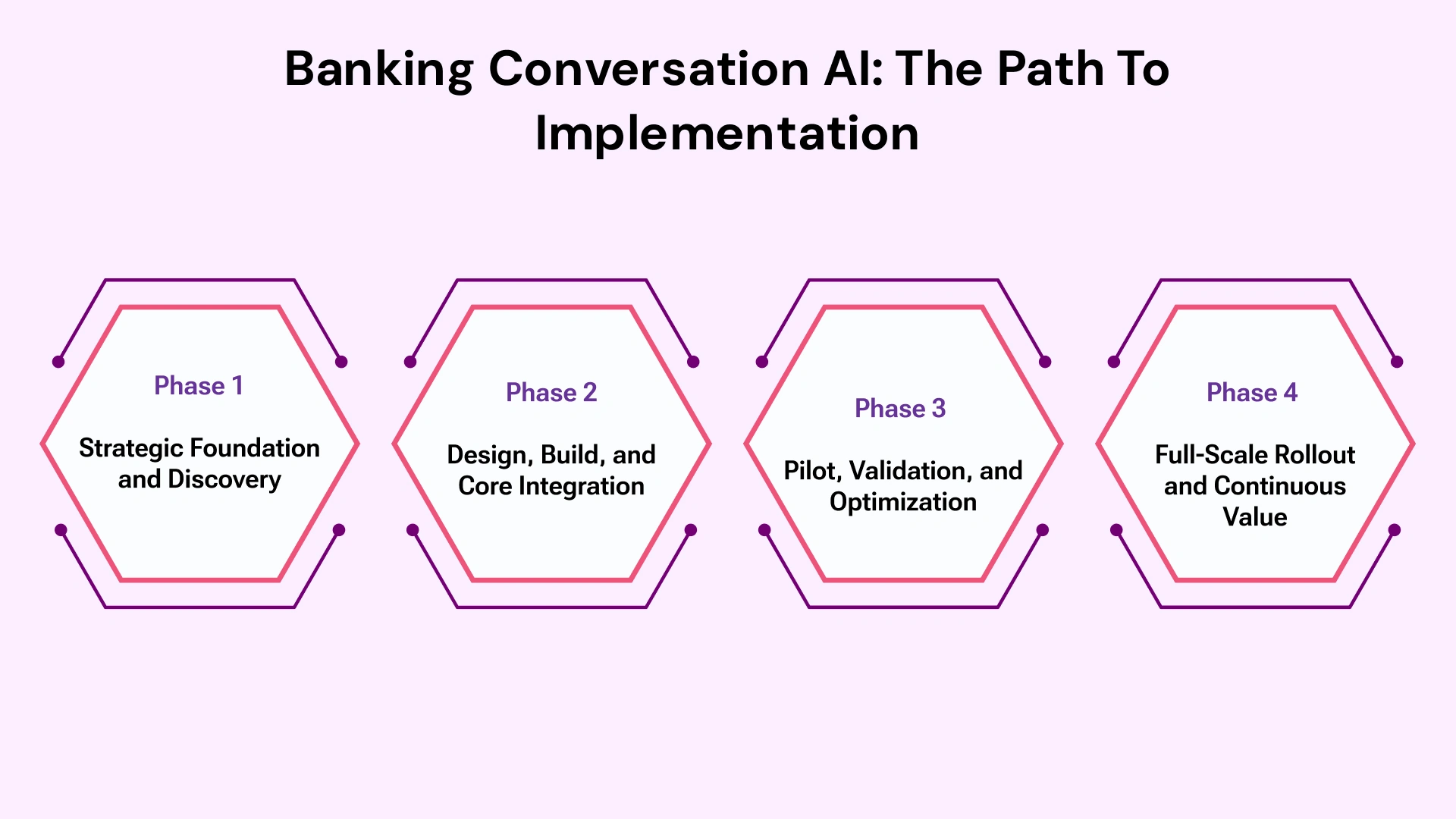
The following roadmap outlines the four critical phases required for a robust, enterprise-grade deployment:
Phase 1: Strategic Foundation and Discovery (The 90-Day Blueprint)
This phase ensures all technological efforts are directly tied to high-value business outcomes, avoiding costly "chatbot silos."
| Milestone | Key Activities | Output/Deliverable for the CTO |
| A. Goal Alignment | Define 3-5 high-impact, high-volume use cases (e.g., FAQ deflection, PIN reset, card block). | Signed Conversational AI for banking strategy document and prioritized use-case matrix. |
| B. Data Readiness | Audit existing data infrastructure (CRM, transaction logs, call transcripts). Establish data quality, governance, and privacy compliance standards (GDPR, CCPA). | Data Readiness Assessment and PII (Personally Identifiable Information) encryption strategy. |
| C. Architecture Scoping | Map existing legacy systems, APIs, and microservices that the AI will need to connect with to achieve transactional capabilities. | High-level Conversational AI integration with the core banking system blueprint. |
| D. Vendor Selection | Evaluate Conversational AI vendors for BFSI based on domain expertise, security track record, native LLM capabilities, and AI development services support. | Finalized Vendor Selection Scorecard and RFP completion. |
Phase 2: Design, Build, and Core Integration (The Six-Month Build)
This is the development and engineering phase, where technical resilience and security protocols are hard coded into the solution.
| Milestone | Key Activities | Output/Deliverable for the CTO |
| A. Technical Integration | Develop and test secure APIs and middleware layers (e.g., Kafka streams) to enable real-time data flow between the AI platform and core systems (CRM, payment gateways). | Integration Test Cases and a Secure API Gateway deployment for transactional flows. |
| B. Model Training | Train the NLU/LLM models on domain-specific data, financial jargon, and bank policy documents. Implement Retrieval-Augmented Generation (RAG) to prevent AI hallucinations in banking. | Model Accuracy Report (Targeting 90%+ intent recognition for priority use cases). |
| C. UX/Conversation Design | Design multi-turn conversation flows for the first set of use cases, focusing on seamless human-to-AI handoffs and establishing the AI's brand persona/tone. | Conversation flow maps for all launch use cases and defined escalation protocols. |
| D. Governance & Compliance | Implement audit logging for every AI decision. Define data retention policies and access controls (RBAC) to ensure a truly Secure conversational AI for banks. | Compliance Audit Trail framework and MLOps pipeline for automated bias/drift detection. |
Phase 3: Pilot, Validation, and Optimization (The Go-Live Readiness)
This phase validates the solution in a real-world, controlled environment, proving its ability to scale and deliver on the initial objectives.
| Milestone | Key Activities | Output/Deliverable for the CTO |
| A. Internal Beta Launch | Deploy the solution to internal agents (Agent-Assist model) or a controlled group of employees. | Agent Feedback Report and 80%+ human confidence rating in AI-generated answers. |
| B. Customer Pilot (MVP) | Launch the AI for the primary use case (e.g., balance check) on a single channel (e.g., web chat) for a small, defined customer segment. | Customer Satisfaction (CSAT) Scores and initial Containment Rate (Target 40-50% query deflection). |
| C. Performance Tuning | Analyze pilot transcripts to identify failure points, intent gaps, and areas requiring flow refinement—Retrain models based on live data. | Updated NLU model and Deflection Metrics Dashboard baseline. |
| D. Final Go/No-Go Review | Review security test results, system load tests, and the initial calculated ROI against the initial cost estimate. | Executive Go/No-Go Decision Document and approval for scaled launch. |
Phase 4: Full-Scale Rollout and Continuous Value (Scaling the Enterprise AI)
The final phase involves expanding the Enterprise conversational AI for banks across all agreed channels and continually optimizing for deeper value.
| Milestone | Key Activities | Output/Deliverable for the CTO |
| A. Omnichannel Expansion | Roll out the solution across all targeted channels: mobile app, secure messaging (WhatsApp), and voicebots/IVR. Ensure flawless context transfer for omnichannel conversational banking solutions. | Full Omnichannel Deployment with unified AI in customer communications for banks. |
| B. Advanced Use Case Deployment | Deploy complex, transactional use cases (e.g., AI for loan processing and applications, AI in KYC/AML compliance). | Automation of core business processes and increased lead qualification rates. |
| C. Quantifying ROI | Formal calculation of the final ROI of Conversational AI for Banking across all three vectors (Cost Savings, Revenue Generation, and Risk Reduction). | Quarterly ROI Dashboard and budget approval for next-stage AI development services. |
| D. Model Maintenance | Implement continuous monitoring (MLOps) to track performance, model drift, and customer sentiment, driving perpetual refinement. | Continuous Improvement Backlog prioritized by business value and error rate reduction. |
The True Cost and ROI of Conversational AI for Banking
The initial cost of implementing conversational AI in banking is substantial, ranging from custom basic solutions ($50,000) to enterprise-grade implementations that exceed $1 million, factoring in security, compliance, and deep integration. However, the return is transformative.
The ROI of conversational AI for banking is measured across three vectors:
- Cost Savings: Reduction in call center operational costs (up to 45% savings) and the lower cost per interaction.
- Revenue Generation: Increased lead qualification rates (up to 60%) and higher customer lifetime value (CLV) due to superior AI and customer satisfaction in banking and targeted cross-selling.
- Risk Reduction: Faster, more accurate detection of fraud and enhanced compliance automation.
The calculation must be comprehensive:
| ROI = ( (Cost Savings + New Revenue from Retention/Sales) - Total Investment ) / Total Investment * 100 |
Positive ROI is achievable swiftly, often within 12–18 months, by strategically targeting high-friction, high-cost areas like customer support and regulatory compliance.
Risk Mitigation and Governance: Building Trust in AI-Powered Banking
For a highly regulated industry like BFSI, the execution of the AI strategy must be rooted in trust and compliance. This commitment to an EEAT framework (Expertise, Experience, Authority, and Trust) is paramount.
AI in KYC/AML Compliance and Preventing Financial Crime
Conversational AI extends beyond the front-end to critical risk functions. AI in KYC/AML compliance automates identity verification, guides customers through complex regulatory documentation, and performs real-time checks on transaction patterns.
For example, the AI can assist in the Conversational AI for identity verification process during digital onboarding, significantly reducing manual verification processes.
Furthermore, AI for fraud detection and prevention is a foundational use case. AI-powered systems monitor 100% of transactions for anomalies, instantly engaging the customer via chat to verify suspicious activity. This real-time response capability is vital for the Security and secure flow of the user when interacting with financial data.
Addressing AI Hallucinations in Banking and Data Privacy
The greatest challenge of using the best LLM model is the risk of generating inaccurate or fabricated information—known as hallucination. In finance, this can lead to massive compliance or financial errors. Preventing AI hallucinations in banking is a key governance priority.
The technical solution lies in the Retrieval-Augmented Generation (RAG) architecture, which forces the LLM to ground its response in the bank's approved, verified knowledge base. This ensures that the AI conversational banking solutions only provide only factual, policy-compliant information.
Additionally, stringent protocols must govern Conversational AI and data privacy in banking. This requires privacy-by-design frameworks, automated logging for audit readiness, and strict adherence to data residency laws—all non-negotiable aspects of any Regulatory compliance of conversational AI for banking strategy.
The challenges of conversational AI for banking are overcome through rigorous testing and an MLOps framework that prioritizes transparency and auditability.

Enterprise Use Cases: Driving Value Across the Banking Value Chain
Conversational AI is not merely a customer service tool; it is a core business application that optimizes high-value processes across retail, commercial, and investment services in financial services.
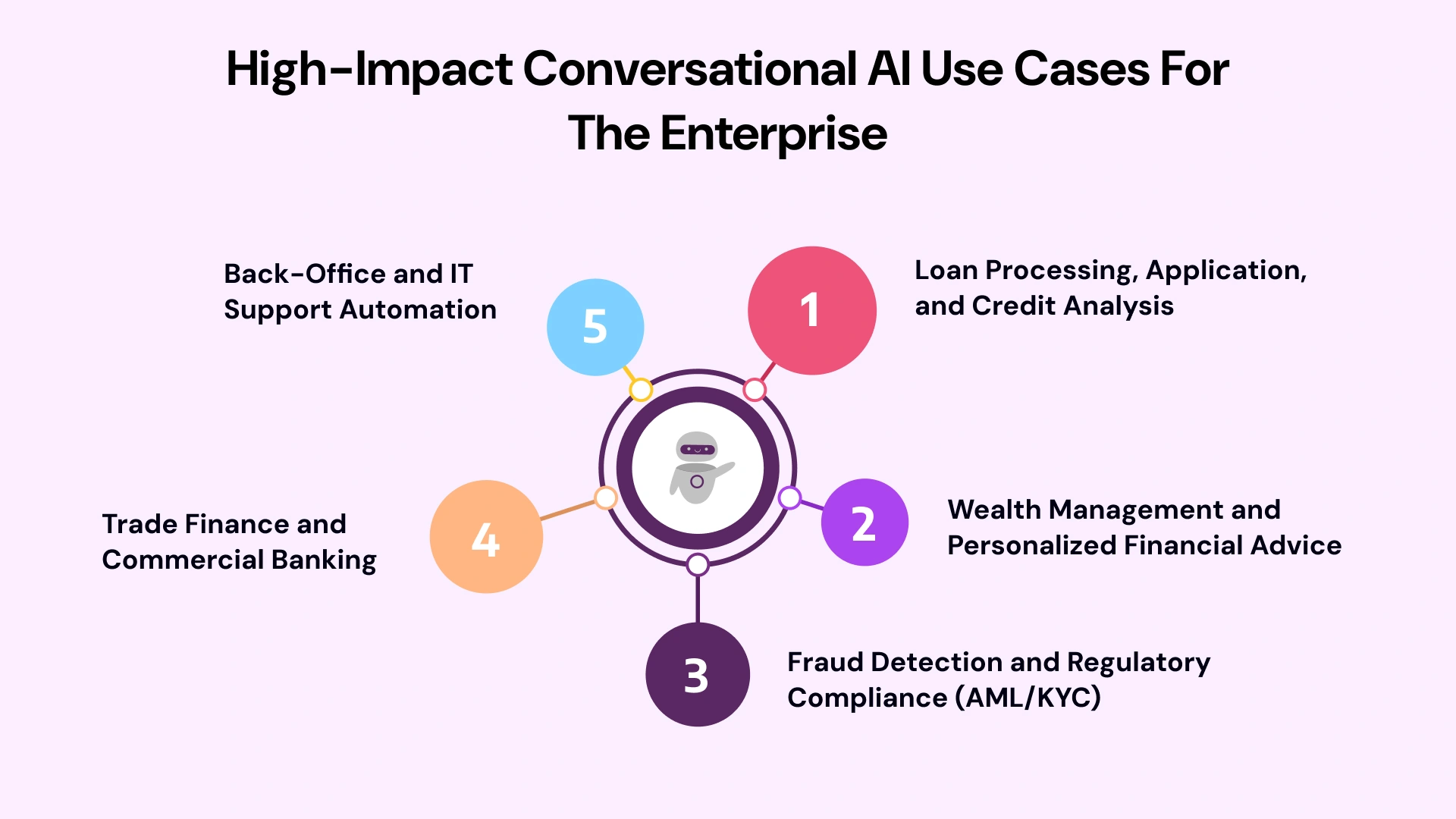
Loan Processing, Application, and Credit Analysis
The loan origination process is notoriously complex and slow. AI for loan processing and applications transforms this:
- Pre-Qualification: AI chatbots for banking can instantly pre-qualify applicants, guiding them through the initial eligibility check and documentation submission.
- Document Processing: The AI uses advanced NLP to extract, validate, and classify structured and unstructured data from application forms and supporting documents, such as tax returns, drastically speeding up the time-to-decision.
- Status Updates: Automated updates and reminders reduce inbound inquiries, enabling the bank to manage a higher volume of applications without increasing operational costs.
Wealth Management and Personalized Financial Advice
For high-value customers, AI-driven personalized financial advice delivered through conversational interfaces is the next frontier. The AI analyzes market data, risk tolerance, and portfolio performance in real-time.
- Real-time Portfolio Analysis: The AI assistant provides instantaneous, conversational summaries of portfolio health, identifying potential risks or opportunities based on live market fluctuations.
- Tailored Investment Insights: By leveraging Large Language Models (LLMs), the AI-powered financial assistants can synthesize complex financial reports and market information to present tailored investment insights in an easy-to-understand conversational format, augmenting—not replacing—the human wealth manager.
- Goal-Based Planning: Conversational interfaces allow clients to interact with their financial plan naturally, asking "What happens to my retirement timeline if I buy a second house?" and receiving immediate, simulated projections.
Fraud Detection and Regulatory Compliance (AML/KYC)
Integrating conversational AI into compliance and security workflows creates a proactive defense mechanism.
- Suspicious Activity Reporting: The custom AI fraud detection can monitor transaction patterns and, upon detecting anomalies, initiate a real-time conversational alert with the customer to confirm the transaction's legitimacy, significantly reducing fraud losses and false positives.
- Customer Due Diligence (CDD): AI assists compliance officers by rapidly cross-referencing customer data against global sanctions lists, adverse media, and regulatory databases (KYC/AML checks). The system can flag discrepancies and generate a concise conversational summary of the risk profile, accelerating the onboarding and review process.
Trade Finance and Commercial Banking
For commercial clients, conversational AI streamlines historically paper-heavy and time-sensitive operations, improving cash flow and international trade efficiency.
- Letter of Credit (LC) Inquiry: Commercial customers can use an AI assistant to check the status of complex LCs instantly, ask about required documentation, or initiate amendments, bypassing slow email and call center channels.
- Cash Management Services: AI can provide real-time, consolidated views of global accounts and cash positions. It can process complex natural-language requests for intercompany fund transfers and liquidity management tasks, offering businesses greater control and speed.
Back-Office and IT Support Automation
Conversational AI can significantly reduce operational friction and costs by automating internal processes, beyond just customer-facing roles.
- Internal Knowledge Base Access: AI assistants provide instant, accurate answers to internal staff inquiries regarding complex policies, HR guidelines, or compliance rules, drastically reducing the burden on specialized departments.
- Tier 1 IT and HR Support: The AI acts as a 24/7 virtual help desk, diagnosing common IT issues (e.g., password resets, software access requests) or handling routine HR questions (e.g., vacation accrual, benefits inquiry). It automates ticket creation and routing, ensuring faster resolution times.
The implementation of Conversational AI moves banking beyond simple customer service enhancements, establishing it as a critical enterprise asset. By tackling complex challenges in compliance, high-value wealth management, and internal efficiency, these solutions directly improve margins and enhance regulatory resilience across the entire banking value chain.
The Path Forward: Future-proofing with Generative AI and Trust
The Future of conversational AI in BFSI is agentic meaning the AI will act autonomously to fulfill multi-step goals on behalf of the customer, further embedding itself as a strategic partner.
From Reactive to Proactive AI Services
Future conversational AI will be inherently predictive. It will not wait for a query; it will initiate a meaningful conversation based on anticipated needs.
- If a customer’s average balance drops, the AI might proactively ask if they want to review their budget or consolidate high-interest debt.
- If a large payment is due, the AI sends a conversational alert rather than a static notification.
This shift to a proactive model deepens the customer relationship. It reinforces the value of AI conversational banking solutions as a trusted advisor, essential for AI in neo banks and digital banks, where the digital interface is the branch.
Mastering Ethical AI and Human-Centric Design
As AI systems become more autonomous, the need for ethical AI governance grows. Banks must avoid bias and ensure fairness in outcomes—especially in high-stakes decisions such as credit scoring and loan approvals.
Investing in continuous model monitoring and explainable AI (XAI) frameworks is paramount. Ultimately, the best BFSI conversational AI solutions will master the art of the seamless human handover, ensuring that when the AI reaches its operational limit, a human agent steps in with complete context, upholding the standard of truly humanized content and service.
Strategic Data Architecture for LLMs
The performance of next-generation conversational AI relies directly on a bank's ability to safely and efficiently utilize its vast data stores.
- Secure Retrieval-Augmented Generation (RAG): Banks must architect secure RAG frameworks that enable the Generative AI model governance in BSFI to access internal, proprietary knowledge (such as policy documents or customer account data) in real time without retraining the core model. This ensures accurate, contextual, and up-to-date responses while maintaining strict data privacy standards.
- Vector Database Implementation: Specialized vector databases are essential for efficiently storing and retrieving dense numerical representations (embeddings) of high-volume financial data, enabling AI to quickly find the most relevant information for complex, nuanced queries.
VLink: Specialized Expertise for Superior Conversational AI
As an executive, you understand that selecting the right technology is only half the battle; the true competitive edge lies in flawless, secure, and strategic implementation. At this mid-funnel stage of your decision-making, the strategic partner you choose must not only possess deep AI capabilities but also an intrinsic understanding of the BFSI regulatory and system landscape.
VLink brings over a decade of experience, bridging the gap between cutting-edge AI innovation and the stringent requirements of top-tier financial institutions across the USA, Canada, and India. Our specialized approach transforms the conceptual promise of conversational AI for banks into measurable, compliant business outcomes.
Bridging Innovation and Compliance: The VLink Advantage
Implementing true enterprise conversational AI for banks demands more than generic software development; it requires a partner fluent in AI development services tailored to financial risk and governance. VLink’s AI development services are centered on the three pillars critical to any BFSI leader:
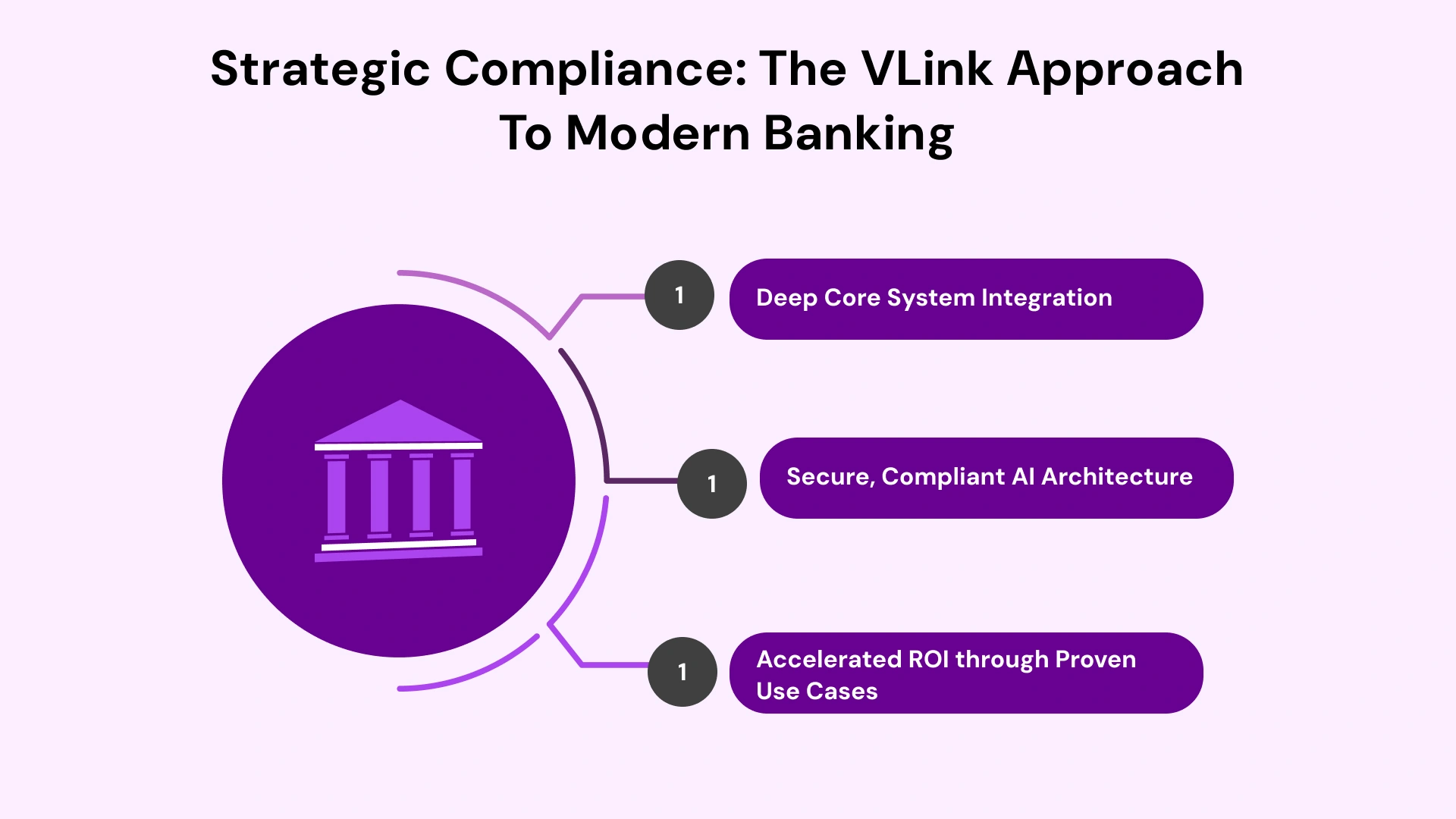
1. Deep Core System Integration:
Our core competency lies in complex Conversational AI integration with core banking systems (e.g., Temenos, Finacle, or custom ERPs). We architect secure middleware layers that enable the AI to perform high-stakes tasks—like fund transfers or loan approvals—in real-time, safely navigating the security and latency demands of transactional systems.
This deep integration is what separates a static chatbot from a genuinely valuable AI-powered financial assistant.
2. Secure, Compliant AI Architecture:
Given the high-risk nature of conversational AI in financial services, security is paramount. Our dedicated team builds solutions with privacy-by-design, ensuring Regulatory compliance of conversational AI for banking (GDPR, PCI DSS, etc.) is baked into the architecture.
We deploy advanced techniques like Retrieval-Augmented Generation (RAG) to prevent AI hallucinations in banking, guaranteeing that the information provided is always accurate and sourced from your bank’s verified policies, creating a truly secure conversational AI for the banking environment.
3. Accelerated ROI through Proven Use Cases:
We move beyond basic customer service. Our solutions target high-impact areas like AI for loan processing and applications, automated KYC/AML support, and AI for fraud detection and prevention.
By focusing on these complex, high-friction points, we ensure your investment in conversational AI for banking delivers maximum ROI by both driving down operational costs and accelerating revenue cycles.
Choosing VLink means partnering with a global team of AI developers, MLOps specialists, and BFSI domain experts who ensure your transition to an omnichannel conversational banking solution is seamless, compliant, and transformative. We provide the expertise needed to turn your strategic vision into a reliable, humanized, 24/7 reality.

Conclusion: Seizing the Conversational AI Opportunity
The convergence of customer demand, technological maturity (NLP, LLMs), and the intense competitive landscape makes the adoption of sophisticated conversational AI for banking an unavoidable commercial imperative.
For BFSI CTOs and CXOs, this guide confirms that the strategic path forward is not about building a standalone chatbot, but about architecting an Enterprise conversational AI for banking platform—one that is deeply integrated with core systems, meticulously governed for compliance and security, and designed to deliver measurable Conversational AI ROI for banking.
The time for pilots and experiments is past. The time is now to commit to the integration, governance, and AI development services that will define the next decade of financial services. Embrace the power of conversational AI in banking to transform your operational efficiency and forge deeper, more intelligent relationships with your customers. The future of banking speaks, and it is conversational.
Ready to transform your bank's customer experience, streamline operations, and realize significant ROI with a secure, enterprise-grade Conversational AI solution? Connect with our AI specialists today to discuss a customized implementation roadmap that aligns with your strategic goals and regulatory environment.

Vice President, Strategy – VLink Inc.
Sambhavi Gopalakrishnan is the Vice President of Strategy at VLink Inc., bringing over a decade of experience in IT leadership, project implementation, and strategic growth. She possesses a strong foundation in technical project management and pre-sales, driving innovation and business transformation at VLink.

 Shivisha Patel