


Tariq Al-Rashidi is the VP Engineering at a Riyadh-headquartered conglomerate with operating units across BFSI, healthcare, and logistics. Following a board decision to consolidate the group’s fragmented IT estate onto a single primary cloud provider — with a secondary provider for specific AI and analytics workloads — Mr. Al-Rashidi has been tasked with producing a cloud provider shortlist. The evaluation criteria are non-negotiable: PDPL data residency compliance, SAMA cybersecurity framework alignment, Arabic-language AI capabilities, and a five-year TCO model that withstands CFO scrutiny. He has 60 days to present a recommendation to the group’s steering committee.
This guide provides a structured comparison of the three dominant cloud computing providers — Amazon Web Services (AWS), Microsoft Azure, and Google Cloud Platform (GCP) — through the specific lens of Saudi enterprise requirements. For CTOs, GMs of IT, and VP Engineering leads, the decision is not about which provider is globally leading. It is about which cloud service providers in Saudi Arabia deliver the right combination of in-Kingdom infrastructure, compliance architecture, AI capability, and commercial flexibility for your specific workload portfolio.

Why Saudi Arabia’s Cloud Market Demands a Deliberate Provider Decision
Three structural forces make the Saudi cloud provider decision more consequential than in most other markets.
Data Residency Is Now a Legal Obligation
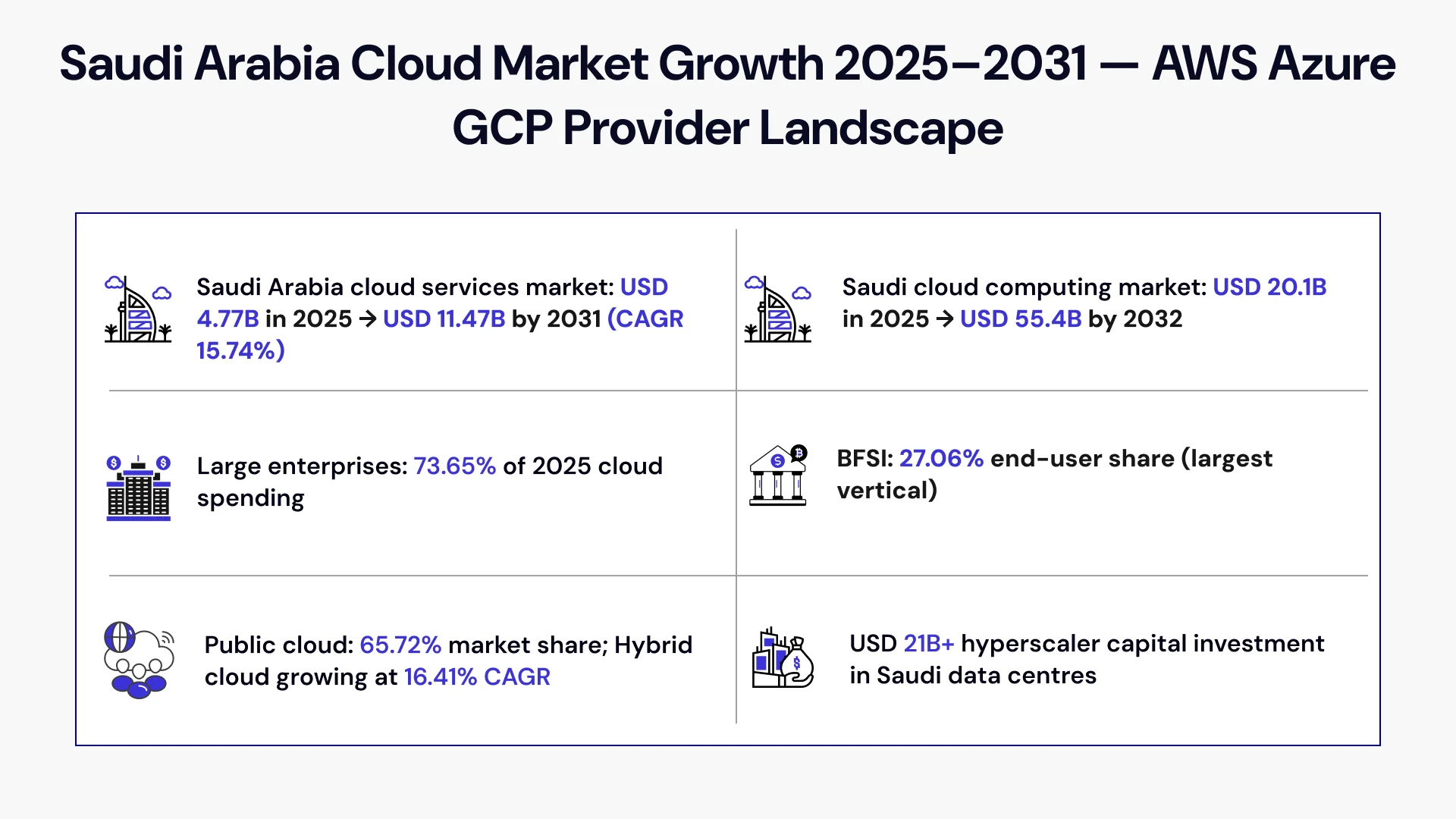
Saudi Arabia’s Personal Data Protection Law (PDPL), enforced since 14 September 2024, requires that personal data of Saudi residents be stored and processed within the Kingdom unless specific cross-border transfer conditions are met. SAMA’s Cybersecurity Framework mandates that SAMA-regulated financial institutions use cloud infrastructure that meets KSA data residency standards. NCA’s CCC 2:2024 controls apply to critical infrastructure operators. A cloud provider without a functioning, compliant KSA data centre is not a viable option for regulated Saudi workloads.
The Cloud First Policy Accelerates Government Enterprise Adoption
The Saudi government’s Cloud First Policy mandates that public sector entities prioritize cloud solutions for IT investments. This directive has pulled government ministries, state-owned enterprises, and regulated-sector firms into accelerated cloud procurement cycles. CTOs and GMs of IT in these organisations must evaluate providers not only on technical merit but on regulatory certification, local contracting structures, and Arabic-language operational support.
AI Workloads Require Regional Infrastructure
Cloud Infrastructure in the Kingdom: What Each Provider Has Built
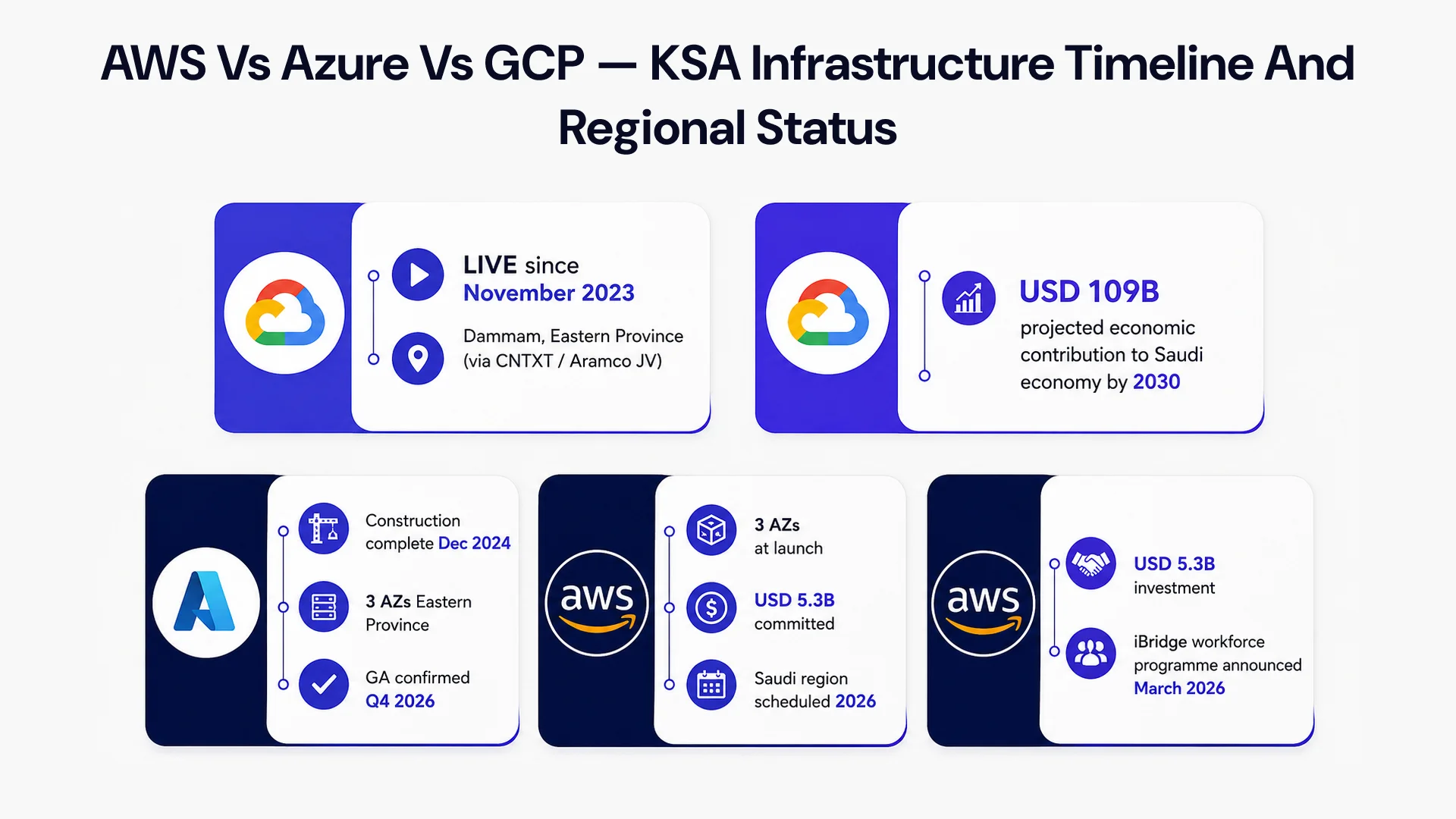
Current KSA Infrastructure Status: AWS vs Azure vs GCP (May 2026)
| Provider | KSA Region Status | Location | Availability Zones | Investment |
| Google Cloud (GCP) | Live since November 2023 | Dammam (Eastern Province) | 1 zone (single region) | Partnership via CNTXT / Aramco JV |
| Microsoft Azure | Construction complete; GA expected Q4 2026 | Eastern Province | 3 zones (independent power, cooling, networking) | USD 2.1 billion |
| AWS | Planned launch 2026 | Riyadh / multi-city (65 MW Phase 1) | 3 AZs at launch | USD 5.3 billion committed |
| Oracle Cloud | Live (existing region) | Jeddah + Riyadh | Multiple | Active |
| Huawei Cloud | Live | KSA | Active | Local partner model |
AWS in Saudi Arabia - Scale, Breadth, and Readiness Timeline
Why AWS Leads Globally
AWS holds approximately 30% of the global cloud infrastructure market (Synergy Research Group, Q4 2024). Its service catalog exceeds 200 fully featured services across compute, storage, databases, networking, AI and ML, IoT, and edge. AWS Bedrock provides access to enterprise generative AI models from Anthropic (Claude), Amazon Titan, Meta Llama, and Mistral. AWS SageMaker is one of the most mature managed ML platforms in the market. For organizations with heterogeneous workload requirements, AWS breadth is difficult to match.
AWS Strengths for Saudi Enterprises
- Largest service catalog: 200+ services covering the full enterprise workload spectrum.
- AWS Bedrock: Multi-model GenAI platform with enterprise security boundaries.
- Most mature DevOps tooling: CDK, CodePipeline, SAM, CodeBuild.
- Deepest third-party ecosystem: widest certified partner and ISV integration library.
- AWS Graviton chips: up to 40% better price-performance than comparable x86 instances.
- Enterprise Discount Program (EDP): custom negotiated discounts for organisations committing USD 1M+ annually.
AWS Limitations for Saudi Enterprises Today
The Saudi Arabia region is not yet live as of May 2026. Organisations with PDPL and SAMA data residency obligations cannot deploy regulated workloads on AWS without using Outposts (on-premises deployment) or accepting data residency risk on non-KSA regions. The regional go-live timeline should be verified directly with AWS before any migration planning that depends on an in-Kingdom AWS footprint.
Microsoft Azure in Saudi Arabia - Enterprise Depth and Regional Commitment
Why Azure Leads in Enterprise Microsoft Environments
Azure’s core strength is ecosystem integration. Organisations running Windows Server, SQL Server, Active Directory, Microsoft 365, Teams, or Dynamics 365 find Azure the lowest-friction cloud destination. Azure Hybrid Benefit allows enterprises to apply existing Windows Server and SQL Server licenses to Azure VMs, delivering up to 40% additional cost reduction on top of reserved instance pricing. Azure Arc extends Azure governance and management to on-premises and multi-cloud environments through a single control plane.
Azure Strengths for Saudi Enterprises
- Microsoft 365 and Teams native integration: essential for Saudi enterprises operating on Microsoft productivity platforms.
- Azure OpenAI Service: exclusive enterprise access to GPT-4o, DALL-E 3, and Whisper within Azure’s security and compliance boundary.
- Azure AI Foundry: centralized hub for enterprise AI model building with governance controls.
- Azure Arc: unified management of on-premises, multi-cloud, and edge environments.
- Microsoft Azure Consumption Commitment (MACC): enterprise spend commitments that count Marketplace purchases (Databricks, Snowflake, etc.) toward the total.
- 100+ compliance certifications including FedRAMP, HIPAA, GDPR, and ISO 27001.
Azure Limitations for Saudi Enterprises Today
The Saudi Arabia East region is confirmed for Q4 2026 but is not yet live. Azure’s current Middle East presence covers the UAE (Abu Dhabi and Dubai). For PDPL-mandated in-Kingdom data residency, Azure deployments to the UAE regions carry cross-border transfer compliance risk that requires formal assessment and SDAIA-approved safeguards. Enterprises with near-term migration timelines must either use Azure in a non-KSA configuration or wait for the Saudi Arabia East general availability date.
Google Cloud in Saudi Arabia - The Live Region and AI-First Positioning
Why GCP Leads in AI and Data Analytics
Google Cloud’s core differentiators are BigQuery, Vertex AI, and Kubernetes. BigQuery is the most capable serverless analytics engine at scale and is widely regarded as the benchmark for petabyte-scale analytics workloads. Vertex AI integrates with Google’s Gemini foundation models and provides a unified platform for model training, evaluation, deployment, and MLOps. Google originated Kubernetes and maintains the deepest engineering expertise in container-native cloud architectures. For data-intensive and AI-first Saudi enterprises, GCP’s technology edge on these three platforms is material.
GCP Strengths for Saudi Enterprises
- Live KSA region in Dammam: the only hyperscaler currently meeting in-Kingdom data residency requirements.
- Aramco / CNTXT partnership: local contracting, billing, and support through a Saudi-domiciled entity.
- BigQuery: serverless, petabyte-scale analytics with no infrastructure management overhead.
- Vertex AI and Gemini: market-leading AI/ML platform for enterprises building Arabic NLP, computer vision, and predictive analytics applications.
- Sustained Use Discounts: GCP automatically applies up to 30% discounts on instances running more than 25% of a month — no commitment required.
- Committed Use Contracts: 28–57% discounts on committed resources, with flexible negotiation terms.
GCP Limitations for Saudi Enterprises
The Dammam region currently operates as a single region with one availability zone configuration. Enterprises requiring multi-AZ resilience within a single KSA region — as AWS and Azure will offer at launch — must design their architecture accordingly. GCP’s enterprise sales motion in Saudi Arabia runs through CNTXT, which means contracting, SLA structures, and escalation paths differ from the direct provider relationship enterprises have with AWS and Azure. Service catalog breadth remains narrower than AWS, which matters for organisations with diverse workload profiles.
Head-to-Head: AWS vs Azure vs GCP Across Six Decision Dimensions
AWS vs Azure vs GCP: Enterprise Comparison for Saudi Arabia (2026)
| Dimension | AWS | Microsoft Azure | Google Cloud (GCP) |
| KSA Region Status (May 2026) | Planned 2026 (3 AZs at launch) | Q4 2026 GA (3 AZs complete) | Live since Nov 2023 (Dammam) |
| PDPL Data Residency (Today) | Not yet available in-Kingdom | Not yet available in-Kingdom | Available via Dammam region |
| Global Market Share | ~30% (Synergy, Q4 2024) | ~21–23% | ~12–13% |
| Service Catalog Breadth | 200+ services (largest) | Strong (enterprise-focused) | Narrower; AI/data depth |
| GenAI Platform | Bedrock (Claude, Titan, Llama, Mistral) | Azure OpenAI Service (GPT-4o) | Vertex AI + Gemini |
| Microsoft Ecosystem Fit | Low | Native (M365, AD, Teams) | Low |
| Analytics / Data Platform | Redshift, Athena, EMR | Synapse Analytics | BigQuery (market-leading) |
| Kubernetes / Containers | EKS (mature) | AKS (strong) | GKE (originated Kubernetes) |
| Hybrid Cloud | Outposts, Local Zones | Azure Arc, Stack HCI (best-in-class) | Anthos, Distributed Cloud |
| Cost Model Advantage | EDP for large enterprises; Graviton | MACC + Hybrid Benefit + Marketplace | Sustained Use Discounts; CUC flexibility |
| Saudi Local Contracting | Direct (post-launch) | Direct (post-launch) | Via CNTXT / Aramco JV |
Compliance and Data Residency: The Mandatory Filter for Saudi CTOs
For Saudi enterprises in BFSI, healthcare, oil and gas, and government-adjacent sectors, compliance is not an evaluation criterion to weigh alongside features and price. It is the first filter that determines which providers are eligible at all.
PDPL Requirements
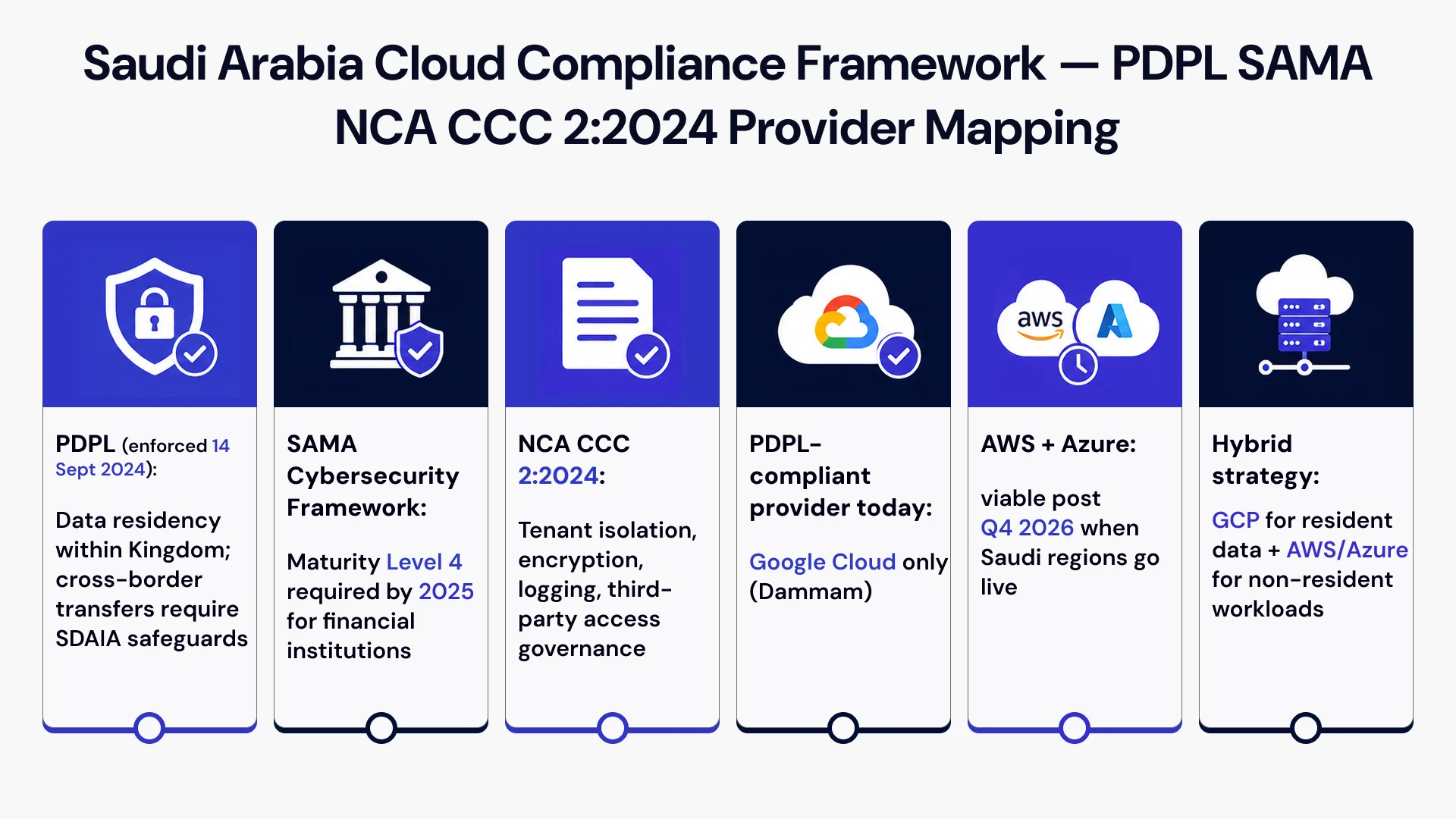
The Personal Data Protection Law (PDPL), enforced since 14 September 2024 under SDAIA, requires that personal data of Saudi residents be stored and processed within the Kingdom unless documented cross-border transfer safeguards are in place. Backups, logs, telemetry, and audit trails that contain personal data are subject to the same residency requirements as production data. The only hyperscaler currently able to host personal data in-Kingdom without cross-border transfer risk is Google Cloud via its Dammam region. AWS and Azure require cross-border transfer safeguards until their Saudi regions go live.
SAMA Cybersecurity Framework
SAMA-regulated financial institutions must demonstrate that their cloud environments — including any third-party SaaS or PaaS platforms — meet SAMA’s Cybersecurity Framework maturity requirements. Maturity Level 4 was required by 2025. This standard affects cloud provider selection at the architectural level: identity and access controls, encryption key management, incident response capabilities, and vendor exit rights must all be contractually defined in alignment with SAMA requirements.
NCA CCC 2:2024
The National Cybersecurity Authority’s Cloud Cybersecurity Controls (CCC 2:2024) set mandatory technical and governance requirements for cloud deployments across government agencies and critical infrastructure operators. These controls cover tenant isolation, data encryption, logging architecture, and third-party access governance. All three major providers carry compliance certifications that map to these controls, but configuration and evidence of compliance remain the responsibility of the enterprise. A managed cloud services partner with Saudi regulatory expertise can significantly reduce the time to achieve and maintain CCC 2:2024 compliance posture.
How to Choose the Right Cloud Service Provider for Your Saudi Enterprise
The correct cloud provider decision for a Saudi enterprise is determined by three primary variables: current data residency requirement, existing technology stack alignment, and workload profile. The framework below applies to CTOs and VP Engineering leads making a primary provider decision.
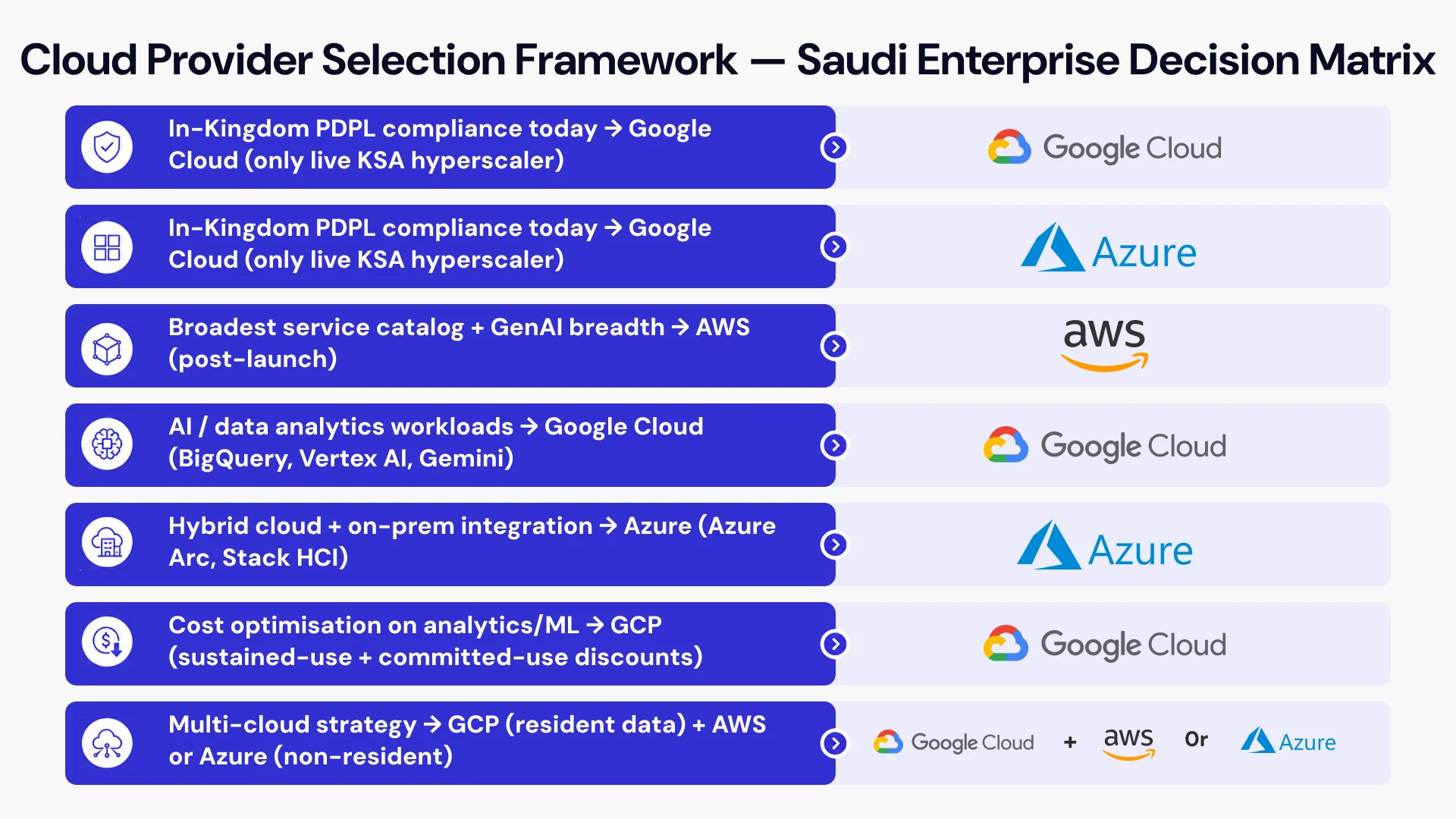
Cloud Provider Selection Framework: Saudi Enterprise Decision Criteria
| If your priority is... | Primary recommendation | Rationale |
| In-Kingdom PDPL compliance today | Google Cloud (GCP) | Only live KSA hyperscaler region; Dammam fully operational |
| Microsoft ecosystem integration | Microsoft Azure | Native M365, AD, Teams, SQL Server integration; Azure Hybrid Benefit |
| Broadest service catalog and GenAI breadth | AWS (post-launch) or interim multi-cloud | 200+ services; Bedrock multi-model GenAI; largest partner ecosystem |
| AI and data analytics workloads | Google Cloud (GCP) | BigQuery, Vertex AI, Gemini; sustained-use discounts for data workloads |
| Hybrid cloud and on-prem integration | Microsoft Azure | Azure Arc is the strongest unified hybrid management platform |
| Cost optimization on analytics / ML | Google Cloud (GCP) | Automatic sustained-use discounts; best committed-use contract flexibility |
| Regulated financial sector (SAMA) | GCP (today) or Azure/AWS (Q4 2026+) | Depends on timeline; all three will offer in-Kingdom data residency post-launch |
| Multi-cloud strategy (resilience + best-of-breed) | AWS + GCP or Azure + GCP | Combine in-Kingdom GCP residency with AWS breadth or Azure enterprise depth |
Saudi enterprises evaluating cloud providers alongside application development requirements should engage a Software Development Company in Saudi Arabia that carries native expertise in all three hyperscaler platforms and understands how cloud provider selection intersects with application architecture decisions.
For enterprises already operating on one or more cloud platforms, a structured approach to Cloud cost optimization should be conducted before any provider migration or multi-cloud expansion, as unmanaged cloud spend remains the most common post-migration governance failure in Saudi enterprise environments.
How VLink Delivers Cloud Strategy and Migration Across All Three Providers
VLink’s cloud practice supports Saudi enterprises across the full cloud adoption lifecycle: provider assessment, architecture design, cloud migration services, and managed cloud services post-deployment. Our teams carry certifications across AWS, Microsoft Azure, and Google Cloud Platform, enabling objective provider recommendations aligned to the specific compliance, workload, and commercial requirements of each engagement.
VLink’s Saudi cloud engagements typically begin with a cloud readiness assessment that maps your current workload portfolio against PDPL data residency obligations, SAMA/NCA compliance requirements, and provider infrastructure availability. This produces a migration sequence — identifying which workloads can move immediately to Google Cloud’s Dammam region, which should wait for AWS or Azure’s 2026 Saudi launches, and which are best served by a hybrid or multi-cloud architecture.
- Cloud consulting Saudi Arabia: architecture design and provider shortlisting grounded in KSA regulatory compliance.
- Cloud migration services: lift-and-shift through re-architecture, with zero-downtime migration patterns for production systems.
- Managed cloud services: 24/7 monitoring, cost governance, and compliance posture management across AWS, Azure, and GCP.
- FinOps and cloud cost comparison: TCO modelling and reserved instance / committed use optimisation across all three providers.
VLink has delivered cloud architecture and cloud solutions for enterprises in financial services, healthcare, logistics, and oil and gas sectors. Our Saudi practice combines deep hyperscaler platform expertise with on-the-ground knowledge of PDPL, SAMA CSF, and NCA CCC 2:2024 compliance requirements.
To commission a cloud provider assessment or cloud migration readiness review for your Saudi enterprise, engage VLink’s advisory team.
Conclusion
The AWS vs Azure vs GCP decision for Saudi enterprises is not the same decision as it is for enterprises in the US, Europe, or Southeast Asia. In-Kingdom infrastructure availability, PDPL data residency obligations, and the Kingdom’s specific compliance frameworks make the provider shortlisting process fundamentally different.
As of 2026, Google Cloud’s Dammam region is the only live hyperscaler option for PDPL-compliant in-Kingdom deployment. Microsoft Azure’s Saudi Arabia East region is confirmed for Q4 2026. AWS’s KSA region is scheduled for 2026 with three availability zones at launch. For workloads that do not require in-Kingdom data residency, all three cloud computing providers are technically viable today, and provider selection should be driven by workload profile, ecosystem alignment, and commercial terms.
To engage VLink’s cloud advisory team for a structured provider comparison tailored to your Saudi enterprise’s compliance, workload, and commercial requirements, contact us at vlinkinfo.com/about-us/contact-us.

Vice President, Strategy – VLink Inc.
Sambhavi Gopalakrishnan is the Vice President of Strategy at VLink Inc., bringing over a decade of experience in IT leadership, project implementation, and strategic growth. She possesses a strong foundation in technical project management and pre-sales, driving innovation and business transformation at VLink.

 Shivisha Patel