


Why Hybrid Cloud Cost Optimization Is a Board-Level Priority in the GCC
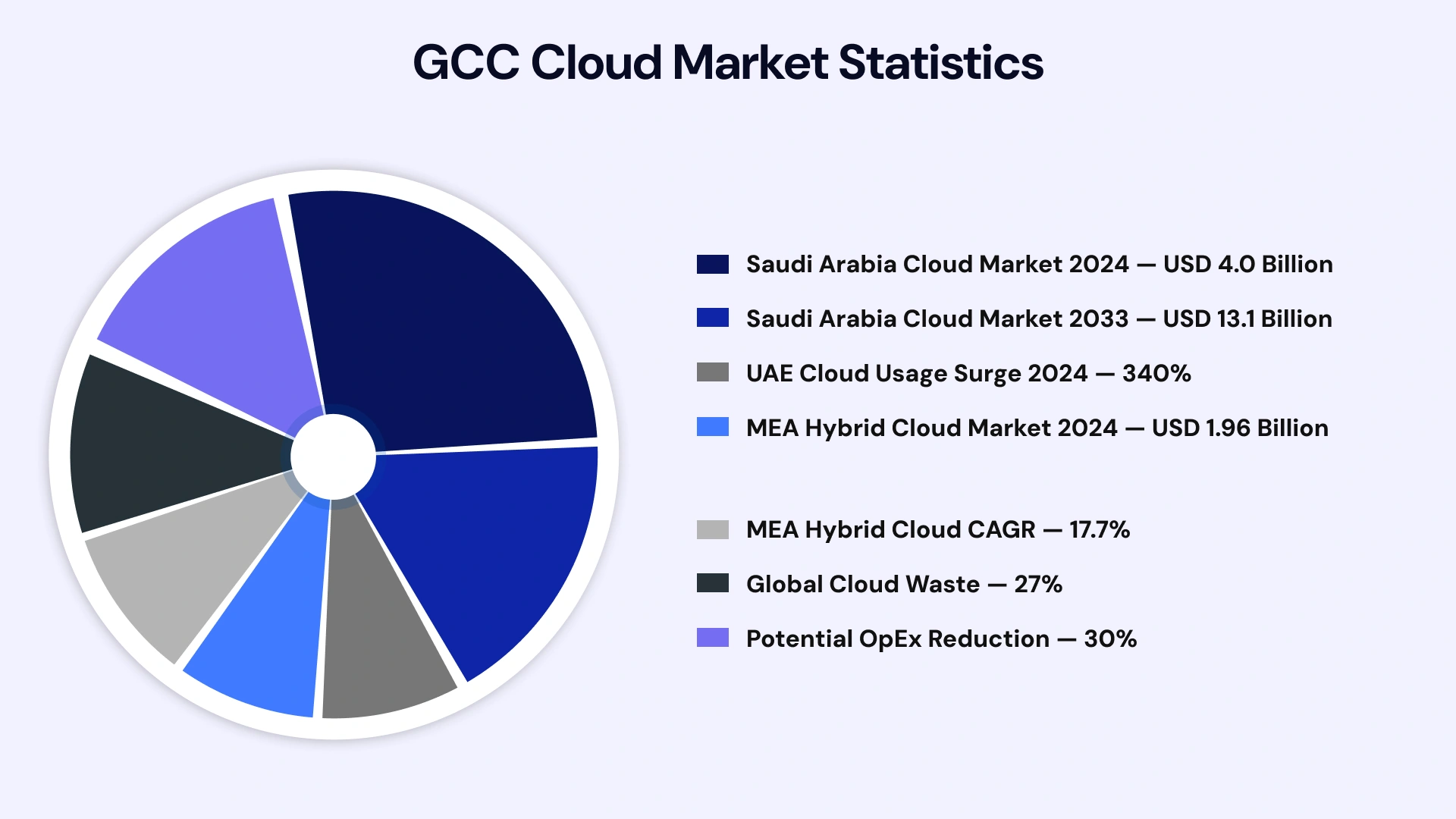
Cloud spending across the GCC has reached unprecedented levels. Saudi Arabia's cloud services market hit USD 4.0 billion in 2024, with projections reaching USD 13.1 billion by 2033. Enterprise cloud-application usage in the UAE surged by 340% in 2024 as organizations embedded collaboration suites to support hybrid labor models across the region.
Rising IT OpEx Pressures in Saudi & UAE Enterprises
Data localization legislation in both countries requires certain data categories stored within national borders, compelling organizations to maintain expensive on-premises infrastructure alongside public cloud deployments. This regulatory environment creates inherent cost complexity that many enterprises underestimate during initial cloud planning.
Saudi Arabia allocated more than USD 10 billion to ICT in 2024, representing an 18.75% increase from the previous year. This investment supports artificial intelligence, cloud adoption, and emerging technologies aligned with Vision 2030's digital transformation goals. The Middle East and Africa hybrid cloud computing market reached USD 1.96 billion in 2024, growing at 17.7% CAGR through 2031. Organizations in finance, telecom, healthcare, and energy drive this growth, yet many struggle to realize promised cost benefits.
The Kingdom has digitized over 97% of government services, creating ripple effects across the private sector as enterprises must match this digital maturity. Meanwhile, hyperscalers including AWS, Microsoft Azure, and Google Cloud have established regional data centers, making enterprise-grade cloud infrastructure services more accessible—but also introducing new cost management challenges.
Why "Cloud-First" Alone Failed to Deliver Cost Savings
Many GCC enterprises adopted cloud-first strategies expecting automatic cost reductions. Simply migrating workloads without strategic workload placement, resource optimization, and financial governance often increased costs rather than reducing them.
Saudi Arabia's Personal Data Protection Law (PDPL) and UAE's Data Protection Law 2021 mandate specific data handling requirements forcing hybrid architectures. Capital Bank Jordan's transition extended by 18 months due to local-processing mandates—elevating costs significantly. These regulatory realities mean that pure public cloud strategies rarely deliver optimal economics for GCC enterprises.
The challenge intensifies when organizations lack visibility into actual cloud consumption. Engineering teams provision resources based on estimated peak requirements, then those resources run continuously regardless of actual utilization. Development and testing environments often mirror production specifications despite serving fraction of the traffic. Without DevOps consulting services that embed cost awareness into development workflows, these inefficiencies compound over time.
Story Placeholder — CIO Perspective: A CIO from a leading GCC telecom described their initial migration as "moving from a predictable utility bill to an unpredictable credit card statement." Monthly cloud costs fluctuated by 40% without corresponding business value changes. Only after implementing structured hybrid cloud economics with cross-functional governance did they achieve cost stability and the targeted 30% OpEx reduction within 14 months.
What Is Hybrid Cloud Cost Optimization? (CXO Definition)
Featured Snippet Definition: Hybrid cloud cost optimization is the strategic discipline of maximizing business value from combined on-premises and public cloud investments by eliminating waste, aligning workload placement with business requirements, and implementing financial governance across multi-cloud environments.
For CXOs, this means treating cloud infrastructure as an economic asset rather than a technical utility. It requires cross-functional alignment between finance, IT, and business units to ensure every dollar spent on cloud services generates measurable returns. Understanding why hybrid cloud is so important for IT strategy provides the foundation for this economic approach.
The distinction between cost reduction and cost optimization matters. Cost reduction focuses narrowly on spending less—often at the expense of capability or performance. Cost optimization ensures every investment delivers maximum business value, which sometimes means spending more on high-return workloads while eliminating waste elsewhere.
Hybrid Cloud vs Public Cloud vs On-Prem: Cost Reality Check
Understanding the true cost profile of each deployment model is essential for informed decision-making. Many organizations compare only direct infrastructure costs while ignoring operational overhead, compliance requirements, and opportunity costs.
Deployment Model Cost Comparison
| Factor | Public Cloud | Private/On-Prem | Hybrid Cloud |
| Capital Expenditure | Low | High | Moderate |
| Operational Expenditure | Variable (often high) | Predictable | Optimized |
| Scalability Cost | Pay-per-use premium | Fixed capacity | Balanced |
| Compliance Cost | Additional controls needed | Built-in | Distributed |
| Talent Requirements | Cloud specialists | Infrastructure teams | Both |
| Total Cost of Ownership (5-year) | Often highest | Moderate | Lowest with governance |
Hybrid cloud, when properly optimized, delivers economic advantages of both deployment models while minimizing their respective drawbacks. The key qualifier is "properly optimized"—without structured governance, hybrid environments can inherit the worst cost characteristics of both models.
Where the 30% OpEx Reduction Actually Comes From
The 30% OpEx reduction is not aspirational—it reflects documented outcomes from enterprises implementing structured optimization strategies. Organizations using AI-driven cost optimization tools report savings of up to 30% according to industry benchmarks from Gartner and IDC.
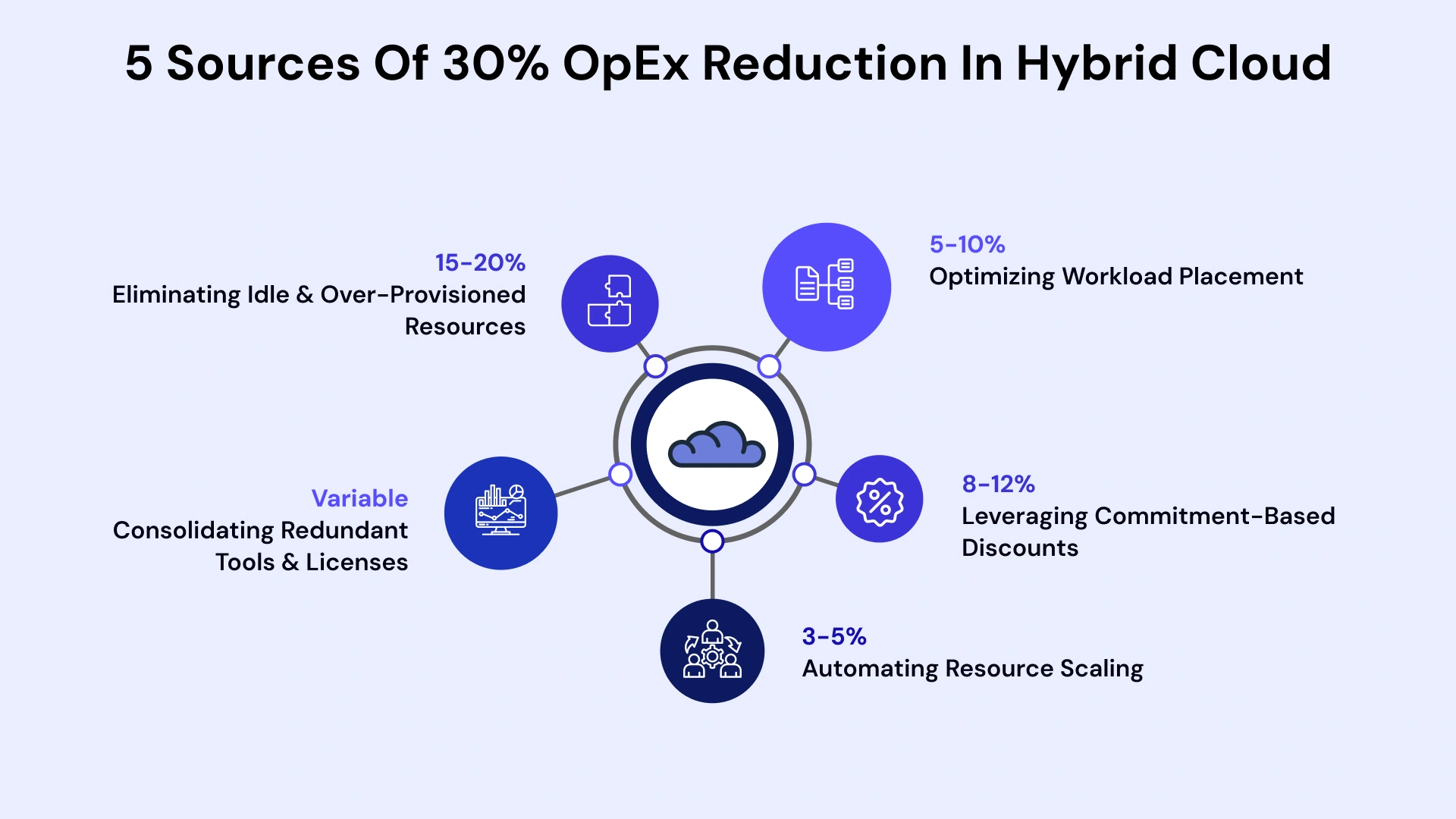
The savings originate from five primary areas:
1. Eliminating Idle and Over-Provisioned Resources (15-20% of cloud spend): Most organizations over-provision by 30-40% to ensure performance headroom. Right-sizing to actual utilization typically yields the largest immediate savings.
2. Optimizing Workload Placement (5-10% savings): Running stable, predictable workloads on-premises while using cloud for variable demand eliminates the premium pricing of public cloud for steady-state compute.
3. Leveraging Commitment-Based Discounts (8-12% reduction): Reserved instances, savings plans, and committed use discounts from AWS, Azure, and GCP reduce per-unit costs significantly for predictable workloads.
4. Automating Resource Scaling (3-5% efficiency gains): Policy-based automation ensures resources scale down during off-peak periods rather than running at peak capacity continuously.
5. Consolidating Redundant Tools and Licenses (variable savings): Multi-cloud strategies often create overlapping capabilities across vendors that structured rationalization can eliminate.
The Hidden Cost Drivers Killing Hybrid Cloud ROI
Three hidden cost drivers consistently erode ROI, even in well-planned deployments. These factors often remain invisible until organizations implement comprehensive cost visibility solutions.
Poor Workload Placement Between On-Prem & Cloud
Workload placement decisions made during initial migration often become permanent fixtures—even when business requirements change. A data analytics workload that made sense in public cloud during development may cost significantly more in production at scale. Conversely, workloads suited for cloud elasticity may languish on-premises, missing opportunities for efficiency.
The challenge compounds for GCC enterprises facing data sovereignty requirements. Saudi Arabia's cloud regulations and UAE finance-sector residency rules mean certain workloads must remain on-premises regardless of cost implications. Organizations that partner with experienced cloud migration specialists understand how to navigate these constraints while optimizing overall economics.
Without continuous workload assessment, organizations pay premium prices for inappropriately placed resources. The solution requires ongoing evaluation rather than one-time placement decisions during migration.
Over-Provisioning, Idle Resources & Cloud Sprawl
Cloud sprawl represents the single largest source of waste in enterprise cloud deployments. Engineering teams provision for peak demand, then forget to right-size when requirements stabilize. Development environments run 24/7 when used 40 hours per week. Test instances accumulate without cleanup policies. Orphaned resources from completed projects continue incurring charges.
Only 29% of organizations find their current cost-saving efforts for cloud investments fully effective according to recent industry surveys. The remaining 71% struggle with visibility gaps allowing waste to persist undetected. This visibility challenge intensifies in multi-cloud environments where each provider uses different billing models and metrics.
Organizations implementing AI development services for automated anomaly detection and cost forecasting gain significant advantages in identifying waste before it accumulates.
Lack of Financial Governance Across Multi-Cloud
Multi-cloud strategies, while providing flexibility and avoiding vendor lock-in, multiply governance complexity. Each cloud provider uses different billing models, discount structures, and cost allocation methods. Without unified financial governance, organizations cannot accurately measure or optimize total cloud spend.
Yet many GCC organizations have not adopted formal FinOps practices, leaving significant optimization potential unrealized. The framework's emphasis on cross-functional collaboration—bringing together finance, engineering, and business teams—requires cultural change that many organizations find challenging.
Example — Telecom Workload Misalignment: A major GCC telecom operator discovered 35% of production workloads running in public cloud regions despite available on-premises capacity. The misalignment resulted from migration decisions made two years prior that were never reassessed. Workload analysis revealed that repatriating stable, predictable workloads while maintaining cloud presence for variable demand would optimize costs. Correcting placement saved USD 2.4 million annually while improving application performance through reduced latency.
Decision Framework - Is Your Enterprise Ready for 30% OpEx Reduction?
Before implementing optimization strategies, enterprises must assess their current maturity level. Organizations at different stages require different interventions—applying advanced strategies to immature environments creates complexity without delivering value.
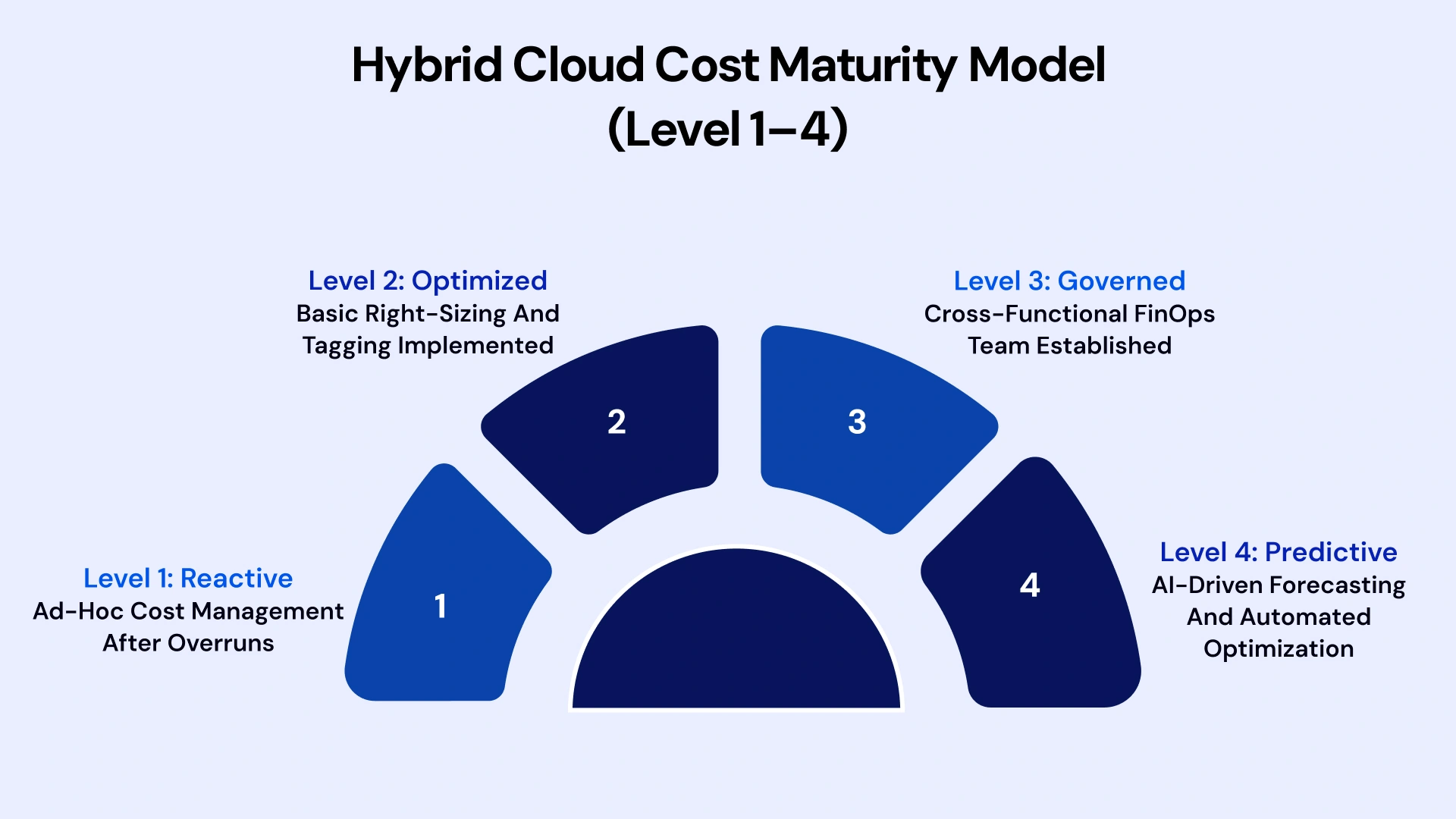
Hybrid Cloud Cost Maturity Model (Level 1–4)
Level 1 — Reactive: Cost management happens after budget overruns. No dedicated team or tools for cloud financial management. Visibility limited to provider billing dashboards. Optimization efforts are ad-hoc responses to executive concern about spending.
Level 2 — Optimized: Basic right-sizing and resource tagging implemented. Cost allocation exists but lacks business context. Savings initiatives are project-based rather than continuous. Some commitment-based discounts utilized but without strategic planning.
Level 3 — Governed: Cross-functional FinOps team established with clear accountability. Policy-based controls prevent waste at provisioning. Unit economics tracked for major workloads. Regular optimization reviews scheduled with executive participation.
Level 4 — Predictive: AI-driven forecasting and automated optimization. Real-time cost anomaly detection with automated response. Cloud costs directly tied to business outcomes with clear ROI measurement. Continuous improvement embedded in engineering culture.
Most GCC enterprises currently operate between Level 1 and Level 2. Reaching Level 3 typically delivers the targeted 30% OpEx reduction. Organizations seeking to accelerate this journey benefit from partners with proven Microsoft Business Solutions expertise who understand both Azure economics and enterprise governance requirements.

7 Proven Hybrid Cloud Cost Optimization Strategies for Saudi and UAE Enterprises
These strategies deliver measurable results for large enterprises with hybrid deployments. Implementation should follow the maturity model—foundational capabilities before advanced automation. Each strategy builds on previous capabilities.
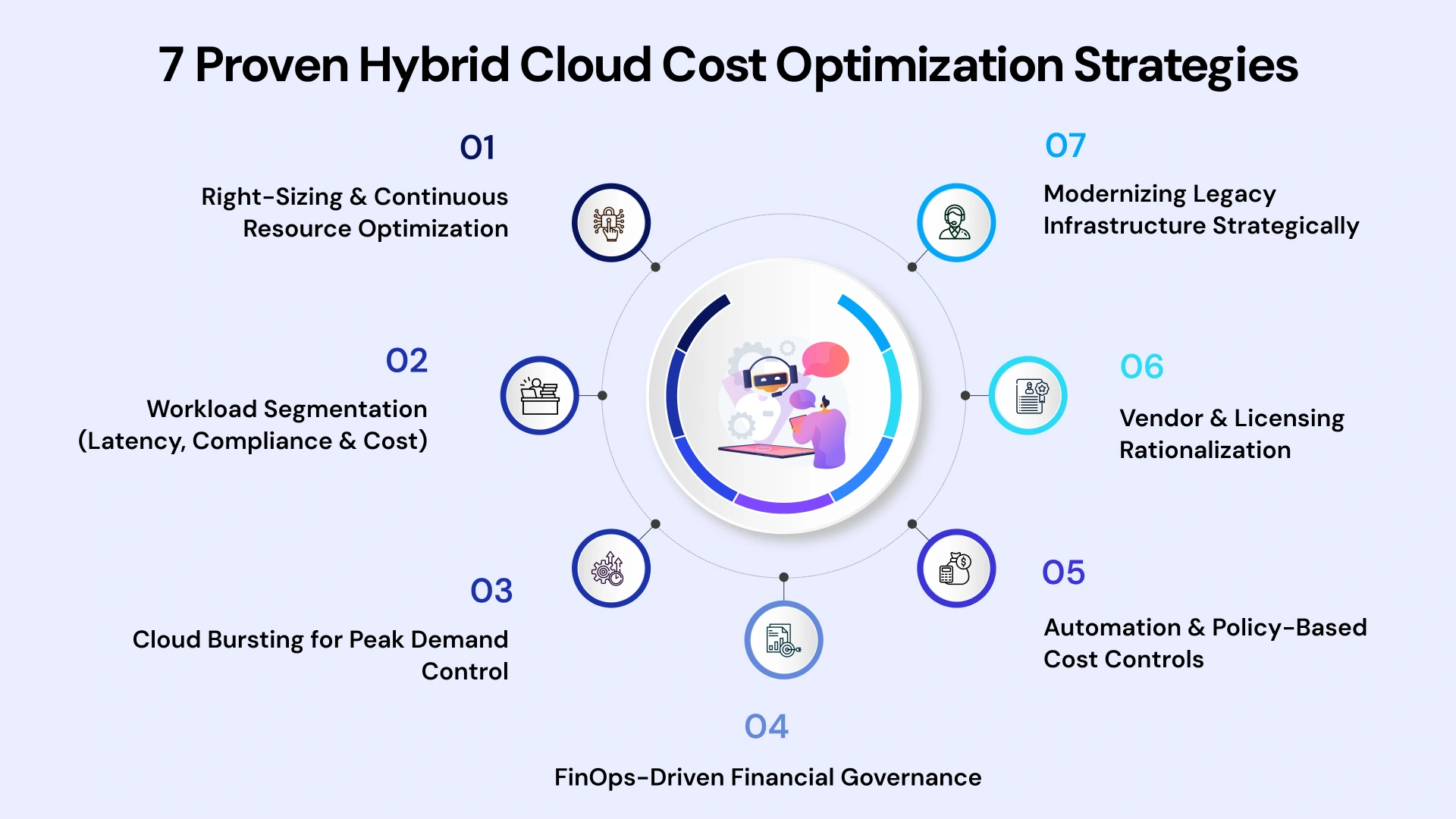
1. Right-Sizing & Continuous Resource Optimization
Right-sizing involves matching resource allocation to actual workload requirements. Most organizations over-provision by 30-40% to ensure performance headroom, but this cushion directly translates to wasted spending. Continuous optimization uses monitoring data to identify safe reduction opportunities without impacting performance.
Effective right-sizing for GCC enterprises requires understanding regional usage patterns. Many organizations experience significant demand variation between UAE business hours and Saudi working days, creating dynamic scaling opportunities that Western-centric approaches miss. Peak demand in Riyadh may occur when Dubai operations are quiet, enabling shared resource pools that reduce total capacity requirements.
Implementation requires robust monitoring that tracks actual utilization over time, not just point-in-time snapshots. Recommendations should account for business cycles, seasonal patterns, and growth projections.
2. Workload Segmentation Based on Latency, Compliance & Cost
Not all workloads belong in the cloud, and not all cloud workloads belong in the same cloud. Effective segmentation considers three dimensions:
Latency Requirements: Customer-facing applications need regional proximity; batch processing can tolerate distance. Placing latency-sensitive workloads in distant regions to save money creates poor user experience.
Compliance Mandates: Data residency rules dictate placement for regulated data. Understanding which data actually requires sovereign hosting versus which can reside anywhere enables optimization within constraints.
Cost Characteristics: Stable workloads benefit from on-premises or committed capacity; variable workloads suit cloud elasticity. Mismatched placement creates unnecessary expense.
Organizations leveraging comprehensive cloud infrastructure services typically begin with workload assessment that maps applications against these three dimensions, identifying optimization opportunities before making placement decisions.
3. Cloud Bursting for Peak Demand Control
Cloud bursting maintains baseline capacity on-premises while using public cloud for demand spikes. This approach is particularly effective for GCC enterprises facing seasonal patterns—Ramadan shopping surges for retail, hajj-related traffic for hospitality, and year-end financial processing for BFSI.
Proper implementation can reduce peak infrastructure costs by 40-60% compared to maintaining permanent capacity for maximum demand scenarios. The key is architecting applications for elastic scaling and establishing automated triggers that provision cloud resources before demand exceeds on-premises capacity.
4. FinOps-Driven Financial Governance
FinOps represents the operational framework for managing cloud economics. According to the 2025 State of FinOps report from the FinOps Foundation, workload optimization and waste reduction remain top priorities, with 50% of practitioners ranking this as their primary focus.
The framework emphasizes three phases: Inform (gaining visibility into cloud spending), Optimize (taking action to improve efficiency), and Operate (embedding continuous improvement into organizational culture). Organizations mature through these phases iteratively, building capabilities over time.
Implementing FinOps for GCC enterprises requires executive sponsorship to overcome traditional IT-Finance silos. The framework's collaborative approach aligns well with relationship-oriented Middle Eastern business culture but requires deliberate effort to establish cross-functional governance structures.
5. Automation & Policy-Based Cost Controls
Automation eliminates human latency in cost optimization. Policy-based controls prevent waste at provisioning rather than detecting it after resources have been running—and billing—for weeks or months.
Effective automation examples include automatic shutdown of non-production resources outside business hours (savings of 60-70% on dev/test environments), approval workflows for large resource requests, budget alerts with automated scaling restrictions, and automatic right-sizing recommendations based on utilization patterns.
Enterprises implementing DevOps services through experienced partners embed cost governance into CI/CD pipelines, making optimization a development standard rather than an afterthought. This "shift-left" approach to cost management catches inefficiencies before they reach production.
6. Vendor & Licensing Rationalization
Multi-cloud strategies and SaaS proliferation create licensing complexity with overlapping capabilities across vendors. Many organizations pay for similar functionality from multiple providers—monitoring tools, security scanners, collaboration platforms—without coordinated purchasing strategy.
The 2025 FinOps Framework now includes SaaS and licensing as formal scopes, with 65% of organizations including SaaS spend in their FinOps practice. This expansion reflects recognition that cloud cost optimization must address the complete technology cost picture, not just infrastructure.
Structured rationalization identifies redundancies, consolidates to preferred platforms, and negotiates enterprise agreements that capture volume discounts across the organization.
7. Modernizing Legacy Infrastructure Strategically
Legacy modernization delivers cost benefits beyond simple cloud migration. Containerizing applications improves resource utilization by 40-60% compared to traditional virtual machines. Adopting microservices architecture enables granular scaling—individual components scale independently rather than requiring entire application scaling.
Strategic modernization prioritizes high-cost, high-impact workloads rather than attempting comprehensive transformation. VLink's approach to cloud-native architecture helps enterprises identify modernization candidates delivering fastest ROI while managing technical debt in other areas.
Story — Oil & Gas Enterprise Savings: A Saudi oil and gas enterprise implemented these seven strategies over 18 months. Starting from Level 1 maturity, they achieved Level 3 governance and reduced annual cloud OpEx by 34%—USD 8.2 million in savings. The largest contributions came from workload repatriation to on-premises data centers (12% savings), right-sizing production resources (11% savings), and commitment discount optimization (8% savings). The remaining 3% came from automation and consolidation initiatives.
How Hybrid Cloud Reduces Operational Expenses in Regulated GCC Industries
Regulated industries face unique hybrid cloud challenges. Compliance requirements often seem to conflict with cost optimization goals—organizations assume sovereignty mandates require expensive dedicated infrastructure. However, strategic hybrid deployment addresses compliance while optimizing costs.
BFSI: Compliance Without Overpaying for Public Cloud
Banking and financial services in Saudi Arabia and UAE operate under strict regulatory oversight including SAMA requirements and Central Bank of UAE guidelines. Many organizations assume compliance mandates expensive dedicated infrastructure that eliminates cloud cost benefits.
In reality, hybrid cloud enables compliance while optimizing costs. Keeping transaction processing and customer data on-premises satisfies data residency requirements while using public cloud for analytical workloads, disaster recovery, and development environments. This approach typically reduces total infrastructure costs by 25-30% compared to fully on-premises deployment while maintaining regulatory compliance.
Financial institutions leveraging conversational AI development for customer service can deploy AI workloads in cloud environments while keeping customer data on sovereign infrastructure, capturing innovation benefits without compliance risk.
Telecom: Scaling 5G & Data Platforms Cost-Efficiently
Telecommunications operators face exponential data growth from 5G deployments. Building permanent capacity for peak demand is economically unfeasible—5G traffic patterns show significant variation between peak and off-peak periods, and new use cases continue emerging.
Hybrid approaches enable edge computing for latency-sensitive 5G applications while using cloud scalability for backend processing. The global 5G edge computing market is projected to grow from USD 4.74 billion in 2024 to USD 7.32 billion in 2025. GCC telcos implementing hybrid 5G/edge architectures can reduce AI and IoT workload costs by 60-80% compared to centralized cloud setups.
Government & Healthcare: Data Sovereignty + Cost Control
Government entities and healthcare organizations face the strictest data sovereignty requirements. Saudi Arabia's Global AI Hub Law and UAE health data regulations mandate local storage for sensitive information including patient records and citizen data.
Hybrid cloud addresses these requirements while enabling innovation. Core patient records and citizen data remain on sovereign infrastructure while AI/ML workloads for analytics, population health management, and predictive services leverage cloud computing power. This approach enables digital transformation without compromising compliance or budget.
Organizations exploring healthcare modernization benefit from partners with experience in regulated environments who understand both compliance requirements and cost optimization opportunities.
Mini Case — Before vs After Cost Structure:
Healthcare Enterprise Transformation
| Cost Category | Before Optimization | After Optimization | Savings |
| On-Premises Infrastructure | USD 4.2M | USD 3.1M | 26% |
| Public Cloud Compute | USD 2.8M | USD 1.6M | 43% |
| Cloud Storage | USD 1.1M | USD 0.8M | 27% |
| Licensing & Tools | USD 0.9M | USD 0.6M | 33% |
| Total Annual OpEx | USD 9.0M | USD 6.1M | 32% |
Measuring ROI - How to Quantify Hybrid Cloud Economics
Demonstrating ROI requires metrics that resonate with both technical and financial stakeholders. Abstract efficiency gains must translate to concrete business value that executives understand.
OpEx vs CapEx Impact Model
Hybrid cloud shifts spending patterns from capital expenditure to operational expenditure. For many GCC enterprises, this shift improves financial flexibility but requires new measurement approaches that traditional IT budgeting doesn't accommodate.
The OpEx model should track total cost of ownership across deployment models, cost per transaction or business outcome, budget variance and forecast accuracy, and cost avoidance from elasticity. These metrics help finance teams understand cloud value beyond simple infrastructure cost comparisons.
Cost-to-Value Mapping for CIOs & CFOs
Moving beyond cost reduction to value creation requires mapping cloud investments to business outcomes. Effective cost-to-value frameworks measure revenue enabled per cloud dollar spent, time-to-market improvement from cloud capabilities, customer experience metrics influenced by infrastructure, and innovation capacity created by freed budget.
This mapping transforms cloud conversations from cost centers to value enablers—changing the relationship between IT and finance from adversarial to collaborative.
KPI Framework: What to Track Quarterly
Quarterly KPI Dashboard
| KPI Category | Metric | Target | Frequency |
| Cost Efficiency | Cloud spend as % of revenue | Declining trend | Quarterly |
| Utilization | Average resource utilization | >70% | Monthly |
| Waste Reduction | Idle resource percentage | <10% | Monthly |
| Commitment Coverage | Committed vs on-demand ratio | >60% committed | Quarterly |
| Governance | Untagged resource percentage | <5% | Monthly |
| Value Delivery | Cost per business transaction | Declining trend | Quarterly |
Framework Insert — ROI Calculator Logic: Annual savings potential = (Current cloud spend × Waste percentage) + (Repatriation candidates × Cost differential) + (On-demand spend × Commitment discount rate). For a typical GCC enterprise spending USD 10M annually on hybrid infrastructure with 25% waste, 20% repatriation opportunity, and 40% on-demand usage, potential savings range from USD 2.5M to USD 3.5M.
Common Myths About Hybrid Cloud Cost Savings (Debunked)
Misconceptions about hybrid cloud economics persist despite evidence to the contrary. Addressing these myths helps executives make informed decisions.
"Hybrid Cloud Is Always More Expensive"
This myth stems from comparing sticker prices rather than total cost of ownership. Yes, maintaining both on-premises and cloud infrastructure creates apparent duplication. However, strategic workload placement, optimized data transfer, and right-sized capacity consistently deliver lower total costs than either pure-play alternative.
The data confirms this: 54% of enterprises now use hybrid cloud for mission-critical workloads, with cost efficiency (62%) cited as the top adoption reason according to industry surveys. Organizations achieving worst outcomes typically lack governance discipline, not inherent hybrid cloud disadvantages.
"FinOps Is Only for Large Global Enterprises"
FinOps practices scale to any organization with meaningful cloud spend. The core principles—visibility, optimization, governance—apply whether monthly spend is USD 50,000 or USD 50 million. What changes is tooling sophistication and team size, not fundamental approach.
Mid-market GCC enterprises (500+ employees, USD 100M+ revenue) particularly benefit from FinOps adoption because they often lack dedicated infrastructure teams of larger organizations while facing similar complexity. Smaller teams mean every efficiency gain has proportionally larger impact.
"Cloud Providers Automatically Optimize Costs"
Effective optimization requires human judgment informed by business context—understanding which workloads are candidates for reduction, which require performance headroom, and which should move between deployment models. Automation can execute decisions, but strategy requires business understanding that cloud providers cannot supply.
PAA Section - Answering Executive Search Questions
How does hybrid cloud reduce operational expenses?
Hybrid cloud reduces operational expenses through strategic workload placement, eliminating the premium costs of public cloud for stable workloads while maintaining elasticity for variable demand. Organizations achieve savings through right-sizing resources to actual utilization, leveraging commitment-based discounts from cloud providers, automating scaling policies that respond to demand changes, and consolidating redundant tools across multi-cloud environments. Typical savings range from 20-35% of total cloud spend when implementing structured optimization practices with proper governance.
What are best practices for hybrid cloud cost optimization?
Best practices include establishing cross-functional FinOps governance that brings finance and engineering together, implementing comprehensive resource tagging for cost allocation, conducting regular workload placement reviews to identify optimization opportunities, automating non-production resource scheduling to eliminate idle capacity, maximizing commitment-based discounts for predictable workloads, and measuring unit economics rather than just total spend. Success requires treating cloud cost optimization as continuous practice rather than one-time project.
Is hybrid cloud cost-effective for large enterprises?
Hybrid cloud is particularly cost-effective for large enterprises with diverse workload requirements. Organizations with regulatory compliance needs, variable demand patterns, and existing on-premises investments achieve optimal economics through hybrid deployment. The key is strategic workload segmentation based on latency, compliance, and cost characteristics rather than default placement decisions that treat all workloads identically.
What is the ROI of hybrid cloud adoption in the Middle East?
What Saudi and UAE CXOs Should Do Next
Achieving 30% OpEx reduction requires deliberate action, not incremental improvement. Three priorities should guide immediate next steps for executive teams serious about capturing hybrid cloud cost optimization benefits. As AI workloads grow, scaling AI-ready data center infrastructure in Saudi and UAE requires planning for GPU density, cooling, and power.
Align Finance, Cloud & Infrastructure Teams
Cost optimization cannot succeed as an IT-only initiative. Finance teams must understand cloud economics—the variable cost model, commitment discounts, and unit economics that differ fundamentally from traditional infrastructure budgeting. Infrastructure teams must understand business value—which workloads matter most, which applications drive revenue, and how technical decisions impact financial outcomes.
Establishing a cross-functional cloud economics committee with executive sponsorship creates accountability for outcomes rather than activities. This governance structure should include representation from finance, IT operations, application development, and business units consuming cloud resources.
Start with Visibility, Not Tool Sprawl
Many organizations invest in optimization tools before establishing visibility into current state. This approach leads to tool proliferation without impact—multiple dashboards showing the same incomplete data without driving action.
Begin with comprehensive cost allocation that attributes every cloud dollar to specific applications, teams, and business functions. Implement resource tagging standards and enforce compliance. Establish utilization measurement that tracks actual consumption over time. Advanced optimization follows this visibility foundation.
Treat Hybrid Cloud as an Economic Strategy, Not Just IT
The most successful organizations frame hybrid cloud as business strategy supported by technology rather than IT infrastructure requiring business justification. This framing elevates cloud economics to board-level discussion and ensures optimization initiatives receive appropriate resources and attention.
Organizations ready to accelerate their hybrid cloud cost optimization journey benefit from experienced partners who understand both technical implementation and GCC market dynamics. VLink's cloud infrastructure services combine global cloud expertise with regional market knowledge to deliver measurable cost reduction for Saudi and UAE enterprises. Our teams have helped organizations across financial services, telecommunications, healthcare, and energy sectors achieve and sustain 30% OpEx reductions while maintaining compliance with regional regulatory requirements.
Conclusion
Hybrid cloud cost optimization represents one of the highest-impact opportunities available to Saudi and UAE enterprises pursuing digital transformation. The 30% OpEx reduction is achievable—documented across industries and validated by GCC organizations that have implemented structured optimization practices with disciplined governance.
Success requires moving beyond technical cloud management to strategic cloud economics. This means establishing cross-functional governance that brings finance and IT together, implementing continuous visibility and optimization rather than one-time projects, and treating hybrid infrastructure as a business asset generating measurable returns rather than a utility expense to minimize.
The organizations achieving best results share common characteristics: executive sponsorship for FinOps initiatives that signal organizational priority, willingness to reassess historical workload placement decisions even when those decisions were made by current leadership, and commitment to measuring business value rather than just cost reduction.
For CXOs navigating the competing demands of Vision 2030 alignment, regulatory compliance, and operational efficiency, hybrid cloud cost optimization offers a path addressing all three priorities simultaneously. The economics are compelling, the frameworks are proven, and the partners with regional expertise are available. The only question is whether your organization will capture these benefits before competitors do.

Vice President, Strategy – VLink Inc.
Sambhavi Gopalakrishnan is the Vice President of Strategy at VLink Inc., bringing over a decade of experience in IT leadership, project implementation, and strategic growth. She possesses a strong foundation in technical project management and pre-sales, driving innovation and business transformation at VLink.

 Shivisha Patel