


Why Cloud Migration in UAE Now Demands NESA Compliance?
A Dubai-based logistics enterprise migrates its fleet management platform to AWS. Three months later, a routine audit by the Dubai Electronic Security Center (DESC) flags 14 unresolved gaps in the company’s information assurance controls. The result: a frozen government contract worth AED 12 million, a mandatory remediation timeline, and a board-level crisis meeting that could have been avoided entirely.
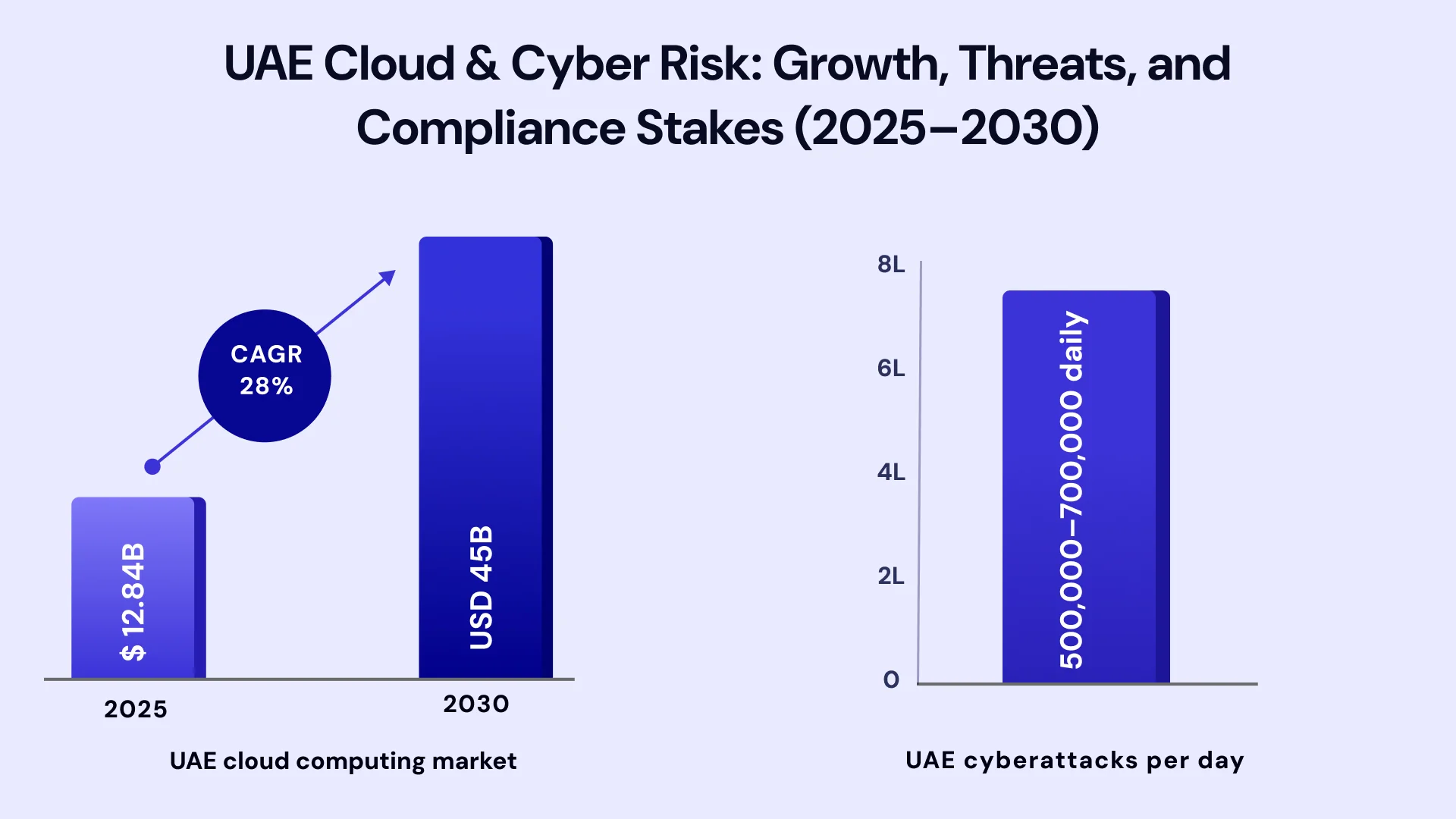
This scenario is becoming alarmingly common across the UAE. Cloud migration in UAE is accelerating at breakneck speed — the country’s cloud computing market crossed USD 12.84 billion in 2025 and is projected to reach USD 45 billion by 2030, growing at roughly 28% annually. Abu Dhabi’s AED 13 billion Digital Strategy (2025–2027) mandates 100% sovereign cloud adoption across government services. Dubai’s Smart City initiatives require cloud-native architectures for every new public-facing application.
But speed without compliance is a liability. The UAE now faces between 500,000 and 700,000 cyberattacks every single day. The average cost of a data breach in the Middle East stands at USD 7.46 million — nearly double the global average. And with the National Cyber Security Strategy (2025–2031) shifting the compliance landscape from voluntary best practices to mandatory resilience, NESA compliance requirements are now a non-negotiable prerequisite for any enterprise-grade cloud migration.
This guide breaks down everything Dubai-based enterprises need to know: the NESA IAS framework, how its 188 security controls map to each cloud migration phase, a practical compliance checklist, cost implications, and a step-by-step approach to executing a cloud migration that is secure, compliant, and built for scale.
What Is NESA and Why Does It Matter for Cloud Migration?
Before diving into migration tactics, every CTO and CIO in Dubai needs a clear-eyed understanding of the authority behind the compliance mandate — and why it matters specifically for cloud environments.
NESA’s Role in UAE Cybersecurity
The National Electronic Security Authority (NESA), now operating under the UAE Signals Intelligence Agency (SIA), is the federal body responsible for defining the country’s cybersecurity and information assurance requirements. Established in 2012, NESA developed the UAE Information Assurance Standards (IAS) — a comprehensive national framework designed to protect critical information infrastructure (CII), government systems, and sensitive data across all sectors.
The IAS Framework — 188 Controls, 4 Priority Tiers
The IAS is structured around 188 security controls, subdivided into 700+ sub-controls. These controls fall into two families:
- Management Controls (60): Cover strategy, planning, risk management, HR security, compliance, awareness training, and performance evaluation.
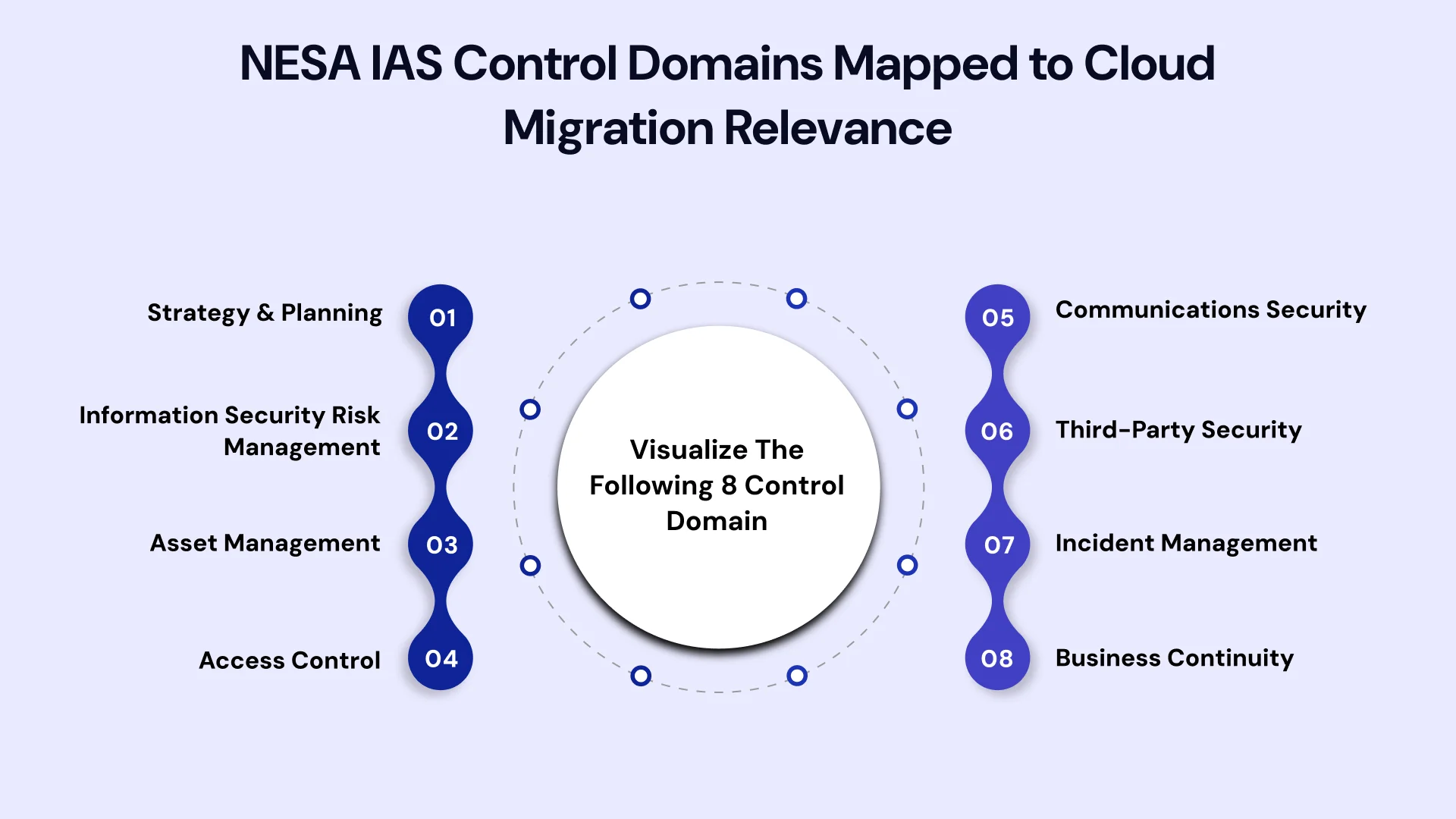
- Technical Controls (128): Address asset management, physical security, operations management, communications, access control, third-party security, incident management, and information security continuity.
Controls are prioritized into four tiers — P1 (highest, mandatory) through P4 (risk-assessment-based). The 39 P1 controls form the mandatory baseline and address 80% of the security threats NESA identified through industry reports. In total, the IAS includes 136 mandatory sub-controls and 564 sub-controls whose application depends on risk assessment results.
Who Must Comply — 11 Critical Sectors + Vendors and Subcontractors
Mandatory NESA compliance applies to 11 critical sectors: energy, water, telecommunications, finance, healthcare, transportation, food, government, emergency services, chemicals, and nuclear. But the reach extends further. If your enterprise provides IT services, cloud infrastructure, or managed security to any of these entities, you fall under NESA’s compliance umbrella as a vendor or subcontractor.
As of 2026, this vendor-side compliance obligation is increasingly being enforced as a contract renewal condition. For cloud migration service providers operating in Dubai, this means NESA alignment is no longer optional — it’s a market access requirement.
Understanding the NESA IAS Framework for Cloud Security
The IAS framework is not a generic cybersecurity checklist. It is a structured, tiered system that combines mandatory baseline controls with risk-based measures — allowing enterprises to implement protections proportional to their operational risk profile. For cloud migration specifically, understanding how these controls map to your migration architecture is critical.
Management Controls vs. Technical Controls
The 60 management controls focus on governance, strategy, and organizational security culture. They cover areas such as information security risk management, HR security procedures (including background screening and exit protocols), compliance efforts, and internal audit programmes. Notably, all 35 of the mandatory controls that NESA considers essential for a strong security foundation fall under this management controls family.
The 128 technical controls, on the other hand, address the operational and infrastructure-level defences: asset management, physical and environmental security, access control, communications security, third-party vendor security, and incident response. While none of the technical controls are universally mandatory, most will apply based on your organization’s risk assessment — especially during cloud migration where data residency, encryption, and access management are paramount.
The 39 P1 Priority Controls Every Enterprise Must Implement First
At the core of the IAS are the 39 Priority One (P1) controls. These are the non-negotiable baseline that every in-scope entity must implement regardless of size, sector, or cloud deployment model. Key P1 controls relevant to cloud migration include:
- Identity and Access Management (IAM): Enforces strict user authentication, role-based access, and monitoring of privileged accounts — critical during migration when temporary access is often granted.
- Patch Management: Ensures timely application of security patches across both source and target environments during the migration window.
- Data Protection: Mandates encryption, data classification, and secure handling of sensitive information — particularly important when data moves across environments.
Incident Response Readiness: Requires documented detection, response, and recovery procedures that remain operational throughout the migration lifecycle.
Cloud-Specific Controls in the IAS
A common compliance gap NESA auditors’ flag: enterprises using major cloud platforms (AWS, Azure, GCP) without any formal security assessment or contractual security clause in their cloud provider agreements. If you’re migrating workloads to the cloud without a documented cloud security agreement, you’re already non-compliant.
NESA IAS Control Domains — Cloud Migration Relevance
Dubai’s Regulatory Stack - How NESA Fits with DESC, PDPL, and TDRA
Enterprises operating in Dubai don’t just answer to NESA. The emirate has its own layered regulatory framework that overlaps, reinforces, and occasionally extends federal requirements. For any enterprise planning a cloud migration from Dubai, understanding this stack is essential to avoid compliance surprises mid-migration.
Here’s how the key regulatory bodies interact:
| Regulatory Body | Scope | Cloud Relevance | Penalty Framework |
| NESA / SIA | Federal — Critical infrastructure, 11 sectors + vendors | 188 controls including cloud-specific domain; data residency; vendor security | Up to AED 5M fines; license suspension; operational restrictions |
| DESC | Dubai — Government, semi-government, and private entities | ISR framework for Dubai entities; cloud security assessment requirements | Contract exclusion from Dubai government projects |
| PDPL (Data Office) | Federal — All UAE mainland businesses processing personal data | Consent, data storage, transfer assessments; processors directly liable | AED 100K–AED 1M general; AED 500K–AED 3M for critical infrastructure |
| TDRA | Federal — Telecom, cloud providers, digital government | IaaS catalogue for government procurement; aeCERT incident reporting | Licensing restrictions; mandatory data residency |
The practical implication for Dubai enterprises: your cloud migration doesn’t need to satisfy just one compliance standard. A financial services firm migrating from on-premises to Azure in Dubai must simultaneously address NESA IAS controls, DESC’s Information Security Regulation, CBUAE’s consumer protection framework, and the PDPL’s data residency mandates. This is why a compliance-first migration methodology — not a bolt-on afterthought — is critical.
Also Read: Maximize ROI: Your Mainframe to Cloud Migration Guide
Steps for NESA-Compliant Cloud Migration in the UAE
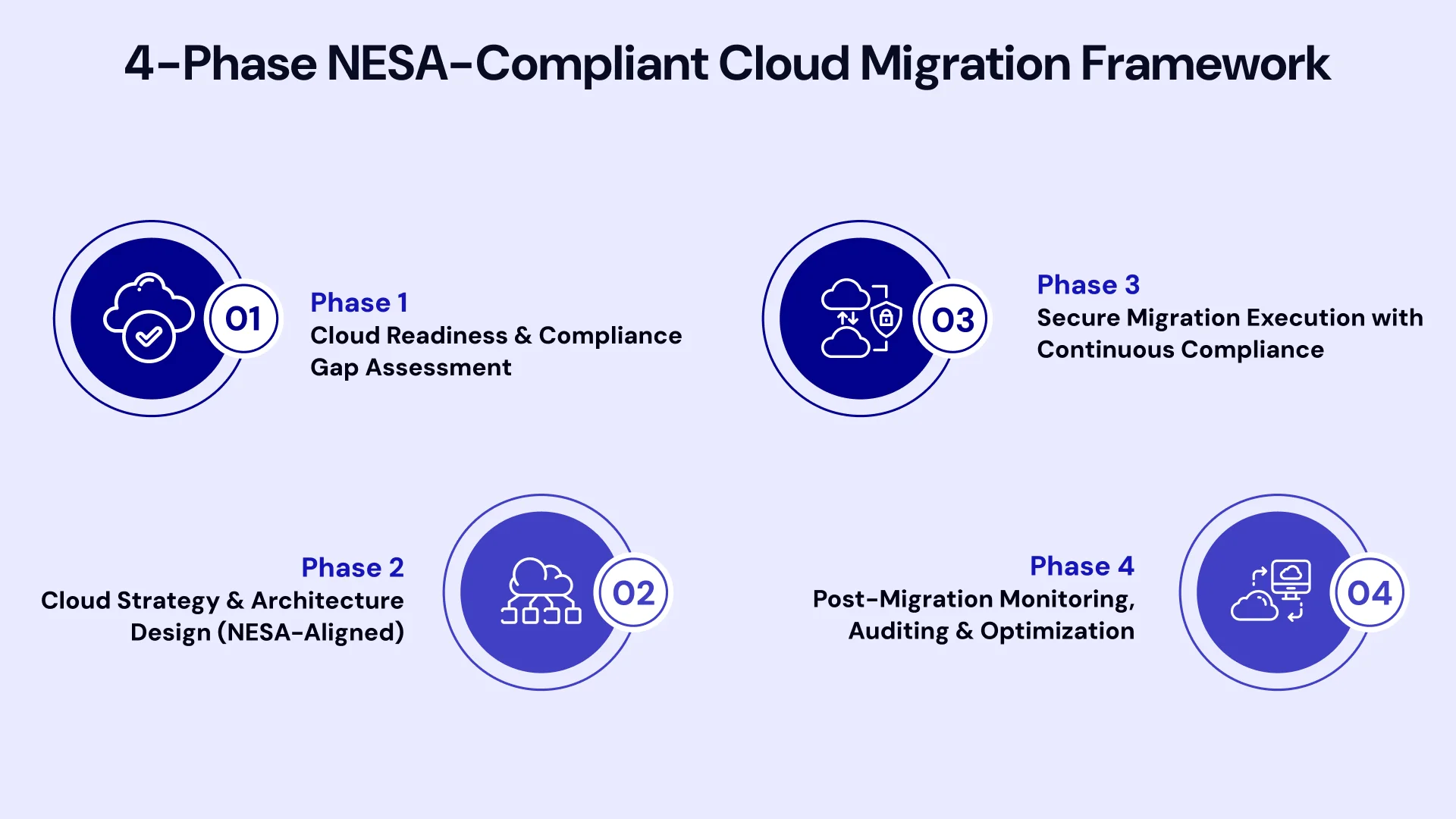
A NESA-compliant cloud migration is not a separate workstream bolted onto a technical lift-and-shift. Compliance must be embedded into every phase of the migration lifecycle. Here is a four-phase framework that maps NESA’s IAS requirements directly to cloud migration execution.
Phase 1 — Cloud Readiness and Compliance Gap Assessment
Before a single workload moves, your enterprise needs a dual assessment: technical readiness and compliance readiness.
- Critical Services Identification: Map all essential business services and the critical information infrastructures supporting them. NESA requires this as the starting point for any compliance journey.
- Gap Assessment Against NESA IAS: Evaluate your current security controls against the 188 IAS controls. Identify gaps at the sub-control level, prioritized by P1 through P4.
- Risk Assessment: Establish risk methodology and criteria aligned to NESA’s M2 control family. Identify risks, threats, vulnerabilities, and their potential impact on your cloud target environment.
- Data Classification: Classify all data assets by sensitivity and criticality. This determines encryption requirements, residency constraints, and access tiers in your cloud architecture.
Pro Tip: A common audit failure is having asset inventories that include IT hardware but omit cloud services, SaaS applications, and data assets. NESA considers information — not just hardware — as an asset requiring classification and protection.
Phase 2 — Cloud Strategy and Architecture Design (NESA-Aligned)
With gaps identified and risks assessed, the next step is designing a cloud architecture that satisfies both business requirements and NESA controls simultaneously.
- Data Residency Architecture: Design for UAE data residency compliance. As of 2026, new executive rules mandate that most personal data should be stored within UAE-compliant data centres unless specific exemptions apply.
- IAM Framework Design: Implement role-based access control (RBAC), multi-factor authentication (MFA), and privileged access management (PAM) aligned to NESA’s P1 access control requirements.
Third-Party Security Contracts: Draft or update cloud provider agreements with contractual security clauses covering NESA requirements. This is a frequently missed step that auditors specifically look for.
Phase 3 — Secure Migration Execution with Continuous Compliance
The migration execution phase is where most compliance failures occur — temporary access grants become permanent, encryption is disabled for speed, and incident response procedures get deprioritized during the cutover rush.
- Encrypted Data Transfer: All data in transit during migration must use TLS 1.2/1.3 or AES-256 encryption. NESA’s communications security controls mandate encryption for data moving between environments.
- Access Audit Trail: Maintain continuous logging of all access events during migration. Temporary elevated privileges must be time-bound and automatically revoked.
- Parallel Incident Response: Keep your incident detection and response procedures fully operational during migration. A security event during cutover can be catastrophic without active IR capability.
- Phased Migration with Validation Gates: Use blue-green deployments or phased cutovers with compliance validation at each gate. Never migrate all workloads simultaneously without verifying control effectiveness.
Phase 4 — Post-Migration Monitoring, Auditing, and Optimization
Migration completion is not compliance completion. NESA requires continuous monitoring, regular risk reviews, and periodic audits to maintain compliance.
- Continuous Monitoring: Deploy cloud-native security monitoring (CSPM, CWPP, SIEM) to detect configuration drift, unauthorized access, and anomalous behaviour in real time.
- Regular Risk Reviews: NESA mandates that risk assessments are not one-off exercises. Risks must be monitored and the assessment must be reviewed regularly — especially after significant changes like a cloud migration.
- Internal Audit Programme: Establish an audit schedule with qualified auditors (internal or external). NESA specifically flags a common gap: internal audits performed by the same team responsible for implementing controls.
- Post-Migration Optimization: Right-size resources, review access policies, and update data classification based on the new cloud architecture. Compliance and cost optimization go hand in hand.
Also Read: AWS Cloud Migration Guide | Transform and Scale Your Business
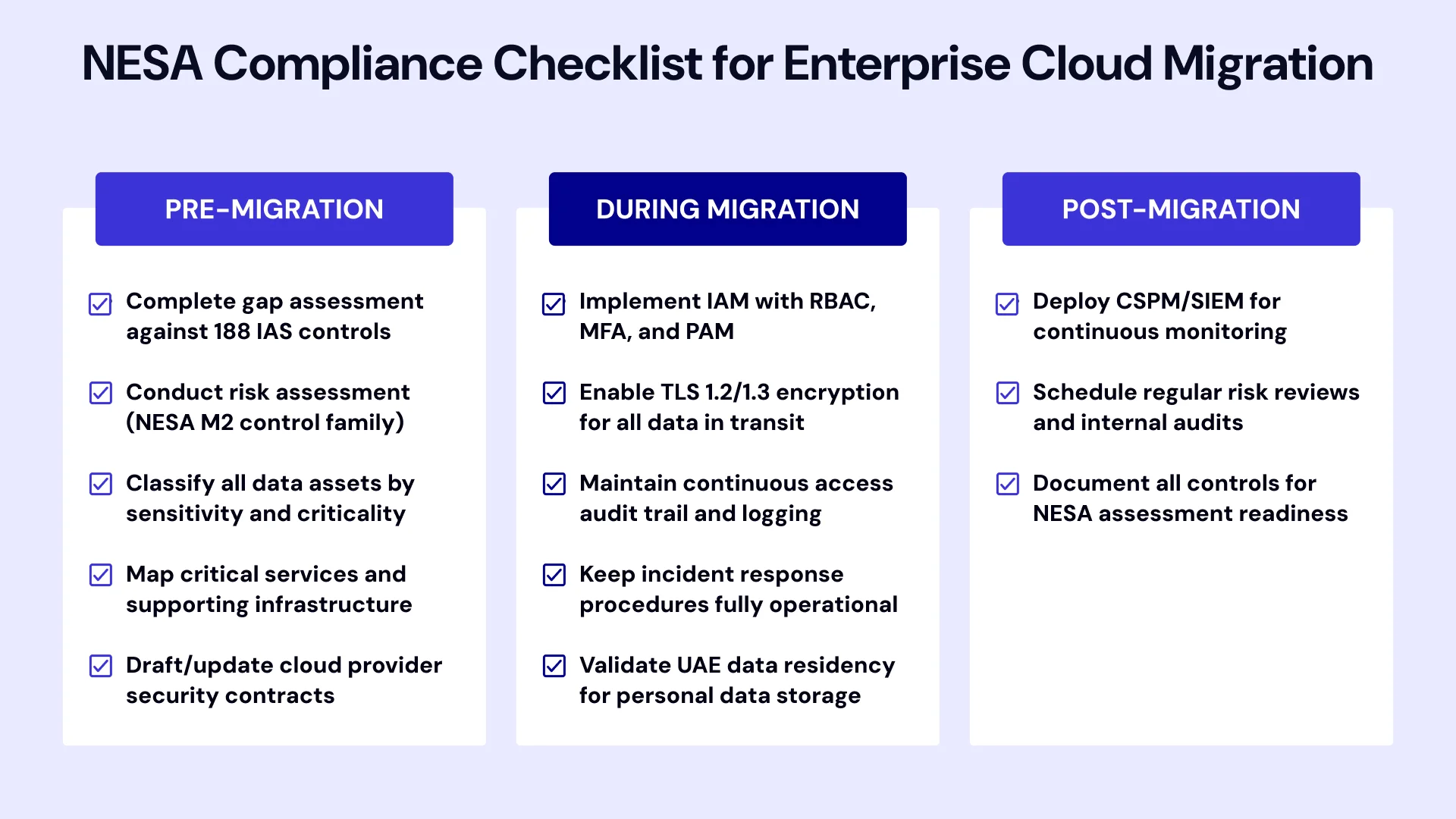
NESA Compliance Checklist for Enterprise Cloud Migration
Use this checklist as a reference to track your compliance readiness across each migration phase. It maps the most critical NESA IAS requirements to practical cloud migration milestones.
| Migration Phase | NESA Compliance Requirement | Status Tracker |
| Pre-Migration | Complete gap assessment against 188 IAS controls | ☐ Not Started / ☐ In Progress / ☐ Done |
| Pre-Migration | Conduct risk assessment (NESA M2 control family) | ☐ Not Started / ☐ In Progress / ☐ Done |
| Pre-Migration | Classify all data assets by sensitivity and criticality | ☐ Not Started / ☐ In Progress / ☐ Done |
| Pre-Migration | Map critical services and supporting infrastructure | ☐ Not Started / ☐ In Progress / ☐ Done |
| Pre-Migration | Draft/update cloud provider security contracts | ☐ Not Started / ☐ In Progress / ☐ Done |
| During Migration | Implement IAM with RBAC, MFA, and PAM | ☐ Not Started / ☐ In Progress / ☐ Done |
| During Migration | Enable TLS 1.2/1.3 encryption for all data in transit | ☐ Not Started / ☐ In Progress / ☐ Done |
| During Migration | Maintain continuous access audit trail and logging | ☐ Not Started / ☐ In Progress / ☐ Done |
| During Migration | Keep incident response procedures fully operational | ☐ Not Started / ☐ In Progress / ☐ Done |
| During Migration | Validate UAE data residency for personal data storage | ☐ Not Started / ☐ In Progress / ☐ Done |
| Post-Migration | Deploy CSPM/SIEM for continuous monitoring | ☐ Not Started / ☐ In Progress / ☐ Done |
| Post-Migration | Schedule regular risk reviews and internal audits | ☐ Not Started / ☐ In Progress / ☐ Done |
| Post-Migration | Document all controls for NESA assessment readiness | ☐ Not Started / ☐ In Progress / ☐ Done |
NESA vs. ISO 27001 - What Dubai Enterprises Need to Know
Many enterprises operating in the UAE assume that an existing ISO 27001 certification automatically satisfies NESA compliance requirements. That assumption is incorrect — and the gap between the two frameworks is where real risk sits.
While NESA’s IAS framework aligns closely with ISO 27001 principles, it includes several UAE-specific requirements that go beyond the international standard. Here’s a direct comparison:
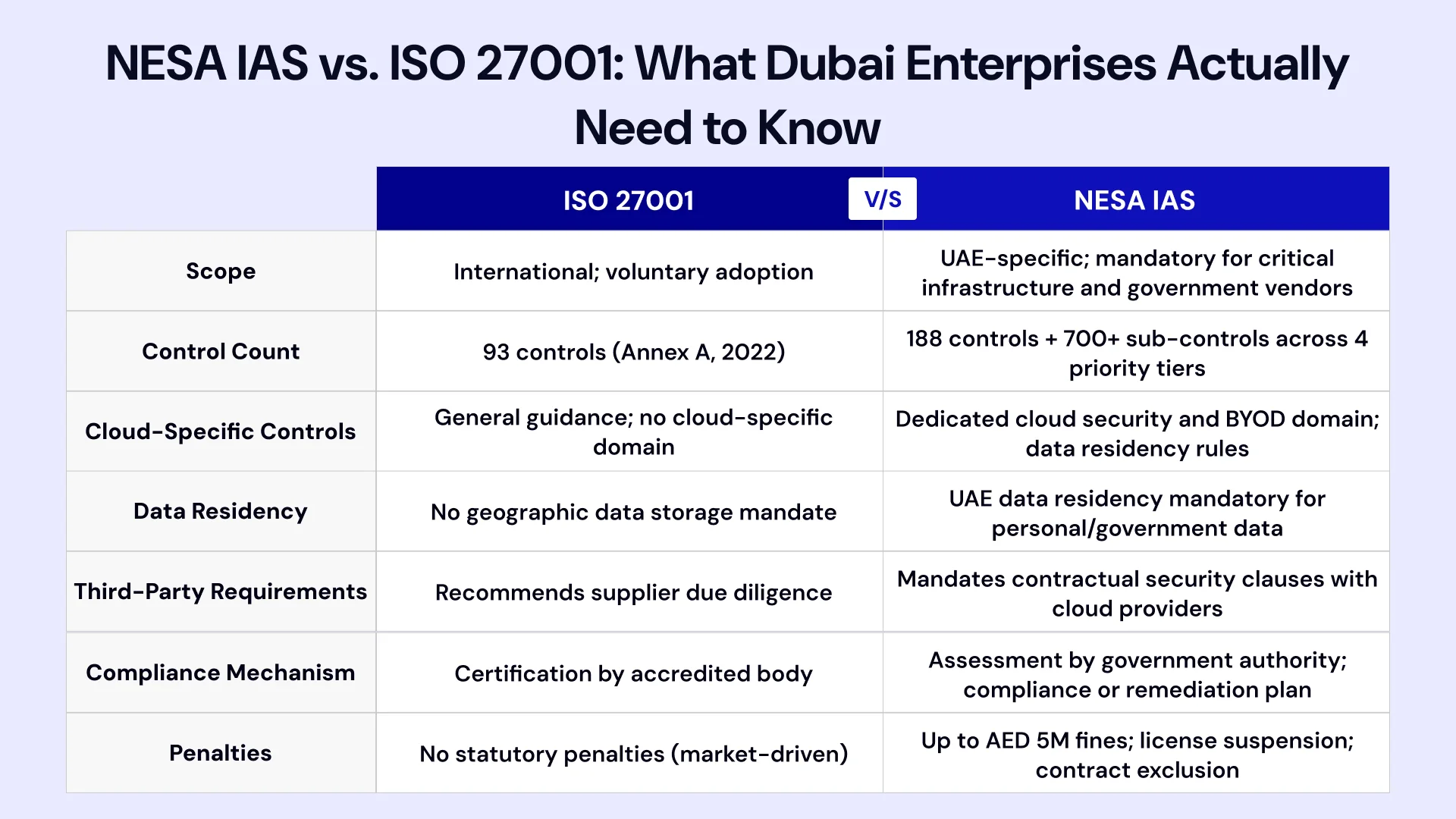
The bottom line: ISO 27001 is a strong foundation, and having it significantly reduces the effort required for NESA compliance. But it is not a substitute. Enterprises must close the UAE-specific gaps — particularly around data residency, cloud provider contracts, and the additional sub-controls NESA mandates — to achieve full compliance.
Cost of Non-Compliance vs. Cost of NESA-Compliant Cloud Migration
Every CXO in Dubai evaluates cloud migration through a cost lens. The question is not whether compliance adds to the migration budget — it does. The question is whether the cost of non-compliance is something your business can absorb. Spoiler: for most enterprises, it is not.
Here is what the numbers look like:
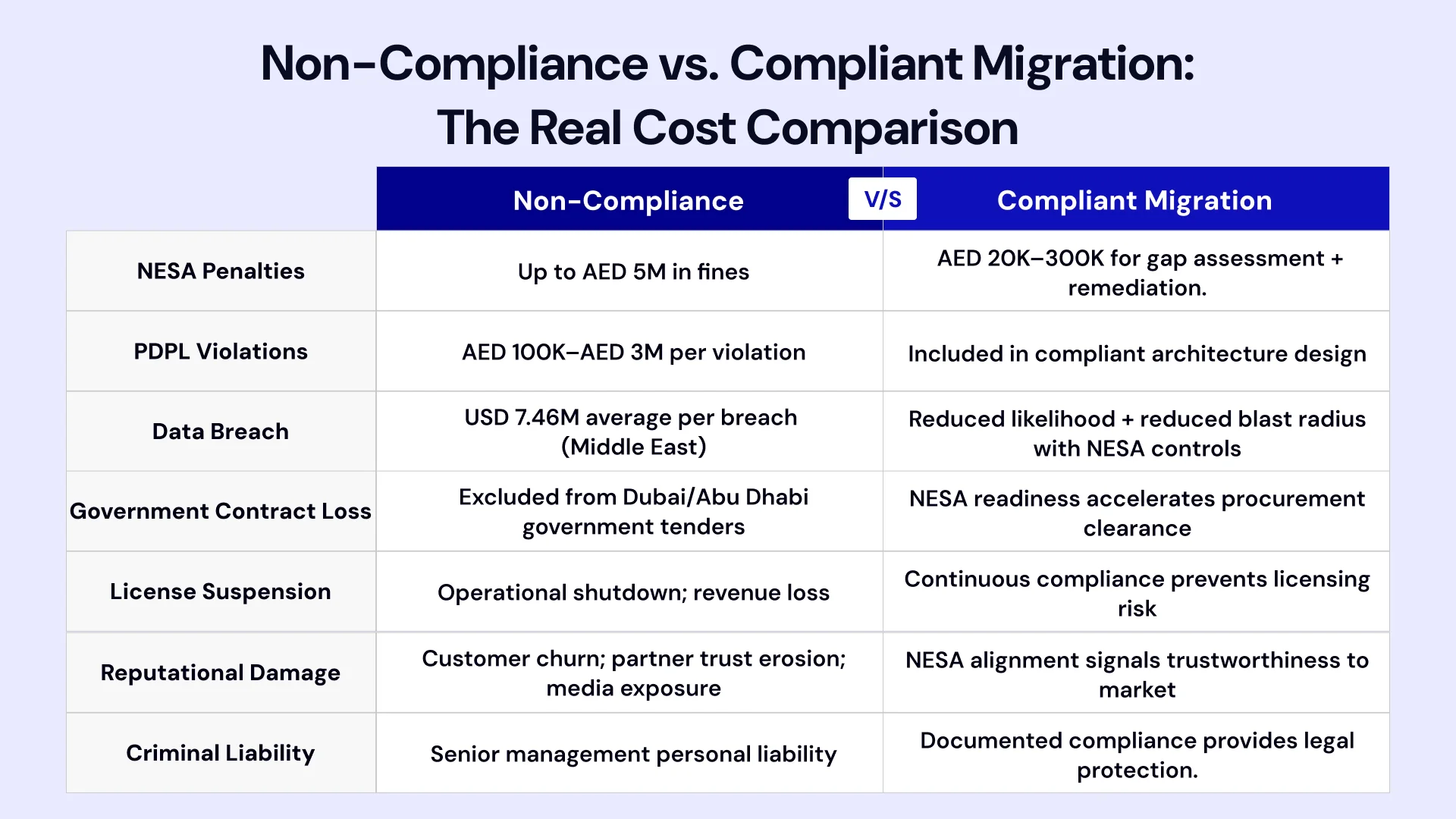
The math is clear. A NESA-compliant cloud migration is an investment — but it is a fraction of the financial, operational, and reputational cost of a compliance failure. For enterprises competing for government contracts in Dubai and Abu Dhabi, NESA compliance is not just risk mitigation. It is a competitive advantage that directly impacts revenue.
Also Read: Scale, Save, Secure: Expert Cloud Migration for Businesses
Best Practices for NESA-Compliant Cloud Migration in UAE
Drawing from the IAS framework and real-world enterprise migration patterns in the UAE, here are the best practices every Dubai-based organization should follow:
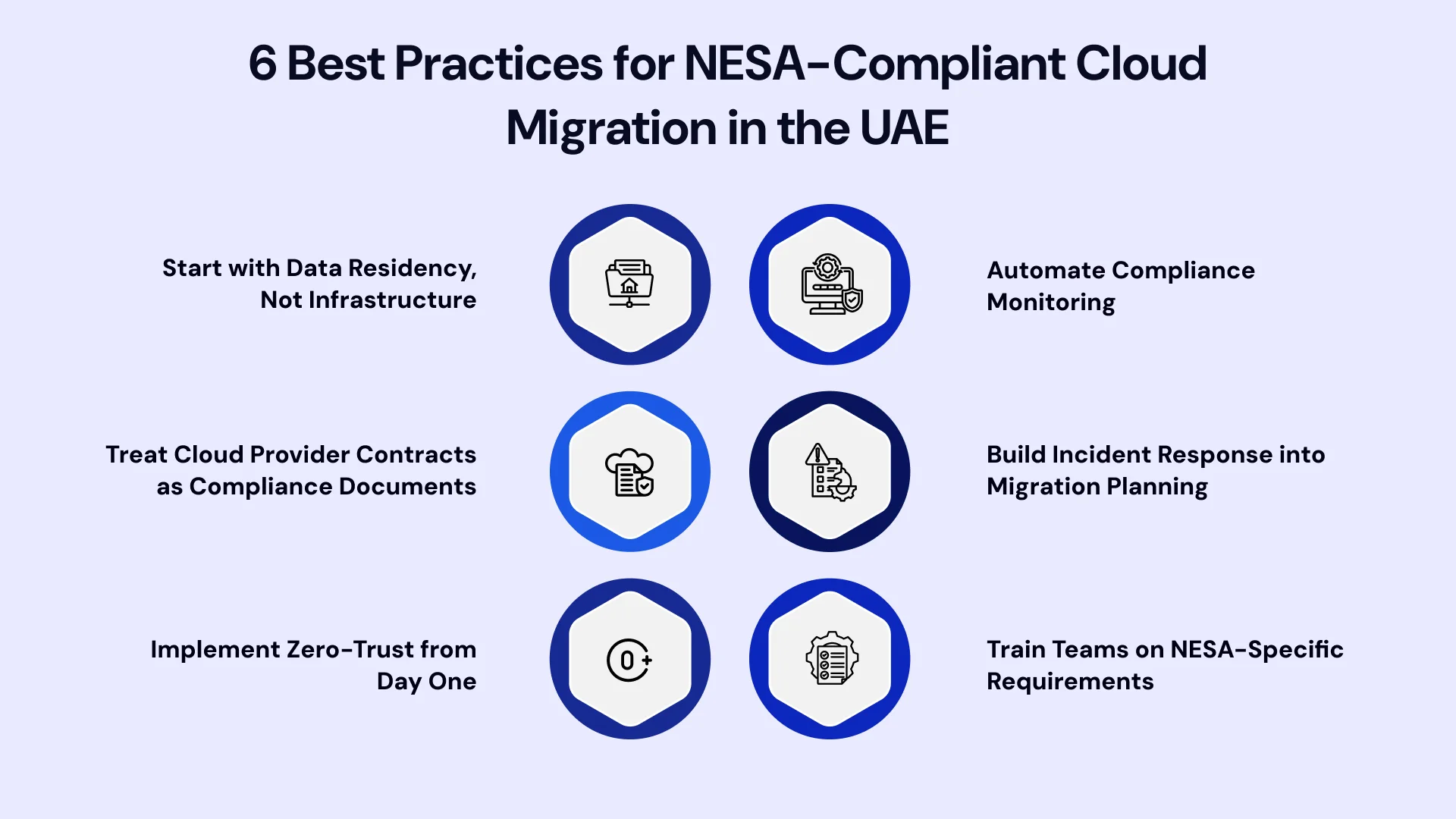
1. Start with Data Residency, Not Infrastructure
Before selecting a cloud provider or deployment model, map your data classification to UAE data residency requirements. As of 2026, personal and government data must reside within UAE-compliant data centres unless specific exemptions apply. This single requirement shapes your entire architecture decision.
2. Treat Cloud Provider Contracts as Compliance Documents
NESA auditors specifically check whether your cloud provider agreements include security requirements. Draft contracts that reference NESA IAS controls, define shared responsibility models, and include audit rights. Contracts without security clauses are a documented compliance gap.
3. Implement Zero-Trust from Day One
The UAE Cyber Security Strategy (2025–2031) emphasizes identity-centric security and continuous verification. Build your cloud architecture on zero-trust principles — least-privilege access, micro-segmentation, continuous authentication — rather than retrofitting after migration.
4. Automate Compliance Monitoring
Manual compliance tracking breaks down at scale. Deploy cloud-native security posture management (CSPM) tools that continuously monitor configuration drift, unauthorized access, and policy violations against NESA control baselines. Automation also simplifies audit preparation.
5. Build Incident Response into Migration Planning
Do not deprioritize incident response during migration. NESA requires documented detection, response, and recovery procedures that remain operational at all times. Define escalation paths, communication protocols, and recovery procedures specifically for the migration window.
6. Train Teams on NESA-Specific Requirements
NESA auditors require individual-level training evidence tied to specific employees and dates. Generic security awareness programmes are insufficient. Conduct targeted training on NESA IAS controls, UAE data protection requirements, and cloud-specific security procedures before and during migration.
How VLink Enables NESA-Compliant Cloud Migration for UAE Enterprises
Executing a compliant cloud migration in the UAE requires a partner who understands both the technical complexity of enterprise migration and the regulatory nuances of the UAE’s cybersecurity landscape. That is exactly where VLink operates.
As a cloud migration services provider with deep expertise across AWS, Azure, and GCP, VLink delivers end-to-end migration engagements that embed compliance into every phase — not as an afterthought, but as a foundational design principle.
- Compliance-First Assessment: We start with a dual-track cloud readiness and NESA gap assessment, mapping your current security posture against the 188 IAS controls before designing any architecture.
- NESA-Aligned Architecture Design: Our cloud architects design migration architectures that satisfy NESA, DESC, PDPL, and TDRA requirements simultaneously — with data residency, IAM, encryption, and vendor security built in.
- Secure Migration Execution: Using phased migration strategies with compliance validation gates, we ensure zero-downtime transitions with continuous security monitoring throughout.
- Post-Migration Governance: From continuous CSPM monitoring to audit-ready documentation, VLink’s managed cloud services keep your environment compliant long after migration is complete.
Also Read: Best Practices of Cloud Migration for Healthcare Insurance
Conclusion
Cloud migration in UAE is no longer a technology decision alone — it is a compliance decision, a risk management decision, and a strategic business decision. For enterprises operating in Dubai, the convergence of government cloud-first mandates, escalating cyber threats (500,000+ attacks daily), and the shift to mandatory resilience under the National Cyber Security Strategy (2025–2031) means that NESA compliance requirements must be embedded into every phase of your migration journey.
The enterprises that treat NESA compliance as a foundational design principle — not a post-migration checkbox — are the ones that will clear government procurement faster, avoid the AED-millions in penalties, and build the kind of trust that wins long-term contracts in the UAE’s most competitive sectors.
VLink’s cloud migration services are built for exactly this: compliance-first, secure by design, and engineered for the UAE regulatory landscape. Whether you are planning your first cloud migration in UAE or optimizing an existing environment for NESA compliance requirements, our team is ready to help you move with confidence.
Get in touch with VLink’s cloud migration experts today and build a migration strategy that passes every audit.

Vice President, Strategy – VLink Inc.
Sambhavi Gopalakrishnan is the Vice President of Strategy at VLink Inc., bringing over a decade of experience in IT leadership, project implementation, and strategic growth. She possesses a strong foundation in technical project management and pre-sales, driving innovation and business transformation at VLink.

 Shivisha Patel