




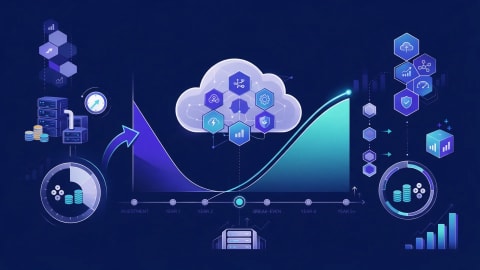
Every CXO has heard the pitch: modernize your legacy applications and costs fall, speed rises, and risk shrinks. Every CFO has asked the follow-up: how much, by when, and how do we know? Most vendors answer with adjectives. This guide answers with a model.
Below you'll find the real benefits of application modernization, an ROI model with the arithmetic on the page, a payback timeline you can adapt, and the stress tests that show when the investment doesn't pay off. It's written for startup owners and enterprise leaders in the US, Canada, and India who are also trying to work out what a modernization program will actually cost and who should deliver it.
The figures below are an illustrative model built on stated assumptions, not benchmarks or quotes. Replace them with your own data.
What Is Application Modernization?
If you're asking what application modernization is, it's the process of updating legacy applications so they run on supported, scalable, secure platforms and are easier to change. Depending on the application, that may mean rehosting to the cloud, replatforming onto managed services, refactoring code, rearchitecting into services, rebuilding, replacing with software as a service, or retiring.
The Application Modernization Process
Transforming legacy software isn’t a one-size-fits-all endeavor—it is a phased journey requiring high-level strategic alignment and application-level execution. Because different Application Modernization Strategies (ranging from low-friction "lift and shift" to full cloud-native redesigns) deliver vastly different cost structures and time-to-value metrics, your ROI model must be evaluated application by application.
Navigating the enterprise modernization lifecycle effectively requires following this structured five-stage framework:
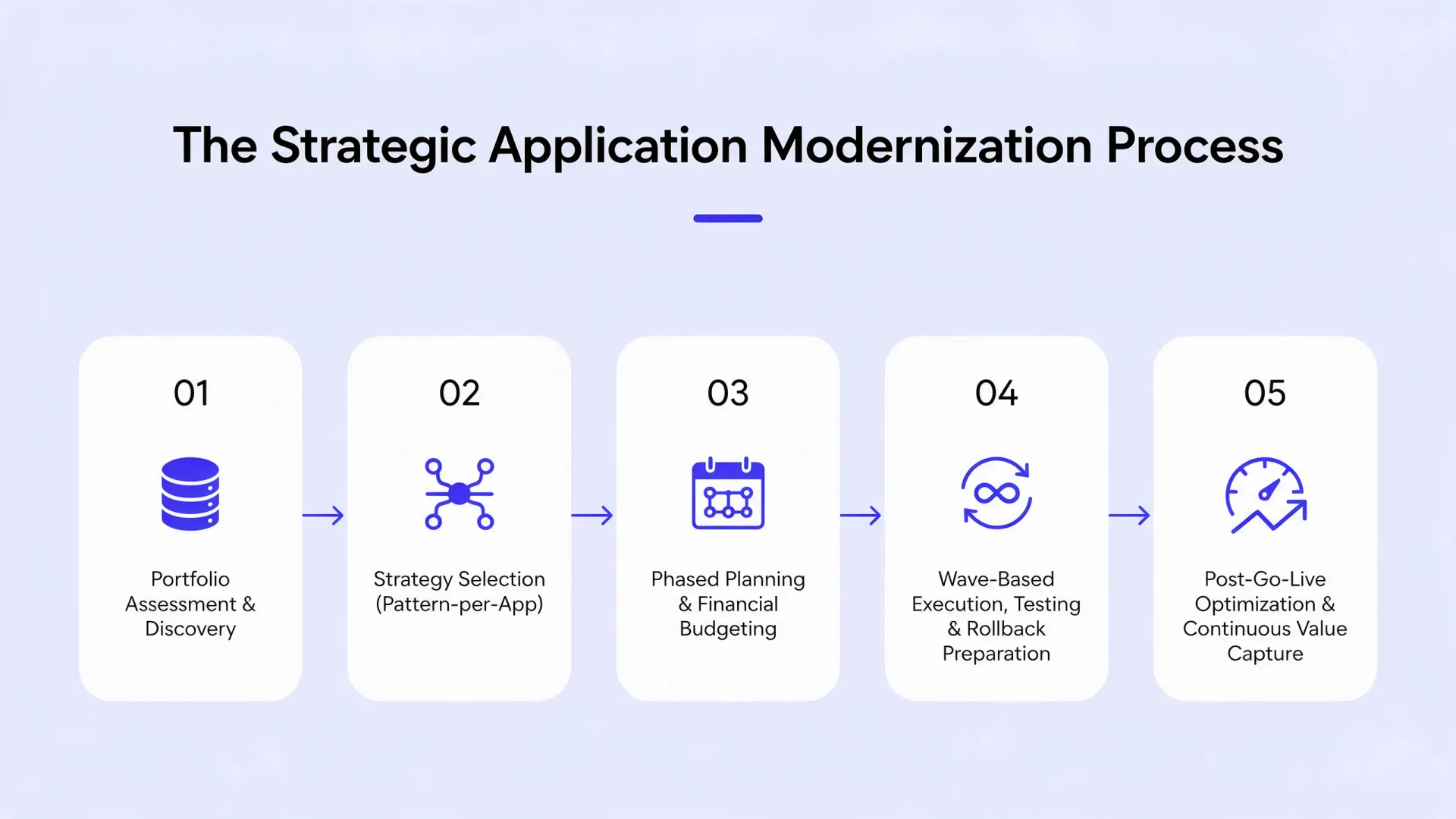
1. Portfolio Assessment & Discovery
Before writing code or migrating infrastructure, evaluate your entire technical ecosystem. Categorize legacy applications based on business criticality, technical debt, security vulnerability, and operational maintenance costs. This step establishes the baseline data needed to justify financial investment and pinpoint fast-payback opportunities.
2. Strategy Selection (Pattern-per-App)
Map each application to the modernization strategy that yields the strongest ROI.
- Rehosting (Lift & Shift): Minimizes upfront costs and speeds up initial migration, though long-term cloud optimization savings remain limited.
- Refactoring / Re-architecting: Requires higher initial CapEx to rebuild as microservices or cloud-native components, but unlocks maximum scalability, lower operational costs, and higher long-term value.
For a comprehensive breakdown of technical pathways and pattern choices, explore our guide to Application Modernization Strategies.
3. Phased Planning & Financial Budgeting
Establish realistic timelines, allocate capital resources, and build risk mitigation contingencies. Structuring the project into distinct phases ensures cost controls remain intact while mapping milestone deliverables directly to your payback timeline model.
4. Wave-Based Execution, Testing & Rollback Preparation
Deploy applications in controlled waves rather than a high-risk "big bang" rollout. Prioritize non-critical or high-payback workloads first to validate processes. Rigorous automated testing, performance benchmarking, and active rollback protocols must be maintained at every release stage to preserve business continuity.
5. Post-Go-Live Optimization & Continuous Value Capture
Modernization does not end at deployment. Continuously monitor cloud resource utilization, tune architecture for cost-efficiency, and implement automated governance. Post-launch refinement ensures your modernized applications achieve their target ROI, reduce ongoing maintenance overhead, and adapt dynamically to evolving market demands.
Benefits of Application Modernization
The core benefits of application modernization show up in four places.
Application Modernization Cost Savings
Cost savings are the most measurable benefit. They come from lower infrastructure and licensing spend, reduced maintenance effort, fewer incidents, and avoided extended-support fees on aging platforms.
For organizations scaling up, application modernization cost savings for enterprises also include avoided hardware refreshes and data center exits, which is why application modernization cost savings for enterprises often exceed those for small teams.
How Application Modernization Reduces IT Maintenance Costs
How application modernization reduces IT maintenance costs is simple to describe: modern platforms need less patching and manual operation, automated testing and deployment remove repetitive work, managed services replace self-managed components, and cleaner code makes changes faster and safer.
Legacy estates often spend most of their IT budget keeping the lights on; modernization shifts that spend toward change.
Application Modernization Business Benefits
Application modernization business benefits go beyond the IT ledger:
- Faster time to market, because smaller, independent releases replace risky quarterly drops
- Better customer experience, through responsive interfaces and reliable performance
- Easier integration with partners, SaaS platforms, and data and AI tools
- Improved resilience, with fewer and shorter outages
- Talent attraction, since engineers prefer modern stacks
Application Modernization Financial Benefits
Application modernization financial benefits can be grouped as cost reduction, cost avoidance (outages, penalties, extended-support fees), and revenue enablement (new products, faster launches). Whatever the Enterprise Application Modernization ROI looks like on paper, treat revenue enablement conservatively; it is the hardest to attribute and the easiest to overstate.
Legacy Application Modernization Benefits
Legacy application modernization benefits are strongest where the starting point is worst: unsupported platforms, scarce skills, frequent incidents, and security exposure. The worse the baseline, the larger the improvement, and the more likely the project pays back quickly.
Application Modernization for Highly Regulated Industries
For organizations operating in tightly governed sectors—such as banking, financial services, healthcare, insurance, and government—application modernization is not merely an IT upgrade. It is a critical risk mitigation and regulatory compliance strategy. In these environments, legacy tech debt is directly correlated with regulatory vulnerability, audit failures, and operational fragility.
While modernizing mission-critical legacy systems unlocks significant efficiency gains, it also introduces rigorous regulatory scrutiny. Building a bulletproof business case requires framing compliance gains as measurable financial benefits while accurately accounting for governance overhead in your ROI model.
Strategic Compliance & Security Benefits
Upgrading legacy architecture delivers structural security and regulatory advantages that protect against catastrophic downside risk:
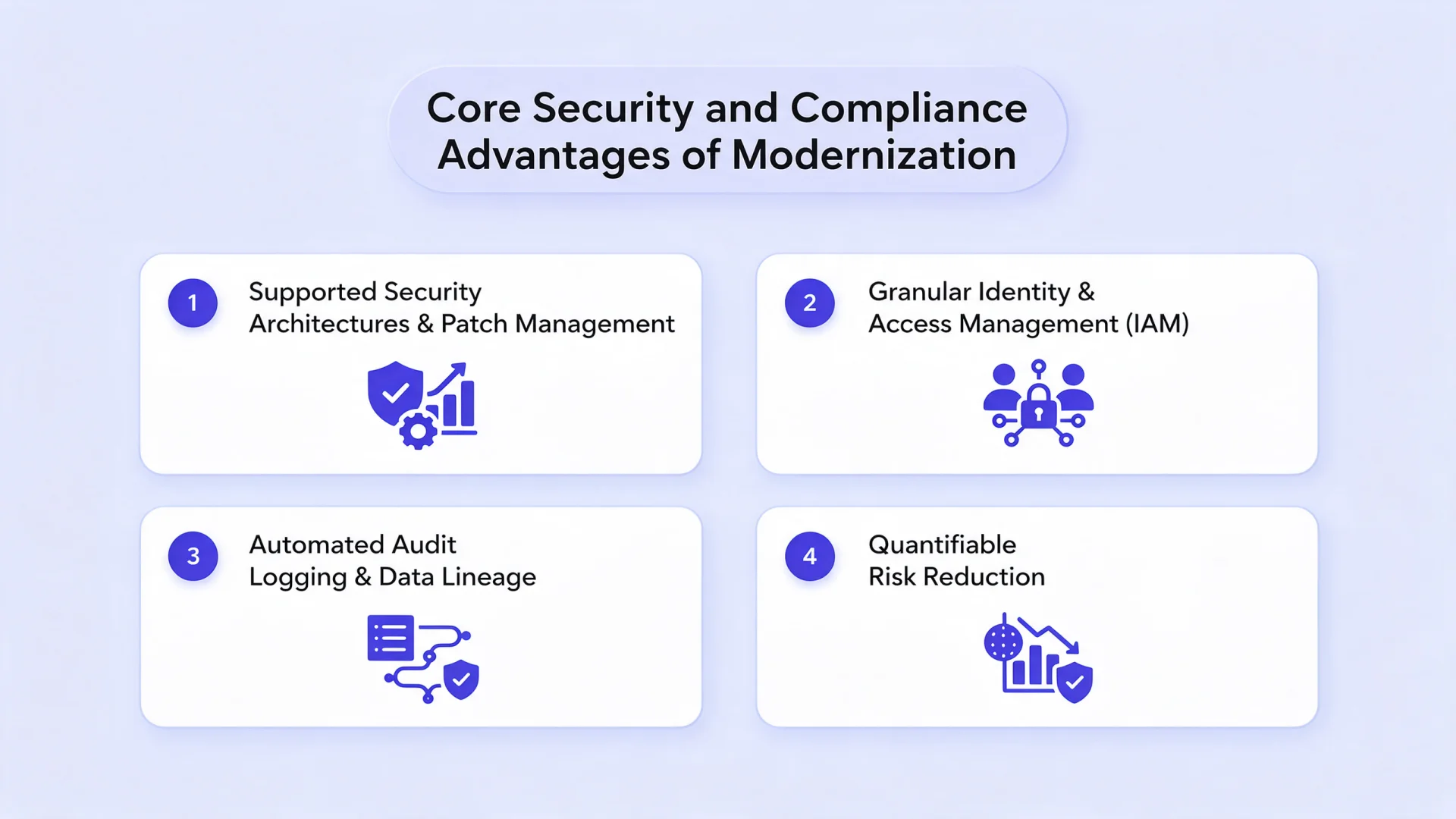
- Supported Security Architectures & Patch Management: Legacy platforms running end-of-life framework versions expose enterprises to unpatchable vulnerabilities. Modern cloud-native architectures ensure continuous patching, automated dependency scanning, and active vendor support.
- Granular Identity & Access Management (IAM): Moving to microservices and modern API frameworks enables Zero Trust security, multi-factor authentication (MFA), and role-based access controls (RBAC) at the component level.
- Automated Audit Logging & Data Lineage: Modern databases and event-driven architectures generate immutable, continuous audit trails. Precise end-to-end data lineage simplifies evidence collection for frameworks like HIPAA, GDPR, PCI-DSS, SOC 2, and DORA.
- Quantifiable Risk Reduction: Streamlined audits and hardened security baselines drastically reduce the probability of regulatory non-compliance fines, breach remediation expenses, and reputation damage.
Accounting for Regulatory Trade-Offs & Governance Costs
Compliance rigor inevitably increases project delivery friction. To survive scrutiny from Risk, Compliance, and InfoSec teams, your financial model must explicitly quantify these regulatory overhead costs:
Compliance Overhead Factor | Financial & Operational Impact |
Data Sovereignty & Localization | Costs associated with hosting data within strict geographic boundaries or deploying dedicated, isolated cloud infrastructure (e.g., GovCloud). |
Validation & Parallel Running | Extended dual-run timelines to benchmark legacy output against modernized system outputs, driving temporary duplicate infrastructure and staffing costs. |
Extended Change Approval (CAB) Cycles | Slower release cadence during early rollout waves to accommodate multi-stage compliance approvals, independent penetration testing, and security sign-offs. |
Third-Party Risk & Vendor Assessments | Additional legal and risk review cycles for new cloud services, SaaS dependencies, and managed service providers. |
Securing Buy-In from Risk & Compliance Teams
To build an accurate payback timeline, do not treat compliance costs as unexpected scope creep—integrate them directly into your CapEx and OpEx forecasts from day one. Involve Chief Risk Officers (CROs) and Chief Information Security Officers (CISOs) during initial portfolio assessment. By capturing the financial value of avoided fines and audit labor reduction alongside the true cost of regulatory governance, you present a defensible, risk-adjusted ROI model that satisfies finance and compliance executives alike.
Application Modernization Investment: What You Actually Spend
Any serious application modernization investment includes more than development. Budget for:
- Discovery and strategy
- Delivery: replatforming, refactoring, rearchitecting, testing
- Data migration and integration
- Dual running of old and new systems during transition
- Training and change management
- Contingency, commonly 15 to 25 percent for complex programs
Application Modernization Cost vs Benefits
The honest application modernization cost vs benefits comparison looks at timing, not just totals. Costs arrive early and heavily; benefits ramp up as workloads move and old systems switch off. That lag explains why payback takes years and why phasing, which starts savings sooner, matters so much.
Application Modernization ROI Model: A Worked Example
A good Application Modernization ROI Model is simple enough to audit. Here is one, in thousands of US dollars. If you want to know how to calculate application modernization ROI for your own estate, work through these six steps.
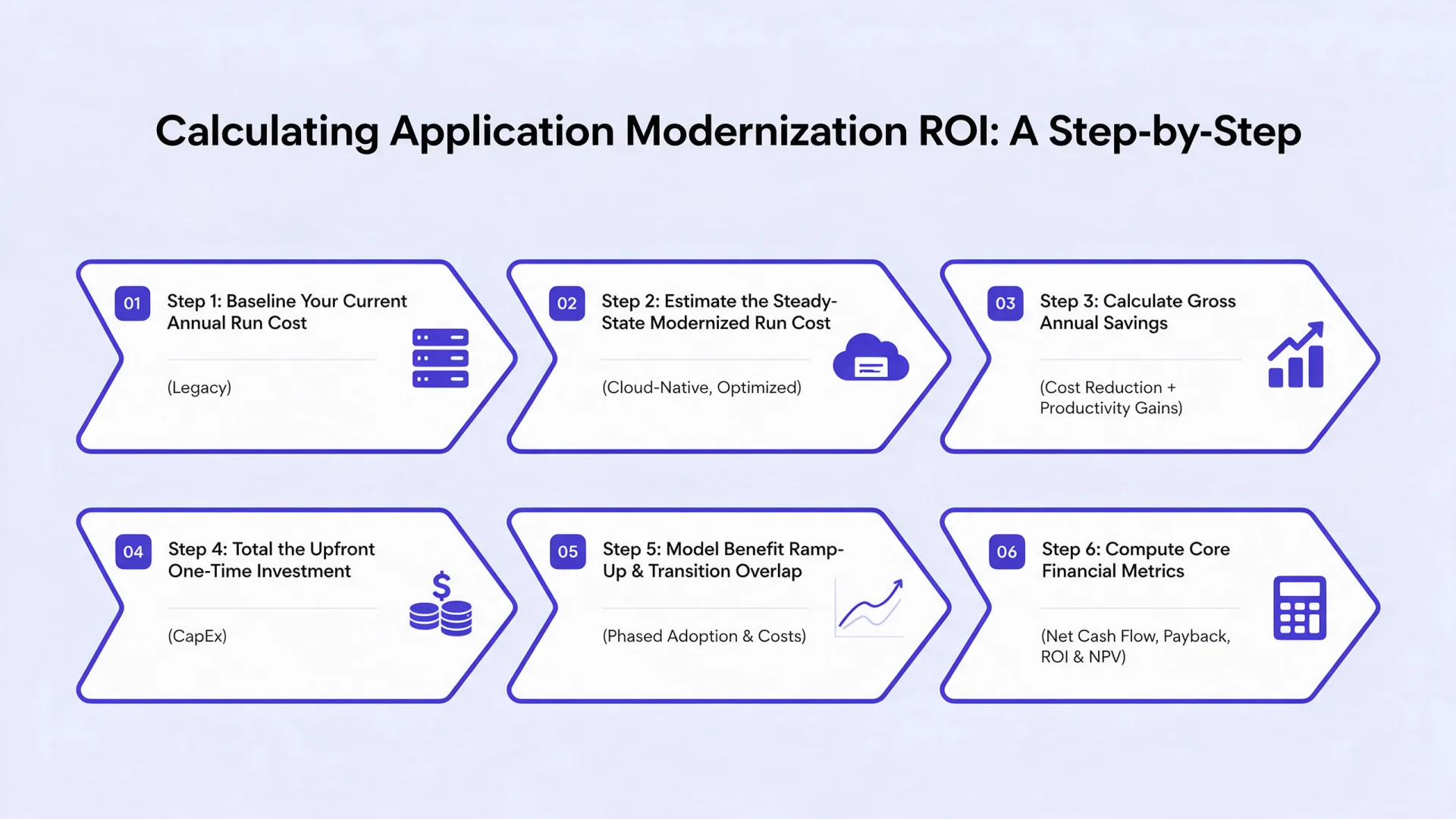
Step 1: Baseline Your Current Annual Run Cost (Legacy)
Establish a total cost of ownership (TCO) baseline for your existing legacy application portfolio over 12 months. Be sure to account for both direct and indirect expenses:
- Infrastructure, server hardware, and hosting fees
- Software licensing, support contracts, and legacy maintenance
- Internal engineering overhead dedicated strictly to keeping the lights on (KTLO)
- Specialized contractor rates for legacy tech stack expertise
Step 2: Estimate the Steady-State Modernized Run Cost
Forecast your ongoing operational expenses (OpEx) after the modernized system is fully deployed. Use data from initial pilot waves or cloud cost estimators to model:
- Cloud consumption costs (compute, storage, serverless execution)
- Modern SaaS and platform licensing (e.g., monitoring, CI/CD tooling)
- Reduced maintenance team size and operational support overhead
Step 3: Calculate Gross Annual Savings
Determine your ongoing annual operational savings once the application reaches steady-state:
| GrossAnnualSavings=BaselineLegacyRunCost-ModernizedSteady-StateRunCost |
Factor in productivity gains, reduced downtime risk, and faster feature release cycles to capture indirect cost savings as well.
Step 4: Total the Upfront One-Time Investment (CapEx)
Sum all one-time transition and project costs required to achieve the modernized state:
- Discovery, architecture design, and re-platforming/refactoring execution
- Data migration and integration testing
- Staff upskilling and change management
- Dual-run infrastructure costs during parallel execution
- Risk Contingency Buffer (typically 10%–15% added to project CapEx)
Step 5: Model Benefit Ramp-Up & Transition Overlap
Financial benefits rarely hit 100% on day one. Create a timeline that reflects realistic implementation waves:
- Wave Decommissioning Schedule: Savings only start as legacy modules are actively turned off.
- Dual-Run Expenses: Account for temporary overlapping costs while legacy and modern systems operate simultaneously during validation.
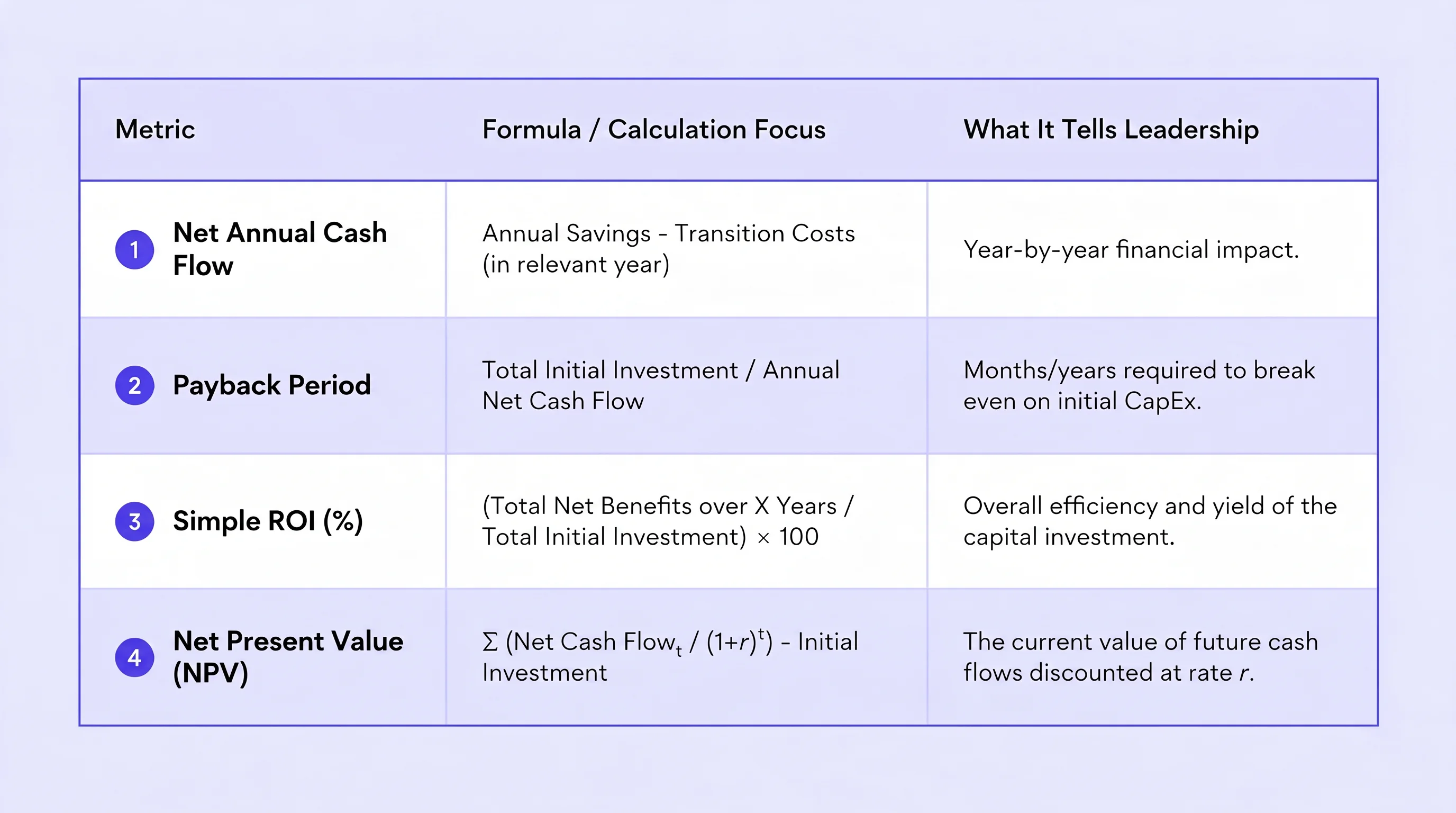
Step 6: Compute Core Financial Metrics (Net Cash Flow, Payback, ROI & NPV)
Consolidate your projections into a standard financial model using key executive metrics:
Application Modernization TCO and ROI Calculation
For a portfolio of 12 legacy applications, the application modernization TCO and ROI calculation starts with run costs:
Annual Run Cost | Legacy | After Modernization | Savings |
Infrastructure, hosting, licensing | $900 | $600 | $300 |
Maintenance and support labor | $1,100 | $660 | $440 |
Downtime and incident cost | $250 | $100 | $150 |
Security, compliance, extended support | $150 | $60 | $90 |
Total | $2,400 | $1,420 | $980 |
Steady-state hard savings are $980 per year, about 41 percent of the baseline.
Investment:
Item | Cost |
Discovery and strategy | $150 |
Modernization delivery (12 applications, about $150 each) | $1,800 |
Dual running | $250 |
Training and change management | $120 |
Subtotal | $2,320 |
Contingency (15%) | $348 |
Total investment | $2,668 |
Spend is phased: $1,300 in year one, $1,000 in year two, and $368 in year three.
Benefit ramp: 20 percent of savings in year one, 60 percent in year two, and 100 percent from year three. Business-value benefits (faster delivery and revenue enablement), assumed conservatively, are $0 in year one, $150 in year two, and $300 per year from year three.
Five-Year Results
| Y1 | Y2 | Y3 | Y4 | Y5 |
Investment | -1,300 | -1,000 | -368 | 0 | 0 |
Hard savings | 196 | 588 | 980 | 980 | 980 |
Business value | 0 | 150 | 300 | 300 | 300 |
Net cash flow | -1,104 | -262 | 912 | 1,280 | 1,280 |
Cumulative | -1,104 | -1,366 | -454 | 826 | 2,106 |
Metric | Hard Savings Only | Including Business Value |
Five-year benefits | $3,724 | $4,774 |
Five-year ROI | about 40% | about 79% |
NPV at 10% | about $394 | about $1,134 |
Payback | about 3.9 years | about 3.4 years |
This is the core of an Enterprise Application Modernization ROI discussion: the answer is positive, but not instant, and it depends on assumptions you can test.
Stress-Testing the Model
Scenario (with business value) | ROI | NPV at 10% | Payback |
Base case | 79% | $1,134 | 3.4 years |
Benefits 30% lower | 25% | $108 | 4.2 years |
Costs 25% higher | 43% | $563 | 3.9 years |
Both | about 0% | -$463 | about 5 years |
The lesson: A program with both cost overruns and underdelivered benefits barely breaks even. That is why governance and de-risking are part of the ROI case, not separate from it. See our guide on application modernization challenges for how to avoid those overruns.
People often ask what is the ROI of legacy application modernization as if there were one number. There isn't. In our model, the ROI of legacy application modernization ranged from roughly zero to about 80 percent over five years, depending on cost control and benefit delivery. Factors that push it higher include a poor starting baseline, high run costs, strong adoption, and phased delivery. Factors that push it lower include scope creep, data problems, and benefits that are assumed rather than tracked.
Application Modernization Payback Period: How Long Does It Take?
The honest answer to how long application modernization takes to pay off is "often three to five years for full programs, sooner for focused ones." Rehosting and replatforming deliver savings faster, sometimes within one to two years, while deep rearchitecture trades slower payback for larger long-term gains.
Legacy Modernization Investment Payback Period
The legacy modernization investment payback period shortens when you:
- Retire applications before migrating them
- Start with high-cost, high-pain applications to bring savings forward
- Phase delivery so benefits begin in wave one
- Switch off old systems promptly to stop dual-running costs
- Track benefits and correct course quarterly
Our Application Modernization Payback Period figure of about 3.4 to 3.9 years is a reasonable midpoint for a mixed portfolio; use your own pilot data to narrow it. Learning how to measure ROI of application modernization projects means tracking outcomes, not activity:
- Run cost: infrastructure, licensing, support labor per application
- Reliability: incident count, downtime hours, mean time to recover
- Delivery speed: release frequency, lead time for changes
- Quality: defect rate, change failure rate
- Security and compliance: open vulnerabilities, audit findings
- Adoption and business impact: usage, conversion, customer satisfaction
Capture the baseline before work starts, review quarterly, and keep a benefits register with named owners.
The Application Modernization Business Case for Enterprises
An application modernization business case for enterprises should be short, numerical, and honest:
- The problem: current cost, risk, and constraints, with data
- The options: do nothing, partial modernization, full program
- The model: investment, ramped benefits, payback, ROI, and NPV
- The risks: with stress tests and mitigations
- The plan: phases, governance, milestones, and funding stages
- The ask: specific approvals and decision dates
"Do nothing" deserves a real number, because legacy costs usually rise through extended support, scarce skills, and security exposure.
Regional Considerations: US, Canada, and India
US and Canadian organizations often prioritize compliance evidence, data residency, and security attestations in the benefits case. In India, large engineering talent pools can lower delivery cost and extend working hours for testing and migration, which can shorten the payback period if handoffs and ownership are managed well. Whatever your mix, confirm local regulatory requirements with your legal and compliance dedicated teams.
Choosing a Reliable Partner: Balancing Costs, Risk Controls, and ROI
Outsourcing application modernization is not a standard software development engagement; it is a high-stakes structural shift. Evaluating partners solely on hourly rates often leads to hidden scope growth, prolonged dual-run environments, and bloated transition costs.
To protect your financial model and ensure predictable outcomes, apply these five disciplined procurement strategies when selecting a modernization partner:
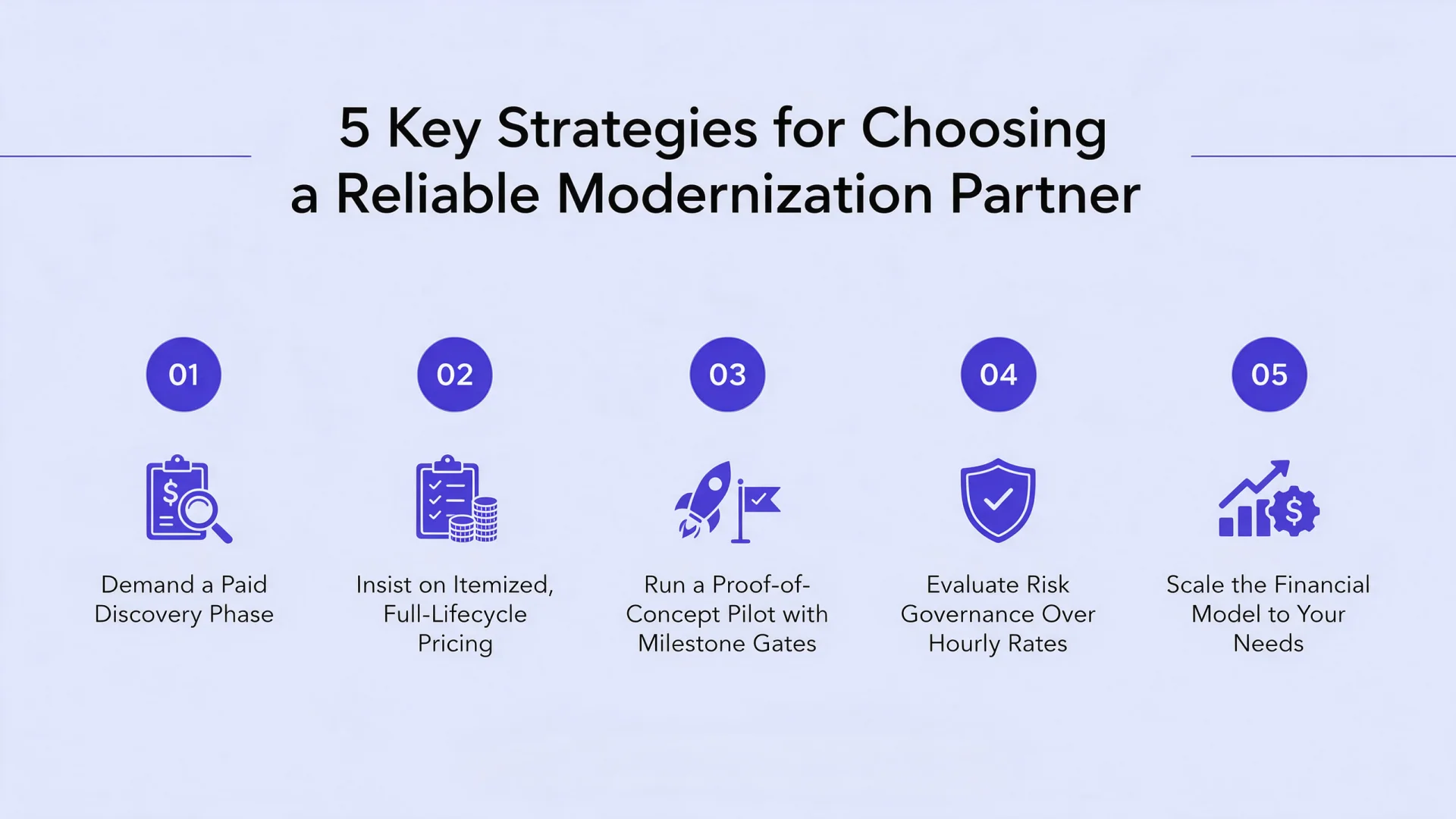
- Demand a Paid Discovery Phase: Avoid fixed-price estimates based on superficial reviews. A dedicated discovery engagement allows the partner to audit legacy code dependencies, map technical debt, uncover security vulnerabilities, and design a realistic wave-based migration schedule before binding contracts are finalized.
- Insist on Itemized, Full-Lifecycle Pricing: Ensure vendor proposals explicitly break down all hidden costs—including data migration, dual-running parallel environments, API integrations, and monitoring tooling—rather than grouping everything into generic engineering fees.
- Run a Proof-of-Concept Pilot with Milestone Gates: Validate the vendor's technical capabilities on a low-risk application before committing your entire portfolio, setting strict success criteria around performance benchmarks, test coverage, and deployment velocity.
- Evaluate Risk Governance Over Hourly Rates: A lower hourly rate from an inexperienced vendor can quickly erode ROI through extended project delays, so evaluate partners based on their automated rollback protocols, regulatory compliance expertise, and formal change-control processes.
- Scale the Financial Model to Your Needs: The underlying discipline remains the same whether you are a startup managing a single monolithic application for rapid feature velocity or a large enterprise coordinating complex multi-wave timelines across hundreds of interconnected systems.
Leverage Our Expertise to Build and Deliver Your ROI Case
Navigating legacy transformation requires more than technical execution—it demands a clear, defensible financial roadmap that secures executive buy-in and guarantees measurable returns. We help IT leaders bridge the gap between complex legacy architectures and high-impact financial outcomes.
Partnering with us gives your organization the strategic and technical groundwork needed to accelerate time-to-value:
- Custom Financial Modeling: We build tailored ROI models grounded in your actual legacy baseline run costs, accounting for risk buffers, compliance overhead, and realistic benefit ramp-up schedules.
- De-Risked Discovery & Pilots: We run structured discovery phases and low-risk proof-of-concept pilots to validate cost savings, performance gains, and deployment velocity before full-scale rollouts.
- Phased Wave Delivery: We execute migration in controlled waves to ensure legacy systems start paying back early, keeping your transition on budget while minimizing operational downtime.
Explore our Application Modernization Services to see how we guide enterprise teams from portfolio assessment to post-go-live optimization, or request a custom, data-driven ROI model designed specifically for your estate today.
Conclusion
The benefits of application modernization extend far beyond modernizing your tech stack. When executed with strategic precision, modernization delivers lower run costs, reduced outage risks, faster feature velocity, hardened security, and seamless regulatory compliance. However, these returns depend heavily on disciplined execution and realistic financial planning.
Transforming a hopeful modernization pitch into a CFO-defensible business case requires a transparent ROI model, rigorous risk stress-testing, and a phased, wave-based migration roadmap. Start by quantifying the baseline run costs of your top 3 to 5 mission-critical applications. That single data-driven step will provide clearer clarity on your actual payback timeline than any industry benchmark ever could.
Ready to Accelerate Your Application Modernization Journey?
Building an application modernization business case doesn't have to be complex or uncertain. Whether you need help auditing your legacy estate, choosing the right migration strategy, or constructing a custom financial model for board approval, our team of modernization experts is here to guide you every step of the way.
Get in touch with us today to schedule a preliminary discovery call or request a tailored ROI analysis built around your specific technical architecture and operational goals.

Vice President, Strategy – VLink Inc.
Sambhavi Gopalakrishnan is the Vice President of Strategy at VLink Inc., bringing over a decade of experience in IT leadership, project implementation, and strategic growth. She possesses a strong foundation in technical project management and pre-sales, driving innovation and business transformation at VLink.

 Shivisha Patel