
Legacy systems rarely fail all at once. They just get slower, harder to maintain, and more expensive to keep running. Until one day a business realizes its core operations depend on software nobody fully understands anymore, built on technology that's no longer supported. At that point, the question isn't whether to modernize. It's which strategy actually fits the application in question.
That question matters more than most companies expect, because legacy application modernization isn't a single move. It's a set of seven distinct approaches, each with a different balance of speed, cost, risk, and long-term payoff. Some applications just need a new home; moved to modern infrastructure with minimal changes. Others need to be rebuilt from the ground up to survive another decade of business growth. Applying the same strategy to every application in a portfolio is one of the most common reasons modernization projects go over budget or fail to deliver the value they promised.
This guide compares all seven modernization strategies side by side, with practical guidance on when each one makes sense, how the overall modernization process typically works, and what to look for in a legacy application modernization company if you're planning to bring in outside expertise.
What Is Legacy Application Modernization?
Legacy application modernization is the process of updating older software systems, outdated in technology, architecture, or infrastructure, to meet current business, performance, and security needs. It covers everything from a straightforward infrastructure move to a complete redesign of how an application is built and deployed.
The goal isn't modernization for its own sake. It's solving real, specific problems: reducing the cost of maintaining unsupported technology, improving performance and scalability, closing security gaps that come with outdated systems, and enabling integration with modern tools that legacy architecture simply can't support.
Because "modernization" can mean very different things depending on the application, most enterprise modernization initiatives are guided by a structured framework, commonly referred to as the 7 Rs of application modernization, that maps each system to the approach best suited to its condition and business value.
Why Legacy Application Modernization Matters Now
A few forces are pushing legacy modernization higher on the priority list for most mid-size and enterprise organizations:
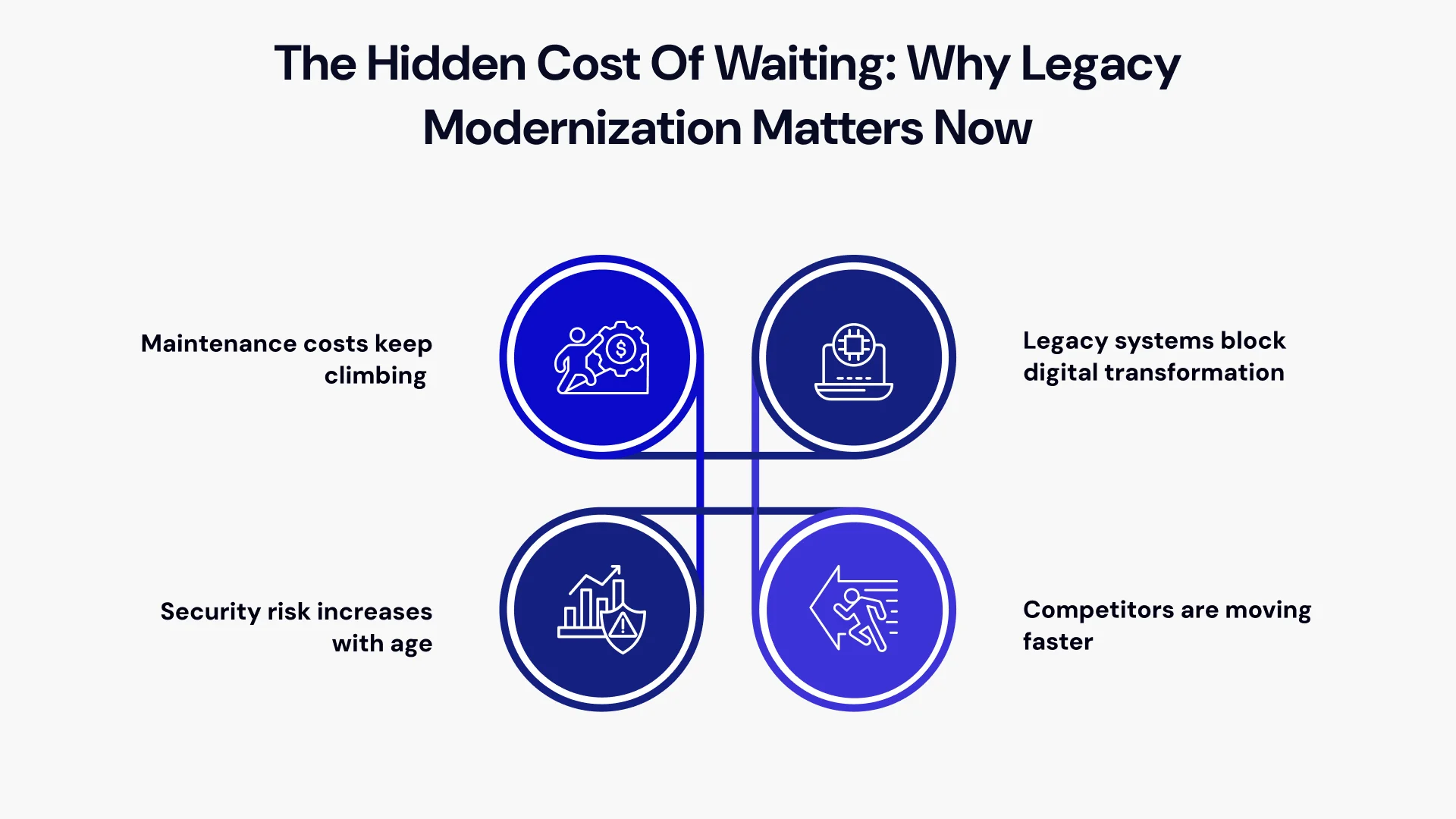
- Maintenance costs keep climbing. Older systems often require specialized (and increasingly rare) skills to maintain, and vendor support for outdated platforms eventually disappears entirely, leaving businesses to patch systems on their own.
- Security risk increases with age. Legacy Application Modernization Challenges frequently center on security; outdated systems are harder to patch, monitor, and secure against modern threats, especially once official support ends.
- Legacy systems block digital transformation. Digital Transformation Services initiatives- customer-facing apps, AI integration, real-time analytics- often can't connect cleanly to legacy architecture without significant rework first.
- Competitors are moving faster. Businesses running on modern, cloud-based infrastructure can ship features and respond to market changes faster than those still tied to rigid, hard-to-change legacy systems.
The 7 Approaches to Legacy Application Modernization Compared
Here's a side-by-side look at all seven modernization strategies, from the least disruptive to the most extensive.
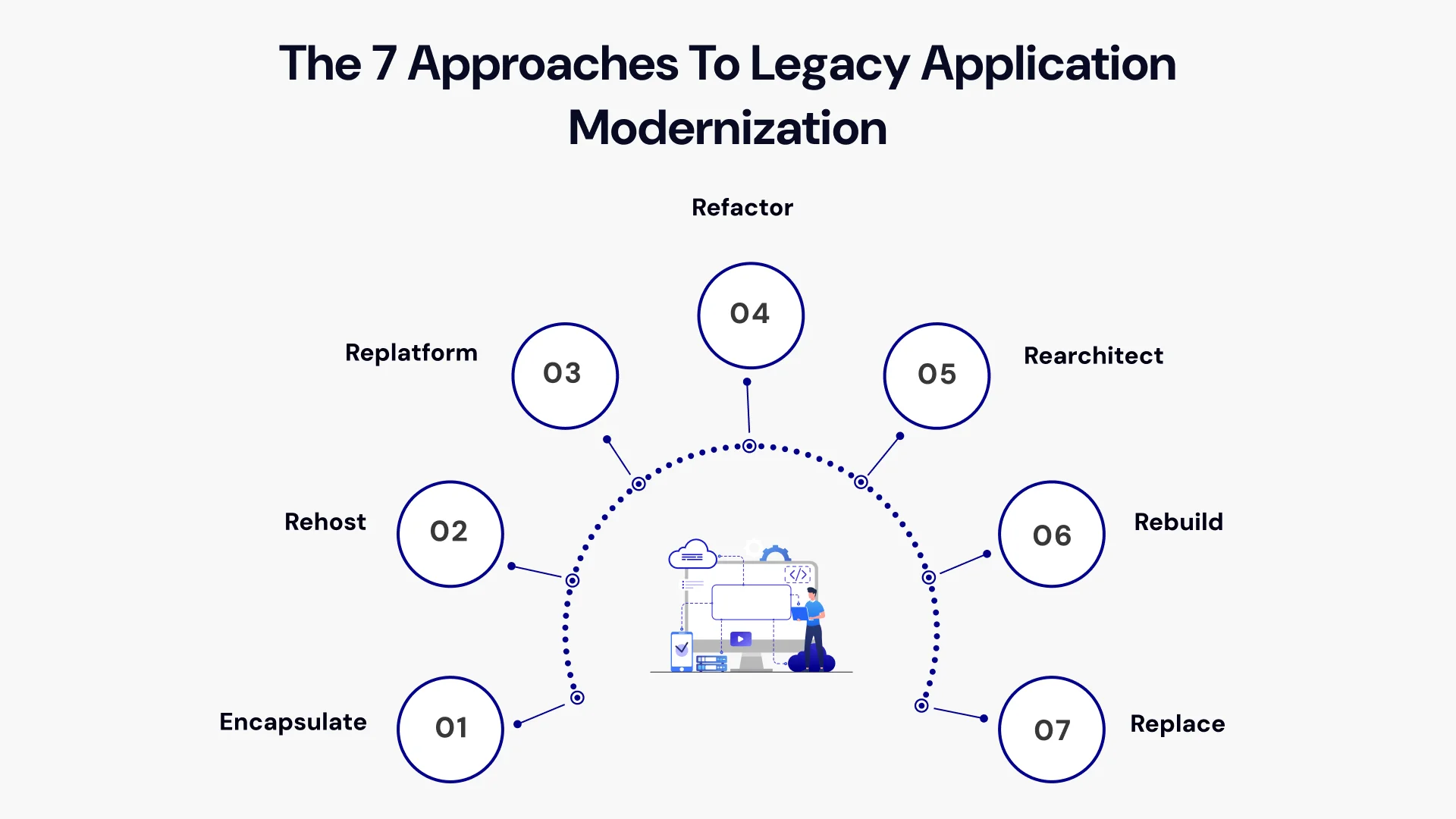
1. Encapsulate
Encapsulation involves wrapping a legacy application with a modern interface, typically an API layer, that allows other systems to interact with it without touching its underlying code.
- Best for: Stable legacy systems that still work reliably but need to connect with modern applications, dashboards, or integrations.
- Tradeoff: It's fast and low-risk, but it doesn't fix underlying technical debt; it just makes the legacy system easier to work with from the outside.
2. Rehost
Rehosting, often called "lift and shift," moves a legacy application to modern infrastructure; typically the cloud, with little to no change to its underlying code.
- Best for: Applications with data center contracts ending soon, or teams needing a fast infrastructure move without a full technical overhaul.
- Tradeoff: It's the quickest path to modern infrastructure, but the application's internal architecture and any inefficiencies within it come along for the ride unchanged.
3. Replatform
Replatforming makes limited, targeted changes during the move to modern infrastructure, such as shifting a self-managed database to a managed cloud database service without a full rebuild.
- Best for: Applications that can benefit from a few specific improvements (like reduced database maintenance) without justifying a full re-architecture.
- Tradeoff: It delivers more value than a straight rehost with only moderately more effort, making it a common middle-ground choice.
4. Refactor
Refactoring restructures an application's existing code to improve performance, maintainability, or scalability, without changing its external behavior or core architecture.
- Best for: Applications with valuable business logic that's become difficult to maintain due to accumulated technical debt, but don't need a full architectural overhaul.
- Tradeoff: It improves code quality and maintainability, but doesn't fundamentally change the application's architecture the way rearchitecting does.
5. Rearchitect
Rearchitecting involves changing an application's underlying architecture; often moving from a monolithic structure to microservices, to unlock better scalability and flexibility.
- Best for: Business-critical applications that need to scale significantly or integrate with modern, distributed systems, but whose core functionality is still valuable.
- Tradeoff: It requires more time and investment than refactoring, but delivers substantially better long-term scalability and cloud-native performance.
6. Rebuild
Rebuilding means redesigning and rewriting an application from scratch, keeping its scope and requirements but replacing its underlying code and architecture entirely.
- Best for: Applications where the existing codebase is too outdated, poorly documented, or technically limited to refactor or rearchitect effectively, but the business function itself still matters.
- Tradeoff: It's resource-intensive and takes longer than any other approach except full replacement, but it produces a fully modern application built for current and future needs.
7. Replace
Replacing means retiring the legacy application entirely and switching to an existing commercial or SaaS alternative that already meets the business need.
- Best for: Applications performing functions that are now well-served by mature, off-the-shelf software, like switching from a custom-built CRM to a modern SaaS platform.
- Tradeoff: It can be the fastest way to get modern functionality, but it depends on a suitable off-the-shelf option existing and may require adjusting business processes to fit the new tool.
When planning budgets, engineering leaders often use baseline multipliers across these pathways. A straight Rehost acts as the 1x baseline for effort and cost, whereas Rearchitecting typically ranges from 3x to 5x, and a complete Rebuild can cost 6x to 10x the baseline. However, data from Gartner shows that rearchitecting applications around modern API-first designs is currently the fastest-growing approach, expanding at a 23.1% CAGR as enterprises seek long-term cloud resilience over quick fixes.
How to Choose the Right Modernization Strategy
With seven options on the table, choosing the right one for each application comes down to a few consistent factors:
- Business value. How critical is this application to core operations? High-value, high-usage systems generally justify deeper investment; rearchitecting or rebuilding, while lower-value systems may only need encapsulation or a simple rehost.
- Technical condition. Applications with valuable logic but messy code often suit refactoring. Applications built on architecture that fundamentally can't scale usually need rearchitecting or a full rebuild instead.
- Urgency. If infrastructure contracts are expiring or support is ending soon, rehosting or replatforming buys time without demanding a lengthy rebuild first.
- Available alternatives. Before investing in rebuilding a custom system, it's worth checking whether a mature SaaS alternative already exists; replacing it is often cheaper and faster when one does.
This is exactly why a structured Legacy Application Assessment Framework matters before committing to a strategy, mapping business value against technical condition for each application, rather than assuming one modernization approach fits the whole portfolio.
Legacy Application Modernization Process Explained
Regardless of which strategy applies, most successful modernization projects follow a similar overall process.
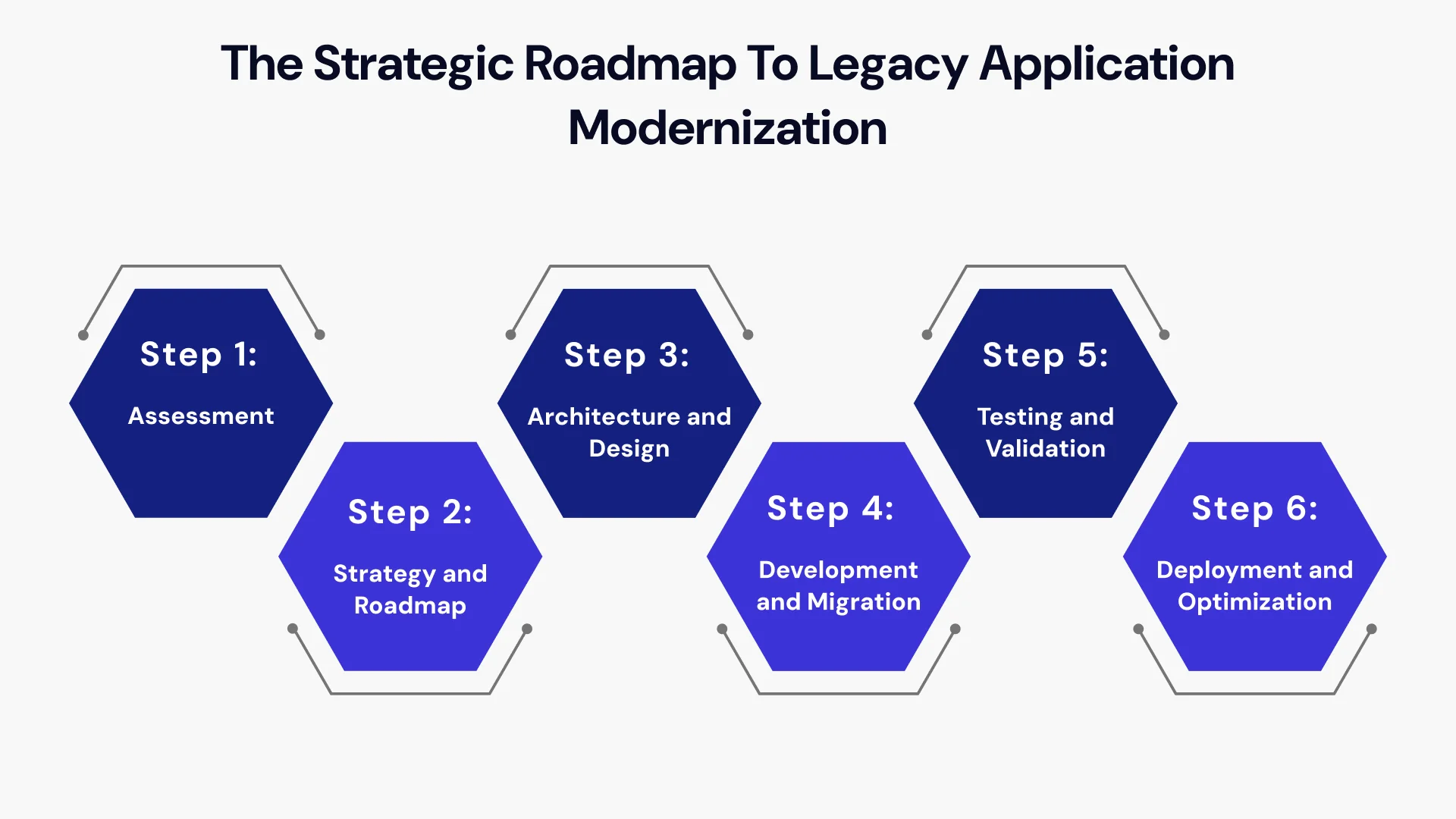
Step 1: Assessment
The process starts with a full assessment of the application portfolio, evaluating technical condition, business criticality, dependencies, and risk for each system to determine the right modernization approach.
Step 2: Strategy and Roadmap
Based on the assessment, a Legacy Application Modernization Roadmap prioritizes applications by business impact and complexity, sequencing modernization work in manageable phases rather than attempting everything simultaneously.
Step 3: Architecture and Design
For approaches beyond rehosting- replatforming, refactoring, rearchitecting, or rebuilding- this phase defines the target architecture, technology stack, and integration points before development begins.
Step 4: Development and Migration
This is the hands-on modernization work itself: encapsulating APIs, migrating infrastructure, refactoring code, or building new application components, depending on the chosen strategy.
Step 5: Testing and Validation
Modernized applications are tested against real business scenarios to confirm functionality, performance, and security meet expectations before full deployment.
Step 6: Deployment and Optimization
The modernized application goes live, often in stages, followed by an optimization period focused on performance tuning and addressing any gaps identified after go-live.
Legacy Application Modernization Benefits
Done well, legacy application modernization delivers benefits that go beyond simply running on newer technology:
- Lower long-term maintenance costs, especially once legacy platforms lose vendor support entirely.
- Improved security posture, since modern platforms typically receive regular security updates that legacy systems no longer get.
- Better scalability, particularly for rearchitected or rebuilt applications designed around cloud-native principles.
- Easier integration with modern tools, APIs, and AI-driven capabilities that legacy architecture often can't support.
- Improved developer productivity, since modern codebases and platforms are typically easier to maintain and extend than deeply outdated systems.
Common Legacy Application Modernization Challenges
Modernization projects run into a few recurring challenges worth planning for upfront:
- Poor documentation. Older systems are often undocumented or maintained by institutional knowledge that's walked out the door with former employees, making assessment harder than expected.
- Underestimated dependencies. Legacy applications frequently connect to other systems in ways that aren't obvious until modernization work begins, which is why thorough assessment matters before committing to a strategy.
- Business disruption risk. Modernizing a system that's actively in use requires careful sequencing and testing to avoid downtime that affects daily operations.
- Choosing the wrong strategy for the wrong reason. Defaulting to the fastest option (like rehosting) for every application, rather than matching strategy to actual business and technical needs, often means revisiting the same applications within a few years.
Cloud-Based Legacy Application Modernization
Cloud platforms play a central role in most modern approaches to legacy application modernization. Cloud Application Modernization often pairs naturally with rearchitecting or rebuilding, since cloud-native services- managed databases, serverless computing, containerization- give modernized applications room to scale in ways on-premises infrastructure typically can't match.
Even simpler strategies like rehosting and replatforming usually target cloud infrastructure as the destination, since it removes the burden of maintaining physical servers while setting the stage for deeper modernization later if the business decides to pursue it.
Enterprise Application Modernization at Scale
Enterprise Application Modernization introduces complexity that single-application projects don't face. Large organizations typically manage dozens or hundreds of legacy systems, many with overlapping dependencies and different owners across departments.
A few things change when modernization happens at enterprise scale:
- Portfolio-wide sequencing becomes essential. Rather than modernizing applications in isolation, enterprises typically group them into phased waves based on shared dependencies, so systems that rely on each other move together rather than breaking mid-project.
- Governance needs to be established upfront. Enterprise System Modernization initiatives usually require clear decision-making around budget ownership, security standards, and which teams approve architecture choices before development work begins; otherwise, priorities tend to shift mid-project.
- Skills gaps become more visible. Rearchitecting or rebuilding legacy systems often requires expertise in both the outdated technology being replaced and the modern architecture replacing it; a combination that's increasingly hard to find in-house as legacy skills become rarer.
- Change management runs in parallel with technical work. Modernizing systems that many teams depend on daily means communication, training, and phased rollouts matter as much as the engineering itself, especially for applications tied to core business operations.
Enterprises that treat modernization as a single, isolated technical project rather than a coordinated, multi-year initiative with proper governance tend to see the same issues resurface: applications modernized without considering shared dependencies, budget overruns from unplanned rework, and internal resistance from teams who weren't included early in the process.
Choosing a Legacy Application Modernization Company
Modernizing a portfolio of legacy applications is rarely a project most internal teams want to run entirely alone, especially when multiple strategies apply across different systems. When evaluating a Legacy Application Modernization Company, look for:
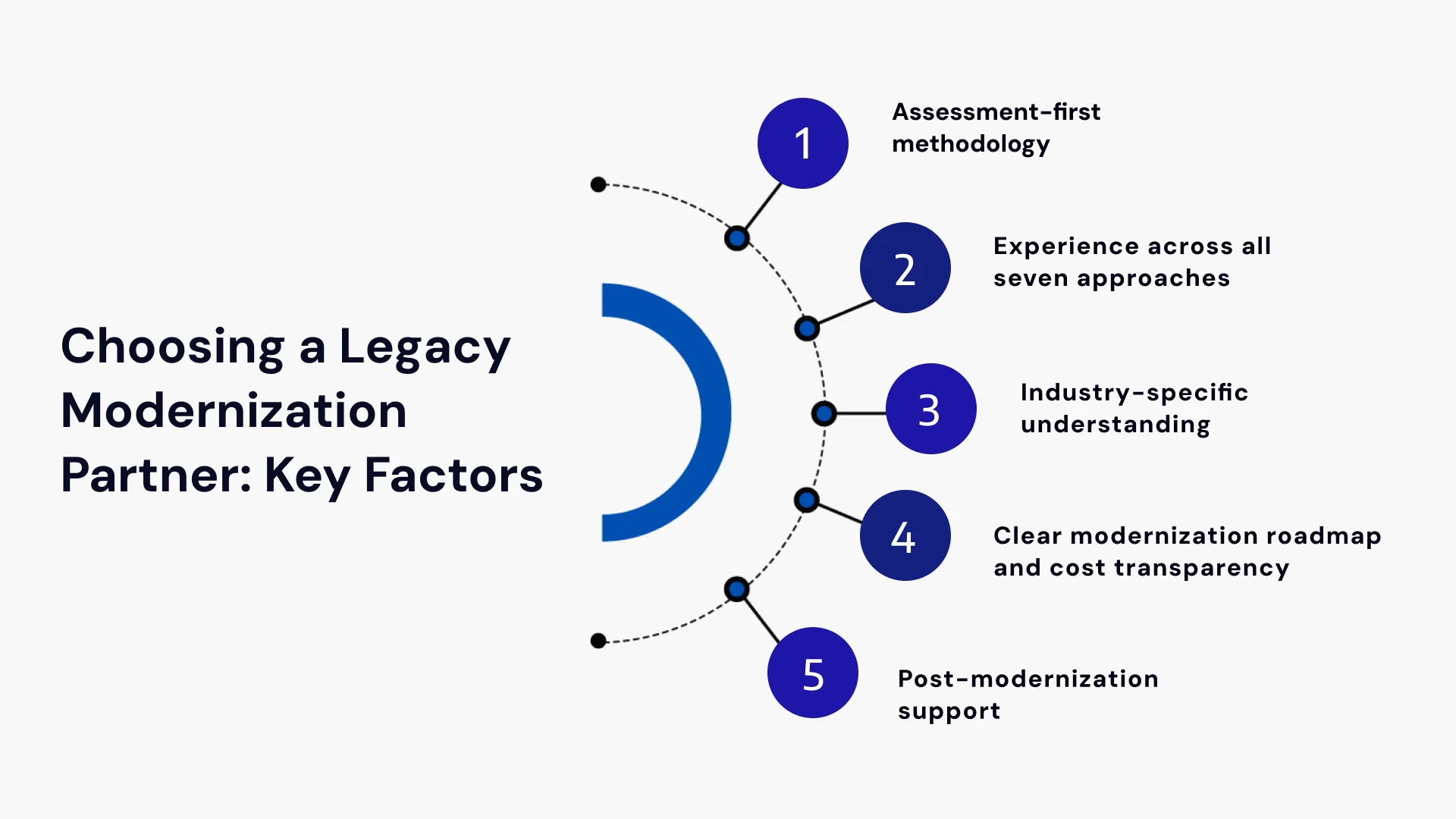
- Assessment-first methodology: A reliable partner starts with a genuine Legacy Application Assessment Framework, not a default recommendation before understanding your systems.
- Experience across all seven approaches: Ask specifically about their experience with rearchitecting and rebuilding, not just rehosting; some providers default to the fastest option regardless of fit.
- Industry-specific understanding: Especially for regulated industries where legacy systems often hold sensitive data and compliance requirements shape what's possible.
- Clear modernization roadmap and cost transparency: Since a multi-application modernization project should be sequenced and budgeted in phases, not treated as a single undefined engagement.
- Post-modernization support: Including performance monitoring and optimization after go-live, not just delivery and handoff.
Legacy Application Modernization Services: Scale Faster with VLink
Choosing among seven modernization strategies isn't something that should happen by default; it should be based on what each application actually needs to deliver for your business. VLink's dedicated team starts with a structured assessment of your application portfolio, mapping business value against technical condition to recommend the right strategy for each system, whether that's a quick encapsulation, a deeper rearchitecture, or a full rebuild.
From legacy system migration to cloud-based modernization and enterprise-scale application transformation, VLink combines assessment-driven planning with hands-on development and post-launch optimization. Explore VLink's Legacy Application Modernization Services to see how this approach applies to your systems, or use our Legacy Modernization ROI Calculator to estimate the potential value of modernizing a specific application before committing to a full engagement.
In Summary
Legacy application modernization works best when it's treated as seven distinct strategic choices, not one default move applied across an entire portfolio. From low-effort encapsulation to a full application rebuild, each approach offers a different balance of speed, cost, and long-term value; and the right choice depends on what each specific application needs to deliver for the business going forward.
Getting there starts with an honest assessment of business value and technical condition for every application in your portfolio, followed by a roadmap that sequences modernization work by priority and risk. Whether you're modernizing a single outdated system or planning an enterprise-wide transformation, the businesses that get the most value are the ones that match strategy to actual need, rather than defaulting to whichever approach seems fastest.
Ready to Modernize Your Legacy Systems?
Navigating the complexities of legacy modernization doesn't have to be a high-risk gamble. VLink’s team of cloud and application development experts helps enterprise leaders evaluate portfolios, mitigate technical debt, and execute tailored modernization roadmaps with zero operational downtime. Contact VLink today to schedule a strategy consultation and find the right modernization path for your business.

Vice President, Strategy – VLink Inc.
Sambhavi Gopalakrishnan is the Vice President of Strategy at VLink Inc., bringing over a decade of experience in IT leadership, project implementation, and strategic growth. She possesses a strong foundation in technical project management and pre-sales, driving innovation and business transformation at VLink.

 Shivisha Patel