


Picking an Azure managed service provider is one of those decisions that looks simple on a slide and gets complicated the moment procurement, security, and finance all have opinions. Every provider claims 24x7 support, deep Microsoft expertise, and "proactive" management. Very few will tell you where their model breaks down.
Most organizations don't fail at Azure because of the platform. They struggle because day-two operations, meaning monitoring, patching, security response, backup testing, and cost control, land on a team that's already stretched. That's the gap an Azure managed service provider fills, and the wrong choice tends to be expensive in slow, quiet ways: missed alerts, unexplained bills, and an environment nobody fully understands.
Search interest in terms like "azure cloud managed service providers" and "azure managed IT services" keeps growing because buyers are moving from "should we use an MSP?" to "which one, and how do we know?" Comparing Azure cloud managed service providers is easier when every candidate is measured against the same yardstick. If you're at that second stage, the checklist below is designed to turn a vague comparison into a scored, defensible decision.
This guide is written for the people who actually sign the contract: CTOs, IT operations directors, CFOs, and security leaders. It walks through how to choose an Azure managed service provider using a 12-point evaluation checklist, the questions to ask an Azure managed service provider before you commit, and the red flags that tend to show up long before the first invoice does.
Before You Evaluate: Define What You Actually Need
Skipping this step is the most common mistake in the whole process. Before speaking to any provider, document:
- Scope: Which subscriptions, workloads, and environments (production, staging, dev) need coverage.
- Support hours: True 24x7 coverage or business hours with on-call escalation.
- Compliance obligations: HIPAA, PCI DSS, SOC 2, GDPR, or regional regulations that constrain how data is handled.
- Current pain points: Rising bills, alert fatigue, slow incident response, audit findings, or a thin internal team.
- Desired outcome: Lower risk, lower cost, faster delivery, or all three, ranked by priority.
With that in hand, every provider conversation becomes a comparison against your needs rather than against each other's marketing.
The 12-Point Checklist for Choosing an Azure Managed Service Provider
Choosing the right Azure Managed Service Provider (MSP) is a critical decision that dictates the security, cost-efficiency, and scalability of your cloud infrastructure.
Here is a comprehensive 12-Point checklist designed to help organizations evaluate, compare, and select a reliable Azure MSP that moves beyond generic IT support into true cloud partnership.
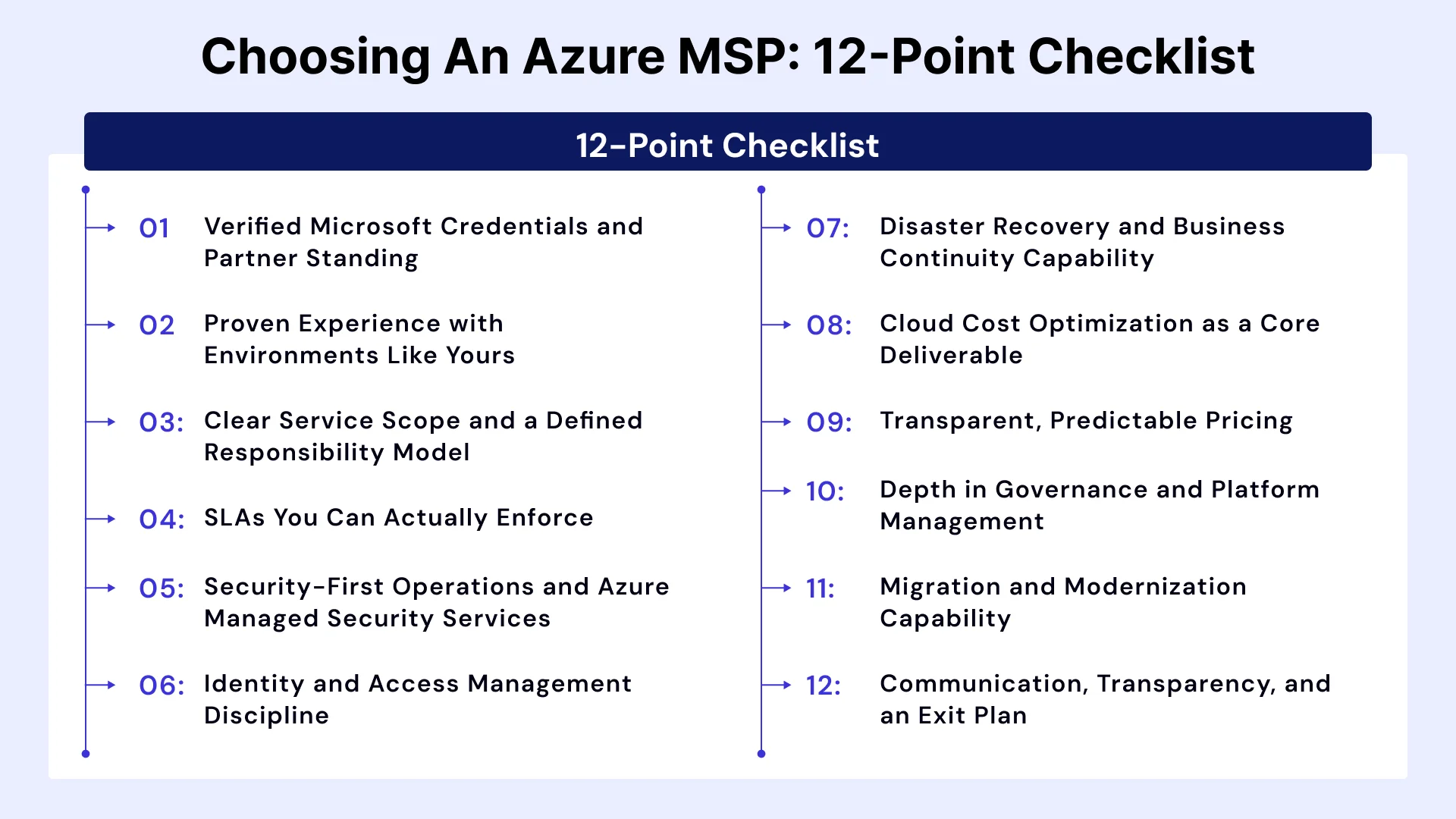
1. Verified Microsoft Credentials and Partner Standing
Start with the basics. A credible Microsoft managed service provider should hold active Microsoft partner status, relevant solution designations, and engineers with current Azure certifications. Check the Microsoft Partner Center profile rather than relying on logos on a website, and ask whether the Azure Expert MSP designation applies. Credentials don't guarantee quality, but their absence is a fast way to shortlist.
2. Proven Experience with Environments Like Yours
A provider that manages small web workloads may not be ready for regulated, multi-subscription enterprise estates. Ask for case studies in your industry and size range, and request at least two references you can call directly. If the provider has helped clients through end-to-end moves, such as the engagement described in this Azure Cloud Migration case study, that signals they understand what happens before and after go-live, not just steady-state operations.
3. Clear Service Scope and a Defined Responsibility Model
Ambiguity is where disputes start. The best Azure managed service provider agreements include a written responsibility matrix (often called RACI) that states who owns patching, backup verification, alert triage, change approvals, and cost reviews. Make sure the scope covers the layers you care about, from infrastructure to Azure database managed services such as Azure SQL, Cosmos DB, and PostgreSQL flexible server. Ask specifically about tuning, backup validation, and failover testing, since Azure database managed services are where data-loss risk concentrates.
4. SLAs You Can Actually Enforce
Look past "24x7 support" and read the numbers. Ask for:
- Response and resolution targets by severity level
- Uptime commitments for managed components
- Escalation paths with named roles
- Service credits or penalties when targets are missed
- Reporting frequency and the metrics behind it
If you're searching for the best Azure managed service for 24x7 support, test the claim: ask who answers at 3 a.m., where they're located, how handoffs work, and how often the on-call process is rehearsed.
5. Security-First Operations and Azure Managed Security Services
Security shouldn't be a paid add-on hidden in an appendix. A strong provider offers Azure managed security services that include continuous posture management through Microsoft Defender for Cloud, threat detection and response with Microsoft Sentinel, vulnerability management, and incident response procedures. If you're weighing SIEM options, this comparison of Azure Sentinel vs. Splunk helps frame what to ask about tooling.
6. Identity and Access Management Discipline
Most cloud breaches involve compromised or over-privileged credentials, so identity and access management deserves its own line item. Ask how the provider handles least-privilege access, privileged identity management, conditional access, multi-factor enforcement, and access reviews. Just as important, ask how their own engineers get access to your environment: just-in-time elevation, session logging, and clear offboarding are the right answers.
7. Disaster Recovery and Business Continuity Capability
Backups that have never been restored are hopes, not plans. Your provider should design and test disaster recovery and business continuity using Azure Backup and Azure Site Recovery, with documented recovery time objectives (RTO) and recovery point objectives (RPO) for each critical workload. Ask for the date and results of their last client recovery test.
8. Cloud Cost Optimization as a Core Deliverable
Cloud cost optimization should be a recurring service line, not a one-off "cost review." Look for right-sizing, reservation and savings-plan management, tagging governance, anomaly alerts, and monthly showback or chargeback reporting. Providers that offer broader Cloud Managed Services tend to have mature FinOps practices because they run them across multiple platforms.
9. Transparent, Predictable Pricing
Pricing models vary, and native service costs such as Azure API Management service pricing tiers sit outside any provider fee: percentage of Azure spend, per-resource fees, or tiered retainers. Whichever is offered, insist on an itemized scope so you can compare like with like. Clarify what triggers extra charges, such as after-hours tickets, project work, or onboarding. Remember that native Azure service costs are separate from the provider's fee, so confirm how pass-through costs are billed and whether the provider takes a margin on Azure consumption.
10. Depth in Governance and Platform Management
Governance keeps a growing estate from turning into sprawl. Strong Azure cloud management services also include ongoing policy enforcement, not just initial setup. Evaluate how the provider delivers Azure cloud management services: landing zone design, Azure Policy, management groups, RBAC standards, naming and tagging conventions, and compliance reporting. A provider with a consulting arm, such as an established Azure Consulting services practice, can usually advise on architecture as well as operate it.
11. Migration and Modernization Capability
Even if you're already in Azure, your roadmap probably includes new workloads, data platform moves, or application modernization. Choose a provider that can support that journey without handing you off to another vendor. Ask about their migration methodology and tooling, and review resources like their Azure Migration tool guide and Azure Cloud Migration Services to see how they approach assessment, landing zones, and cutover. Broader Cloud Migration Services experience is a useful signal if you run multicloud or hybrid environments.
12. Communication, Transparency, and an Exit Plan
The best providers behave like an extension of your team. Look for a named service manager, regular business reviews, shared dashboards, and honest reporting when things go wrong. Then read the exit terms: you should own your data, configurations, runbooks, and documentation, and the contract should include reasonable transition assistance. A provider that's confident in its service won't fear a clean exit clause.
Questions to Ask an Azure Managed Service Provider Before You Sign
The strongest questions to ask an Azure managed service provider are specific and evidence-based. Use these in discovery calls and RFP responses. Weak or evasive answers are informative.
- What percentage of your clients have environments similar in size and compliance profile to ours?
- Who exactly will be on my account, and what happens when they leave your company?
- Can you show a sample monthly report, including cost and security findings?
- How do you handle a Severity 1 incident outside business hours, step by step?
- What is your process for onboarding an existing environment, and how long does it take?
- Which tasks are included in the base fee, and which are billed separately?
- How do you separate your engineers' access from our production data?
- Can we speak with two customers who have been with you for more than three years?
- What happens to our documentation and configurations if we terminate the contract?
Asking these questions to an Azure managed service provider consistently, using the same list for each vendor, makes scoring far more objective.
How to Score Providers: A Simple Evaluation Framework
Turn the checklist into a decision tool:
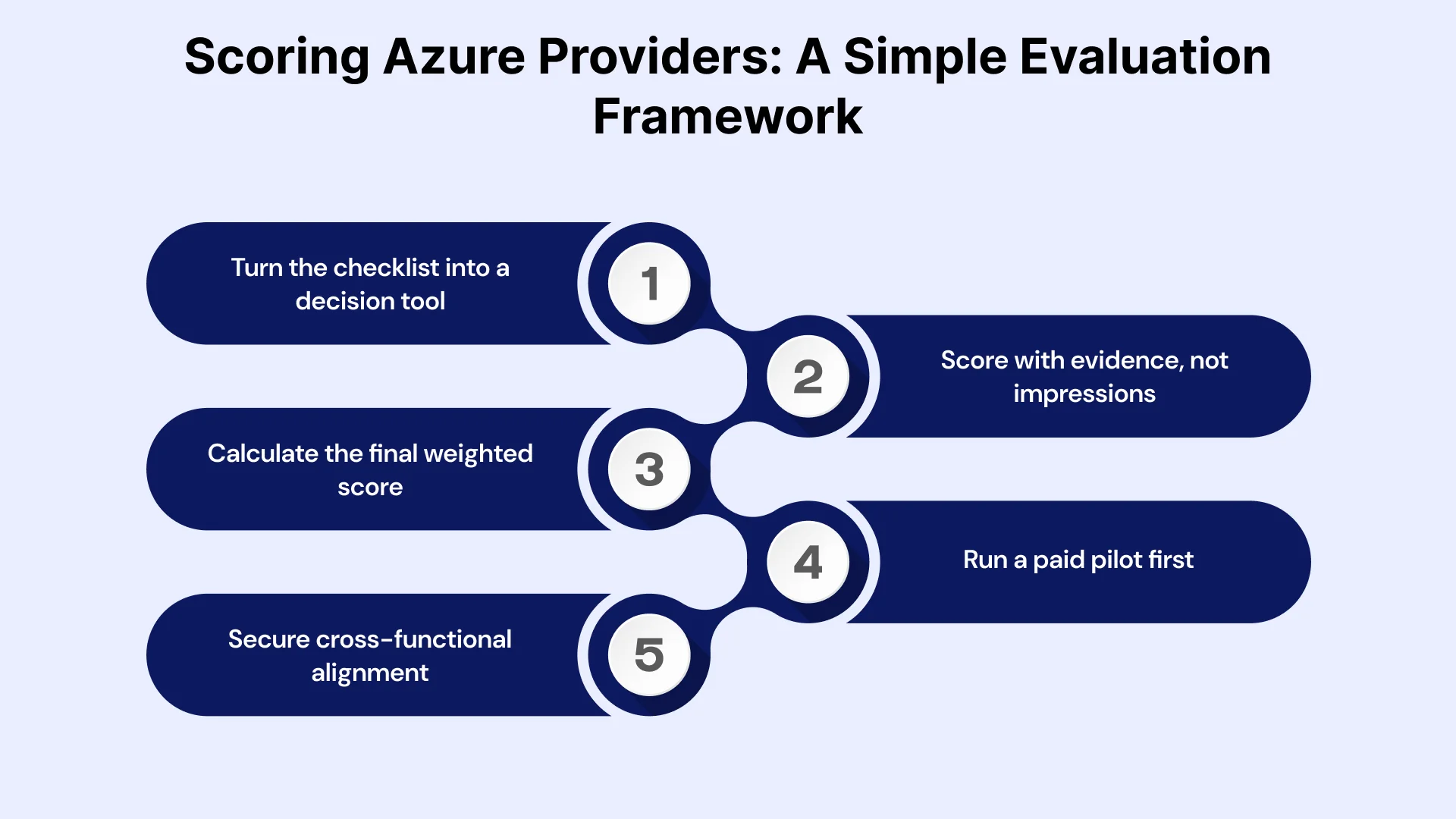
- Weight each of the 12 points from 1 to 5 based on importance to your business. A regulated healthcare company will weight security and DR higher than a startup will.
- Score each provider from 0 to 5 on every point, using evidence such as contract language, references, and demonstrations.
- Multiply and total. The highest weighted score wins the shortlist, not the best presentation.
- Run a paid pilot on one workload or subscription for 60 to 90 days before committing to the full estate.
- Secure cross-functional alignment. This data-backed approach keeps negotiations honest and gives your CFO and CISO a shared, transparent rationale for the final choice.
This approach keeps the conversation honest and gives your CFO and CISO a shared, documented rationale. A well-run onboarding is the best early indicator of long-term quality. Expect the following:
- Days 1 to 30: discovery and baseline. Environment inventory, access setup, monitoring onboarding, initial security and cost findings, and a documented responsibility matrix.
- Days 31 to 60: stabilization. Alert tuning, backup and recovery validation, tagging and policy remediation, and the first cloud cost optimization actions such as right-sizing and removing idle resources.
- Days 61 to 90: optimization and roadmap. A first business review with measurable results, a prioritized improvement backlog, and agreement on reporting cadence.
If you reach day 90 without a written baseline, a tested recovery, or a first cost report, treat it as an early warning sign and raise it in your first business review.
Red Flags: Critical Warning Signs to Avoid
Before signing any contract or committing to a partnership, carefully evaluate potential vendors against these warning signs to protect your organization from hidden risks, operational lock-in, and unexpected costs.
| Red Flag | Potential Risk & Impact | How to Probe / Interview Question |
| Zero References or Sample Reports | Hiding poor performance, lack of relevant industry experience, or fabricated case studies. | "Can you connect us with two clients in our industry, and walk us through a redacted sample report from start to finish?" |
| "Unlimited" Everything (No Scope Definition) | Scope creep, hidden bottlenecks, unexpected throttling, or low-quality output masquerading as abundance. | "Where are the hard architectural or operational caps on this 'unlimited' service, and what triggers a service tier upgrade?" |
| Vague SLAs or Toothless Consequences | Zero accountability for downtime, poor quality, or missed deadlines; no financial recourse. | "What specific performance metrics are contractually guaranteed, and what exact financial credits or penalties apply if you miss them?" |
| High-Pressure Tactics (Long-Term Lock-in Pre-Pilot) | Forcing commitment before proving value; trapping you in a poor partnership. | "Why can’t we run a paid, time-boxed pilot to validate performance and ROI before committing to a multi-year agreement?" |
| Superficial Security ("Checkbox" or Third-Party Claims) | High vulnerability to data breaches, compliance violations, and intellectual property leaks. | "Can you provide your latest SOC 2 Type II report, third-party penetration test summaries, and a detailed data-flow diagram?" |
| Opaque, Unexplainable Pricing | Surprise overages, hidden fees, unpredictable billing, and inability to forecast budget scaling. | "Can you break this pricing model down line by line—including implementation, maintenance, and scale tiers—so we can audit the unit economics?" |
| Vendor-Owned Documentation & Runbooks | Vendor lock-in: Holding your operational knowledge hostage so you cannot easily migrate or self-host. | "Will all technical documentation, playbooks, and runbooks be authored in our shared repositories so our internal team retains complete ownership?" |
Common Mistakes Buyers Make When Selecting an MSP
Even with a checklist, a few patterns keep repeating. Knowing them in advance is half the defense.
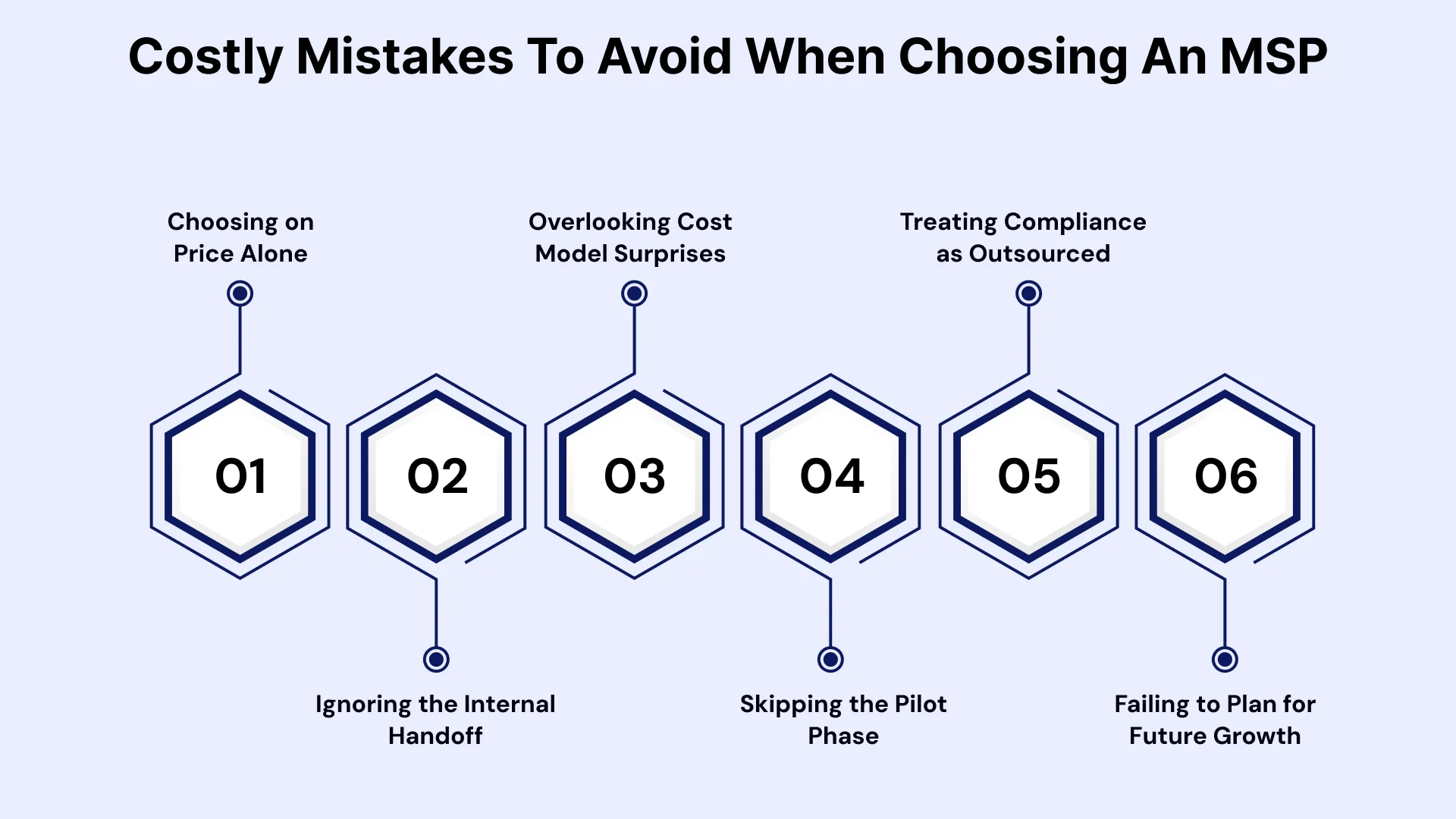
- Choosing on price alone. The cheapest quote usually excludes something you assumed was included, such as after-hours response, security monitoring, or backup testing. Compare scope line by line before comparing totals.
- Ignoring the internal handoff. Your team still owns architecture decisions, business priorities, and approvals. Agree early on who approves changes, who receives escalations, and how often both sides meet. Providers succeed when a capable internal owner exists on your side.
- Overlooking cost model surprises. Buyers often focus on the management fee and forget that Azure API management service pricing, storage tiers, egress, and premium support plans are billed by Microsoft separately. Ask for a sample invoice that shows both the provider fee and the underlying Azure consumption so finance can forecast accurately.
- Skipping the pilot. A short paid pilot on one workload exposes communication style, ticket quality, and reporting depth far better than a demo does.
- Treating compliance as the provider's problem. A provider can operate controls, but accountability for regulated data stays with you. Confirm which controls they evidence and which remain your responsibility.
- Not planning for growth. If you expect to add regions, subscriptions, or business units in the next 18 months, check that the pricing model and support structure scale without a full renegotiation. This is a practical part of how to choose Azure managed service provider partners who will still fit in year three.
Leverage Our Expertise for an Azure Partnership Built on Evidence
Navigating the complexities of cloud operations requires a partner who operates with total transparency, accountability, and technical rigor. Selecting the right managed service provider should never feel like a gamble; it should be an evidence-based decision backed by verifiable proof, strict SLAs, and crystal-clear accountability.
Our dedicated team specializes in delivering robust Azure managed services, automated governance frameworks, 24/7 security operations, and advanced cost optimization for mid-market and enterprise organizations across the US, Canada, and India. We align your cloud infrastructure directly with your business goals, eliminating the hidden traps of opaque pricing, scope creep, and vendor lock-in.
If you are still evaluating your broader cloud architecture or weighing platform strategies, our comprehensive guide on the MS Azure Cloud Platform breaks down where Azure delivers maximum ROI, scalability, and enterprise-grade performance.

Conclusion
Learning how to choose an Azure managed service provider comes down to replacing impressions with evidence. Define your needs first, score every candidate against the same 12 points, verify claims with references and contract language, and pilot before you commit. The right partner will strengthen your security, reduce waste through cloud cost optimization, and free your internal team to focus on work that moves the business forward.
If you remember one thing about how to choose Azure managed service provider partners, make it this: if a provider can't answer the questions in this guide clearly, that's your answer.

Vice President, Strategy – VLink Inc.
Sambhavi Gopalakrishnan is the Vice President of Strategy at VLink Inc., bringing over a decade of experience in IT leadership, project implementation, and strategic growth. She possesses a strong foundation in technical project management and pre-sales, driving innovation and business transformation at VLink.

 Shivisha Patel