



Almost every executive agrees legacy applications need to change. Far fewer enjoy the experience of changing them. Budgets stretch, timelines slip, and the system everyone wanted to retire is still running alongside its replacement a year later.
If you are a startup founder weighing an outsourcing partner, or an enterprise CXO deciding how much to fund, the useful question isn't whether modernization is hard. It's where it goes wrong, how much that costs, and what actually prevents it.
This blog covers the most common application modernization challenges, the specific risks behind them, and a de-risking approach you can apply whether you build in-house or hire a partner. It's written for leaders in the US, Canada, and India.
Why Application Modernization Projects Fail
Understanding why application modernization projects fail starts with the numbers. In Ensono's State of IT Modernization research for 2026, more than seven in ten respondents said modernization initiatives had exceeded their original budgets, and over a quarter said they exceeded them by 51 percent or more. The same survey found that most organizations had paused, delayed, scaled back, or abandoned modernization work in the previous two years.
As the future of application modernization rapidly shifts toward AI-driven re-engineering and cloud-native frameworks, mitigating project delays and cost overruns remains top of mind for enterprise leaders. Other surveys report similar patterns, with the share of projects missing budget or schedule expectations ranging from the high 60s to the high 70s.
Figures vary by study and sample, so treat "roughly 70 percent" as a representative range rather than a precise rate, highlighting why a structured roadmap is essential for the future of application modernization.
The Pattern Behind Application Modernization Project Failure
When you look at application modernization project failure across these studies, the same causes recur:
- Expectations and scope set before discovery is complete
- Underestimated complexity in legacy code, data, and integrations
- Organizational change that wasn't planned alongside technical change
- Budget diverted or cut mid-program
- Skills gaps and over-reliance on a few people
- Big-bang cutovers with no safe fallback
None of these are exotic. They are predictable, which means they are manageable.
Common Application Modernization Challenges
Application modernization programs rarely fail due to a single catastrophe. Instead, they bleed time and budget through predictable operational friction. Below are the six most common roadblocks that derail transformation initiatives and what to watch out for.
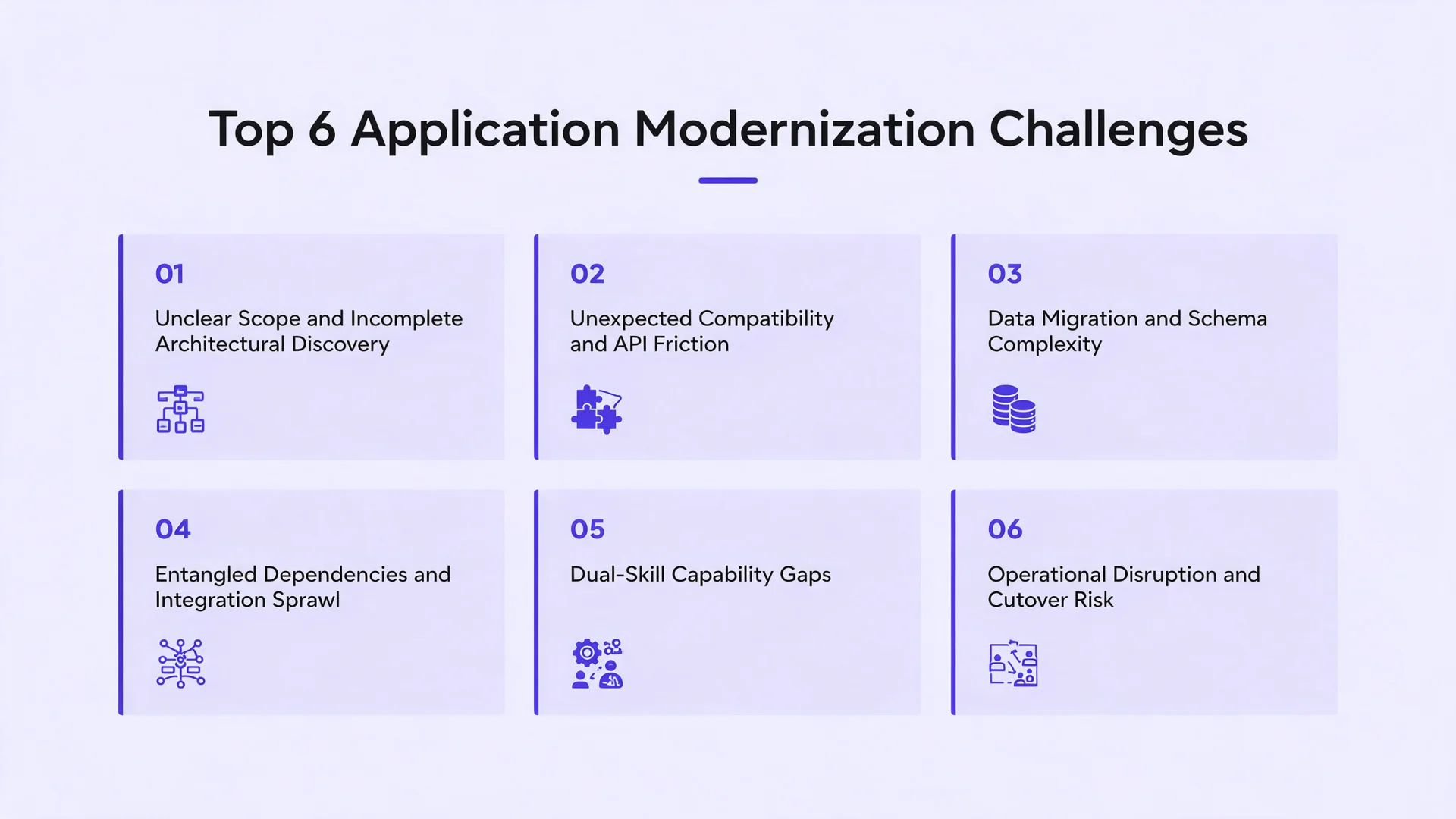
1. Unclear Scope and Incomplete Architectural Discovery
Teams frequently commit to hard deadlines long before mapping their actual tech stack. Undocumented application logic, forgotten microservices, and shadow IT dependencies surface mid-project, instantly diluting resources. Shallow discovery at the start creates expensive rework at the end.
2. Unexpected Compatibility and API Friction
Legacy code base rarely plays nice with modern cloud-native architecture. Compatibility issues peak when framework versions, underlying operating systems, or cloud environments demand patterns the original system was never engineered to support. Unsupported dependencies and deprecated APIs force unplanned redesigns mid-flight.
3. Data Migration and Schema Complexity
Data migration is notoriously the single largest source of project delay. Legacy databases often house decades of poor data quality, mismatched schemas, and complex business logic buried deep inside stored procedures. Translating and cleansing this data while minimizing downtime frequently becomes a massive project within the project.
4. Entangled Dependencies and Integration Sprawl
Legacy systems don’t exist in isolation. They are intertwined with third-party tools, scheduled batch jobs, and legacy reporting pipelines. Changing a single interface can trigger a domino effect across the enterprise ecosystem, creating silent points of failure during rollout.
5. Dual-Skill Capability Gaps
Modernization requires two distinct talent sets: deep domain knowledge of legacy systems and expertise in modern cloud architectures. As veteran developers retire, legacy tribal knowledge vanishes, while modern platform engineering talent remains scarce and expensive.
6. Operational Disruption and Cutover Risk
A technical deployment is only half the battle. If cutovers trigger unexpected service downtime or force major workflow friction without adequate change management, the business suffers, even if the underlying code is flawless.
Legacy Application Modernization Challenges
Legacy app modernization services challenges have their own flavor, because age compounds every problem above.
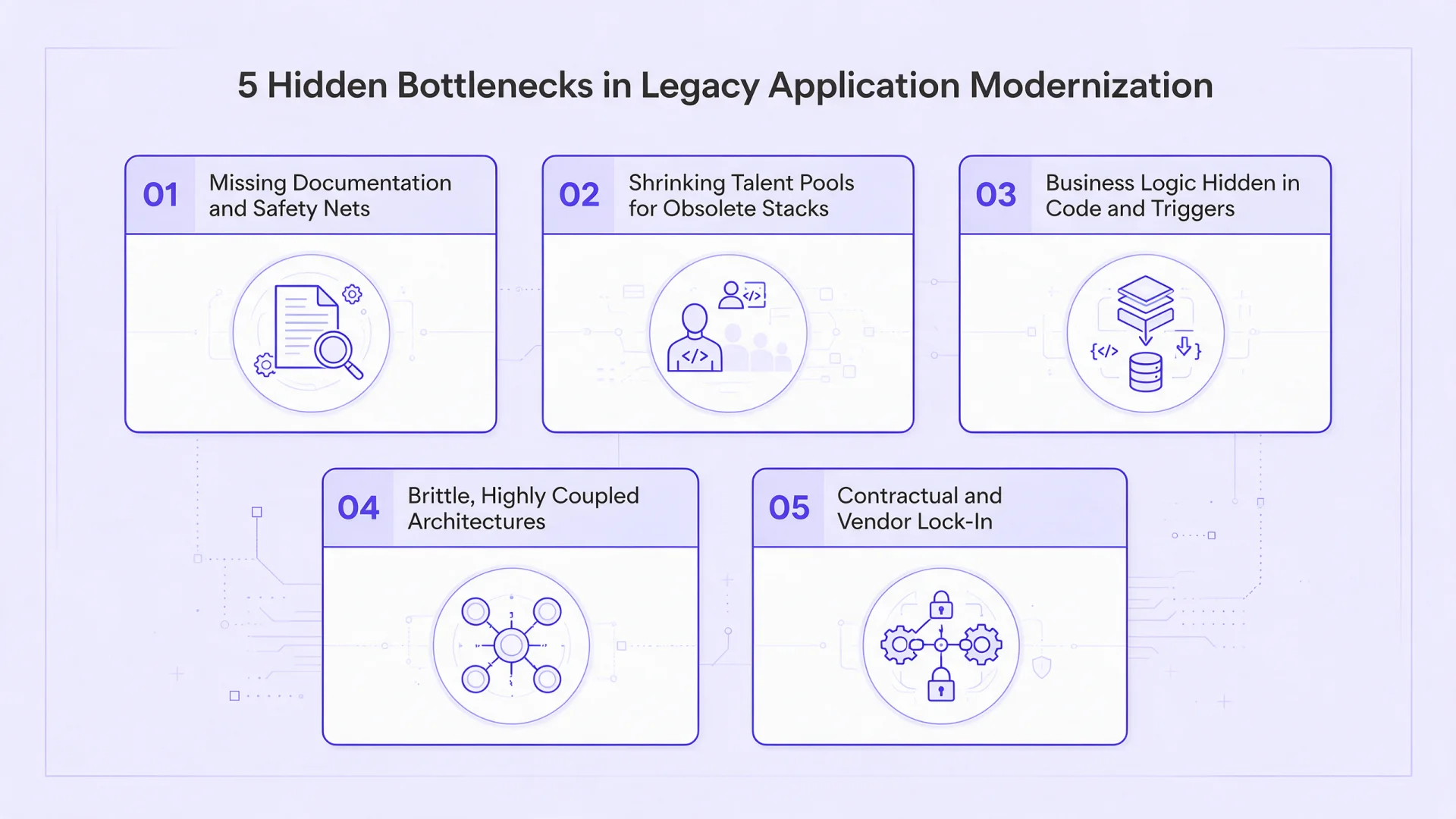
1. Missing Documentation and Safety Nets
You can’t safely transform what you don’t understand. Decades of quick fixes without updated specifications or automated test suites turn every code change into a blind risk.
2. Shrinking Talent Pools for Obsolete Stacks
Mainframes, legacy COBOL, outdated .NET frameworks, and monolithic Java setups severely limit your engineering options. Finding developers who can maintain these systems, let alone modernize them, is increasingly difficult and expensive.
3. Business Logic Hidden in Code and Triggers
In legacy environments, critical business rules rarely exist in clear documentation. Instead, they are buried deep inside undocumented code, database triggers, stored procedures, and external spreadsheets.
4. Brittle, Highly Coupled Architectures
Legacy monoliths lack clean separation of concerns. Monolithic coupling means changing a single line of code in one module can trigger unpredictable ripples across the entire platform.
5. Contractual and Vendor Lock-In
Proprietary frameworks, restrictive software licenses, and legacy vendor agreements limit modern cloud choices and lock organizations into costly, outdated ecosystems.
The Strategic Blueprint: Characterize Before You Change
To mitigate these risks, never attempt a blind "big bang" rewrite. Always characterize current system behavior before modifying it:
- Capture Baseline Behavior: Build regression test suites to validate current logic before writing new code.
- Map All Dependencies: Graph incoming and outgoing data feeds, APIs, and batch dependencies to understand the blast radius.
- Modernize Incrementally: Apply proven architectural migration patterns; like the Strangler Fig pattern, to slice away and replace legacy modules gradually without disturbing business operations.
Application Modernization Challenges in Large Enterprises
Application modernization challenges in large enterprises add organizational scale to the technical ones.
- Portfolio Scale and Prioritization: Hundreds or thousands of applications can't all be modernized at once. Without clear criteria, politics decides, and low-value systems get funded while critical ones wait.
- Multiple Stakeholders and Competing Priorities: Business units, security, compliance, and infrastructure teams each have requirements. Without an accountable owner, decisions stall.
- Regulatory and Compliance Requirements: Financial, healthcare, and public-sector organizations must preserve audit trails, retention rules, and security controls through the change. Compliance work that arrives late is expensive.
- Funding Cycles: Annual budget cycles clash with multi-year programs. Funding gaps mid-program leave systems half-modernized, which is often the worst state to be in.
Application Modernization Risks You Should Plan For
Application modernization risks fall into five groups. Naming them early is half of managing them.
Risk Category | Examples | Typical Impact |
Scope and planning | Incomplete discovery, shifting requirements | Cost and schedule overruns |
Technical | Compatibility problems, performance regressions, integration failures | Rework, delays |
Data | Quality issues, migration errors, loss or corruption | Outages, compliance exposure |
Organizational | Skills gaps, change resistance, unclear ownership | Stalled delivery |
Operational and security | Downtime, new vulnerabilities, weak access control | Business disruption, incidents |
For Application Modernization Project Risks in Delivery
Application modernization project risks intensify during cutover and the weeks after: parallel running costs, defects found by real users, performance under load, and the pressure to declare success too early.
For Legacy System Modernization Risks and Legacy Application Modernization Project Risks
Legacy system modernization risks, and the legacy application modernization project risks that follow from them, are dominated by unknowns: hidden dependencies, undocumented behavior, and knowledge concentrated in a few people. Budget time for discovery and reserve contingency specifically for these unknowns.
How to Prevent Application Modernization Cost Overruns
Learning how to prevent application modernization cost overruns means attacking their causes, not just tracking spend.
- Finish discovery before committing to a fixed price or date. Use a paid discovery phase if needed.
- Estimate bottom-up, then add risk-adjusted contingency. Don't apply a single percentage to a top-down guess.
- Control scope with formal change management. Every addition has a cost and an owner.
- Phase the work. Smaller releases expose errors earlier, when they are cheaper to fix.
- Retire before you modernize. Don't pay to migrate applications nobody uses.
- Include the costs vendors forget. Parallel running, data cleansing, testing, training, and decommissioning belong in the budget.
- Track forecast against actuals monthly and make go, change, or stop decisions at stage gates.
How to Estimate Application Modernization Costs
If you're asking how to estimate application modernization costs, use a structured method:
- Inventory applications with owner, criticality, size, dependencies, and compliance needs.
- Assign a pattern to each (retire, rehost, replatform, refactor, rearchitect, rebuild, replace).
- Apply unit costs per pattern, calibrated with a pilot rather than assumed.
- Add cross-cutting work: data migration, integration, security, testing, training, and project management.
- Model parallel running for the months when the old and new systems both operate.
- Add contingency. A common rule of thumb for complex programs is 15 to 25 percent, higher when discovery is thin.
- Express the result as a range, not a single number, and narrow it as discovery completes.
Application Modernization Budget Planning
Application modernization budget planning works best as a multi-year view that separates one-time project cost, transition cost, and ongoing run cost. Fund in stages tied to measurable milestones, protect a contingency reserve, and agree in advance what is deferred first if costs trend up. Pairing budget with an Application modernization ROI model shows finance leaders what the spend buys: lower run cost, faster delivery, reduced risk, and avoided outages.
How to De-Risk Application Modernization Projects
How to de-risk application modernization projects comes down to a handful of disciplines applied consistently.
Application Modernization Risk Management
Application modernization risk management means a living risk register: each risk has an owner, likelihood, impact, mitigation, and trigger. Review it weekly during delivery, escalate to the steering group, and retire risks only with evidence.
Application Modernization Risk Mitigation Strategies
Effective application modernization risk mitigation strategies include:
- Characterization tests that lock in current behavior before change
- Pilots that validate estimates and tooling on a representative application
- Parallel runs to compare old and new outputs
- Rollback plans that are rehearsed, not just written
- Feature flags to separate deployment from release
- Independent security and performance testing before cutover
- Knowledge capture from key people early
Phased Modernization Strategy
A phased modernization strategy replaces big-bang cutovers with small, reversible steps. Sequence by business value and dependency, deliver working increments, and learn between waves. The strangler pattern, where new components gradually take over functionality behind a stable interface, is the most reliable way to modernize critical systems without a single high-stakes switchover.
Modernization Project Governance
Modernization project governance gives the program authority to say no. It should include an executive sponsor, a steering committee, defined stage gates, a change-control board for scope and budget, clear decision rights, and transparent reporting. Programs without governance drift; programs with it correct.
How to Minimize Downtime During Application Modernization
Knowing how to minimize downtime during application modernization protects both revenue and trust. Application downtime prevention is mostly deployment design:
- Blue-green deployment runs old and new side by side and switches traffic with instant rollback
- Canary releases expose a small percentage of users first
- Backward-compatible database changes let both versions work during transition
- Data replication and incremental sync shorten final cutover windows
- Off-peak cutovers with rehearsed runbooks and clear go or no-go criteria
- Observability so problems are seen in minutes, not hours
Add business continuity planning: define tolerable downtime, communication plans, and who can invoke rollback.
Application Modernization Strategy and Roadmap
Building a successful application modernization strategy and roadmap requires shifting from one-off tech upgrades to a continuous, value-driven transformation.
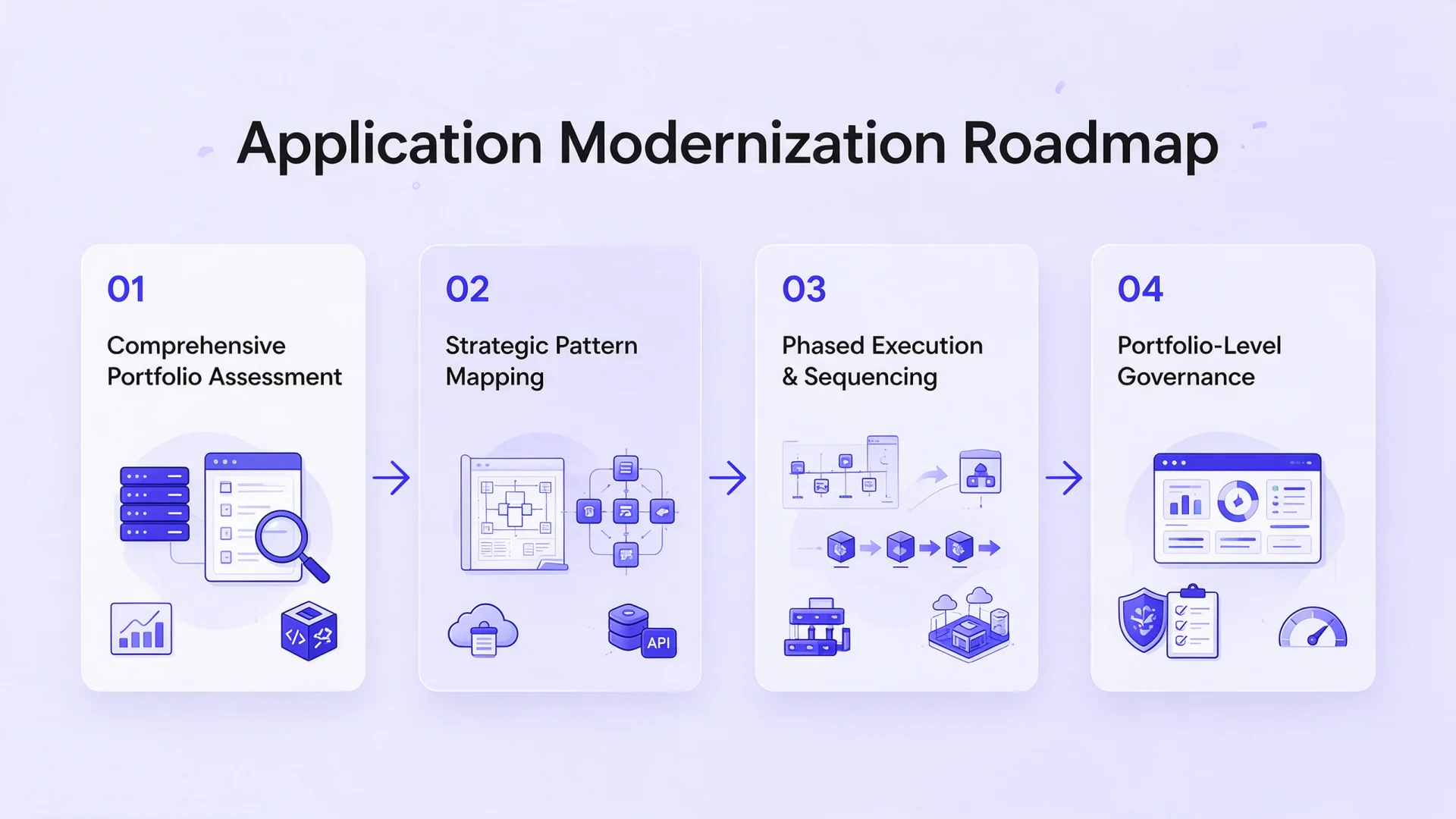
- Comprehensive Portfolio Assessment: Evaluate legacy assets across business value, technical debt, security risk, and cloud readiness.
- Strategic Pattern Mapping: Assign the right modernization pattern to every application, whether that means rehosting, refactoring, re-architecting, or replacing.
- Phased Execution & Sequencing: Build a multi-wave roadmap detailing clear dependencies, milestone targets, resource allocation, and application owners.
- Portfolio-Level Governance: Ensure long-term execution by funding and managing the modernization program as an interconnected portfolio rather than isolated, competing projects.
Note: For an in-depth breakdown of modernization patterns, risk mitigation, and application sequencing, read our comprehensive guide to Application Modernization Strategies.
Cloud-Native Transformation: When It's Worth the Risk
Cloud-native transformation, such as containers, microservices, and serverless, delivers the biggest gains in scalability and delivery speed, and carries the highest risk. Reserve it for applications that differentiate your business and truly benefit; for many others, rehosting or replatforming captures most of the value at far lower risk.
Application Modernization Best Practices
Consistent application modernization best practices include:
- Assess before you commit
- Modernize the portfolio, not just one application
- Choose the lightest pattern that meets the goal
- Build tests before changing behavior
- Migrate data early and validate often
- Automate builds, tests, and deployments
- Measure outcomes, not just activity
Application Modernization Project Planning Checklist
Use this application modernization project planning checklist before kickoff and at each stage gate:
- Business case, goals, and success metrics agreed
- Application inventory and dependency map complete
- Pattern chosen for each application, with rationale
- Data assessment done, with quality and migration approach defined
- Budget built bottom-up, with contingency and parallel-run costs
- Phased roadmap with owners, milestones, and stage gates
- Governance structure and change control in place
- Test strategy covers behavior, integration, performance, and security
- Cutover, rollback, and communication plans documented and rehearsed
- Skills plan covers internal dedicated team and partners
- Compliance and security requirements mapped to each phase
- Post-go-live support and optimization funded
Regional Considerations: US, Canada, and India
In the US and Canada, regulated sectors need change-approval evidence, data-residency controls, and security attestations built into the plan. In India, large engineering talent pools and extended-hours delivery can accelerate discovery, testing, and migration work when ownership and handoffs are explicit. Whichever mix you use, define overlap hours, security obligations, and decision rights in the contract.
To summarize how to overcome application modernization challenges, and how to reduce application modernization risks along the way: discover thoroughly, phase deliberately, govern firmly, test relentlessly, and budget honestly. Each of those habits removes one of the common failure causes. Together they change a program from a gamble into a managed investment.
Choosing a Reliable App Modernization Partner
If you plan to outsource, the partner you pick shapes how many of these risks you carry. Look for:
- A structured discovery and assessment process, offered before a fixed commitment
- Experience with your source and target technologies and with your industry
- A pilot-first approach with defined success criteria
- Transparent, itemized costing, including what is excluded
- Clear governance, reporting, and escalation paths
- Knowledge transfer and ownership of code, documentation, and infrastructure definitions
- References at similar scale in your region
Ask every vendor to explain how they would handle data migration, rollback, and scope change on your project. Vague answers are an early warning.
Leverage Our Expertise to De-Risk Your Modernization
Executing a successful modernization program demands deep technical domain expertise and disciplined risk management. We partner with emerging startups and Fortune 500 enterprise leaders to simplify complex legacy transformations, translating technical debt into scalable, high-performance assets.
Our structured approach begins with an objective portfolio assessment to establish realistic budgets, prioritize quick wins, and mitigate architecture risks. By delivering modernization in controlled, incremental phases, we ensure your core business remains fully protected at every stage.
Explore our full suite of Application Modernization Services to see how our discovery, delivery, and governance frameworks turn complex IT challenges into predictable business growth. Talk to our engineering leaders today about a low-risk pilot project to prove performance and ROI before deploying your full budget.
Wrap Up!
Application modernization challenges are predictable, which is good news. Overruns trace back to incomplete discovery, unmanaged scope, data and compatibility surprises, weak governance, and all-at-once plans. Counter them with assessment first, phased delivery, risk-adjusted budgets, rehearsed rollback, and firm governance, and your project looks very different from the roughly 70 percent that overrun.
Start with a short discovery on your most critical application. It will tell you more about your real cost, risk, and timeline than any estimate made from a distance.

Vice President, Strategy – VLink Inc.
Sambhavi Gopalakrishnan is the Vice President of Strategy at VLink Inc., bringing over a decade of experience in IT leadership, project implementation, and strategic growth. She possesses a strong foundation in technical project management and pre-sales, driving innovation and business transformation at VLink.

 Shivisha Patel