


So, when a startup in Dubai Internet City or an enterprise scaling across the UAE asks, “What does app development cost in Dubai?” — the answer matters. Not just as a budget line item, but as a strategic investment decision that shapes whether your digital product competes or gets buried.
Here’s the short answer: app development cost in Dubai typically ranges from AED 25,000 to AED 500,000+ (approximately USD 7,000 to USD 136,000+), depending on app complexity, platform, design requirements, and whether you choose a local agency, freelancer, or an offshore development partner.
But the short answer rarely tells the whole story. This guide breaks down every cost factor — from feature complexity and platform choice to regulatory compliance and hidden post-launch expenses — so you can plan your 2026 budget with clarity and confidence. Whether you’re building a fintech MVP or an enterprise logistics platform, this is your roadmap.
Why Dubai Is a Hotspot for Mobile App Development in 2026
Several structural forces are driving this growth simultaneously. The Smart Dubai initiative and UAE Digital Government Strategy have digitized government services at a pace that few cities globally can match — nine out of ten government service interactions are now handled entirely by AI. The UAE’s 5G coverage stands at 94% of the population, delivering the infrastructure backbone that makes real-time, data-intensive mobile apps viable at scale.
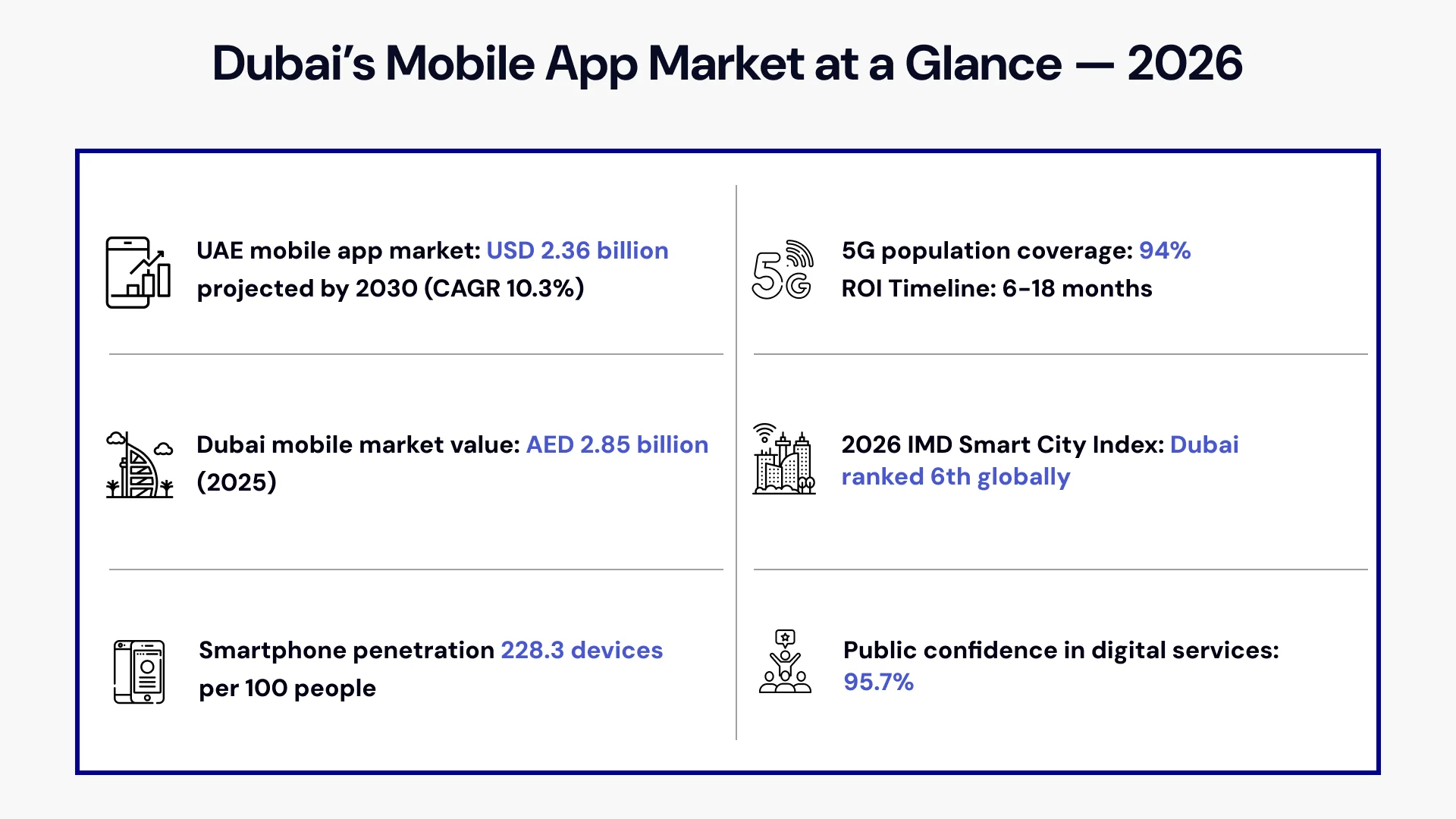
From a business perspective, the numbers reinforce the opportunity. The UAE’s digital commerce sector is projected to exceed USD 9 billion by 2026. Digital wallet transactions reached AED 147 billion in 2023, a 39% year-on-year increase. Over 200 government services are exclusively accessible through the UAE Pass digital identity app. And Dubai’s annual influx of 25 million+ visitors creates a transient but enormous addressable market for travel, hospitality, and on-demand service apps.
For businesses considering app development in Dubai, these aren’t just statistics. They represent validated market demand, government-backed infrastructure, and a consumer base that expects mobile-first digital experiences as the default — not the exception.
How Much Does App Development Cost in Dubai? Quick Overview
Before diving into the details, here’s a bird’s-eye view of what application development in Dubai typically costs in 2026. These ranges reflect real project data from agencies, offshore partners, and hybrid development teams operating in the UAE market.
| App Complexity | Cost Range (AED) | Cost Range (USD) | Timeline |
| Basic / MVP | AED 25,000 – 80,000 | USD 7,000 – 22,000 | 2–4 months |
| Mid-Level | AED 80,000 – 200,000 | USD 22,000 – 55,000 | 4–7 months |
| Complex / Feature-Rich | AED 200,000 – 500,000 | USD 55,000 – 136,000 | 6–12 months |
| Enterprise-Grade | AED 500,000+ | USD 136,000+ | 9–18 months |
A basic app with 3–5 screens, single-platform support, and minimal backend — think appointment booking or a simple informational tool — sits at the lower end. Mid-level apps layer on cross-platform support, payment integration, user dashboards, and custom UI/UX. Complex apps introduce AI/ML features, real-time data, multi-role user logic, and third-party integrations. Enterprise solutions demand CRM integration, advanced security, and compliance with industry-specific regulations.
Keep in mind: these are development costs. Total cost of ownership — which includes post-launch maintenance, marketing, hosting, and iterative updates — typically adds 40–70% to your initial investment over the first year.

Key Factors That Influence App Development Cost in Dubai
The gap between a AED 25,000 app and a AED 500,000 app isn’t arbitrary. It’s the sum of six interconnected cost drivers that every Dubai business should understand before engaging a development partner. Let’s break each one down.
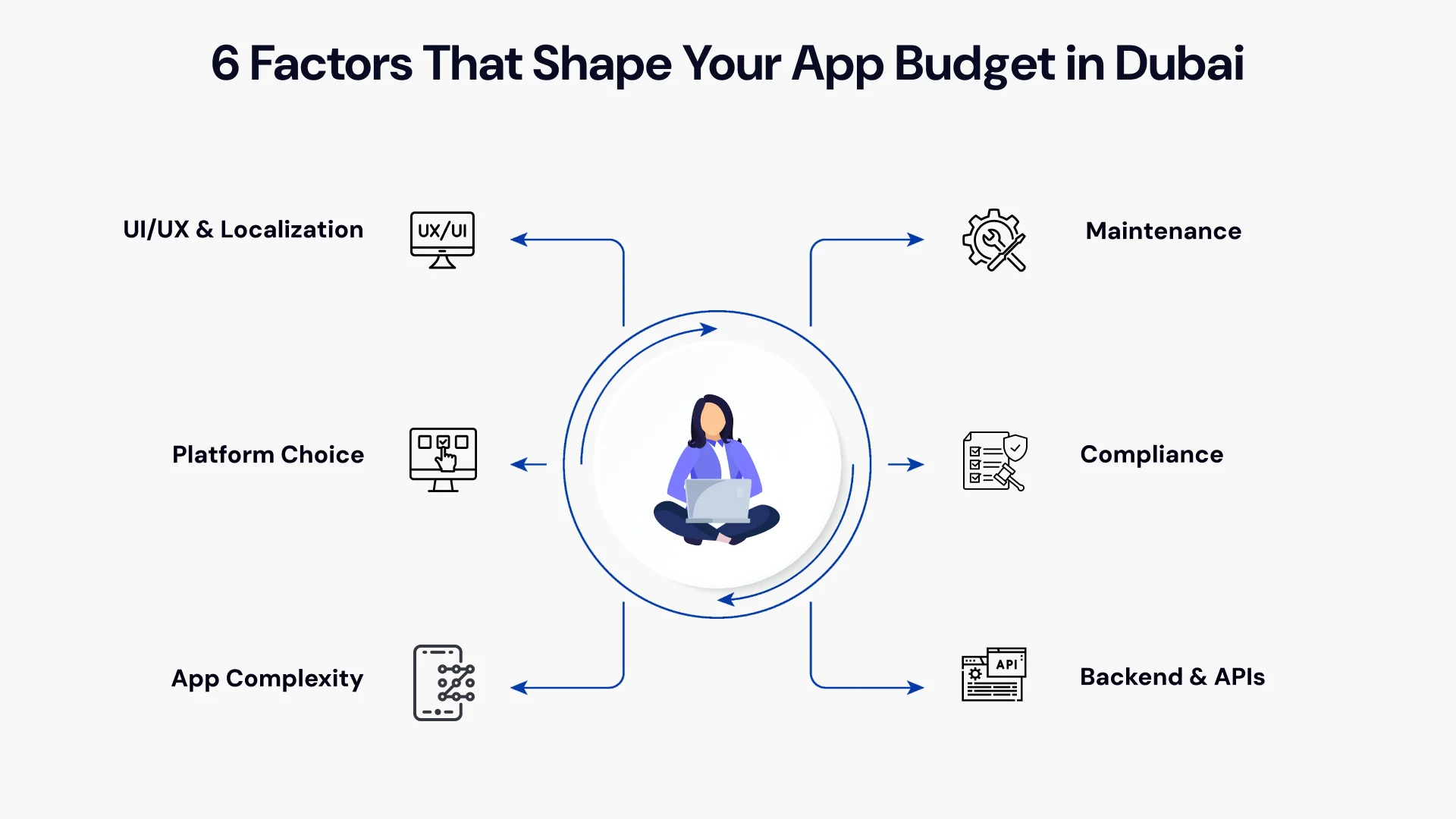
App Complexity and Feature Set
This is the single largest determinant of your app development cost in Dubai. A straightforward utility app with a login screen, static content, and push notifications requires fundamentally different engineering from an app with real-time chat, AI-powered recommendations, payment gateways, and multi-role user dashboards.
Here’s how feature complexity maps to cost in the Dubai market:
| Feature Category | Examples | Estimated Cost Impact |
| Basic Features | Login, profiles, static content, notifications | AED 18,000 – 40,000 |
| Moderate Features | Payment integration, social features, dashboards, search/filter | AED 40,000 – 120,000 |
| Advanced Features | AI/ML, real-time tracking, video calls, blockchain, AR/VR | AED 120,000 – 400,000+ |
Each feature you add doesn’t just increase coding hours — it compounds testing time, server infrastructure requirements, and ongoing maintenance scope. A payment gateway alone, for example, adds regulatory compliance overhead specific to the UAE’s Central Bank (CBUAE) requirements.
Platform Choice — iOS, Android, or Cross-Platform
Your platform decision has a direct multiplier effect on cost. Building native apps for both iOS and Android means two separate codebases, two QA cycles, and two maintenance streams — effectively doubling your investment compared to a single-platform build.
Cross-platform frameworks like Flutter and React Native have matured significantly. In 2026, most Dubai-based development agencies recommend Flutter for new projects because it delivers a single codebase for iOS, Android, and web, with near-native performance. This approach typically reduces development cost by 25–40% compared to dual-native builds.
However, native development still makes sense for apps requiring complex animations, hardware-intensive features, or deep platform-specific integration — particularly enterprise apps where performance under heavy data loads is non-negotiable.
UI/UX Design and Arabic Localization
Dubai isn’t a single-language market. Your app needs to support both English and Arabic, which means implementing right-to-left (RTL) interfaces, culturally appropriate design patterns, and bilingual content management. This localization layer typically adds AED 10,000–30,000 to your design budget — but skipping it isn’t an option if you want meaningful local adoption.
Arabic-first applications demonstrate 60% higher engagement rates among local users, according to industry benchmarks. Custom UI/UX design with brand-aligned animations, micro-interactions, and adaptive layouts for foldable screens and wearable devices adds further to the budget — but significantly improves conversion and retention rates in Dubai’s competitive consumer market.
Backend Infrastructure and API Integrations
Your app’s backend — the server, database, business logic, and APIs — is the engine under the hood. Apps that require real-time updates (ridesharing, chat platforms, live tracking) need robust server-side logic, websocket infrastructure, and scalable cloud architecture. This backend complexity can represent 35–50% of your total development budget.
Third-party API integrations — payment gateways (Tabby, Telr, Apple Pay), mapping services, Emirates ID verification, UAE Pass authentication — each add development time and cost. A fintech app integrating with local payment processors and CBUAE-compliant systems will have a significantly heavier backend than an informational tourism app.
Also Read: Cost to Develop a BNPL App Like Tabby in Dubai/UAE
Regulatory Compliance (PDPL, TDRA, CBUAE)
Compliance isn’t a checkbox — it’s an engineering requirement that affects your data architecture, encryption standards, user consent flows, and audit logging. Depending on your industry, compliance-related development can add AED 20,000–100,000 to your total cost. Non-compliance, however, risks fines that start at AED 500,000, making this a cost you cannot afford to defer.
Post-Launch Maintenance and Hidden Costs
Development is just the beginning. Post-launch costs are where budgets derail if not planned for. Industry benchmarks suggest allocating 15–25% of your initial development cost annually for maintenance alone. Here’s what that covers:
Annual maintenance and updates: AED 5,000–20,000/year — OS compatibility patches, bug fixes, performance optimization.
Cloud hosting: AED 3,000–15,000/year — scales with user base and data volume.
App store fees: AED 370 (Apple) + AED 92 (Google) annually.
Marketing and ASO: 30–50% of total budget in the first year for user acquisition.
Feature iterations: AED 2,000–50,000+ per feature update.
Most experienced app developers in Dubai recommend budgeting for at least 18 months of post-launch expenses alongside your initial development costs. This ensures your app stays competitive, compliant, and responsive to user feedback.
App Development Cost in Dubai by Industry
Generic cost tiers only tell part of the story. In Dubai’s market, the industry you’re building for shapes your cost profile dramatically — because each sector carries different feature requirements, compliance burdens, and user expectations. Here’s what businesses across Dubai’s key verticals should expect:
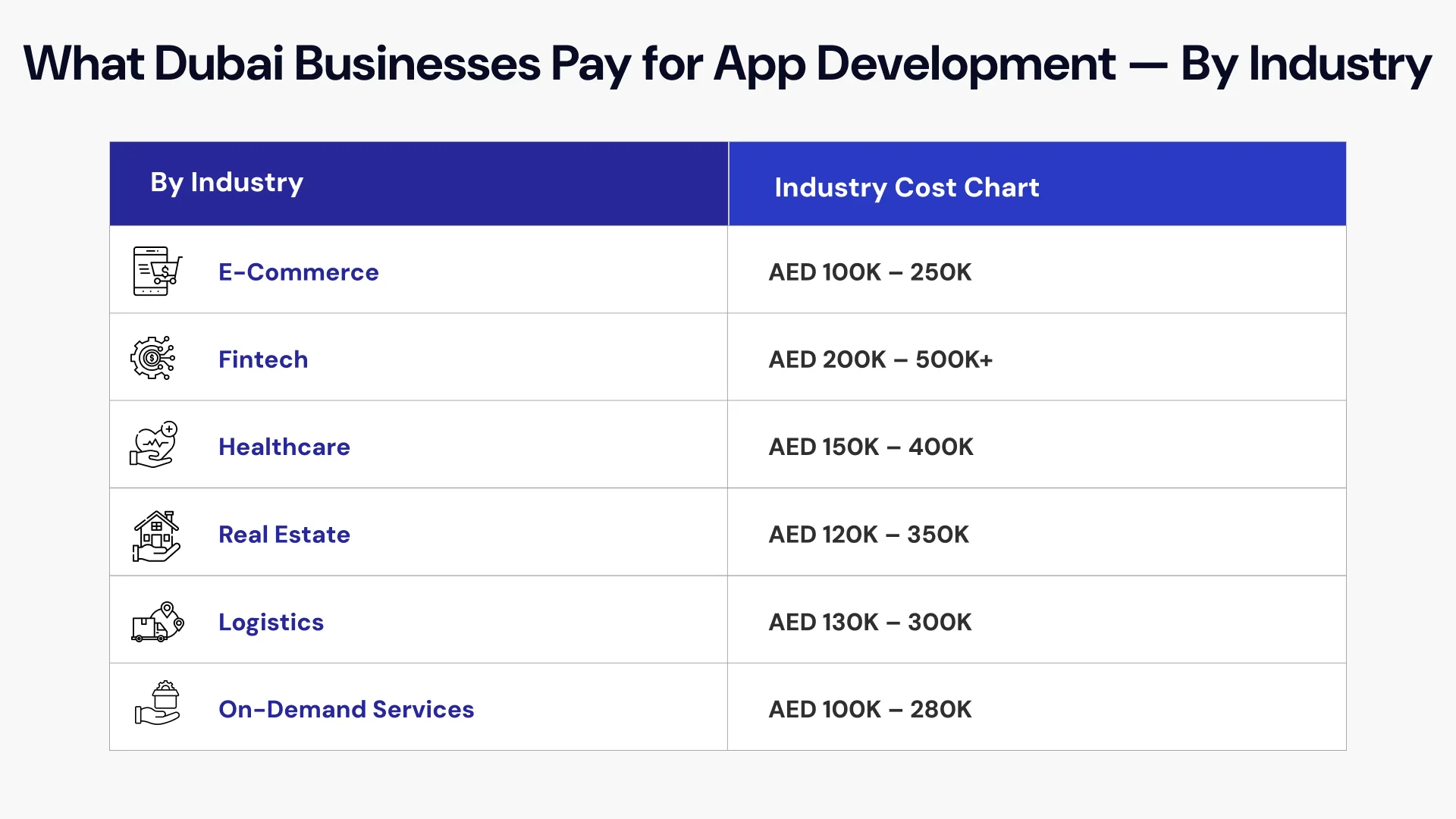
| Industry | Cost Range (AED) | Key Cost Drivers | Timeline |
| E-Commerce | AED 100,000 – 250,000 | Product catalog, payments, logistics integration, multilingual UI | 4–8 months |
| Fintech | AED 200,000 – 500,000+ | CBUAE compliance, KYC/AML, payment processing, encryption | 8–14 months |
| Healthcare | AED 150,000 – 400,000 | DHA compliance, EMR integration, HIPAA-level security, telehealth | 6–12 months |
| Real Estate | AED 120,000 – 350,000 | DLD API integration, AR property tours, CRM, off-plan booking | 5–10 months |
| Logistics | AED 130,000 – 300,000 | Real-time GPS tracking, fleet management, route optimization, IoT | 5–10 months |
| On-Demand Services | AED 100,000 – 280,000 | Multi-panel (customer/driver/admin), live tracking, payment, ratings | 5–9 months |
Fintech and healthcare consistently sit at the top of the cost curve because of their stringent regulatory requirements. A fintech app in Dubai requires CBUAE authorization, robust KYC/AML implementation, and end-to-end encryption — each adding layers of engineering complexity that a lifestyle or utility app simply doesn’t face.
E-commerce and on-demand service apps, while less regulated, demand complex multi-panel architectures — separate interfaces for customers, service providers, and administrators — plus real-time synchronization across all panels. The UAE’s digital commerce sector is projected to surpass USD 9 billion by 2026, validating the investment for businesses entering this space.
Also Read: Cost to Develop a Car Rental App Like Udrive

App Development Cost Breakdown by Development Phase
Understanding where your money goes at each stage helps you allocate budget strategically and avoid the “where did the money go?” conversations that plague poorly planned projects. Here’s a realistic phase-wise cost breakdown for a mid-complexity app in Dubai:

| Development Phase | Cost Range (AED) | % of Total Budget | Timeline |
| Discovery & Planning | AED 5,000 – 20,000 | 5–10% | 1–3 weeks |
| UI/UX Design | AED 15,000 – 50,000 | 10–20% | 2–6 weeks |
| Frontend Development | AED 30,000 – 120,000 | 25–35% | 6–16 weeks |
| Backend Development | AED 25,000 – 100,000 | 20–30% | 6–16 weeks |
| QA & Testing | AED 10,000 – 40,000 | 10–15% | 2–6 weeks |
| Deployment & Launch | AED 3,000 – 10,000 | 2–5% | 1–2 weeks |
| Compliance & Legal | AED 10,000 – 50,000 | 5–15% | Ongoing |
The discovery and planning phase is frequently underinvested. Businesses that skip thorough requirements gathering and competitor analysis often face 20–40% cost overruns during development because of scope changes. Investing AED 10,000–20,000 upfront in a detailed discovery phase with your development partner can save you multiples of that downstream.
Frontend and backend development together typically consume 50–65% of the total budget. This is where the core engineering happens — and where the choice between a local Dubai agency charging AED 150–250/hour and an offshore partner at AED 60–120/hour makes the biggest financial difference.
Hiring Models Compared - What Works Best for Dubai Businesses?
Where and how you hire your development team can swing your total app development cost in Dubai by 30–60%. This isn’t just about hourly rates — it’s about what you get for those rates, including project management, compliance awareness, communication reliability, and long-term support.
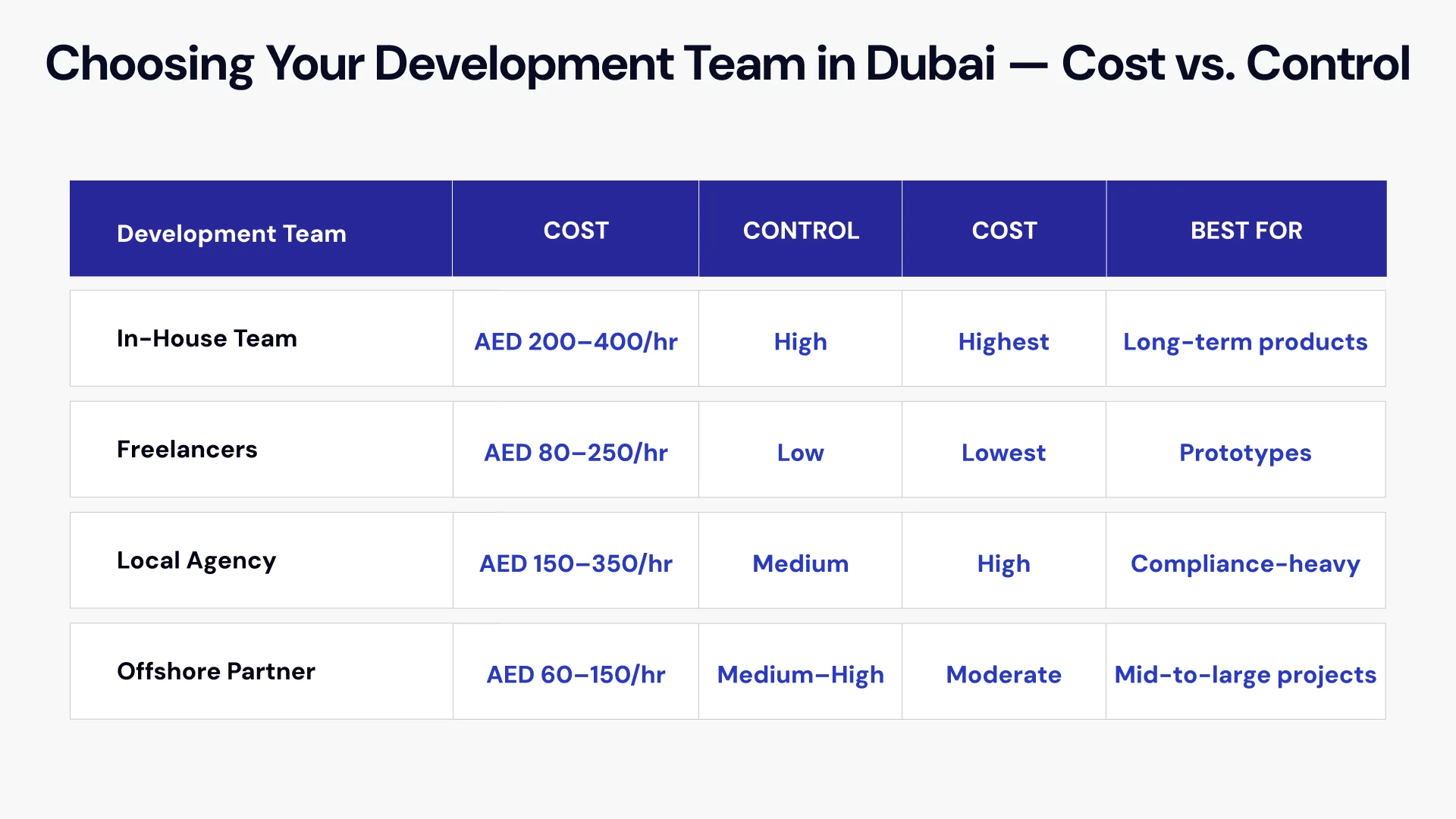
| Hiring Model | Hourly Rate (AED) | Pros | Cons | Best For |
| In-House Team (Dubai) | AED 200–400/hr (fully loaded) | Full control, deep domain knowledge, cultural alignment | High overhead, slow hiring (3–6 months), benefits, visa costs | Long-term products with ongoing development |
| Freelancers | AED 80–250/hr | Low cost, flexible, quick start | Low reliability, no QA process, IP risks, limited scalability | Small MVPs, prototypes, single-feature updates |
| Local Dubai Agency | AED 150–350/hr | UAE compliance expertise, local market understanding, face-to-face | Premium pricing, limited team scalability | Compliance-heavy apps (fintech, healthcare) |
| Offshore Development Partner | AED 60–150/hr | 30–50% cost savings, large talent pool, scalable teams, process-driven | Time zone gap (mitigated by overlap hours), requires strong communication | Mid-to-large projects needing cost efficiency without sacrificing quality |
The most effective approach for Dubai businesses in 2026? A hybrid model. Keep compliance-critical functions — regulatory consulting, payment gateway integration, and project management — with a partner who understands the UAE market. Outsource the bulk of development, testing, and maintenance to a proven offshore team.
This hybrid strategy typically saves 30–50% compared to a fully local approach while ensuring your app meets PDPL, CBUAE, and TDRA requirements. Companies like VLink operate this exact model — combining global engineering talent with Dubai-specific delivery expertise to give UAE businesses the best of both worlds.

Smart Ways to Reduce Your App Development Cost in Dubai
Budget optimization isn’t about cutting corners. It’s about making strategic decisions that get your product to market faster without sacrificing quality, compliance, or long-term scalability. Here are five proven approaches that Dubai businesses are using in 2026:
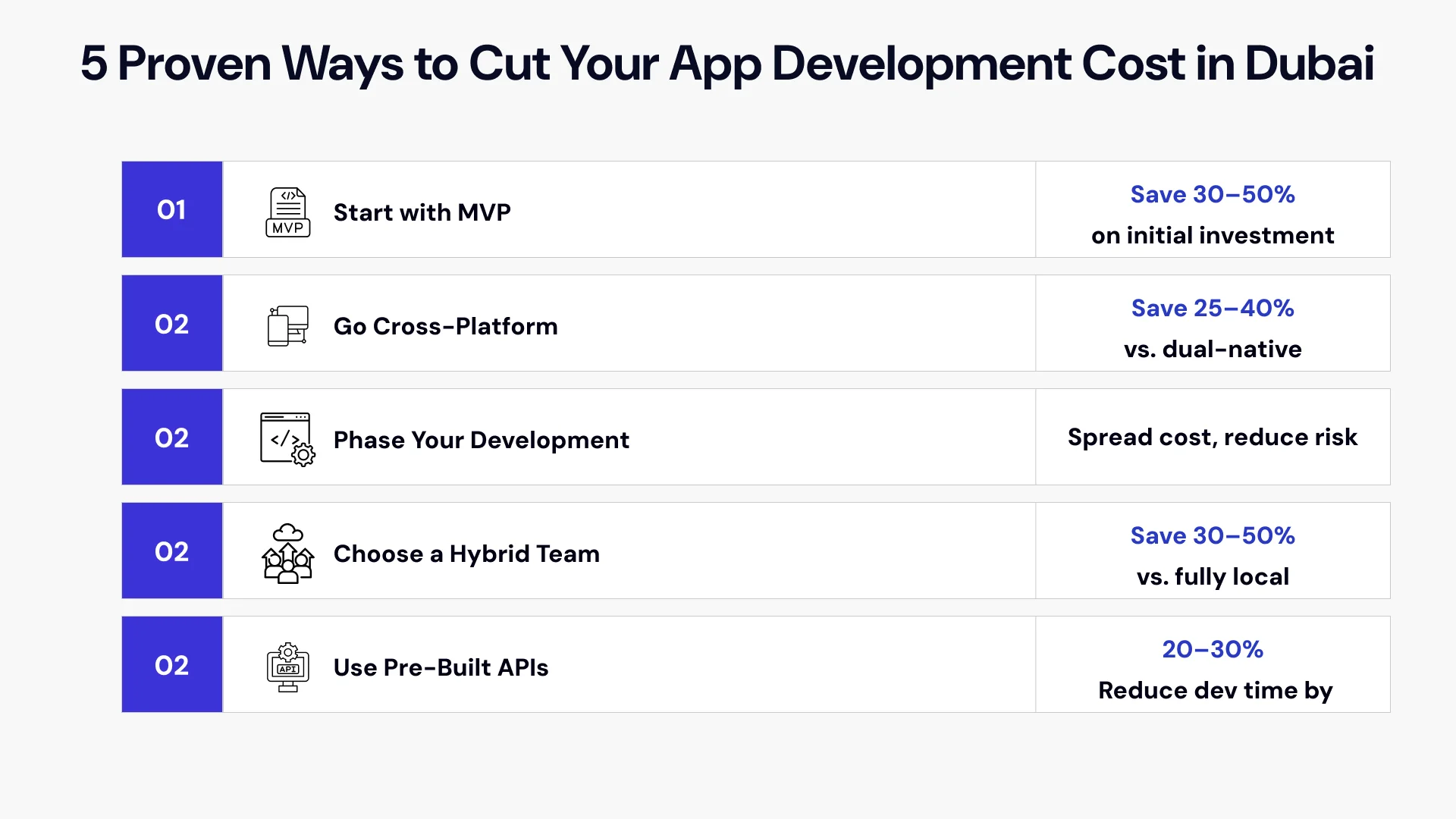
1. Start With an MVP
An MVP (Minimum Viable Product) strips your app down to its core value proposition — the single problem it solves best. This approach reduces your initial investment by 30–50% and gets you to market in 2–4 months instead of 8–12. You validate your concept with real users, gather data-driven feedback, and then invest in additional features that the market actually wants. For a Dubai startup, this means launching an MVP at AED 25,000–80,000 rather than committing AED 200,000+ to a full-featured app that may need pivoting.
2. Choose Cross-Platform Development
Flutter and React Native have closed the performance gap with native development for most commercial use cases. Choosing cross-platform eliminates the need for separate iOS and Android development teams, saving 25–40% on total cost. For most Dubai businesses launching in 2026, Flutter is the recommended choice — it delivers near-native performance with a single codebase.
3. Adopt Phased Development
Instead of building everything at once, break your project into strategic phases. Phase 1 covers core features and launch. Phase 2 adds user-requested features based on analytics. Phase 3 scales infrastructure and adds advanced capabilities. This approach spreads cost over time, reduces financial risk, and ensures each feature is informed by real user data rather than assumptions.
4. Partner With an Offshore or Hybrid Team
As the hiring comparison above shows, offshore partners like VLink offer 30–50% cost savings compared to local Dubai agencies, with comparable quality and process maturity. The key is choosing a partner with proven UAE market experience — one that understands PDPL compliance, Arabic localization requirements, and Dubai’s regulatory landscape.
5. Leverage Pre-Built Components and APIs
Not every feature needs to be built from scratch. Payment gateways (Stripe, Telr), authentication services (Firebase, Auth0), mapping (Google Maps API), and push notification services (OneSignal) can be integrated at a fraction of the cost of custom development. Smart use of pre-built components can reduce development time by 20–30%.
How VLink Helps Dubai Businesses Build Smarter Apps for Less
VLink operates as a strategic app development partner for startups and enterprises across Dubai, Abu Dhabi, and the wider UAE. With delivery expertise spanning 30+ industries and a team of 500+ engineers, VLink combines the cost efficiency of a global technology firm with the compliance expertise that Dubai’s regulatory environment demands.
Here’s what this looks like in practice. VLink’s Dubai delivery model uses an agile, hybrid approach — senior architects and project managers aligned with your time zone, backed by dedicated development pods that ship production-ready code across sprints. This means you get the quality and reliability of a local agency at 30–50% lower cost.
For Dubai businesses specifically, VLink brings Arabic-first UI/UX design capabilities, RTL interface expertise, PDPL and CBUAE compliance engineering, and integration with local payment gateways and government APIs like UAE Pass and Emirates ID. These aren’t add-ons — they’re built into every UAE-facing project from day one.
Also Read: iOS App Development Cost: Project Breakdown Guide

Conclusion
Dubai’s mobile app market is projected to reach USD 2.36 billion by 2030. The city’s 6th-place global Smart City ranking, 95.7% public confidence in digital services, and a smartphone penetration rate that exceeds 228 devices per 100 people all point to one reality: mobile apps are the primary channel through which Dubai’s businesses will engage customers, deliver services, and compete.
The cost to build that app — whether it’s AED 25,000 for a lean MVP or AED 500,000+ for an enterprise platform — is ultimately a function of the decisions you make around complexity, platform, design, compliance, and your hiring model. The businesses that succeed aren’t always the ones that spend the most. They’re the ones that plan strategically, start with validated MVPs, and partner with development teams that understand both the technology and the market.
VLink brings that combination to every Dubai project — global engineering capability, local market expertise, compliance-first development, and a hybrid model that delivers premium quality at 30–50% lower cost. Whether you’re a startup with a fintech idea in DIFC or an enterprise rolling out a logistics platform across the GCC, understanding your app development cost in Dubai is the first step to building something that matters.

Vice President & Global Head of Digital, VLink Inc.
Amitabh is the Vice President and Global Head of Digital at VLink Inc., with over 20 years of leadership experience in IT strategy, digital transformation, and emerging technologies.

 Shivisha Patel