

As digital transformation accelerates across industries, chatbot technology has evolved from simple rule-based systems to sophisticated AI-powered conversational agents capable of handling complex customer interactions, automating business processes, and delivering measurable ROI.
However, the question that keeps business leaders awake isn't whether to build a chatbot—it's how much it will cost and whether the investment will deliver sustainable business value. This guide serves as your definitive blueprint for budgeting, validating, and optimizing your chatbot investment in 2026.
For teams comparing scope and budget, cost to develop an AI platform like Sora offers useful direction for planning timelines, resources, and delivery expectations.
AI Chatbot Development Cost Dynamics
AI Chatbot Development costs vary dramatically based on complexity, features, integration requirements, and deployment scope. A basic rule-based chatbot for a small business might cost between $5,000 to $15,000. In contrast, enterprise-grade AI chatbots with natural language processing, machine learning, and omnichannel deployment can cost $50,000 to $500,000 or more. Custom chatbot solutions for large organizations with complex integration needs often exceed $1 million, including development, infrastructure, and ongoing optimization.
The cost estimation isn't merely about initial development—it encompasses infrastructure, third-party integrations, AI training, maintenance, and continuous improvement. Forward-thinking CTOs recognize that AI Chatbot Development cost should be evaluated as a strategic investment with quantifiable returns, not just a line item in the IT budget.
Leading implementations are achieving 148-200% ROI and annual cost savings exceeding $300,000, making chatbots among the most financially attractive automation technologies. Organizations that approach chatbot budgeting strategically—considering total cost of ownership, scalability requirements, and long-term optimization—consistently outperform those focused solely on minimizing upfront expenses.
Understanding the AI Chatbot Development Cost Landscape
In today’s hyper-competitive digital economy, the decision to deploy an AI-driven chatbot has shifted from a "discretionary tech upgrade" to a "foundational business requirement." As we move through 2025, the most successful enterprises are no longer viewing these builds as isolated expenses but as scalable digital assets that generate compounding returns through data collection and operational agility.
Market Context and Business Opportunity
The chatbot industry represents one of the fastest-growing segments in enterprise technology. More than 987 million people worldwide currently use AI chatbots, and this number continues to climb as businesses recognize the transformative potential of conversational AI. The banking and financial services sector alone is investing heavily, with the chatbot market value in this vertical expected to surpass $2 billion in 2025.
What makes chatbots particularly attractive from a financial perspective is their ability to deliver immediate operational efficiencies. Customer support automation via chatbots can reduce interaction costs by up to 92%, with businesses saving approximately $4.13 per customer interaction compared to the cost of human agents. For enterprise organizations handling millions of customer interactions annually, these savings translate into tens of millions of dollars in cost avoidance.
The Real Cost of Not Investing
While AI Chatbot Development costs represent a significant investment, the opportunity cost of inaction may be even greater. By 2025, 95% of customer interactions are expected to be AI-powered, and organizations lagging in chatbot adoption risk falling behind the competition. Customers increasingly expect instant, 24/7 support across multiple channels—expectations that traditional support models cannot cost-effectively meet.
The strategic imperative extends beyond customer service. Chatbots are transforming HR functions, sales processes, IT helpdesks, and operational workflows. Organizations that delay chatbot investments face mounting pressure from competitors who've already automated these functions, captured efficiency gains, and redirected resources toward innovation and growth.
Breaking Down AI Chatbot Development Cost Factors
Estimating the cost of a chatbot requires a deep dive into the specific functionalities, integrations, and intelligence levels your business demands. From simple automated scripts to sophisticated generative agents, each layer of complexity introduces new financial variables that impact both your initial investment and long-term ROI.
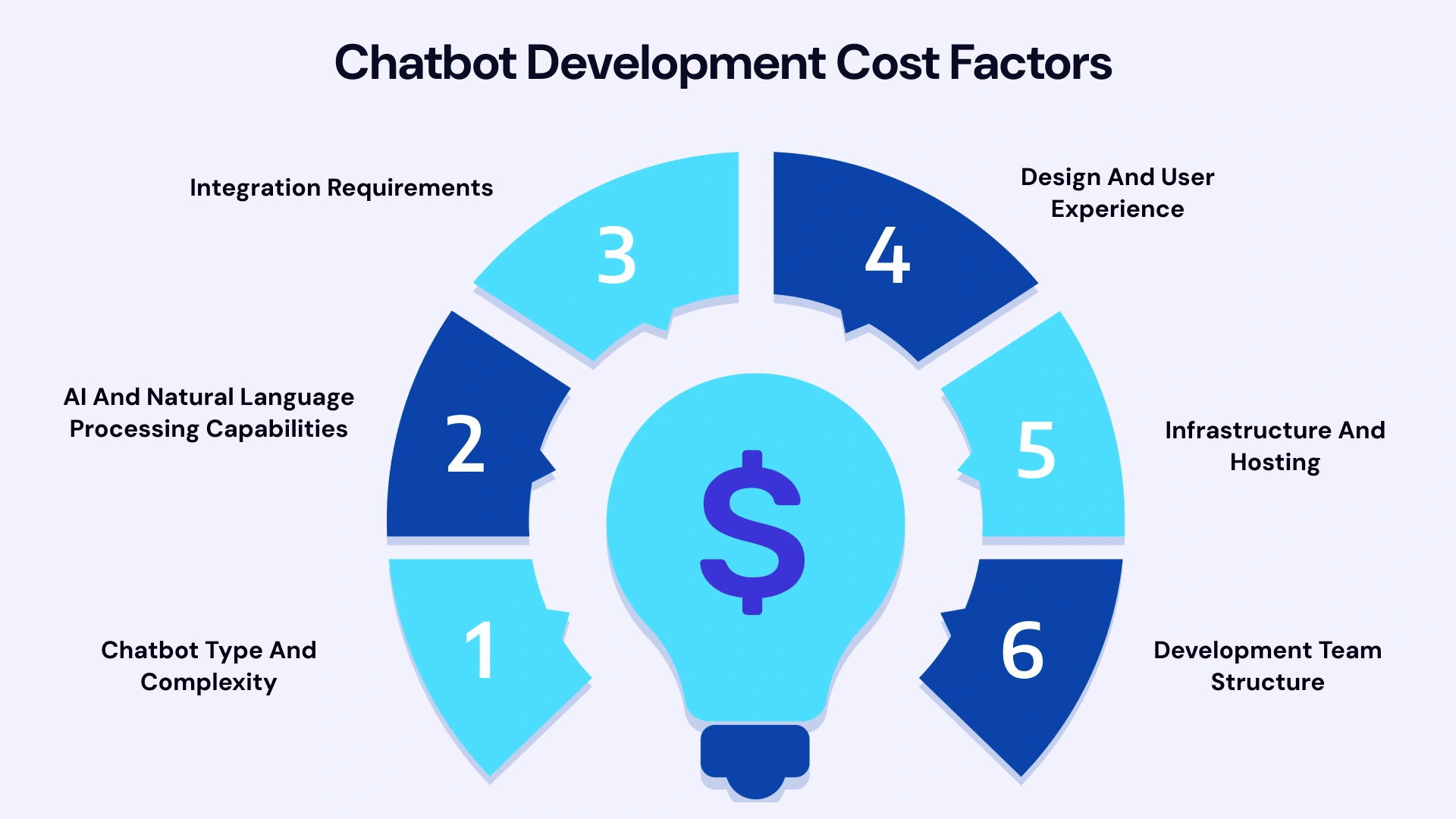
1. Chatbot Type and Complexity
The type of chatbot you build fundamentally determines your investment level and expected outcomes.
Rule-Based Chatbots ($5,000 - $30,000)
Rule-based chatbots follow predefined decision trees and respond to specific keywords or commands. They're ideal for straightforward use cases like FAQ responses, appointment scheduling, or basic information retrieval. Development costs remain relatively low because they don't require machine learning infrastructure or extensive training datasets.
Best suited for: Small businesses, internal helpdesks, simple customer inquiries with limited variation
Cost drivers: Number of conversation flows, integration complexity, UI/UX design requirements
AI-Powered Conversational Chatbots ($30,000 - $150,000)
These chatbots leverage natural language processing to understand user intent, context, and sentiment. They can handle more complex conversations, learn from interactions, and provide personalized responses. Development requires NLP expertise, training data preparation, and ongoing model refinement.
Best suited for: Mid-market to enterprise customer service, e-commerce support, lead qualification
Cost drivers: NLP model sophistication, training data volume, multilingual requirements, and context management capabilities.
Enterprise AI Chatbots ($150,000 - $500,000+)
Enterprise-grade chatbots feature advanced AI capabilities, including deep learning, sentiment analysis, predictive analytics, and seamless integration with enterprise systems. They support omnichannel deployment, handle high concurrent user volumes, and maintain sophisticated conversation histories across customer touchpoints.
Best suited for: Large enterprises, complex customer journeys, mission-critical applications
Cost drivers: Custom AI model development, enterprise integration complexity, security and compliance requirements, scalability needs
Generative AI Chatbots ($100,000 - $1,000,000+)
Powered by large language models, Generative AI chatbots can engage in human-like conversations, generate creative content, and handle unprecedented query variety. They represent the cutting edge of chatbot technology but require substantial investment in model fine-tuning, hallucination prevention, and responsible AI governance.
Best suited for: Organizations requiring maximum flexibility, creative applications, and complex problem-solving scenarios
Cost drivers: LLM licensing costs, fine-tuning requirements, computational infrastructure, safety, and alignment testing
2. AI and Natural Language Processing Capabilities
The sophistication of your chatbot's AI engine significantly impacts development costs and long-term value creation.
Natural Language Understanding (NLU)
Implementing robust NLU enables your chatbot to accurately interpret user intent despite variations in phrasing, slang, or grammatical errors. Advanced NLU systems can detect sentiment, extract entities, and understand context across multi-turn conversations. Developing custom NLU models typically adds $20,000-$80,000 to project costs, though leveraging pre-trained models can reduce this investment.
Machine Learning Infrastructure
Chatbots that learn and improve over time require machine learning pipelines for model training, evaluation, and deployment. This infrastructure includes data collection systems, annotation tools, model versioning, and automated retraining workflows. Establishing this capability typically requires an initial investment of $30,000-$100,000, plus ongoing operational costs.
Multilingual Support
Expanding your chatbot to support multiple languages multiplies development costs but unlocks global market opportunities. Each additional language requires translation, cultural adaptation, and testing, typically adding 30-50% to base development costs. However, organizations serving diverse markets often find that multilingual chatbots deliver disproportionate returns.
3. Integration Requirements
Enterprise chatbots rarely operate in isolation—they must integrate seamlessly with existing technology ecosystems.
CRM Integration
Connecting your chatbot to Salesforce, HubSpot, Microsoft Dynamics, or other CRM platforms enables personalized interactions based on customer history and automated data capture. Integration complexity varies but typically costs $10,000-$40,000, depending on customization needs and data synchronization requirements.
Payment Gateway Integration
For e-commerce and transactional chatbots, secure payment processing integration is essential. Implementing connections to Stripe, PayPal, or custom payment systems requires robust security measures and PCI compliance, adding $15,000-$50,000 to development costs.
Enterprise System Connectivity
Large organizations often need chatbots to interact with ERP systems, databases, legacy applications, and proprietary software. Custom API development, middleware implementation, and data transformation logic can add $30,000-$150,000, depending on system complexity and security requirements.
Omnichannel Deployment
Deploying chatbots across websites, mobile apps, messaging platforms (WhatsApp, Facebook Messenger, Slack), and voice assistants requires channel-specific adaptations and unified conversation management. Each additional channel typically adds $5,000 to $25,000 in development costs.
4. Design and User Experience
Exceptional chatbot experiences require thoughtful design that balances functionality with conversational naturalness.
Conversation Design
Professional conversation designers map user journeys, craft dialogue flows, and ensure personality consistency. Comprehensive conversation design for enterprise chatbots typically costs $15,000-$60,000 and dramatically improves user satisfaction and task completion rates.
UI/UX Development
Creating intuitive chatbot interfaces—whether embedded widgets, standalone applications, or voice experiences—requires specialized design expertise. High-quality UI/UX development typically adds $10,000-$40,000 to project costs but significantly impacts adoption and user perception.
5. Infrastructure and Hosting
Where and how you deploy your chatbot affects both initial costs and ongoing operational expenses.
Cloud vs. On-Premise Deployment
Cloud-based chatbots offer scalability and reduced upfront infrastructure costs, typically ranging from $500 to $5,000 per month, depending on usage volume. On-premise deployments require substantial infrastructure investment ($50,000-$200,000) but provide greater control for organizations with strict data residency requirements.
Scalability and Performance
Enterprise chatbots must handle traffic spikes during peak periods without degradation. Building auto-scaling infrastructure, implementing load balancing, and ensuring sub-second response times adds $20,000-$80,000 to development costs but proves essential for customer-facing applications.
6. Development Team Structure
Your chatbot's quality and timeline depend heavily on team composition and expertise.
In-House Development ($150,000 - $800,000+ annually)
Building internal chatbot capabilities provides maximum control but requires hiring AI engineers, conversation designers, developers, and data scientists. Annual compensation alone can exceed $500,000 for a capable team, not including overhead, tools, and infrastructure.
Outsourcing to Development Agencies ($30,000 - $300,000 per project)
Specialized agencies bring proven expertise and accelerated timelines. Costs vary based on agency location, reputation, and project scope. Top-tier agencies charge $150-$300 per hour, while offshore options may charge $30-$80 per hour.
Hybrid Approach ($50,000 - $500,000)
Many organizations adopt hybrid models—maintaining core expertise internally while leveraging external specialists for specific components. This approach balances cost, control, and speed.
Ultimately, the total cost of AI Chatbot Development is an investment in your company's digital maturity and customer engagement strategy. By carefully aligning your technical requirements with your business goals, you can build a solution that provides meaningful value while keeping operational expenses sustainable.
AI Chatbot Development Cost Breakdown by Use Cases
While general technical complexity sets the baseline for pricing, the specific use case often dictates the hidden costs associated with data training, security compliance, and specialized integrations.
Below is a breakdown of AI Chatbot Development costs categorized by common industry use cases for 2025.
Customer Service AI Chatbot Cost ($40,000 - $200,000)
Customer service represents the most common chatbot use case, with implementations ranging from simple FAQ bots to sophisticated support agents.
Basic Customer Support ($40,000 - $80,000)
- Rule-based responses to common inquiries
- Knowledge base integration
- Ticket creation capabilities
- Basic analytics dashboard
- Single-channel deployment
Advanced Customer Support ($80,000 - $200,000)
- AI-powered intent recognition
- Sentiment analysis
- Context-aware responses
- CRM integration
- Omnichannel support
- Live agent handoff
- Comprehensive analytics
E-commerce AI Chatbot Cost ($50,000 - $250,000)
E-commerce chatbots drive revenue by guiding product discovery, answering questions, and facilitating transactions.
Product Recommendation Bot ($50,000 - $120,000)
- Product catalog integration
- Preference learning
- Search and filter capabilities
- Basic recommendation engine
- Cart integration
Full-Service E-commerce Bot ($120,000 - $250,000)
- Advanced personalization
- Visual product search
- Order tracking
- Payment processing
- Post-purchase support
- Inventory management integration
- Abandoned cart recovery
Lead Generation AI Chatbot Cost ($30,000 - $150,000)
Marketing teams deploy chatbots to qualify leads, schedule meetings, and nurture prospects.
Basic Lead Qualification ($30,000 - $70,000)
- Contact information capture
- Qualification questions
- CRM integration
- Email notification
- Basic lead scoring
Advanced Marketing Automation ($70,000 - $150,000)
- Predictive lead scoring
- Dynamic conversation flows
- Marketing automation integration
- A/B testing capabilities
- Multi-touch attribution
- Calendar integration
HR and Recruitment AI Chatbot Cost ($60,000 - $200,000)
HR and recruiting chatbots are expanding at a 25.3% CAGR as organizations automate candidate screening and employee support.
Employee Self-Service ($60,000 - $120,000)
- HR policy information
- Benefits inquiries
- Time-off requests
- Document retrieval
- HRIS integration
Full Recruitment Automation ($120,000 - $200,000)
- Resume parsing
- Candidate screening
- Interview scheduling
- Assessment integration
- ATS connectivity
- Onboarding automation
Banking and Financial Services AI Chatbot Cost ($100,000 - $500,000+)
Financial institutions require chatbots with enhanced security, regulatory compliance, and transactional capabilities.
Banking Support Bot ($100,000 - $250,000)
- Account information
- Transaction history
- Bill payment
- Secure authentication
- Fraud detection
- Regulatory compliance
Comprehensive Financial Assistant ($250,000 - $500,000+)
- Personalized financial advice
- Investment recommendations
- Loan origination
- Credit analysis
- Risk assessment
- Multi-language support
- Advanced security features
Hidden Costs and Ongoing Expenses in AI Chatbot Development
Maintenance and Updates (15-25% of initial development cost annually)
Chatbots require continuous maintenance to remain effective. This includes:
- Bug fixes and performance optimization
- Conversation flow improvements
- Integration updates as APIs evolve
- Security patches
- Platform upgrades
Training Data and Model Improvement ($10,000 - $100,000+ annually)
AI chatbots need ongoing training to improve accuracy and handle new scenarios:
- Data collection and annotation
- Model retraining
- A/B testing new conversation flows
- Performance analysis
- Bias detection and correction
Conversation Monitoring and Quality Assurance ($20,000 - $80,000 annually)
Ensuring consistent chatbot performance requires:
- Conversation review
- Quality metrics tracking
- User feedback analysis
- Continuous optimization
- Compliance monitoring
Infrastructure and Hosting Costs ($6,000 - $60,000+ annually)
Ongoing operational expenses include:
- Cloud hosting fees
- API usage costs
- Database storage
- Bandwidth and compute resources
- Backup and disaster recovery
Third-Party Service Costs ($5,000 - $50,000+ annually)
Many chatbots rely on external services:
- NLP API licensing (Dialogflow, Watson, Azure)
- LLM access fees (GPT-4, Claude)
- Analytics platforms
- Customer data platforms
- Integration middleware
Cost Optimization Strategies for Enterprises
Enterprise cost optimization is no longer just about "cutting the budget." In 2025, it has evolved into a strategic discipline of maximizing value while minimizing waste. Unlike traditional cost-cutting, which often targets headcounts and immediate expenses, optimization focuses on long-term sustainability and operational efficiency.
Here are the primary cost optimization strategies for modern enterprises, categorized by impact area.
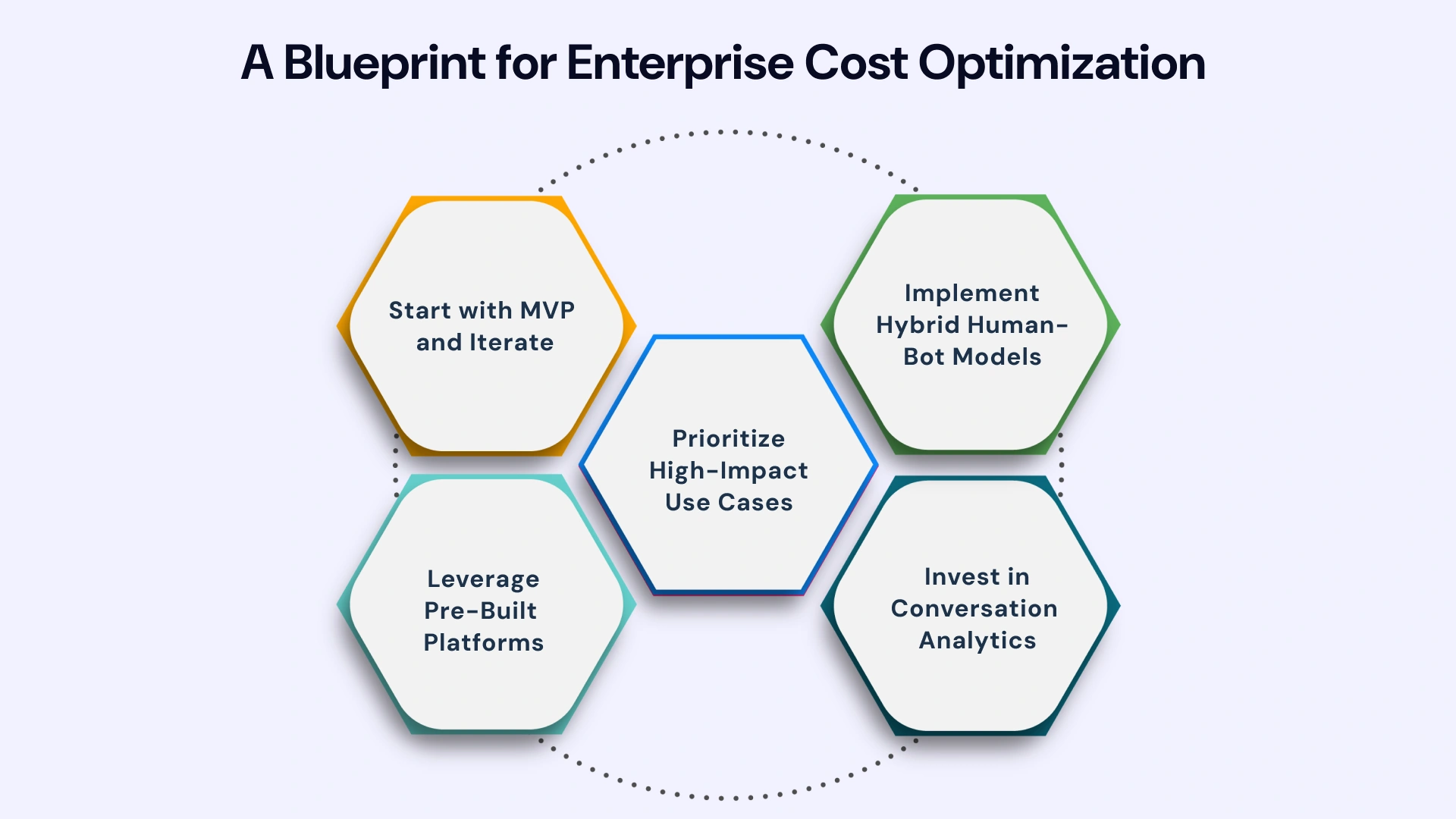
1. Start with MVP and Iterate
Rather than building comprehensive chatbots immediately, successful organizations often deploy minimum viable products(MVPs) to validate assumptions and gather user feedback. This approach typically reduces initial investment by 40-60% while accelerating time-to-value.
MVP Approach Benefits:
- Faster market validation
- Reduced financial risk
- User-driven feature prioritization
- Iterative improvement based on real data
- Easier stakeholder buy-in
2. Leverage Pre-Built Platforms
Chatbot platforms like Dialogflow, Microsoft Bot Framework, IBM Watson Assistant, and Amazon Lex provide pre-built NLP capabilities and infrastructure, significantly reducing development time and cost.
Platform Benefits:
- 50-70% reduction in development time
- Pre-trained AI models
- Managed infrastructure
- Regular updates and improvements
- Lower maintenance burden
Platform Considerations:
- Ongoing licensing fees
- Potential vendor lock-in
- Customization limitations
- Data residency concerns
3. Prioritize High-Impact Use Cases
Not all chatbot applications deliver equal business value. Strategic CTOs conduct thorough analysis to identify use cases with:
- High transaction volumes
- Significant cost-per-interaction
- Clear automation potential
- Measurable KPIs
- Strong user demand
4. Implement Hybrid Human-Bot Models
The most cost-effective chatbot strategies often involve seamless collaboration between automated bots and human agents. This approach:
- Handles routine inquiries automatically
- Escalates complex issues to humans
- Maintains service quality
- Reduces full automation costs
- Improves customer satisfaction
5. Invest in Conversation Analytics
Robust analytics capabilities pay for themselves by identifying:
- Common failure points
- High-value automation opportunities
- User behavior patterns
- Optimization priorities
- ROI measurement data
ROI Analysis: Justifying Chatbot Investment
Quantifiable Benefits
- Cost Savings
Organizations typically achieve 30-70% cost reduction in customer service operations through chatbot deployment. For a mid-size enterprise handling 100,000 monthly customer interactions at $8 per interaction, automation can save $240,000 to $560,000 per month.
- Revenue Generation
E-commerce chatbots increase conversion rates by 10-30% through personalized recommendations and immediate support. For a business generating $10 million in monthly revenue, this translates to $1- $3 million in additional revenue annually.
- Operational Efficiency
Chatbots handle inquiries 24/7 without fatigue, eliminating after-hours staffing costs and reducing average response time from hours to seconds. This operational improvement often delivers productivity gains of 40-60%.
- Customer Lifetime Value
Improved customer experience through instant, consistent support increases satisfaction scores and retention rates. Research shows well-implemented chatbots improve NPS by 10-20 points and reduce churn by 15-25%.
Calculating Total Cost of Ownership (TCO)
Smart CXOs evaluate chatbot investments using a comprehensive TCO analysis:
Year 1 Costs:
- Initial development: $100,000
- Infrastructure setup: $20,000
- Training and change management: $15,000
- Integration work: $30,000
- Total Year 1: $165,000
Annual Recurring Costs (Years 2-5):
- Maintenance and updates: $20,000
- Hosting and infrastructure: $15,000
- Continuous improvement: $25,000
- Third-party services: $10,000
- Annual Total: $70,000
5-Year TCO: $445,000
5-Year Benefits:
- Customer service cost reduction: $2,400,000
- Revenue increase from improved conversion: $1,500,000
- Operational efficiency gains: $800,000
- Total Benefits: $4,700,000
The 5-year ROI for this chatbot investment is approximately $956.18%. This means that for every dollar invested, the organization realizes net benefits of over $9.50.
Choosing the Right Development Approach for AI Chatbot Development
When selecting a development approach for a chatbot or AI initiative, CXOs must balance speed to market, total cost of ownership, and long-term flexibility. There is no "one size fits all" solution; the right choice depends on your internal capabilities and specific business goals.
Here is a breakdown of the primary paths:
Build vs. Buy Decision Framework
Build a Custom AI Chatbot When:
- Unique business requirements exist
- Competitive differentiation is critical
- Complex proprietary system integration needed
- Data sovereignty is paramount
- Long-term cost optimization is a priority
Buy Platform-Based Solution When:
- Standard use cases predominate
- Speed to market is critical
- Internal AI expertise is limited
- Predictable costs are important
- Ongoing innovation is valued
Selecting a Development Partner
For organizations choosing external development, evaluate partners based on:
Technical Expertise
- AI and NLP capabilities
- Platform experience
- Integration proficiency
- Security knowledge
- Scalability understanding
Industry Experience
- Relevant vertical expertise
- Regulatory compliance knowledge
- Best practice familiarity
- Reference customers in your industry
Methodology and Process
- Agile development approach
- User-centered design process
- Quality assurance practices
- Project management capabilities
- Post-launch support model
Cultural Fit
- Communication style
- Collaboration approach
- Transparency and reporting
- Long-term partnership orientation
Geoeconomics of AI: Mapping Development Costs by Region
AI Chatbot Development costs vary significantly by geography, with location affecting both hourly rates and total project expenses.
| Region | Country Examples | Hourly Rates (USD) | Key Strengths & Characteristics |
| North America | USA, Canada | $150 – $300 | Highest quality standards, strong AI/ML expertise, and comprehensive regulatory compliance. |
| Western Europe | UK, Germany, France | $100 – $250 | Excellent technical skills, GDPR compliance expertise, and strong design capabilities. |
| Eastern Europe | Poland, Ukraine, Romania | $40 – $100 | Growing AI expertise, cost-effective, and high English proficiency. |
| Latin America | Brazil, Argentina, Mexico | $40 – $90 | Favorable time zones for US clients, a growing tech ecosystem, and Spanish/Portuguese expertise. |
| Asia | India, Philippines, Vietnam | $25 – $80 | Largest talent pool and significant cost savings, though quality standards can be variable. |
Future-Proofing Your AI Chatbot Investment
As the AI landscape shifts from simple text-based responses to autonomous reasoning, your financial strategy must evolve. Future-proofing isn’t just about adopting new tech—it’s about balancing innovation costs with operational scale.
Emerging Trends & Cost Drivers
The move toward advanced AI introduces higher complexity but unlocks significantly greater value.
| Trend | Financial Impact | Strategic Value |
| Generative AI & LLMs | API costs range from $0.02 to $0.12 per interaction. | Shifts bots from rigid scripts to fluid, human-like reasoning. |
| Voice Integration | Increases dev costs by 30–50%. | Essential for accessibility and hands-free environments. |
| Multimodal UX | Increases dev costs by 40–70%. | Drives engagement through image, video, and document processing. |
| Autonomous Agents | Requires high initial integration/security spend. | Moves from "answering" to "doing"—executing tasks end-to-end. |
Pro Tips:- By 2026, 40% of enterprise applications will feature task-specific AI agents. Transitioning to an agentic workflow is no longer an "extra"—it is the new baseline for ROI.
Scalability Architectures
Wise CTOs build for the "next million users" from day one. To prevent technical debt, focus on the three pillars of scalability:
1. Technical Scalability (The Foundation)
Ensure your infrastructure can handle peak loads without manual intervention:
- Microservices & Containerization: Decouple components to allow for independent updates.
- Auto-scaling Infrastructure: Use cloud-native triggers to dynamically manage compute costs.
- Edge Computing & CDNs: Reduce latency for global users by processing data closer to the source.
2. Functional Scalability (The Experience)
Design a system that grows in intelligence without requiring a total rewrite:
- Modular Conversation Design: Build reusable "intents" and workflows.
- Extensible Frameworks: Use a "plugin" mindset for easy integration with future CRMs or ERPs.
- Multilingual & Multi-channel: Architect a single "brain" that speaks 50+ languages across web, mobile, and social.
3. Organizational Scalability (The Governance)
Scale the human processes behind the AI to ensure safety and accuracy:
- Conversation Governance: Establish strict protocols for best LLM "hallucination" monitoring and brand safety.
- Knowledge Management: Maintain a "Single Source of Truth" (SSoT) to feed the AI accurate data.
- Continuous Learning Loops: Implement automated analytics to identify and resolve friction points in real time.
Leverage VLink Expertise for AI Chatbot Development
To maximize your ROI and ensure a competitive edge in 2026, you need more than just a developer; you need a strategic partner who understands the high-stakes world of enterprise AI. VLink combines 15+ years of digital transformation experience with a unique US-India Hybrid Delivery Model, allowing us to provide Silicon Valley-grade engineering at optimized global pricing.
Here is why Global CXOs and CTOs trust VLink’s dedicated team for their AI Chatbot Development services:
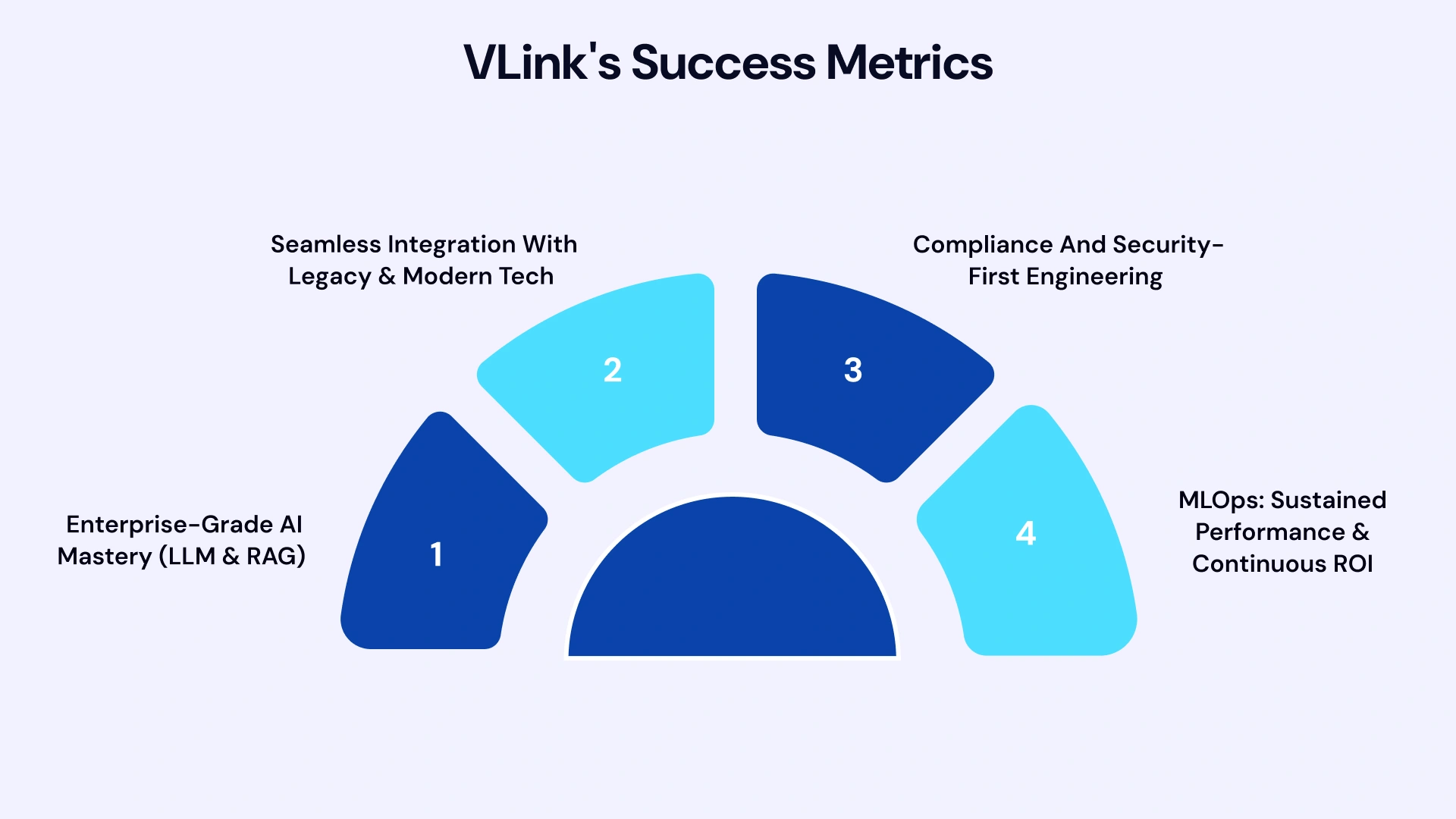
1. Enterprise-Grade AI Mastery (LLM & RAG)
We don't just build "wrappers" around third-party APIs. We architect proprietary Retrieval-Augmented Generation (RAG) pipelines that eliminate AI "hallucinations."
- Accuracy: Your bot only speaks from your verified corporate knowledge base (PDFs, Wikis, ERP).
- Model Choice: Whether you need the power of GPT-4/5 or the privacy of a self-hosted Llama 3 model, we select the tech stack that balances cost with performance.
2. Seamless Integration with Legacy & Modern Tech
A chatbot is only as effective as the systems it can access. VLink’s engineers specialize in:
- CRM & ERP Connectivity: Real-time data sync with Salesforce, SAP, and HubSpot.
- Legacy Mainframes: Building secure RESTful APIs to bridge the gap between 2025 AI and legacy COBOL-era systems.
- Omnichannel Orchestration: Ensuring a unified user context across WhatsApp, Web, Slack, and Mobile.
3. Compliance and Security-First Engineering
For highly regulated industries like Fintech and Healthcare, security is our baseline.
- Standard-Compliant: Our development follows GDPR, HIPAA, and PCI-DSS frameworks.
- Data Privacy: We implement PII (Personally Identifiable Information) redaction and end-to-end encryption to safeguard every interaction.
- Audit-Ready: Detailed conversation logging and explainable AI (XAI) modules ensure your legal teams stay compliant.
4. MLOps: Sustained Performance & Continuous ROI
A bot is an asset that must be managed. VLink provides full-lifecycle MLOps services to prevent "model drift":
- Performance Tuning: Monitoring intent accuracy and first-contact resolution (FCR) rates.
- Model Retraining: Automatic updates as customer language patterns and business policies evolve.
- Scalable Infrastructure: Orchestrating GPU resources on AWS, Azure, or GCP to handle traffic spikes effortlessly.
Partner with VLink to leverage our specialized AI Development Services, where we’ve helped global enterprises eliminate operational bottlenecks and drive a 35% increase in efficiency through intelligent automation.
Conclusion: Making the Strategic Investment
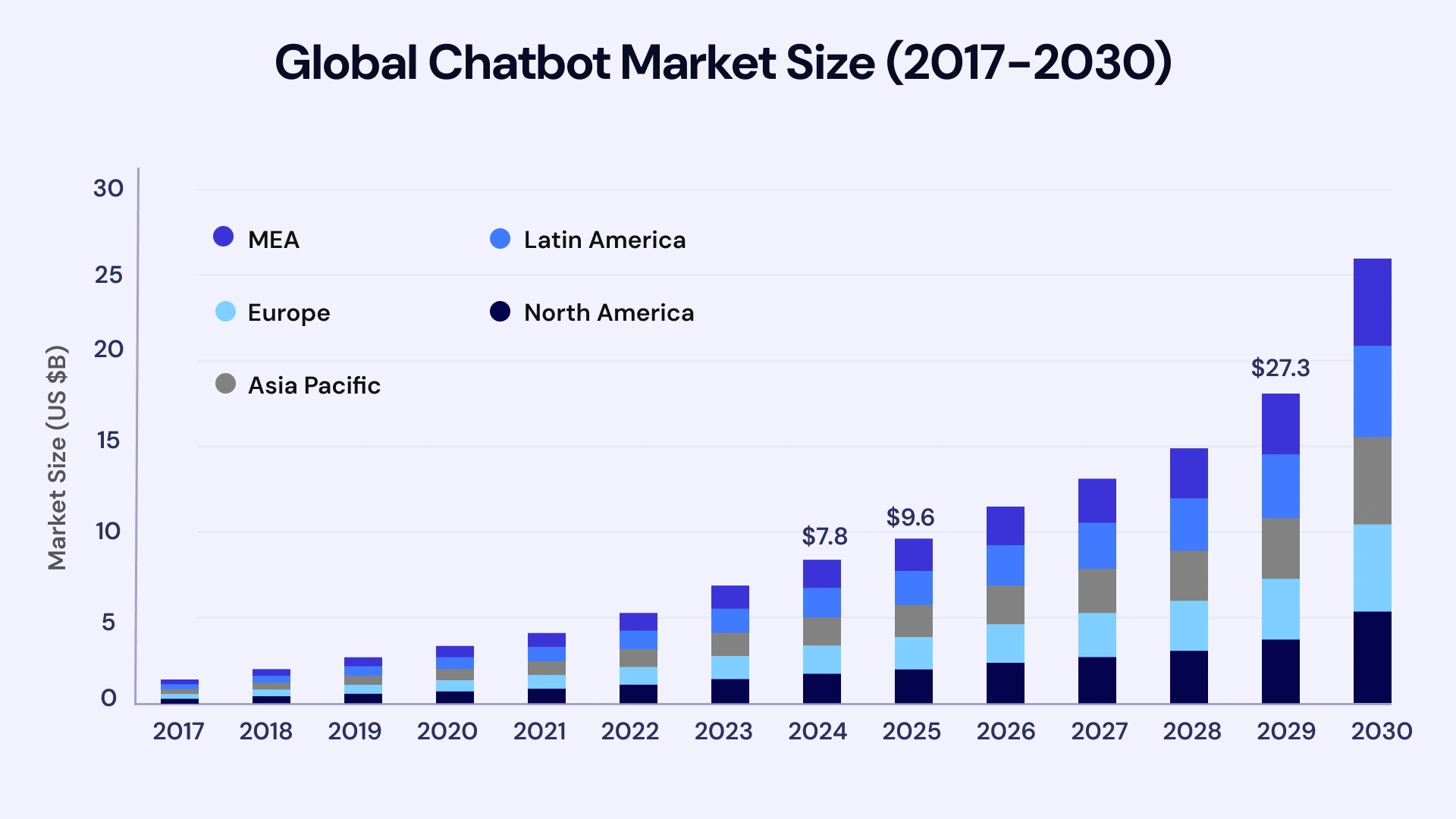
AI Chatbot Development is a transformative opportunity for forward-thinking organizations. With the market projected to reach $27.29 billion by 2030, delaying adoption is no longer a viable option. However, success requires shifting from cost minimization to strategic value creation.
The most effective implementations prioritize user-centered design, robust architecture, and a commitment to continuous, iterative improvement. For CXOs and CTOs, the focus should be on architecting solutions that align with long-term organizational strategy rather than just solving immediate technical hurdles.
Investing in workplace chatbot development for employee retention pays off through faster issue resolution and feedback collection, making it a strategic lever rather than just an operational upgrade. As organizations embrace AI Chatbot Development at scale, these internal solutions enhance employee experience, reduce friction in daily workflows, and support long-term engagement—aligning seamlessly with a broader vision of value-driven, future-ready digital transformation.
By identifying high-value use cases and establishing clear governance, companies can move beyond budget concerns to drive genuine growth. The chatbot revolution is here; those who make disciplined, well-planned investments today will build the conversational AI capabilities necessary to lead tomorrow.
Ready to transform your customer experience? Whether you need a technical deep dive or a strategic roadmap, our experts are here to help. Contact us today to begin your AI journey. Let’s build the future of your business together.

Vice President, Strategy – VLink Inc.
Sambhavi Gopalakrishnan is the Vice President of Strategy at VLink Inc., bringing over a decade of experience in IT leadership, project implementation, and strategic growth. She possesses a strong foundation in technical project management and pre-sales, driving innovation and business transformation at VLink.

 Shivisha Patel