

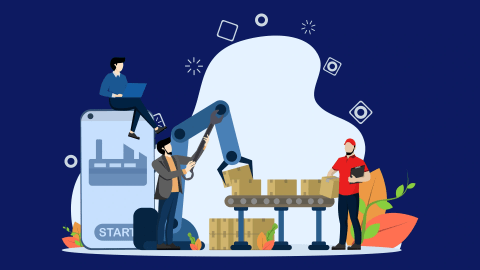
India's factories are getting smarter. The engineers to run them are not keeping pace. We hear a lot about India's manufacturing boom — the PLI schemes, the China+1 tailwind, the record FDI into auto, electronics, and pharma. What we hear a lot less about is the uncomfortable truth sitting right behind all that growth: a talent gap in Indian manufacturing that is, by every honest measure, widening faster than we're fixing it.
The India Decoding Jobs Report 2026 puts it plainly — hiring cycles in manufacturing are getting longer, not shorter, and the roles that are hardest to fill are precisely the ones that matter most for the Industry 4.0 transition. That should stop every CTO and digital transformation head in their tracks.
But why is this different from past skill gaps?
This is not the familiar story of a slow mismatch between degrees and jobs. Every industrial revolution has had that. What makes the skill gap in India's manufacturing sector uniquely difficult in 2026 is the speed of technology change relative to talent development cycles.
Think about it this way. Training a competent civil engineer takes 4 years. Training a competent IIoT integration specialist who understands both PROFIBUS protocols and cloud data pipelines, who can talk to the plant manager and the AWS architect in the same meeting — that's a 2-3 year learning curve on top of an existing engineering degree, in a domain that is itself changing every 18 months. The training system simply has not caught up. And while it tries to, the machines are already on the factory floor, waiting.
Here's where it gets concrete.
- The Deloitte-NASSCOM report makes the AI talent picture even starker. India's AI talent demand is expected to nearly double — from 650,000 professionals today to over 1.25 million by 2027. In manufacturing specifically, that means roles in predictive maintenance, computer vision-based quality control, and AI-driven supply chain optimization are being created far faster than they're being filled.

What Has Industry 4.0 Actually Changed on the Indian Manufacturing Floor?
The phrase gets overused. Here's what Industry 4.0 in manufacturing actually means at the ground level.
Five years ago, a typical mid-size Indian manufacturer ran on a combination of ERP (usually SAP or Oracle), Excel spreadsheets for production tracking, and human operators who read gauges and manually logged data every 2 hours. The 'digital transformation' was mostly about putting the ERP on the cloud. That was it.
Today's ask is categorically different. A global OEM customer expects real-time machine data. A USFDA audit requires electronic batch records with full traceability. A private equity investor's 100-day plan includes an OEE dashboard that auto-flags production anomalies. Industry 4.0 India has gone from buzzword to contract clause.
The Rapid Advancement of Technology on the Factory Floor
The rapid advancement of technology in industrial settings is not happening in a controlled, phased way that talent development can mirror. It's happening in bursts — driven by falling sensor costs, cheap cloud compute, and a competitive anxiety that makes every plant manager feel behind. IIoT gateway devices that cost USD 5,000 three years ago now cost USD 400. That price drop opened the floodgates, and suddenly every plant of any size is a candidate for connectivity.
But connecting the machines is only 10% of the job. The remaining 90% — making sense of the data, integrating it with business systems, running models on it, securing the network — requires people who simply don't exist in sufficient numbers in the Indian talent market right now.
The Four Technologies Creating the Biggest Skill Crunch
You can trace most of the manufacturing skills shortage back to four specific technology stacks, each of which requires a profile that the existing engineering workforce isn't naturally producing:

- Industrial IoT (IIoT) platforms: Datonis, ThingWorx, Azure IoT Hub, and similar systems need engineers who understand factory-floor hardware (PLCs, SCADA, OPC-UA) and cloud architecture simultaneously. That's a rare two-headed profile.
- AI and Machine Learning for manufacturing: Not generic ML. Manufacturing-specific ML — predicting die wear in a stamping press, flagging contamination in a tablet press, optimizing a furnace temperature profile. Domain expertise plus data science is the rarest combination on the market.
- MES (Manufacturing Execution Systems): Platforms like SAP ME, Siemens Opcenter, and Rockwell FactoryTalk require consultants and engineers who can do both process mapping (understanding how a production order flows through the floor) and technical configuration. The pool is tiny.
- Cybersecurity for OT environments: As factories get connected, they get exposed. But the cybersecurity talent gap in manufacturing OT is catastrophically underappreciated. Most cybersecurity engineers in India have zero OT training. And most OT engineers have zero security training. That intersection — the person who understands both — is almost impossible to find.
The Skills Required for Industry 4.0: A Role-by-Role Breakdown
If you're trying to hire, upskill, or augment your team, the first thing to get right is precision — not 'we need digital talent,' but which specific role, with which stack, for which problem.

IIoT Engineering and OT/IT Integration
This is the most in-demand role in Indian manufacturing digitalization right now, and arguably the one with the worst talent-to-demand ratio. The IIoT engineer's job is to build the nervous system of the smart factory — connecting PLC and SCADA systems to cloud platforms, managing data pipelines from edge devices, and making sure latency, reliability, and data integrity meet production-grade standards.
Key skills required for Industry 4.0 IIoT roles:
- OPC-UA, MQTT, Modbus, PROFIBUS protocol literacy
- Edge computing platforms (Azure IoT Edge, AWS Greengrass)
- Time-series databases (InfluxDB, OSIsoft PI)
- SCADA integration and historian data management
- Network architecture for factory environments (OT network segmentation)
The catch is that almost no pure software engineer has OT protocol literacy. Almost no control systems engineer has cloud platform experience. The talent who naturally straddles both typically came from embedded systems backgrounds or telecom, and they've been rapidly poached by the large SIs (system integrators) and the GCCs that set up earlier. For manufacturers trying to hire now, this profile typically has a 6-9 month open headcount cycle.
AI in Workforce Management and Predictive Operations
AI in workforce management is getting attention, but the more pressing industrial use case is AI on the production floor — predictive maintenance, anomaly detection, and yield optimization. This requires a data scientist or ML engineer who has actually worked with industrial sensor data — noisy, high-frequency, context-dependent time-series data that behaves nothing like the clean datasets in Kaggle competitions.
What these profiles must know:
- Python / R with industrial ML libraries (scikit-learn, TensorFlow, but applied to sensor data)
- Statistical process control and failure mode analysis (FMEA)
- Model deployment on edge devices (TensorFlow Lite, ONNX)
- Integration with CMMS (Computerized Maintenance Management Systems)
- Familiarity with at least one industry domain — auto, pharma, or metals — for contextual model building
Here's the thing — most Indian data scientists were trained on fintech and e-commerce problems. Manufacturing domain knowledge is a complete foreign language to them. The upskilling investment to bridge that gap is real, and most companies underestimate it.
Industrial Cybersecurity: The Ignored Talent Gap
Let's be direct: the cybersecurity talent gap in Indian manufacturing OT environments is a ticking clock, and almost nobody is talking about it seriously.
A connected factory floor is not just an efficiency asset — it's an attack surface. As IIoT deployments scale across India's auto, pharma, and FMCG sectors, the number of networked endpoints in manufacturing environments is exploding. But the talent who can audit an OT network, implement IEC 62443 controls, and respond to a ransomware incident on a SCADA system — that person is extraordinarily rare.
We've seen reports of IT-qualified cybersecurity engineers being placed in OT environments without any SCADA or PLC knowledge — a situation that gives plant managers the illusion of security without the substance. A manufacturing software development services partner who can staff this role properly, with genuine OT security credentials, is genuinely hard to find.
Data Engineering and Manufacturing Analytics
Before there's AI, there has to be clean data. And in most Indian factories, the data architecture is a mess. Multiple PLCs logging in incompatible formats, ERP data that doesn't sync with MES data, and quality lab systems that are completely offline.
Data engineers who can build reliable manufacturing data pipelines — pulling from OPC-UA servers, normalizing tag data, loading into data lakes, and making it available for analytics — are the unglamorous but essential layer. This role has a technology skills gap that directly costs manufacturers money every single day through bad reporting, invisible defects, and unmeasured yield losses.
MES, Digital Twin, and Smart Factory Operations
The most demanding skills in the IT industry right now, from a manufacturing context, sit at the intersection of MES configuration and digital twin development. A digital twin of a press shop or an assembly line is not a 3D render — it's a live simulation model fed by real sensor data, used to test process changes virtually before deploying them on the floor. Building and maintaining one requires a combination of process engineering, physics modeling, and software integration that doesn't fit neatly into any existing job profile.
The companies in India that have successfully deployed digital twins in 2025-26 have almost universally done so with dedicated teams that mix internal domain engineers with external software talent — because no single hire reliably covers both sides.
Challenges for Industry 4.0 Adoption: Why the Gap Is Getting Worse, Not Better
Understanding why the manufacturing skills shortage exists is necessary if you want to bridge it smartly, not just throw job postings at it.
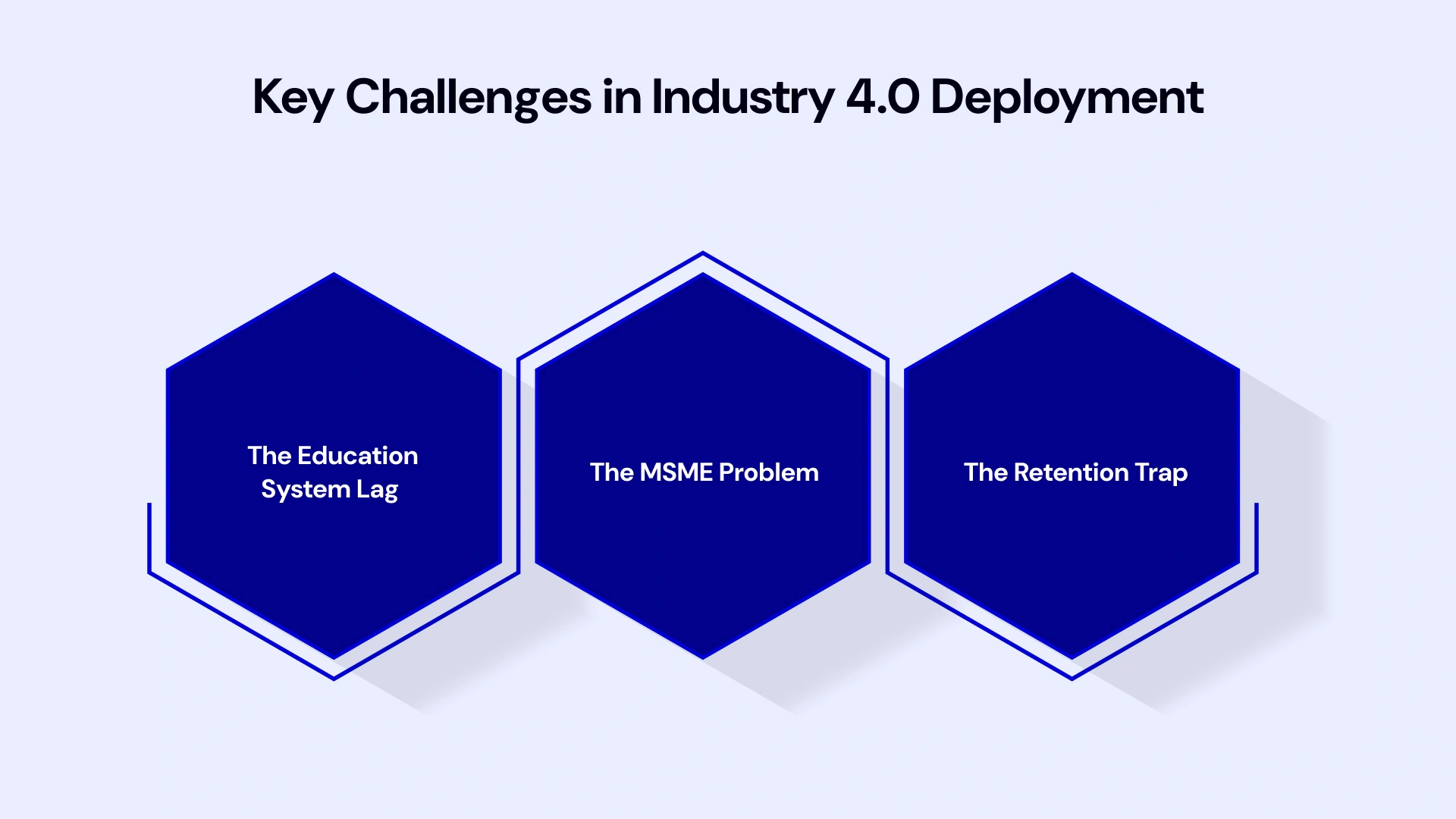
The Education System Lag
Only 42.6% of Indian graduates are currently employable according to the Wheebox ETS report, meaning more than half of fresh graduates need substantial additional training before they can do their intended job. In manufacturing technology, this figure is almost certainly worse — because even the small percentage of graduates who are employable in general IT roles lack the OT, industrial protocol, and domain-specific knowledge that factory digitalization demands.
The curriculum problem is real. Most engineering colleges have not updated their automation and control systems syllabi to reflect IIoT-era requirements. The IIT and NIT programs that are starting to teach machine learning still teach it in a generic context with no manufacturing application layer. And vocational/ITI programs, which train the workers who actually run the machines, have virtually no digital content at all.
The MSME Problem
This is where the talent acquisition in the manufacturing industry challenge gets genuinely painful. MSMEs represent about 45% of India's manufacturing output and employ over 110 million people. They are also the segment least equipped to solve their own digital skills gap.
A Tier-1 auto OEM can invest in a Center of Excellence, hire 20 data scientists, and run a 2-year transformation program. An MSME with 150 employees and a 12% EBITDA margin cannot. They need plug-and-play talent solutions that come with the skills already baked in, can show results in 90-120 days, and don't require a multi-year commitment. The traditional IT recruitment model doesn't serve this need at all.
The Retention Trap
Let's say a company does successfully hire a strong IIoT engineer. The moment that person has 18 months of live deployment experience on their resume, they become one of the most sought-after profiles in the market. The IT talent shortage and tech talent shortage are making attrition in these profiles brutal — especially when a GCC in Bengaluru is offering 40% more comp for a similar role with better remote flexibility and a global career path.
Talent management in the manufacturing industry is therefore not just a hiring problem. It's a culture and structure problem. Companies that treat digitalization engineers the same as production floor engineers — with the same comp bands, the same rigid shift structures, the same limited learning paths — will keep losing them.
How Do You Bridge the Tech Talent Gap in Indian Manufacturing in 2026?
There is no single solution that works for every company size, every technology stack, or every timeline. But we've seen enough deployments across Indian manufacturing to say clearly which approaches are producing results and which are producing expensive delays.
IT Staff Augmentation Services: Plugging the Immediate Gap
IT staff augmentation services are the fastest bridge between a live requirement and a deployed engineer. Rather than going through a 6-9 month open headcount process, augmentation lets you bring in a pre-vetted IIoT engineer, MES consultant, or manufacturing data engineer within 2-4 weeks — already carrying the specific skills, already having delivered in similar manufacturing contexts.
For mid-size manufacturers facing a specific project deadline — say, an IIoT rollout across 3 plants in 6 months — augmentation is not just faster, it's smarter economically. You're paying for output, not onboarding overhead. And if the project scope changes, the team composition can change with it, without the legal and HR complexity of a full-time headcount reduction.
An IT staff augmentation company in India with manufacturing domain depth — not just generic software talent — can deliver 60-70% of the impact of a full-time hire at 40-50% of the all-in cost, especially when you factor in the cost of a 9-month open headcount in a fast-moving deployment context.
GCC Talent Solutions: The Structural Fix for Large Enterprises
For large Indian manufacturers and MNCs with a multi-year digitalization roadmap, GCC talent solutions represent a structural answer to the emerging industries and required skills challenge. Rather than fighting the open market for individual hires, a GCC model allows you to build a dedicated capability center — with a curated team of IIoT engineers, data scientists, MES specialists, and OT security analysts — under a managed talent structure.
The advantage is not just talent density. It's knowledge retention. When a team is structured around your manufacturing context — your machines, your processes, your data architecture — the institutional knowledge builds up within your organization, not in a contractor's head who walks out after the project.
We've seen clients with 15-20 plant locations use GCC talent solutions to build a 40-person smart manufacturing team in Pune that effectively serves as an internal Center of Excellence — faster to deploy across plants, more consistent in standards, and far more cost-effective than hiring at each plant location separately.
Dedicated Teams for Manufacturing Digitalization Projects
Dedicated teams sit between augmentation and GCC. You get a committed team — say, a project lead, two IIoT engineers, a data engineer, and a QA specialist — fully allocated to your manufacturing digitalization project for a defined period, with outcome accountability built into the engagement.
This model works especially well for MSMEs and mid-size manufacturers who have a clear problem (bridge the digital skills gap on a specific production line) but don't have the bandwidth to manage individual hires or the scale to justify a full GCC setup. It's the model that most closely replicates having your own team, without the hiring, retention, and HR overhead.
Choosing the Right Engagement Model: Costs, Timelines, and ROI
| Engagement model | Typical scope | Indicative cost (INR) | Typical OEE / ROI outcome | Payback horizon |
| 3-person augmented team | IIoT engineer + data engineer + manufacturing analyst; 6-month deployment | ₹35–55 lakhs total | 8–18 pp OEE improvement on targeted lines; ₹50L–₹2Cr annual benefit per plant | Within the first year of deployment |
| 5-person dedicated team | MES implementation; 9-month fixed scope | ₹60–90 lakhs total | Compliance readiness + OEE gains; project-dependent | 12–18 months |
| Focused MSME dedicated team (3 engineers) | Scoped to critical production cells; 4–5 month engagement | ₹25–40 lakhs total | Contract retention + new business qualification (Case Study 5: ₹4.1Cr contract secured on ₹38L spend) | Immediate (contract renewal) |
| OT security assessment | 2–3 week OT network audit | ₹8–15 lakhs | Vulnerability remediation; insurance premium reduction (Case Study 3: 22% reduction) | Immediate risk reduction |
| Full GCC build (manufacturing AI) | 60-person smart manufacturing analytics team | Multi-crore, multi-year | 35–45% cost reduction vs domestic equivalent; Case Study 4: ₹4.2Cr annual yield improvement from first model | 18–36 months |
Real-World Impact: How the Talent Gap Is Reshaping Indian Manufacturing
The talent gap isn't an abstract HR problem. It shows up in real production losses, delayed automation ROI, and lost contracts. Here's how the digital skills gap is actually hitting the factory floor right now.
- Stalled smart factory projects: Multiple Tier-1 automotive suppliers we've spoken with report IIoT rollout projects that are 12-18 months delayed — not because of technology failures, but because they couldn't staff the OT/IT integration phase. Every month of delay on a smart factory project costs in deferred OEE gains, typically INR 50-150 lakhs per plant per month, depending on throughput.
- Compliance exposure: As the USFDA, EU MDR, and automotive IATF requirements increasingly demand digital traceability and data integrity, the manufacturing skills shortage is creating compliance risk. Companies without the digital talent to implement proper electronic records are one audit finding away from a major revenue impact.
- Competitive divergence: The gap between manufacturers who have solved the talent problem and those who haven't is creating a structural competitiveness divide that will be very hard to close. The India Decoding Jobs Report 2026 notes that manufacturers who are expanding capacity fastest are also the ones who solved talent acquisition in the manufacturing industry earliest — they have a 2-3 year head start that pure technology investment can't easily replicate.
- OT cybersecurity exposure: As more Indian factory floors get connected, the attack surface grows — and the cybersecurity talent gap means most of that surface is unguarded. Industry reports show that manufacturing was among the top 3 sectors globally for ransomware attacks in 2024-25. The Purdue Model network segmentation, intrusion detection, and incident response playbooks that are standard in mature industrial environments are almost completely absent in most Indian factories.
- GCC talent flight to non-manufacturing sectors: The same AI and data science engineers that manufacturing GCCs need are being aggressively recruited by fintech, healthtech, and consumer internet companies that offer better brand visibility and remote work flexibility. Without a deliberate strategy to make manufacturing AI roles attractive, companies are losing the talent war before the interview even happens.
Case Studies: Five Companies, Five Problems, One Lesson
Each case study is drawn from recurring, real-world deployment scenarios across Indian manufacturing. Here are the proven solutions:
Case Study 1: Auto Ancillary, Pune — IIoT Rollout Stuck at Pilot Stage
A precision stamping components manufacturer serving 3 global OEMs had deployed IIoT sensors across 40 presses 18 months prior. The sensors were live, the data was flowing to an Azure IoT Hub — but nobody on the internal team knew how to build reliable dashboards, set meaningful alert thresholds, or integrate the sensor data with their SAP production orders. The project was effectively frozen at 'data collection' and delivered zero business value.
- Solution:
An augmented team of 3 was deployed: one IIoT data engineer with Azure Stack experience, one manufacturing domain analyst with stamping process knowledge, and one SAP integration specialist. They were embedded with the client's internal IT team for a 6-month engagement, working inside the client's environment rather than from a delivery center.
- Result:
Within 90 days, 5 critical KPIs — parts per hour, die wear cycle, downtime cause analysis, SAP order vs. actual variance, and energy per part — were live on a Power BI dashboard visible to plant managers and the India MD. Unplanned downtime dropped 18% in the first quarter. The internal team was trained alongside, and 2 of 5 internal engineers were subsequently capable of maintaining the system independently.
Case Study 2: Pharmaceutical Manufacturer, Ahmedabad — FDA Audit Deadline
A mid-size API manufacturer had a scheduled USFDA facility inspection in 5 months. The client's current electronic batch recording was partial — some processes were on paper, some on a legacy system that didn't meet 21 CFR Part 11 requirements. Internal IT had 3 engineers, none with pharma MES experience. Traditional hiring said 6-9 months minimum for the right profile.
- Solution:
A dedicated team of 4 — 1 MES implementation lead with pharma background, 1 validation specialist (IQ/OQ/PQ), 1 SAP PM integration engineer, and 1 QA documentation writer — was stood up in 3 weeks. The team worked on a fixed-deliverable model with milestone-based review checkpoints tied to the audit preparation timeline.
- Result:
Full 21 CFR Part 11-compliant electronic batch records were live across the 3 critical API production lines within 14 weeks. The FDA inspection resulted in zero 483 observations related to data integrity. The client subsequently extended the dedicated team engagement to cover 2 additional production buildings.
Case Study 3: Steel Manufacturer, Odisha — OT Cybersecurity Gap
A medium-sized secondary steel producer had completed a major DCS (Distributed Control System) upgrade in 2024, connecting their furnace control systems to the corporate network for the first time. Six months later, their IT security audit flagged 23 high-severity vulnerabilities in the OT network — including direct internet-facing HMIs. The internal IT team had no OT security experience, and every cybersecurity firm they approached wanted to start from scratch with a generic framework.
- Solution:
An IT staff augmentation engagement placed 2 OT security specialists — one with a DCS network architecture background, one with an IEC 62443 certification — alongside the client's existing IT security team. The scope was a 4-month remediation project with a defined exit state: all critical vulnerabilities closed, network segmentation implemented, and an OT incident response playbook documented.
- Result:
All 23 critical vulnerabilities were remediated within the engagement period. Network segmentation between the OT and corporate IT networks reduced the blast radius of any future incident by an estimated 80%. The playbook trained 4 internal engineers. The company's insurance premium for cyber coverage was subsequently reduced by 22%.
Case Study 4: FMCG Manufacturer, Setting Up a Manufacturing AI GCC
A large packaged foods company with 18 plants across India and a global HQ approved a Bangalore-based GCC to house a 60-person smart manufacturing analytics team. The mandate: build AI models for yield optimization and waste reduction across all plants. HR's timeline was 12 months for full build-out. 9 months in, only 22 positions were filled — and 6 of those hires had already resigned.
- Solution:
The company engaged a GCC talent solutions partner to take over the talent build-out. The partner conducted a role architecture review (the job descriptions were written by generic IT HR and didn't reflect manufacturing domain reality), reclassified 8 roles, adjusted comp benchmarks based on the actual market for FMCG manufacturing AI talent, and implemented a talent pipeline strategy targeting engineers from IISc, IIT, and relevant domain experience backgrounds.
- Result:
Full 60-person team hired within 7 months of engagement. 12-month retention rate hit 88% — above the 85% target. First production-ready yield optimization model for the biscuit manufacturing line deployed within 5 months of team completion, delivering an estimated INR 4.2 crore annual yield improvement.
Case Study 5: Precision Engineering MSME, Tamil Nadu — Digital Twin for Customer Retention
A 180-person precision machining MSME supplying to a Japanese Tier-1 OEM received a formal notice that their contract renewal in 12 months would require live SPC data and APQP digital documentation as a minimum qualification. They had no MES, no connected machines, and an internal IT team of one person managing email and basic ERP. The owner's estimate for solving this through traditional consulting was INR 1.8 crore and 18 months — both out of reach.
- Solution:
A focused dedicated team — 1 IIoT engineer, 1 quality systems specialist, 1 embedded developer for machine connectivity — was deployed on a 5-month fixed-scope engagement. The scope was deliberately scoped down to the 6 critical machining cells serving the Japanese OEM, not the entire plant.
- Result:
Live SPC control charts for 8 critical-to-quality dimensions were operational within 14 weeks. APQP documentation was digitized and linked to production records. The OEM contract was renewed, and the customer subsequently invited the MSME to quote for 2 additional part families previously reserved for a Tier-1 supplier. Total engagement cost: INR 38 lakhs. Contract value secured: INR 4.1 crore annually.
What Makes VLink the Right Talent Partner for Industry 4.0 Manufacturing Challenges?
Not all IT talent partners understand manufacturing. Most don't.
The difference between a generic staff augmentation firm and a genuine Manufacturing Software Development Services partner is the difference between someone who can build a dashboard and someone who knows why the shift supervisor will never look at a dashboard built without shift-level drill-downs. Manufacturing context is not something you can wiki.
At VLink, we bring together three things that the talent gap problem actually requires: engineering depth in IIoT, AI, and MES; domain experience in automotive, pharma, metals, and FMCG manufacturing; and flexible delivery models — from individual IT staff augmentation services all the way to fully managed GCC builds. We've done this not in boardrooms but in press shops, tablet manufacturing suites, and steel plant control rooms across India.
We know what the digital skills gap costs you per delayed quarter. We also know the fastest, most cost-effective path to close it — because we've walked it with dozens of manufacturers already.
- Manufacturing domain-fluent talent pool — not generic IT engineers placed into production contexts
- IIoT, OT/IT integration, MES, AI/ML, and industrial cybersecurity specializations under one roof
- An IT staff augmentation company in India with dedicated manufacturing verticals
- GCC talent solutions — from team design to full talent build-out and ongoing management
- Dedicated teams for discrete digitalization projects with fixed-scope, outcome-based models
- Track record across multiple manufacturing clients in India, North America, and Europe

In Summary: How Indian Manufacturers Should Close the Industry 4.0 Skills Gap
The talent gap in Indian manufacturing is not going to solve itself in the next 2-3 years.
The education system is too slow, the upskilling programs are too generic, and the market competition for the small pool of skilled engineers who do exist is only getting fiercer. If you're a CTO, digital transformation head, or GCC leader waiting for the talent market to normalise before accelerating your Industry 4.0 roadmap, you're waiting for a bus that isn't coming on that schedule.
The companies winning right now are doing something different. They're not accepting 9-month hiring cycles for critical roles. They're not betting on fresh graduates to self-learn OT protocols. They're partnering with specialists who already have the bench, have already done the manufacturing deployments, and can move at the speed that industry 4.0 adoption actually demands.
Let's Close Your Talent Gap — Starting This Week
If you've read this far, you already know the stakes. You know the exact skills you need, and you know the open market isn't delivering them fast enough.
Let's skip the fluff and talk specifics about your manufacturing digitalization challenge—whether you need a single IIoT engineer for a pilot, a dedicated team for a 6-month MES implementation, or a GCC built from scratch. Our specialized manufacturing practice team responds within 24 hours, every time.
Contact Us Today to get your project moving, or schedule a briefing this week.

Vice President & Global Head of Digital, VLink Inc.
Amitabh is the Vice President and Global Head of Digital at VLink Inc., with over 20 years of leadership experience in IT strategy, digital transformation, and emerging technologies.

 Shivisha Patel