

The financial services landscape is undergoing a seismic shift. As digital transformation accelerates and regulatory requirements become increasingly complex, financial institutions face unprecedented challenges in managing risk effectively. Traditional legacy systems—once the backbone of banking operations—are now struggling to keep pace with the velocity of modern threats, from sophisticated cyberattacks to real-time fraud detection demands.
Enter Microsoft Azure—a comprehensive cloud platform that's revolutionizing how financial institutions approach risk management. By combining advanced artificial intelligence, machine learning, robust security frameworks, and seamless integration, Azure provides a blueprint for modernizing risk management infrastructure. This transformation isn't merely about technology upgrades; it's about fundamentally reimagining how financial institutions identify, assess, mitigate, and monitor risks in real-time.
The lack of real-time visibility in traditional systems leads to reactive risk management instead of proactive prevention—a pain point that keeps startup owners, enterprise CXOs, and risk management leaders awake at night. Microsoft Azure addresses this challenge head-on, offering financial institutions the tools to transition from legacy constraints to cloud-enabled agility, from siloed data to integrated intelligence, and from periodic assessments to continuous monitoring.
This comprehensive blog explores how Microsoft Azure serves as the cornerstone for enhancing risk management in financial institutions, driving operational excellence, ensuring regulatory compliance, and ultimately protecting both institutions and their customers in an increasingly digital world.

Understanding Risk Management Challenges in Financial Institutions
Vendors introduce cyber risk—cybersecurity risk in third-party vendors includes data breaches, compliance gaps, and supply chain attacks.
In 2026, risk management in financial institutions has shifted from traditional "siloed" risk categories to a more interconnected landscape where technology, geopolitics, and macroeconomic instability converge. The following points break down the primary challenges currently facing Chief Risk Officers (CROs) and risk managers.
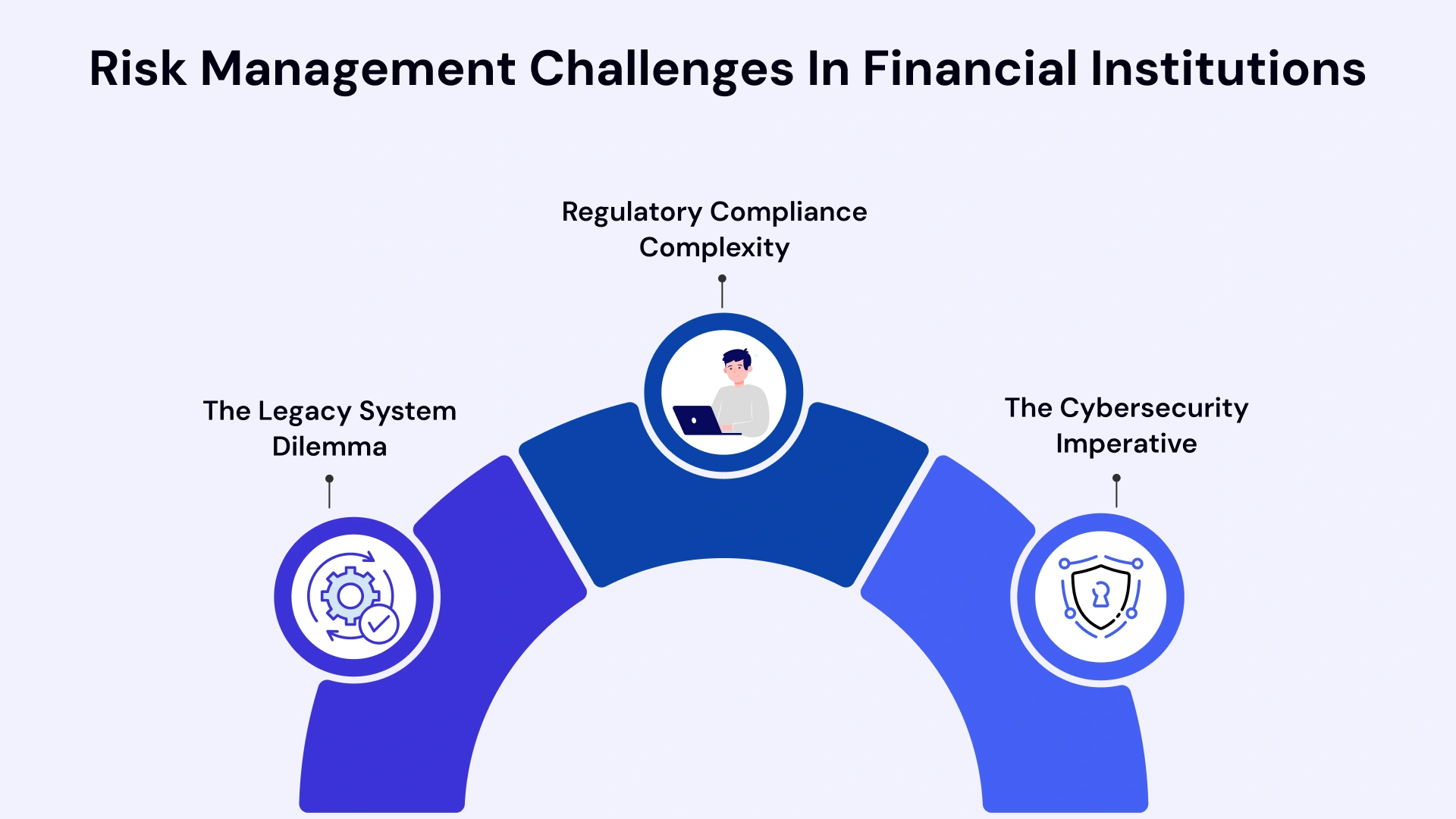
The Legacy System Dilemma
Financial institutions have historically relied on on-premises infrastructure and legacy systems that were designed decades ago. While these systems served their purpose in their time, they now present significant obstacles to effective risk management. Legacy system modernization has become not just a competitive advantage but a survival imperative.
These outdated systems often operate in silos, creating fragmented data landscapes where critical risk information remains isolated. The inability to aggregate and analyze data across different business units, geographies, and product lines leaves institutions vulnerable to blind spots. Moreover, legacy systems lack the computational power and flexibility required for advanced analytics, machine learning, and real-time processing—capabilities essential to modern risk management.
The maintenance costs alone for these aging systems drain resources that could be invested in innovation. Financial institutions find themselves trapped in a vicious cycle: investing heavily to keep legacy systems operational while simultaneously recognizing that these same systems are impediments to digital transformation.
Regulatory Compliance Complexity
The regulatory landscape for financial institutions has grown exponentially more complex. From Basel III and IV to GDPR, SOX, PCI DSS, and countless regional regulations, compliance requirements demand sophisticated risk management capabilities. Regulatory compliance in BFSI isn't just about meeting current standards—it's about building adaptable systems that can evolve as regulations change.
Traditional approaches to compliance—manual reporting, periodic audits, and reactive remediation—no longer suffice. Regulators increasingly expect continuous monitoring, real-time reporting, and demonstrable risk mitigation strategies. The penalties for non-compliance have also escalated dramatically, with fines reaching into billions of dollars for major institutions.
Financial institutions need risk management solutions that provide comprehensive audit trails, automated compliance reporting, and the ability to demonstrate adherence to multiple regulatory frameworks simultaneously.
The Cybersecurity Imperative
Financial institutions are prime targets for cybercriminals, state-sponsored actors, and sophisticated fraud networks. The volume, velocity, and sophistication of attacks have reached unprecedented levels. According to industry reports, the average cost of a data breach in the financial services sector exceeds USD 5.85 million—substantially higher than most other industries.
Traditional perimeter-based security models have proven inadequate against modern threats. Attackers exploit vulnerabilities in legacy systems, leverage social engineering, and employ advanced persistent threats (APTs) that can remain undetected for months. Real-time risk monitoring has become essential, requiring solutions that can analyze millions of transactions and events per second to identify anomalous patterns that indicate potential threats.
The challenge extends beyond external threats. Insider risks, whether malicious or inadvertent, pose equally significant dangers. Financial institutions need comprehensive risk assessment frameworks that encompass external threats, internal vulnerabilities, third-party risks, and supply chain exposures.
Microsoft Azure: The Foundation for Modern Risk Management
1. Cloud Infrastructure Services That Transform Operations
Microsoft Azure provides financial institutions with enterprise-grade cloud infrastructure services that deliver the scalability, reliability, and security required for mission-critical risk management operations. Unlike traditional on-premises infrastructure, Azure's cloud architecture enables institutions to scale resources dynamically based on demand, ensuring that risk management systems maintain optimal performance even during peak periods or crises.
Azure's global infrastructure—spanning 60+ regions worldwide—ensures that financial institutions can deploy risk management solutions closer to their operations, reducing latency and improving response times. This geographic distribution also enhances resilience, providing robust disaster recovery and business continuity capabilities that are essential for financial services.
The platform's infrastructure-as-code capabilities enable financial institutions to standardize risk management deployments across different business units and geographies, ensuring consistency while maintaining the flexibility to address local requirements. This standardization significantly reduces operational complexity and improves governance.
2. Azure Security Center and Microsoft Defender for Cloud
At the heart of Azure's risk management capabilities lies Azure Security Center (now integrated into Microsoft Defender for Cloud), a unified security management system that provides advanced threat protection across hybrid cloud workloads. This solution offers continuous security assessment, identifying vulnerabilities and misconfigurations before they can be exploited.
Microsoft Defender for Cloud employs machine learning algorithms to establish behavioral baselines for applications and services, detecting anomalous activities that may indicate compromise. The system provides actionable recommendations prioritized by severity, enabling security teams to focus resources on the most critical risks.
For financial institutions, this means moving from periodic vulnerability assessments to continuous security posture management. The platform's integration with Microsoft's global threat intelligence network provides institutions with insights into emerging threats, enabling proactive defense strategies.
3. Azure Sentinel: Intelligent Security Information and Event Management
Azure Sentinel revolutionizes security information and event management (SIEM) for financial institutions by combining cloud-native scalability with AI-powered threat detection. Traditional SIEM solutions struggle with the volume of data generated by modern financial institutions, often requiring significant investments in infrastructure and specialized personnel.
Sentinel addresses these challenges by leveraging Azure's cloud infrastructure to ingest and analyze massive volumes of security data from across the enterprise—on-premises systems, cloud workloads, SaaS applications, and IoT devices. The platform's built-in machine learning models detect threats that would be impossible to identify through manual analysis or traditional rule-based systems.
For operational risk management in banks, Sentinel provides capabilities for investigating incidents, proactively hunting for threats, and orchestrating automated responses. The platform's playbooks enable financial institutions to codify their incident response procedures, ensuring consistent, rapid remediation of security incidents.
Implementing Azure for Risk Management: Key Components
Implementing Azure for Risk Management involves a multi-layered approach that integrates security, governance, and compliance. By leveraging Azure's native tools, organizations can move from reactive security to a proactive risk posture.
The key components of an Azure-based risk management strategy are categorized into four main pillars:
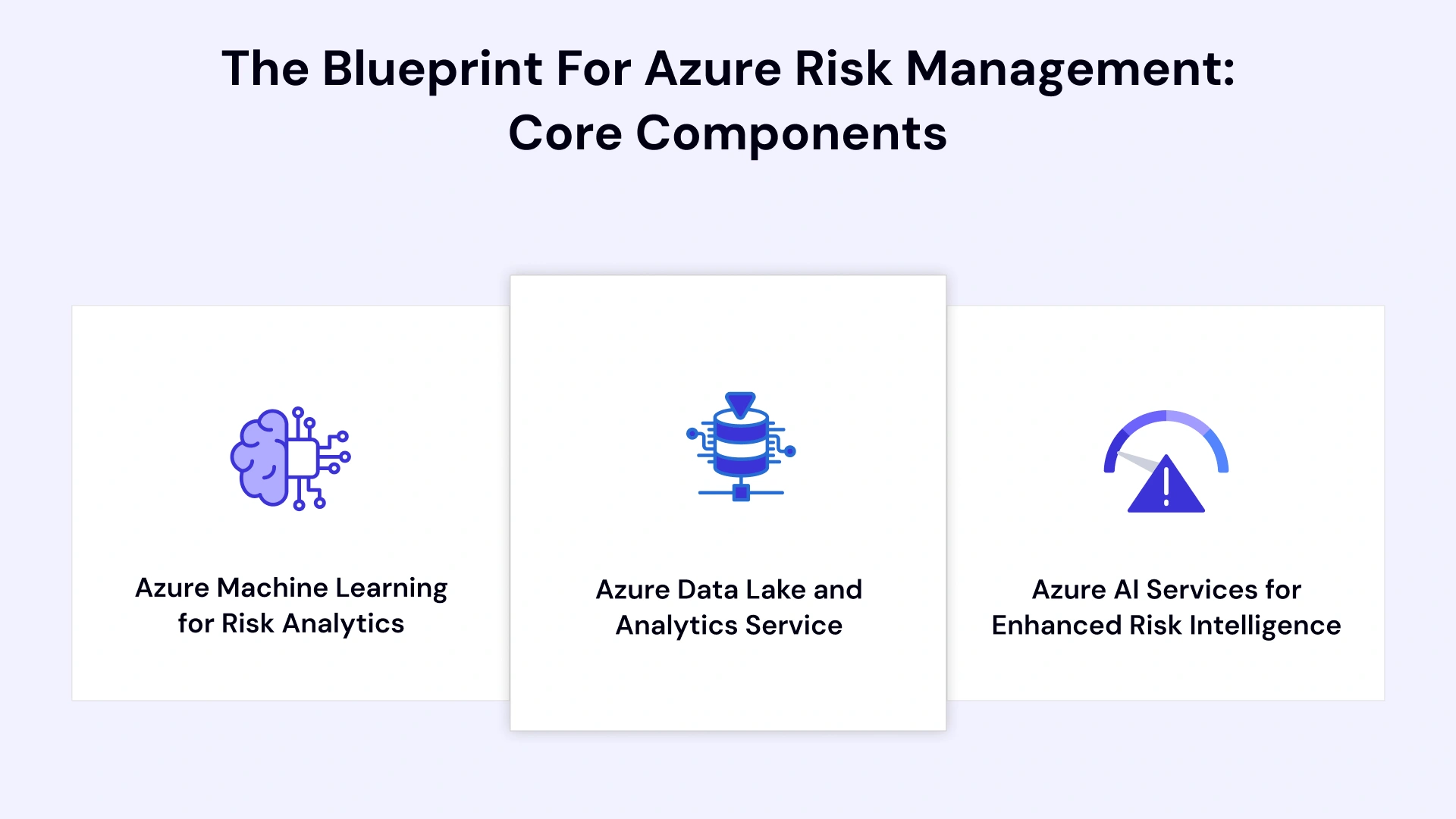
Azure Machine Learning for Risk Analytics
Azure Machine Learning empowers financial institutions to build, deploy, and manage sophisticated risk models at scale. The platform supports the entire machine learning lifecycle—from data preparation and model training to deployment and monitoring—providing data scientists and risk analysts with the tools they need to develop predictive risk models.
For credit risk analytics, Azure Machine Learning enables institutions to analyze vast datasets encompassing borrower information, transaction histories, macroeconomic indicators, and alternative data sources. These models can identify early warning signals of credit deterioration, enabling proactive interventions that minimize losses.
Fraud detection in financial services benefits tremendously from Azure's machine learning capabilities. By analyzing transaction patterns in real time, these models can identify suspicious activity with remarkable accuracy, reducing false positives while catching fraudulent transactions that traditional rule-based systems would miss.
The platform's automated machine learning (AutoML) capabilities democratize advanced analytics, enabling risk teams without deep data science expertise to develop and deploy effective risk models. This acceleration in model development significantly enhances an institution's ability to respond to emerging risks.
Azure Data Lake and Analytics Services
Effective risk management depends on comprehensive data analysis. Azure Data Lake provides financial institutions with virtually unlimited storage for structured and unstructured data, enabling them to aggregate information from disparate sources into a unified analytics platform.
This consolidation eliminates the data silos that plague traditional risk management approaches. By bringing together customer data, transaction records, market data, operational metrics, regulatory filings, and external intelligence feeds, financial institutions gain a holistic view of their risk landscape.
Azure Synapse Analytics, the platform's unified analytics service, enables financial institutions to perform enterprise risk management at unprecedented scale and speed using Azure. The service combines big data and data warehousing capabilities, allowing institutions to analyze petabytes of data using familiar SQL queries or advanced Spark-based analytics.
For financial institutions implementing Basel III/IV risk calculations or complex stress-testing scenarios, Azure's analytics capabilities provide the computational power needed to perform these calculations within required timeframes, even as data volumes continue to grow exponentially.
Azure AI Services for Enhanced Risk Intelligence
Azure AI services extend risk management capabilities beyond traditional analytics, incorporating natural language processing, computer vision, and cognitive services that enhance risk intelligence.
Azure Cognitive Services can analyze unstructured data sources—news articles, social media feeds, regulatory filings, earnings calls—extracting insights that inform risk assessments. This capability is particularly valuable for assessing reputational risks, monitoring market sentiment, and identifying emerging threats that may not be apparent from structured data alone.
For customer due diligence and know-your-customer (KYC) processes, Azure AI services can automate document verification, entity extraction, and risk scoring, significantly reducing onboarding time and costs while improving accuracy and consistency.
Azure OpenAI Service represents the cutting edge of risk management innovation, enabling financial institutions to build conversational AI assistants that help risk analysts navigate complex datasets, generate risk reports, and explore what-if scenarios using natural language queries. This democratization of advanced analytics empowers broader teams to engage with risk data effectively.
Enhancing Specific Risk Management Domains with Azure
To move beyond general infrastructure, Azure offers specialized services that target specific risk domains. By integrating, organizations can tailor their risk management strategy to the unique needs of their industry, whether they are focused on financial stability, legal compliance, or operational continuity.
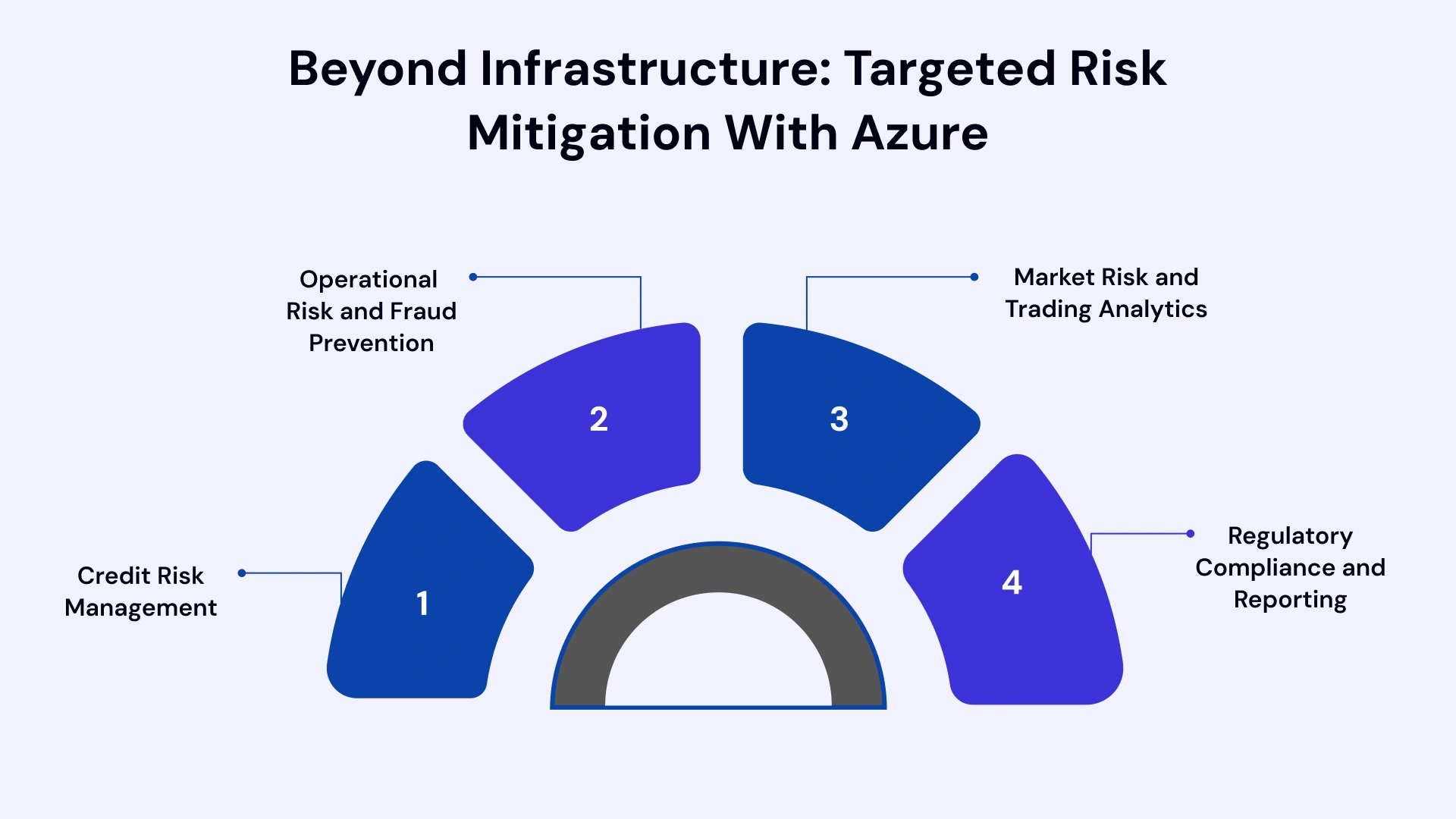
Credit Risk Management
Credit risk remains one of the most significant exposures for banking institutions. Microsoft Azure for financial services transforms credit risk management from a periodic, backward-looking process to a continuous, forward-looking discipline.
Azure's data platform enables institutions to integrate traditional credit bureau data with alternative data sources—such as payment histories, social media activity, transaction patterns, and employment verification data—to create more comprehensive borrower profiles. Machine learning models built on this enriched data deliver more accurate credit assessments, particularly for underserved populations lacking traditional credit histories.
For portfolio management, Azure's analytics capabilities enable institutions to perform sophisticated stress testing and scenario analysis, assessing portfolio resilience under various economic conditions. These capabilities support more informed capital allocation decisions and ensure adequate provisioning for potential losses.
Azure's real-time analytics also enable dynamic risk pricing, adjusting interest rates and credit terms based on current risk assessments rather than static models. This approach optimizes risk-adjusted returns while ensuring responsible lending practices.
Operational Risk and Fraud Prevention
Operational risks—encompassing process failures, system outages, human errors, and external events—represent substantial exposures for financial institutions. Azure provides a comprehensive framework for BFI risk management modernization that addresses these challenges.
Azure's infrastructure reliability features—including geo-redundancy, automated failover, and disaster recovery capabilities—minimize the operational risks associated with system failures. Financial institutions can achieve recovery time objectives (RTO) and recovery point objectives (RPO) that were previously impossible with on-premises infrastructure.
In financial services fraud detection, Azure's real-time analytics capabilities process millions of transactions per second, applying machine learning models to identify suspicious patterns. The platform's anomaly detection services establish behavioral baselines for customers and accounts, flagging deviations that may indicate fraud, account takeover, or money laundering.
Microsoft Azure cloud solutions for financial services integrate fraud detection capabilities across channels—online banking, mobile applications, ATMs, and branches—providing a unified view of customer activity that enables more effective fraud prevention. This cross-channel visibility is essential for detecting sophisticated fraud schemes that exploit inconsistencies between different systems.
Market Risk and Trading Analytics
For financial institutions engaged in trading and market-making activities, Azure provides the low-latency, high-throughput infrastructure required for risk assessment in banking related to market exposures. The platform's computational capabilities enable real-time calculation of value-at-risk (VaR), stress testing, and scenario analysis across complex trading portfolios.
Azure's integration with market data providers ensures that risk calculations reflect current market conditions, incorporating real-time prices, volatilities, and correlations. This immediacy is crucial for managing exposures in fast-moving markets where delays in risk assessment can result in significant losses.
For algorithmic trading operations, Azure provides the infrastructure to monitor algorithms in real time, identifying anomalous behavior that could indicate malfunctions or market manipulation. These capabilities help institutions manage the operational and regulatory risks associated with automated trading.
Regulatory Compliance and Reporting
Regulatory compliance represents one of the most resource-intensive aspects of risk management. Azure streamlines compliance processes through automation, centralization, and comprehensive audit capabilities.
Azure's compliance framework encompasses dozens of regulatory standards relevant to financial institutions, including SOC 1/2/3, ISO 27001, PCI DSS, GDPR, HIPAA, and industry-specific regulations. The platform provides detailed documentation, compliance reports, and audit support that accelerate institutions' own certification processes.
For regulatory reporting, Azure Data Factory enables automated extraction, transformation, and loading (ETL) of data from multiple sources into standardized reporting formats. This automation eliminates manual data compilation errors while ensuring the timely submission of regulatory reports.
Azure's blockchain service, Azure Confidential Ledger, provides immutable audit trails that demonstrate regulatory compliance and support forensic investigations when issues arise. This capability is particularly valuable for demonstrating adherence to anti-money laundering (AML) and know-your-customer (KYC) requirements.
Cloud Migration Strategies for Risk Management Systems
1. Assessment and Planning
Successful migration of risk management systems to Azure begins with a comprehensive assessment and planning. Financial institutions must inventory existing systems, identify dependencies, assess data volumes and flows, and establish migration priorities based on business value and technical complexity.
Cloud migration consulting services help institutions develop tailored migration strategies for their specific circumstances. The most common approaches include:
- Rehost (Lift-and-Shift): Moving applications to Azure with minimal modifications, providing quick migration while deferring optimization. This approach is appropriate for legacy applications that are difficult to modernize but need to move off aging on-premises infrastructure.
- Refactor: Making modest modifications to applications to take advantage of cloud capabilities without fundamentally redesigning them. This balanced approach delivers improved performance and cost efficiency while managing migration risks.
- Rearchitect: Substantially redesigning applications to fully leverage cloud-native capabilities—microservices architectures, containerization, serverless computing. This approach delivers the greatest benefits MS Azure cloud platform, but requires a greater investment of time.
- Rebuild: Completely redeveloping applications using cloud-native technologies. This approach makes sense for critical risk management applications where legacy systems have become insurmountable obstacles.
The optimal strategy often involves different approaches for different systems based on their strategic importance, technical debt, and business requirements.
2. Migration Execution Best Practices
Executing risk management system migrations requires careful planning to minimize disruption to ongoing operations. Financial institutions should adopt a phased migration approach, beginning with non-critical systems to build expertise and confidence before migrating core risk management platforms.
Data migration represents one of the most challenging aspects. Azure provides multiple tools—Azure Data Box for large-scale offline transfers, Azure Data Factory for ongoing data synchronization, Azure Database Migration Service for database migrations—that enable institutions to move data securely and efficiently.
For insurance and financial software development services, maintaining data consistency during migration is paramount. Azure's migration tools support continuous replication, enabling institutions to keep source and destination systems synchronized until they're ready to cut over completely.
Testing is critical. Financial institutions must validate that migrated risk management systems function correctly, meet performance requirements, and maintain data integrity. Azure's environments enable institutions to create production-like testing environments without incurring the full costs of production infrastructure.
3. Post-Migration Optimization
Migration to Azure is not the end of the journey but the beginning of continuous optimization. Financial institutions should implement cloud-managed services that provide ongoing management, monitoring, and optimization of their Azure environments.
Cost optimization is a key focus area. Azure's pricing models—pay-as-you-go, reserved instances, spot instances—offer flexibility, but institutions must actively manage their cloud spending. Azure Cost Management provides visibility into spending patterns and offers optimization recommendations.
Performance optimization ensures that risk management systems deliver the responsiveness required for real-time operations. Azure provides extensive monitoring and diagnostics capabilities that help institutions identify bottlenecks and optimize configurations.
Security optimization remains an ongoing priority. As threats evolve, institutions must continuously update security configurations, apply patches, and refine access controls. Azure's security recommendations provide actionable guidance for maintaining robust security postures.

Integration with Existing Financial Ecosystems
Hybrid Cloud Architecture
Most financial institutions cannot immediately migrate all systems to the cloud. Regulatory requirements, technical constraints, and business considerations often necessitate hybrid approaches that maintain certain workloads on-premises while moving others to Azure.
Azure's hybrid capabilities—including Azure Stack, Azure Arc, and hybrid connectivity options—enable institutions to build unified risk management platforms spanning on-premises and cloud environments. These capabilities ensure that cloud migration doesn't create new data silos or integration challenges.
For example, institutions might maintain transaction processing systems on-premises due to latency requirements or regulatory constraints while moving risk analytics and reporting to Azure. Azure's hybrid architecture ensures seamless data flow between these environments, enabling comprehensive risk visibility.
API Management and Integration Services
Risk management systems must integrate with numerous other systems—such as core banking platforms, payment processors, trading systems, customer relationship management (CRM) systems, and external data providers. Azure API Management provides a unified gateway for managing these integrations, ensuring security, reliability, and performance.
Microsoft business solutions include extensive integration capabilities that connect Azure with Microsoft Dynamics 365, Microsoft 365, and Power Platform. These integrations enable financial institutions to embed risk intelligence into business processes—for example, surfacing credit risk scores in loan origination workflows or flagging high-risk customers in CRM systems.
Azure Logic Apps and Azure Functions enable institutions to build custom integrations and workflows that orchestrate complex processes spanning multiple systems. These capabilities are essential for implementing end-to-end risk management processes that depend on coordinated actions across the enterprise.
Data Governance and Quality
Effective risk management depends on high-quality, well-governed data. Azure provides comprehensive data governance capabilities through Azure Purview, a unified data governance service that provides visibility into data assets across the enterprise.
For financial institutions managing data across multiple jurisdictions, Azure Purview's data lineage capabilities trace data flows through systems, supporting compliance with data residency and privacy regulations. The service's data classification capabilities automatically identify sensitive information—personally identifiable information (PII), payment card data, and account numbers—ensuring appropriate security controls are applied.
Azure's data quality tools help institutions identify and remediate data quality issues that could compromise risk assessments. By monitoring data completeness, accuracy, consistency, and timeliness, these tools ensure that risk management decisions are based on reliable information.
Measuring Success: KPIs for Azure-Based Risk Management
Financial institutions implementing Azure for risk management should establish clear key performance indicators (KPIs) to measure success and guide continuous improvement.
- Operational KPIs include system availability and uptime, mean time to detect (MTTD) security incidents, mean time to respond (MTTR) to incidents, and processing latency for risk calculations. These metrics ensure that Azure-based systems meet operational requirements.
- Risk Management KPIs encompass the accuracy of predictive models, the reduction in false positives in fraud detection, the coverage of risk assessments across the enterprise, and the time required to complete regulatory reporting. These metrics demonstrate the effectiveness of risk management capabilities.
- Financial KPIs include total cost of ownership compared to legacy systems, cost per transaction or risk calculation, and return on investment from fraud prevention. These metrics justify ongoing investments in Azure-based risk management.
- Compliance KPIs track regulatory examination findings, time to remediate compliance issues, and audit success rates. These metrics demonstrate the platform's effectiveness in supporting regulatory compliance.
Regular review of these KPIs enables financial institutions to identify opportunities for improvement and ensure that their Azure investments deliver the expected value.
Future Trends: The Evolution of Risk Management with Azure
The risk management landscape continues to evolve rapidly, driven by technological advances, changing regulations, and emerging threats. Azure's continuous innovation enables financial institutions to adapt to these changes.
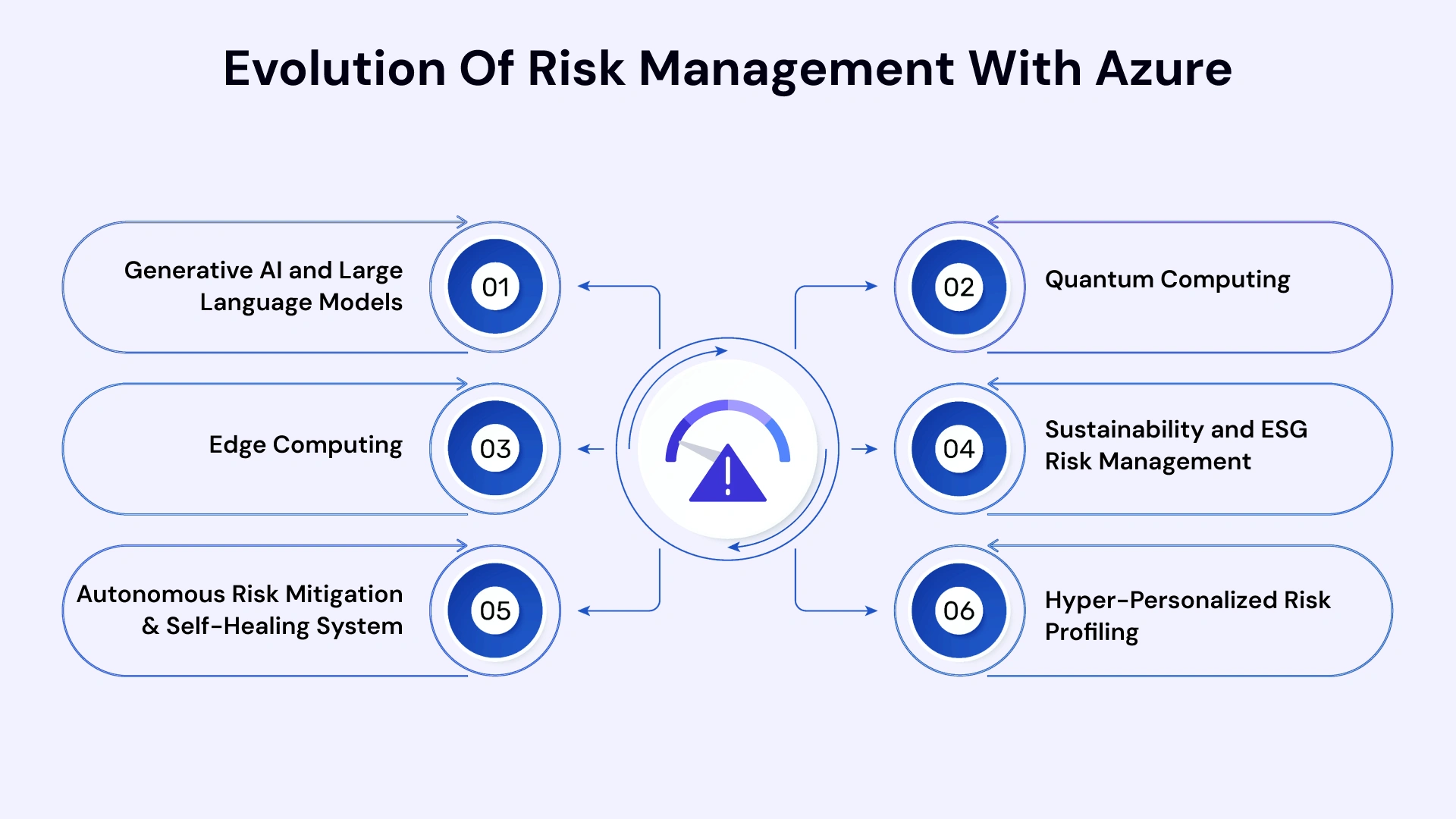
- Generative AI and Large Language Models are transforming risk management by enabling natural language interaction with risk data, automated generation of risk reports, and advanced scenario modeling. Azure OpenAI Service positions financial institutions to leverage these capabilities while maintaining enterprise security and compliance.
- Quantum Computing promises to revolutionize risk modeling by enabling calculations that are impractical with classical computers. Azure Quantum provides financial institutions with early access to quantum computing capabilities, positioning them to explore applications in portfolio optimization, cryptography, and complex risk modeling.
- Edge Computing extends Azure's capabilities to edge locations, enabling real-time risk processing closer to where transactions occur. This architecture reduces latency and enables more responsive fraud prevention for point-of-sale and ATM transactions.
- Sustainability and ESG Risk Management are emerging as critical concerns for financial institutions. Azure's sustainability capabilities enable institutions to measure and manage environmental, social, and governance (ESG) risks, supporting both regulatory compliance and stakeholder expectations.
- Autonomous Risk Mitigation and Self-Healing Systems represent the move toward "Zero-Touch" risk management. By integrating Azure Automanage with AI-driven policy enforcement, institutions can move beyond detection to automated remediation—where systems automatically reconfigure themselves to neutralize security threats or liquidity breaches in real-time without human intervention.
- Hyper-Personalized Risk Profiling leverages Azure's advanced analytics and "Customer 360" views to shift from broad market risk categories to individualized risk assessments. By processing massive datasets of behavioral and alternative data, banks can offer real-time, tailored credit limits and insurance premiums that adapt instantly to a client's changing risk posture.
Leverage VLink's Microsoft Business Solutions for Risk Management
While Azure provides the technological foundation for modern risk management, successfully implementing and optimizing these solutions requires deep expertise, industry knowledge, and proven methodologies. This is where VLink's specialized Microsoft business solutions make the difference.
VLink brings over a decade of experience delivering cloud infrastructure, cloud migration consulting, and cloud managed services specifically tailored for the financial services industry. Our dedicated team understands the unique challenges faced by banks, insurance companies, and financial institutions across Canadian and global markets.
Our comprehensive approach encompasses every phase of your risk management transformation journey:
- Strategic Consulting: We work with your leadership team to develop cloud adoption strategies aligned with your business objectives, regulatory requirements, and risk tolerance. Our consultants help you identify quick wins and long-term opportunities for Azure-enabled risk management.
- Custom Development: Our financial software development services and insurance software development services teams build purpose-built risk management solutions leveraging Azure's advanced capabilities. We don't just configure platforms—we engineer solutions that address your specific risk management challenges.
- Migration Excellence: Our cloud migration consulting services ensure smooth transitions from legacy systems to Azure, minimizing disruption while maximizing the benefits of cloud-native architectures. We've successfully migrated complex risk management systems for numerous financial institutions.
- Ongoing Optimization: Through our cloud-managed services, we continuously monitor, optimize, and enhance your Azure environment, ensuring you stay ahead of emerging threats while controlling costs.
- Training and Enablement: We transfer knowledge to your teams, building internal capabilities that reduce long-term dependence on external support while fostering innovation.
VLink's proven track record in legacy system modernization for financial institutions means we understand the complexities of transforming decades-old risk management infrastructure. We've helped institutions navigate regulatory complexities, integrate disparate systems, and build the resilient, scalable platforms required for modern risk management.
Don't let outdated systems hold your institution back—partner with VLink to unlock the full potential of Azure for your risk management transformation.
Conclusion
The financial services industry stands at a pivotal moment. Traditional approaches to risk management—characterized by siloed systems, periodic assessments, and reactive responses—are no longer adequate for the complexity and velocity of modern threats. The dramatic increase in security and risk management spending projected for 2024 reflects this reality: financial institutions recognize that transformation is not optional but essential for survival.
Microsoft Azure provides a comprehensive, proven platform for this transformation. By combining enterprise-grade infrastructure, advanced analytics, artificial intelligence, and robust security capabilities, Azure enables financial institutions to reimagine risk management from the ground up. The platform addresses the full spectrum of risks—credit, market, operational, compliance, and cybersecurity—through integrated solutions that provide real-time visibility, predictive intelligence, and automated responses.
The journey to cloud-enabled risk management requires careful planning, phased execution, and ongoing optimization. Financial institutions must assess their current state, develop clear migration strategies, build necessary expertise, and foster risk-aware cultures that extend beyond specialized risk functions. Success depends not just on technology but on organizational commitment to transformation.
The institutions that embrace this transformation—moving from reactive to proactive risk management, from siloed to integrated intelligence, from periodic to continuous monitoring—will gain substantial competitive advantages. They will operate more efficiently, respond more rapidly to emerging threats, ensure regulatory compliance more effectively, and ultimately serve their customers more responsibly.
The blueprint for modernizing risk management in financial institutions is clear. Azure provides the foundation, proven methodologies guide the journey, and specialized partners like VLink accelerate success. The question is not whether to transform risk management but how quickly your institution can execute this critical transformation.
The time to act is now. Every day spent on legacy systems is a day of increased vulnerability, missed opportunities, and competitive disadvantage. The financial institutions that lead their industries in five years will be those that invest in modern, cloud-enabled risk management today.

Vice President, Strategy – VLink Inc.
Sambhavi Gopalakrishnan is the Vice President of Strategy at VLink Inc., bringing over a decade of experience in IT leadership, project implementation, and strategic growth. She possesses a strong foundation in technical project management and pre-sales, driving innovation and business transformation at VLink.

 Shivisha Patel