


In the demanding landscape of modern retail, the war for customer loyalty is won in milliseconds—and often, through a single, perfect suggestion. As senior technology leaders, you understand that scaling personalized experiences is no longer a luxury; it is the fundamental axis of competitive differentiation.
The complexity and sheer volume of inventory in major retail organizations across the USA, Canada, and India demand an intelligent, automated solution that can replicate the expertise of a seasoned sales associate on a million concurrent screens.
The future of commerce is conversational, and the key technology driving this transformation is the Product Recommendation Chatbot.
This is not a guide about simple FAQ bots. This is a strategic and technical blueprint designed for Retail CTOs and CXOs who are ready to move beyond static, algorithm-driven suggestions to deploy dynamic, AI-powered conversational agents that actively drive top-line revenue.
The Strategic Value Proposition: Data That Demands Action
The evidence supporting this technological pivot is irrefutable. Investing in a robust product recommendation chatbot moves the needle on every critical retail metric:
- Revenue Growth through Personalization: Targeted personalization, which is the core function of these bots, consistently drives a 10-15% revenue lift, according to McKinsey analysis.
- Conversion Rate Acceleration: Shoppers who engage with AI chatbots convert at up to 4X higher rates (12.3% versus 3.1%), effectively closing the gap between interest and purchase by resolving ambiguity instantly.
- Customer Satisfaction and Sales Efficiency: Chatbot interactions boast an average satisfaction rate of 87.6%. Furthermore, businesses leveraging chatbots for sales purposes report an average increase of 67% in sales.
For retail leaders managing complex, high-volume ecosystems, the product recommendation chatbot represents the most direct, scalable path to realizing these returns. It is your 24/7, multilingual, expert sales associate ready to guide millions of customers simultaneously.

The Strategic Imperative: Why Retail CXOs Must Invest Now
The decision to allocate significant resources to a new platform requires a strategic justification that resonates across the organization, from finance to marketing. For a retail CXO, the product recommendation chatbot delivers value in three critical areas:
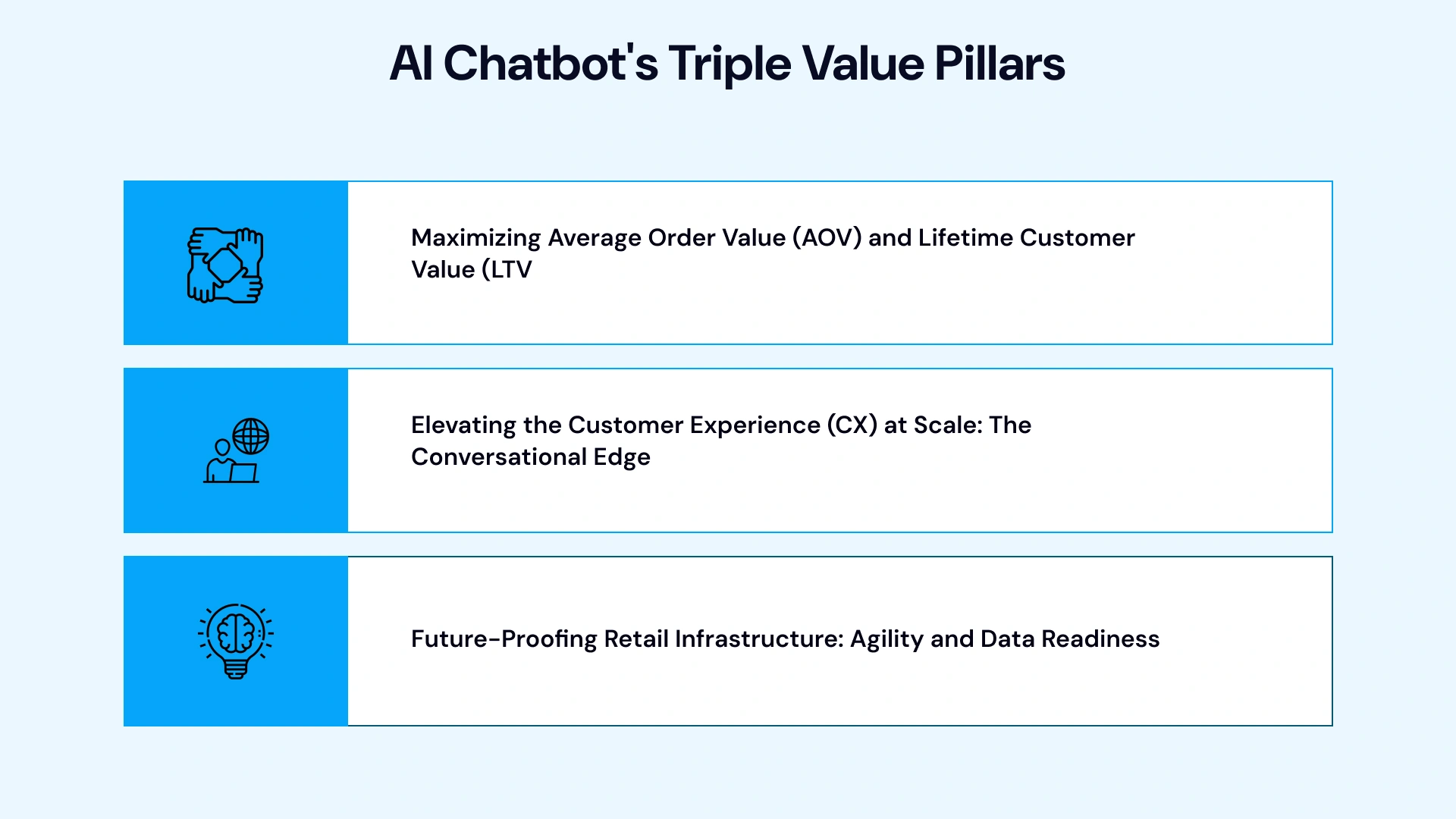
1. Maximizing Average Order Value (AOV) and Lifetime Customer Value (LTV)
The strategic power of a conversational agent lies in its ability to intervene at the perfect moment in the buying journey. Static recommendation widgets lack context; a chatbot, however, can dynamically engage.
- Contextual Cross-Selling: If a customer states, "I need a running shoe for marathons," the bot not only recommends the correct shoe but immediately cross-sells necessary accessories (hydration packs, specialized socks) with a logical, conversational explanation, resulting in increased transaction size.
- Zero-Party Data Collection: Every conversation is a goldmine. The customer willingly shares preferences, budgets, and needs—this zero-party data is inherently high-quality and directly informs future personalization models, boosting LTV across subsequent visits and marketing campaigns.
- Decoy Effect and Anchoring: An expert bot can intelligently present product bundles or tiered options, effectively using behavioral economics principles to steer the customer toward higher-margin or premium products, a sophisticated sales technique impossible for a simple website algorithm.
2. Elevating the Customer Experience (CX) at Scale: The Conversational Edge
Modern retail demands convenience and immediacy. The chatbot fulfills this demand by eliminating decision fatigue. When a customer faces a catalog of 50,000 items, the friction is immense.
- Instant Expert Advice: The bot acts as a specialized personal shopper. Instead of filtering through endless categories, the customer asks, "Show me a highly rated espresso machine under $500 that fits on a small counter," and receives an immediate, filtered, personalized list.
- 24/7 Omnichannel Presence: Whether the customer is on the website, WhatsApp, or a brand-specific mobile app, the AI agent provides consistent, high-quality service, ensuring that the critical buying moment is never lost due to time zone differences or queue wait times.
- Consistency and Brand Voice: The chatbot enforces brand guidelines and sales messaging consistently, unlike human teams that may vary in training and expertise. This ensures every customer interaction aligns with the desired brand experience, building trust and authority.
3. Future-Proofing Retail Infrastructure: Agility and Data Readiness
As retail moves toward headless commerce architectures and microservices, the product recommendation chatbot serves as a lightweight, flexible front-end layer that integrates seamlessly without requiring costly overhauls of legacy systems. This technical agility is crucial for large retail operations:
- API-First Integration: A well-built bot is API-first, enabling it to pull inventory, pricing, and customer history in real time from various backend systems (ERP, PIM, CRM) without disruption.
- Iterative Optimization: Unlike a complete e-commerce software development services platform redesign, chatbot dialog and recommendation logic can be rapidly A/B-tested and deployed, accelerating time-to-value for new product launches or strategic sales campaigns.
Technical Architecture Deep Dive: The Engine Behind the Recommendations
For the CTO, the performance, scalability, and integration complexity of the product recommendation chatbot are paramount. A truly successful solution is a complex integration of several specialized Machine Learning (ML) components.
Core Components of the Recommendation Stack
A high-performance product recommendation chatbot is typically structured into three functional layers:
1. The Conversational Interface (NLP/NLU)
This layer is responsible for translating human language into structured, actionable data (intents and entities).
- Natural Language Processing (NLP): Handles tokenization, stemming, and syntactic analysis, ensuring the bot understands the basic meaning of the input ("I want a dress").
- Natural Language Understanding (NLU): The critical layer that extracts the intent (product_search) and entities (product_category: dress, color: red, budget: $100). Modern agents leverage large language models (LLMs) to handle complex, ambiguous, and out-of-scope queries gracefully, ensuring a high conversational success rate.
2. The Recommendation Engine
This is the mathematical core, the engine that queries the product catalog and customer profiles to generate the ranked list of suggestions.
- Vector Database/RAG (Retrieval-Augmented Generation): The product catalog is indexed into a vector database. When a query is received, the system retrieves the most semantically similar products, not just keywords, dramatically improving relevance.
- Scoring and Ranking Algorithm: The retrieved results are then scored based on business logic, customer history, real-time inventory, and algorithmic biases (e.g., favoring higher-margin items or products with higher customer ratings).
3. The Integration Layer (API/Webhook)
The component that connects the brain (the engine) to the body (the retail ecosystem).
1. Headless Commerce Integration: The bot uses secure APIs (e.g., REST or GraphQL) to interface directly with core systems:
- PIM/ERP: To fetch up-to-the-minute product descriptions, images, and specifications.
- Inventory Management: Critical to avoid recommending out-of-stock items, a central CX friction point.
- CDP/CRM: To retrieve the user’s historical purchase data, loyalty status, and saved preferences.
Algorithmic Selection: Choosing the Right Recommendation Model
The type of ML model defines the quality and depth of the recommendation:
| Model Type | Mechanism | Data Requirements | Best Use Case for Retail |
| Collaborative Filtering | Based on the similarity between users or items. E.g., "Customers who liked Product A also purchased Product B." | Requires extensive user-interaction history (purchases, clicks, ratings). | Mass-market retail; Enhancing AOV through cross-sells on product pages. |
| Content-Based Filtering | Based on product attributes and user profile data. E.g., If a user bought a high-end black t-shirt, recommend other high-end black apparel. | Requires rich product metadata (color, material, brand, price). | Niche or specialty retail; Early-stage recommendations for new users (solving the "cold start" problem). |
| Hybrid Models (Preferred) | Combines the strengths of both, often via weighted scoring or sequential mixing. | Requires both deep customer history and rich product metadata. | Enterprise-level retail; Provides the highest accuracy and diversity of suggestions, crucial for dynamic conversational flow. |
For a robust, enterprise-grade product recommendation chatbot, a Hybrid Model is non-negotiable. It leverages the precision of content matching with the serendipity of collaborative insights, making the conversation feel intuitive and highly valuable.
The CTO’s Implementation Roadmap: Building, Testing, and Scaling
The execution strategy for a product recommendation chatbot must be deliberate, iterative, and focused on measurable ROI from day one. This is a multi-phased approach that addresses technology, people, and processes.
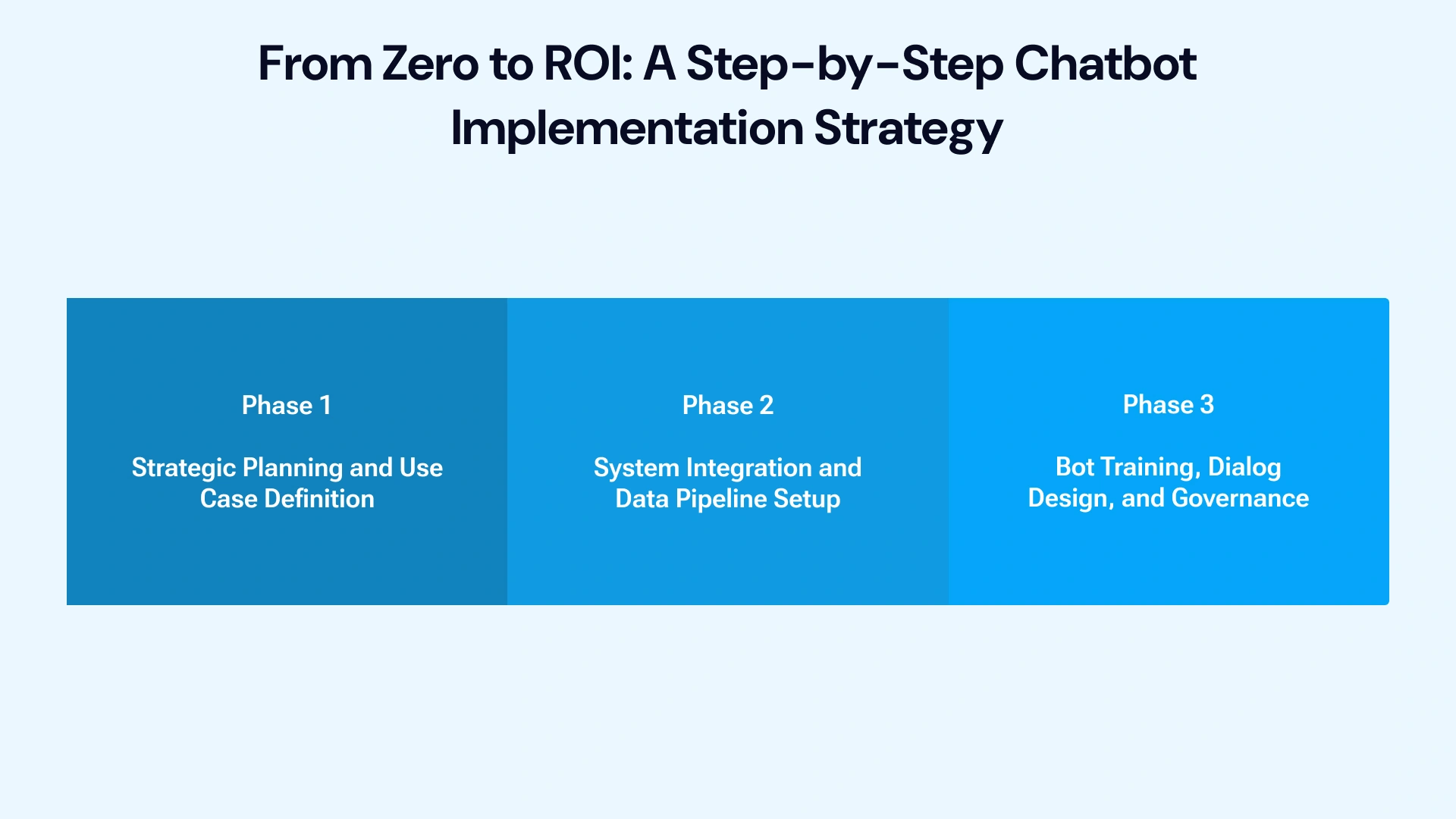
Phase 1: Strategic Planning and Use Case Definition
Before writing a line of code, define the strategic intent.
1. Define Core Use Cases: Which part of the journey yields the highest immediate ROI? (e.g., New visitor product discovery, or post-purchase support and re-engagement). Focus on 2-3 high-value scenarios first.
2. The "Build vs. Buy" Decision:
- Buy (Platform/SaaS): Recommended for rapid deployment (3-6 months), especially for specialized platforms with integrated LLM and RAG capabilities. Lower initial cost, faster time-to-value, but limited customization.
- Build (Custom): Recommended for retailers with highly unique data needs, proprietary algorithms, or complex, legacy system integration requirements: high initial investment, but maximum control over logic and scalability. The retail tech leader must weigh the cost of maintenance versus the competitive edge of proprietary technology.
3. Data Readiness Assessment: Perform an audit of your Product Information Management (PIM) and Customer Data Platform (CDP). Are product descriptions detailed? Is historical purchase data unified and accessible via API? Garbage in, garbage out—data quality is the single most significant determinant of success.
Phase 2: System Integration and Data Pipeline Setup
This is the technical heavy lifting, ensuring the bot can access and process real-time information reliably.
1. Establish Secure API Gateways: Set up robust, low-latency connections between the chatbot platform and your core retail systems (PIM, ERP, Inventory). Security (OAuth 2.0, API key rotation) is paramount, as the bot handles transactional and user-specific data.
2. Real-Time Data Sync: Implement a process that pushes inventory updates to the bot's knowledge base in real time. A five-minute delay can lead to a negative CX when a recommended product is suddenly out of stock.
3. CDP Integration: Connect the bot directly to your CDP. This allows the bot to leverage consolidated historical data from web, app, email, and POS systems, providing a unified view of the customer, which is vital for hyper-personalization.
Phase 3: Bot Training, Dialog Design, and Governance
A technologically superior bot can still fail if the conversation feels robotic or leads to frustration.
1. Crafting the Conversational Flow: Employ content specialists and UX designers to craft the bot’s personality and dialog trees. The tone must align with the brand (Expert, Friendly, Premium) and anticipate user frustration points. Utilize open-ended questions to gather preference data and conversational guards to handle fallbacks gracefully.
2. Training and Fine-Tuning: Train the NLP model on real, domain-specific retail language. Fine-tune the LLM layer using Retrieval-Augmented Generation (RAG) methodology, grounding the Generative AI in your specific product knowledge base to prevent "hallucinations" (inaccurate product details).
3. Rigorous A/B Testing: Deploy the bot to a limited audience first (e.g., 5% of traffic). A/B test key variables:
- Prompt Engineering: Does "How can I help you find the perfect gift?" convert better than "Looking for products?"
- Recommendation Density: Should the bot suggest 3 products or 5?
- Placement: Does the bot perform better on the homepage or the category page?
Post-Deployment: Monitoring for Success
Success metrics must move beyond basic usage counts. CTOs need to track metrics that directly link to the bottom line.
| Key Performance Indicator (KPI) | Measurement Focus | Strategic Impact for CXOs |
| Recommendation-to-Conversion Rate | Percentage of customers who bought a recommended product after engaging with the bot. | Direct measure of sales effectiveness and ROI. |
| AOV Uplift (Segmented) | The difference in AOV between customers who used the bot and those who didn’t. | Quantifies the bot's cross-sell/upsell effectiveness. |
| Containment Rate | Percentage of queries handled successfully without human agent handoff. | Measures operational efficiency and cost savings in support. |
| Fall-back/Confusion Rate | Frequency of the bot responding with "I don't understand." | Measures the quality and maturity of the NLP/NLU models and data coverage. |
Advanced Strategies: Future-Proofing Your Conversational Commerce Strategy
To maintain an EEAT position in the market, large retail organizations must look beyond current best practices and integrate future-forward technologies.
Integrating with a Customer Data Platform (CDP) for Hyper-Personalization
A true next-generation product recommendation chatbot cannot operate in a silo. It must be seamlessly connected to a robust CDP. The CDP acts as the single source of truth, allowing the chatbot to:
- Recognize Identity Across Channels: Know if a user chatting on the website is the same person who abandoned a cart on the mobile app last week.
- Leverage Contextual Triggers: Initiate a conversation based on high-intent actions—e.g., "I see you've looked at the X and Y cameras three times. Would you like me to compare their features for you?"
- Dynamic Segmentation: Instantly identify the customer's loyalty tier, geography, or known brand preferences, ensuring all recommendations are filtered and ranked accordingly.
This tight coupling turns the chatbot from a transactional tool into a full-fledged customer relationship asset.
The Role of Generative AI (GenAI) in Next-Generation Bots
Generative AI (specifically, advanced LLMs) is rapidly transforming the potential of product recommendation.
- Dynamic, Unscripted Conversation: Traditional bots rely heavily on predefined flow trees. GenAI allows the bot to handle complex, unscripted queries (e.g., "I'm furnishing a mid-century modern apartment and need three pieces of furniture that match this lamp I sent you a picture of."). The bot can synthesize product attributes, style guides, and inventory data to generate a truly unique, curated response.
- Creative Problem Solving: Instead of simply saying, "That item is out of stock," a GenAI-powered bot can analyze the unavailable item's features, search the PIM for alternatives, and generate a creative, compelling justification for the best substitute, maintaining the sale.
- Content Generation: Bots can dynamically create personalized product descriptions or even marketing copy on the fly within the chat window, increasing engagement.
Multi-Channel Deployment and Consistency (Omnichannel Retail)
Retail software development services scale requires an omnichannel presence. Your chatbot strategy must extend beyond the website.
- Social Commerce Integration: Deploy the same core recommendation logic on platforms like WhatsApp, Instagram, and Facebook Messenger, where customers are increasingly initiating transactions.
- In-Store Assistance: Integrate the bot's engine into employee-facing tablets or kiosks, empowering human sales associates with AI-driven, real-time product knowledge and recommendations, bridging the gap between digital and physical experience.
Navigating the Technical and Operational Hurdles
A successful deployment hinges on retail leaders' ability to anticipate and navigate complex technical, compliance, and operational hurdles. Understanding these challenges is the first step toward a smooth, effective AI integration.
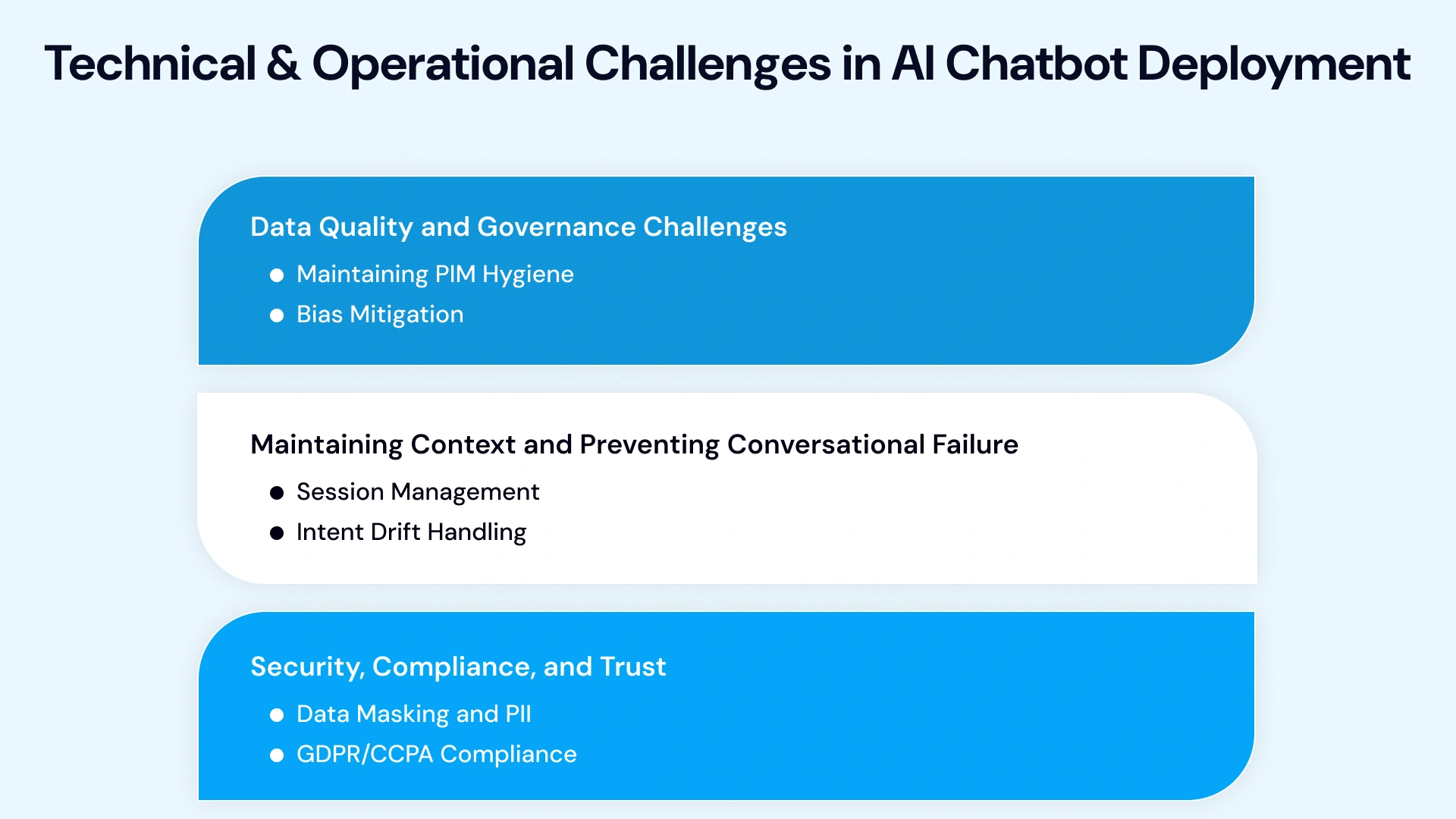
Data Quality and Governance Challenges
The largest bottleneck for any recommendation engine is data rot and inaccuracy.
- Maintaining PIM Hygiene: In large retail operations with thousands of SKUs, product metadata (colors, sizes, materials, compatibility) can quickly become outdated or inconsistent. Implementing automated data validation pipelines is essential to feed the bot accurate information.
- Bias Mitigation: Recommendation algorithms, by nature, can introduce bias (e.g., constantly recommending best-sellers, stifling discovery of niche or new products). CTOs must enforce algorithmic governance, ensuring models are tested for fairness and configured to promote product diversity.
Maintaining Context and Preventing Conversational Failure
The bot's ability to "remember" previous turns or even sessions is vital for a humanized experience.
- Session Management: Implement robust user identification and memory persistence features. The bot must retain the user's preferences (e.g., budget, style, size) for the duration of the conversation and potentially for future sessions (leveraging the CDP).
- Intent Drift Handling: Customers rarely stick to a single topic. The bot must be engineered to handle seamless switching between tasks (e.g., recommending a product, checking store hours, and then returning to the product recommendation flow) without losing the original context or entities.
Security, Compliance, and Trust
Operating in jurisdictions like the US, CA, and India requires strict adherence to security and privacy standards.
- Data Masking and PII: While the bot needs access to user data (purchase history, location) to personalize, it must handle Personally Identifiable Information (PII) securely, often through tokenization or masking, especially in chat logs.
- GDPR/CCPA Compliance: The chatbot framework must include precise mechanisms for obtaining consent for data use. Customers must easily be able to exercise their "right to be forgotten" or request a copy of the data the bot has collected about them. Trust is the foundation of conversational commerce.
Drive Sales with AI: VLink's Product Recommendation Chatbot Solution
For CTOs and CXOs navigating the complexities of integrating advanced AI with enterprise-level retail infrastructure, the path from strategic vision to reliable deployment requires specialized expertise. VLink's AI Development Service delivers production-ready, high-ROI conversational commerce solutions tailored for large-scale retail operations across the US, Canada, and India.
VLink’s Approach: Bridging Retail Scale and AI Sophistication
Our team understands that deploying a product recommendation chatbot is more than a software installation—it is a transformation of your sales and service channels. Our solution is engineered to address the unique challenges of high-volume retail environments:
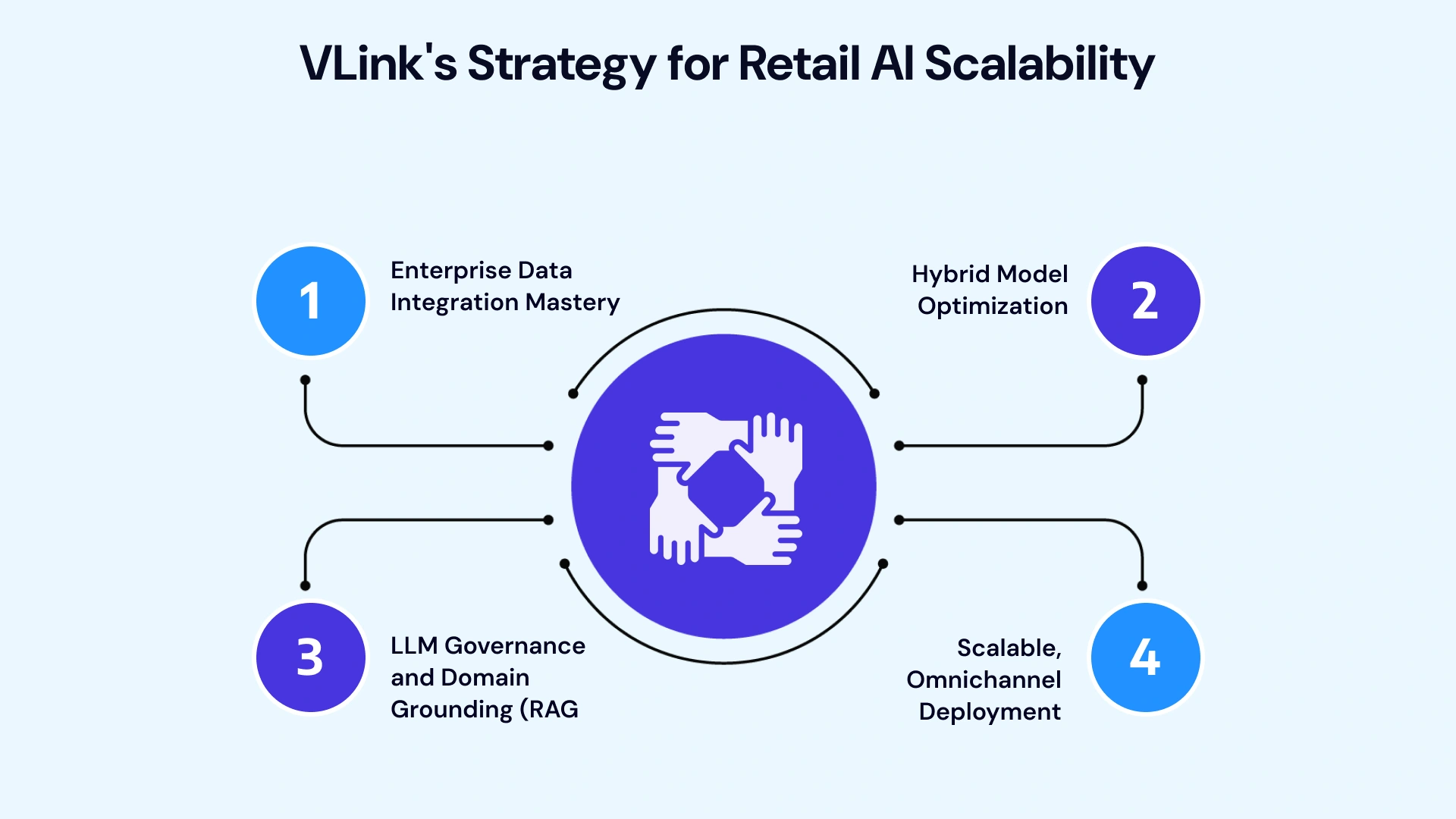
- Enterprise Data Integration Mastery: We specialize in securing, consolidating, and normalizing data from disparate enterprise sources (legacy ERPs, modern PIMs, and CDPs). Our custom API development ensures real-time inventory and pricing accuracy, eliminating the risk of customer friction caused by recommending out-of-stock items.
- Hybrid Model Optimization: VLink builds and fine-tunes proprietary Hybrid Recommendation Models. These models strategically blend Collaborative Filtering with your rich product metadata, ensuring that every recommendation is both highly personalized and aligned with your business objectives, such as promoting high-margin or new-arrival inventory.
- LLM Governance and Domain Grounding (RAG): We employ rigorous Retrieval-Augmented Generation (RAG) techniques to ground advanced Large Language Models (LLMs) in your specific retail knowledge base. This significantly reduces the risk of AI "hallucinations," ensuring the bot’s conversational flow and product knowledge are accurate, authoritative, and on-brand.
- Scalable, Omnichannel Deployment: Our solutions are built on cloud-native architectures, designed for peak retail traffic (e.g., holiday seasons) and deployed consistently across all channels—web, mobile, WhatsApp, and social platforms—ensuring a seamless, high-performance customer experience regardless of the touchpoint.
Choosing VLink means partnering with a team that has a decade of experience translating retail technology strategy into measurable commercial success in global markets. Our dedicated team delivers the certainty and security that top-tier retail technology leadership demands.
Conclusion
The product recommendation chatbot has evolved from a novel customer service gadget into a mission-critical, revenue-generating machine. For Retail CTOs and CXOs, this technology offers a powerful pathway to realizing massive gains in Average Order Value, conversion rates, and long-term customer satisfaction.
The successful implementation hinges not just on selecting the right platform, but on a holistic strategy that ensures real-time data integration, rigorous algorithmic governance, and a deeply humanized conversational design. By implementing the architecture and roadmap detailed in this guide, your organization can transition seamlessly into the era of conversational commerce, ensuring your vast inventory is navigated with expert precision and delivering the perfect product to the right customer, every single time. The time to build is now.
Ready to transform your sales strategy and deploy an intelligent, high-ROI product recommendation solution? Connect with VLink's AI strategy specialists today to discuss a tailored blueprint for your retail organization. We offer expertise in integrating with complex enterprise ecosystems and delivering AI solutions that drive tangible business results across the global markets.

Vice President, Strategy – VLink Inc.
Sambhavi Gopalakrishnan is the Vice President of Strategy at VLink Inc., bringing over a decade of experience in IT leadership, project implementation, and strategic growth. She possesses a strong foundation in technical project management and pre-sales, driving innovation and business transformation at VLink.

 Shivisha Patel