


This comprehensive blog explores the strategic approach to microservices migration for trading platforms, delivering actionable insights from a decade of experience modernizing capital market infrastructure across USA and Canadian financial institutions.
A structured framework ensures success—trading platform modernization framework covers assessment, design, migration, and testing.

The Business Case for Legacy Trading Platform Migration to Microservices
Legacy systems modernization services have become critical for capital market firms facing mounting pressure from digital-first competitors and evolving regulatory frameworks. According to EPAM's research on legacy system modernization, approximately 70% of financial institutions cite their existing infrastructure as the primary barrier to digital transformation.
Why Monolithic Trading Platforms Fail in Modern Markets
Traditional monolithic architectures in capital markets face fundamental limitations that directly impact revenue generation and risk management:
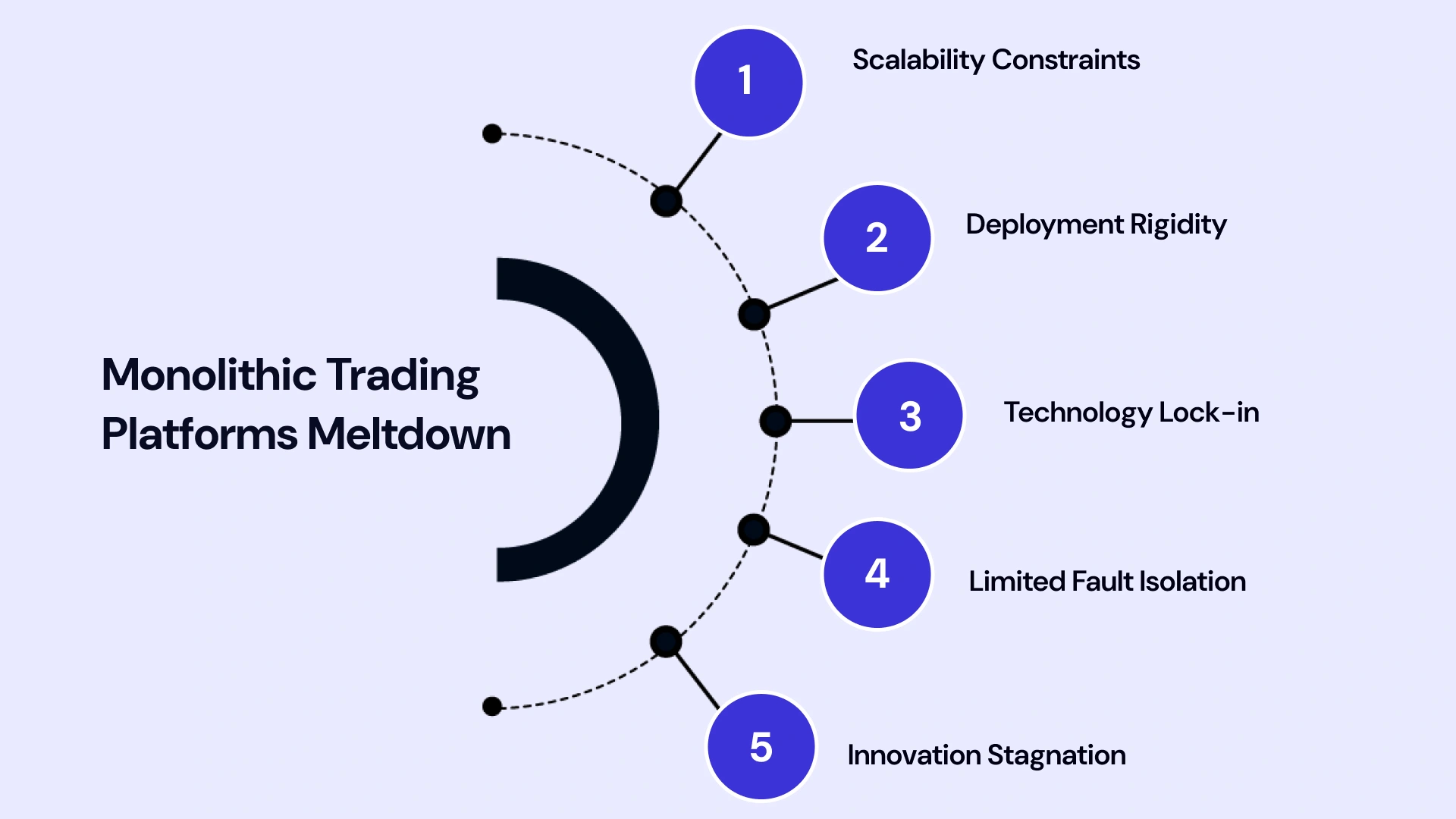
- Scalability Constraints: Monolithic systems struggle to handle peak trading volumes, particularly during market volatility, when milliseconds matter. A single bottleneck can cascade across the entire platform, causing system-wide degradation.
- Deployment Rigidity: Updates to trading algorithms, risk models, or compliance rules require a full-system redeployment, creating extended maintenance windows that directly translate into lost trading opportunities and revenue.
- Technology Lock-in: Legacy platforms often rely on proprietary frameworks or deprecated technology stacks, making it prohibitively expensive to attract top engineering talent or integrate with modern cloud infrastructure services.
- Limited Fault Isolation: A single component failure can bring down the entire trading ecosystem, exposing firms to catastrophic financial and reputational risk during critical market events.
- Innovation Stagnation: Tightly coupled architectures make it nearly impossible to experiment with emerging technologies such as machine-learning-driven trading strategies or real-time blockchain settlement without undertaking massive reengineering.
The Microservices Advantage for Capital Markets
Microservices migration strategy for trading platforms delivers measurable business outcomes that directly impact the bottom line. Based on implementations across tier-one financial institutions, firms typically realize:
- 35-50% Reduction in Time-to-Market: Independent service deployment enables parallel development streams, accelerating feature delivery from quarters to weeks.
- 60-75% Improvement in System Availability: Fault isolation and circuit breaker patterns ensure critical trading functions remain operational even during component failures.
- 40-60% Cost Optimization Through Elastic Scaling: Managed cloud services and cloud infrastructure services enable precise resource allocation, paying only for capacity during actual trading hours rather than maintaining permanent infrastructure for peak loads.
- 10x Faster Innovation Cycles: Teams can experiment with new trading algorithms, risk models, and customer experiences in isolated services without risking platform stability.
Understanding the Trading Platform Modernization Landscape
Before implementing microservices in trading platforms, capital market IT services teams must comprehensively assess their current architecture and define clear modernization objectives aligned with business priorities.
Conducting a Comprehensive Legacy System Assessment
The foundation of successful trading platform modernization using microservices begins with a forensic analysis of existing systems. This assessment should examine:
- Business Capability Mapping: Document all trading, risk management, settlement, reporting, and compliance functions. Identify which capabilities generate revenue, which support regulatory requirements, and which enable operational efficiency.
- Dependency Analysis: Map data flows, API contracts, batch processes, and integration points with third-party market data providers, clearing houses, and regulatory reporting systems. Understanding these dependencies is crucial to adopting microservices in capital markets.
- Performance Baseline Establishment: Measure current latency profiles, throughput capacity, error rates, and resource utilization under various market conditions, including normal trading, volatility spikes, and market open/close periods.
- Technical Debt Quantification: Identify code complexity hotspots, test coverage gaps, security vulnerabilities, and architectural violations that will complicate migration efforts.
- Compliance and Regulatory Constraints: Document all regulatory reporting requirements, audit trail preservation needs, data residency mandates, and compliance controls that must be maintained throughout the migration.
Defining Clear Migration Objectives and Success Metrics
Legacy systems modernization services in Canada and the United States must align with specific business outcomes. Effective objectives include:
- Revenue Impact: Quantify expected improvements in trading venue connectivity, execution speed, or algorithmic strategy deployment that translate to measurable profit increases.
- Risk Reduction: Define acceptable downtime windows, maximum tolerable latency during failures, and recovery time objectives for critical trading functions.
- Operational Efficiency: Establish targets for deployment frequency, mean time to recovery, infrastructure cost reduction through cloud migration consulting services, and development team productivity.
- Regulatory Compliance: Ensure migration maintains or enhances audit trail integrity, regulatory reporting accuracy, and data governance standards required by financial regulators.
Step-by-Step Microservices Migration Methodology for Trading Platforms
Successful microservices migration for trading platforms follows a phased approach that minimizes business disruption while progressively capturing modernization benefits. This methodology synthesizes best practices from numerous capital markets transformations.
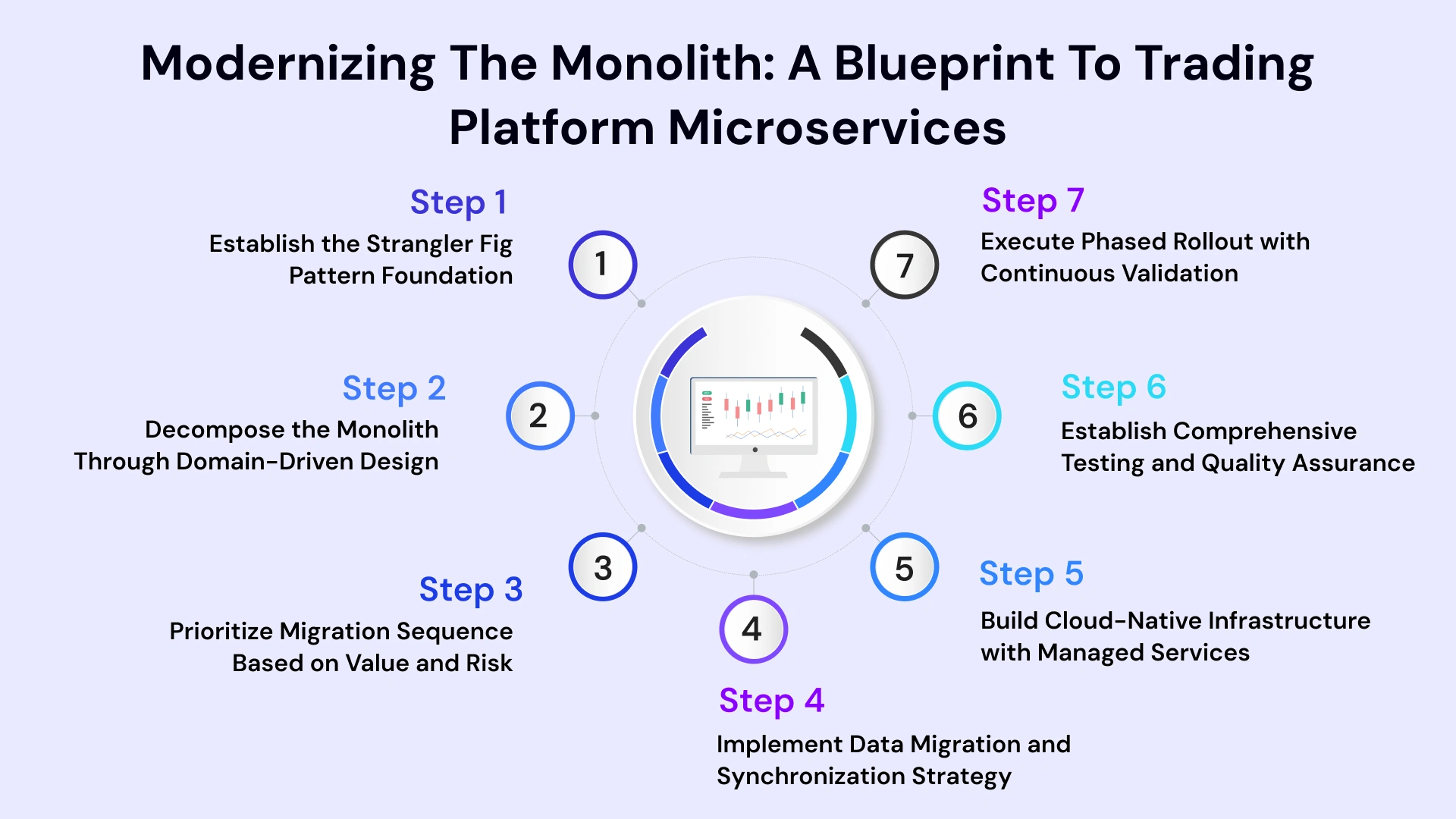
Step 1: Establish the Strangler Fig Pattern Foundation
The strangler fig pattern provides the safest migration path for mission-critical trading systems. Rather than attempting a risky big-bang rewrite, this approach gradually replaces monolithic components with microservices while maintaining operational continuity.
Implementation Strategy:
- Deploy an API Gateway Layer: Implement a routing facade that intercepts all inbound requests to the monolithic platform. This gateway serves as the traffic control point for progressive migration, directing requests to either legacy components or new microservices based on configurable routing rules.
- Implement Feature Flags and Canary Deployment: Build infrastructure to gradually shift traffic from monolithic modules to microservices, enabling real-time performance comparisons and instant rollback if issues arise.
- Establish Comprehensive Monitoring: Deploy distributed tracing, centralized logging, and real-time alerting across both legacy and modern components to identify integration issues and performance degradation early.
- Create a Service Registry and Discovery Mechanism: Implement dynamic service registration to manage the growing microservices ecosystem without manual configuration overhead.
Step 2: Decompose the Monolith Through Domain-Driven Design
Effective trading platform legacy modernization requires intelligent decomposition by business domain rather than by technical layers. Domain-driven design principles prevent the creation of distributed monoliths that replicate existing problems.
Decomposition Framework:
- Identify Bounded Contexts: Analyze trading platform capabilities to identify natural business boundaries. Typical domains include Order Management, Market Data Distribution, Risk Calculation, Trade Execution, Settlement Processing, Regulatory Reporting, and Client Portal Services.
- Define Service Granularity: Strike a balance between excessively fine-grained services (increasing operational complexity) and coarse-grained services (limiting flexibility). Each service should represent a complete business capability that can be deployed, scaled, and evolved independently.
- Design Data Ownership Boundaries: Assign database schemas and data ownership to specific services to prevent shared-database anti-patterns that create hidden dependencies and limit independent scaling.
- Establish Contract-First API Design: Define service interfaces using OpenAPI specifications before implementation, ensuring clean separation of concerns and enabling parallel development across teams.
Step 3: Prioritize Migration Sequence Based on Value and Risk
Strategic sequencing of microservices extraction determines both short-term wins and long-term success. The challenges of monolithic trading platforms require careful prioritization, balancing business value delivery against technical risk.
Prioritization Matrix:
- Start with Low-Risk, High-Value Services: Begin the migration with capabilities that deliver immediate business benefits while minimizing the impact of failure. Reporting services, client portals, or market data feeds are often ideal candidates, as they provide visible improvements without touching critical trading logic.
- Address Performance Bottlenecks Early: If specific monolithic components create scalability constraints during peak trading volumes, prioritize their extraction to demonstrate measurable performance improvements that justify continued investment.
- Defer Core Trading Engine Until Late Stages: Reserve the most critical, complex components for later migration phases, when the team's expertise with microservices patterns has matured, and the supporting infrastructure is battle-tested.
- Create Demonstration Projects: Implement 2-3 pilot services early to validate architectural decisions, establish operational patterns, and build organizational confidence before scaling migration efforts.
Step 4: Implement Data Migration and Synchronization Strategy
Data architecture is the most complex challenge in modernizing trading platforms using microservices. Financial systems demand perfect consistency for trades, positions, and settlements, while regulatory requirements mandate complete audit trails.
Data Migration Approaches:
- Database per Service Pattern: Allocate dedicated database instances to each microservice to ensure true autonomy and prevent hidden coupling through shared data access. Use event-driven architectures to maintain eventual consistency across service boundaries.
- Implement Change Data Capture: Deploy CDC mechanisms to replicate data changes from monolithic databases to microservice data stores in real time, enabling dual-write scenarios during transitions without risking data loss.
- Event Sourcing for Critical Transactions: For trading operations that require a perfect audit trail, implement event sourcing patterns that capture every state change as immutable events, satisfying regulatory requirements and enabling temporal queries.
- Saga Pattern for Distributed Transactions: Replace distributed transactions with choreographed or orchestrated sagas that maintain consistency across multiple services through compensating actions when partial failures occur.
- Reference Data Synchronization: Establish authoritative sources for market reference data, security master information, and customer profiles with well-defined propagation mechanisms to all consuming services.

Step 5: Build Cloud-Native Infrastructure with Managed Services
Successful microservices require a robust infrastructure that supports rapid deployment, automatic scaling, and comprehensive observability. Cloud migration consulting services and managed cloud services accelerate this transformation by eliminating undifferentiated infrastructure management overhead.
Infrastructure Components:
- Container Orchestration Platform: Deploy Kubernetes or equivalent orchestration systems to automate service deployment, scaling, and health management. Leverage managed Kubernetes offerings to reduce operational complexity while maintaining portability.
- Service Mesh Implementation: Implement service mesh technology like Istio or Linkerd to handle cross-cutting concerns, including mutual TLS encryption, traffic management, circuit breaking, and observability, without embedding these capabilities in application code.
- Cloud Infrastructure Services Selection: Leverage managed services for databases, message queues, caching layers, and monitoring to accelerate delivery. However, ensure these selections don't create unacceptable vendor lock-in for regulated financial institutions.
- CI/CD Pipeline Automation: Establish comprehensive continuous integration and deployment pipelines with automated testing gates, security scanning, and progressive rollout capabilities, enabling multiple deployments per day without manual intervention.
- Observability Stack Deployment: Implement distributed tracing (Jaeger, Zipkin), centralized logging (ELK, Splunk), and metrics aggregation (Prometheus, Grafana) to provide complete visibility into microservices interactions and performance characteristics.
Step 6: Establish Comprehensive Testing and Quality Assurance
Microservices architecture introduces complexity to distributed systems that requires evolved testing strategies. Capital market IT services teams must implement multilayered testing approaches that validate both individual service correctness and end-to-end business workflow integrity.
Testing Strategy:
- Unit Testing with High Coverage: Maintain a minimum 80% code coverage for individual service logic, using test-driven development practices to ensure business rules and calculations meet specifications.
- Contract Testing for Service Integration: Implement consumer-driven contract testing using tools like Pact to verify API compatibility between services without requiring full integration test environments.
- Integration Testing with Production-Like Data: Create comprehensive integration test suites that validate service interactions using realistic market data scenarios, including edge cases like halted trading, circuit breakers, and settlement failures.
- Performance Testing Under Load: Conduct regular load tests that simulate peak trading volumes to measure latency distributions, throughput capacity, and resource consumption under stress.
- Chaos Engineering for Resilience Validation: Systematically inject failures into production-like environments to verify circuit breakers, fallback mechanisms, and overall system resilience before issues impact live trading.
- Regulatory Compliance Verification: Validate that all regulatory reporting, audit trail generation, and compliance controls function correctly across the distributed system, which may require specialized testing frameworks to simulate regulatory scenarios.
Step 7: Execute Phased Rollout with Continuous Validation
The final migration phase focuses on a carefully orchestrated production cutover that minimizes business risk while capturing the benefits of modernization. This step exemplifies the benefits of microservices in trading platforms by delivering value incrementally.
Rollout Strategy:
- Dark Launching for Confidence Building: Deploy new microservices to production but route them only to shadow traffic initially, allowing real-world validation without customer impact. Compare results against monolithic components to verify correctness.
- Progressive Traffic Shifting: Gradually increase the percentage of live traffic directed to microservices using feature flags, starting with 1-5% and progressively increasing to 100% over days or weeks based on performance metrics and error rates.
- Blue-Green Deployment for Risk Mitigation: Maintain parallel environments running both legacy and modern versions, enabling instant rollback to the monolithic platform if critical issues emerge during cutover.
- Business Metric Monitoring: Track revenue-critical metrics, including order execution rates, fill quality, system latency, and error rates, with automated alerting for any degradation from baseline performance.
- Monolith Decommissioning: Only after microservices demonstrate stable production performance should legacy components be gradually decommissioned, ensuring that the audit trail is preserved and regulatory compliance is maintained throughout the retirement process.
Overcoming Common Challenges in Microservices Migration
Despite following best practices, organizations encounter predictable obstacles when migrating legacy trading platforms to microservices. Understanding these challenges enables proactive mitigation strategies.
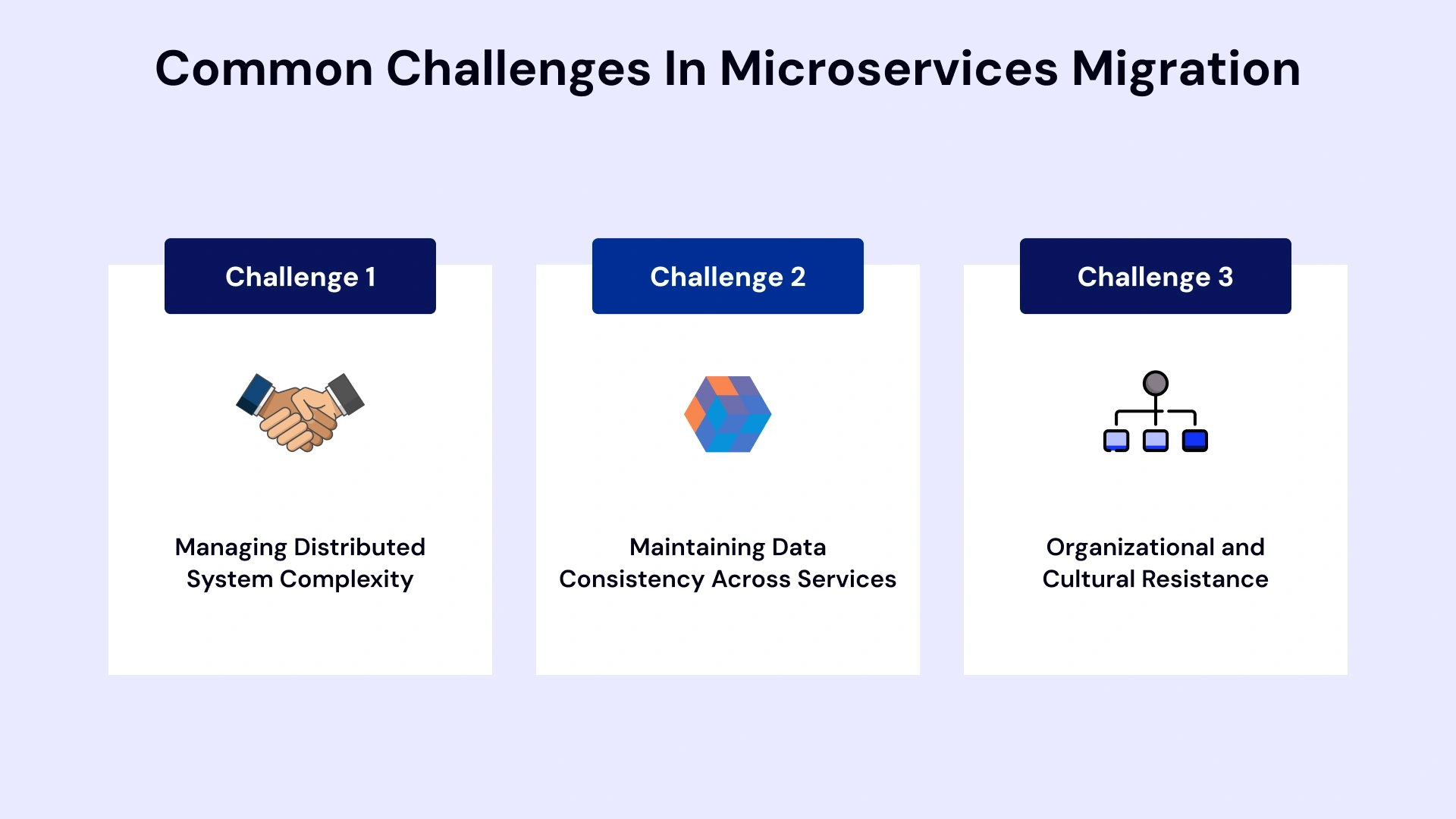
Challenge 1: Managing Distributed System Complexity
Microservices introduce fundamental distributed systems challenges, including network latency, partial failures, and eventual consistency that didn't exist in monolithic architectures.
Mitigation Strategies:
- Invest heavily in observability infrastructure from day one, implementing distributed tracing and centralized logging before deploying the first microservice to production.
- Implement circuit breakers, timeouts, and bulkhead patterns systematically across all service interactions to prevent cascading failures.
- Establish clear ownership and on-call responsibilities for each microservice to ensure rapid incident response when issues occur.
- Conduct regular game days and chaos engineering exercises to validate system behavior under failure conditions before real incidents occur.
Challenge 2: Maintaining Data Consistency Across Services
The shift from ACID transactions in monolithic databases to eventual consistency in microservices creates particular challenges for trading platforms where financial accuracy is paramount.
Mitigation Strategies:
- Implement the saga pattern with compensating transactions to maintain business-level consistency even when distributed transactions fail partway through execution.
- Use event sourcing for critical financial transactions to create immutable audit trails that enable reconstruction of any historical state.
- Establish clear bounded contexts that minimize cross-service data dependencies, keeping related data within single service boundaries whenever possible.
- Implement comprehensive reconciliation processes that detect and correct data inconsistencies, with clear escalation paths for identified discrepancies.
Challenge 3: Organizational and Cultural Resistance
Technical challenges often prove easier to solve than organizational inertia. Development teams familiar with monolithic architectures may resist adopting microservices, while business stakeholders may question the extended investment timeline.
Mitigation Strategies:
- Demonstrate early wins through pilot projects that deliver visible business value, building momentum and organizational confidence in the new architecture.
- Invest in comprehensive training programs that upskill existing teams rather than replacing them, creating internal champions who understand both legacy systems and modern patterns.
- Establish clear communication channels between business and technology teams, translating technical progress into business metrics that stakeholders understand and value.
- Create cross-functional product teams organized around business capabilities rather than technical layers, breaking down silos and accelerating decision-making.
Technology Stack Selection for Trading Platform Microservices
Selecting the right technology foundation significantly impacts the long-term success of microservices adoption in capital markets. The stack must balance performance requirements, regulatory constraints, talent availability, and operational maturity.
Programming Languages and Frameworks
Language selection should prioritize performance for latency-sensitive components while enabling rapid development for supporting services:
- Java or C# for Core Trading Services: Enterprise-grade languages with mature ecosystems provide the reliability and performance required for order management and execution engines. Spring Boot and .NET Core offer comprehensive microservices frameworks with built-in patterns.
- Go or Rust for Ultra-Low Latency Components: When microsecond-level latency matters, consider modern compiled languages that offer C++-like performance with improved safety and developer productivity.
- Python for Data Analytics and Reporting: Leverage Python's rich data science ecosystem for risk analytics, regulatory reporting, and market surveillance services where development velocity outweighs execution speed.

Leverage VLink Expertise for Microservices Migration
Transforming legacy trading platforms into modern microservices architectures demands specialized expertise spanning financial services domain knowledge, cloud-native technologies, and proven migration methodologies.
VLink brings a decade of experience delivering capital market IT services to institutions across North America, combining deep technical capabilities with a pragmatic understanding of regulatory constraints and business imperatives.
Our Comprehensive Service Portfolio:
- Legacy Systems Modernization Services: End-to-end assessment, architecture design, and execution of trading platform transformations using proven strangler fig patterns and progressive migration strategies.
- Cloud Migration Consulting Services: Expert guidance on cloud provider selection, architecture design, and migration execution leveraging AWS, Azure, and Google Cloud capabilities optimized for capital markets.
- Managed Cloud Services: Ongoing operation and optimization of cloud infrastructure, ensuring high availability, cost efficiency, and continuous performance improvement post-migration.
- Cloud Infrastructure Services: Design and implementation of containerized environments, Kubernetes orchestration, service mesh deployment, and comprehensive observability platforms.
- Capital Market IT Services: Specialized support for trading platforms, risk management systems, regulatory reporting, and market data infrastructure with a deep understanding of financial services requirements.
VLink's dedicated team approach combines technical excellence with business pragmatism, ensuring modernization efforts deliver measurable ROI while minimizing disruption to critical trading operations. Our teams have successfully migrated platforms that process billions of dollars in daily trading volume, maintaining seamless operational continuity throughout the transformation journeys.
Whether you're contemplating an initial assessment of legacy infrastructure, planning a comprehensive microservices migration, or seeking expert augmentation for existing modernization initiatives, VLink provides the specialized expertise and proven methodologies to ensure success.
Conclusion: The Strategic Imperative of Trading Platform Modernization
Microservices migration for trading platforms represents more than a technological upgrade—it fundamentally transforms organizational capability to compete in rapidly evolving capital markets. The strategic question is no longer whether to modernize monolithic trading infrastructure, but rather how quickly firms can execute transformation while managing risk and maintaining operational excellence.
The business case for migrating legacy trading platforms to microservices is compelling: improved time-to-market, faster response to competitive threats, enhanced system reliability, reduced operational risk, cost optimization through elastic cloud infrastructure, and organizational agility that supports continuous innovation. Firms that delay modernization face mounting technical debt, escalating operational costs, and diminishing ability to attract engineering talent comfortable with modern technology stacks.
However, success requires more than adopting microservices patterns and cloud infrastructure services. Effective transformation demands a comprehensive strategy spanning architecture design, organizational change management, technology stack selection, and phased execution that balances business continuity against modernization velocity. The steps outlined in this guide for implementing microservices in trading platforms synthesize proven approaches from numerous successful migrations, providing an actionable roadmap for capital market firms embarking on modernization journeys.
Ready to Transform Your Trading Platform?
Contact VLink today to schedule a comprehensive assessment of your trading platform infrastructure. Our experts will analyze your current architecture, identify optimization opportunities, and develop a customized modernization roadmap aligned with your business priorities and risk tolerance. Whether you're planning initial discovery or ready to execute transformation, VLink provides the partnership you need to succeed.

Vice President, Strategy – VLink Inc.
Sambhavi Gopalakrishnan is the Vice President of Strategy at VLink Inc., bringing over a decade of experience in IT leadership, project implementation, and strategic growth. She possesses a strong foundation in technical project management and pre-sales, driving innovation and business transformation at VLink.

 Shivisha Patel