


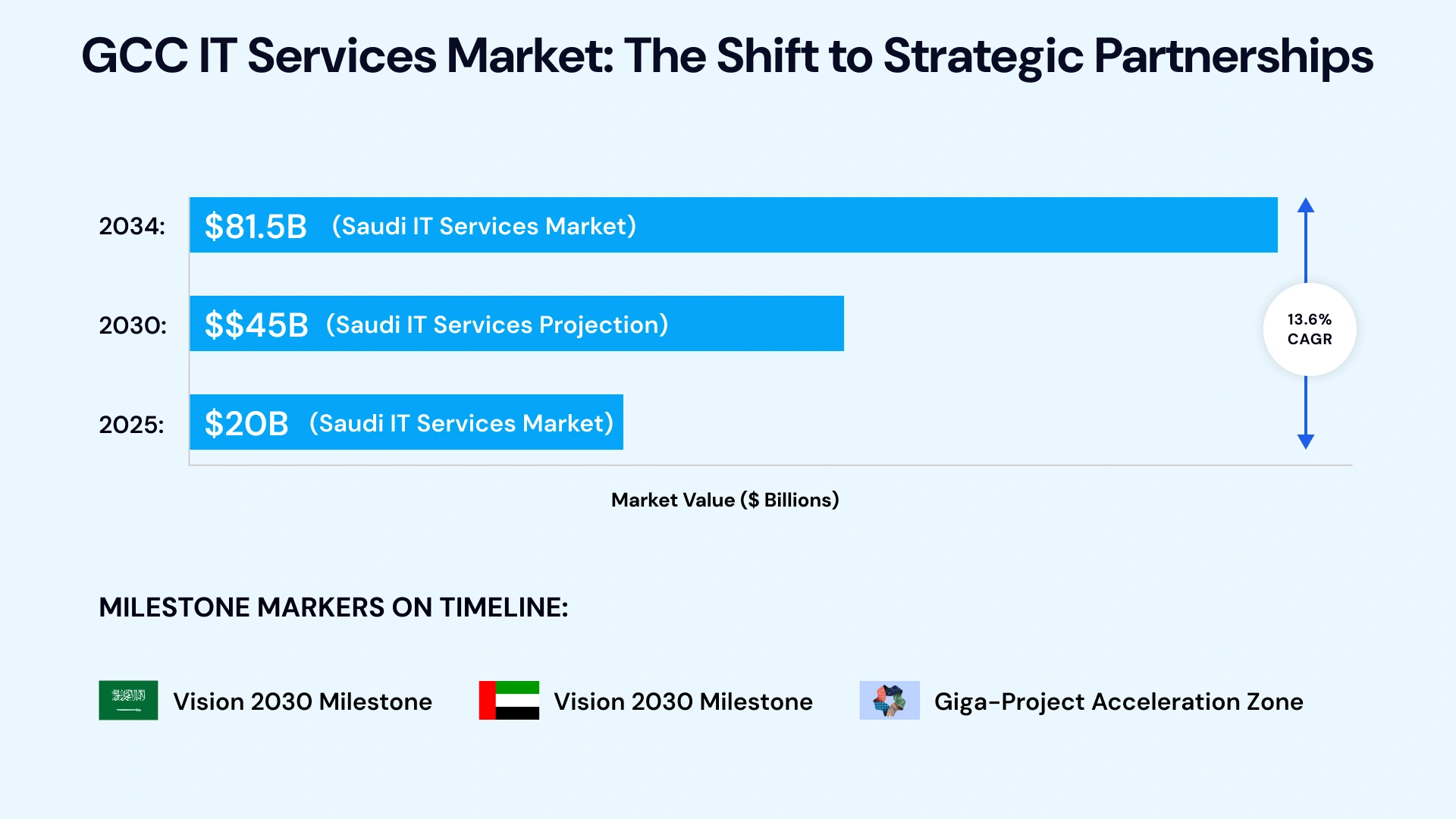
The question facing every CIO, CTO, and CDO across the GCC today isn't whether to invest in technology—it's how to structure those investments for maximum return. With the Middle East managed services market projected to reach $81.5 billion by 2034 and Saudi Arabia's IT services sector alone expected to grow from $20 billion to $45 billion by 2030, the stakes have never been higher.
Yet beneath these headline figures lies a critical strategic decision that separates enterprises achieving genuine enterprise digital transformation from those trapped in perpetual technology cycles: the choice between long-term IT partnerships and project-based support models. This decision fundamentally shapes how organizations approach vendor relationships, knowledge management, and innovation capacity.
This analysis examines real ROI data from GCC enterprises—spanning BFSI, energy, government, and healthcare sectors—to provide a clear framework for making this decision. The findings challenge conventional procurement wisdom and reveal why the region's most successful digital transformations are built on strategic technology partnerships rather than transactional vendor relationships. Organizations leveraging AI development services and cloud infrastructure solutions particularly benefit from partnership models that enable continuous innovation rather than episodic project delivery.
Why GCC Enterprises Are Re-Evaluating Traditional Project-Based IT Models
The traditional model of procuring IT services through isolated, project-based contracts served GCC enterprises well during the early stages of digitalization. Individual projects delivered specific outcomes—a mobile app here, a system upgrade there—with clear scope, timeline, and budget boundaries. This approach made sense when digital initiatives were discrete improvements rather than fundamental business transformations.
The "Project Trap" in UAE & Saudi Digital Transformation
Enterprises pursuing ambitious digital transformation through sequential project-based engagements consistently encounter what industry analysts call the "project trap"—a cycle where each completed project creates dependencies requiring additional projects, while accumulated technical debt and knowledge gaps compound with every vendor transition. This pattern becomes particularly acute in GCC IT outsourcing scenarios where multiple vendors operate without unified governance.
A government ministry managing fifteen different vendors for web, mobile, and backend systems illustrates this pattern. Each vendor optimized for their specific deliverable, but the result was conflicting SLAs, security vulnerabilities, and no unified view of citizen data. The fragmentation that seemed efficient at the project level created systemic dysfunction at the enterprise level. Without IT staff augmentation strategies that maintain continuity, organizations face perpetual onboarding cycles that drain resources and delay outcomes.
The average enterprise now manages over 1,000 applications and vendor relationships—creating security gaps, integration challenges, and management overhead that consume resources far beyond the original project budgets. This vendor sprawl represents one of the most significant hidden costs in enterprise IT, yet it rarely appears in project-level ROI calculations.
Hidden Costs CXOs Don't See in Line-Item Project Pricing
Project-based pricing appears transparent: defined scope, fixed timeline, clear cost. But this apparent clarity obscures significant hidden costs that accumulate across the enterprise and erode the ROI of IT partnerships when measured over multi-year horizons.
Procurement overhead for each new project typically adds 1-3 months and substantial internal resources for RFP development, vendor evaluation, and contract negotiation. Context transfer costs accumulate as each new vendor requires onboarding to existing systems, security protocols, and business requirements. Change order premiums emerge when inevitable scope adjustments command significant markups on original pricing. These costs compound when organizations lack integrated DevOps consulting services that could streamline deployment and reduce friction between project phases.
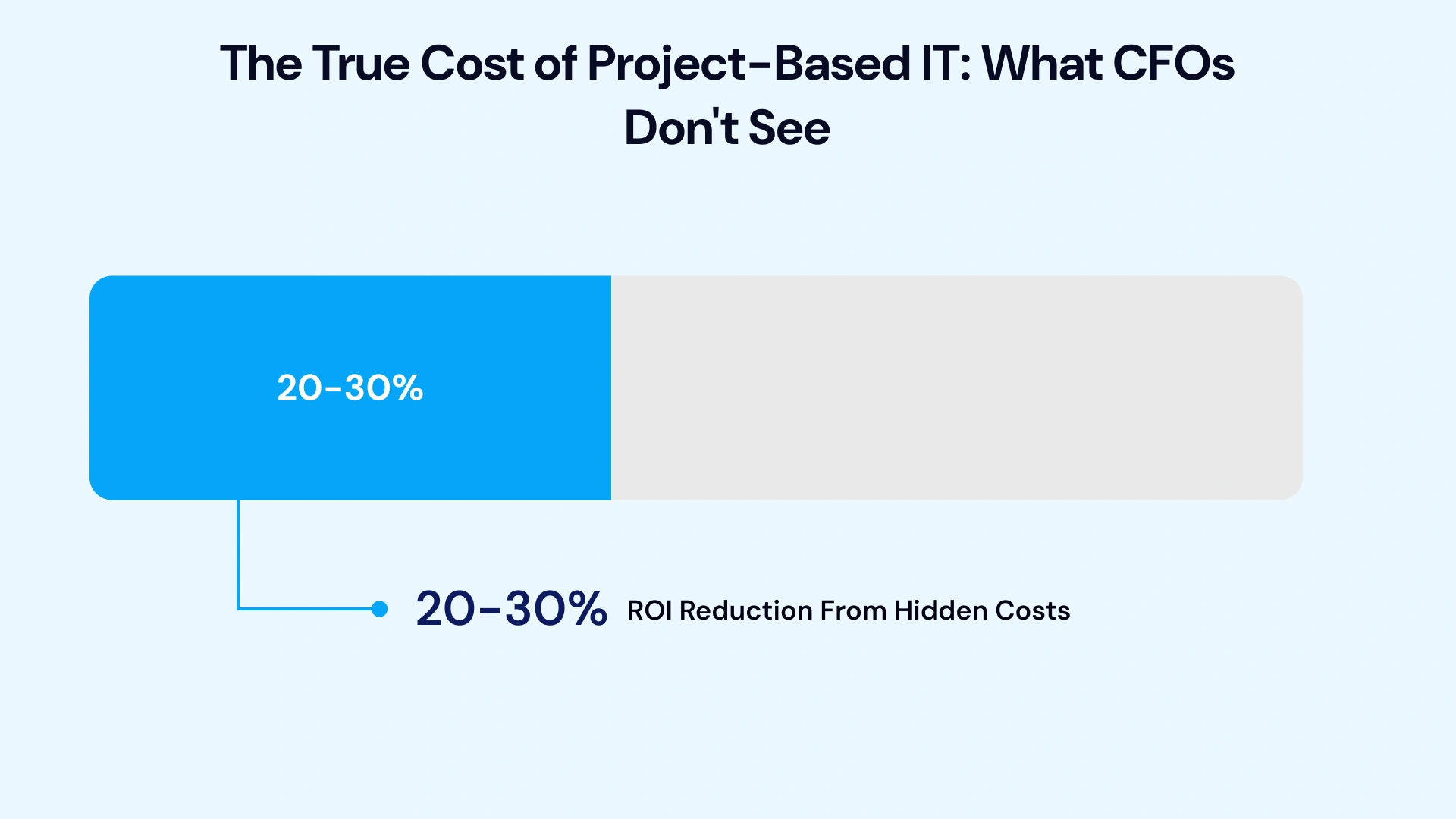
Research indicates that these hidden costs reduce long-term ROI by 20-30% compared to consolidated strategic partnerships—a gap that widens with each additional project engagement. For enterprises pursuing digital transformation partnerships, this cost differential represents the difference between sustainable technology investment and perpetual resource drain.
Long-Term IT Partnership vs Project-Based Support - A Side-by-Side ROI Comparison
Moving beyond anecdotal evidence, systematic comparison of these IT service engagement models reveals distinct performance patterns across key enterprise metrics. The following analysis synthesizes data from regional IT service market reports and global vendor management benchmarks, providing GCC CXOs with actionable intelligence for strategic decisions.
Cost Structure & TCO Predictability
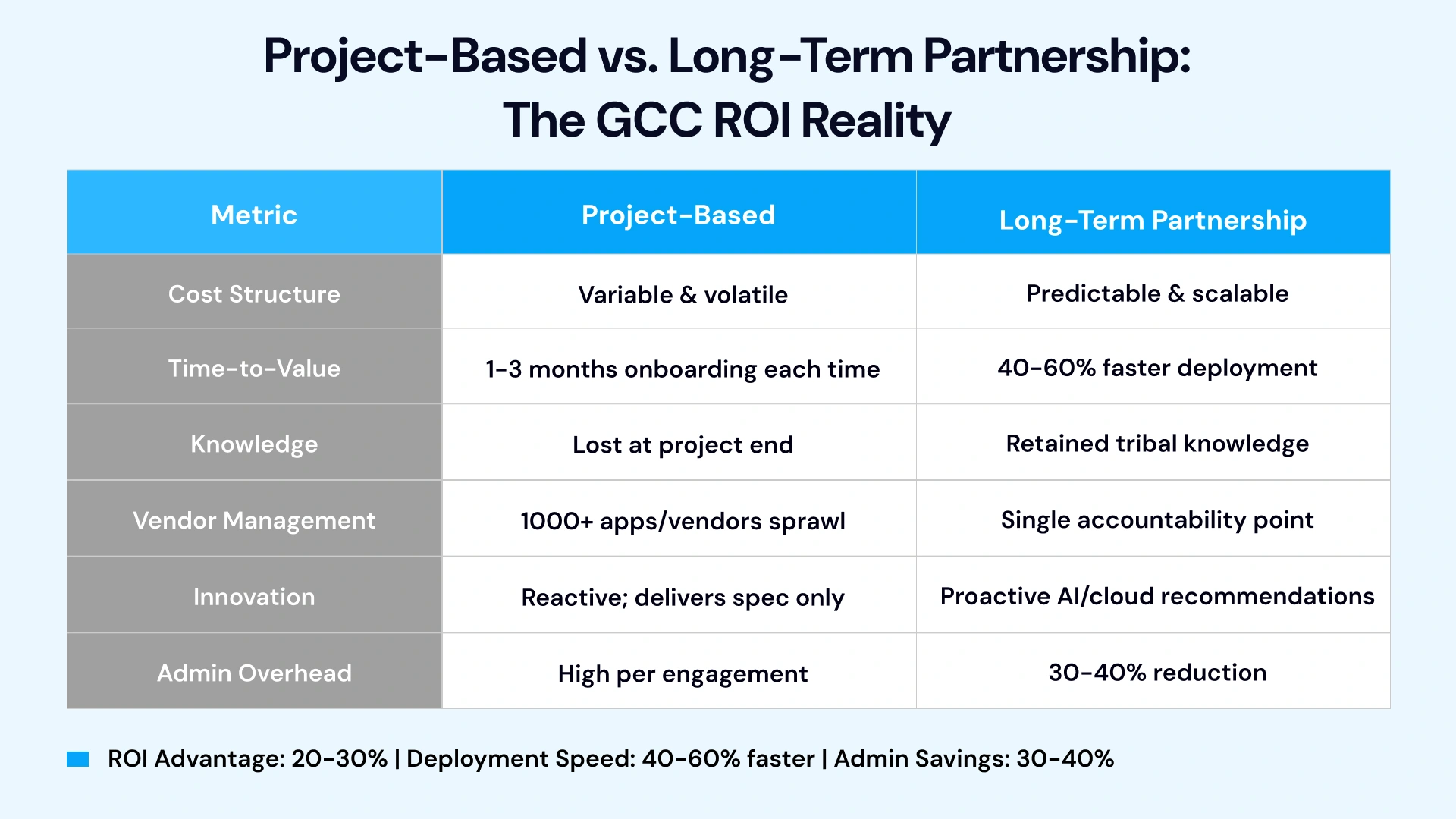
Project-based models exhibit variable and volatile cost structures. Costs spike with change orders, while high administrative overhead accompanies procurement for each project. CFOs face unpredictable quarterly variances that complicate financial planning and budget allocation. This volatility creates particular challenges for organizations pursuing managed IT services partnerships where budget predictability directly impacts strategic planning capacity.
Long-term IT partnerships offer predictable and scalable cost structures through fixed managed service fees combined with outcome-based pricing. Enterprises report 30-40% reduction in procurement administrative time and significantly improved budget predictability—a critical advantage for organizations reporting to boards demanding financial discipline. The cost comparison of IT outsourcing models consistently favors partnerships when total cost of ownership replaces project cost as the evaluation metric.
Time-to-Value & Speed of Execution
Each new project-based initiative requires fresh RFP processes, vendor onboarding (typically 1-3 months), and context learning. This repetitive cycle delays time-to-value and creates competitive disadvantage in fast-moving markets. For organizations implementing AI-powered solutions or cloud migration initiatives, these delays can mean missing critical market windows entirely.
Strategic partners already "plugged in" to security infrastructure and enterprise systems enable rapid deployment of new capability pods. Data indicates 40-60% faster deployment for new initiatives once partnership foundations are established—transforming technology from bottleneck to competitive accelerator. This acceleration proves particularly valuable for software development partnerships where iteration speed directly impacts product-market fit.
Knowledge Retention vs Knowledge Leakage
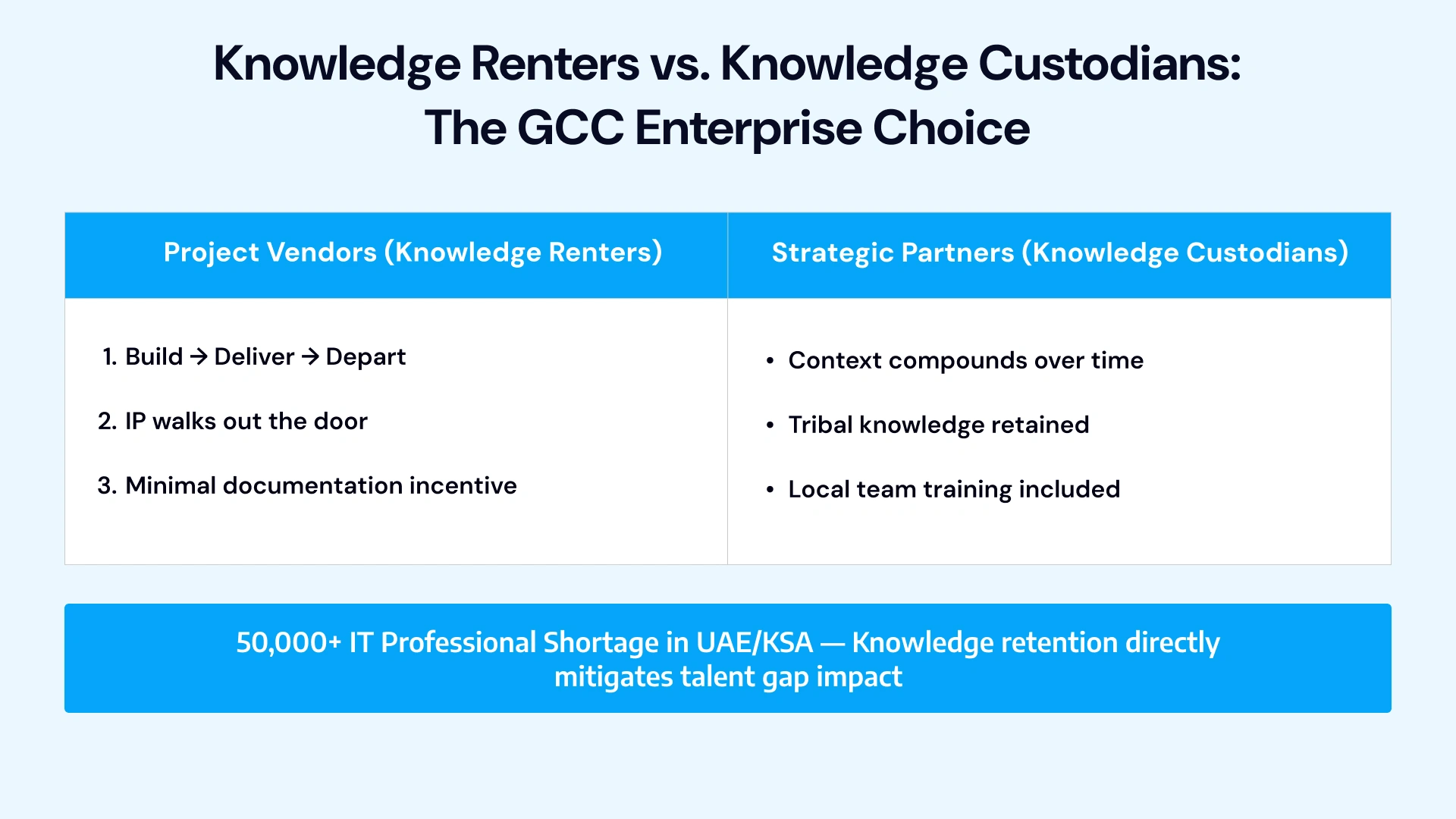
Project vendors operate as "knowledge renters"—they build, deliver, and depart, taking critical IP and contextual understanding with them. There's minimal incentive to document deeply or invest in internal staff development when the engagement has defined end dates. This knowledge leakage represents one of the most significant drawbacks of project-based IT support that rarely appears in procurement evaluations.
Strategic partners function as "knowledge custodians," with dedicated teams retaining tribal knowledge of legacy systems, business logic, and integration dependencies. This retained intelligence directly addresses the 50,000+ IT professional shortage across UAE and Saudi Arabia by preserving institutional capability regardless of individual personnel transitions. Organizations leveraging IT staff augmentation services within partnership frameworks gain the flexibility of external talent with the continuity of internal teams.
Vendor Sprawl, Security Risk & Accountability
Managing hundreds of vendor relationships creates exponential security surface area and the notorious "finger-pointing" problem when issues arise. No single party owns end-to-end outcomes, and accountability fragments across contract boundaries. This fragmentation undermines the IT vendor partnership ROI that organizations seek from technology investments.
Consolidated partnerships establish single accountability points for end-to-end delivery—from design through build to ongoing support. This structure reduces security surface area, eliminates inter-vendor coordination overhead, and creates clear ownership for enterprise outcomes. For organizations implementing cybersecurity solutions, partnership models enable unified security postures that project-based fragmentation cannot achieve.
Innovation Cycle & Proactive Technology Recommendations
Project-based vendors deliver exactly what specifications define—even when those specifications become outdated between contract signing and delivery. There's no commercial incentive to suggest improvements or alternatives that might reduce future project scope. This reactive posture represents a fundamental limitation of project-based software development in rapidly evolving technology landscapes.
Strategic partners operate with different incentive structures. Long-term relationships reward proactive recommendations that reduce client maintenance burden and demonstrate ongoing value. Partners suggesting AI capabilities, cloud optimizations, or architecture improvements strengthen relationships rather than cannibalizing future project revenue. This alignment supports the AI and Digital Economy goals central to Vision 2030 implementation.
What GCC ROI Data Actually Shows (2024-2025 Benchmarks)
Managed Services & Strategic Partnership Market Growth in the GCC
The migration from project-based procurement to retained service models is reflected in regional market data. The Middle East managed services market projects a compound annual growth rate of approximately 13.6%, reaching $81.5 billion by 2034—confirming substantial capital reallocation toward long-term engagement models. This growth trajectory validates the benefits of IT partnerships that GCC enterprises are experiencing firsthand.
Why Vision 2030 & We the UAE 2031 Favor Long-Term Models
Both national transformation frameworks emphasize sustainable capability building over transactional outcomes. Vision 2030's focus on knowledge economy development, technology transfer, and local workforce enablement aligns naturally with partnership models that prioritize training, documentation, and institutional capacity building. Organizations pursuing strategic IT investments in the GCC find partnership structures better equipped to deliver on these national priorities.
Government procurement bodies, including Saudi PIF, increasingly scrutinize "advisory-only" or "build-and-run" contracts, demanding stronger accountability and long-term value transfer. Organizations failing to demonstrate sustainable impact face exclusion from major procurement opportunities—creating regulatory pressure toward partnership structures that support IT project outsourcing in the GCC with measurable capability development outcomes.
CFO Lens — Budget Predictability vs Variable Spend
For CFOs navigating board expectations and shareholder reporting, budget predictability represents a significant value driver independent of absolute cost levels. Project-based models create quarterly variance headaches as scope changes, delays, and change orders generate unpredictable financial impacts that complicate IT partnership performance metrics reporting.
Strategic partnerships with fixed managed service components enable confident forward planning, smoother cash flow management, and reduced financial risk disclosure requirements. Research from enterprise finance functions indicates this predictability often justifies premium partnership pricing when evaluated on risk-adjusted ROI basis. The ROI comparison of long-term IT partnerships vs project-based support consistently favors partnerships when financial risk is properly weighted in the analysis.
Real GCC Enterprise Scenarios - When Each Model Works
Saudi Government Entity — Vendor Consolidation Outcome
A Saudi ministry managing fifteen different vendors for digital services experienced the classic fragmentation pattern: conflicting SLAs across vendors, security vulnerabilities at integration points, and no unified citizen data view. Annual vendor management consumed substantial IT leadership bandwidth while service quality remained inconsistent—a common outcome when technology vendor relationships lack strategic coherence.
Consolidating to a primary strategic partner for "Digital Experience" delivery produced measurable results: 25% TCO reduction in Year 1, unified citizen super-app launch in 6 months (versus 18-month estimate with multiple vendors), and dramatically simplified governance structure. The partnership model enabled accountability that fragmented project relationships could never provide, demonstrating the advantages of long-term IT partnerships for complex government digital services.
UAE Tier-1 Bank — From One-Off Projects to Continuous Innovation
A major UAE bank's project-based vendors delivered a mobile banking update but refused post-launch support without a new contract—precisely when optimization and iteration would deliver maximum customer value. Each enhancement required fresh procurement cycles, delaying competitive responses to market changes and limiting the benefits of project-based support to initial delivery only.
Shifting to a retained services model with partner incentives tied to "Active User Growth" rather than "Code Delivery" transformed the relationship dynamic. The result: continuous bi-weekly feature releases, proactive AI fraud detection integration (which saved millions in prevented losses), and partnership value extending far beyond original scope definitions. This outcome illustrates why AI integration services deliver maximum value within partnership frameworks rather than isolated project engagements.
Energy & Utilities — Why Giga-Projects Break Project-Based Models
Energy and utilities giga-projects across the GCC—spanning smart grid implementations, renewable energy integration, and industrial IoT deployments—illustrate why project-based models structurally fail at certain scales. These initiatives require multi-year technology roadmaps, continuous system optimization, and deep integration across operational technology and information technology domains. The disadvantages of project-based support become insurmountable at giga-project scale.
Project-based vendors optimizing for defined deliverables cannot provide the sustained capability development, ongoing performance optimization, and adaptive capacity these initiatives demand. Strategic partners with multi-year commitments and outcome-aligned incentives become operational necessities rather than procurement preferences—particularly for data analytics and business intelligence implementations that require continuous refinement based on operational feedback.
The Knowledge Equity Problem in the GCC
Project Vendors as "Knowledge Renters"
Project-based vendors accumulate critical knowledge during engagements—understanding of legacy system dependencies, business process nuances, integration requirements, and organizational context. But this knowledge remains "rented" rather than owned by the enterprise, representing one of the most significant drawbacks of IT partnerships structured around project deliverables rather than ongoing relationships.
When projects conclude, this knowledge walks out the door. Documentation, where it exists, captures explicit procedures but rarely preserves the tacit understanding that enables efficient problem-solving and informed decision-making. The enterprise pays for knowledge development but retains only artifacts—a pattern that undermines IT engagement strategy effectiveness over time.
Strategic Partners as Long-Term Knowledge Custodians
Strategic partners operate as "knowledge vaults"—retaining context across initiatives, maintaining deep understanding of enterprise systems and processes, and building cumulative capability over extended engagements. This retained intelligence compounds in value as partnership duration extends, creating sustainable advantages of project-based support alternatives that grow stronger over time.
Critically, strategic partners often invest in training local teams as part of partnership value delivery—transferring knowledge rather than hoarding it. This knowledge transfer model directly supports enterprise capability building and reduces long-term dependency while maintaining partnership value. Organizations implementing digital transformation services find partnership models enable the capability development that national transformation agendas require.
Alignment with Saudization & Emiratization Mandates
In the GCC context, where talent localization represents both regulatory requirement and strategic priority, the knowledge equity dimension takes on additional significance. Project vendors relying purely on offshore talent may deliver project outcomes but fail to support Nitaqat compliance or Emiratization targets—creating compliance risk alongside capability gaps for organizations pursuing how to choose the right model for your project.
The ideal partnership model offers "hybrid-shoring"—a front office of local GCC nationals (project managers, architects, client relationship managers) supported by high-capacity engineering delivery centers. This structure satisfies localization compliance while maintaining cost efficiency and delivery capability. Organizations leveraging hire dedicated developer services within partnership frameworks gain both flexibility and compliance alignment.
Decision Framework - How GCC CXOs Should Choose
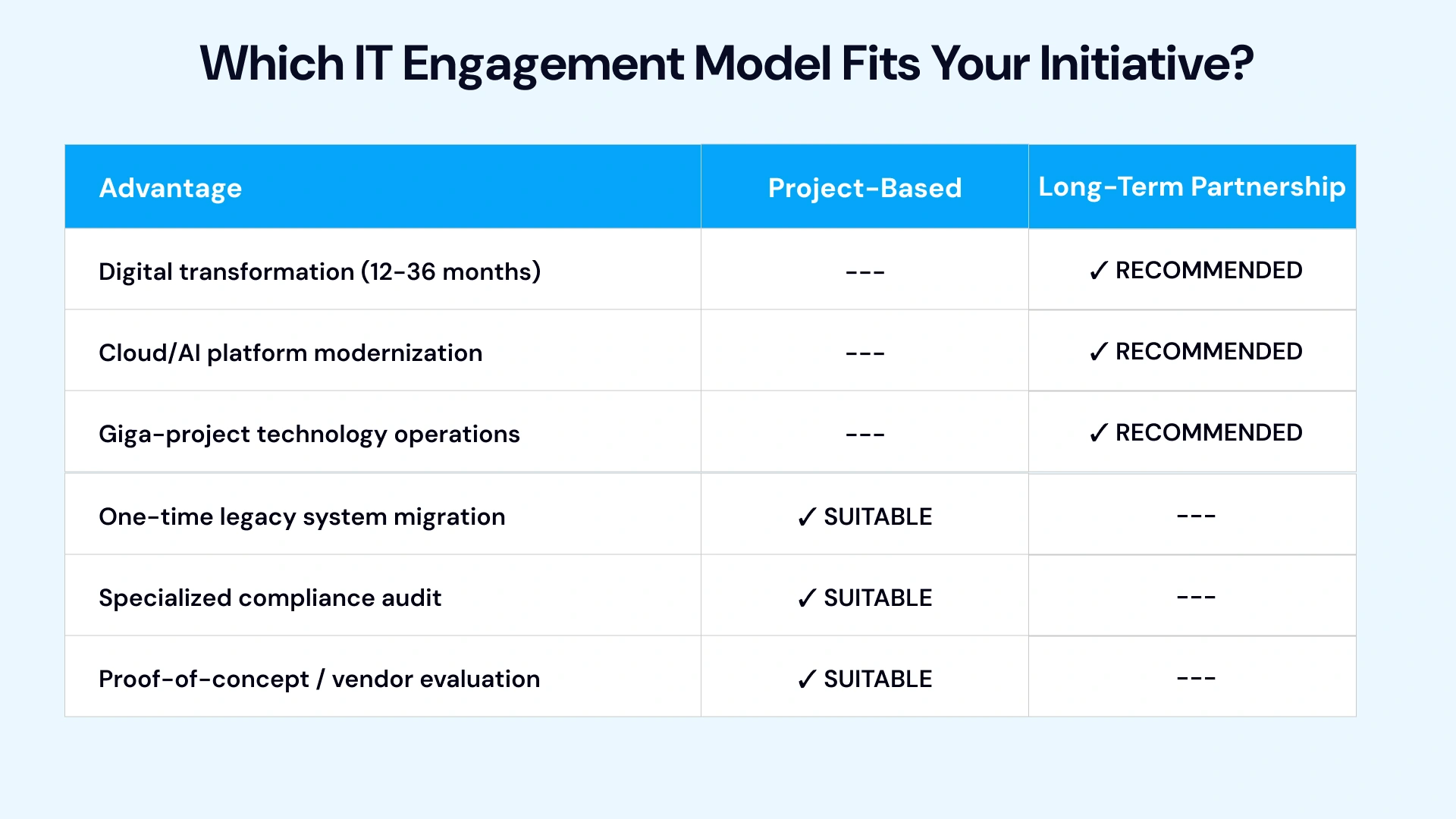
When Project-Based Support Still Makes Sense
Project-based models retain validity for specific initiative types, despite the overall disadvantages of long-term IT partnerships alternatives in many scenarios. Truly one-off implementations with no anticipated follow-on work—a single legacy system migration with no ongoing development—may suit project structures. Highly specialized capabilities needed only briefly, such as niche compliance audits or specialized security assessments, often fit project engagement patterns.
Proof-of-concept work where you're deliberately testing multiple vendors before commitment can appropriately use project structures. The key evaluation criterion: if the initiative is genuinely isolated with minimal knowledge dependencies and no anticipated continuity requirements, project-based procurement remains rational for IT outsourcing models selection.
When a Long-Term IT Partnership Delivers Superior ROI
Strategic partnerships deliver superior ROI when initiatives share any of these characteristics: multi-year technology roadmaps requiring sustained capability, continuous improvement requirements beyond initial delivery, integration complexity across multiple systems or business domains, knowledge retention as a critical success factor, or innovation requirements demanding proactive technology recommendations. The ROI of IT outsourcing consistently favors partnerships for initiatives matching these profiles.
For GCC enterprises pursuing Vision 2030 alignment, digital transformation at scale, or operational technology modernization, these characteristics describe the majority of technology investments. The partnership premium pays for itself through accelerated delivery, reduced hidden costs, and retained knowledge equity—demonstrating the ROI of long-term IT partnership vs project-based support across enterprise-scale implementations.
Key Evaluation Criteria for CIOs, CTOs & Procurement Heads
Effective engagement model selection requires evaluation across multiple dimensions to determine the optimal IT engagement strategy for each initiative. Initiative duration and continuity expectations should drive initial model consideration. Knowledge complexity and retention requirements differentiate initiatives where context matters from truly commoditized work.
Integration dependencies across existing systems indicate partnership value, as does innovation expectation beyond specified scope. TCO calculation including hidden costs provides accurate comparison for staff augmentation vs IT outsourcing decisions. Finally, governance and accountability requirements often favor partnership structures for enterprise-critical initiatives requiring unified ownership.
How to Transition from Project-Based Vendors to Strategic IT Partnerships
Step 1 — Vendor & Spend Audit
Effective transition begins with comprehensive visibility into current vendor consolidation IT landscape. Map all current IT vendors across the enterprise, identifying redundant capabilities (multiple vendors providing Java development, for example) and "zombie contracts" (maintenance payments for retired applications). Quantify total spend including hidden costs: procurement overhead, integration maintenance, and incident coordination.
This audit typically reveals consolidation opportunities representing 15-25% of current spend—creating budget space for partnership investment while reducing operational complexity. Organizations leveraging Microsoft business solutions or cloud infrastructure services often discover significant redundancy across multiple vendor relationships serving similar technology domains.
Step 2 — Pilot with a Non-Critical Initiative
Rather than wholesale vendor replacement, introduce potential strategic partners through controlled pilot engagements. Select initiatives that are important but not existential—internal dashboard modernization, secondary system enhancement, or operational tool development. Apply rigorous SLAs covering velocity, quality, and communication metrics to establish baseline IT partnership performance metrics for evaluation.
The pilot phase allows both parties to calibrate working relationships, establish communication patterns, and validate cultural fit before expanding scope. Most successful transitions invest 2-3 months in pilot validation before broader commitment, enabling informed decisions about custom software development partnerships based on demonstrated capability rather than proposal promises.
Step 3 — Governance, SLAs & Co-Managed Delivery Pods
Formalize partnership governance through a Digital Center of Excellence (CoE) structure with shared KPIs: uptime targets, release frequency, TCO reduction metrics, and innovation contribution measures. Establish co-managed delivery pods where partner teams integrate into enterprise project management tools (Jira, Slack, Teams) with transparent visibility into resource allocation and work progress.
This governance model addresses the "black box" concern where enterprises cannot verify whether vendors deploy senior engineers or juniors. Client-retained Product Owner control combined with partner-managed Engineering Delivery creates appropriate accountability distribution that supports both DevOps consulting services integration and transparent performance measurement.
Step 4 — Gradual Vendor Consolidation
Implement the "Strangler Fig" pattern: don't attempt wholesale vendor replacement. Assign the strategic partner to new innovation projects first, building capability and demonstrating value. As existing project-based vendor contracts expire, gradually migrate maintenance and support responsibilities to the strategic partner—a proven approach for GCC IT outsourcing trends indicating partnership preference.
This approach minimizes disruption risk while building the knowledge foundation that makes partnership value compound over time. Typical enterprise transitions achieve full consolidation within 12-18 months following this graduated approach, enabling organizations to realize the full benefits of long-term IT collaboration without the disruption risks of rapid vendor replacement.
Common Myths GCC Leaders Believe About Long-Term IT Partnerships
"Project-Based Is Cheaper" — Myth vs Reality
The line-item cost comparison favoring project-based models ignores significant cost categories that undermine the cost comparison of long-term IT partnerships vs project-based support. "Spin-up/spin-down" friction—the repeated cycles of vendor onboarding, context transfer, and relationship building—creates substantial overhead invisible in project budgets.
Long-term partners offer lower blended rates through volume commitment and, more importantly, prevent costly architectural mistakes that project vendors making isolated decisions frequently introduce. When total cost of ownership replaces project cost as the evaluation metric, partnership models consistently demonstrate superior economics for enterprise IT outsourcing requirements.
"Partnership Means Vendor Lock-In" — Governance Reality
The vendor lock-in concern misidentifies the actual risk in IT service engagement models. "Vendor sprawl"—the accumulated dependencies across dozens of project vendors—creates accidental lock-in to chaos. Each vendor's proprietary approaches, undocumented integrations, and departed knowledge create switching costs that dwarf any partnership exit complexity.
Strategic partnership represents intentional commitment with governance. Well-structured partnership contracts include "Exit Assistance" clauses defining knowledge transfer obligations, documentation requirements, and transition support. The governance that accompanies partnership investment actually reduces lock-in risk compared to fragmented vendor relationships—a critical consideration for technology vendor relationships evaluation.
"Long-Term Equals Slow" — Agile Retainer Reality
The association of long-term commitment with bureaucratic slowness reflects outdated partnership models. Modern strategic technology partnerships typically operate on Agile Retainer structures—capacity commitment with flexible scope allocation. Priorities can pivot instantly based on business needs without renegotiating contracts.
Contrast this with project-based models where any scope change requires contract amendments, change order negotiations, and procurement approval cycles. The partnership's pre-established capacity and governance actually enable faster response than project structures constrained by fixed scope definitions—demonstrating why software development partnerships accelerate rather than impede organizational agility.
Key Takeaways for GCC CXOs
The Strategic Shift from Task Execution to Outcome Ownership
The fundamental insight from GCC enterprise ROI data is clear: the choice between long-term IT partnerships and project-based support isn't primarily about cost—it's about strategic positioning. Project-based models optimize for task execution within defined boundaries. Partnership models optimize for outcome ownership across evolving requirements.
For GCC enterprises navigating Vision 2030 mandates, giga-project complexities, and talent localization imperatives, outcome ownership increasingly determines competitive position. The 20-30% ROI advantage, 40-60% faster deployment, and retained knowledge equity that partnerships provide aren't marginal improvements—they're strategic differentiators that compound over multi-year transformation journeys.
The enterprises leading GCC digital transformation have already made this transition. The question for remaining organizations isn't whether to evolve their IT engagement models—it's how quickly they can execute the shift from fragmented project procurement to strategic technology partnerships that deliver sustainable competitive advantage.

Vice President, Strategy – VLink Inc.
Sambhavi Gopalakrishnan is the Vice President of Strategy at VLink Inc., bringing over a decade of experience in IT leadership, project implementation, and strategic growth. She possesses a strong foundation in technical project management and pre-sales, driving innovation and business transformation at VLink.

 Shivisha Patel