

If you want to invest in building an e-learning app like Duolingo, this guide will help you, from reasons and features to the development process and costs.
From Memrise and Babbel to Mondly, the language-learning market is filled with popular platforms. Yet, Duolingo continues to dominate the EdTech industry with 600million+ downloads and over $1B in annual revenue.
If you're considering e-learning app development like Duolingo, this guide covers everything — features, costs, tech stack, AI integration, and process that converts learners and generates revenue.
What is an eLearning App?
An e-learning app like Duolingo is a digital platform that helps users learn online. It offers interactive lessons, quizzes, videos, and gamified features to make learning fun and engaging. Users can learn anytime, anywhere through mobile or web apps.
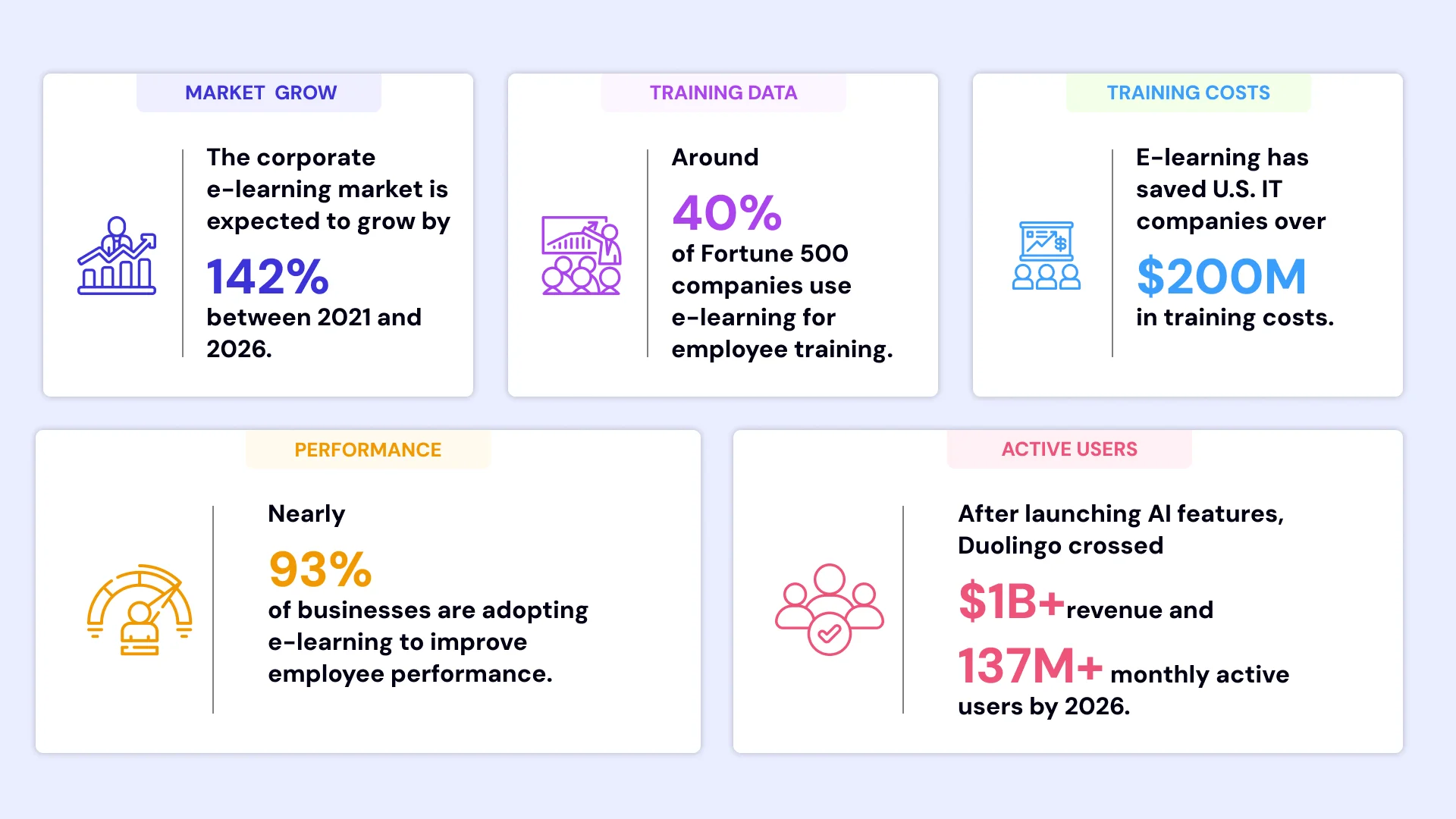
Why create an e-learning app like Duolingo? It’s time to stats!
Here are some stats on why you should invest in education app development like Duolingo:
The opportunity is clear: learners want flexible, engaging, on-demand education. The challenge is building an education app like Duolingo that delivers that experience while driving sustainable revenue. That's exactly what this guide covers.
What Makes Duolingo So Successful?
Duolingo is the world's most downloaded education app — not because it's the most comprehensive language course available, but because it mastered behavioral design. Understanding its success model is the foundation of Duolingo like smart eLearning app development.
The Duolingo Success Formula
- Micro-lessons (3–5 minutes): Lessons fit into daily life. Commute, lunch break, before sleep. Lowering the time commitment removes the biggest barrier to daily engagement.
- Gamification engine: Streaks, XP points, gems, badges, and leaderboards create dopamine-driven engagement loops that encourage users to return every day.
- AI-powered personalization: Adaptive AI algorithms analyze user behavior and performance to deliver personalized lessons, speaking practice, and smarter recommendations.
- AI conversational learning: Features like AI Video Call and real-time speaking simulations make learning more interactive, human-like, and immersive.
- Social accountability: Friend leagues, follower systems, and competitive leaderboards leverage social proof to reduce churn.
- Freemium monetization: Free core product with Duolingo Plus/Super removing ads and enabling offline learning. This model drove $531M in 2023 revenue.
Must-Have Features of an E-learning App like Duolingo
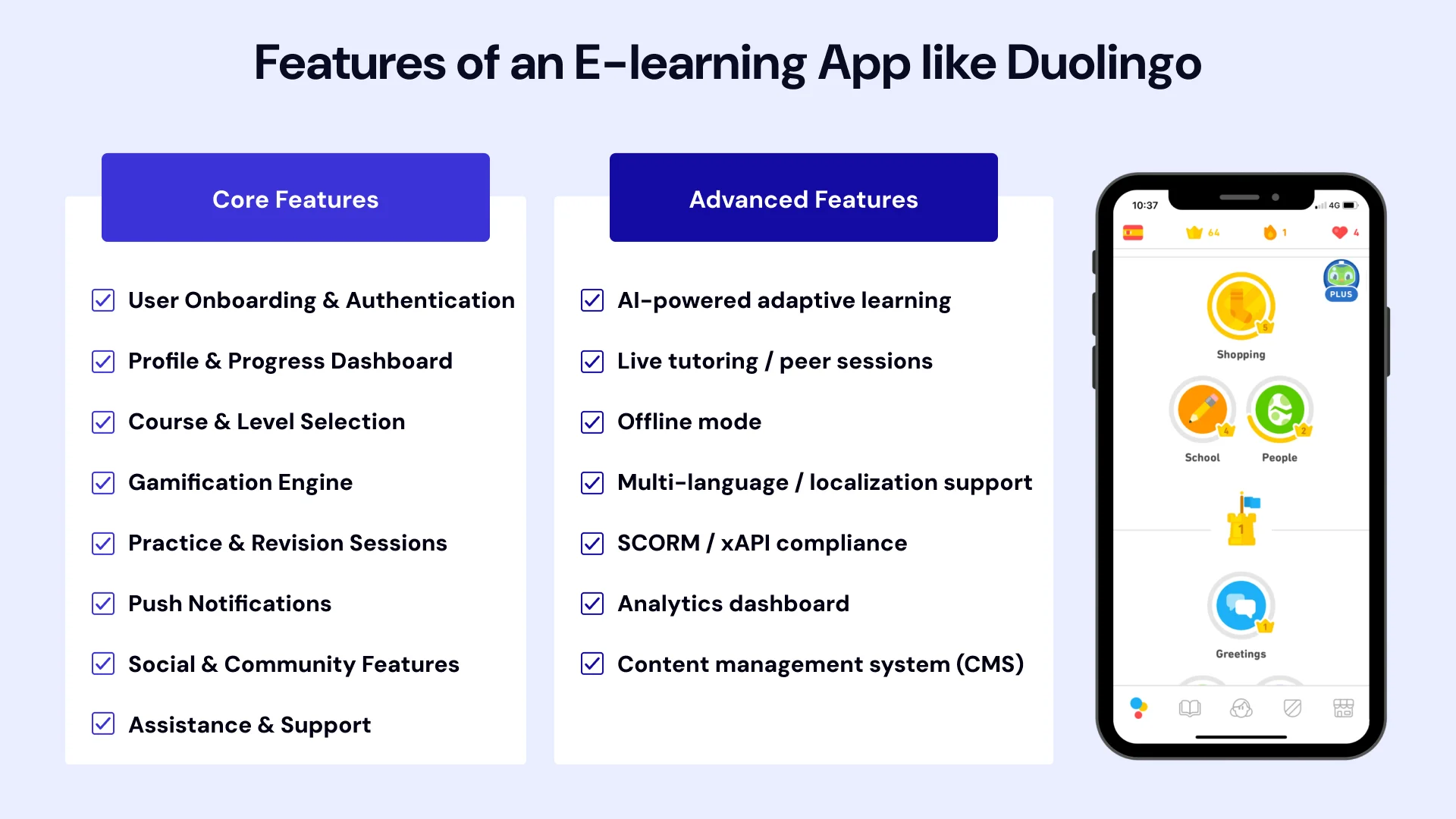
Here are the core features required for a market-ready eLearning app, followed by advanced differentiators.
User Onboarding & Authentication
Social login (Google, Apple, Facebook), skill assessment quiz, goal-setting, and personalized learning path setup. First-impression UX drives 30-day retention.
Profile & Progress Dashboard
User profiles with learning stats, streak counts, XP history, skill trees, and course completion tracking. Saves lessons for offline revision.
Course & Level Selection
Structured curriculum with multiple courses, levels, and learning tracks. Users set pace, difficulty, and daily goal (minutes per day).
Gamification Engine
Streaks, XP points, virtual currency (gems/coins), daily challenges, achievement badges, and competitive leaderboards. The single highest-impact retention feature.
Practice & Revision Sessions
Spaced repetition system (SRS) for vocabulary review. Performance history, weak area identification, and practice drills for listening, speaking, reading, and writing.
Push Notifications
Smart reminders based on user behavior patterns. Streak reminders, friend activity alerts, and challenge invitations. Duolingo's notification strategy drives 20%+ of daily sessions.
Social & Community Features
Friend systems, discussion forums, peer challenges, and community leaderboards. Social accountability dramatically reduces 30-day churn rates.
Assistance & Support
In-app help center, AI chatbot for instant answers, and escalation to human support. For language apps: voice recognition and pronunciation feedback integration.
Advanced Features of E-learning App Development Like Duolingo
- AI-powered adaptive learning: personalized content sequencing based on performance data
- Live tutoring / peer sessions: video-based human interaction layer
- Offline mode: downloadable lessons for low-bandwidth environments (critical for emerging markets)
- Multi-language / localization support: expand TAM significantly
- SCORM / xAPI compliance: essential for B2B/enterprise sales
- Analytics dashboard for admins: cohort analysis, completion rates, engagement heatmaps
- Content management system (CMS): enable instructors to create and upload courses without developer involvement
Step-by-Step Process to Build an Education App like Duolingo
Duolingo has grown into one of the world’s leading AI-powered eLearning platforms, with 137M+ monthly active users and over $1B in annual revenue by 2026.
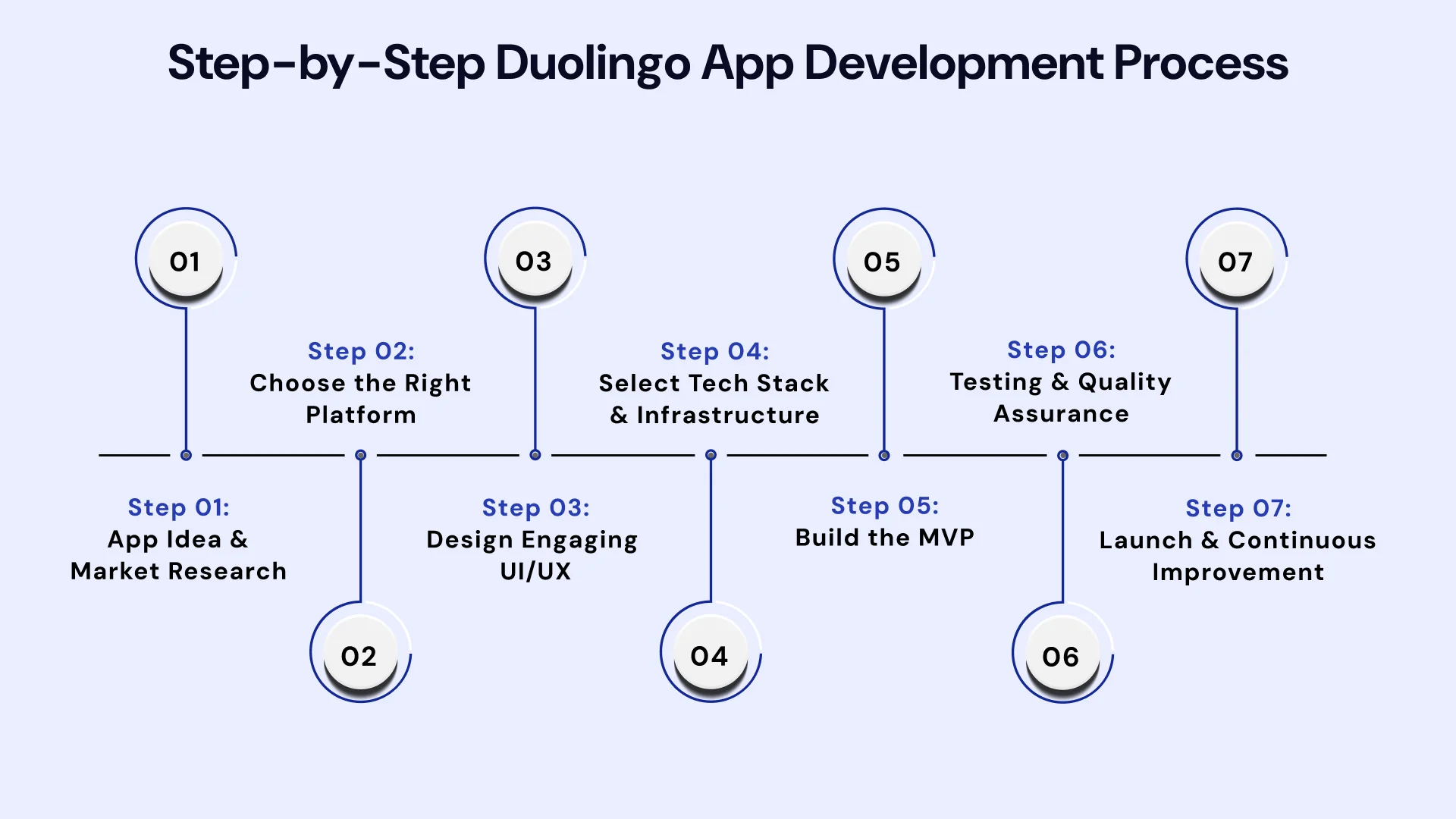
As demand for AI-driven education apps continues to rise, businesses are increasingly investing in eLearning mobile app development to build engaging, scalable, and personalized learning platforms.
Here is the step-by-step process to create a language learning app like Duolingo.
Step 1: Get an App idea (2-4 Weeks)
Define your niche (language learning, K-12, corporate training, certification prep), target audience, monetization model, and competitive differentiation. Conduct user interviews, competitor audits, and technical feasibility assessment. Output: Product Requirements Document (PRD) and go-to-market hypothesis.
Step 2: Choose the Right Platform (1-2 Weeks)
Choose between native (iOS/Android separately), cross-platform (React Native, Flutter), or web-first approach. For eLearning apps targeting global audiences, React Native or Flutter deliver 70% cost savings vs. native with 95%+ feature parity. Architecture must account for content delivery, offline sync, and real-time features from day one.
Step 3: Create an appealing UI/UX (3-6 Weeks)
A badly designed education app only leads to the failure of your education application. The users will uninstall it if they find challenges in navigating the features. That’s why UI/UX design is important in mobile app development.
Create wireframes, interactive prototypes, and high-fidelity designs. For eLearning apps, UX priorities are: zero-friction onboarding (under 90 seconds to first lesson), clear progress visualization, and accessible lesson interfaces. Conduct usability testing with 5–8 target users before handing off to development.
Step 4: Select advanced tech stack & infrastructure setup (1 Week)
Finalize frontend, backend, database, and cloud infrastructure choices. For instance,
Use programming languages like Kotlin and Java for android mobile app development. On the other hand, Objective C and Swift are preferred languages for iOS app development, like Duolingo e-Learning app development.
Set up CI/CD pipelines, development environments, and code repositories. Establish coding standards, API documentation templates, and QA frameworks before a single line of product code is written.
Step 5: Start MVP development (8-14 Weeks)
After completing the steps mentioned above, you can now start the MVP development process of your learning management system.
Build core features: onboarding, lesson delivery engine, progress tracking, and gamification. Use agile sprints (2-week cycles) with continuous stakeholder demos. MVP scope should include only the features that validate your core value proposition.
Step 6: Testing your e-learning app (2-4 Weeks)
Conduct different types of testing like functional testing, usability testing, load testing (simulate 10,000+ concurrent users), security audits, and accessibility compliance (WCAG 2.1 AA). For eLearning apps, test audio/video playback across device types and network conditions, including 3G simulation for emerging markets.
Step 7: E-learning app launch (Ongoing)
After successfully implementing all the steps mentioned above, you must finally launch your e-learning app. Having an app launched isn’t the final stage but the beginning of taking your business to new heights.
App Store Optimization (ASO), phased rollout starting with soft launch in 1–2 markets, crash monitoring (Firebase Crashlytics), and engagement analytics setup (Amplitude or Mixpanel).
Plan your first 90 days: A/B test onboarding flows, optimize push notification timing, and iterate based on real user data — not assumptions.
Hiring a dedicated & trustworthy language learning app development company is recommended to guide you throughout the entire process smoothly.
Tech Stack for eLearning App Development
Choosing the right technology stack is one of the most important decisions in your eLearning app development project. The wrong choices here create technical debt that costs 3–5x more to fix post-launch.
Here's what VLink recommends based on latest ecosystem maturity and long-term scalability.
Layer | Recommended Technology | Why It's the Right Choice |
Mobile (Cross-Platform) | React Native | One codebase for iOS + Android. New Architecture (Fabric) delivers near-native performance. Massive talent pool. |
Mobile (Alternative) | Flutter | Excellent for pixel-perfect UI. Dart language. Strong choice for gamification-heavy apps. |
Web Frontend | Next.js (React) | Server-side rendering for SEO, App Router for performance. Optimal for course marketplace pages and admin dashboards. |
Backend API | Node.js + Express / NestJS | Event-driven architecture handles real-time features (streaks, leaderboards) efficiently. Shared JS knowledge with frontend team. |
Backend (Alt.) | Python + Django / FastAPI | Preferred for ML-heavy backends. Seamless integration with TensorFlow, PyTorch, and OpenAI SDK. |
Primary Database | PostgreSQL | ACID compliance for user/billing data. Rich JSON support. Best-in-class for relational learning data models. |
Caching / Real-time | Redis | Session management, leaderboard updates, and streaks require sub-millisecond response times. Redis delivers. |
Content Storage | AWS S3 + CloudFront CDN | Globally distributed video/audio delivery. Critical for language learning apps with heavy media content. |
Cloud Platform | AWS (Primary) or GCP | Auto-scaling, managed Kubernetes (EKS/GKE), and native ML services (SageMaker / Vertex AI) for AI feature deployment. |
AI / LLM APIs | OpenAI GPT-4o / Claude API | Conversational tutors, content generation, and personalized feedback. Cost-effectively via API vs. training from scratch. |
Speech Recognition | Google Speech-to-Text / Whisper | Pronunciation scoring and voice input for language learning. Google STT supports 125+ languages. |
Analytics | Amplitude + Firebase | Amplitude for product analytics (funnels, cohorts, A/B tests). Firebase for crash reporting and push notifications. |
Payments | Stripe + RevenueCat | RevenueCat abstracts iOS/Android in-app purchase complexity. Stripe for web subscriptions. Critical for freemium model. |
Bonus Tips to Understand the success criteria of the Duolingo App.
- Focus on hyper-personalized AI learning experiences
- Integrate AI voice tutors and real-time conversations
- Use gamification to improve daily user engagement
- Build AI-powered adaptive learning paths
- Localize content for global and regional audiences
- Leverage generative AI for faster content creation
- Follow modern UI/UX and micro-learning trends
- Add social learning and community-driven features
- Use predictive analytics to reduce user churn
- Invest in AI-driven marketing and pre-launch promotion
- Ensure data privacy and ethical AI implementation
- Continuously optimize the app using user behavior insights
Now that you are well-versed with features and bonus tips to make your e-learning app successful, like Duolingo. The main concern is how much it costs to build an educational application.
What is the cost to Build an e-learning app like Duolingo?
There is no such fixed e-learning app development cost as it fluctuates from one app to another. Still, the average cost to build an education app like Duolingo varies from $95,000 to $160,000.
Factors influencing e-learning software development cost –
- UX/UI Design
- Development Platform
- Number of Hours
- Location
- App Complexity
- Time & Efforts
- App Type & Size
These factors can affect your app development cost to a great size. To help you get a better insight, here is the detailed cost estimation for different language learning app development processes based on time.
Here are the required stages of development costs and time frame.
Tier | Description | Timeline | Estimated Cost (USD) |
MVP / Starter | Core lessons, basic gamification, user profiles, push notifications. Single platform (iOS or Android). No AI. | 4–6 months | $25,000 – $60,000 |
Mid-Complexity | iOS + Android + web, advanced gamification, social features, basic adaptive learning, admin CMS, Stripe integration. | 6–10 months | $60,000 – $150,000 |
Full-Featured (Duolingo-scale) | All platforms, AI tutors, NLP speech recognition, predictive analytics, live tutoring, SCORM compliance, multi-language support. | 10–18 months | $150,000 – $300,000+ |
Cost Breakdown by Development Phase
Development Phase | Estimated Duration | Cost Range (USD) | Notes |
Discovery & Architecture | 2–4 weeks | $3,000 – $8,000 | PRD, tech audit, competitive analysis |
UI/UX Design | 3–6 weeks | $5,000 – $18,000 | Wireframes, prototypes, design system |
Frontend Development | 8–14 weeks | $18,000 – $70,000 | Mobile (React Native) + Web (Next.js) |
Backend & APIs | 8–12 weeks | $15,000 – $55,000 | REST APIs, auth, database, real-time |
AI/ML Integration | 4–8 weeks | $10,000 – $40,000 | Adaptive learning, NLP, LLM tutor |
QA & Testing | 2–4 weeks | $4,000 – $12,000 | Functional, load, security, accessibility |
Deployment & Launch Support | 1–2 weeks | $2,000 – $5,000 | App store submission, cloud setup, monitoring |
Ongoing Monthly Costs (Post-Launch)
- Cloud infrastructure (AWS/GCP): $800 – $5,000/month depending on user volume
- AI API costs (OpenAI/Google): $200 – $2,000/month
- Maintenance & bug fixes: 15–20% of initial build cost per year
- Content updates & new features: $3,000 – $10,000/month

How to Make Money From E-learning App Like Duolingo?
The technology is only half the equation. Your business model determines whether your eLearning app development investment generates revenues.
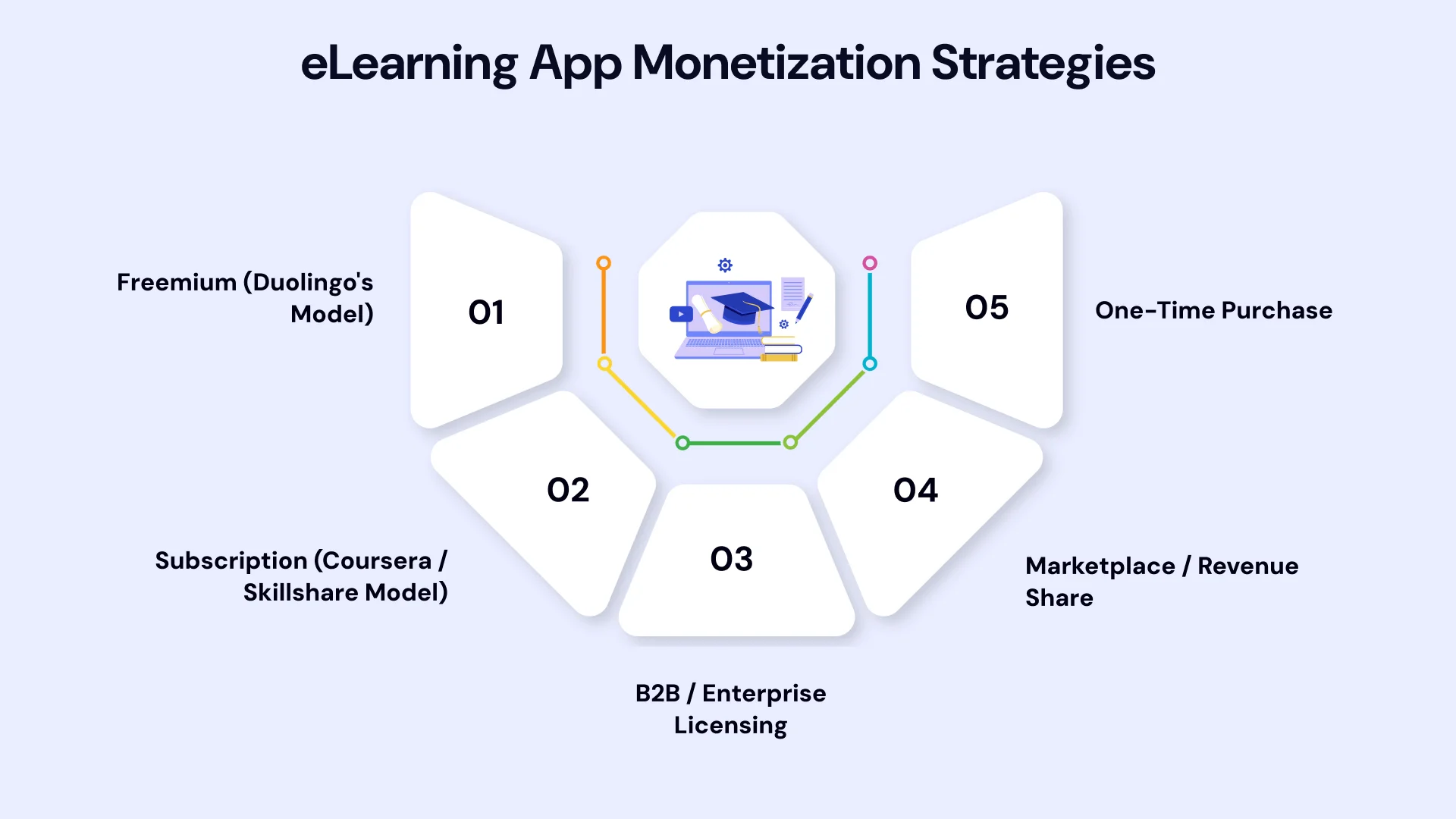
Here are the proven monetization models — with revenue benchmarks from real platforms.
Freemium (Duolingo's Model)
Free core product with a premium tier removing ads and unlocking advanced features (offline mode, personalized review, streak repair). Works best when the free tier is genuinely valuable and the premium upgrade has clear, felt benefits. Duolingo converts approximately 8–9% of free users to paid subscribers. At scale, this generates hundreds of millions in ARR.
Subscription (Coursera / Skillshare Model)
Monthly or annual access fees for all content. Simpler unit economics. Works best with high-volume, constantly updated content libraries. Monthly plans typically convert at 3–5x higher volume than annual; annual plans deliver 2–3x lower churn.
B2B / Enterprise Licensing
Sell access to organizations rather than individuals. Average contract values of $20,000–$500,000 per year. Requires SCORM compliance, SSO integration, admin dashboards, and usage reporting. The fastest path to meaningful ARR for niche professional training platforms.
Marketplace / Revenue Share
Instructor-led content marketplace (like Udemy). Platform takes 30–50% of instructor revenue. Low content production cost; high acquisition cost for quality instructors. Requires critical mass on both sides of the marketplace.
One-Time Purchase
Declining model in mobile. Works for specialized tools (exam prep apps, professional certification cram apps). Price ceiling limits revenue potential significantly vs. subscription.
VLink is a Trusted e-Learning App Development Company
Building an app like Duolingo demands scalable architecture, engaging learning experiences, AI-driven personalization, and seamless performance across devices. VLink helps businesses build feature-rich eLearning applications tailored for modern learners.
From gamification and real-time progress tracking to cloud scalability and multilingual support, our team delivers secure and high-performing learning platforms that drive measurable growth. Backed by successful EdTech transformations like helping a global education company modernize and scale its Student Information System, we enable businesses to build intuitive and future-ready learning ecosystems.
- Up to 45% faster app performance with optimized architecture
- Improved learner engagement through AI-powered personalization & gamification
- Cross-platform app development for Android, iOS, and Web
- Agile development with faster launch cycles and scalable cloud infrastructure
- Dedicated eLearning app developers with expertise in LMS, AI, and mobile learning solutions
Planning to explore how to build an eLearning app like Duolingo for your enterprise, EdTech startup, or corporate training ecosystem? Connect with the experts at VLink to develop scalable, secure, and AI-powered eLearning solutions tailored for businesses across the U.S. and Canada.

Global Delivery Manager, VLink Inc.
Shivisha Patel serves as the Global Delivery Manager at VLink Inc., bringing a wealth of experience in program delivery and management, particularly in the insurance and banking sectors. She has a robust technical background with deep expertise in WebSphere MQ, WTX, IIB, middleware, and enterprise system integration.

 Shivisha Patel