

"How much will it cost?" is the first question every hospital group, digital health startup, and payer asks, and the honest answer is "it depends," which helps nobody plan a budget. This guide replaces that non-answer with a structured view of healthcare mobile app development cost in 2026: what drives the number, realistic ranges by app type, where the hidden costs sit, and how to keep spending under control without cutting the parts that keep patients safe.
Below, we treat healthcare mobile app development cost 2026 as a range, not a single number. Two notes on the figures. First, every range below is an indicative planning estimate based on common market patterns, not a quote; actual pricing varies by region, vendor, and scope. Second, cost is only half the story. In healthcare, a cheap app that fails a security review or can't connect to the hospital's records system costs far more than a well-scoped one.

Why Healthcare App Pricing Is Different in 2026
Unlike standard consumer apps, a healthcare app functions simultaneously as a digital product, a regulatory compliance obligation, and a patient-critical clinical tool. Estimating its development cost requires looking beyond simple screen design and feature lists.
Core Cost Drivers
- Multi-Layered Regulatory Compliance: Engineering costs account for strict data handling mandates (e.g., HIPAA, GDPR, SOC 2, and FDA software standards). You pay for end-to-end encryption, access controls, audit trails, and signed Business Associate Agreements (BAAs).
- Legacy System & EHR Integration: Connecting modern mobile front-ends with legacy hospital infrastructure or EHR systems (like Epic or Cerner) via FHIR/HL7 protocols requires specialized integration engineering.
- High-Stakes Quality Assurance: QA goes beyond basic bug checking; apps require rigorous penetration testing, security audits, and fault-tolerant clinical workflows to ensure patient safety and data integrity.
- Rising Baseline Market Expectations: Modern users demand seamless digital front doors, remote condition monitoring, real-time video visits, and self-service capabilities, shifting high-complexity features from "nice-to-have" to minimum baseline requirements.
How Much Does It Cost to Develop a Healthcare App in 2026?
Most healthcare projects fall between roughly $40,000 and $400,000+, with the healthcare app development cost estimate depending on complexity, compliance, and integrations. Here is how that typically breaks down.
Healthcare App Development Cost by Complexity
Complexity | Typical Scope | Indicative Cost Range | Typical Timeline |
Basic MVP | Patient login, profile, appointment requests, notifications, one platform | $40,000 – $80,000+ | 3–4 months |
Mid-complexity | Booking, secure chat, e-prescriptions or records view, payments, iOS and Android | $80,000 – $180,000+ | 5–8 months |
Advanced platform | Telemedicine, EHR integration, analytics, wearables, admin portals, high compliance | $180,000 – $400,000+ | 8–14 months |
Treat these bands as healthcare app development cost by complexity benchmarks, and adjust them for your context. They describe healthcare mobile app development cost in 2026 for a typical mid-market build using a blended onshore/offshore team. Fully onshore teams in the US or Canada usually price higher, while nearshore and offshore delivery models often reduce hourly rates, though communication and compliance oversight need to be managed carefully.
Healthcare App Development Cost by App Type
Different products carry different baseline costs:
- Doctor appointment app: Doctor appointment app development is a relatively low-complexity build, so the cost to develop a doctor appointment app sits at the lower end, roughly $35,000 to $100,000, because scheduling, reminders, and provider profiles are well-understood patterns.
- Patient portal or patient engagement app: The cost of developing a patient healthcare app that includes records access, messaging, billing, and education typically runs $70,000 to $200,000.
- Telemedicine app: How much does it cost to build a telemedicine app? Expect roughly $80,000 to $250,000, driven by real-time video, secure messaging, e-prescribing, and clinician workflows.
- Remote patient monitoring app: Device connectivity and data pipelines push costs to $100,000 to $300,000.
- Hospital app development: Hospital app development for wayfinding, staff tools, and patient services can range from $100,000 to $400,000+, especially with hospital system integration.
- Full custom platform: How much does it cost to build a healthcare app that combines patient, provider, and admin experiences? Usually $150,000 and up.
- Mental health or wellness app: Usually $50,000 to $150,000, depending on content, tracking, and AI features.
Healthcare App Development Cost Breakdown
A useful healthcare app development cost breakdown separates the project into the phases that generate the invoices. The percentages below are typical, not universal.
Phase | Share of Budget | What It Covers |
Discovery and planning | 5–10% | Requirements, compliance mapping, user research, technical architecture |
UI/UX design | 10–15% | Wireframes, prototypes, accessibility, design system |
Development (front end and back end) | 45–55% | Mobile apps, APIs, databases, admin panel |
Integrations | 8–15% | EHR/EMR, payments, labs, pharmacy, wearables |
Security and compliance | 8–12% | Encryption, access controls, audits, documentation |
Testing and QA | 10–15% | Functional, performance, security, device testing |
Launch and release | 3–5% | Store approvals, deployment, monitoring setup |
Understanding this healthcare application development cost structure helps you challenge vendor estimates. If a proposal shows almost nothing for security and testing, expect surprises later.
Healthcare App Development Cost by Feature
Feature scope is the fastest lever on price. Here is healthcare app development cost by feature, using indicative ranges per feature set:
Feature | Indicative Cost | Notes |
User registration, secure login, MFA | $3,000 – $8,000+ | Biometrics and SSO increase cost |
Patient profiles and medical history | $4,000 – $12,000+ | Depends on data model complexity |
Appointment scheduling | $5,000 – $15,000+ | Calendar sync and reminders add effort |
Video consultations | $15,000 – $50,000+ | Bandwidth handling, recording, waiting rooms |
Secure messaging | $6,000 – $18,000+ | Attachments and audit trail increase scope |
E-prescriptions | $10,000 – $30,000+ | Regulatory and pharmacy network integration |
Payments and billing | $6,000 – $20,000+ | Insurance claims cost more than card payments |
Push notifications and reminders | $2,000 – $6,000+ | Personalization adds cost |
Wearable and device sync | $10,000 – $35,000+ | Multiple device vendors multiply effort |
Analytics dashboard | $8,000 – $30,000+ | Clinician and admin reporting |
AI features (symptom checker, triage) | $20,000 – $80,000+ | Validation and clinical oversight required |
Choosing healthcare app features is the most direct way to steer budget, and the most useful healthcare app features are rarely the flashiest. Features that seem small on a wireframe, such as "sync with the hospital system," often hide the greatest effort. Which brings us to integration.
The Big Variable: EHR, EMR, and Healthcare API Integration
Most healthcare apps become valuable only when they exchange data with clinical systems. That is why EHR integration and EMR integration deserve their own budget line. Depending on the vendor, connecting to Epic, Cerner (Oracle Health), Allscripts, or athenahealth can take anywhere from a few weeks to several months, and fees for developer programs, sandbox access, or production certification may apply.
Modern healthcare API integration relies heavily on HL7 FHIR, which standardizes how systems exchange patient data. FHIR-based integration is more predictable than older HL7 v2 interfaces or custom database connections, but real-world projects still involve authorization flows, data mapping, and testing against each provider's quirks.
Typical integration cost impact:
- Single FHIR-enabled EHR: $15,000 – $50,000
- Multiple EHR/EMR systems: $50,000 – $150,000+
- Legacy or non-standard interfaces: often the most expensive, since they may need middleware or custom adapters
If your organization runs aging systems, modernizing them first can lower long-term integration cost. Our Legacy App Modernization Services help healthcare teams expose older platforms through clean APIs before the mobile app is built.
HIPAA Compliance and Healthcare Data Security Costs
Healthcare data security is not optional, and it shapes the budget from the first design decision. The cost to develop a HIPAA-compliant healthcare app is typically 10 to 30 percent higher than a comparable non-regulated app, because it requires:
- Encryption of data at rest and in transit
- Role-based access control and multi-factor authentication
- Audit logging and monitoring
- Secure hosting under a signed business associate agreement (BAA)
- Secure backup and disaster recovery
- Risk assessments, policies, and staff training
- Penetration testing and vulnerability scans
How much does it cost to develop a HIPAA-compliant healthcare app in total? For a mid-complexity product, plan for roughly $15,000 to $60,000 of the budget to go specifically toward security architecture, compliance documentation, and independent testing. If you also operate in the EU, GDPR adds consent management and data-residency considerations; in other regions, local health-data laws apply.
A HIPAA-compliant healthcare app is built with these controls from the start. Retrofitting them later almost always costs more.
Healthcare App Development Pricing Models: How Vendors Charge
The same scope can be priced in different ways, and the healthcare app development pricing model you choose affects both risk and flexibility. Understanding each healthcare app development pricing model helps you compare healthcare app development pricing from different vendors fairly.
- Fixed price: Best for a well-defined MVP. You get budget certainty, but changes require formal change orders.
- Time and materials: Best when requirements will evolve. You pay for actual effort, so strong governance and sprint reporting are essential.
- Dedicated team: Best for long-term roadmaps. A monthly retainer covers a dedicated team, which suits products that keep shipping.
- Milestone-based: A hybrid where payments tie to delivered phases such as design, MVP, and integration.
Whichever approach you pick, ask for an itemized healthcare app development cost estimate that separates design, development, integrations, security, testing, and post-launch support. Many providers publish only a headline figure, so a detailed medical app development cost proposal signals maturity.
A note on comparing quotes: a healthcare software development cost that looks 30 percent lower often omits compliance work, integration effort, or a maintenance plan. When two quotes for the same healthcare application development cost differ sharply, the gap is almost always scope, not efficiency. The same logic applies to mobile healthcare app development cost estimates from freelancers versus specialized firms.
Platform, Technology, and Team Choices
The right technical architecture and development partner directly determine both the initial build cost and the long-term operating expenses of a healthcare application. Balancing native performance, accessible design, secure backend systems, and team geography allows you to optimize budget allocation without compromising clinical quality or security.
- Native vs. Cross-Platform
Native iOS and Android builds deliver the best performance and device integration but roughly double the mobile engineering effort. Cross-platform frameworks like Flutter and React Native can reduce mobile development cost by 25 to 40 percent for many healthcare use cases. Choose native when you depend on advanced device features, such as complex Bluetooth medical devices or heavy real-time processing.
- Healthcare App UI/UX Design
Healthcare app UI/UX design is more than aesthetics. Elderly patients, caregivers, and clinicians using the app between appointments all need clear, accessible interfaces that meet WCAG guidelines. Good design typically costs 10 to 15 percent of the project but reduces support tickets and abandoned sessions.
- Healthcare App Backend Development
Healthcare app backend development often takes more effort than the mobile front end. It handles authentication, data storage, integration engines, notification services, and audit logs. Cloud services and managed databases keep infrastructure flexible, and compliant hosting options add to the hosting bill.
- Team Location and Vendor Model
A healthcare app development company's rates vary widely by geography. US and Canadian teams commonly range from $100 to $200 per hour, Western Europe from $70 to $150, and India or Eastern Europe from $30 to $70. Rate alone is a poor guide, though. Look for proven healthcare delivery, compliance maturity, and clear communication.
Testing, Launch, and Ongoing Costs
Ensuring long-term app viability requires budgeting beyond initial code deployment. Continuous validation, regular maintenance, and third-party operational fees form the baseline for maintaining regulatory compliance and seamless performance.
Healthcare App Testing
Healthcare app testing is a meaningful share of the budget, typically 10 to 15 percent. It covers functional testing, device and OS coverage, performance under load, accessibility checks, interoperability validation with clinical systems, and security testing. In healthcare, a bug is not an inconvenience; it can be a patient-safety risk.
Healthcare App Maintenance Cost
Healthcare app maintenance cost is the line item most often forgotten. Plan for roughly 15 to 25 percent of the initial build per year to cover:
- OS and device updates
- Security patches and compliance reviews
- Cloud hosting and monitoring
- Bug fixes and small enhancements
- EHR vendor API changes
- Customer and clinician support
An app that isn't maintained ages quickly, both technically and from a compliance standpoint.
Other Recurring Costs
Budget separately for app store fees, third-party licenses (video, SMS, mapping), analytics tools, and cloud infrastructure. For a growing product, these can add up to a few thousand dollars per month.
Cost Estimates for Common Healthcare App Types in 2026
To make this actionable, here are quick reference points for the most requested categories.
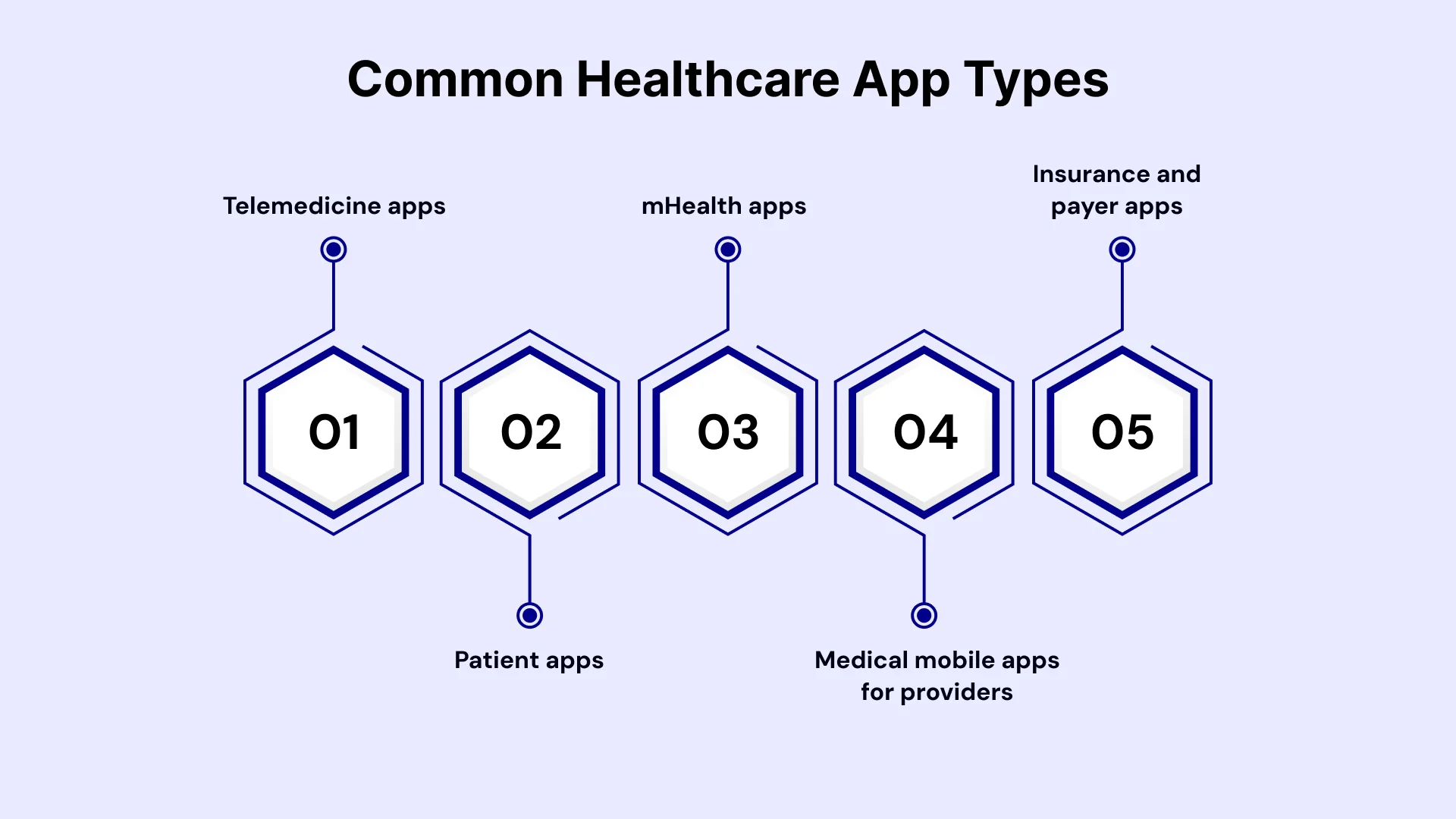
- Telemedicine Apps:
The answer to how much it costs to build a telemedicine app depends mostly on video quality requirements, multi-party sessions, e-prescribing, and integration with scheduling and records systems. Telemedicine app development is one of the most in-demand categories, and healthcare software development teams report steady growth in hybrid care models; a full-featured platform commonly reaches $150,000 to $250,000.
- Patient Apps:
Patient app development and the cost of developing a patient healthcare app for portals and engagement tools generally lands between $70,000 and $200,000, with cost rising when you add payments, records access, and multilingual support.
- mHealth Apps:
mHealth app development for fitness, chronic disease management, and medication adherence ranges widely. Any mHealth application development effort that touches clinical data, and any mHealth app solution that collects clinical data or connects to devices, needs stronger security and validation, which raises the budget. Teams researching mHealth app development solutions should compare not just price but also clinical evidence, regulatory posture (some apps may qualify as software as a medical device), and data-sharing design.
A well-scoped mHealth application development project starts with the clinical use case, not the feature list, and an mHealth app solution that patients actually use will usually cost less to fix after launch than one designed around assumptions. Reviewing several mHealth app development solutions side by side, including their evidence base and data-sharing design, is time well spent.
- Medical Mobile Apps for Providers:
Medical mobile app development for clinicians (sometimes called medical mobile app development for care teams), such as rounding tools, secure messaging, and on-call scheduling, often costs $80,000 to $220,000 because of integration and security demands.
- Insurance and Payer Apps:
Payer platforms simplify member self-service by offering seamless eligibility checks, claims management, digital ID access, and provider directories. A well-designed payer app helps insurers drive engagement, cut operational costs, and build member trust.
Looking for a broader view of app pricing? Explore our Mobile App Development Cost Breakdown to see how core architectural choices drive final project quotes, or check out our Health Insurance App Development Guide for specialized insights on insurance workflows and regulatory compliance.
10 Strategies to Reduce Healthcare Mobile App Costs
Building a secure, compliant healthcare app doesn’t require an open-ended budget. By focusing on smart architectural choices, leveraging industry standards, and prioritizing essential features early, you can significantly optimize your development spend.
Here are 10 proven strategies to keep costs under control while delivering a high-quality, clinical-grade digital product.
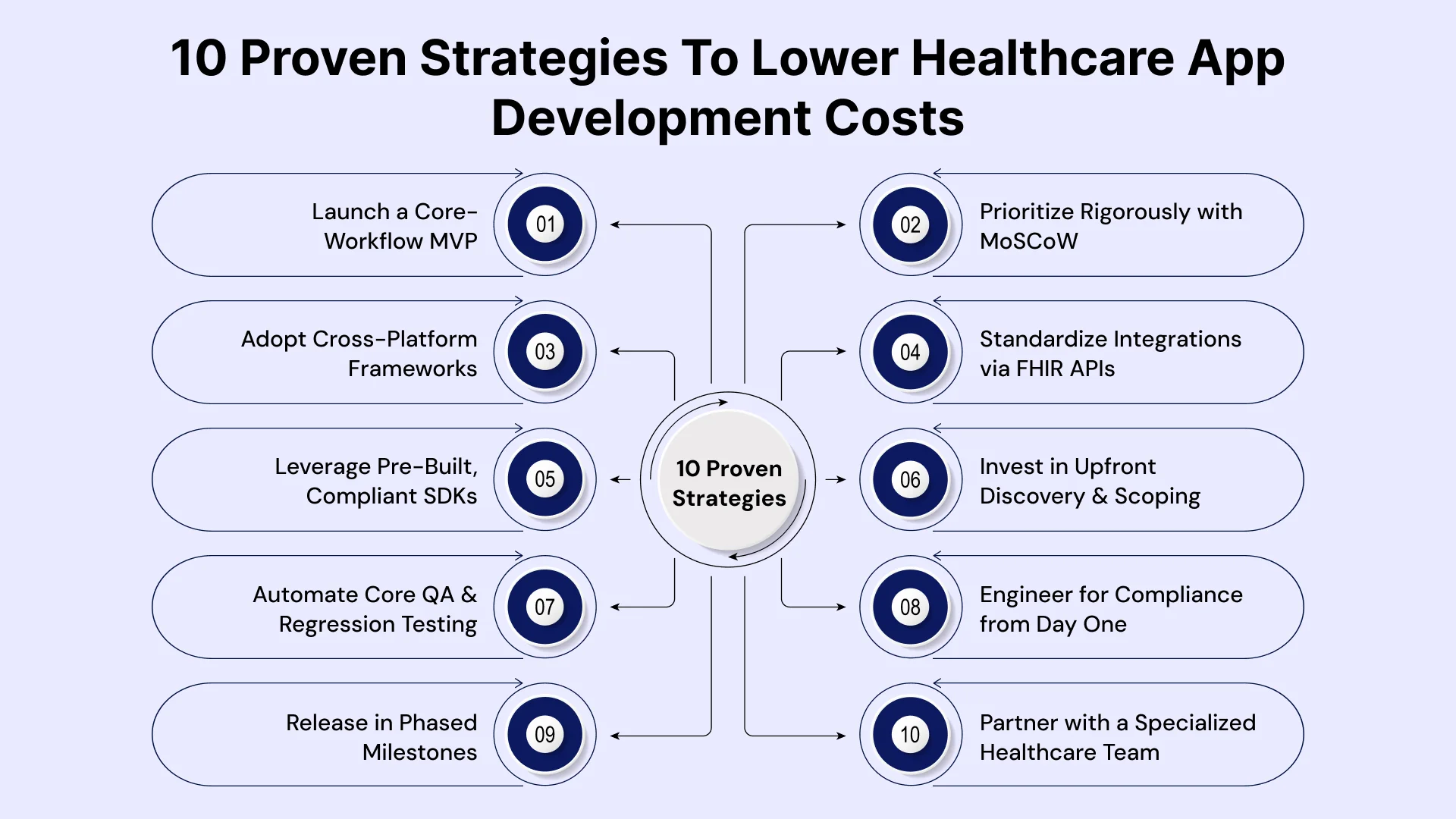
- Launch a Core-Workflow MVP: Focus on solving one high-value patient or provider problem first. Launching lean reduces initial capital output and validates usability through real-world feedback before scaling.
- Prioritize Rigorously with MoSCoW: Filter features into Must-haves, Should-haves, Could-haves, and Won’t-haves. Deferring non-essential features keeps the initial scope predictable and prevents budget bloat.
- Adopt Cross-Platform Frameworks: Utilize Flutter or React Native to build for both iOS and Android from a single codebase. This can cut core development and ongoing maintenance effort by 30–40%.
- Standardize Integrations via FHIR APIs: Avoid writing custom middleware for legacy EHRs. Standard interfaces like HL7 FHIR streamline data exchange with systems like Epic and Cerner, dramatically cutting integration hours.
- Leverage Pre-Built, Compliant SDKs: Don't rebuild the wheel. Integrate pre-certified modular SDKs for non-proprietary features like HIPAA-compliant video calls (e.g., Twilio), chat, and secure authentication.
- Invest in Upfront Discovery & Scoping: A 2–3 week discovery phase aligns technical requirements, UI/UX, and data flows before code is written, preventing costly mid-project architecture pivots.
- Automate Core QA & Regression Testing: While automated testing has a modest upfront setup cost, it exponentially speeds up post-launch releases, catches bugs early, and minimizes manual QA overhead.
- Engineer for Compliance from Day One: Integrate security and data privacy safeguards (HIPAA, GDPR, HITECH) into your initial architecture. Retrofitting security onto a finished product costs up to 3x more.
- Release in Phased Milestones: Break development into distinct release phases. Spreading expenditure across milestones lets you fund future builds using revenue or user-validated ROI from early releases.
- Partner with a Specialized Healthcare Team: Domain expertise shortens onboarding and reduces risk. A team familiar with clinical workflows and regulatory standards works faster and avoids expensive compliance errors.
Choosing a Healthcare App Development Partner
If you are buying healthcare mobile app development services for the first time, treat the vendor decision as a risk decision, not just a price decision. Likewise, a realistic medical app development cost depends as much on the team's compliance track record as on its hourly rate, and any mobile healthcare app development cost you are quoted should list security and testing explicitly.
Not every healthcare app development company is equipped for regulated work. The right partner for healthcare mobile app development services should be able to show HIPAA experience, integration case studies, security practices, and a delivery model that fits your governance needs. Ask how they estimate, how they handle change requests, who owns the source code, and what post-launch support looks like.
Healthcare software development is a specialty: a team that has shipped patient app development projects, telemedicine app development platforms, and doctor appointment app development products will already know the compliance and integration traps. When comparing proposals, make sure each includes the same scope for compliance, testing, and integrations so you are comparing like with like.
Turn Your Healthtech Vision into Reality with VLink’s Experts
Healthcare software development cost is easier to control when the team knows the domain, and building a compliant, integrated, patient-ready app takes more than developers; it takes teams who understand clinical workflows and regulated data.
VLink’s engineers deliver Mobile App Development Services for providers, payers, and digital health companies across the US, Canada, and India, with security and interoperability designed in from discovery onward.
Explore our full range of Healthcare Software Development Services to see how we support hospitals, clinics, and health-tech startups, from patient-facing apps to back-office platforms. If your project depends on older systems, our modernization team can prepare them for integration, so your mobile roadmap doesn't stall.
Conclusion
Healthcare mobile app development cost in 2026 is a function of choices: how many features you build first, how deeply you integrate with clinical systems, how rigorously you secure patient data, and how well you plan for life after launch. Realistic budgets run from about $40,000 for a tightly scoped MVP to $400,000 or more for an integrated, multi-role platform, and the strongest results come from phased delivery, early compliance planning, and a partner who has done this before.
Keep in mind that healthcare mobile app development cost 2026 estimates will keep shifting as regulations, AI features, and interoperability requirements evolve, so revisit your numbers each quarter. Use the ranges and healthcare app development cost breakdown in this guide as a starting point, then validate them with a discovery workshop tailored to your users, your systems, and your regulatory obligations.
Ready to bring your digital health product to life without cost overruns?
At VLink, our team of domain experts helps you navigate complex compliance standards, choose the right technology stack, and build a high-performance app tailored to your budget. Contact Us Today to schedule a discovery session and receive a detailed, custom cost estimate for your project.

Global Delivery Manager, VLink Inc.
Shivisha Patel serves as the Global Delivery Manager at VLink Inc., bringing a wealth of experience in program delivery and management, particularly in the insurance and banking sectors. She has a robust technical background with deep expertise in WebSphere MQ, WTX, IIB, middleware, and enterprise system integration.

 Shivisha Patel